Game Development Pipeline: A Modern Production Guide
A one-page pitch lands in your inbox on a Monday morning. The target platform is already agreed, a partial build sits in source control, and the creative team has enough confidence to start making assets. What nobody has yet resolved is whether the central mechanic is fun, whether the target hardware can support the intended presentation, or whether the first playable build is carrying three months of scope risk. That's the starting point of a game development pipeline. It isn't a sequence of departments passing work over a wall. It's a chain of decisions, handoffs, reviews and constraints. A weak decision in pre-production can become an art rework problem, then an engineering dependency, then a QA delay, and finally a launch risk. A good producer sees those connections early.
A Producer Walks Onto a New Build
The first meeting lasts less than an hour, but it sets the tone for the production. The producer has a one-pager, a target SKU, a build that launches, and a team that's eager to move. The temptation is to turn the pitch into a task list immediately. That's usually the wrong first move. Start with the build, not the backlog. Play the current loop without explanation, then ask the designer to describe the intended player experience in one sentence. If those two things don't match, more content won't solve the problem. The first consultation should usually include design, engineering, art, technical art and QA, because each discipline sees a different version of the same risk.
The first triage
The greenlight prototype doesn't need final art or a complete feature set. By the end of the first month, it should demonstrate the measurable fun loop, the basic input response, the intended camera or viewpoint, and the technical behaviour that could invalidate the concept. If the game depends on online synchronisation, spatial tracking, procedural generation or a demanding rendering feature, that risk belongs in the prototype. I'd put four questions on the first production board:
- •What must be true? Identify the player action, feedback and reward that define the experience.
- •What could invalidate it? Test platform performance, networking, controls, camera behaviour or a specialist tool early.
- •Who owns the decision? Name the person who can approve design, visual direction, technical approach and scope.
- •What is deliberately out? Write exclusions down before enthusiasm turns them into implied commitments.
Practical rule: If a prototype only proves that the team can build content, it hasn't proved that the project works.
The quiet scope risks usually enter through language such as “while we're here” or “it should be straightforward”. A target SKU can imply performance requirements. A familiar genre can conceal an unfamiliar content burden. A reference image can become an unpriced promise about animation quality, lighting or simulation. The producer's job isn't to suppress ambition. It's to separate the essential risk from the attractive possibility.
The handoff that matters
The first sign-off should produce more than approval. It should leave behind a target stack, design pillars, prototype acceptance criteria and an agreed route to the first playable. Those artefacts become the contract between disciplines, even when the project remains exploratory. A pipeline decision made in week one shapes every later handoff. If the team doesn't agree how a feature will be measured, art can polish the wrong behaviour. If no one owns import validation, engineers inherit broken assets. If QA enters only after content is “finished”, the team discovers integration problems when changes are most expensive. The rest of the production follows from that first hour. Good planning doesn't remove uncertainty. It makes uncertainty visible while the team still has room to respond.
The Modern Game Development Pipeline From Brief to Live
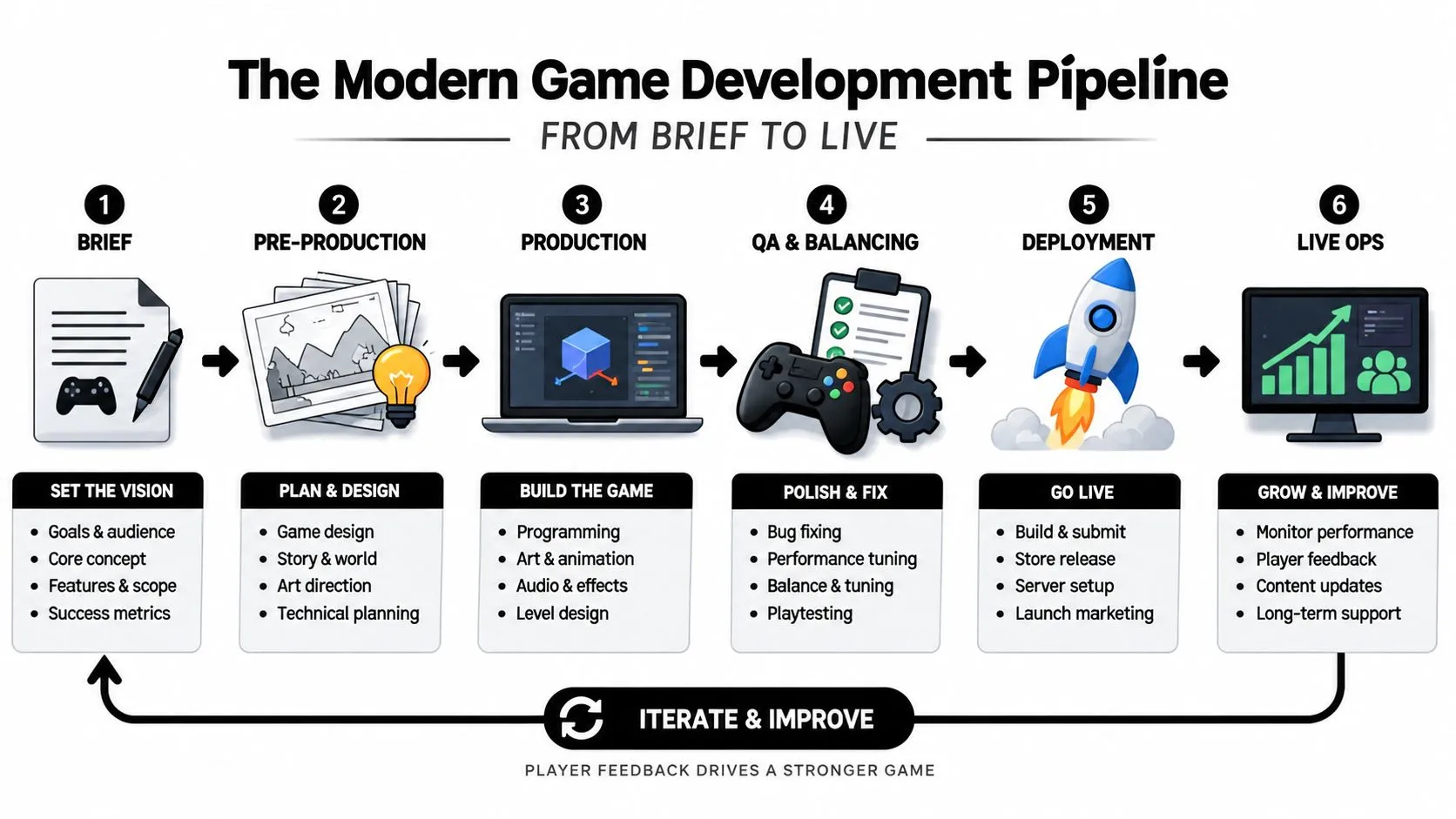
A modern pipeline is best understood as a dependency graph rather than a row of isolated phases. Each stage must hand something usable to the next, and each handoff should include a clear decision about what can still change.
Brief and pre-production
The brief establishes the audience, platform, commercial objective, creative promise and constraints. Pre-production turns those ambitions into resolved design pillars, a target technology stack, a content model and a risk register. It should also define the production language: naming conventions, source control expectations, review ownership and the meaning of “done”. The output isn't a large document. It's a set of decisions that the prototype can test. If the team can't explain what the first build is supposed to prove, the project isn't ready for production.
Prototype and vertical slice
A prototype delivers a playable loop. It should answer whether the core interaction works, not whether the final game has enough missions. Once that loop is credible, the vertical slice tests the complete production chain: representative design, final-intentional art, audio, UI, performance and build integration. The vertical slice is where hidden dependencies surface. A character may look fine in a DCC package but fail after engine import. A level may be visually strong but exceed memory limits. A feature may work in isolation but create unacceptable load times when combined with real content.
Production and feature complete
Production turns the validated slice into a repeatable content system. The team needs lockable feature scope, predictable asset throughput and a build cadence that lets QA test the game as it grows. “Feature complete” means the required feature set exists in an integrated build. It doesn't mean every asset is polished or every defect is resolved. This distinction protects the schedule. If feature complete is treated as a late creative milestone, new work keeps entering the pipeline. If it's treated as a scope gate, the team can focus on stability, usability, balance and platform requirements.
QA, certification and launch
QA delivers more than a bug list. It delivers evidence that the build is ready for platform submission, including smoke coverage, regression results, crash triage and known-issue decisions. Certification requirements need attention before submission, because platform failures can require code, UI or content changes that affect already-approved assets. Launch is a controlled promotion through environments, not a single upload. Metadata, age ratings, store copy, screenshots, package settings and release branches all need named owners.
Live operations
Live operations hands the next team a set of content rails, telemetry questions, support processes and release rules. A live game needs staged content, hotfix discipline, player communication and a way to evaluate what should change next. Iteration should cycle deliberately. Design can return to prototype, art can return to source, and engineering can return to tooling. The producer's responsibility is to make those loops explicit, estimate their capacity and prevent late rework from masquerading as normal progress.
Unity and Unreal as Production Environments
Unity and Unreal are not just rendering choices. They shape the asset pipeline, build tooling, source-control practice, recruitment profile and the amount of technical ownership a studio needs. Unity often suits teams that value flexible scripting, broad platform reach and a familiar workflow for mobile, 2D and interactive simulation. Addressables and asset bundles can support modular content, but they demand disciplined labelling, dependency management and build testing. URP, HDRP and a custom SRP each create different art and performance expectations. Unreal offers strong real-time visual tooling for teams targeting photorealistic PC, console or cinematic work. Primary Asset labels and Data Assets provide a structured way to organise content, but the team still needs clear ownership of cooking, packaging, dependencies and streaming. Nanite and Lumen can accelerate visual development, yet they don't remove platform profiling or lighting trade-offs.
| Dimension | Unity | Unreal |
|---|---|---|
| Asset organisation | Addressables, asset bundles and project-specific import rules | Primary Asset labels, Data Assets and cooking rules |
| Rendering | URP, HDRP or custom SRP choices | UE5 rendering features including Nanite and Lumen |
| Source control | Git LFS can suit smaller teams, while larger projects may need stronger file-locking practice | Perforce is common for large binary-heavy projects, with Git LFS possible in selected workflows |
| Team profile | C# engineering, technical art and platform-focused optimisation | C++, Blueprint, technical art and real-time rendering expertise |
| Typical strength | 2D, mobile, simulation and broad deployment flexibility | High-end real-time visuals, cinematic presentation and complex 3D worlds |
| Commercial planning | Seat and service costs need to be modelled against team structure | Royalty exposure and commercial terms need to be modelled against revenue plans |
Licensing is a production decision, not a procurement footnote. Unity seat fees can affect the cost of scaling a team, while Unreal royalties can matter more as a project generates revenue. The right comparison depends on the contract, the target platforms, the team's existing skills and the cost of hiring or retraining. Performance work should happen inside the production loop. For teams investigating image-based enhancement or upscaling as part of a wider optimisation workflow, using MyImageUpscaler for frame rate can sit alongside profiling, LOD work and texture budgeting. It isn't a substitute for measuring frame time on the actual target device. A studio considering a switch should read this comparison of Unreal and Unity for real-time animation. Switching engines changes import rules, tools, source-control habits and recruitment needs. Engine choice is therefore a hiring and pipeline decision, not a feature checklist.
Art Animation and Asset Pipelines That Actually Ship
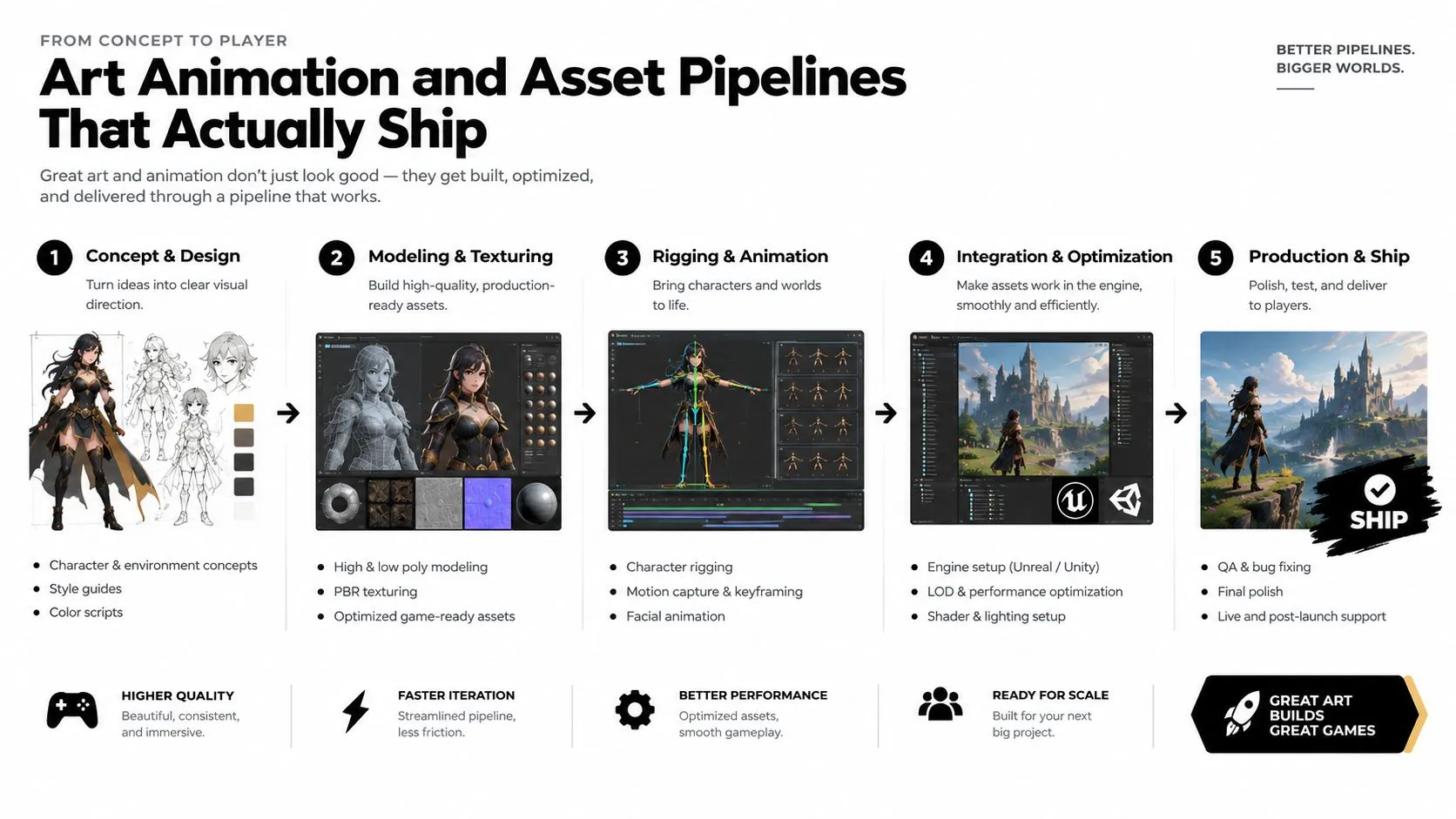
An asset is not finished when the artist saves the Maya or Blender file. It's finished when the approved source survives export, import, assembly, version control and build verification without creating a new problem for another discipline.
The gates between source and engine
The first gate is source quality. Folder structure, naming, units, pivots, material slots, skeleton rules and animation frame ranges should be agreed before production accelerates. A clean source file makes later fixes possible. A clever shortcut often makes the asset unmaintainable. The second gate is export and import. The producer should expect the team to validate transforms, skin weights, texture channels, compression settings and engine import options. For animated characters, rig validation must include the intended skeleton, root motion behaviour and retargeting assumptions. The third gate is runtime assembly:
- Build the asset in the engine. In Unity, confirm prefab structure, Addressables settings and dependencies. In Unreal, confirm Blueprint assembly, Data Asset references and packaging behaviour.
- Generate the right performance versions. Check LODs, texture resolution, material complexity and collision. These choices belong to the target platform, not just the art review.
- Commit the complete change. Source files, exported files, metadata and engine-side configuration need a coherent version-control commit.
- Verify a real build. An asset that works in an editor scene may fail in a clean build, a streamed level or a packaged platform environment.
Where the Pipeline Really Breaks in UK Studios
The lazy explanation is that a pipeline fails because junior artists or engineers aren't good enough. UK evidence points to a more specific pressure point. A 2025 skills audit found that 94% of games employers with recruitment difficulties said candidates lacked the required skills, qualifications or experience, with UI/UX designers, researchers, programmers and senior production staff among the difficult roles to fill (UK Creative Industries Skills Audits). That matters because experienced people connect the work. A technical producer spots an integration dependency before it reaches QA. A senior engineer owns build and tooling health. A lead artist can negotiate a visual target against platform constraints without turning every decision into a late escalation.| Pipeline pressure point | Share of UK studios citing it | Typical impact on schedule |
|---|---|---|
| Candidates lack required skills, qualifications or experience | 94% | Recruitment gaps extend review and ownership queues |
| Skills shortages increase workload for current staff | 62% | Senior staff spend more time covering missing capability |
| Studios need to outsource more work | 40% | More handoffs, approvals and integration dependencies |
| Growth is hindered by shortages | 23% | Planned production capacity becomes harder to sustain |
The most expensive queue is often the queue nobody owns.Staff technical production, build ownership, lead review and QA planning early. Otherwise competent contributors produce work that waits for approval, gets revised against changing assumptions, or arrives in an integration state nobody expected.
AI Efficiencies and the New Review Bottleneck
AI can remove repetitive work from a game development pipeline. It can assist with texture cleanup, animation inbetweening, code completion and asset tagging. Those uses are practical when a human has defined the visual standard, the technical boundary and the acceptance test. The problem begins when teams measure generation speed but ignore review capacity. An AI-assisted texture still needs an artist to check seams, material logic and consistency. Generated code still needs an engineer to test edge cases, security implications and maintainability. An inbetweened animation still needs a lead animator to check weight, intention and contact.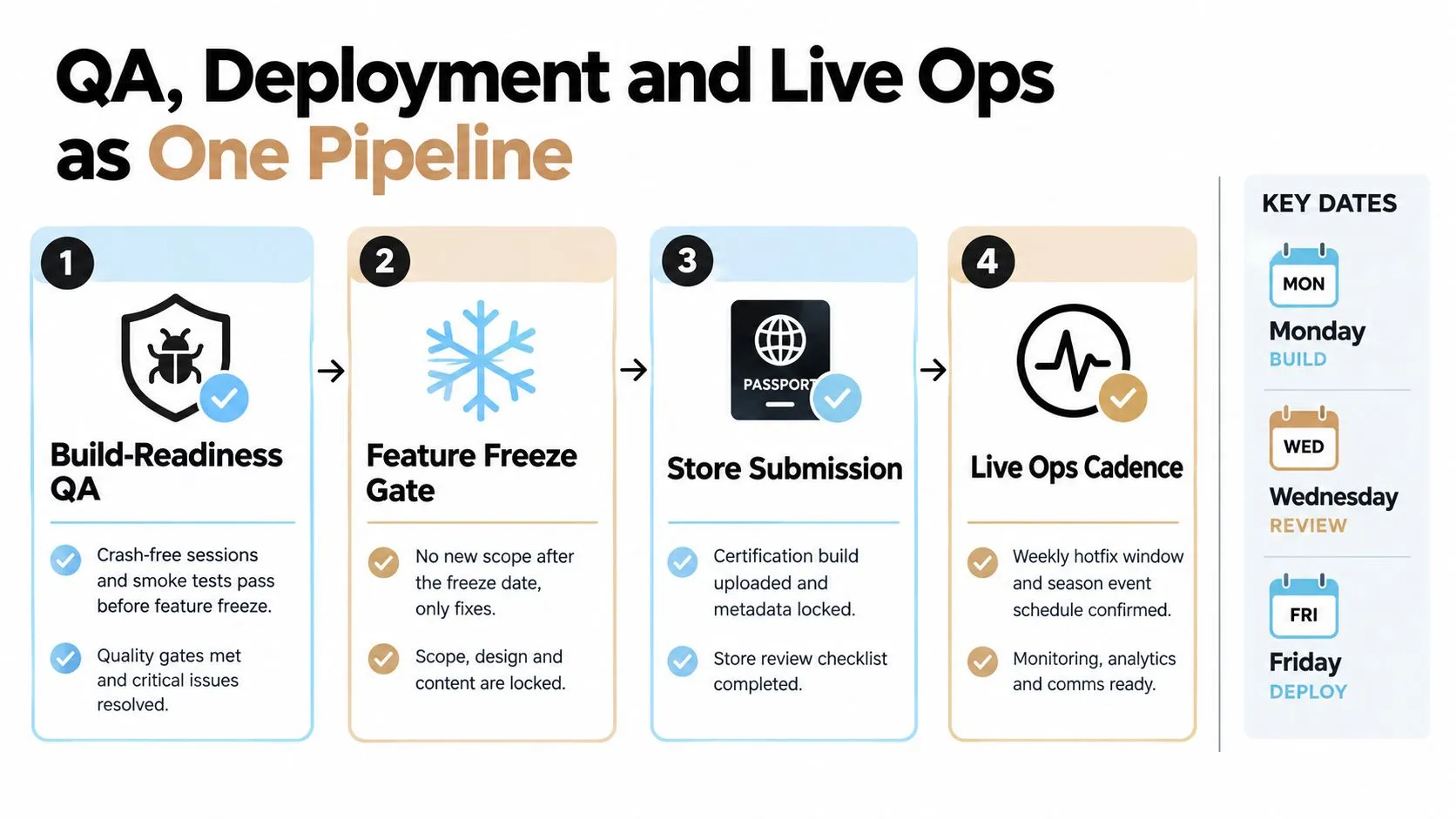 UK evidence shows the labour context clearly. The sector supports 73,000 FTEs, generates £5.26 billion in GVA, and produces around £121,000 GVA per FTE, compared with a UK average of £66,100, according to Ukie evidence to Parliament. That productivity density makes wasted senior review time particularly consequential. Recent UK-focused reporting also describes studios using generative AI for routine asset creation, level layout and code generation, while reporting that the sector lost 1,537 development jobs between April 2024 and September 2025 as AI adoption increased (UK games skills reporting). The lesson isn't that AI caused the contraction. The lesson is that automation doesn't automatically create resilience. A sound AI workflow adds review gates:
 - •Define the output boundary: Decide what the tool may generate and what must remain human-authored.
- •Route review by risk: A placeholder texture and a player-facing character performance shouldn't receive the same approval process.
- •Track rework: Measure how often generated output is accepted, revised or discarded.
- •Fund the reviewers: AI efficiency depends on senior people who can validate the result quickly.
The AI animation software guide is relevant to this distinction. AI compresses production when it shortens the path to an approved result. If it creates more unreviewed output, it has only moved the bottleneck upstream.
QA Deployment and Live Operations as One Pipeline
QA should enter with the first meaningful build, not the final polish pass. A producer's weekly review needs to connect asset versioning, build promotion, feature freeze, certification and live support into one operating rhythm. The animation production model offers a useful comparison. UK animation workflows commonly divide work into pre-production, production and post-production, with post-production covering compositing, sound, colour, titles, graphics, mastering and delivery checks (UK animation production pipeline guide). A game pipeline has different technical demands, but the principle is similar. Each stage must verify what it receives before the next stage builds on it.
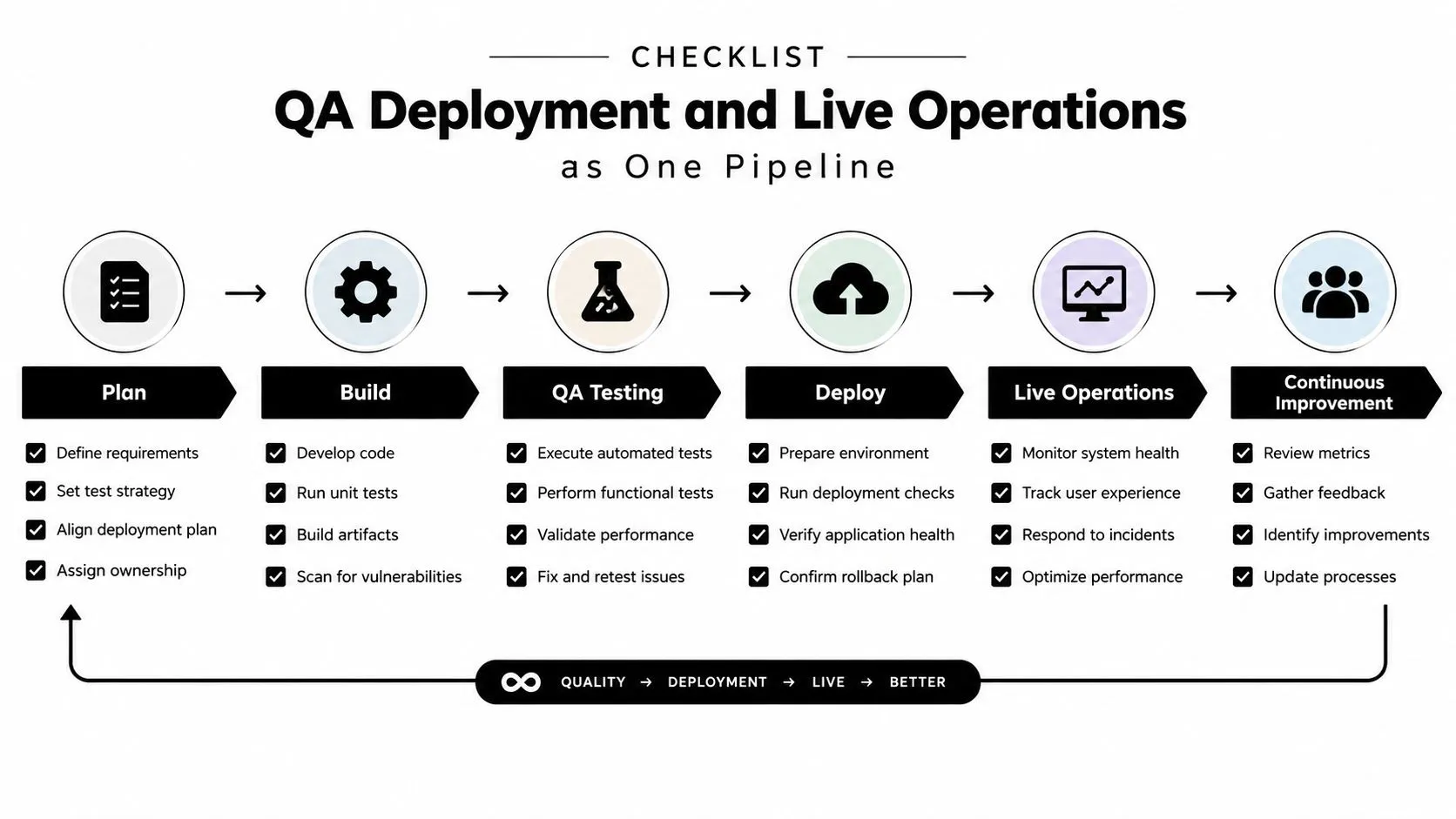
A weekly shipping checklist
- •Build readiness: Run smoke tests on the current build and confirm that critical paths launch, save, load and complete.
- •Regression control: Review new defects against the previous known-good build. Don't allow a feature branch to become the only place where a fix is tested.
- •Feature freeze: Confirm that no new scope enters after the agreed freeze. Fixes need triage, ownership and a release decision.
- •Platform readiness: Check console compliance, input behaviour, suspend and resume, localisation, achievements, privacy requirements and store package rules.
- •Metadata lock: Verify store copy, age-rating information, screenshots, trailers, package names and version numbers.
- •Deployment promotion: Move the approved build through the release environment using a named owner and a rollback plan.
- •Live handoff: Prepare crash telemetry triage, player-support notes, content-drop staging and a hotfix decision path.
Broadcast delivery offers a useful reminder about technical discipline. UK delivery guidance lists QuickTime MOV or MP4 using formats such as Photo JPEG, H.264 or ProRes, with common resolutions including 1920×1080, 2048×1080 for 2K and 3840×2160 for 4K. A separate UK production guide notes a Channel 5 requirement for edited material at 50 frames per second and progressive capture where film motion is required (UK motion graphics delivery guidance). The specific specifications differ by platform, but the production habit is the same: confirm the delivery target before the final export. The producer should leave each weekly review with one answer to three questions: what is safe to promote, what is blocked, and who owns the next decision. That keeps QA, deployment and live operations honest.
Treating Your Pipeline as a Product
A studio's pipeline needs a roadmap, an owner and a definition of value. If the team only improves tools when production is already in trouble, every intervention becomes an emergency ticket. The underlying process never gets enough attention to become reliable. Treat the internal pipeline like a product with versioning, changelogs, documentation and adoption checks. A new export script isn't complete because it runs on the creator's machine. It needs ownership, onboarding, failure handling and a clear answer to the question, “What does this replace?”
Shared ownership creates better trade-offs
Producers understand schedule and dependency risk. Artists understand the cost of poor review tools and unstable imports. Engineers understand build integrity. QA understands what players and platforms will expose. When those disciplines share pipeline ownership, the team can choose improvements based on production impact rather than technical novelty. That cross-discipline model is especially important as senior review capacity tightens. A studio that adds AI generation without improving approval routing may increase the amount of work waiting for leads. A studio that invests in validation tools, clear gates and reusable templates can turn automation into dependable throughput. The UK Games Fund evaluation estimated £30 million to £58 million in productivity benefits over a ten- to 15-year horizon, with a central estimate of around £38 million, alongside roughly 430 additional FTE jobs, according to the government evaluation of the UK Games Fund. The broader point is practical: targeted support and better production capability can affect the throughput of smaller studios, especially during early development when revenue hasn't arrived. A healthy pipeline is a maintained deliverable. Give it release notes. Retire tools that no longer earn their support cost. Measure whether handoffs become clearer, whether review queues shrink and whether teams can recover from a failed build without burning out the same senior people. --- Studio Liddell offers cross-discipline production across animation, games and XR, including Unity and Unreal development and AI-enhanced production workflows. If your team needs to find the bottleneck between concept, asset production, engine integration and delivery, visit Studio Liddell to start a practical production conversation.