What Is Motion Graphics? a Complete Guide for UK Brands
Motion graphics are graphics with movement, and for most commercial work they're the clearest way to turn design, type, charts, icons, and brand elements into a message that unfolds over time. They're also built on a mature production discipline: nearly 8 out of 10 motion designers use Adobe After Effects as their primary tool, which tells you this isn't a vague creative trend but a standard way to make explainers, social ads, title sequences, and branded content. You're probably here because a team member has said, “We need a video,” and you're trying to work out what kind. Not a full film crew, not a character cartoon, and not a dense slide deck with transitions pretending to be animation. You need something that explains, persuades, and looks polished. That's where motion graphics earns its place. Think of it as graphic design with a fourth dimension: time. A static diagram can show structure. Motion graphics can show structure, sequence, cause and effect, hierarchy, and emphasis. For a business, that difference matters. It's often the gap between “people saw it” and “people understood it”.
Defining Motion Graphics A Primer for Businesses
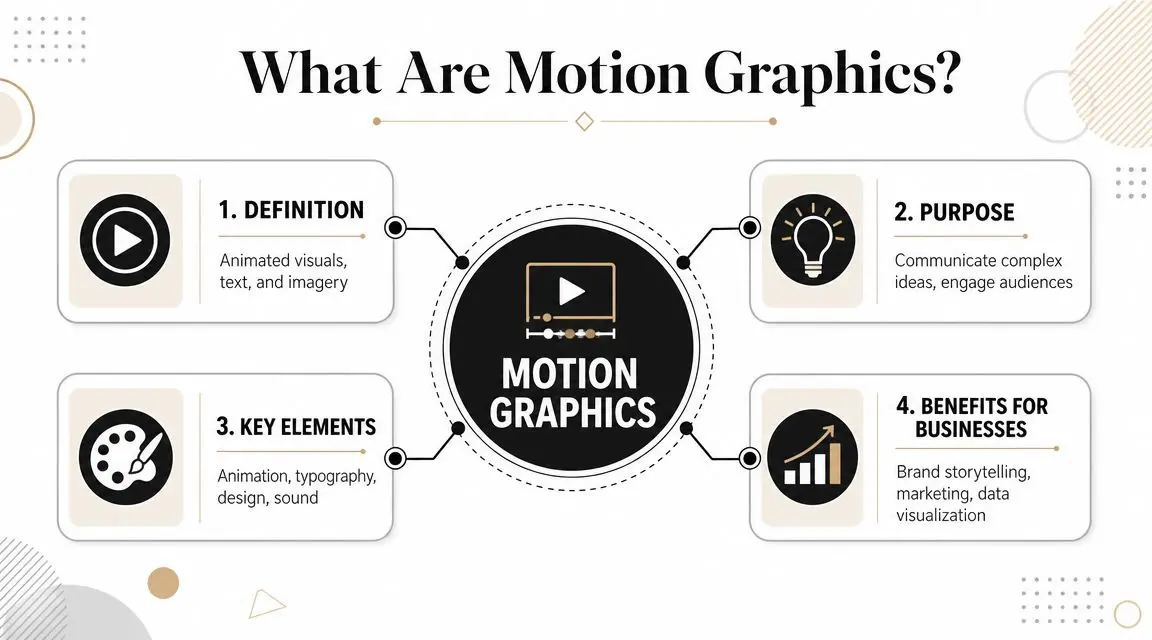
At its simplest, motion graphics means taking visual design elements and animating them with purpose. That usually includes typography, logos, icons, shapes, illustrations, data, interface elements, and transitions. The movement isn't decorative if the work is doing its job. It guides attention, reveals meaning, and controls pace. Adobe's UK guide puts it plainly: motion graphics are “graphics with movement”, and describes them as shorter-form animation used to “entertain or impart information” across opening credits, advertising, social media posts, website design, and digital marketing in the mid-20th century and beyond as digital tools widened access to creators (Adobe's UK motion graphics guide). That history is useful because it explains why clients often recognise motion graphics before they know the term. You've seen it in title cards, app launch videos, logo reveals, UI demonstrations, event screens, data visualisations, and product explainers. It sits between static design and full narrative animation.
What actually makes something motion graphics
Three ingredients usually show up together:
- •Designed elements: Type, shapes, charts, icons, brand assets, or illustration.
- •Time-based communication: Information appears in an intentional sequence, rather than all at once.
- •Controlled movement: Scale, position, timing, opacity, rhythm, and transitions all carry meaning.
A useful analogy is this: a brochure lays everything on the table at once. Motion graphics is a presenter walking you through the same material in the right order, at the right pace, with the right emphasis.
Practical rule: If the main job is to explain an idea, clarify a process, or give a brand system energy without needing actors or dramatic character performance, motion graphics is usually the right starting point.
Why businesses care about it
For a business audience, “what is motion graphics” is really a buying question in disguise. You're not asking for a museum definition. You're asking whether this format can help sell a product, launch a service, train an audience, or make abstract information easier to absorb. It can. Motion graphics is especially good when you need to show things that are hard to film, such as software processes, invisible systems, technical workflows, future concepts, or changes over time. It's also useful when a brand needs consistency across a lot of touchpoints, because the same design language can be adapted for multiple formats. If you want a broader business case from a studio perspective, Studio Liddell has also written about why motion graphics are essential for businesses.
Motion Graphics vs Animation vs VFX Understanding the Difference
Clients often use these terms interchangeably. In production, they're related but not identical. If you blur them together, budgets, schedules, and expectations start drifting almost immediately.
A side-by-side comparison
| Discipline | Core Purpose | Primary Focus | Best For | Why It Matters for a Client |
|---|---|---|---|---|
| Motion graphics | Communicate information and brand ideas over time | Typography, layout, icons, diagrams, abstract visuals, UI, graphic systems | Explainers, title sequences, product education, social ads, data stories | Usually the clearest route when your message is more important than character performance or filmed realism |
| Animation | Create performance, emotion, and narrative movement | Characters, creatures, acting, staging, world-building, visual storytelling | Series work, ads with mascots, story-led campaigns, educational characters | Better when you need empathy, personality, or a memorable world rather than concise information delivery |
| VFX | Blend or enhance digital elements within live-action footage | Integration, realism, compositing, tracking, clean-up, simulations | Product spots, film, TV, branded films, impossible shots | Best when you already have footage or need the audience to believe something happened in-camera |
Motion graphics is about ideas in motion
If you need to explain how a platform works, how funds move through a system, what a medical process does, or why a product solves a problem, motion graphics is often the cleanest answer. It's built for abstraction. You don't need to cast talent to show “data syncing securely across departments”. You can visualise the logic directly. This matters commercially because abstraction removes friction. You're not organising locations, weather cover, props, wardrobe, crew logistics, and reshoots just to explain a concept that was never physical in the first place.
Animation is about performance
Character animation asks a different question: not “How do we explain this?” but “Who is experiencing this?” The audience follows a figure, a creature, or a cast through an action. That can be brilliant for storytelling, children's content, branded mascots, or campaigns that need warmth and personality. But it changes the production brief. Character design, rigging, acting choices, lip sync, staging, and performance notes all become central. If your core objective is clarity and speed, those layers can be unnecessary. If your objective is emotional attachment, they're exactly what you should pay for.
If the audience needs to understand a system, motion graphics usually leads. If the audience needs to care about a character, animation usually takes over.
VFX is about belief
Visual effects enters the picture when live action is already part of the plan, or realism is the point. A good example is a product film that needs screens replaced, environments enhanced, or impossible camera moments added without breaking the illusion. From a client point of view, this distinction is practical. VFX depends heavily on plate quality, tracking data, lighting continuity, and integration work. Motion graphics can be much more self-contained. That usually means fewer variables. A simple commissioning test helps:
- •Choose motion graphics if you need to explain, simplify, label, compare, or brand.
- •Choose animation if you need character, performance, or narrative world-building.
- •Choose VFX if you need digital work to merge convincingly with filmed footage.
Types of Motion Graphics and Real-World Use Cases
The fastest way to understand motion graphics is to see what problem it solves. Businesses rarely commission “motion graphics” in the abstract. They commission a launch film, an investor explainer, a conference opener, a paid social cutdown, or a product demo.
For UK marketers, video is the second most-used content format, and that matters because businesses often need a lot of assets, not just one hero film. In that environment, motion graphics is a lower-friction, faster-to-produce option for social media, explainers, and product education than organising a full live-action shoot (Boris FX on motion graphics and marketing use cases).
Explainer videos for complex products
A software firm has a strong platform and a weak explanation. The sales team understands it. Prospects don't. The website tries to cover features, integrations, benefits, and workflow in static sections, but the story feels fragmented. Motion graphics excels when you can introduce a problem, visualise a process, spotlight a feature, and land a value proposition in a sequence that feels effortless. Icons become actors. Data paths become visible. Interface elements appear when the script needs them, not all at once. That same logic applies to technical sectors, where the subject may be invisible, distributed, or too abstract to photograph. If your team is thinking through wider content marketing strategies for SMBs, motion graphics often fills the gap between written thought leadership and expensive live production.
Social ads and campaign cutdowns
A campaign rarely lives in one format now. You may need a hero version, shorter edits, square variants, vertical edits, and silent-first versions for feeds. Motion graphics handles this well because the visual language is modular. A headline can animate differently for paid social than it does on a landing page video. The same product scene can become a six-second sting, a carousel-style sequence, or an end-card system. That flexibility is harder to achieve once a concept depends on a very specific filmed performance.
Title sequences and brand systems
Broadcasters and event teams use motion graphics to create a recognisable visual identity in motion. That might mean title cards, lower thirds, transitions, bumpers, or large-format screen content. The design system matters as much as the individual asset. This kind of work often looks simple from the outside because the craft is hidden. Good motion design controls rhythm, hierarchy, spacing, and transitions so the whole brand feels coherent. Bad motion design looks like separate pieces fighting each other.
A logo isn't just a mark anymore. In motion, it becomes behaviour. How it enters, pauses, shifts, and exits tells the audience what kind of brand they're dealing with.
UI motion and product demonstration
When the product lives on a screen, motion graphics can simulate use before development is complete or polish a real capture after the fact. That's useful for launch films, pitch decks, trade show screens, and onboarding materials. The business value is straightforward. You can sell the experience before every engineering detail is final, provided the message is honest and the visualisation is clearly controlled.
Inside the Studio The Motion Graphics Production Pipeline
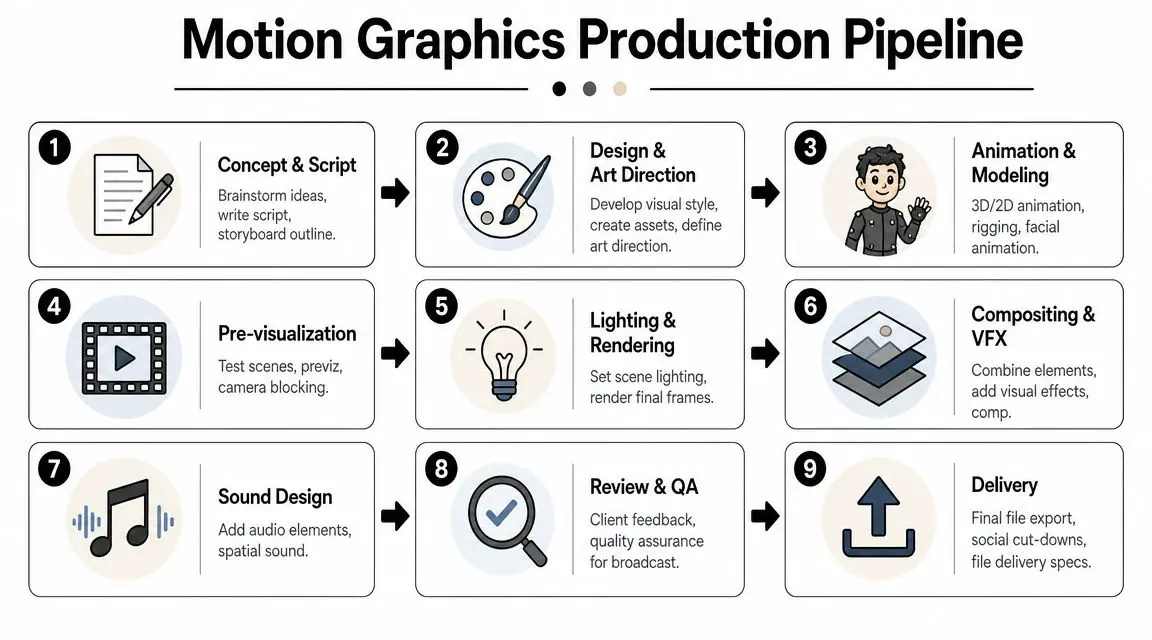
Clients usually don't need every technical detail, but they do need to know how decisions get made and where approval points sit. A good pipeline protects quality and keeps everyone aligned.
Brief, script, and story logic
The first stage isn't “make it look good”. It's “work out what this needs to say”. A useful brief answers a few hard questions early: who's it for, what should they understand after watching, where will it appear, and what action should follow? Then comes the script or structure. Even a short motion piece needs logic. A clear opening, a build, and a finish. If the script wanders, the animation won't rescue it. At this point, many teams move into rough boards or an animatic. Think of this as the blueprint. It's much cheaper to fix sequence, emphasis, and pacing before detailed design begins.
Style frames and animation
Once the message is settled, designers create style frames. These are still images that show the look of key moments. Colour, typography, illustration style, composition, and brand handling all get locked in here. Only then should full animation start. At this stage, timing, easing, transitions, and scene-to-scene flow come alive. Across the industry, nearly 8 out of 10 motion designers report Adobe After Effects as their primary tool, which is one reason the workflow is so established for explainers, TV branding, and social ads (School of Motion's motion design survey). If you're curious about newer workflows, this overview of transforming video creation with AI is a useful companion read. The sensible view is that AI can support parts of production, but it doesn't remove the need for art direction, design judgment, and careful review.
Approval discipline saves money. If a team signs off the style frames, then changes the visual direction halfway through animation, the schedule usually takes the hit.
For readers comparing 2D and 3D approaches within the same family of work, Studio Liddell has a practical guide to 3D motion graphics and end-to-end studio production.
Sound, review, and delivery
Sound often gets left late in client thinking, but it has a huge effect on polish. Music sets pace. Sound design gives movement weight. Even subtle interface clicks or transition textures can make a piece feel intentional. Delivery is the final technical stage, and practical specs matter. Common professional outputs include QuickTime MOV or MP4 with accepted codecs such as Photo JPEG, H.264, and ProRes, along with delivery resolutions such as 1920×1080, 2K minimum 2048×1080, or 4K minimum 3840×2160 (Envato motion graphics requirements). In practice, teams usually keep a high-quality master and transcode platform-specific versions from that source. A client should expect review rounds to focus on different things at different times:
- •Early review: Message, structure, script clarity.
- •Mid review: Visual style, hierarchy, pacing.
- •Late review: Fine motion, audio balance, text accuracy, output variants.
Measuring the ROI of Motion Graphics in Your Business
Creative work gets approved faster when the business case is clear. Motion graphics isn't valuable because it moves. It's valuable because the movement helps people understand, remember, and act.
Clarity reduces friction
Most commercial communication breaks down in one of three places. The audience doesn't grasp the offer. They don't understand how it works. Or they can't see why it matters now. Motion graphics can improve all three because it controls sequence. A static page leaves the viewer to decide what to read first. A motion piece guides them through the argument. Problem first. Product second. Benefit third. Proof fourth. Call to action last. That can show up in different business metrics depending on the context. A clearer product explainer may support stronger sales conversations, fewer repetitive questions, or smoother onboarding. A cleaner internal comms piece may help teams align faster. A better launch asset can strengthen the performance of the campaign around it.
Reuse improves value over time
One of the strongest commercial arguments for motion graphics is that the work can often be repurposed intelligently. A single core animation system can feed multiple outputs: website headers, social cutdowns, event screens, presentation openers, app-store previews, and paid media edits. That doesn't mean “one video does everything”. It means a well-planned project can generate a family of assets from one creative base. Clients often get more value when they commission with versioning in mind from day one.
Consistency improves brand perception
Many brands have visual guidelines but no motion behaviour. The result is a familiar problem: every team makes assets that look roughly right but move differently. One social ad is slick. Another is clumsy. A sales deck uses abrupt transitions. An event opener uses a completely unrelated rhythm. Motion graphics can solve that by turning brand style into brand behaviour. The same principles can govern reveal speed, text pacing, transitions, logo movement, and screen choreography.
Strong motion systems do two jobs at once. They make individual assets better, and they stop future assets from drifting off-brand.
Better measurement starts with better objectives
If you want to judge return properly, define success before production starts. That sounds obvious, but many teams still brief in aesthetic terms alone. “Make it modern” isn't a measurable objective. “Help prospects understand the service in one viewing” is much closer. A sensible measurement frame might include:
- •Attention metrics: Are people watching long enough to absorb the core point?
- •Conversion signals: Are more viewers taking the next step you intended?
- •Sales enablement: Are teams using the asset in presentations, proposals, or follow-up emails?
- •Operational efficiency: Has the asset reduced repeated explanation work?
The strongest ROI usually comes when motion graphics is treated as part of a communication system, not a one-off decoration.
How to Commission Motion Graphics A Guide for UK Clients
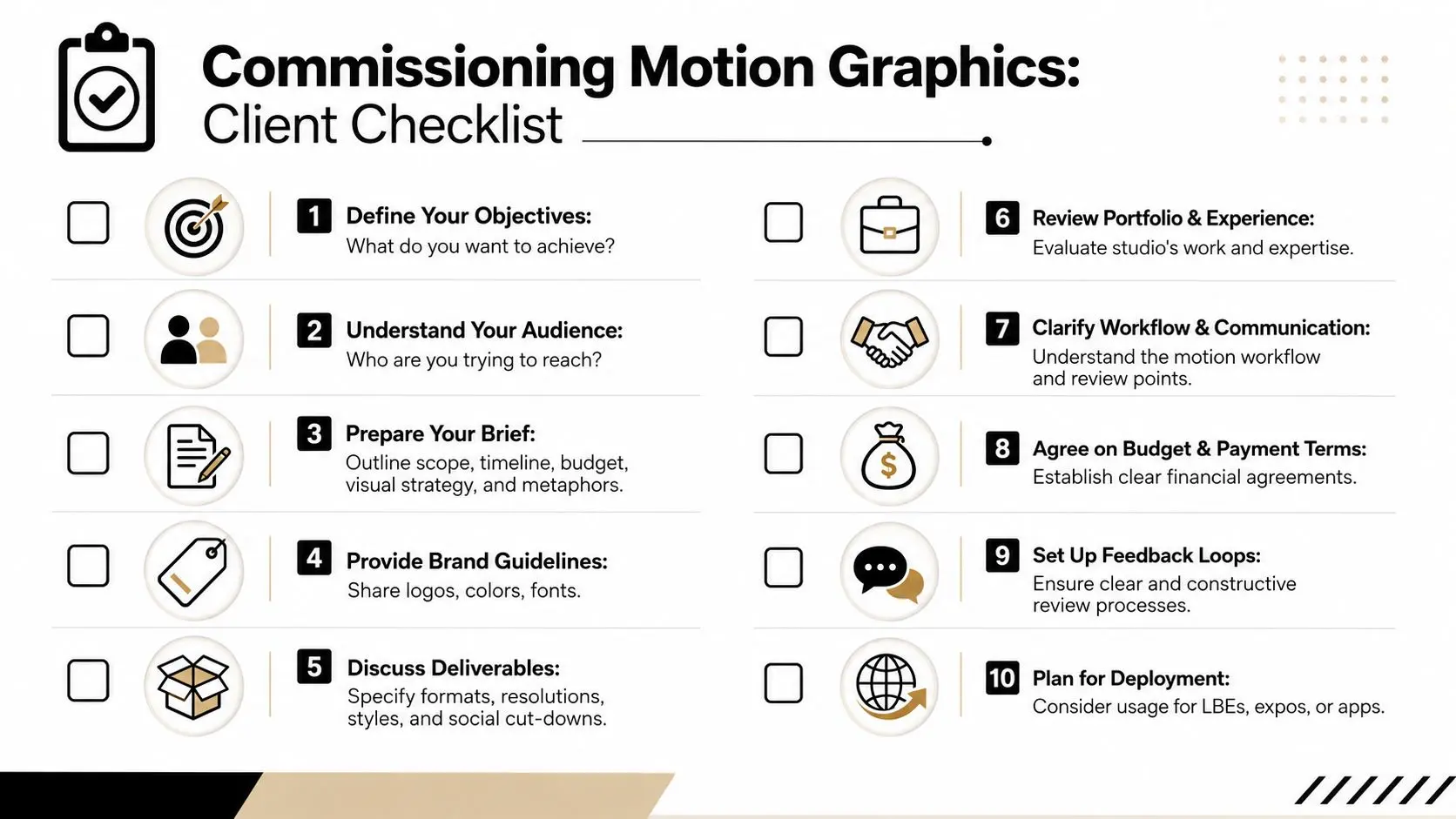
Commissioning well is half the battle. Most troubled projects don't fail because the animators lacked skill. They fail because the brief was vague, the approvals were messy, or the deliverables were underspecified.
Start with the brief, not the reference reel
Reference videos are useful, but they're not a strategy. A strong brief tells the studio what business problem needs solving and what constraints are real. Include these essentials:
- •Audience: Who needs to understand this, and what do they already know?
- •Message: What's the one thing they should remember?
- •Context: Where will the piece live? Website, paid social, events, broadcast, app, internal comms?
- •Action: What should the viewer do next?
- •Inputs: Brand guidelines, logos, fonts, product UI, deck material, previous campaigns, legal requirements.
- •Constraints: Deadline, approval chain, mandatory wording, version needs.
Be realistic about scope
A short piece can still be complex. Length alone doesn't determine effort. A fifteen-second identity sting may be straightforward, while a concise product explainer can involve strategy, scripting, design systems, and multiple output versions. Instead of asking for a fixed price before the scope is clear, ask the studio to define production variables. The key ones are usually:
- •Design intensity: Bespoke illustration and 3D elements take more time than simple brand-led typography.
- •Script complexity: Dense messages require more development and more careful pacing.
- •Versioning: Multiple aspect ratios and language versions affect schedule.
- •Review process: One decision-maker moves faster than a committee.
Specify deliverables properly
Many briefs tend to be too loose. “We need the video” isn't enough. The studio needs to know what “finished” means. Useful deliverable questions include:
- •Master format: Do you need a high-quality archive file as well as platform-ready exports?
- •Aspect ratios: Horizontal format only, or also square and vertical?
- •Captions: Burned-in, sidecar, or both?
- •Edit variants: Hero version, cutdowns, end cards, silent versions?
- •Usage environment: Website embed, conference playback, social upload, in-app playback?
If you're comparing suppliers and want a more structured framework, this buyer's guide to choosing an animation studio is worth reading before you send enquiries.
The best client brief isn't the longest one. It's the one that removes ambiguity.
Treat feedback as direction, not taste alone
Feedback works best when it answers one of three questions. Is the message unclear? Is the brand expression off? Is the timing wrong for the audience and platform? Comments like “make it pop” rarely help unless they're tied to a communication issue. A practical review rule is to gather internal comments first, resolve contradictions, then send one consolidated response. That saves everyone time and avoids circular revisions.
Frequently Asked Questions About Motion Graphics
Is motion graphics the same as video editing?
Not really. Editing is the arrangement of footage, audio, and sequences. Motion graphics is the creation and animation of graphic elements over time. A project can include both, but they're different disciplines.
When should I choose motion graphics over live action?
Choose it when the idea is abstract, technical, process-driven, or difficult to film cleanly. It's also a sensible option when you need multiple versions across channels and want tighter control over brand consistency.
Can motion graphics be 3D as well as 2D?
Yes. Motion graphics isn't limited to flat design. A project might use 2D typography, 3D product forms, compositing, simulated interface scenes, or a hybrid of all three. The deciding factor is the communication goal, not whether the images have depth.
What file formats should I expect at delivery?
That depends on where the work will run, but professional delivery often involves a high-quality master plus compressed platform versions. Common delivery containers include MOV and MP4, with codec choices depending on playback needs and post-production requirements.
Is AI changing motion graphics production?
Yes, and buyers should ask about it directly. In 2024, 72% of UK organisations had used at least one AI technology, which makes AI-assisted production a mainstream business reality rather than a novelty (Coursera on motion graphics and AI context). In practice, AI can speed up parts of ideation, asset preparation, and workflow support. It does not remove the need for human judgment. Typography, pacing, brand fit, narrative emphasis, and quality control still depend on people who know what they're doing. That's the nuance many simple explainers miss. AI can help make things faster. It doesn't automatically make them clearer.
Can motion graphics be used in XR, events, or immersive work?
Yes. The same design principles that make a strong explainer or title sequence can feed event screens, spatial interfaces, immersive content, and interactive environments. The difference is that motion has to respond to context, scale, and sometimes user behaviour, rather than only a fixed timeline.
If you're weighing up whether motion graphics is the right format for your next campaign, product launch, explainer, or branded content system, Studio Liddell is one option to consider for animation, motion design, and wider digital production. A good next step is to bring a short brief, your audience, your key message, and the channels you need to support. That gives a studio enough to scope the right approach without guesswork.