Branded Content Production: A Practical UK Guide
UK branded content has already moved beyond informal experimentation. The UAL Branded Content Research Hub report describes the first dedicated UK survey of branded content professionals, covering 2019 to 2023, while also recording £16.47 billion in UK online advertising spend in 2020 and projected influencer marketing market volume of US$1.52 billion by 2027. The commercial question is no longer whether brands should make content. It's whether the production process can turn a brief into work that earns attention, builds memory, and creates measurable movement beyond views.
What Branded Content Production Actually Means
Branded content production is the complete process of creating narrative-led content for a brand, from strategy and creative development through production, post-production, distribution versions, and measurement. It can result in a documentary, animated series, product film, explainer, podcast, social campaign, interactive experience, or XR installation. The format matters less than the relationship between the audience, the story, and the commercial objective. That definition separates three activities that procurement teams often mix together:
- •Branded content uses entertainment, education, or useful information to build a relationship with an audience. The brand may be central to the story, or it may act as the enabler.
- •Advertising usually has a more direct persuasion job, with controlled media placement, a defined call to action, and tighter message requirements.
- •Earned editorial coverage is created independently by publishers or journalists. The brand can influence access and context, but it doesn't own the final editorial decision.
The distinction affects budget, approvals, rights, disclosure, and success metrics. A brand film commissioned as a paid campaign needs a different production plan from a documentary intended to live on a company site and earn organic discovery.
What the buyer is actually purchasing
You aren't buying a “video” as a single object. You're buying intellectual property, production craft, rights management, and an accountable decision-making process. That process should define the audience, narrative purpose, visual language, platform requirements, approval points, deliverables, and measurement plan before the crew or animators begin work. The UK production ecosystem is substantial. A separate EVCOM Top 50 ranking for brand and corporate film producers returned in 2022 with the first ranking of its kind since 2019. Its model weighted producer success through 65% revenue from corporate and brand video, 20% peer recognition, 10% major awards, and 5% project volume, a useful reminder that branded production is a commercial market, not merely an artistic category. A practical guide to branded entertainment should therefore help a buyer decide what is being made, why it deserves to exist, and how it will be used after the hero asset is approved.
Practical rule: If the quote covers only the hero film, ask who is paying for the cut-downs, captions, localisation, platform exports, usage rights, and measurement setup.
The common failure is predictable. Teams commission an attractive central asset, then discover that the budget doesn't cover the versions needed for social, paid media, regional markets, landing pages, sales enablement, or accessibility. The production looked complete at approval, but the distribution plan was never funded.
Formats and Where Each One Earns Its Place
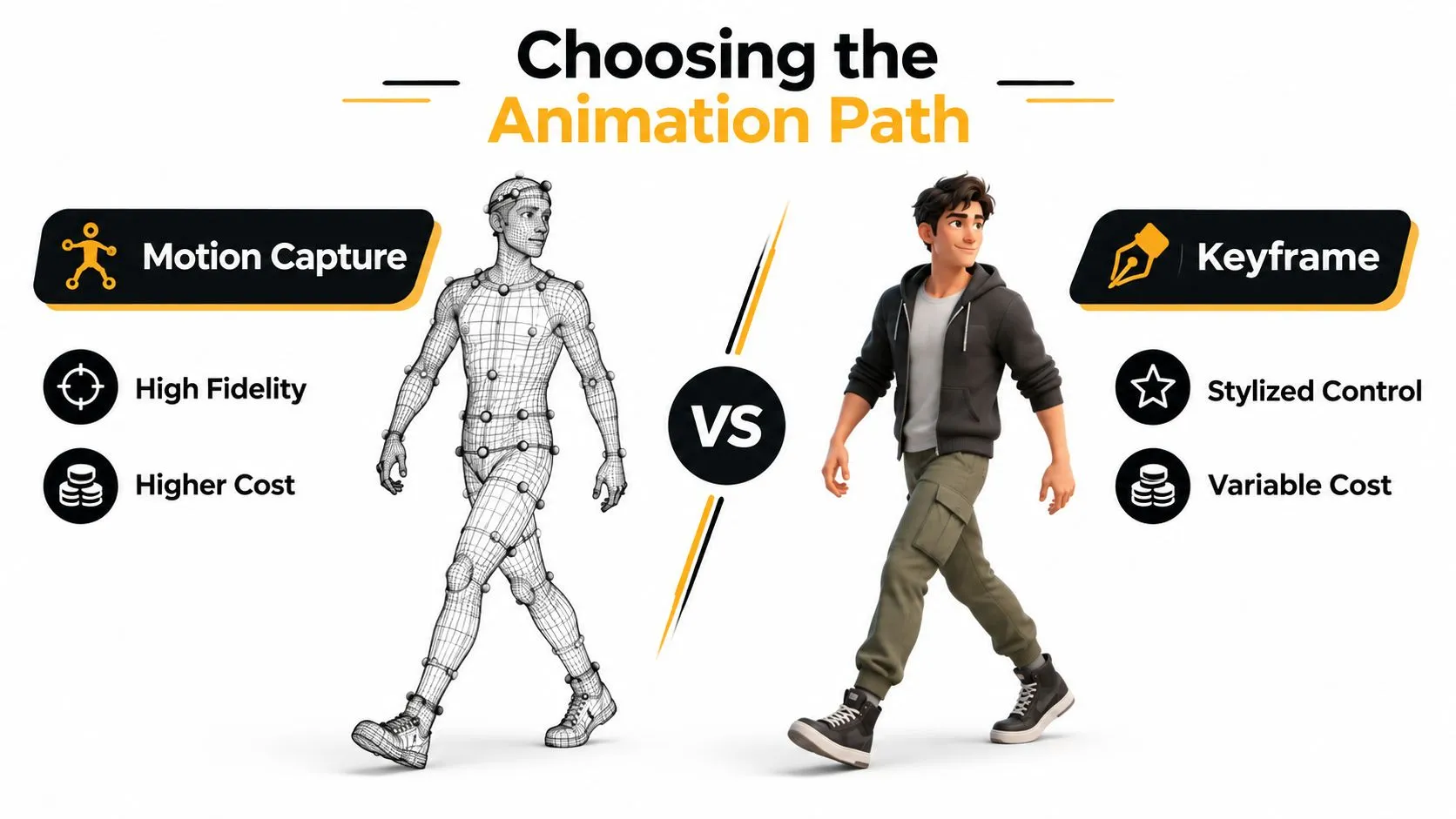
A format should earn its place by solving a communication problem. Novelty isn't a production strategy, and a technically impressive asset can still fail if the audience can't understand it quickly or the brand has no credible distribution plan. Animation and motion graphics are strong choices for explainers, regulated categories, technical products, and briefs that may require localisation. Once the visual system is designed, teams can often revise scripts, replace screen graphics, or create language versions without reshooting locations and talent. That flexibility doesn't make animation automatically cheap. Modelling, character work, rendering, and compositing can expand the scope quickly. Live-action brand film remains the natural choice when the brief depends on human presence, physical environments, documentary credibility, or emotional performance. It can carry a launch story with more immediacy than a diagram, but it introduces location, casting, crew, weather, access, and reshoot risks. A buyer should choose live action because reality is part of the message, not because an agency has a preferred shoot setup. Short-form social video needs its own edit logic. Vertical-first work should be framed, paced, captioned, and cleared for mobile viewing from the outset. A cropped version of a horizontal hero film often loses the subject, the product, or the visual hierarchy. UK benchmark analysis of nearly 175 Instagram and TikTok accounts found average engagement of 1.6% on Instagram and 4.5% on TikTok, with TikTok posts averaging about 177,454 views, 58,997 reach, 413 shares, and 179 saves per post, according to Dash Social's UK social media benchmarks. Those figures don't guarantee performance, but they support a practical production decision: build modular, platform-native edits rather than treating every channel as an afterthought. XR and AR justify their budget when the audience needs to interact with a product, environment, process, or training scenario. A product configurator, immersive event game, or spatial demonstration can create a richer experience than a passive film, but the team must account for hardware, tracking, installation, testing, support, and user flow. Spokesperson-led editorial video works well for financial, health, education, and B2B brands where trust depends on clarity and credibility. It needs disciplined interviewing, careful scripting, and strong audio. It shouldn't imitate journalism superficially. The audience needs a useful answer, not a corporate executive reading a press release.
| Format | Indicative cost band in the UK | Typical lead time | Best-fit brief |
|---|---|---|---|
| Motion graphics | Animation pricing guidance places many motion graphics projects among the faster options, with style and revision scope driving the quote. Media Village's UK animation guide places motion graphics at a typical 3 to 4 weeks. | Often 3 to 4 weeks for a contained project | Product explainers, data stories, title sequences, social variants |
| 2D animation | About £3,000 to £8,000 per minute, according to Studio Liddell's UK animation pricing guide | Typically 4 to 6 weeks | Explainers, educational content, regulated messaging, localisation-heavy work |
| 3D animation | About £8,000 to more than £20,000 per minute, with complex hero campaigns reaching £80,000 to £250,000+ in the cited UK guidance | Commonly 8 to 16 weeks for 3D, while hero campaigns can take 4 to 9 months | Product visualisation, cinematic brand films, creatures, environments, premium launch work |
| Live action | No reliable universal band. Crew, locations, cast, kit, travel, post, rights, and reshoots determine the quote | Depends on access, production scale, and approvals | Documentary, launch films, human stories, physical demonstrations |
| Short-form social | No reliable universal band. The key variable is whether cut-downs are planned within the original production | Depends on the master asset and versioning plan | Paid social, organic discovery, creator-style campaigns |
| XR and AR | No reliable universal band. Hardware, software, tracking, deployment, support, and analytics must be scoped | Depends on interaction design, build, testing, and venue requirements | Exhibitions, retail, events, training, interactive product experiences |
The comparison is useful only if the brief names the job. Don't choose 3D because it sounds premium, or AR because the event team wants something novel. Choose the production method that makes the message easier to understand and the audience action easier to complete.
The End-to-End Production Pipeline in Practice
A credible production plan gives every stage an owner, an approval gate, and a reason to exist. It also makes uncertainty visible. If an agency can't explain what changes the price or schedule, the quote isn't ready for approval.
Start with a decision-ready brief
The first stage covers strategy and briefing. Stakeholders need to agree the audience, proposition, platform mix, rights, tone, deliverables, and primary success metric before concept development begins. A workshop is useful when it resolves competing opinions. It isn't useful when it produces another vague moodboard. The creative development stage turns the brief into concepts, scripts, visual references, storyboards, and a costed treatment. For many projects, allow roughly two to three weeks for this work as a planning assumption, not a guaranteed industry standard. The output should show what the audience sees, hears, and does, as well as what the team will deliver in each aspect ratio. A complete animation production pipeline guide is particularly useful for exposing the stages that disappear inside a vague “production” line item.
Treat pre-production as risk control
Pre-production includes casting, location work, storyboards, animatics, technical tests, asset preparation, and shoot or capture planning. The team discovers that the proposed product angle doesn't fit the chosen frame, that a character rig can't support the required performance, or that a venue lacks the technical conditions for an installation. A contingency line belongs here. It shouldn't be a mysterious reserve that disappears into the final invoice. It should relate to identifiable risks, such as weather, access, approvals, render complexity, additional language versions, or hardware testing.
Protect the production and post schedule
During production, the variance usually comes from day rates, kit, crew composition, capture requirements, locations, and the number of assets being created. In CG and real-time work, asset complexity, animation style, lighting, rendering, and technical integration create the equivalent variance. Post-production covers edit, VFX, compositing, sound design, music, grade, captions, legal changes, and exports. The first cut is not the end. Platform cut-downs, subtitles, audio descriptions, thumbnail options, and language files should be specified before approval, because late additions can force editorial and technical rework. A sensible planner should see a stage-by-stage cost breakdown, but there is no reliable universal percentage split for every branded content project. A live-action documentary, a 3D product film, and an XR activation have different cost centres. Require pounds allocated to named deliverables rather than invented percentage bands that create false precision.
Deliver and learn
The final stage is trafficking, quality assurance, publication, and optimisation. Each channel has its own file, caption, duration, safe-area, and naming requirements. Agree who checks the files, who uploads them, and who owns any platform rejection. The production isn't operationally complete until the team reviews the agreed metrics after launch. That review should identify which opening, message, format, or audience segment deserves further investment. Without it, versioning becomes guesswork and the next brief repeats the same assumptions.
Technology, Real-Time Engines, and Where AI Genuinely Helps
Technology changes the production workflow when it removes a bottleneck. It doesn't create a strategy, direct a performance, or decide whether a story deserves the audience's time. Unreal Engine and Unity can support product visualisation, virtual production, interactive installations, AR, and VR. Their value lies in reusability and rapid iteration. A team can test an environment, move a camera, configure a product, or create multiple outputs from a structured digital asset rather than rebuilding every version from scratch. The choice between engines should follow the deliverable, team skills, target hardware, plugins, rendering needs, and long-term maintenance plan. AI is more useful in the repetitive edges of production than in the creative centre. It can help with:
- •Early development: moodboard exploration, reference sorting, rough shot-list drafting, and alternative visual directions.
- •Post-production support: rotoscoping roughs, transcript preparation, automated conform edits, caption drafts, and asset tagging.
- •Versioning: localisation voice passes, language adaptation, crop suggestions, and structured export preparation.
- •Operational work: organising review notes and identifying missing deliverables against a version matrix.
Human judgement remains essential for performance direction, narrative pacing, visual consistency, cultural nuance, rights decisions, and final brand approval. AI-generated concept material can accelerate a conversation, but it shouldn't become the approved look, voice, or character without a human review process. Buyers should also ask how tools handle confidential scripts, unreleased products, personal data, voice rights, and source assets. A tool that saves editing time can create legal and reputational exposure if the team can't explain where inputs go or how outputs are cleared. For a broader overview of current AI content workflows, browse RedactAI's pro guide for 2026, then ask the production partner to translate the technology into specific stages, owners, and review gates. The AI animation software production guide is a useful prompt for that conversation. Don't ask an agency whether it “uses AI”. Ask which task it accelerates, what quality check follows, and whether the saving appears in the scope and schedule.
Measuring Branded Content Beyond Views and Likes
Views and likes describe distribution and reaction. They don't prove that the audience understood the proposition, remembered the brand, changed preference, or took a commercially relevant action. A stronger measurement stack starts with the role of the content. Upper-funnel work may need awareness, message recall, time spent, and brand lift. Mid-funnel work can examine consideration, preference, search behaviour, and qualified engagement. Lower-funnel assets need a clearer link to enquiries, product journeys, attributed conversions, or pipeline contribution. UK industry commentary increasingly points buyers towards time spent and brand lift rather than vanity metrics. A Kantar measurement study referenced by IAA London found sponsored YouTube campaigns delivered stronger awareness than conventional digital ads and produced a 3 percentage point lift in consideration or purchase intent. That doesn't mean every sponsored video will create the same effect. It does show why a buyer should measure more than exposure.
Build the measurement set before the edit
A publisher example reported average brand-lift gains of 21% across measured campaigns, with greater creative variety associated with stronger lift, as discussed in InPublishing's native advertising interview. The useful production lesson isn't to promise a particular lift. It's to plan video, article, and interactive variants as a measurement set, then compare their role and context. Short-form distribution needs platform-specific analysis. The UK social benchmarks cited earlier show materially higher interaction density on TikTok than Instagram, but engagement alone still can't tell a team whether the right people understood the message or whether the content improved brand memory.
| Metric | What it tells you | Typical use case |
|---|---|---|
| Brand lift | Whether exposure changed awareness, consideration, preference, or intent | Campaigns with a clear audience and control design |
| Message recall | Whether viewers retained the proposition or proof point | Explainers, product launches, regulated categories |
| Time spent | Whether the content held meaningful attention | Documentary, editorial-style, and long-form branded work |
| Completion rate | Where viewers stayed or dropped by platform and version | Short-form social, paid video, serial content |
| Search lift | Whether interest increased after exposure | Category education and launch campaigns |
| Branded search uplift | Whether more people actively sought the brand | Awareness work with a distinct proposition |
| Pipeline contribution | Whether content assisted a qualified commercial journey | B2B, enterprise, product and service campaigns |
| Dwell time | Whether users engaged with an experience or installation | AR, VR, exhibition, retail and event work |
Commission the minimum measurement setup alongside production: a baseline where appropriate, a defined primary metric, platform tracking, naming conventions, a version matrix, and an agreed review date. If those decisions wait until after launch, the team may have plenty of data but no defensible way to interpret it.
Choosing a UK Production Studio You Can Trust
A credible partner makes the work easier to govern. A risky partner makes every decision feel like a surprise, from the first treatment through the final invoice. Start by testing ownership of the brief. Can the studio restate the audience, message, format choice, deliverables, risks, and success metric without hiding behind creative language? Does the treatment explain what will not be made within the budget? A partner that promises every output usually hasn't made the necessary trade-offs.
Compare capability with accountability
Ask which craft sits in-house, which work is subcontracted, and who remains accountable when the schedule slips. Subcontracting isn't automatically a problem. The concern is whether the buyer knows who is handling animation, sound, VFX, interactive development, data, security, and final quality assurance. Rights should be explicit. Confirm ownership or licensing for characters, music, voice performances, stock material, software assets, source files, training data, generated outputs, and future versions. For XR and interactive work, add deployment rights, analytics ownership, maintenance, and hardware responsibilities. The four projects below illustrate different production problems rather than a single house style:
- •BooSnoo represents the challenge of extending an established children's IP into digital shorts while protecting its personality and audience expectations.
- •Dance! Dance! Dance! shows the demands of a mixed-reality event game, where character animation and player flow must work under real operational conditions.
- •Aurora demonstrates how a VR short needs story direction, performance capture, spatial sound, and optimisation to function as an experience rather than a conventional film viewed through a headset.
- •GeoEnergy NI reflects the challenge of explaining complex technical material to stakeholders through a clear visual strategy and iterative communication.
These examples matter because they reveal range across animation, broadcast-grade character work, immersive experience, and technical communication. They don't replace evidence from a relevant reference call.

Use the first scoping call to ask:
- What assumptions in our brief create the greatest cost or schedule risk?
- Which deliverables would you remove if the budget were reduced?
- Who owns the creative, technical, and production decisions?
- What will be handled internally and what will be commissioned externally?
- How will you manage brand, product, personal data, and AI-related rights?
- What does the first approved milestone look like?
- Which comparable project can we discuss with a recent client?
- What happens after final delivery when we need new versions?
Your Next 30 Days as a Branded Content Buyer
Use the first month to make decisions, not to collect more vague inspiration. Week one is for pressure-testing the brief. Write the outcome you could defend in a board meeting, choose one primary metric, and decide whether the work needs animation, live action, motion graphics, AR, or VR before contacting studios. If every outcome is “awareness and sales and engagement”, the brief isn't ready. Week two is for partner comparison. Send the same information to three production companies and score them on pipeline transparency, relevant format experience, rights clarity, budget realism, and the trade-offs they identify. Pay attention to what each partner refuses to promise. A credible producer will protect the scope rather than agree to every request.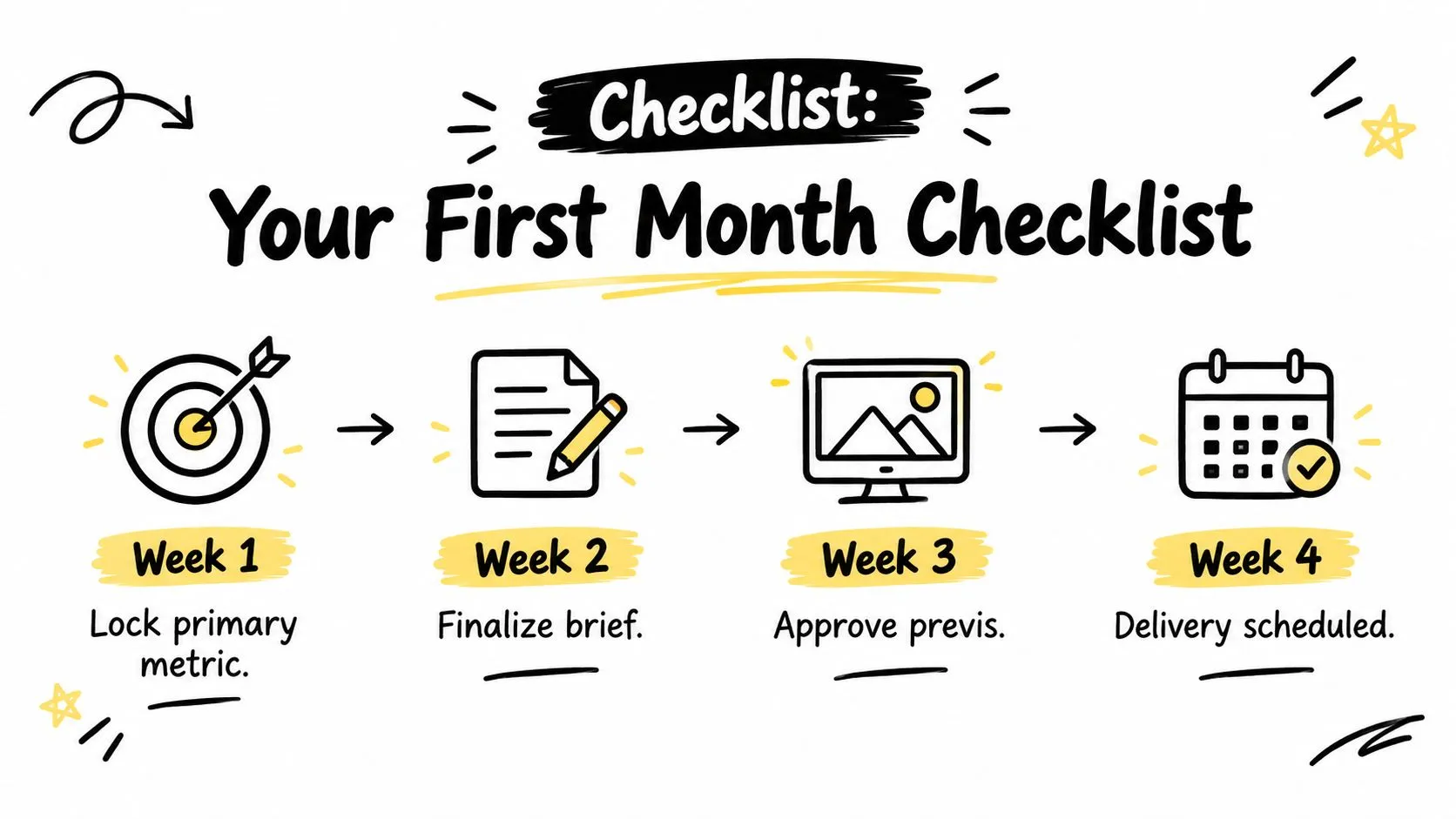 Week three is for a paid pilot. Keep the experiment bounded, with one hero asset and at least two purposeful cut-downs, all instrumented for the agreed platform and brand measurement. Approve the previs, storyboard, or treatment before the team commits to the expensive part of production. Week four is for review. Compare the pilot with the primary metric, examine completion and quality signals by version, and decide whether to establish a longer-term relationship, repeat project work, or stop. Don't turn a weak result into an automatic retainer. Find out whether the problem was the idea, the execution, the distribution, the audience, or the measurement design. --- Bring your script, product challenge, or campaign brief to Studio Liddell for a practical conversation about format, pipeline, versioning, and delivery. The team can help scope animation, branded film, motion graphics, or XR work before you commit to a production plan that doesn't match the outcome.