What Is Branded Entertainment and Why It Works
Branded entertainment is content funded by a brand where the story is the experience and the brand is woven into it, distinct from interruptive advertising. In the UK, Channel 4 found that branded entertainment lifted brand perceptions by 29% versus a traditional spot ad, while 44% of viewers felt more positive about a brand after seeing it in a programme. You know the viewing pattern. Someone skips a pre-roll before the first sentence, then watches three episodes of a brand-funded series because the story has earned their attention. The difference isn't the presence of a logo. It's the exchange being offered. An advert asks for attention before giving anything back. Branded entertainment gives the audience a reason to stay. That distinction matters for marketing managers commissioning content, agencies shaping campaigns, and commissioners deciding whether animation, live action, games or immersive experiences can solve a business problem. The UK market already has measurable scale. Research from the University of the Arts London on the UK branded content industry recorded an estimated £40 billion in total advertising industry turnover in 2019, alongside £17 billion in GVA and £4 billion in exports. The practical question isn't, “What is branded entertainment?” It's when does an entertainment-first approach work better than a conventional ad, which format suits the audience, and how can a team commission it without losing creative control or compliance discipline?
Introduction to Branded Entertainment That Audiences Choose to Watch
A viewer sits down to watch a favourite programme. The pre-roll begins, and they skip it as soon as the platform allows. Later, the same viewer chooses a short animated episode funded by a brand because the characters, humour or subject matter appeal to them. The brand is present, but it isn't demanding the viewer stop what they came to do. That is the central tension. Interruption can buy exposure, while entertainment has to earn attention. A successful project doesn't hide the commercial relationship. It makes the audience experience worthwhile enough that the brand's involvement feels relevant to the story rather than bolted on afterwards. This guide is for brand marketers, agencies and commissioners exploring content-led growth. It starts with a plain definition, separates branded entertainment from neighbouring formats, maps the main production choices, then turns to effectiveness, measurement, compliance and commissioning. By the end, you should be able to describe the idea clearly, choose a suitable format and brief a studio with more useful questions. The timing is commercially relevant in the UK. The 2023 UK branded content study from the Branded Content Research Hub at UAL described the field as fast-growing and drew on data from 2019 to 2023 to map its development. Ofcom data cited in that research shows total commercial TV and online video revenue reached £17.3 billion in 2022. The broader advertising market reached £36.6 billion in 2023, online video revenue rose 20% to £5.4 billion, and daily broadcaster video-on-demand viewing rose 29% to 20 minutes per person per day in 2023. Those figures don't make every branded project a good investment. They do show why marketers need to understand the choices behind content, rather than treating branded entertainment as a fashionable synonym for an advert.
The producer's test: If the brand disappeared from the pitch, would the audience still want to experience the story?
What Branded Entertainment Really Means and How It Works
Think of two ways to welcome people into a venue. One brand stands outside handing out flyers and asking visitors to come in. Another hosts a well-organised event, chooses the music, creates the atmosphere and makes its presence clear without turning every conversation into a sales pitch. The second approach is closer to branded entertainment. The brand funds, commissions or helps shape an experience that audiences choose because it offers entertainment, useful information, emotional connection or participation. The commercial message matters, but it works through the experience rather than interrupting it.
Branded entertainment is content funded by a brand where the story, activity or experience is the primary reason to engage, and the brand is woven into that experience.
The brand's role can sit on a spectrum. It might fund a film that shares a relevant theme, commission an animated character series, support a creator-led programme or build an interactive game. The integration can be subtle, but the relationship should remain clear. The important question isn't how large the logo appears. It's whether the brand has a credible reason to be part of the audience's experience. Emotional transfer becomes useful. If a viewer enjoys a character, admires a performance or feels curiosity while exploring an interactive world, some of that positive experience can become associated with the brand. That transfer only works when the connection feels natural. A product forced into an unrelated story can create the opposite effect, because the audience notices the commercial agenda before they find the entertainment. A practical definition needs more than a list of formats. It needs to explain the value exchange. The audience gives time and attention. The brand provides funding and creative direction. The producer turns that investment into a story or experience with its own reasons to exist.
A brand can therefore be visible without being the protagonist. It can also be central, particularly when it owns or develops the intellectual property. The commissioning decision should begin with the audience problem and brand objective, then identify the level of control and integration the story can support.
How Branded Entertainment Differs from Advertising and Related Formats
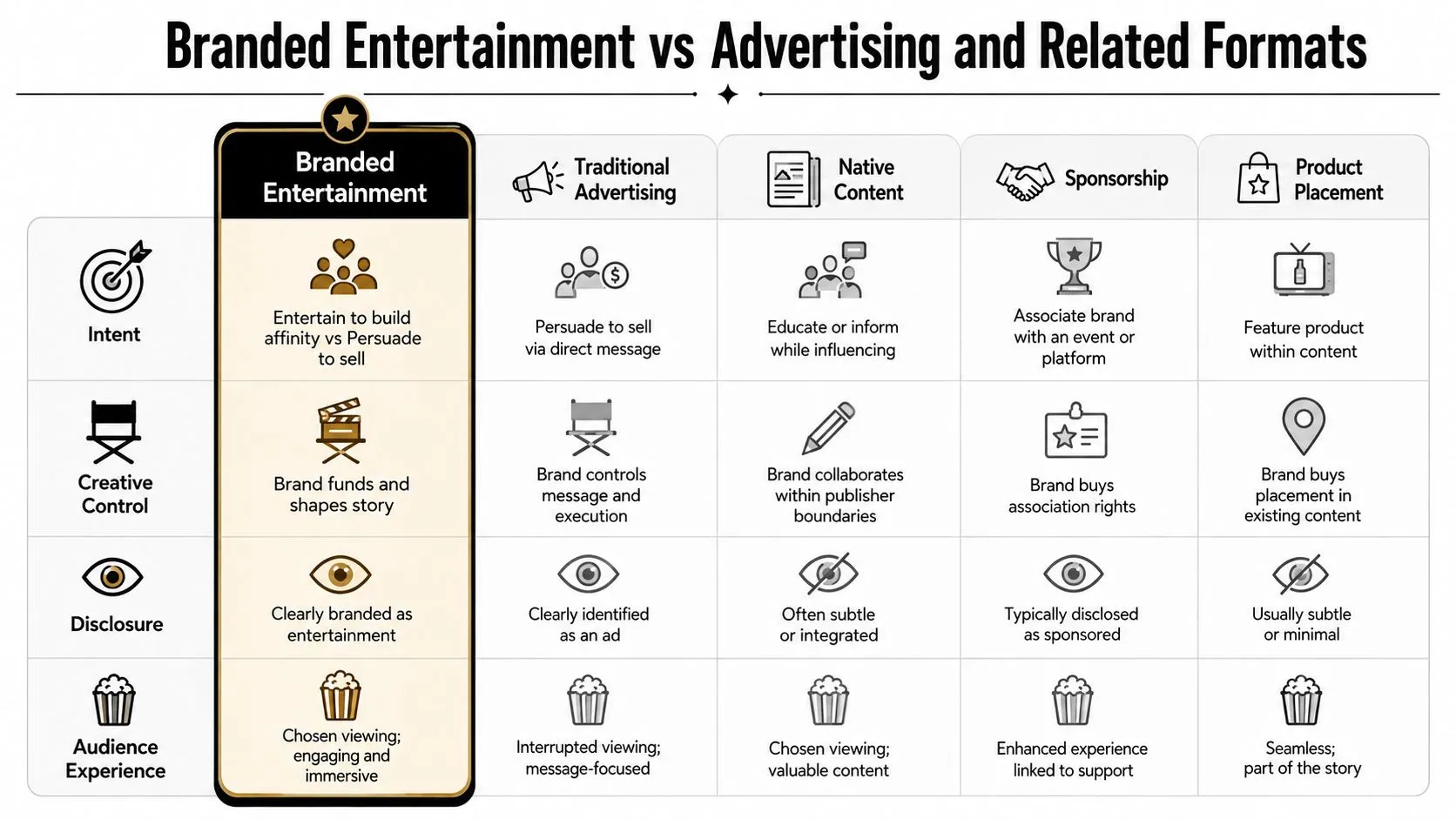
The confusion usually starts because several formats share the same ingredients: a brand, a creative idea, a distribution channel and a paid relationship. Their audience experience and creative purpose can be very different. Traditional advertising usually starts with a sales or awareness message and places it into bought media. A pre-roll, television spot or social ad asks the viewer to pause their intended activity. Branded entertainment starts with an experience the audience might actively choose, such as a series, film, animation, game or immersive installation. Native content is designed to look and feel like the surrounding publisher or platform content. It can be entertaining and useful, but the distinction from branded entertainment lies in emphasis. Native content describes how a piece fits its media environment. Branded entertainment describes a brand-funded entertainment experience and the role the brand plays in it. Sponsorship gives a brand association with an existing programme, event or property. The sponsor may receive naming rights, credits, signage or supporting content without controlling the core story. Product placement puts a product or brand inside independently created entertainment. The product may appear in a scene, but it doesn't necessarily fund or shape the whole experience.
| Format | Primary purpose | Brand control | Audience relationship |
|---|---|---|---|
| Branded entertainment | Create an entertaining experience that builds affinity | Brand funds and helps shape the work | Chosen viewing or participation |
| Traditional advertising | Deliver a persuasive message | Brand controls the creative and buys placement | Interrupted viewing |
| Native content | Fit a platform or publisher environment | Shared between brand and publisher or creator | Platform-native engagement |
| Sponsorship | Associate the brand with an existing property | Usually limited control over the core content | Association with a chosen property |
| Product placement | Show a product within entertainment | Control over placement and usage varies | Integrated exposure inside a story |
The formats aren't interchangeable. A sponsor may be appropriate when a brand wants association with a trusted event. Product placement may be enough when the product naturally belongs in the scene. Branded entertainment becomes the stronger candidate when the brand has a story, audience need or cultural role that deserves more space. For teams researching creator and publisher partnerships, SponsorRadar tracks brand deals across entertainment channels. That kind of market visibility can help a commissioner understand how sponsorship and branded integrations appear in practice, but it shouldn't replace a clear creative brief.
Popular Formats for Branded Entertainment from Screen to Immersive
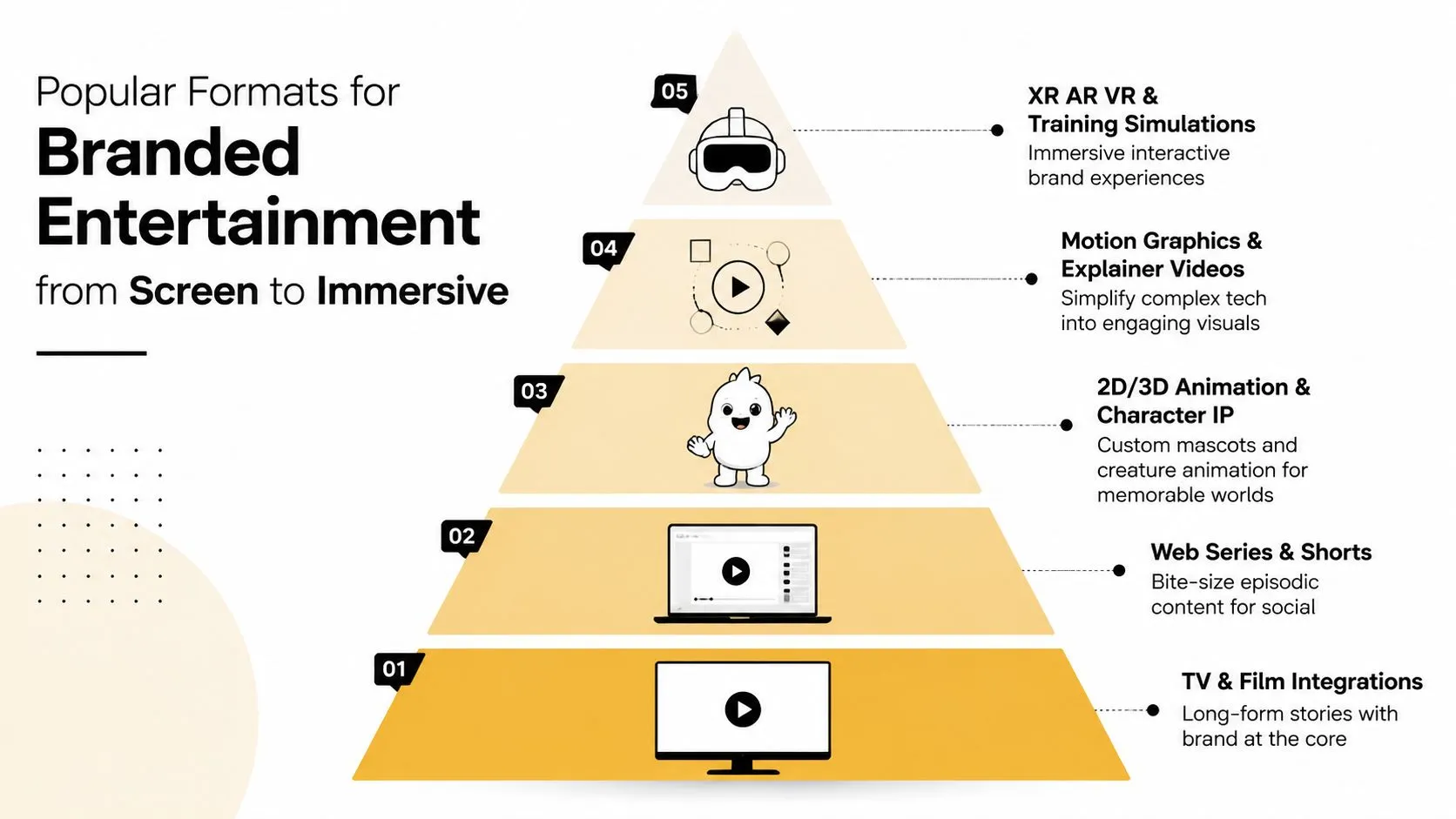
A useful way to choose a format is to ask what job the audience experience must perform. TV and film integrations suit brands that need cultural association, character-led storytelling or broad shared viewing. The brand might fund a programme, support a film or develop a meaningful role within a production. This route depends on editorial fit, rights, distribution and a level of patience that short campaign assets may not require. Web series and shorts give a brand a repeatable publishing rhythm. Short episodes can answer questions, develop a recurring character or explore a theme across social and video platforms. They work well when the concept has enough range to create several moments without making every instalment feel like a product demonstration. 2D and 3D animation can make an abstract proposition visible. A 2D character may simplify a service or create a distinctive social identity. 3D can build a richer world, product visualisation or creature performance. Animation also gives producers control over environments, tone and visual continuity, although the production plan must account for design, modelling, rigging, lighting and rendering. Motion graphics and explainers are particularly useful for complex technology, data or processes. They can turn an unfamiliar system into a visual metaphor, provided the script doesn't overload the frame with claims and labels. XR, AR, VR and games change the audience from viewer to participant. An augmented retail experience can reveal product information through a camera. A VR installation can create a guided journey. A game can make a brand value tangible through mechanics rather than explanation. Location-based work adds operational questions, including staffing, safety, reset time and the number of people who can experience it.
These formats can connect through transmedia storytelling. A character may begin in a film, continue in shorts, appear in an interactive installation and support a game. The platform shouldn't be chosen because it sounds advanced. Each extension needs a reason, a suitable interaction model and a route to the intended audience. For a clear introduction to that planning mindset, this guide to transmedia storytelling provides useful context. The same principle applies to film analysis and story development. A resource such as ShipTeaser's AI movie breakdown can help teams examine how a story is structured, where audiences might engage and which elements could carry into another format. The tool doesn't replace a treatment or production plan, but it can prompt better early questions.
Business Benefits and How to Measure Branded Entertainment Success
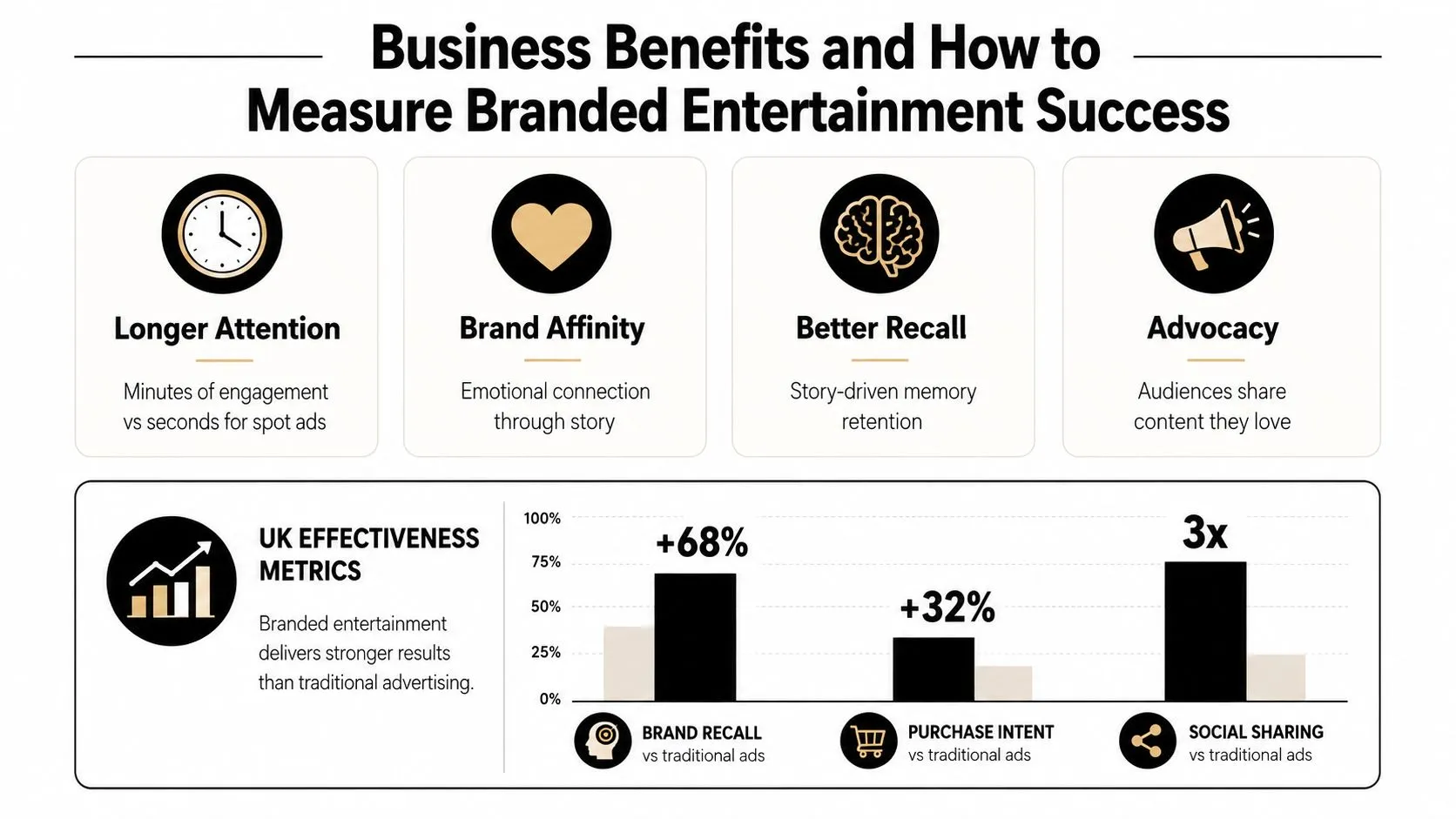
Branded entertainment earns its place in a marketing plan when the experience solves a communication problem that a short spot can't solve as effectively. A story can give a brand more room to establish tone, explain a complicated idea, create a character or invite participation. That doesn't mean longer content is automatically better. It means the audience needs a reason to spend more time with the message. The UK effectiveness evidence is unusually useful here. Channel 4's first UK study found that branded entertainment lifted brand perceptions by 29% versus a traditional spot ad, and 44% of viewers felt more positive about a brand after seeing it within a programme. The same study reported that six in ten viewers felt positive about the format, with particularly strong effects among younger audiences. These results support a practical decision rule: branded entertainment can be a strong option when the brand needs emotional association and the audience is receptive to a softer-sell experience. The Channel 4 study results provide the relevant UK evidence. That evidence doesn't promise a fixed return for every campaign. Format, audience fit, disclosure, distribution and execution still determine the outcome. A brilliant film aimed at the wrong audience can underperform, while a modest interactive demo may work well when the purchase journey depends on understanding.
Match the KPI to the audience job
Start with the intended change, then choose the measure.
- •Awareness: Track qualified reach, brand recognition and recall against a defined baseline.
- •Consideration: Measure perception, relevance, favourability and intent through research designed for the audience.
- •Engagement: Review watch time, completion, repeat visits, interaction depth and meaningful participation.
- •Advocacy: Look at shares, recommendations, earned discussion and the quality of audience response.
- •Action: Use trackable journeys, landing-page behaviour, enquiries or conversions where the experience has a direct response role.
A project designed to change perception shouldn't be judged only by clicks. A location-based game shouldn't be judged only by impressions. Measurement should reflect what the entertainment was commissioned to accomplish. Teams can also use analytics to understand where viewers leave, which scenes hold attention and which interactions cause confusion. Studio Liddell's analytics guidance on customer behaviour is relevant to that diagnostic stage. The producer and marketer should agree the baseline, audience definition, success measures and reporting method before production begins.
How to Commission and Produce Branded Entertainment That Delivers
A brief can approve a film before anyone knows why the audience should watch it. Start with the audience benefit, then define the business challenge, desired change, mandatory messages, distribution environments, brand constraints and success measures. “Make it entertaining” is not a production direction. A useful brief explains the experience the audience will choose and the role the brand can credibly play within it.
Build gates into the creative process
A disciplined animation, interactive or immersive project moves through decisions in sequence:
- Brief and discovery: Confirm the audience, objective, rights, platforms and practical constraints.
- Concept and treatment: Develop the central idea, tone, narrative shape and brand role.
- Styleframes and design: Set the visual language before the team builds the full world.
- Previz and animatic: Test camera, performance, pacing and duration with representative scenes.
- Production: Move into modelling, rigging, animation, lighting, rendering, development or capture.
- Compositing and post: Combine passes, sound, typography, colour and finishing.
- Quality assurance and delivery: Check content, accessibility, technical specifications, legal requirements and platform versions.
Treat compliance and delivery as creative requirements
UK audiovisual advertising operates through a co-regulatory system involving Ofcom and the ASA. Sponsorship, commercial references and on-demand services each affect how the brand appears, so disclosure belongs in the viewer journey rather than on a last-minute legal card. The UK policy analysis on branded content governance highlights disclosure problems in adjacent influencer formats, with only about 57% of UK influencer content considered likely to be adequately disclosed as advertising. It also notes that Ofcom's VSP regime was repealed in July 2025, with services moving under the Online Safety regime, while the ASA and Ofcom framework remains relevant to commercial references and product placement. For XR, games and location-based work, the same planning applies to interaction design, permissions, accessibility and platform behaviour. A clear immersive brand experiences strategy, tech and production can prevent the creative idea from outrunning the build, testing or compliance plan. Delivery specifications can shape the production setup from the start. UKTV guidance specifies 16:9 Full Height Anamorphic SD, safe versions in both 16:9 and 4:3 for overlaid elements, Targa graphics with 32-bit embedded alpha channels, and sequentially numbered Targa files for animated sequences. It also states that SD content files should be around 1.6 MB and HD content around 8 MB. Check the UKTV broadcast delivery guidance against the receiving broadcaster's current requirements before final export.Choosing the Right Branded Entertainment Partner and Next Steps
The right partner can explain the creative idea in audience terms and the production reality in practical terms. Look for evidence of storytelling craft, technical capability, IP experience, compliance awareness and distribution understanding. A studio that can pitch a striking concept but can't explain the animatic gate, delivery versions or rights position creates avoidable risk. Before a scoping call, prepare:- •The business objective: State the change you want the audience to make or feel.
- •The audience: Include age, context, platform behaviour and any accessibility needs.
- •The brand role: Explain what the brand can credibly contribute to the story.
- •The mandatories: List products, claims, visual rules, legal requirements and approvals.
- •The distribution plan: Identify broadcast, social, web, event, app or immersive destinations.
- •The success measures: Agree how you'll assess attention, perception, participation or action.
Studio Liddell has operated since 2019 and works across animation, games, TV advertising, multi-episode series and XR immersive experiences. Its stated production expertise includes 3D CGI film and television, 2D and 3D animation, XR design and development, virtual and immersive gaming, AI-enhanced production and IP development. That range is relevant when a branded idea needs to move from a film or character into an interactive or cross-platform experience. The memorable test remains simple. Don't ask only where the brand will appear. Ask why the audience would choose to spend time with the work. If the answer is clear, the format, production plan and measurement framework become much easier to shape. --- If you're developing a branded film, animated series, explainer or XR experience, Studio Liddell can help scope the idea from treatment and previz through production, post and delivery. Bring your audience, objective, mandatories and intended platforms to a production scoping conversation, and turn the brand message into an experience people have a reason to choose.