XR Development Company Guide: Services, Costs and Red Flags
An educator sees a VR training demo at an exhibition and leaves with a convincing question: could this work for our learners? A marketing lead sees an augmented product visualisation and needs something similar for a campaign. A product team watches a mixed-reality game attract a queue and suddenly has to find a partner capable of building the experience, testing it on real hardware, and supporting it after launch. That's where the phrase XR development company becomes difficult. It can describe a team making smartphone AR, a studio producing a VR short film, or a technical partner delivering a mixed-reality installation for a busy venue. The headset, phone or glasses are only the visible layer. Behind the demo sits a pipeline covering research, interaction design, 3D production, engineering, optimisation, testing, deployment and measurement. The right buying decision isn't about choosing the studio with the most impressive reel. It's about finding the team that understands your business outcome, can explain the technical trade-offs, and has a credible route from prototype to repeatable use. This guide looks at what XR companies do, how their production pipelines work, where immersive experiences create practical value, and which warning signs deserve attention before you approve a budget.
What an XR Development Company Actually Does
An XR development company is part animation studio, part games developer and part product consultancy. It combines visual storytelling with real-time software, interaction design and user research. That combination matters because an immersive experience can be beautiful and still fail if users don't understand what to do, the application drops frames, or staff can't deploy it reliably. Start with the three common formats:
- •Augmented reality, or AR, adds digital content to the physical world. A phone might show a 3D product on a retail counter, or a visitor might point a device at a museum object to reveal an animated layer.
- •Virtual reality, or VR, replaces the user's surroundings with a digital environment. A trainee can practise a procedure in a simulated workspace, while a viewer can enter a short film rather than watch it on a flat screen.
- •Mixed reality, or MR, combines digital content with physical surroundings in a way that lets users interact with both. An event game might map a room, place virtual targets within it and ask players to move through the surrounding space.
The distinction helps you define the brief, but it doesn't define the team. A capable studio may need Unity or Unreal Engine specialists, 3D artists, animators, interaction designers, spatial audio designers, UX researchers and production managers. For a training application, it may also need subject-matter experts and someone responsible for assessment logic. For a public installation, deployment planning and technical support can matter as much as the original creative concept.
The UK market has historically been built around specialist teams rather than only large technology corporations. Nesta estimated that the UK had approximately 1,000 immersive-specialist companies, employing around 4,500 people and generating approximately £660 million in annual sales by 2018, with activity potentially representing as much as 9% of the global immersive-technology market (Nesta's Immersive Economy research). Later written evidence submitted to Parliament reported more than 2,100 XR-technology companies, representing 83% growth over the preceding five years, with approximately 80% employing between one and nine people (the 2022 UK Immersive Economy Report). That structure has a practical consequence. You're often buying a compact, multidisciplinary team that can move quickly, but you need to check whether its reusable engineering assets, documentation and support model are mature enough for your project. If you're exploring physical-world scanning or spatial capture, a resource such as mastering iPhone lidar sensors can also help your team understand the input data before discussing production requirements. Studio Liddell's VR and AR development service is one example of a production offer that sits across creative development and interactive technology.
Services and the Production Pipeline from Concept to Launch
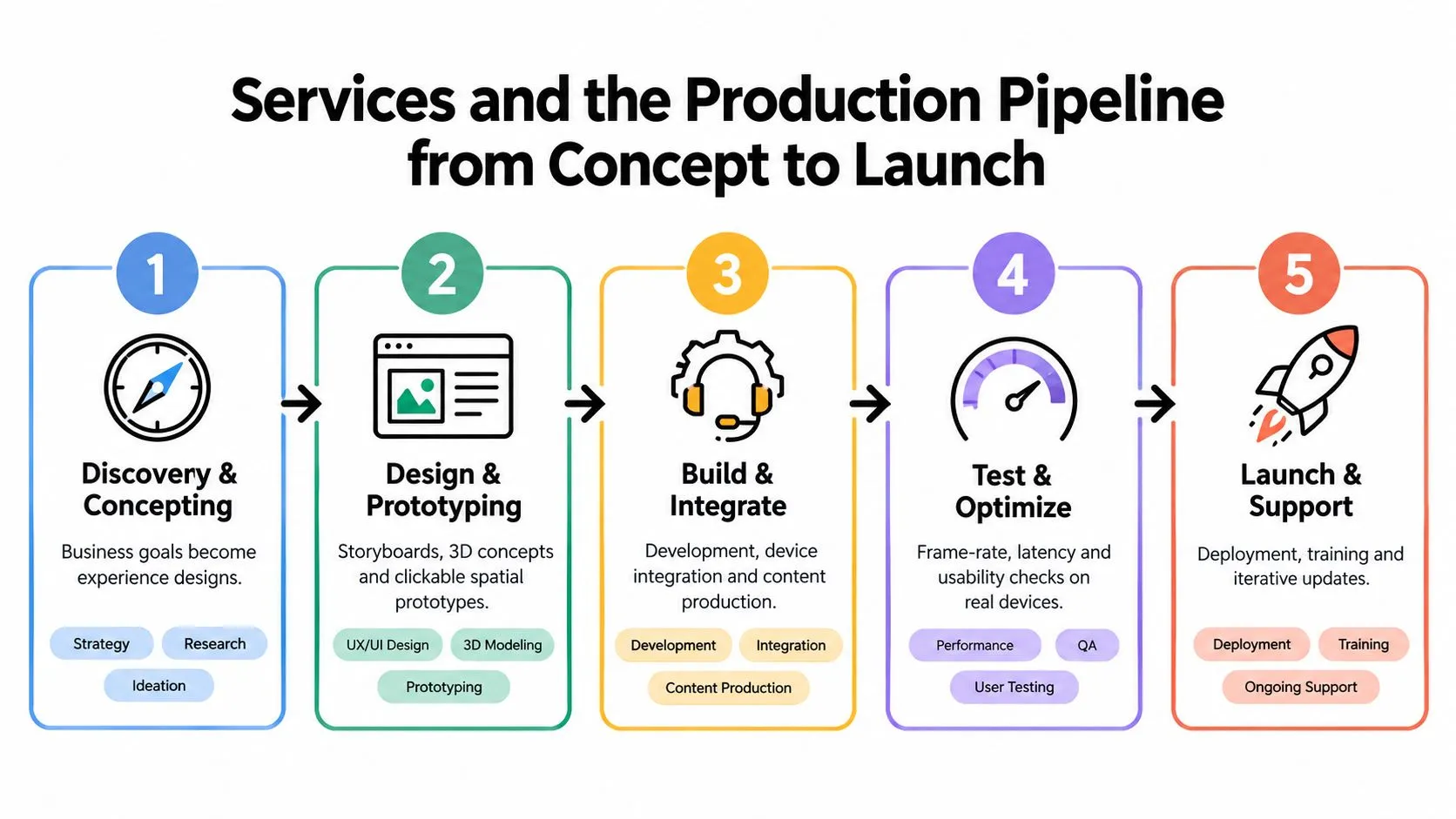
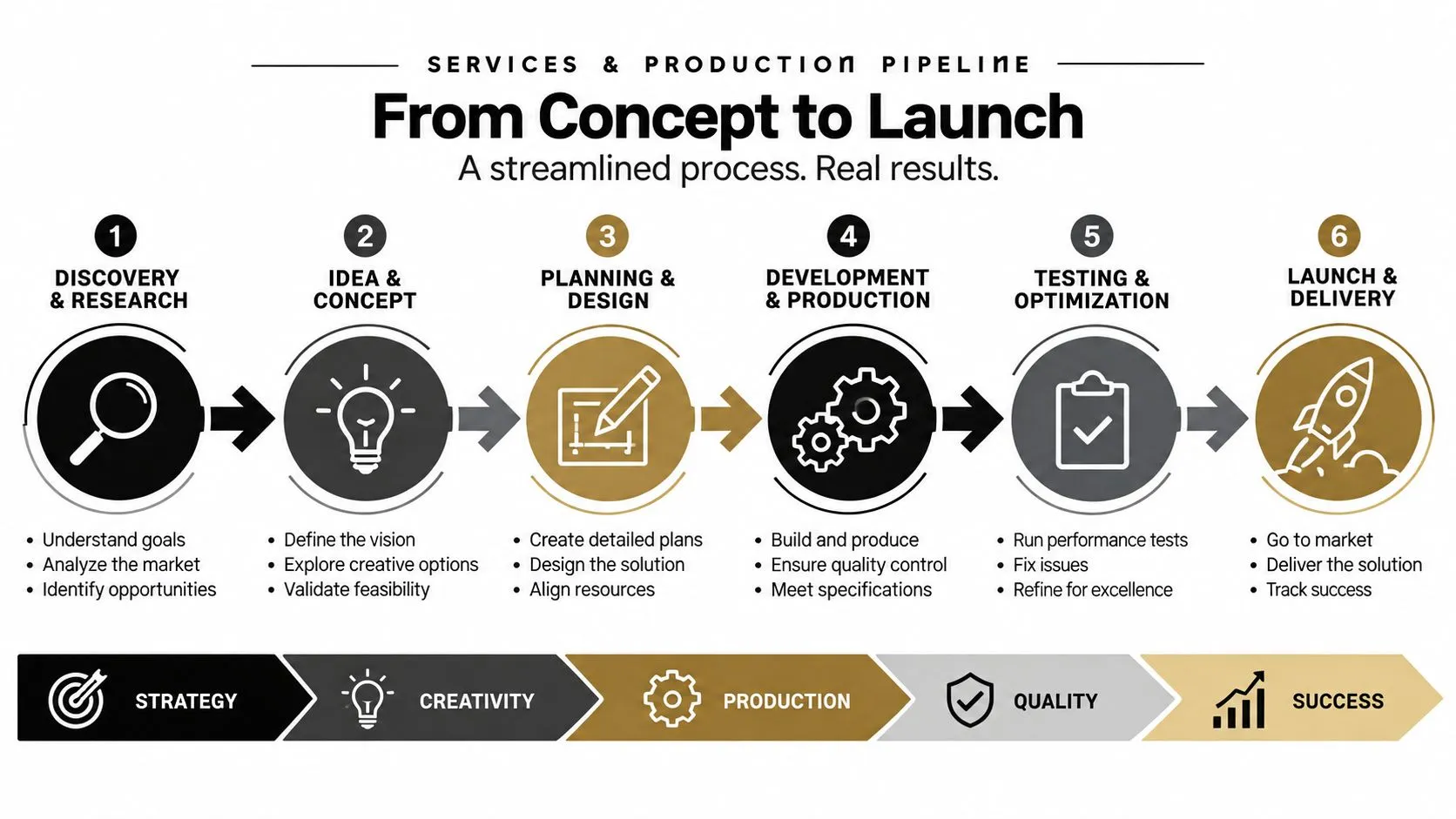
A demo tells you what a studio has made. A pipeline tells you whether it can make your project. The first stage is discovery and concepting. The team clarifies the audience, business objective, physical setting, target devices, content requirements and success measures. A good workshop should expose constraints early. A retail AR experience has different needs from a headset-based training simulation, even if both involve a 3D model.
From brief to working prototype
Pre-production turns the brief into something people can test. Storyboards describe the user journey, while previz establishes camera movement, interaction beats, scale and pacing. In XR, the team should test the interaction model early because a gesture that looks obvious in a storyboard may be awkward when a user is wearing a headset or holding a phone. Asset production follows. Artists create or adapt models, textures, animation, environments and interface elements. Engineers build the real-time application in Unity, Unreal Engine or another suitable environment, then connect the assets to interactions, spatial audio, tracking and data systems.
Practical rule: Ask to see the first meaningful prototype, not just the final render. Early testing reveals whether the experience is understandable before the team has spent heavily on polish.
Optimisation is part of the creative work
A beautiful scene that drops frames damages comfort and immersion. The production team should profile performance on the target devices, not only on a powerful development workstation. That means checking geometry, texture memory, lighting, shaders, draw calls, loading behaviour, tracking stability and thermal performance. For cross-device work, ask how the studio handles input abstraction, scene architecture and build automation. Reusable Unity or Unreal templates, modular interaction systems and documented deployment procedures can reduce duplicated work when an experience moves between devices or venues. An explanation of AR app costs for UK businesses can help frame the wider cost conversation, but a credible quotation should still be based on your audience, content volume, hardware and support requirements. Testing should include representative users and real operating conditions. An exhibition build needs checks for queues, lighting, staff resets and network interruptions. An app-store release needs installation, permissions, analytics and update procedures. A location-based experience needs safety checks, hygiene processes and a plan for recovering from a failed session. Before launch, agree what you receive. The handover may include source projects, build pipelines, device builds, content files, deployment documentation, analytics configuration and training for staff. AI-enhanced production can help with selected tasks, and reusable assets can shorten some stages, but neither replaces creative direction, technical review or testing with real users.
Business Use Cases Where XR Delivers
The most useful way to assess XR is by the job it performs, not by the device it uses. A headset isn't a business case. A safer rehearsal, more engaging product demonstration or more efficient visitor journey might be.
| Use case | Typical format | What to measure |
|---|---|---|
| Workforce training | VR simulation or AR guidance | Completion accuracy, error rate, time-on-task and real-world transfer |
| Marketing and branded experiences | AR product visualisation, interactive film or MR activation | Engagement quality, participation, dwell time and qualified follow-up |
| Exhibitions and retail | Phone AR, spatial configurator or interactive installation | Stand dwell time, interaction completion and visitor feedback |
| Cultural experiences | Location-aware AR, projection or VR interpretation | Visitor flow, content completion and accessibility feedback |
| Entertainment | VR short, mixed-reality game or interactive children's content | Session completion, player throughput, repeat participation and audience response |
Training is a strong fit when real-world rehearsal is expensive, risky or difficult to organise. A care provider might let staff practise a hygiene procedure in a repeatable simulation. An energy company could use animated technical visuals and interactive models to explain complex systems to stakeholders. In both cases, the team should define the behaviour the user must perform, then build interactions and feedback around that behaviour. Marketing works when the audience has a reason to participate. An AR product configurator can let a customer explore finishes or components. A branded entertainment experience can place characters and products inside a story rather than interrupting one. Channel 4 research reported that branded entertainment increased brand perceptions by 29% compared with a traditional spot advertisement, while 44% of viewers said they felt more positive about a brand after seeing it integrated into a programme (Studio Liddell's summary of the branded entertainment research). Exhibitions create a different operational challenge. A visually rich installation that serves only one person at a time may attract attention but produce a queue. The producer must design for reset speed, staff confidence, shared-device hygiene and clear alternatives for visitors who can't or won't use a headset. Entertainment projects need a strong game or story loop. A VR short depends on direction, performance and spatial sound. A mixed-reality event game depends on throughput, safety and simple instructions. Children's IP adds age-appropriate interaction, safeguarding, licensing and platform planning to the production brief.
Proving Value Beyond the Demo
The biggest barrier to XR adoption is often not technical quality. It's the lack of a credible route from an impressive prototype to a measurable, repeatable deployment. Define the outcome before production starts. For training, useful measures may include completion accuracy, error rate, time-on-task, retention and real-world transfer. For a visitor experience, dwell time and content completion may be more relevant. For an event game, the producer needs to understand how many people can play, how quickly staff can reset the experience and where users abandon the interaction. A UK multi-site care-home study illustrates why this distinction matters. Participants gave smartphone AR a System Usability Scale score of 77.89 and immersive VR a score of 84.40, while 95% supported further use. Hand-hygiene technique scores rose from 4.77 out of 11 before training to 7.23 afterward, although average knowledge-test performance increased by only 6% (the Bath study preprint on AR technology for co-creative design). The lesson isn't that every XR training programme will produce the same result. It's that high usability and stronger procedural performance don't automatically mean stronger factual recall. The application must be designed around the task, with feedback timing, affordances, assessment logic and repetition working together.
A successful pilot should answer what users can do better, not only whether they enjoyed wearing the headset.
Deployment is part of the evidence
Accessibility and operations need to enter the brief early. A school, museum or public body may need a headset-optional route, alternative interaction modes, support for users affected by motion sickness, clear safeguarding procedures and staff training. Shared hardware introduces cleaning, charging, storage and reset requirements. The Ada Lovelace Institute identifies financial and digital-access barriers, hardware usability problems and accessibility shortcomings as constraints on immersive adoption (its Reality Check report). A UK XR healthcare mapping study also identified fragmented evidence generation, procurement difficulties, regulatory uncertainty and unsustainable funding models as barriers, while reporting that universities use XR more widely than NHS Trusts (the UK XR healthcare landscape mapping report). Ask the prospective partner for a pilot measurement plan. It should name the baseline, the users, the tasks, the collection method, the privacy controls, the review point and the decision criteria for continuing. Without that plan, you're funding a demonstration rather than testing a business proposition.
Red Flags When Choosing an XR Partner
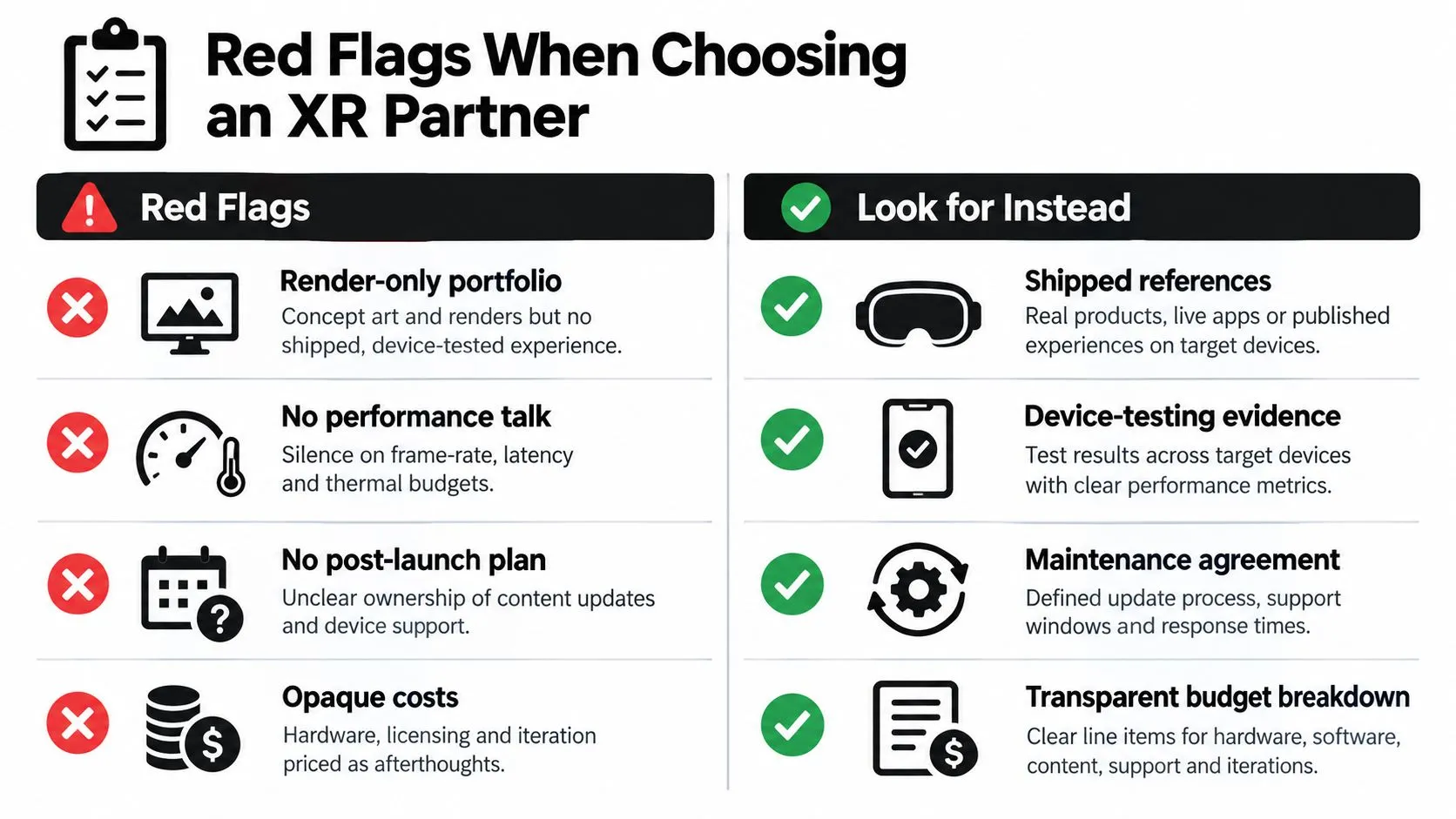
A polished headset demo can hide an untested production process. Before choosing an XR development company, ask whether the team can ship your content, support the intended devices and work through your organisation's approvals. Review the portfolio for launched projects, not only concept art, renders and festival clips. Ask to see work tested on comparable hardware, then request a walkthrough of what happened after release: updates, bug fixes, content changes, analytics and support ownership. A studio should be able to explain the pipeline from prototype to maintained deployment, rather than present a one-off vendor deliverable. Use the technical conversation to expose gaps:
- •No performance targets: Ask how the team will set frame-rate, latency, loading and thermal requirements for every target headset or phone.
- •No optimisation evidence: Request profiling examples, device test plans and a clear process for reducing asset or rendering overhead.
- •No post-launch plan: Establish who handles operating-system changes, hardware replacement, content updates, analytics and venue support.
- •Opaque costs: Require separate visibility for discovery, content creation, engineering, hardware, licensing, testing, travel and iteration.
- •Unclear ownership: Confirm who owns source files, project repositories, models, code, music, recordings and final intellectual property.
- •A quote that skips discovery: A fixed price based on an untested idea can create change requests later. Ask which assumptions the quote contains.
- •Narrow production experience: A team with no evidence across apps, games, animation, broadcast or live delivery may struggle when the project changes shape.
- •No accessibility discussion: Ask how the experience serves people who cannot wear a headset, have different mobility needs or require alternative sensory cues.
- •No deployment documentation: Check whether staff receive installation instructions, recovery procedures, training and a clear escalation route.
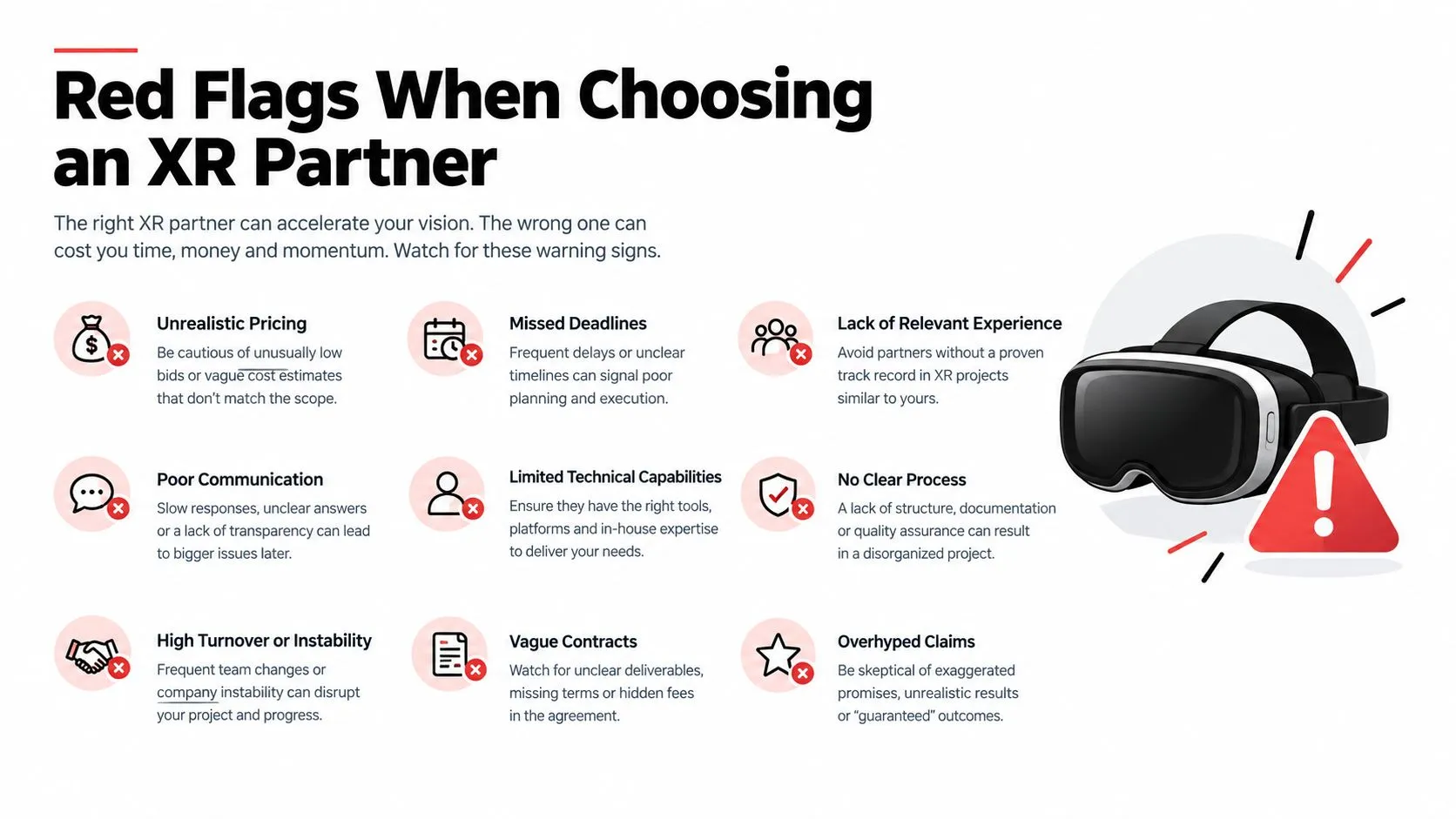
The useful test is whether the producer can explain trade-offs when a feature threatens performance, budget, accessibility or schedule. This practical guide to choosing a VR game development company provides useful context, but your due diligence should still include references, a written scope and a technical review of the proposed delivery route. Ask directly: “Show us the point in your process where a real user, on real hardware, can prove that the experience works.”
Why Studio Liddell and Your Next Step
Studio Liddell applies the criteria above across animation, games, TV, apps and XR. It's a full-service creative digital production company whose work has been watched and played by millions of people globally, with clients including Sky Kids, BBC, Nat Geo from Disney, Merck, Manchester United, Historic Scotland and TT Games. The range of work matters because XR projects rarely stay inside one discipline. Dance! Dance! Dance! demonstrates the demands of a high-throughput mixed-reality event game. Aurora represents the creative and technical requirements of an award-calibre VR short, including direction, performance and spatial presentation. BooSnoo for Sky Kids shows how a children's IP can move from series production into digital shorts. GeoEnergy NI applies animation and visual communication to complex technical subject matter. That portfolio gives a buyer more to examine than device compatibility. Ask how the team moves from concept to previz, how it manages Unity and Unreal development, how artists and engineers share assets, how user testing informs iteration, and what documentation supports launch. The multidisciplinary model is the operational backbone, particularly when a brief combines real-time interaction, animation, branded storytelling and institutional deployment. The next step doesn't need to be a fully formed specification. Bring the audience, the business problem, the intended setting and the outcome you want to test. A focused discovery conversation can identify whether AR, VR, MR, animation or a combination of formats gives you the most practical route forward. --- Studio Liddell offers animation, games, apps and XR production with Unity and Unreal expertise, supporting projects from early concept and previz through build, testing and delivery. If you're assessing an XR development company, visit Studio Liddell to start a conversation about your audience, deployment requirements and measurable project goals.