How to Choose the Right VR Game Development Company for Your Project
Choosing the right VR game development company is impossible if you don’t have a clear vision for what you want to build. A vague idea won’t suffice; you need a concrete plan linked to specific business objectives. This initial planning stage is the single most critical phase of the entire process. Nailing this ensures your project stays on schedule, adheres to the budget, and successfully meets its goals.
Define Your Vision Before You Build
Before you begin your search for partners, you must look inward. A comprehensive project brief will be your guiding star, influencing every decision from the technology stack to the user experience design. It's the essential document that transforms a compelling concept into a buildable reality. This isn't just about listing exciting features. It’s a strategic exercise that connects your VR experience directly to tangible business outcomes. Skipping this step sets you up for miscommunication with developers, costly revisions, and a final product that fails to make an impact.
Start with Your Core Objectives
First, what is the primary goal of this VR project? Your answer will shape every subsequent step. Are you trying to:
- •Create a Training Simulation? Your objective might be to reduce workplace accidents by 15% or improve employee certification pass rates. Success is measured by safety metrics and knowledge retention.
- •Develop a Marketing Experience? The goal could be to increase brand engagement at a trade show or generate more qualified leads. Success is tracked through user dwell time, social shares, and lead capture rates.
- •Build a Location-Based VR (LBVR) Game? In this scenario, commercial performance is key. Success is measured by player throughput, revenue per session, and customer return rates.
Defining your core objective helps you prioritise what’s essential and eliminate distractions. Before starting your search for a VR partner, it’s wise to understand the market; reviewing the latest metaverse statistics can offer valuable insights into current trends.
Outline the User Journey and Key Features
Once you understand why you are building this, you can define the what. Map out the ideal user journey from the moment they put on the headset. What should they see? What actions will they take? How should they feel at each stage? This narrative approach simplifies the identification of core features necessary for the experience to succeed.
A detailed project brief doesn’t stifle creativity; it provides a clear framework. It empowers a skilled VR game development company to propose effective solutions, provide accurate quotes, and deliver a final product that perfectly aligns with your vision.
A clear brief not only attracts the right talent but also establishes the foundation for a smooth and successful partnership. For more guidance on this crucial first step, our guide on choosing application development service partners can help. Now that you have a solid brief, it’s time to distinguish the contenders from the pretenders. A studio's portfolio is your first and most important evaluation tool. It's more than a gallery of visuals; it's concrete evidence of their capabilities, creative style, and technical proficiency. But don’t be swayed by aesthetics alone. An impressive cinematic VR film doesn’t guarantee that a studio can develop a fast-paced, high-throughput arcade game. Your goal is to find a VR game development company whose portfolio demonstrates they have solved challenges similar to yours.
Do They Have the Right Platform Experience?
The target hardware fundamentally shapes the entire project. There is a significant difference between developing for a high-end, PC-powered Valve Index and a standalone headset like the Meta Quest 3. The technical challenges are entirely distinct. As you review their past work, look for specific experience on your chosen platform:
- •Standalone VR (e.g., Meta Quest 2/3): For these devices, optimisation is paramount. Their limited processing power requires a studio skilled at maximising performance. Look for projects that maintain a high, smooth frame rate without significant visual compromise.
- •PC VR (Valve Index, HTC Vive): This is where graphical boundaries can be pushed. You should expect to see high-fidelity graphics, complex physics, and visually rich environments. Does their portfolio demonstrate an ability to deliver stunning, graphically intense experiences?
- •Console VR (PlayStation VR2): Developing for a console requires navigating strict certification processes (like Sony’s) and leveraging unique hardware features, such as eye-tracking and advanced haptics. This demands a very specific skill set.
Look for Sector-Specific Smarts and a Good Creative Vibe
Technical skill is only half the equation; relevant industry experience is the other. A team that has built medical training simulations will inherently understand the need for precision and user assessment. Conversely, a studio specialising in marketing activations will know how to create short, impactful, attention-grabbing experiences. This is particularly important now. The UK virtual reality gaming market is poised for explosive growth, projected to reach between USD 4.08 billion and USD 6.0 billion by the early 2030s, driven by both consumer and enterprise applications. A studio with a foothold in your sector is better positioned to deliver. While reviewing their work, ask yourself:
- •Does their art style align with our brand identity?
- •Have they designed user interfaces that our target audience would find intuitive?
- •Do their case studies show they understood the business goals behind the project, not just the technical requirements?
A great portfolio doesn't just show you what a studio built. It tells you why they built it that way and what results it actually delivered. Hunt for case studies that walk you through the initial problem, their process, and the tangible outcomes.
When evaluating a VR studio's past projects, check if they have experience creating other types of immersive content, such as virtual tour development. Exploring a diverse collection of projects, like those in our work portfolio, is an excellent way to assess a studio's versatility and creative capabilities.
Assessing Technical Capabilities and Development Workflows
After reviewing a studio's portfolio, it's time to examine their technical skills and production processes. A beautiful VR experience is useless if it's buggy, performs poorly, or is built on an unstable foundation. Understanding how a VR game development company operates is crucial to ensuring your project is stable, scalable, and delivered without unexpected issues. Early technical decisions have a lasting impact on the entire project. Choices regarding the game engine, asset creation pipeline, and optimisation strategies are not just technical jargon; they directly affect your budget, timeline, and the quality of the final user experience. A team that has mastered these elements can build fluid, responsive worlds, while a less experienced one will deliver a project plagued by glitches and inconsistent frame rates.
Unity vs Unreal: The Great Engine Debate
The two giants of real-time development are Unity and Unreal Engine, and most studios specialise in one. Neither is universally superior; they simply have different strengths suited to different types of VR projects. Your choice of partner may depend on which engine aligns with your vision.
- •Unity: Praised for its flexibility and excellent support across a wide range of platforms, particularly standalone headsets like the Meta Quest. It excels in creating stylised, performant experiences and is a popular choice for mobile VR, interactive training, and games that don't require photorealistic graphics. To learn more about its capabilities, you can explore Unity VR development for immersive experiences.
- •Unreal Engine: Renowned for its stunning graphical power. If your project demands hyper-realistic visuals, such as architectural visualisations, high-fidelity simulators, or AAA-quality games, Unreal is often the preferred engine. Achieving this level of visual fidelity, however, requires a highly skilled team and powerful hardware.
This diagram helps visualise how these choices fit into the broader evaluation process, breaking down the core areas to consider.
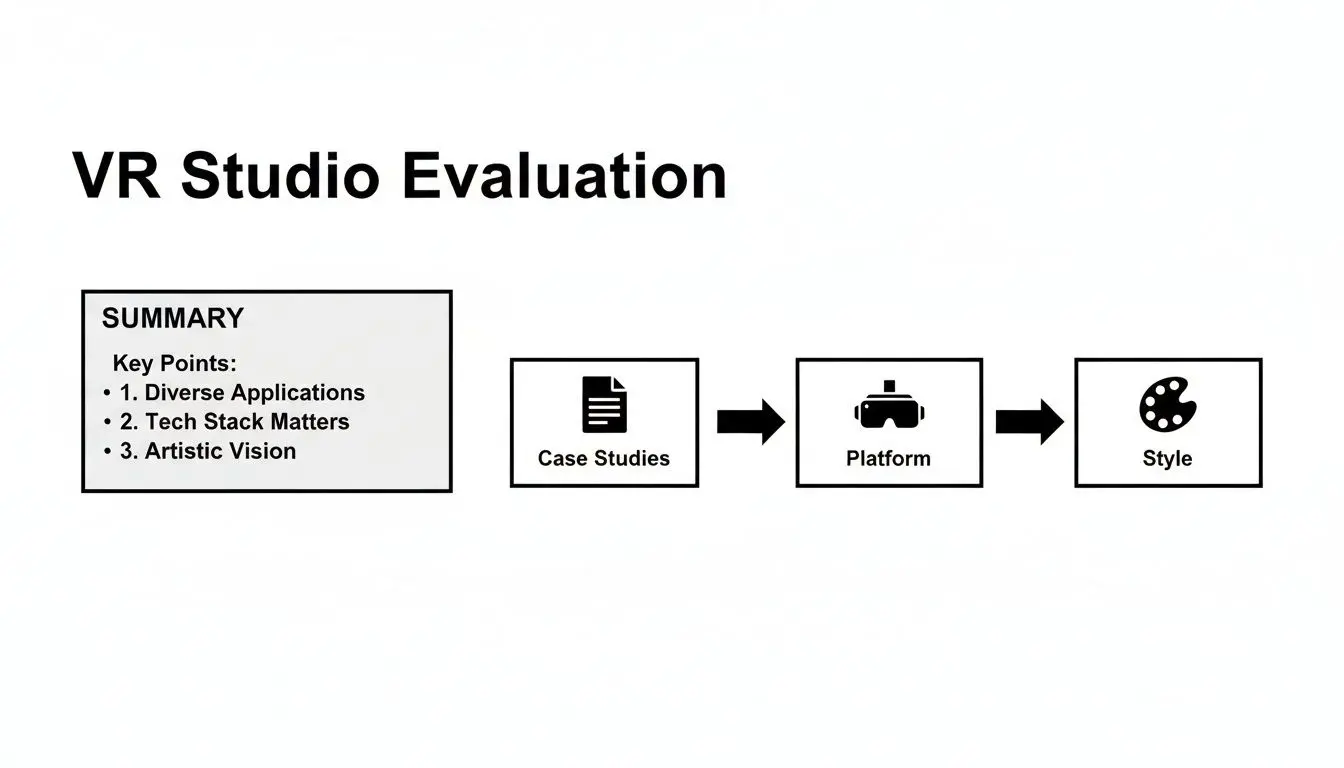
It serves as a reminder that a thorough evaluation considers everything together, proven work, technical expertise, and a creative style that resonates with your own. Here is a quick comparison of the two leading engines.
Unity vs Unreal Engine for VR Development
| Factor | Unity | Unreal Engine |
|---|---|---|
| Visual Fidelity | Strong, especially for stylised graphics. Capable of realism but requires more effort. | World-class, out-of-the-box photorealism and advanced lighting effects. |
| Platform Support | Excellent, particularly for mobile and standalone VR headsets like Meta Quest. | Very good, but can be more demanding on hardware, making it better suited for PC VR. |
| Ease of Use | Generally considered more beginner-friendly with a large asset store for rapid prototyping. | Steeper learning curve but offers powerful tools like Blueprints for visual scripting. |
| Best For... | Mobile VR, interactive apps, training simulations, stylised games. | High-end architectural visualisation, realistic simulators, AAA-quality games. |
Ultimately, the "right" engine depends on your project's goals. A reputable studio will explain why their chosen engine is the best fit for your objectives.
Key Technical Questions to Ask
When engaging with a potential partner, you must delve into their technical expertise. Their answers will reveal much about their experience and whether their workflow aligns with your needs. Don't hesitate to be specific.
A professional VR game development company will welcome detailed technical questions. It demonstrates that you are a serious client and helps them better understand your project's requirements. Vague answers or a reluctance to discuss processes should be seen as a red flag.
Here are a few essential questions to start the conversation:
- How do you approach performance optimisation for our target hardware (e.g., Meta Quest 3)? Listen for terms like draw call reduction, texture compression, and polygon count management. This indicates they know how to ensure smooth performance on less powerful devices.
- Can you walk me through your 3D asset creation and integration pipeline? This reveals how they manage the journey from a 3D model to the game engine, a critical part of the workflow. An efficient process saves time and prevents complications.
- What does your QA testing and bug tracking process look like for VR? You want to hear about a structured approach. Do they have dedicated testers? Do they use a system to report and track bugs? This is a sign of a mature studio.
- How do you handle version control and collaboration on a project of this scale? They should mention tools like Git or Perforce, which are industry standards for professional teams working on complex codebases.
Getting to Grips with Pricing, Timelines, and Contracts
Let's discuss the practicalities: money, deadlines, and legal agreements. Clarifying these details from the outset is what separates a smooth partnership from a project plagued by scope creep, budget overruns, and disagreements. A clear contract serves as the foundation for your entire working relationship. Most studios use one of two pricing models. Determining which one suits your project is the first step.Common Ways Studios Charge for Work
- •Fixed-Price Contract: This involves a single, total cost for the entire project. It works well for tightly defined projects, like a specific training module or a self-contained marketing experience. The main advantage is budget predictability, but it offers little flexibility for changes once the scope is set.
- •Time and Materials (T&M): With this model, you pay for the actual hours the team works, plus any direct costs like software licenses or assets. It is far more flexible, making it ideal for ambitious VR games or projects where the scope is expected to evolve. It allows for iteration and experimentation, but requires careful budget monitoring.
When negotiating, remember that a contract is more than just a price. It's the rulebook for your partnership. A good agreement will clearly outline payment milestones, deliverables, timelines, and the process for handling changes. It’s designed to protect both you and the studio.
How Long Will It Actually Take?
Project timelines can vary significantly depending on the complexity of your vision. It is essential to have realistic expectations. A simple interactive demo or proof-of-concept might be completed in 6-10 weeks. A more complex corporate training simulation is likely to take 4-6 months. A full-scale commercial VR game with intricate mechanics could easily take a year or more to develop.
The Must-Haves in Your Contract
Your development agreement must be comprehensive. Ensure these critical points are clearly covered:
- •Intellectual Property (IP) Ownership: This clause must state unequivocally who owns what. Typically, the client owns the IP of the final, delivered product, while the studio retains ownership of its underlying code and tools.
- •Payment Schedule: This breaks down the total cost into payments tied to specific project milestones, such as contract signing, prototype approval, alpha build, and final delivery.
- •Scope of Work (SoW): This document is your project's blueprint. It should detail every feature, asset, and deliverable with as much specificity as possible.
- •Post-Launch Support: The contract should define the terms for bug fixes, updates, or ongoing maintenance after launch, often handled through a separate support package or retainer.
The demand for high-quality VR is surging. The UK VR gaming sector is a significant growth area, with some forecasts predicting a 28% CAGR in revenue through 2027. This boom makes it even more critical to establish a strong, clear contractual relationship. You can find more insights on UK gaming market growth on marketdataforecast.com.
Asking the Right Questions to Find the Best Fit

You've reviewed portfolios, analysed their tech stack, and examined the contracts. Now it's time for the human element. This final stage is less about technical specifications and more about finding a team you can genuinely connect with. A strong working relationship, built on clear and honest communication, is paramount. This is your opportunity to look beyond the sales pitch and understand how they truly operate. You need to assess their project management style, how they handle feedback, and what happens when challenges arise.
Probing Project Management and Communication Styles
A studio's project management approach reflects its professionalism. A disorganised workflow can lead to missed deadlines and frustration. During a discovery call, your questions should aim to uncover how they keep projects on track. It's vital to know how they will keep you informed. Will it be weekly check-ins? A shared project board? Regular builds for review? Clarifying this from the start eliminates guesswork later. Here are a few key questions to ask:
- •Who will be my main point of contact? Knowing whether you'll have a dedicated project manager or communicate directly with developers is important.
- •What project management tools do you use (e.g., Jira, Asana, Trello)? Familiarity with tools like Jira or Asana indicates a structured, professional process.
- •How often can we expect updates and progress builds? This establishes a rhythm for collaboration and ensures you are always aware of the project's status.
- •What’s your process for handling feedback and revisions? A good partner will have a clear system for collecting, discussing, and implementing your feedback.
This conversation is about ensuring their workflow is compatible with your own team's operational style.
Gauging Their Approach to Collaboration and Scope Changes
No project plan is completely immune to change. A new idea might emerge, or a technical challenge could require a different approach. What truly matters is how a VR game development company manages these shifts. You are looking for a partner, not just an order-taker. A top-tier studio will be transparent about how changes will affect the timeline and budget. They should have a clear process for evaluating and approving scope adjustments to avoid surprises.
A studio’s reaction to questions about scope changes speaks volumes. A collaborative partner will see it as an opportunity to find the best solution together, while a less flexible one might see it only as a contractual problem.
The UK's VR software market is growing rapidly, with revenue expected to reach around US$194.3 million in 2025, driven by hardware like the Meta Quest. This growth requires studios to be agile. You can explore the data on the UK's VR software market growth on statista.com.
Confirming Team Structure and Access
Finally, get a clear picture of the team that will bring your project to life. Will it be a small, dedicated crew or a larger group with rotating members? Crucially, will you have direct access to the artists and developers? Even occasional access to creative and technical talent can be invaluable for resolving issues quickly. Ask them to introduce the key people who would be assigned to your project. This simple request helps you move from evaluating a faceless company to understanding the individuals you will be collaborating with.
Answering Your Questions About Hiring a VR Company
Embarking on VR development raises numerous questions, particularly regarding budget, timelines, and legalities. To provide clarity, we have compiled answers to the most common questions from businesses seeking to partner with a VR game development company. Addressing these early on ensures a much smoother project for everyone involved. Let's begin with the most common question: budget.
How Much Does VR Development Cost?
The cost of a VR project is directly related to its complexity and target platforms. There is no one-size-fits-all price. To provide a general idea, here are some typical budget ranges:
- •Simple Interactive Apps: For a basic 360-degree video tour or a simple product visualiser, you can generally expect costs between £20,000 and £50,000.
- •Complex Games & Simulations: For a commercial game with extensive features or a detailed training simulation with custom functionalities, the starting point is typically around £100,000 and can increase significantly from there.
The most effective way to get an accurate figure is to provide a detailed brief to a potential studio, allowing them to fully understand your vision and provide a precise quote.
What’s a Realistic Timeline for a VR Project?
Similar to cost, the timeline depends entirely on the project's scope. Smaller, more contained projects will naturally have a faster turnaround than large-scale games. A simple proof-of-concept could be ready in just 4-8 weeks. A standard corporate training module typically takes between 3-6 months from initial design to final deployment. For a full-scale commercial VR game, you should plan for a development cycle of at least a year, and often longer.
Before any code is written, it's crucial to be clear on who owns the final product. This is one of the most important clauses in your contract and is vital for protecting your investment.
Who Owns the Intellectual Property?
This is a critical point that must be explicitly defined in your contract. Typically, the client who funds the project owns the intellectual property (IP) of the final, delivered application. However, the development studio usually retains ownership of its underlying code, proprietary tools, and established workflows. This is standard practice, but it should always be confirmed in writing before signing any agreement. Finally, remember that your team plays a significant role in the process. You should expect to be involved in initial discovery workshops, regular check-ins, and key milestone reviews. The most successful projects occur when there is a dedicated point of contact on your side who can consolidate feedback and facilitate communication, ensuring the project moves forward smoothly and avoids costly delays. At Studio Liddell, we bring years of experience to every VR project, ensuring clarity and quality from concept to launch. Get in touch to discuss your project.