What Is Immersive Experience Design a Practical Guide
Immersive experience design is the practice of creating multi-sensory, interactive environments across XR, AR and VR that move audiences from passive viewing to active participation. In the UK, the market was estimated at £2.9 billion in 2024 and £3.6 billion in 2026, with 2,450 immersive technology businesses in 2026, according to IBISWorld's UK immersive technology analysis. You may be a brand manager who's just been pitched a VR launch, an AR retail installation or a mixed-reality game for an event. The deck looks polished, the language is confident, and the promised “wow factor” sounds appealing. Yet you're left with a practical question: what are you buying, and how will anyone know whether it worked?
A Working Definition of Immersive Experience Design
Start with the familiar meaning of an experience. A product launch, training day or theme-park ride has a beginning, a middle and an end. People arrive with expectations, move through a sequence of moments, make choices and leave with some form of memory or outcome. An experience becomes immersive when the audience isn't only watching. Their body, attention and decisions become part of the system. A visitor might walk around a virtual product, use a phone to reveal an AR layer over a physical object, or choose a route through a mixed-reality story. Multi-sensory design can involve sight and sound, while interactive design gives the participant meaningful agency and embodied behaviour makes movement, position or gesture part of the experience. That leads to a useful working definition:
Immersive experience design is the practice of designing multi-sensory, interactive environments across XR, AR and VR that move audiences from passive viewing to active participation.
The definition matters because “immersive” is often used as a synonym for impressive visuals. A photoreal environment can still feel empty if the participant has no clear objective, receives poor feedback or can't understand what to do next. A simpler experience can feel more involving when its story, interaction and sensory cues work together.
The business test
Brands rarely measure immersion as an abstract feeling. They look at dwell time, recall, completion rate, behavioural change, sharing and conversion, depending on the brief. A training simulation might need to show whether learners complete a scenario and apply the correct procedure. A product reveal might focus on attention, understanding and later action. An entertainment installation may prioritise repeat visits, session flow and audience throughput. This is why immersive work resembles a complete design thinking process from start to finish, rather than a visual concept exercise. You need to understand the audience, define the problem, test assumptions and refine the result. For a broader look at how spatial layout affects movement, attention and interaction, see this guide to spatial design, UX, VR and architecture. The practical point is simple: immersive design is a production discipline with a pipeline, not a moodboard with a headset attached.
The Core Disciplines Behind an Immersive Experience
A credible immersive project brings several disciplines into one working system. XR provides the umbrella for augmented reality, virtual reality and mixed reality, but the headset or phone isn't the experience by itself. It's one delivery layer. Real-time 3D graphics create the worlds, objects and visual responses that participants see. Artists build environments and assets, while technical artists make sure those assets perform on the target hardware. In a headset-based product reveal, this might mean a product model that opens into component layers when the participant reaches towards it. Interaction design determines what people can do and how the system responds. It covers gestures, controllers, gaze, spatial movement, prompts and feedback. If the participant pulls a virtual lever, the response should be immediate and understandable. If nothing happens, the illusion breaks quickly. Narrative architecture gives the experience purpose and progression. Writers and directors decide what the participant learns, when the central reveal occurs and how the ending resolves. Interactive stories need more than a script. They need rules for how the story behaves when users hesitate, explore or choose an unexpected route. Spatial audio provides another layer of orientation and emotion. Sound can direct attention towards an off-screen event, establish the scale of a virtual space or signal that an interaction is available. It also helps a participant understand where they are when visual information is limited.
Why the disciplines must meet early
A 3D artist can't finalise a beautiful environment without knowing the interaction range, frame-rate target or available memory. An audio engineer needs to understand the spatial layout and narrative cues. A Unity or Unreal developer needs interaction rules early, and the writer needs to know which story moments can respond to user behaviour. That's why a siloed workflow creates expensive surprises. A team may discover that a key animation is too heavy for the headset, that a sound cue arrives after the participant has moved on, or that the intended gesture is unreliable in a busy exhibition environment. The United We Transform agenda examples are useful when planning early collaborative sessions because they show how structured workshops can align people around a problem before production decisions harden. In practice, the strongest teams share a treatment, greybox scene and interaction hypothesis early enough for every discipline to challenge it.
How a Modern Immersive Production Pipeline Actually Runs
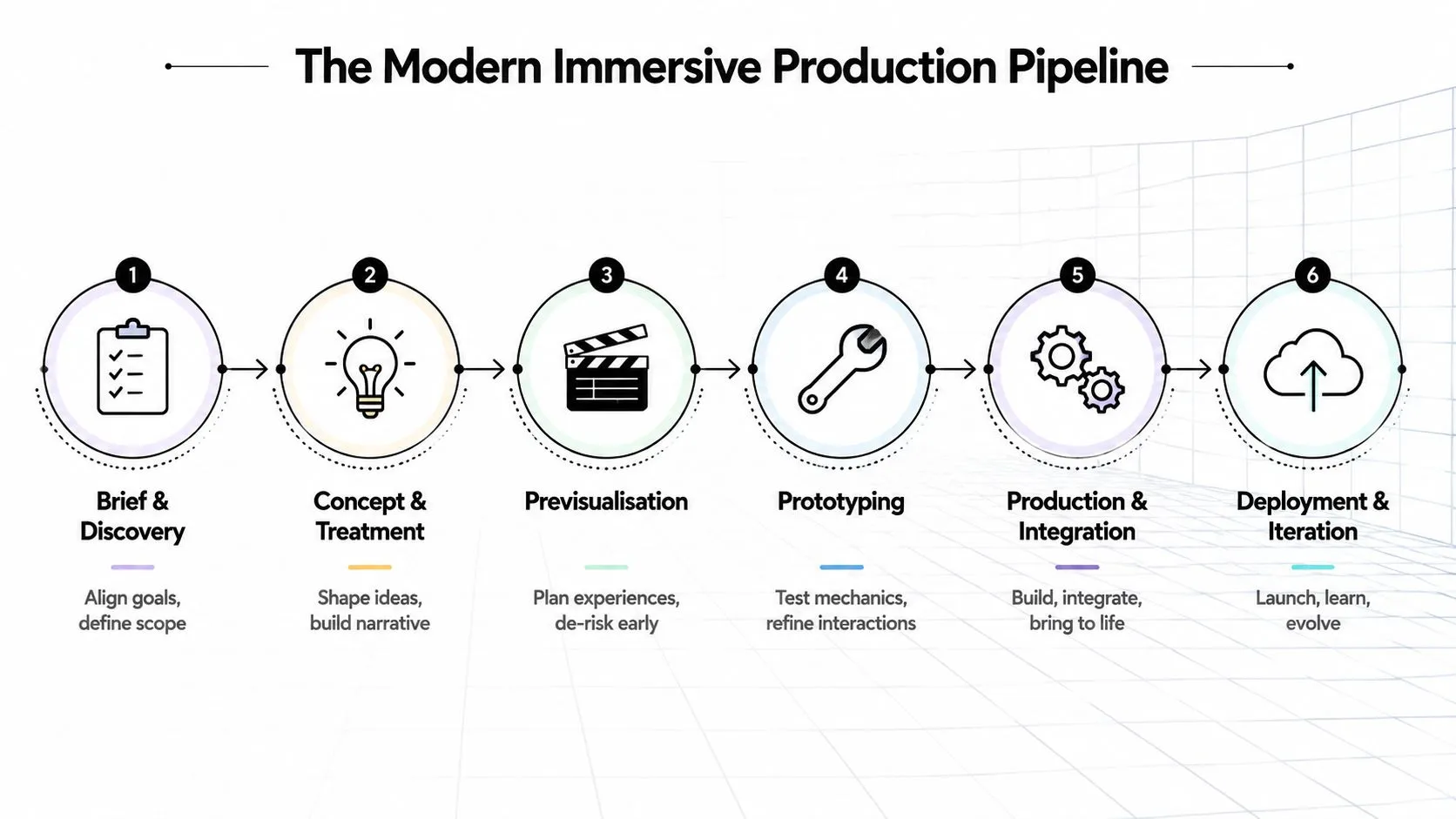
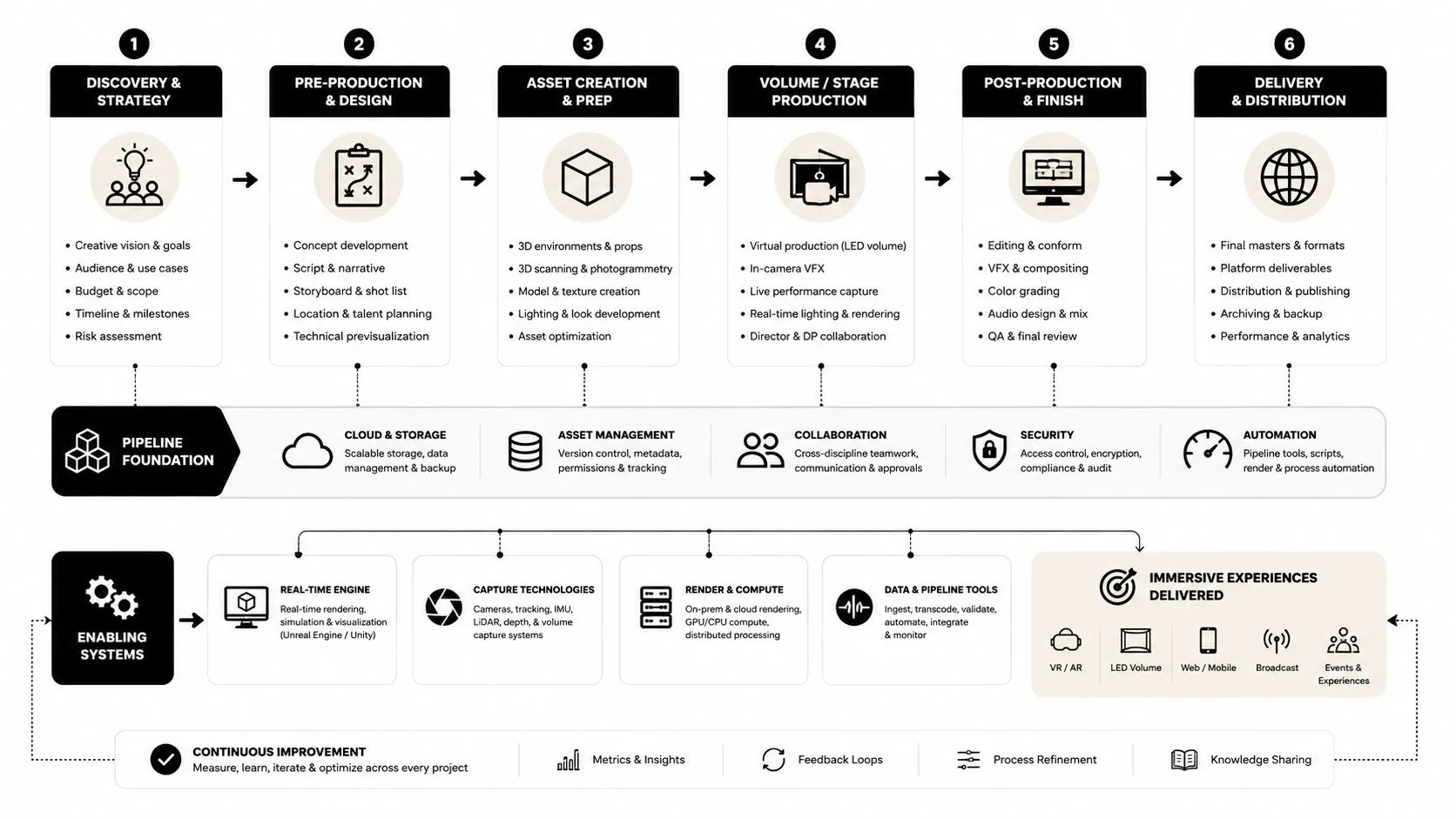
The pipeline starts with the brief and discovery. A producer, creative director and client team define the audience, business objective, environment, platform and success criteria. The output isn't a finished idea. It's a focused brief, audience assumptions, technical constraints and a list of questions that need testing. Concept and treatment then turn that brief into something people can assess. The team develops a visual direction, story structure, experience map, moodboards and an early production plan. At this stage, the important question isn't “does this look exciting?” It's “can the audience understand what they're doing, and can the production team deliver it?” Previsualisation, or previs, makes the experience tangible before full asset production. A greybox scene may contain primitive geometry, temporary sound and placeholder interactions. That's enough to test scale, navigation, timing and sightlines. In a live installation, previs can also reveal whether queues, staff positions and audience movement will interfere with the design.
Prototype before you polish
Prototyping in Unity or Unreal tests the core loop. The build might contain one room, one interaction and one story beat. That narrow slice can answer questions that a presentation can't, such as whether a hand-tracking gesture works, whether users know where to look or whether the experience produces discomfort. The prototype should feed back into the brief. If playtesting shows that participants ignore the intended object, the team changes the interaction or narrative emphasis before building the remaining world. This is why a useful animation production pipeline guide is relevant even to XR producers. Asset planning, approvals, version control and compositing discipline remain essential, even when the final output is interactive. Asset production and integration follow once the central risks are understood. Modellers, texture artists, animators, developers, technical artists and sound designers turn approved direction into production assets. Interaction and audio implementation then connect those assets to user behaviour, narrative timing and environmental cues. QA covers more than software bugs. Teams test comfort, accessibility, tracking, performance, onboarding, recovery from errors and behaviour in the deployment environment. AI tools can assist with generative concept art, automated asset rigging, AI-assisted QA and real-time lip-sync, but they don't replace art direction, rights checks, human testing or production judgement. Generated outputs still need review for consistency, suitability and technical reliability. Deployment may involve a public app, an expo installation, a location-based entertainment venue or an on-site event. The delivery team needs a support plan, device preparation, staff guidance and a process for capturing useful feedback. Iteration continues after launch because real audiences reveal friction that internal teams can't always predict.
Measuring Success Beyond Wow Factor
A creative experiment becomes a business tool when the team can connect audience behaviour to the project's purpose. The right KPI depends on what the experience is meant to change. For a consumer campaign, useful measures can include dwell time, recall, sentiment, sharing and conversion. One UK event report claims that 74% of attendees feel a stronger brand connection, 58% are more likely to share socially and 61% are more likely to buy later, as reported by this UK immersive events analysis. Those figures shouldn't be copied into every brief, but they show why emotional connection and post-experience behaviour may matter more than attendance alone. Training requires a different measurement model. Completion rate tells you whether learners reached the end, but it doesn't prove competence. You may need assessment scores, time to proficiency, error reduction or observed behaviour after the session. A visually convincing simulation that doesn't change performance has missed its purpose. Entertainment and location-based work often depends on throughput, session length, repeat visitation and audience satisfaction. A museum installation may value learning and remembered content, while an event game must balance engagement with the number of people who can participate within the available operating window.
A practical KPI hierarchy
Vanity metrics, such as headset minutes or social impressions, can help describe reach. They become decision-grade only when connected to a business or learning outcome.
| Use Case | Primary KPIs | Measurement Gap to Watch |
|---|---|---|
| Brand and consumer campaigns | Recall, sentiment, dwell time, sharing and conversion | Attribution may not capture delayed consideration or later purchase |
| Training and learning | Completion, assessment, time to proficiency and error reduction | Completion alone doesn't prove applied competence |
| Entertainment and location-based experiences | Throughput, session length, repeat visitation and satisfaction | High attendance can conceal queues, drop-off or weak repeat appeal |
The biggest gap often sits between launch reporting and the audience's real decision cycle. High-consideration purchases may happen after the campaign window, so brand teams should agree holdout audiences or matched-market testing before launch rather than trying to reconstruct attribution afterwards. Use a three-tier dashboard. Give creative quality an owner, commercial performance another, and accessibility compliance a third. That structure stops a strong visual reaction from hiding poor usability or weak business results.
Where Immersive Design Earns Its Keep in Business
A brand activation might use VR to replace a conventional teaser film with a guided product discovery. The brand director wants attention and understanding, while the production team must manage session length, equipment and audience flow. The sensible commercial model is often a defined project with a pilot or prototype before a larger rollout, rather than an open-ended technology experiment. Sales enablement creates a different scenario. A buyer could explore a configurable product in VR, compare options or view a complex system at a scale that's difficult to reproduce physically. The head of sales or marketing owns the commercial objective, while the production team must connect the experience to a real conversation, demonstration or follow-up process. A beautiful configurator that collects no useful response data may be memorable but hard to justify. Training briefs are usually owned by an L&D lead, clinical team or operational manager. An AR overlay can guide a physical task, while VR can place learners inside a controlled scenario where mistakes are safe to observe and discuss. Accuracy, assessment design, privacy and subject-matter review matter more than visual spectacle. Location-based entertainment and museum installations depend on the relationship between content, space and operations. A mixed-reality game may need a clear loop, fast onboarding, reliable tracking and staff who can reset the experience. A museum installation may prioritise exploration, accessible alternatives and a clear exit transition. In both cases, dwell time supports the commercial or cultural value, but it can't compensate for confusing interaction.
Three production snapshots
A VR short film such as Aurora is judged through story, direction, performance capture, spatial sound and headset optimisation. Its success depends on guiding attention without taking away the participant's sense of presence. A high-throughput mixed-reality event game such as Dance! Dance! Dance! has a different pressure. The team must make the mechanics immediately understandable while keeping the visual world distinctive enough to feel like an event rather than a standard game. Technical communication projects such as GeoEnergy NI show why visual strategy matters when the subject is difficult to explain. The team must translate specialist information into a sequence that stakeholders can follow, question and remember. For procurement teams assessing a partner, this guide to how to pick a design partner offers a useful reminder to examine process, communication and fit alongside portfolio quality. A strategy and production guide for immersive brand experiences can help frame the same decision around audience, technology and operational delivery.
Common Pitfalls and How Smart Teams Avoid Them
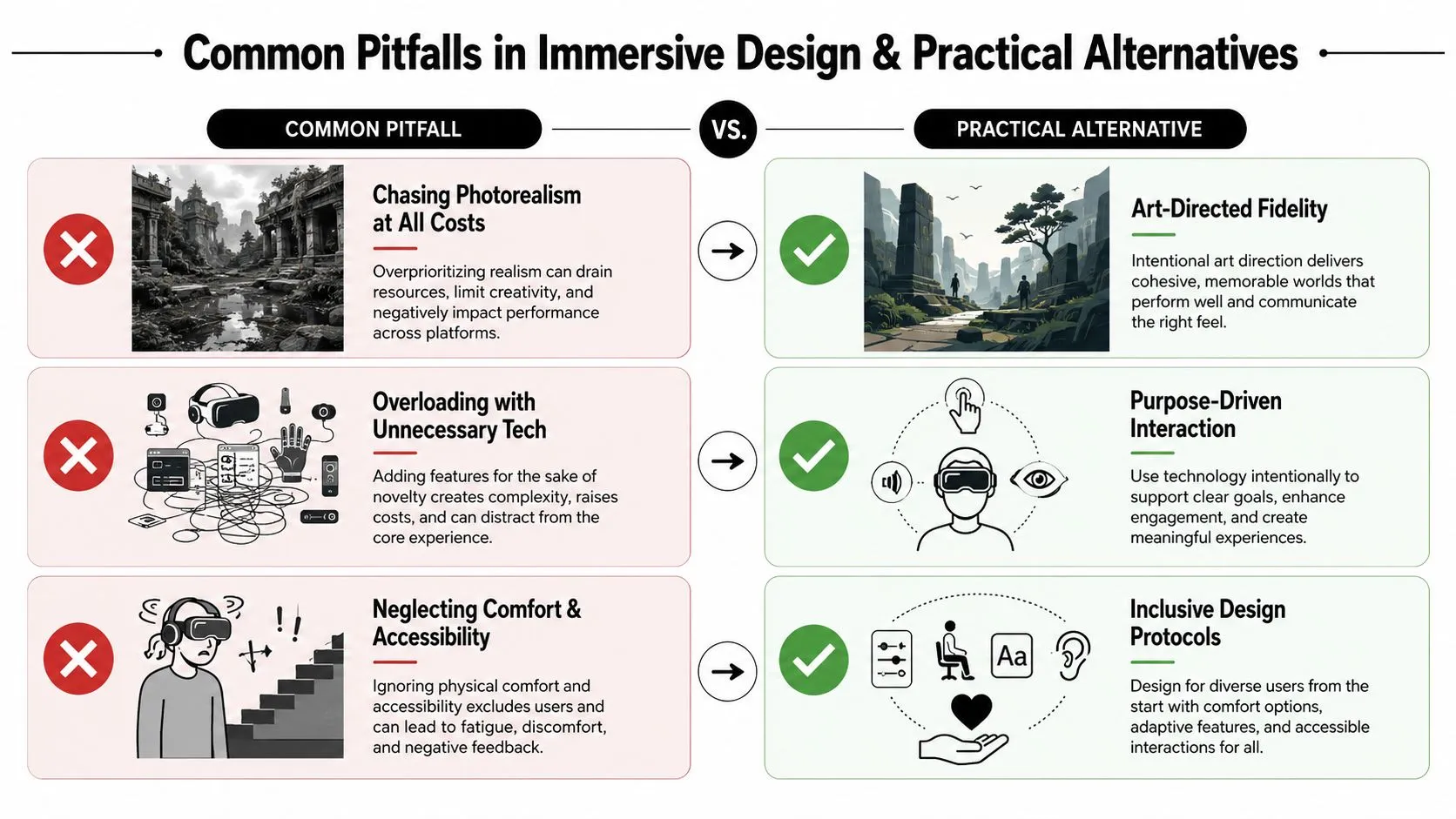
More technology doesn't automatically create more immersion. A high-end headset, projection system, or tracking setup can add complexity without giving the participant a meaningful reason to act. The first failure mode is chasing fidelity instead of agency. Teams spend months refining photoreal environments, then discover that the user has little to do beyond looking around. Build an interaction prototype early, even if the environment uses rough geometry. Test whether each moment offers a clear choice, response or discovery. The second is designing for the demo. The first ninety seconds dazzle because the team has concentrated all its strongest material at the opening. After that, the experience becomes repetitive, unclear or narratively flat. Run pacing workshops and usability sessions across the complete arc, including onboarding, escalation, resolution and exit.
Comfort is part of the creative brief
The third failure mode is ignoring physical comfort and accessibility until late production. That choice can remove people from the audience, especially when the experience assumes standing, rapid movement, intense audio or colour distinctions that aren't available to everyone. Set a comfort budget from the beginning. Offer seated and seated-plus-standing modes where appropriate, provide captioning and audio description, avoid unnecessary acceleration, and use colour-blind-safe palettes. Test with people who have different mobility, sensory and cognitive needs instead of treating accessibility as a compliance pass at the end.
Practical rule: If a participant needs a staff member to explain the interaction every time, the design hasn't finished onboarding.
The same discipline applies to technical decisions. Purpose-driven interaction usually beats a collection of novelty features. Art-directed fidelity often performs better than chasing maximum realism, because a controlled visual language can focus attention and protect performance. Immersion is a craft of attention. The producer's job isn't to assemble the longest feature list. It's to decide what the participant should notice, feel, understand and do at each moment.
A Short Brief Checklist Before You Commission Work
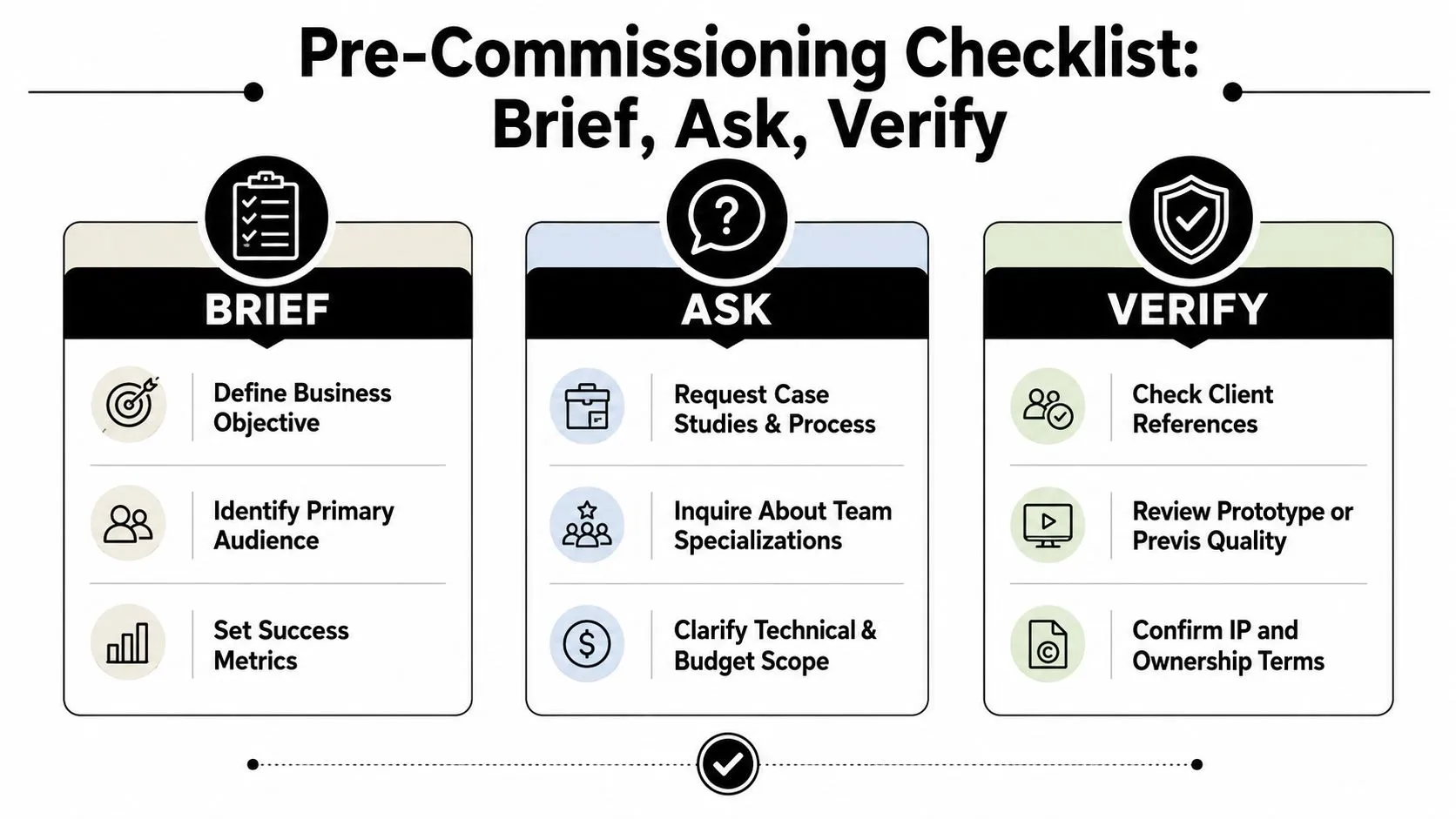
Before you invite proposals, divide your questions into brief, ask and verify. This keeps the conversation focused on outcomes, production risk and ownership rather than allowing impressive terminology to lead the decision.
Brief
Write these questions into the initial request:
- •Business objective: What should the experience change, and why is XR, AR or VR the right channel?
- •Primary audience: Who will use it, in what environment, with what level of technical confidence?
- •Use-case category: Is this brand activation, sales enablement, training, entertainment, education or another defined application?
- •Success metric: Which KPI will decide whether the pilot works, and who owns that measurement?
- •Audience journey: What should happen during onboarding, interaction, peak engagement and exit?
Clear answers prevent a studio from solving the wrong problem beautifully. They also connect the brief to the measurement model rather than treating evaluation as a reporting exercise after launch.
Ask
Use the next conversation to test production maturity:
- •Relevant delivery: Can the team show shipped work in the target medium and explain what it personally delivered?
- •Pipeline: How will discovery, treatment, previs, prototype, asset production, integration, QA and deployment connect?
- •Technology choice: Why does the proposed Unity, Unreal, mobile AR or headset approach suit the audience and venue?
- •Performance: What optimisation targets and device constraints shape the art direction?
- •Accessibility: How will the team handle motion comfort, captions, audio description, colour contrast and alternative modes?
- •Operations: Who manages device preparation, staff training, resets, updates and on-site support?
- •Data privacy: What information is collected, where is it stored and what does the experience work without?
A serious partner should be able to discuss limitations as clearly as possibilities. If every answer is framed as effortless, ask for the assumptions behind the estimate.
Verify
Before signing, confirm the details that are expensive to fix later:
- •IP ownership: Who owns source files, software, artwork, characters, music and future adaptations?
- •Pilot scope: What is the smallest build that can test the central interaction and KPI?
- •Instrumentation: Which events, interactions and outcomes will the team measure?
- •References: Can you speak with clients about communication, change control and post-launch support?
- •Previs quality: Does the proposed treatment show how the audience moves through the experience, not only how it looks?
- •Support terms: What happens when hardware, operating systems or venue conditions change?
The UK supply base includes many small teams. The 2022 Immersive Economy evidence submitted to Parliament estimated 2,106 immersive technology companies, an 83% increase over five years, with 80% of firms employing 1 to 9 people and total turnover around £1.4 billion. That scale can bring focus and flexibility, but it makes clear scope, modular production and pipeline efficiency especially important.
A useful final check is whether the proposal makes iteration affordable. UK occupational standards treat immersive projects as structured production work with defined idea-generation and project-delivery requirements, as set out in the UK immersive technology skills standard. Your supplier should therefore explain not only the concept, but also how decisions, tests, approvals and revisions will run. --- Studio Liddell develops animation, XR, AR and VR experiences through structured creative and technical production pipelines, from concept and previs to interactive build, optimisation and deployment. If you're defining an immersive brief and need help turning the idea into a testable experience with clear measures, visit Studio Liddell to start a conversation.