VR for Museums: Immersive Exhibits That Draw Visitors
Only 14% of adults digitally engaged with museums or galleries in England in the 2024/25 survey year, according to the Department for Culture, Media and Sport's Participation Survey. That's a useful reality check: making a digital experience available isn't the same as getting people to use it. VR for museums should solve a collection or interpretation problem, not just add headsets to a gallery. The strongest proposal explains what visitors will discover, why they can't discover it another way, and how the museum will support them.
Where Museums Use VR and What Each Use Delivers
| Use | Visitor goal | UK example or evidence | Best for |
|---|---|---|---|
| Remote access to stored collections | Study objects that are not on display | University of Glasgow survey: 79% wanted digital access to inaccessible collections | Large collections with little gallery space |
| Reconstruction of lost or inaccessible places | Stand inside a historic room, landscape or event | Dr Edward Jenner's House Museum and Garden study | Sites that are fragile, lost or changed |
| Close inspection of specimens | See valuable items up close without handling | Natural History Museum, Hold the World | Fragile or high-value objects |
| Story-led experiences | Follow a real journey or event | Science Museum, Space Descent VR with Tim Peake | Narrative exhibits with a clear protagonist |
The University of Glasgow-led Museums in the Metaverse survey found that 79% of respondents were interested in digital access to inaccessible cultural collections, while 96% were aware of VR, as reported by Innovate UK Business Connect. The same survey found that 38% were probably or definitely willing to pay for virtual cultural-heritage experiences. Access and discovery therefore make a stronger starting proposition than assumed ticket revenue.
Start with what visitors can't encounter
Remote collection access means more than recreating display cabinets. A visitor might rotate a stored object, examine its underside and compare related pieces held elsewhere. For collections spread across institutions, the HD Asian Art museum guide offers a useful starting point for exploring museums with important Southeast Asian iconography collections. Curators should then establish which objects belong together interpretively, rather than assembling a virtual room around visual similarity alone. Reconstruction addresses a different absence: the place itself. Visitors can understand the scale of a lost room or the relationship between buildings, provided the interpretation clearly separates surviving evidence from conjecture. A convincing environment mustn't imply certainty that historians don't have. Close inspection keeps attention on the object. Enlarging a specimen or revealing a concealed surface should answer a question, such as how its structure relates to its function. Interactions that merely let visitors spin everything can distract from that explanation. Story-led experiences organise attention around a journey. A protagonist, destination and consequence give visitors a reason to follow events rather than browse without direction.
Collection test: Match a specific object or site to a row in the table, then write the discovery visitors should make. If that sentence is vague, the concept isn't ready.
VR, AR and 360 Video Compared for Each Exhibit Goal
| Format | Visitor response | Best use | Main limit |
|---|---|---|---|
| Immersive VR | Embodied and emotional | Reconstructing a room, landscape or event | Headsets, cleaning, staff and cybersickness management |
| Augmented reality | Cognitive and comparative | Comparing a reconstruction with surviving fabric | Needs a device or screen; less immersive |
| 360-degree video | Watched rather than freely explored | Reaching remote audiences with a simpler production | Little interaction |
| Projection | Shared by a group | Atmosphere in a gallery space | Fixed location; no individual navigation |
| Interactive web | Solo, browser-based | Collections for learners off site | Lacks the sense of presence |
An exploratory study at Dr Edward Jenner's House Museum and Garden found that VR prompted a visceral, embodied and subjective response, whereas AR encouraged a cognitive, comparative and objective response, according to Sheffield Hallam University's account of the study. That's a useful design distinction, not proof that either format is universally better.
Choose the relationship with the evidence
Use VR when position, scale and surrounding space carry the meaning. Standing within a reconstructed workshop can help visitors understand how people moved between work areas. A conventional image may show the same equipment without communicating those relationships. Use AR when the surviving place remains important. An overlay can show a missing wall while visitors inspect the foundations beneath it. Give them control over the overlay so they can distinguish the reconstruction from the physical evidence. 360-degree video isn't the same as an interactive virtual environment. Visitors can look around a recorded viewpoint, but usually can't walk elsewhere or manipulate objects. That constraint can be helpful when a guided view of an inaccessible location is all the interpretation needs. Projection suits a shared atmosphere without requiring everyone to wear equipment. Interactive web content suits closer study: learners can revisit object descriptions, compare images and follow references at their own pace.
When the simpler format wins
Say the main learning task is comparing inscriptions. A browser-based viewer with enlargement controls and transcriptions may serve visitors better than a headset. If the task is understanding how a chamber surrounds its occupant, VR becomes more persuasive.
Practical rule: Choose VR to feel a place, AR to compare evidence, and video or web when straightforward access matters more than embodied presence.
That rule still needs a comfort and support check. A format that communicates beautifully in a demonstration can be the wrong choice for a gallery whose visitors need frequent assistance or whose staff can't supervise the equipment.
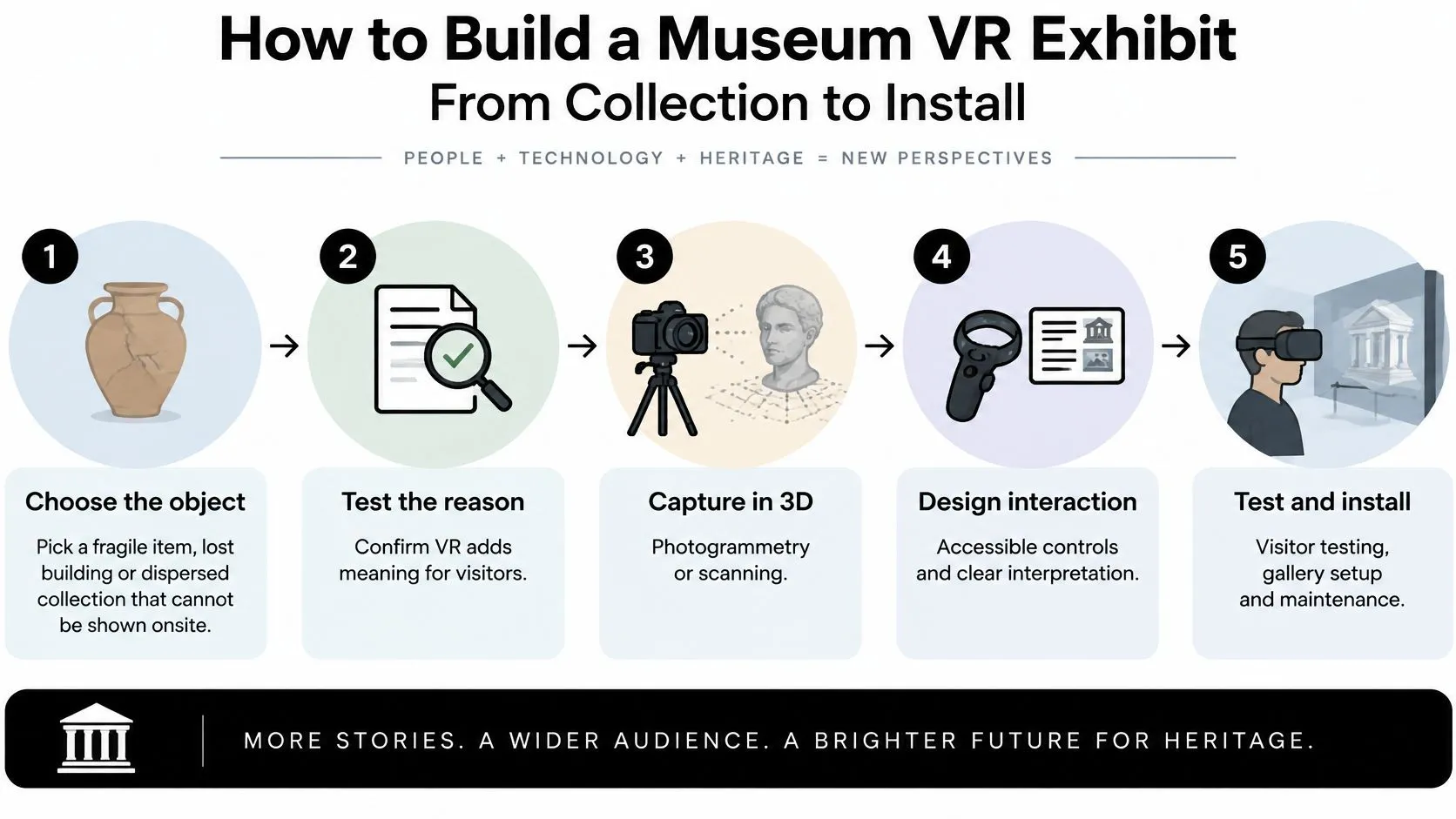
How to Build a Museum VR Exhibit From Collection to Install
Treat production as an interpretation project with technical dependencies. Curatorial decisions, rights clearance and visitor testing belong in the schedule from the beginning, not after the environment looks finished.
Develop the content before the finish
- Choose an object or place that needs virtual access. A fragile item, lost building or geographically dispersed collection gives the project a concrete purpose. The common slip is selecting an attractive subject without checking whether an ordinary display would explain it just as well.
- Secure scans, photographs, archive references and permissions, then test the assets on the intended headset. Photogrammetry can produce detailed surface models, but those models need optimisation for real-time rendering. Don't leave rights clearance until the finished exhibit depends on material you can't use.
- Write the spatial narrative. Specify the visitor's first view, the interaction that reveals meaning and the point at which the experience feels complete. Avoid transferring a long audio-guide script into VR without considering where visitors look or what they're doing.
- Build a rough prototype in Unity or Unreal Engine using simple shapes before polishing textures and lighting. Test navigation, object scale and instruction placement on the actual device. A beautiful scene won't rescue an interaction visitors can't understand.
Test the installation, not just the software
- Pilot with real visitors. Record where participants stall, lose orientation, request help or remove the headset, and ask what they understood afterwards. Testing only with the production team hides problems because its members already know the controls and story.
- Plan staff responsibilities, charging, cleaning, device storage and an unobstructed exit route. Assess the surrounding gallery too: Colorado Art Services' guidance on museum-quality hanging and lighting standards is a useful companion when coordinating nearby physical displays. Don't treat the headset boundary as the whole installation footprint.
- Configure evaluation before opening. Record starts, completions and collection engagement without collecting unnecessary personal information. Leaving measurement until later makes it difficult to distinguish a popular demonstration from an effective exhibit.
Making VR Accessible to Disabled, Older and Neurodivergent Visitors
Immersion isn't inclusive by default. A University of Glasgow accessibility study identifies under-addressed sensory, cognitive and age-related needs, alongside exclusion associated with headsets and high-performance computing requirements. Removing the need to travel doesn't remove every barrier to participation.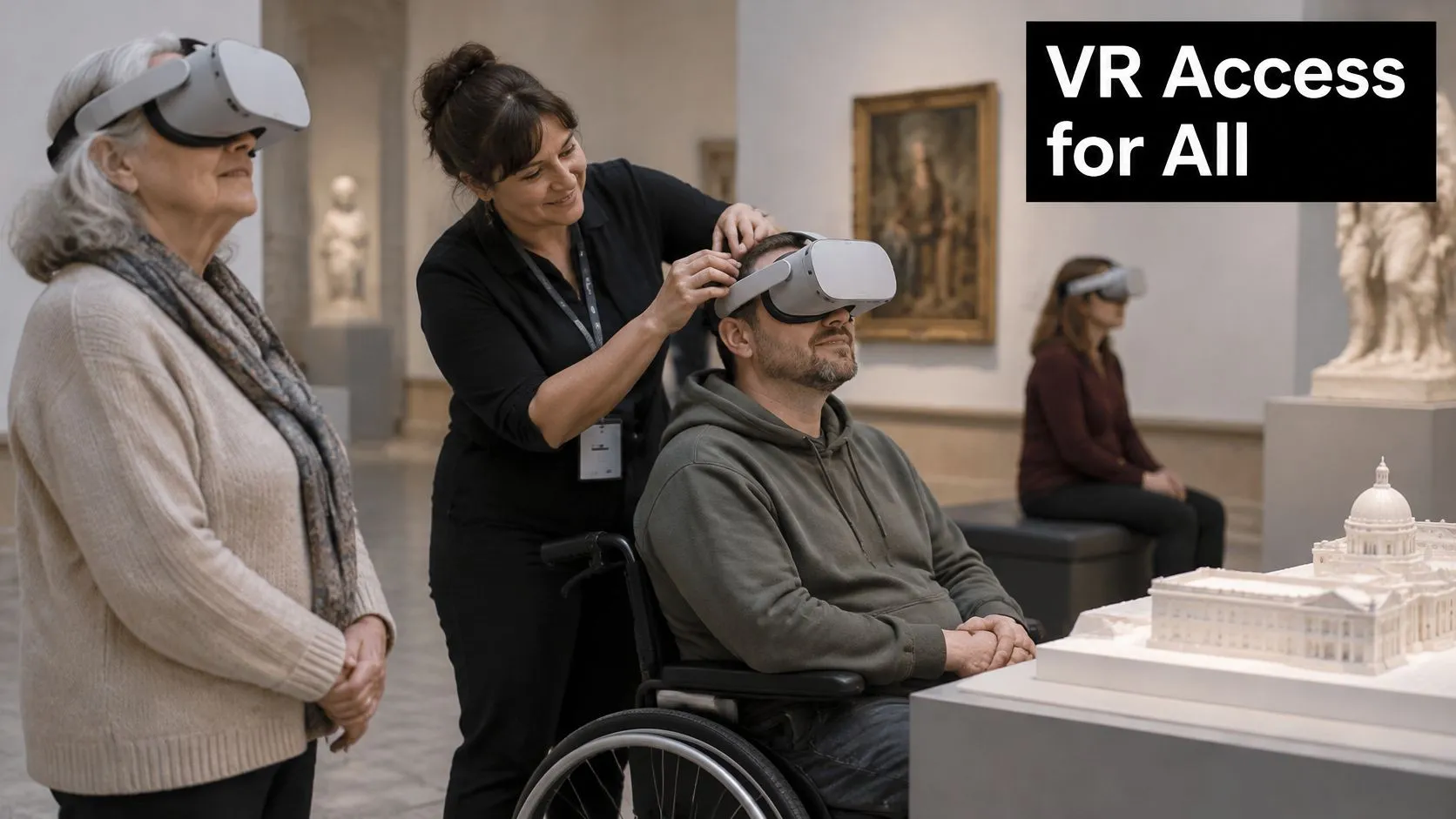
Specify choices rather than a standard visitor
Offer seated and standing modes with reachable controls and adjustable viewing height. Don't assume that seated mode means placing a chair inside an experience designed entirely around standing. For movement, offer teleport navigation or a stationary experience where appropriate, rather than forcing smooth travel through the scene. Include an immediately available exit or passthrough option, and explain it before the visitor starts. Captions need readable contrast, suitable positioning and enough display time. Audio description should communicate important visual information without competing with essential narration. Teams preparing transcripts can use Translate AI's guide to build subtitle files with AI, but a person must check terminology, timing and meaning before publication.Make support part of the experience
Simplified interaction and controller-free options can help some visitors, but hand tracking isn't automatically accessible either. Test alternative input methods with people who have different movement and dexterity needs. Staff should explain the experience without assuming prior device knowledge. Avoid making visitors download an application or create an account merely to understand whether they can participate.Equivalent access means preserving the learning opportunity, not merely offering a trailer to someone who can't wear a headset.A screen-based version should retain the important objects, explanations and meaningful choices. Evaluate comfort, assistance requests and completion alongside whether visitors using different formats can reach comparable interpretive outcomes. Use this checklist in the design brief:
- •Physical choice: Seated and standing modes, reachable controls and alternative inputs.
- •Sensory choice: Captions, audio description and adjustable sound.
- •Predictability: Clear instructions, movement options and an obvious exit.
- •Supported participation: Trained staff and a cleaning procedure compatible with the equipment.
- •Equivalent content: A usable non-headset route through the same learning material.
What a Museum VR Exhibit Really Costs to Run
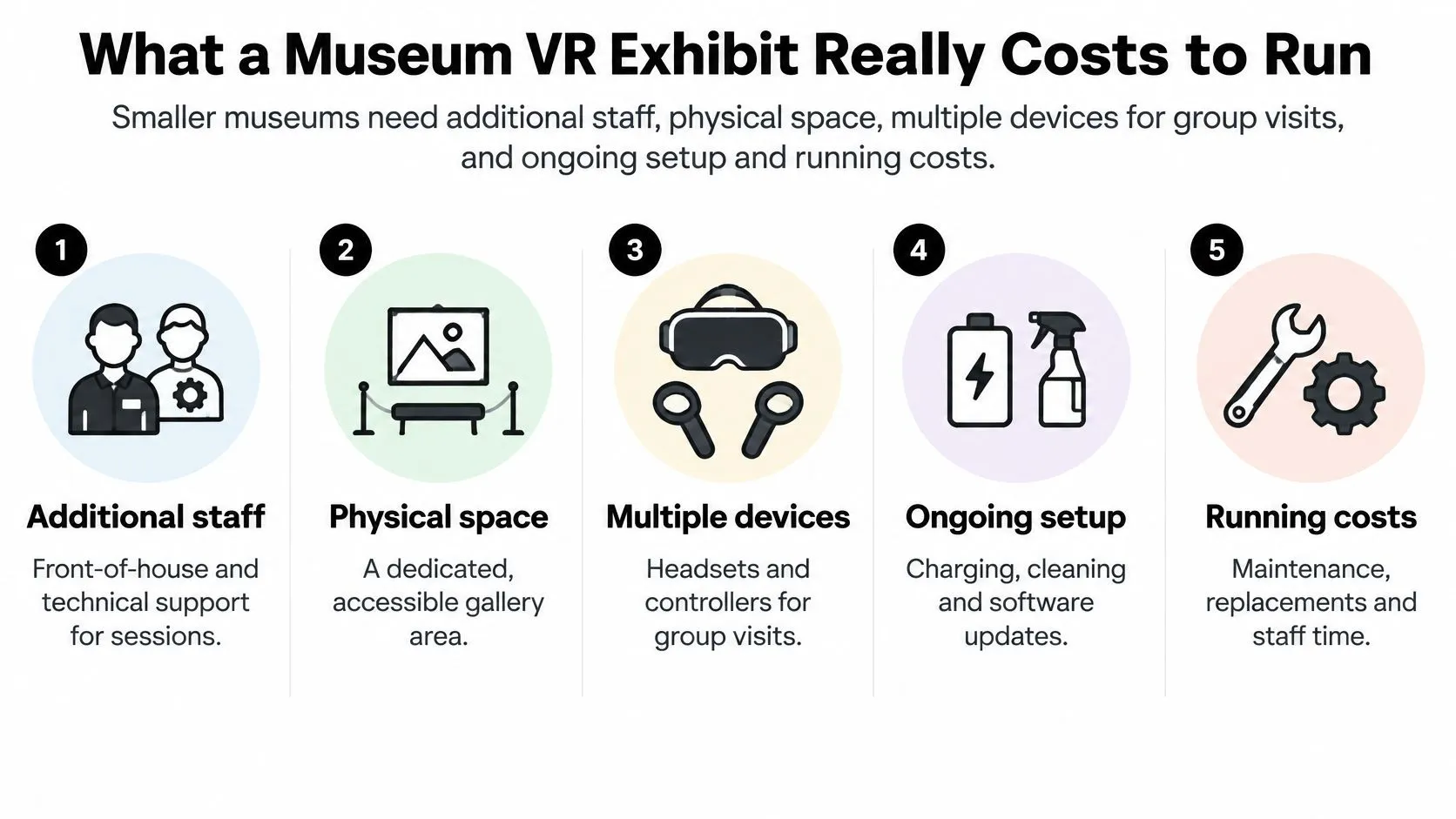
The production quote isn't the operating budget. Written evidence to Parliament on immersive technologies identifies requirements for additional staff, space, multiple devices and ongoing setup and running costs, and notes that high-standard production can be prohibitive for smaller institutions.
Budget beyond opening day
| Cost line | One-off or recurring |
|---|---|
| Capture and digitisation | One-off |
| Rights clearance | One-off |
| Software updates | Recurring |
| Headset replacement | Recurring |
| Cleaning and hygiene | Recurring |
| Staff training | Recurring |
| Safeguarding | Recurring |
| Storage of digital assets | Recurring |
| Evaluation | Recurring |
Treat capture and rights clearance as initial budget lines, while checking whether future additions or licence renewals create further charges. Assign an owner to every recurring task. Software maintenance isn't covered just because someone in the museum knows how to restart a headset. Include staff time for fitting equipment, answering questions and resetting sessions. Reserve suitable space for waiting visitors and companions as well as participants. Our location-based VR guide to throughput, safety and ROI provides a useful planning framework for these operational questions.
Compare public value, not visual polish
A temporary exhibition and a reusable collection asset need different business cases. For temporary work, account for installation, removal and what happens to the content afterwards. For reusable assets, require organised source files, documented permissions and exportable models so future interpretation doesn't depend entirely on rebuilding. Bespoke production and limited digitisation skills can make even a modest concept difficult to sustain. Ask whether the same budget would achieve more through collection photography, conservation, web interpretation or projection. VR deserves consideration where physical access is impossible, a site is fragile or a spatial experience can't be staged in the gallery. Those conditions justify investigation, not an automatic purchase. Annual running cost ÷ measured annual reach = running cost per visitor. For a stricter comparison, divide by completed experiences instead. Keep production investment visible separately, or allocate it across the intended operating life, so a low running-cost figure doesn't conceal the initial commitment. Compare alternatives using the same definition of reach and completion.
UK Museum VR Projects and What They Show
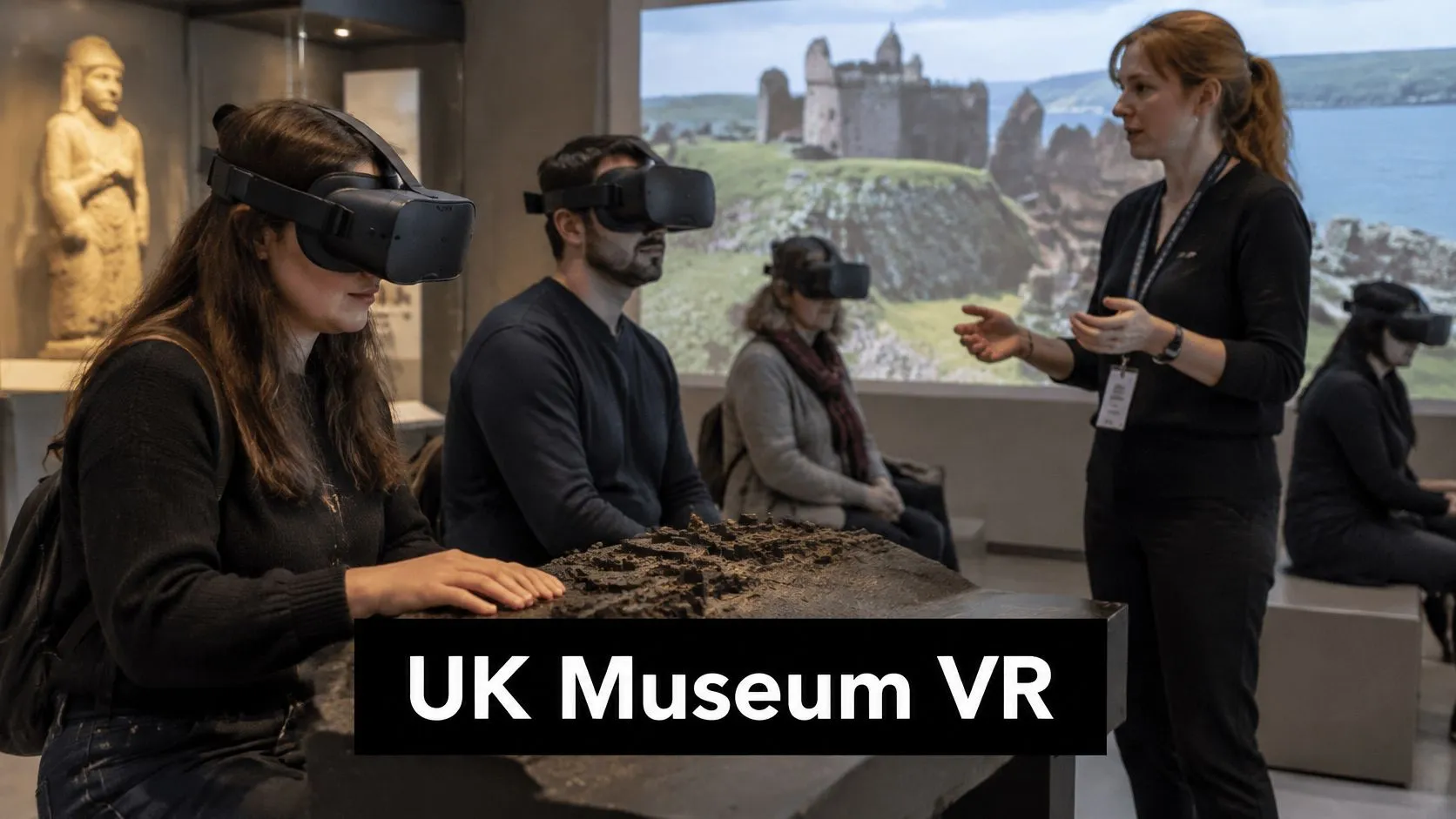
In October 2019, the UK Government announced more than £4 million for Factory 42 to create two multisensory interactive experiences at London's Natural History Museum and Science Museum, with a planned opening in 2020, as described in the Science Museum's collaboration announcement. That announcement establishes investment and intention; on-time opening is a separate question.
Different subjects need different visitor roles
The Science Museum's Space Descent VR with Tim Peake recreates an astronaut's return to Earth in a Soyuz capsule. Its interpretive strength lies in a bounded situation: the visitor follows a journey whose setting and destination provide natural structure. A museum team considering a similar approach should identify what the visitor needs to notice, rather than adding interaction because the software permits it. The Natural History Museum's Hold the World uses a lifelike digital representation of Sir David Attenborough to guide access to valuable specimens. Here, the guide and the objects provide the focus. The design lesson is to make the relationship between explanation and inspection deliberate, so visitors aren't asked to listen closely while simultaneously learning complicated controls. Studio Liddell's credentials include a related museum experience: Sir David Attenborough opened Studio Liddell's Late Cretaceous room-scale experience, Feed The Titanosaur. The shared lesson is that a recognisable guide only works when specimen access remains the point.
Design the service around the story
For a smaller heritage venue, a tightly defined question can be more useful than an expansive virtual world. Studio Liddell builds XR experiences for heritage venues, and its radar museum visitor and XR guide shows how a site-specific question can keep interpretation tied to the existing visit.
- •Narrative planning: Decide the visitor's role and what marks the end.
- •Gallery planning: Allocate waiting space, supervision and reset responsibilities.
- •Operational planning: Test how the installation behaves during ordinary visitor service, not just a demonstration.
These projects point to a narrow conclusion. VR earns its place when the visitor needs to be inside a journey, beside an unreachable specimen, or within a fragile site; it is the wrong tool when the same understanding could come from a handleable replica, projection, or a well-lit label. Audience ambition must fit the room, staffing and operating budget.
Decide Whether One Exhibit Justifies VR Before Committing
Apply these questions in order. They turn enthusiasm into a decision the collection, learning and visitor-services teams can share.
- Is there meaningful content that cannot be shown onsite? Identify the object, place or perspective, and explain why virtual access adds understanding.
- Can the museum staff, clean and support the headsets? Name who will handle opening checks, visitor assistance and faults.
- Can the museum measure reach and completion from opening day? Agree what counts as participation and what counts as finishing.