Radar Museum Bawdsey Visitor Guide and XR Experiences
A green trace sweeps across a screen, an operator leans closer, and a faint return appears where the sky had seemed empty a moment before. At Bawdsey, that sort of moment changed Britain’s understanding of air defence, and today it gives visitors one of the clearest ways to grasp how radar moved from experiment to necessity. If you’re searching for radar museum bawdsey, you’re not just looking for a local museum. You’re looking at the place where operational radar first took shape in a form that would matter in wartime, and where that story still feels unusually tangible.
Introduction to Radar Museum Bawdsey
A visit to Bawdsey begins best with a simple idea. Long before radar became familiar as a wartime tool, people here were trying to answer one question that now sounds almost impossible. How do you detect an aircraft you cannot yet see? That question gives the museum its shape. Bawdsey is more than a collection of old equipment. It is a place where visitors can follow the path from experiment to early warning, and from early warning to national defence. The site feels grounded because each room, object, and display connects back to one practical task: finding danger sooner. For many visitors, that focus makes Bawdsey easier to grasp than a very large military museum. Instead of moving across dozens of themes at once, you can trace one chain of ideas from start to finish.
- •The problem: aircraft could approach faster than visual observers could report them.
- •The method: radio pulses were sent out, and returning signals were measured.
- •The result: defenders gained time to prepare.
Radar’s principle is similar to an echo. A radio pulse is sent out, and the returning signal reveals a target’s location. Once that clicks, many of the museum’s displays become much easier to read. Screens, aerials, transmitter components, and operators’ rooms stop looking like isolated artefacts and start to make sense as parts of one coordinated system. The visit today works on two levels. On one level, it is a heritage experience rooted in wartime rooms, equipment, and local memory. On another, it is a strong candidate for richer digital interpretation. Bawdsey’s story is unusually well suited to XR because radar itself deals with the invisible. Visitors are asked to understand signals, timing, distance, and decision-making, all of which are easier to grasp when digital tools can show what the human eye could not. That is where a thoughtful interpretation approach matters. Studio Liddell could help bring Bawdsey’s legacy to life through augmented layers, reconstructed operator viewpoints, or interactive signal visualisations that show how a pulse travelled outward and returned. Used carefully, those tools would not distract from the museum’s authenticity. They would help visitors see the hidden processes behind the objects in front of them. The strongest visit usually comes from asking three plain questions at each display. What did this do? Who relied on it? What changed because it worked? At Bawdsey, those answers build steadily, like signals resolving into a clearer picture.
History of Bawdsey Radar Station
Bawdsey’s story becomes clearer if you picture the site as a workshop that turned an uncertain idea into a working shield. Before radar became part of Britain’s wartime defence, it had to be tested, adjusted, and trusted. Bawdsey was one of the places where that shift happened.
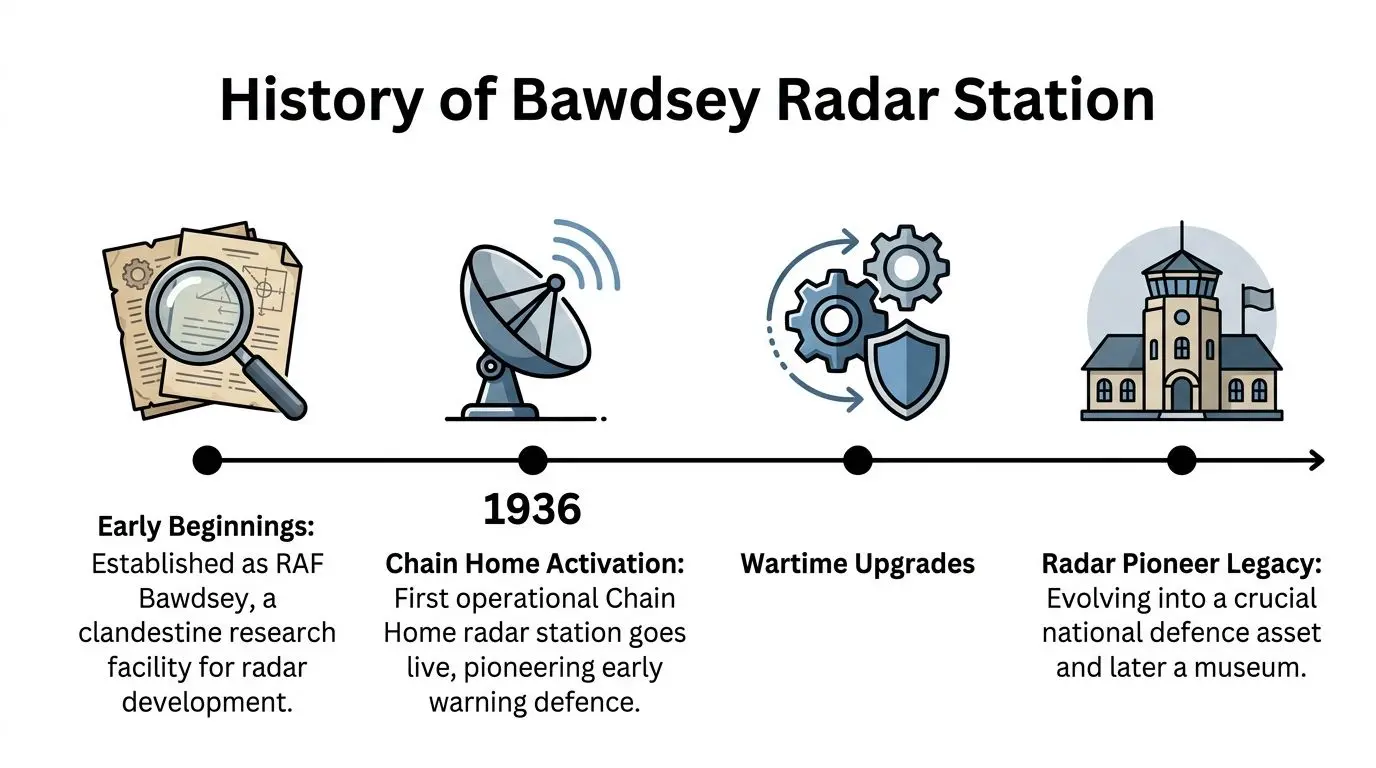
The early breakthrough
At the heart of the site was the Bawdsey Radar Transmitter Block. Visitors often focus on it first because it makes the history feel concrete. Instead of hearing only about invisible radio waves, you stand in front of a building made to support powerful equipment and intense operational work. The technical details matter, but only if they are tied to purpose. The transmitters sent out strong pulses over long distances so aircraft could be detected well before they reached the coast. A simple way to read this is to see the station as an early warning lantern, except its beam was made of radio energy rather than light. That shift from seeing with eyes to sensing with signals changed everything.
From experiment to defence system
Bawdsey mattered because radar here became organised practice, not just promising research. Detecting an aircraft was only the first step. The primary achievement was building a chain of action around the detection. Signals had to be received, interpreted, passed to operators, plotted, and turned into decisions quickly enough to matter. That can be the confusing part for first-time visitors. A radar station was never only a set of towers and machinery. It worked more like an orchestra. Transmitters, receivers, operators, telephones, plotting rooms, and commanders all had different parts to play, and the result only worked if the timing held together. Seen that way, Bawdsey helps explain why radar was so important in wartime Britain. It gave time. In air defence, a few extra minutes could mean fighters were airborne and ready rather than reacting too late.
Wartime expansion and layered defence
As the war developed, Bawdsey’s role changed with it. The station did not remain fixed in one early form. New threats demanded new methods, so the site expanded into a more layered system rather than relying on one radar type alone. By 1942, Bawdsey had become the UK’s only site operating Chain Home, Chain Home Low, and Coast Defence radar together, giving it an unusually broad role in air and coastal surveillance at one location, according to Subterranea Britannica on Bawdsey Chain Home Radar Station. That detail helps visitors read the museum more accurately. The collection is not the remains of one machine frozen in time. It represents a site that kept adapting, with each addition responding to a different height, range, or kind of threat. If standard interpretation explains the hardware, XR could go a step further by showing how these overlapping systems covered the sky and shoreline in different layers, almost like transparent maps placed over one another.
After the war
The post-war phase deserves attention because it shows that Bawdsey was not only a Battle of Britain story. The site continued to play a part in Britain’s radar and control network as defence planning became more formal in the Cold War period. A short timeline helps keep those phases distinct:
| Period | What changed at Bawdsey | Why it matters |
|---|---|---|
| Early phase | Research and operational radar development | Radar moved from a promising idea into practical defence use |
| Wartime phase | Upgrades and multiple radar roles at one site | The station responded to changing air and coastal threats |
| Post-war phase | Integration into later defence networks | Bawdsey remained part of Britain’s wider monitoring system |
| Museum era | Preservation and interpretation | Visitors can connect technical systems with human decisions and memory |
For a museum visitor, that long timeline matters because it prevents a common misunderstanding. Bawdsey was not important for one dramatic moment alone. Its legacy lies in repeated adaptation. That is also why it offers such strong potential for digital interpretation. Studio Liddell could help visitors trace how one site changed across decades, letting them compare rooms, equipment, and radar coverage across time instead of seeing each object in isolation.
Visiting Practicalities and Access
Planning a trip to radar museum bawdsey is best done with a flexible mindset. This is a heritage visit in Suffolk rather than a city-centre attraction that runs on commuter logic. A little preparation makes the day far smoother.
Start with the museum’s own current details
Opening days, guided access arrangements, and seasonal changes can shift, especially at specialist heritage sites. Check the museum’s latest official visitor information before you travel, particularly if you’re making a longer journey from London, Cambridge, or elsewhere in East Anglia. That matters more at Bawdsey than at some large national museums because local access can shape the whole day. Travel time, parking, weather, and ferry or road options may affect your schedule.
Reaching Bawdsey without stress
If you’re coming by rail for part of the journey, sort that leg first. Many visitors compare routes into Suffolk and then finish the trip by taxi, lift share, or local onward travel. If you’re trying to reduce rail costs, it can be worth checking cheap train tickets before you finalise plans. A simple planning order works well:
- Choose your arrival hub: Ipswich is often the easiest anchor point for rail travellers.
- Decide on the final leg: car, taxi, or another local arrangement.
- Build in spare time: rural heritage visits are better when you’re not rushing.
- Check return travel early: that’s especially useful if you’re depending on timed connections.
What to think about before booking
Some visitors assume a radar museum visit is quick because the subject is specialised. In practice, people often stay longer than expected because the exhibits reward careful reading and discussion. Ask yourself three things:- •Are you visiting for a brief stop or a half day?
A half day usually feels more comfortable.
- •Do you want a guided experience?
If so, confirm availability in advance.
- •Are you visiting with children or a school-age group?
Build in pauses, because technical displays often prompt questions.
Access and comfort on site
Because Bawdsey is a historic site, access can differ from a modern purpose-built venue. Contacting the museum ahead of time is the best approach if anyone in your group has mobility needs or would benefit from specific access guidance. Look out for practical basics when you plan:
- •Rest breaks: heritage visits can involve more standing than people expect.
- •Weather readiness: coastal Suffolk conditions can change quickly.
- •Toilet and refreshment timing: know what’s available on site and what may be limited.
Practical rule: treat Bawdsey as a destination with heritage constraints, not as a plug-and-play attraction. A quick check before travel usually prevents most avoidable surprises.
A simple visitor checklist
Here’s a straightforward way to prepare.
- •Check current opening information: don’t assume standard daily hours.
- •Confirm route choices: especially for the last stretch of the journey.
- •Wear sensible shoes: museum floors and surrounding grounds may not suit flimsy footwear.
- •Bring questions: this is one of those museums where asking staff or guides can transform the visit.
The reward for that small amount of planning is a calmer, more focused experience once you arrive.
Top Exhibits and Their Significance
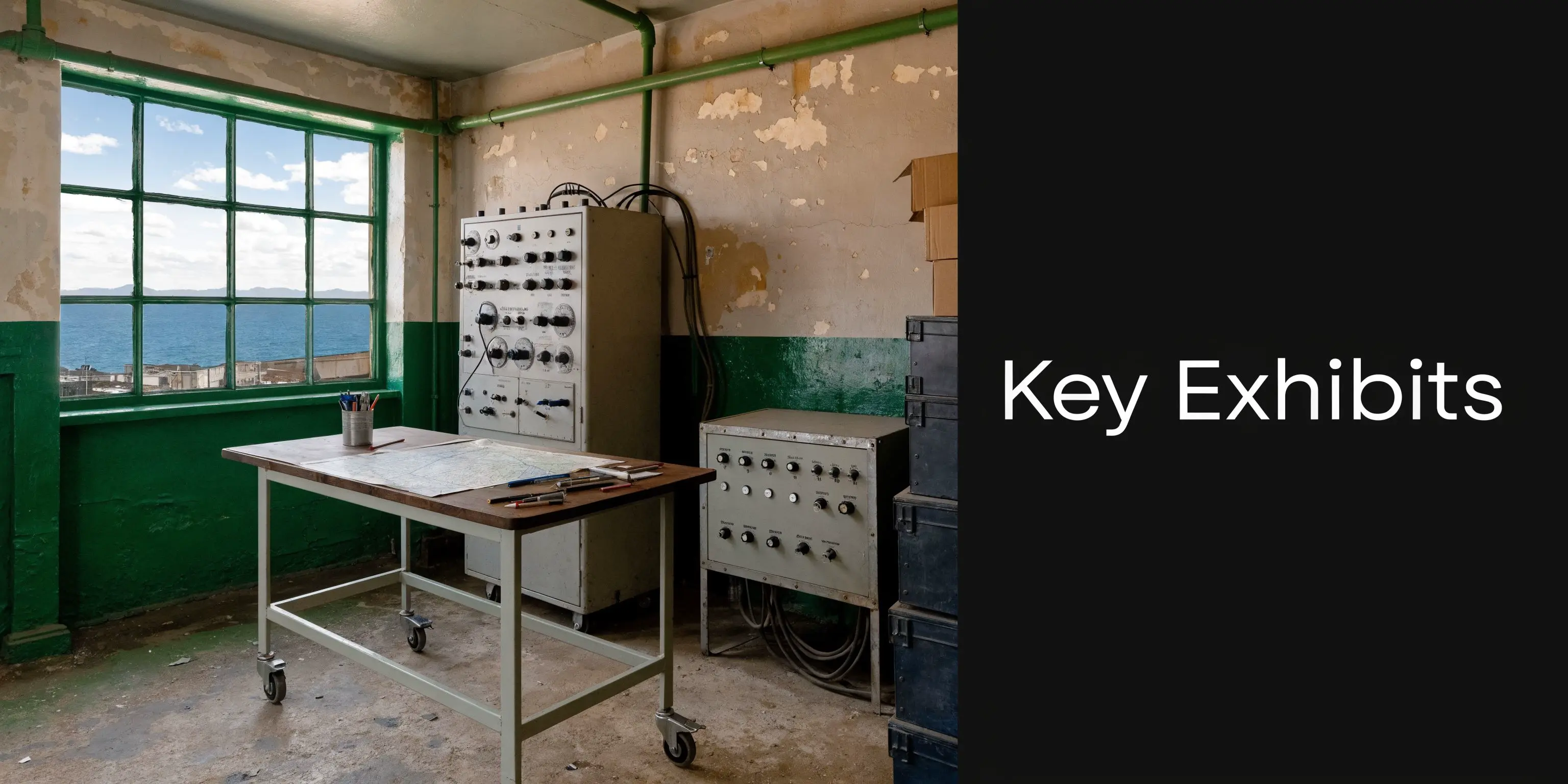
A visitor can stand in one room at Bawdsey and see metal cabinets, dials, and cables. A few minutes later, those same objects start to read like parts of a living system. That shift matters. The museum’s strongest exhibits do not work as isolated curiosities. They explain how Britain learned to detect danger at a distance, pass that information along, and act on it quickly.
The transmitter block
The transmitter block is one of the clearest examples of architecture carrying historical meaning. The building itself helps tell the story. Its protective construction shows that radar at Bawdsey was treated as working defence infrastructure, not a minor laboratory experiment. That point often helps first-time visitors. Once you read the building as part of the exhibit, the museum becomes easier to understand. The rooms begin to make sense as stages in a process.
The T3026 transmitters
The Chain Home T3026 transmitters show where that process begins. They sent out the pulse that made detection possible. A torch is a useful comparison. You can only spot an object in darkness once light reaches it and returns to your eye. Radar followed the same basic logic with radio energy. The transmitter sent the outgoing signal. Everything else depended on that first step happening reliably.
Receivers and the art of listening
The receiver displays add the second half of the story. Sending a signal is only half the job. The harder task is catching a faint return and deciding what it means. At Bawdsey, equipment such as the Cossor RF8 receivers helps explain that challenge. Visitors often understand radar more clearly here than at the transmitter displays, because the human judgement becomes visible. Operators were doing more than watching a machine work. They were listening for weak answers in a noisy system and deciding whether those answers pointed to something real, misleading, or urgent.
Mk II and Mk III consoles
The Mk II and Mk III consoles are among the museum’s most revealing exhibits because they show radar turning from detection into action. These consoles, with their electrical calculators and plotting functions, helped convert raw returns into usable positions and heights. That is the moment many visitors stop thinking of radar as “old electronics.” They start to see an early information network. Data came in, was processed, checked, and passed onward. In modern terms, these consoles sit closer to a control interface than to a simple radio set.
Plotting rooms and operator spaces
The recreated operator spaces are just as important as the machinery. A machine on its own can feel abstract. Place it in a room with desks, sightlines, communication points, and working surfaces, and the social side of radar comes back into view. These spaces show how many hands and minds were involved. Radar depended on teamwork, not just invention. One person observed, another interpreted, another reported, and someone else made a decision based on what they heard. The museum communicates that chain well when the room is read as part of the exhibit.
Coastal Defence Mk IV
The Coastal Defence Mk IV helps explain how radar developed beyond early warning. As noted earlier in the article’s historical source material, Bawdsey’s work also supported more precise defensive use, including gun-laying and coastal detection. That distinction is important. Early warning answers the question, “Is something coming?” A system used for gun-laying asks a more demanding question. “Where exactly is it, and can that information guide a response?” Visitors do not need every technical detail to grasp the leap. The exhibit shows radar becoming more accurate, more operational, and more closely tied to immediate action.
A quick way to read the gallery
| Exhibit or system | What it helps visitors understand | Why it matters |
|---|---|---|
| Transmitter block | Radar as protected infrastructure | The site functioned as a working defence system |
| T3026 transmitters | How pulses were generated | Detection started with transmission |
| Cossor RF8 receivers | How echoes were captured and judged | Weak returns needed skilled interpretation |
| Mk III console and calculators | Radar as information processing | Data had to be turned into decisions |
| Coastal Defence Mk IV | Radar as a precision tool | The technology developed beyond warning alone |
Why these exhibits matter for digital interpretation
Bawdsey is also unusually promising for XR and digital interpretation. The site already contains the ingredients that immersive storytelling needs: signal flow, spatial logic, human communication, pressure, and consequence. A visitor could follow a pulse from transmission to reception to plotting in a way that feels almost made for interactive media. That is where Studio Liddell’s perspective becomes useful. A carefully designed layer of projection, spatial audio, or mixed reality could help visitors see invisible processes without overwhelming the original artefacts. The kind of spatial storytelling used in this immersive museum installation in Norway points to what could work here: digital interpretation that supports the room, the story, and the visitor’s understanding rather than distracting from them. At Bawdsey, the goal would be simple. Help people see the signal, follow the decision, and feel why these rooms mattered.
Educational Programs and Resources
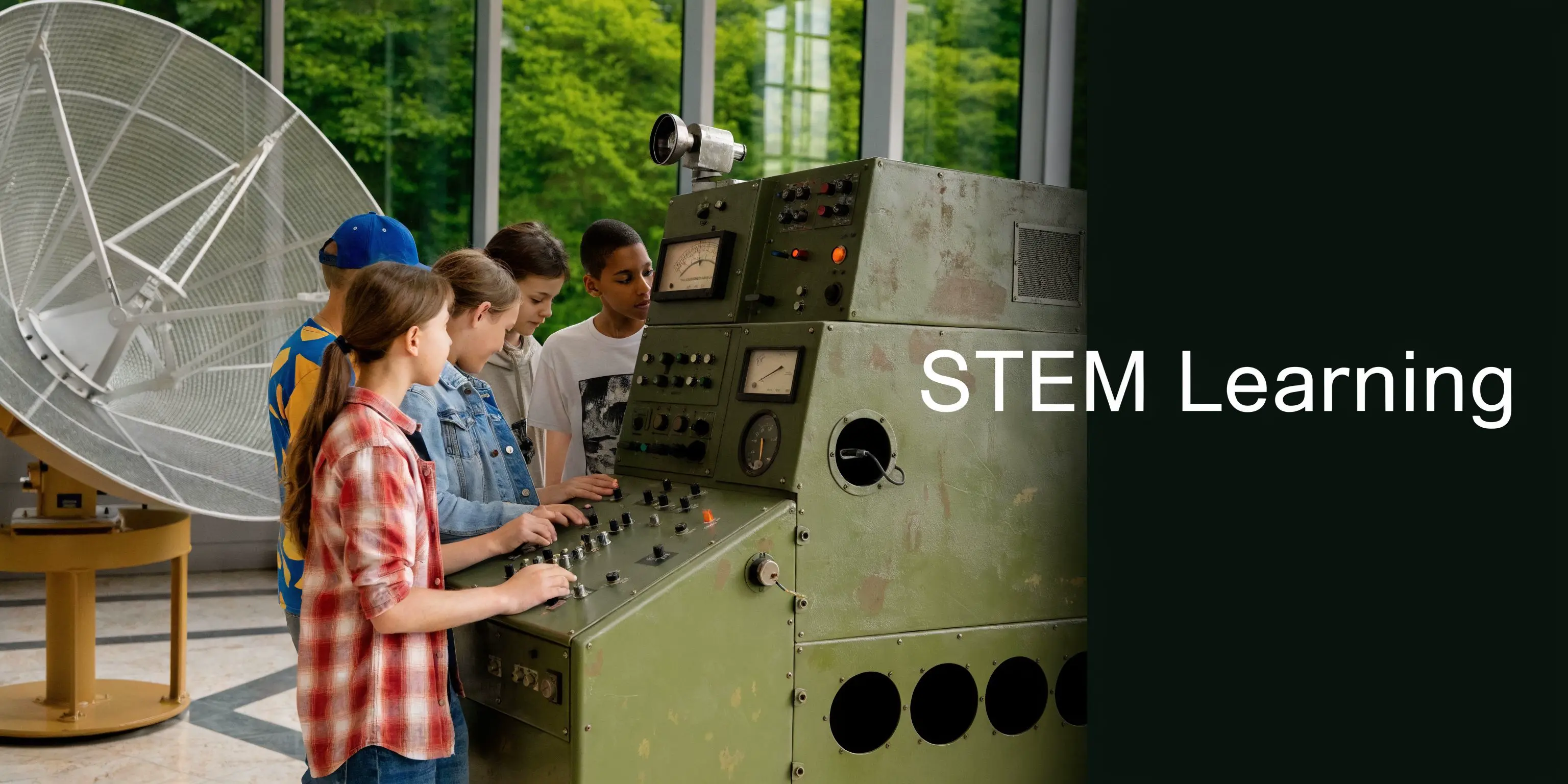
Bawdsey works well as an educational site because it joins physics, history, communication, and problem-solving in one place. A child can begin with a simple question such as “How can a machine detect something far away?” and end up discussing wartime decision-making, signal reflection, and teamwork.
For schools and family learning
Teachers often need a site that can support more than one subject outcome at once. Bawdsey can do that well if the visit is framed carefully. A school visit can prompt work on:
- •Science: waves, reflection, frequency, and signal behaviour
- •History: wartime Britain, defence systems, and social change
- •Design and technology: machinery, interface thinking, and systems
- •English: note-taking, questioning, and explanation writing
The strongest approach is to give pupils one “big question” before arrival. For example, ask them whether a machine can change history even if it remains unseen.
Podcasts and overlooked stories
The museum’s more recent interpretive work also helps widen the narrative beyond the earliest radar breakthroughs. The “Bawdsey Radar Presents Under the Radar” podcast launched in 2025 and covers underrepresented stories including the Cold War and Women in the WAAF, according to the podcast listing at Spotify. The same source notes a 15% rise in WWII/Cold War tourism and £500m+ in UK heritage funding for radar site preservation. For educators, that matters because it prevents the story from becoming too narrow. Students can explore not only invention, but also service, memory, gender roles, and how heritage is interpreted over time.
For teachers: use the podcast after the visit rather than before it. Pupils often engage better with overlooked voices once they’ve seen the physical site.
Turning a museum trip into a lesson sequence
A good Bawdsey learning plan often has three stages. First, introduce the science with a simple echo demonstration or classroom discussion about waves. Second, use the museum visit to gather evidence. Ask pupils to sketch one device, describe one room, and note one human role involved in making radar useful. Third, return to class and ask them to explain the full chain from transmission to action in their own words. For educators interested in interactive learning design, this broader idea of participation rather than passive viewing connects well with approaches discussed in gamification in education and learning engagement.
For researchers and independent learners
Adult visitors often want more than labels. They want context, terminology, and pathways for further reading. Bawdsey is strong when treated as a starting point for deeper research into radar development, defence networks, and local military heritage. If you’re planning educational use, keep the task design simple. Too many worksheets can flatten curiosity. A handful of well-chosen prompts usually produces better conversations than a packed booklet of disconnected questions.
Visitor Tips and Nearby Attractions
The best Bawdsey visits tend to be unhurried. This isn’t the kind of museum where you sprint through, take a photo of the main object, and leave satisfied. The material is technical, and technical museums reward slower looking.
Tips that improve the visit
One helpful habit is to do a first pass quickly, then return to the displays that raised questions. The first circuit gives you orientation. The second gives you understanding. A few practical habits make a difference:
- •Arrive with time to spare: rushing into a specialist museum makes everything feel harder to absorb.
- •Read object labels in sequence: radar stories are easier when you follow process, not random highlights.
- •Ask about guided interpretation: staff and volunteers often supply the missing human context.
- •Take notes, not just photos: a short written thought beside an object helps you remember why it mattered.
Photography and attention
Photography can be useful, but it can also flatten the visit. Radar consoles and rooms often look more impressive in person because their meaning depends on layout, not just appearance. If you do take photographs, focus on relationships rather than isolated objects. Capture how equipment sits within a room, how displays align, and how operators would have moved through the space.
A good museum photo answers a question later. A rushed museum photo usually just proves you were there.
Building a Suffolk day around Bawdsey
Bawdsey works especially well as part of a wider Suffolk itinerary. Visitors often combine technical heritage with coastal scenery, village stops, or other historic sites nearby. Depending on your interests, a day can be shaped in different ways:
| Visit style | Suggested rhythm | Best for |
|---|---|---|
| Half-day heritage trip | Bawdsey as the main stop, with a nearby meal or walk | Visitors focused on radar history |
| Landscape and history day | Museum visit plus coastal or riverside time | Couples, families, relaxed day-trippers |
| Research-led visit | Longer museum stay with notes and follow-up stops in the area | Students, enthusiasts, local historians |
Nearby places often appeal for different reasons. Some visitors look for castle or military heritage elsewhere in Suffolk. Others prefer estuary views, villages, or a quieter meal after the museum.
Making your day realistic
The mistake people most often make is overpacking the itinerary. Bawdsey itself is mentally demanding in a good way. By the time you’ve read, discussed, and absorbed the technical displays, you may not want another dense museum immediately after. A better approach is balance. Pair the museum with one lighter local stop. That could be a waterside walk, a heritage town, or a lunch break somewhere calm. If you’re travelling with children, let them alternate between concentration and movement. If you’re travelling with history enthusiasts, leave space for conversation afterwards. Bawdsey tends to generate discussion well beyond the site itself.
XR and Digital Interpretation Opportunities
Bawdsey has the kind of content that lends itself naturally to immersive interpretation. Radar is invisible by nature. That means visitors often need help visualising what the equipment was doing, how signals moved, and how operators turned abstract returns into decisions.
Why XR fits this site so well
An AR layer could show the path of a transmitted pulse moving outward from the site and returning from a target. A VR reconstruction could place visitors inside an operational room where they follow a signal from transmission to plotting. A short 3D animation could explain pulse timing and reflected energy far more clearly than a static panel can manage. Radar can be difficult to picture. The equipment is visible. The process is not.
Practical concepts that suit Bawdsey
Some interpretation ideas are especially strong here:
- •AR signal visualisation: hold up a device and see pulse paths overlaid on the view.
- •VR operator experience: let visitors stand in a recreated wartime workflow and make timed decisions.
- •Interactive console simulation: allow users to match returns with plotting actions.
- •Animated physics explainer: show pulse, echo, distance, and target movement in plain language.
For creative teams developing this sort of work, conceptual exercises such as the Museum of Impossible Futures can be a useful prompt for thinking beyond static interpretation and toward participatory storytelling.
Technical authenticity matters
Bawdsey’s history gives digital teams unusually concrete material to work from. The verified historical record supports modelling 360ft steel transmitter masts and 240ft wooden receiver masts, along with receiver aerial switching and phasing units for accurate simulation, as described in the earlier Bawdsey source material. That kind of specificity is gold for XR production because it grounds the experience in real infrastructure rather than vague “retro tech” styling. Another valuable detail is the operator workflow. Simulating console use, signal flow, and room relationships can teach visitors more effectively than presenting isolated artefacts in digital form. A good benchmark for museum-focused spatial interpretation is how digital content can increase dwell time without distracting from the collection itself, a balance discussed in AR for exhibitions and retail and increasing dwell time with spatial content.
The strongest digital outcome
The most effective XR layer at Bawdsey wouldn’t try to replace the site. It would reveal the invisible systems already present within it. That’s the central opportunity. The museum preserves the physical evidence. Digital interpretation can restore motion, sequence, sound, uncertainty, and scale.
Conclusion and Next Steps
Bawdsey earns its reputation because it connects a world-changing technical breakthrough with a site visitors can still experience directly. The buildings, equipment, and stories make radar understandable in human terms. If you're planning a visit, give yourself time, read sequentially, and treat the museum as both a history site and a lesson in systems thinking. If you teach, it offers rich ground for STEM and humanities work together. If you work in heritage or interpretation, it offers rare material for XR, AR, and animation that can reveal what static displays can’t easily show. A visit to radar museum bawdsey works best when it becomes more than a stop on a map. It becomes a way of seeing how ideas, machines, and people shaped one another under pressure.
If you'd like to turn complex heritage stories into animation, interactive exhibits, or immersive XR experiences, talk to Studio Liddell. Their team develops digital content for museums, education, and brands, with production expertise across 2D and 3D animation, apps, games, and spatial storytelling.