Virtual Reality Content Creation: A 2026 Guide
A VR pitch can look convincing in a meeting, then stall as soon as someone asks what headset it targets, how users will move, who will maintain the content, and what happens when the frame rate drops on site. That gap between an exciting concept and a deployable product is where many virtual reality content creation projects lose time, budget, and stakeholder confidence. The production challenge isn't solved by choosing Unity or Unreal, buying better hardware, or adding more visual detail. It's solved by aligning spatial storytelling, technical art, interaction design, testing, procurement, and rollout from the first brief. The UK already has the production depth to support that approach, but buyers need to treat VR as a complete content system rather than a short film placed inside a headset.
Defining Virtual Reality Content Creation in a Mature Market
A VR project can contain excellent modelling, spatial audio, or 360-degree footage and still fail during deployment. Interactive, spatial environments respond to a user's position, gaze, movement, input, and decisions. That definition covers real-time 3D scenes, guided training simulations, multiplayer games, virtual production assets, spatial audio, and 360-degree footage, but individual components do not determine whether the experience works. The defining test is user presence. Conventional animation controls the camera and sequence. VR content must account for where users look, what they can reach, how quickly they move, what they understand without a fixed frame, and how the system responds to unexpected behaviour. Spatial design for VR architecture and UX therefore belongs beside modelling, programming, sound, and production management, not after them.
The UK has an established production base
The UK has a developed immersive production market. Nesta estimated around 1,000 immersive specialist companies, employing about 4,500 people and generating £660 million in sales by 2018 to 2019. Estimates placed the UK at as much as 9% of the global immersive market, while a later 2019 report identified around 1,250 active specialist firms. The same Nesta's UK immersive economy report projected the VR entertainment market to grow from £118 million in 2018 to £294 million in 2023. That maturity changes the procurement conversation. A VR commission may need software engineering, technical art, content authoring, hardware preparation, user testing, and deployment support. These requirements reflect the production model, rather than a lack of maturity. Immersive work brings together disciplines that film and software teams often keep separate, so the budget must cover their coordination as well as the visible content. The operating environment sets the commercial test. A training deployment, public installation, or entertainment release needs different support, maintenance, and content decisions. Budget for the production system that keeps the experience usable after launch, then assess its value against the people, hardware, and conditions it must serve.
The End-to-End VR Production Pipeline
A reliable VR pipeline brings creative and technical decisions forward. Teams that wait until the final build to test interaction, comfort, or performance usually discover that a beautiful asset doesn't work at the scale, distance, or frame rate the experience requires.
Start with a spatial brief
The brief should define the audience, learning or commercial objective, target devices, environment, session length, user movement, accessibility needs, and deployment model. A museum installation, an enterprise training app, a location-based game, and a consumer Quest release may share a visual theme, but they need different interaction patterns, support plans, and quality controls. Spatial storyboarding follows. Instead of drawing only a sequence of shots, the team maps user position, points of attention, interaction zones, audio cues, transitions, and fallback states. A VR previz can use grey-box geometry in Unity or Unreal, placeholder sound, and simple controller inputs. It answers questions that a 2D animatic can't, such as whether a user can see the instructional panel while holding an object or whether a transition makes them lose orientation. The principles of a complete animation production pipeline still apply, but immersive work adds an important requirement. The production team must validate spatial behaviour before investing in final detail.
Build the experience in parallel
A practical hand-off sequence looks like this:
- Design the interaction loop. Define what the user notices, chooses, manipulates, and receives in response. Keep the first playable interaction deliberately simple.
- Block out the environment. Use primitive geometry to test scale, navigation, sightlines, and reach. A technically correct room can still feel too large, too empty, or uncomfortable.
- Create and classify assets. Artists model props, characters, and environments with target-platform budgets in mind. Technical artists prepare materials, levels of detail, colliders, lightmap settings, and import rules.
- Prototype engine integration. Engineers connect input, state changes, audio triggers, menus, save behaviour, and error handling. This work shouldn't wait for final art.
- Add lighting and sound. Baked lighting, reflection strategies, occlusion, and spatial audio can transform presence, but they also consume memory and processing capacity.
- Test on the actual deployment hardware. Desktop previews aren't enough. Test with real headsets, controllers, room layouts, network conditions, and the people who will support the rollout.
Technical Constraints and Platform Optimisation
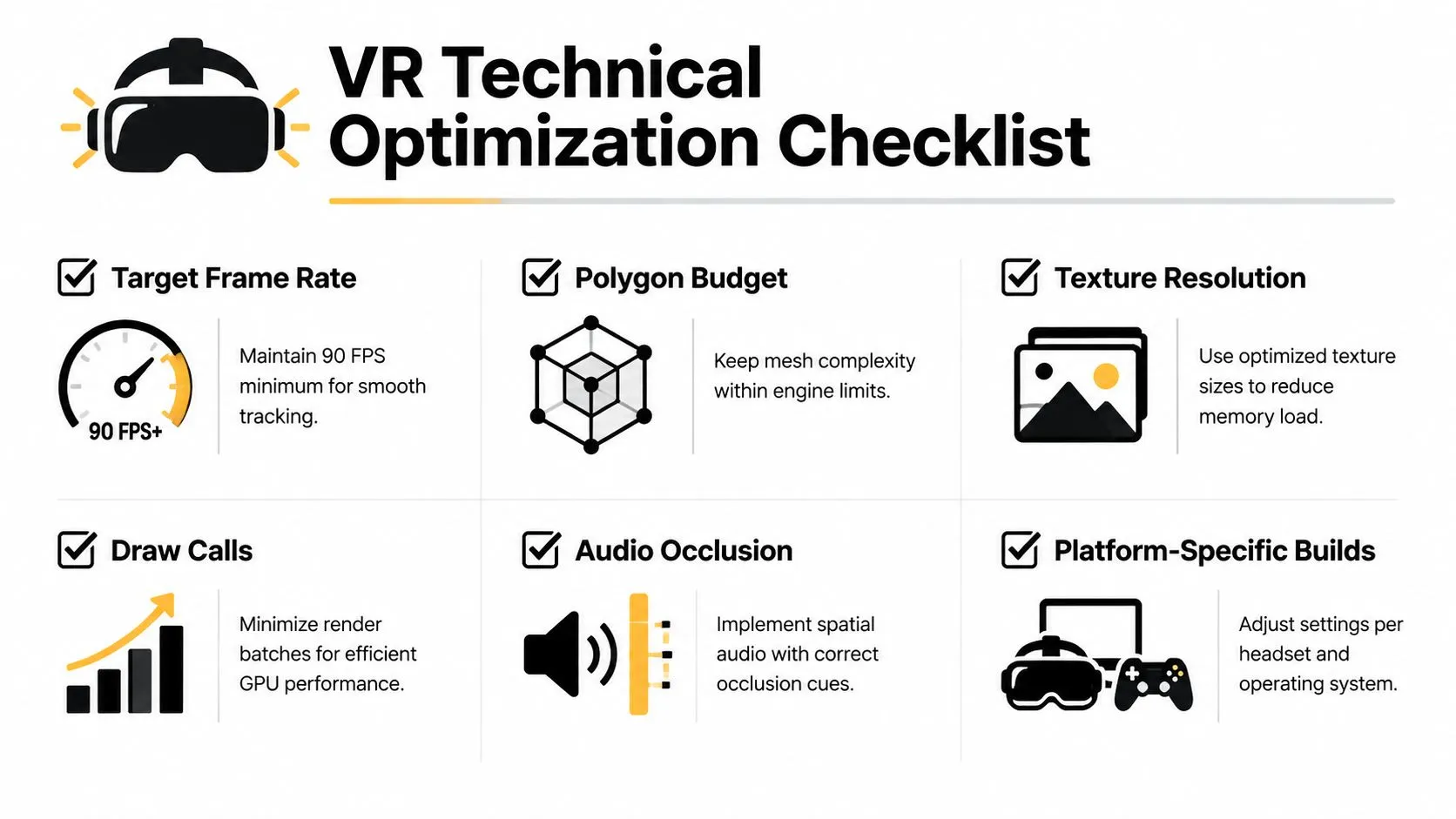
A headset doesn't care how persuasive the pitch deck looked. It has a fixed processing envelope, and the application must render the scene repeatedly while tracking the user, processing input, playing audio, and managing interaction. Standalone devices such as Meta Quest headsets place tighter limits on graphics and memory than tethered PC-VR systems. That doesn't make standalone VR visually weak. It means the art direction must favour controlled complexity, efficient materials, strong composition, baked or carefully managed lighting, and assets that hold up from the distance at which users see them.The metrics that shape creative decisions
Draw calls matter because each separate material or render batch can add work for the processor. A scene with fewer, well-organised materials may look better in motion than a more detailed scene that causes inconsistent rendering. Artists and engineers should identify repeated materials, atlas compatible textures, combine where appropriate, and review transparent surfaces early. Polygon count is only one part of the problem. A high-polygon object may be acceptable when it's close to the user, while a poorly optimised environment can consume resources through unnecessary geometry, dense colliders, or hidden assets. Levels of detail should be planned around user distance and movement, not applied as a late export setting. Texture memory affects loading, stability, and build size. Use appropriate resolutions, compressed formats, sensible UV layouts, and material reuse. A production team should review whether a surface needs a unique texture at all, particularly for background assets and repeated architectural elements. Lighting strategy needs an early decision. Baked lighting can deliver stable visual quality on constrained hardware, while dynamic lighting offers flexibility at a greater runtime cost. Mixed approaches can work, but they add complexity around shadows, reflections, moving objects, and scene transitions.Optimise for the real venue
The target isn't only a headset model. It's the complete operating condition. A training application may run in a bright room with changing boundaries. An exhibition build may face repeated launches, staff interruptions, and users who ignore instructions. A location-based experience may need rapid reset and dependable recovery after a controller disconnects.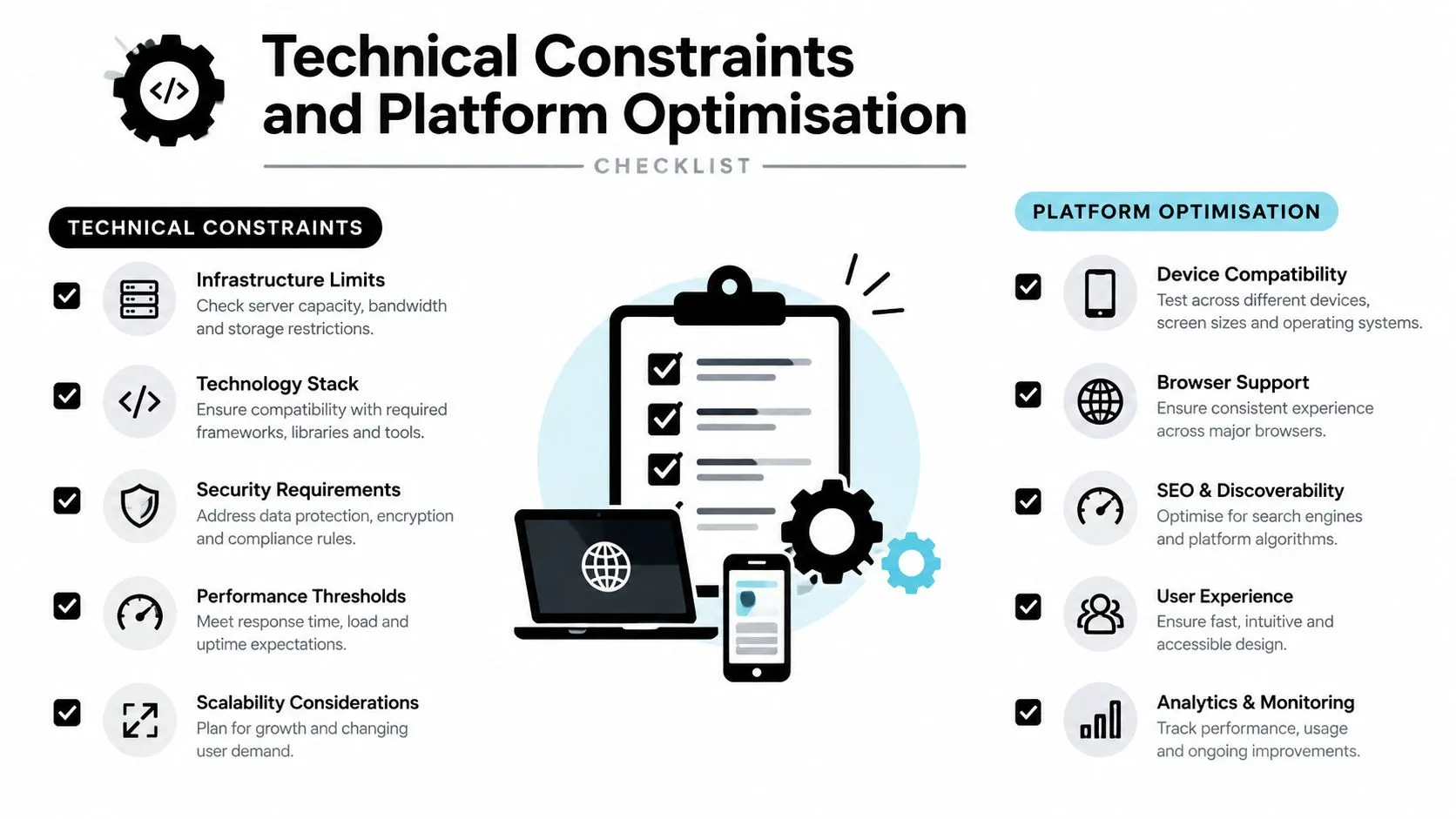 Run profiling sessions throughout production, not just before release. Review frame timing, memory behaviour, loading, tracking, audio transitions, and failure states on the intended hardware. A Unity VR development workflow for high-performance experiences can be appropriate for modular, device-focused deployments, while Unreal may suit projects where real-time visual fidelity and an established cinematic toolchain carry more weight. The engine decision should follow the production and deployment requirements, not personal preference.
 Structuring Cross-Disciplinary XR Teams
A conventional film team can create excellent assets and still struggle to ship a comfortable, interactive VR experience. A conventional game team can build systems and still produce an experience with weak pacing, unclear visual direction, or poor emotional performance. XR projects need both, connected by people who understand the trade-offs between them.Where the roles diverge
The technical artist is the bridge between visual ambition and runtime performance. This role establishes shader rules, export conventions, material libraries, levels of detail, lighting workflows, profiling routines, and platform-specific fixes. Without that bridge, artists may optimise assets in isolation while engineers repeatedly discover new rendering problems. The interaction designer or programmer turns a concept into a usable loop. They define input behaviour, affordances, feedback, locomotion, menus, state management, and recovery paths. In VR, a button isn't automatically obvious because it exists in 3D space. Users need visual, audio, and physical cues that explain what can be touched and what will happen next. The spatial audio designer shapes orientation and attention. Sound can direct users towards an object, signal an approaching event, or provide confirmation when a gesture succeeds. It also needs careful occlusion and level management, because a sound that feels subtle on a development rig may become distracting in a busy installation.Allocate budget around risk
Traditional production often places most creative effort in modelling, animation, cinematography, and post-production. XR reallocates some of that budget towards prototyping, technical art, device testing, interaction logic, analytics, and deployment support. Those roles aren't overhead added after the “real” work. They are part of the content. A small team can combine responsibilities, but it shouldn't remove the responsibilities themselves. One experienced technical artist may prevent weeks of rework, while a focused interaction prototype can expose a flawed concept before final assets arrive. The right staffing model depends on the target platform and ambition, but every project needs clear ownership of comfort, performance, interaction, content quality, and operational support.Practical rule: If nobody owns the experience after it leaves the studio, the production plan isn't complete.
High-Impact Use Cases and Sector Adoption
Commercial VR survives procurement when the experience solves a defined operational or sales problem. Engineering and manufacturing teams use immersive environments to explain complex systems, rehearse procedures, and support technical understanding. Retail teams use AR and VR to demonstrate products, configure options, and show scale or operation more clearly than a catalogue can. UK evidence identifies engineering and manufacturing as the strongest XR use area at 24.13%, followed by retail and consumer at 10.90% and professional services at 10.65%. Consumer engagement leads the application categories at 37.9%, with learning and development second at 21.7%. (UK XR market assessment) Together, these figures support a utility-led production strategy. An engineering project should improve understanding or operation, while a retail experience should help customers evaluate a product or option.Match the format to the job
Engagement experiences need an immediate hook, intuitive onboarding, and a short route to value. Learning experiences require scenario structure, feedback, assessment logic, and a clear connection between virtual actions and real-world capability. Those differences affect scope, interaction design, content review, and the evidence required for approval. Teams planning interactive learning can review interactive video software for e-learning before commissioning a fully immersive build. Interactive video may deliver the teaching outcome with less device friction, while VR earns its place when spatial practice, embodied action, or environmental context affects performance.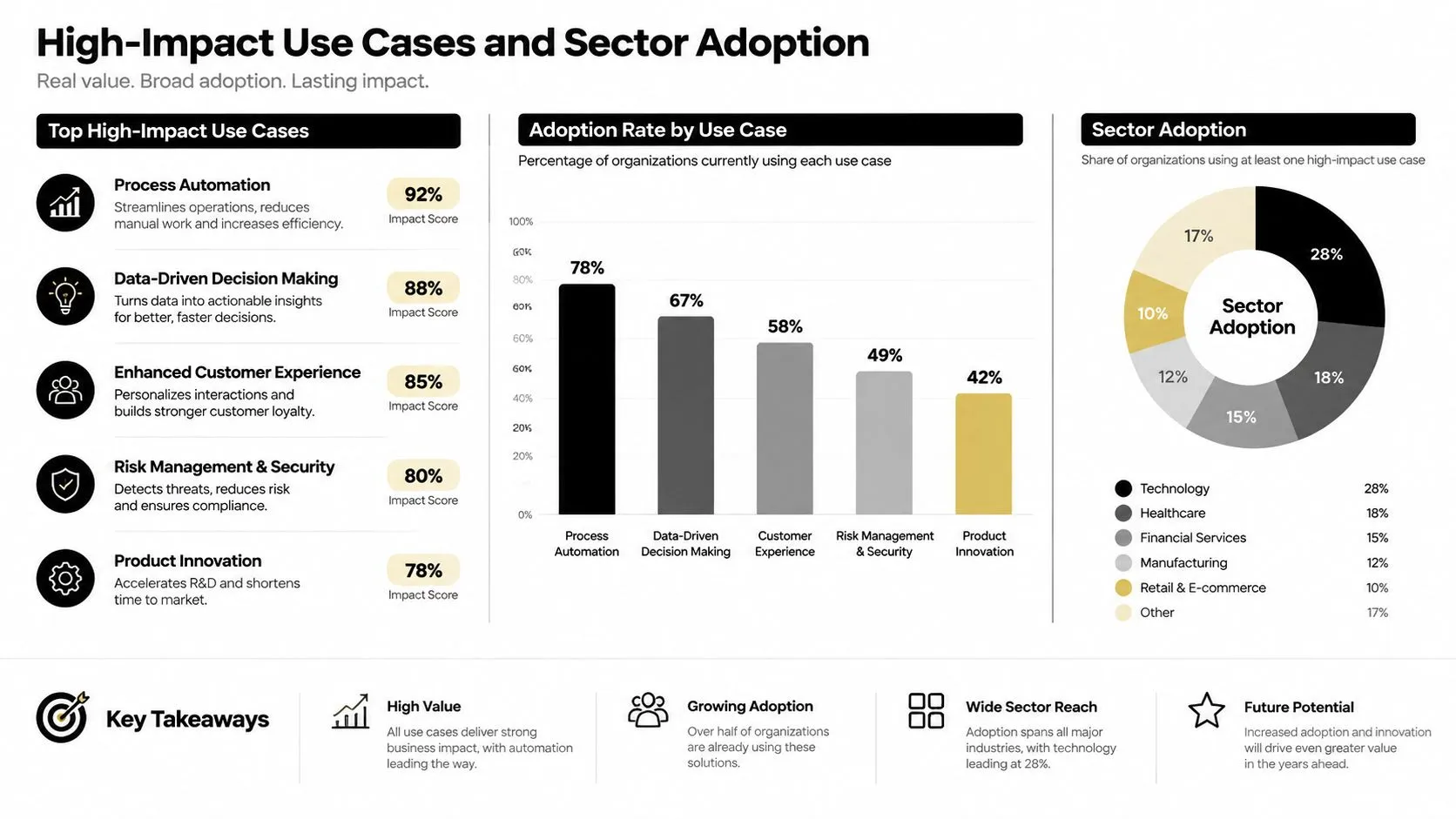 Healthcare shows why adoption data cannot be separated from deployment planning. A UK-wide report found XR use among over 60% of universities, compared with roughly 30% of NHS Trusts, while NHS deployment has been rising and 2025 was already nearing the previous peak deployment year. (UK XR healthcare landscape report) The product still has to pass governance, device management, privacy review, clinical input, training, and support requirements. Production teams should define the buyer's measurable outcome before building the experience. Events can track completed sessions and successful onboarding. Training can assess performance and repeat practice. Technical demonstrations can measure comprehension, qualified conversations, or stakeholder approval. Headset time alone rarely proves business value.
 Real-World Production Case Studies
A live mixed reality game and a cinematic VR short impose very different pressures. The first must onboard people quickly, survive repeated use, recover from interruptions, and keep operators informed. The second can prioritise performance, atmosphere, lighting, spatial sound, and controlled pacing because the audience enters a more carefully directed experience.