Location-Based VR (LBVR): A Producer’s Guide to Throughput, Safety, and ROI
At its heart, location-based entertainment (LBE) is any kind of entertainment you have to physically go to a place to enjoy. But within this broad category, Location-Based VR (LBVR) is the high-tech, high-immersion frontier. Think of the difference between watching a film on your laptop versus the collective gasp of a packed cinema during a blockbuster finale. LBVR takes that a step further, placing guests _inside_ the blockbuster. It swaps passive, solo viewing for active, shared participation in a virtual world.
The Resurgence of Shared Experiences
After years of screen time and digital bubbles, there's a real hunger for tangible, real-world activities that bring people together. This deep-seated human need for connection is fuelling a massive boom in the LBE world, with immersive VR at the cutting edge. People are genuinely excited to get off the sofa and step into spaces designed for pure fun and interaction. For brands and venue owners, this growing appetite for out-of-home entertainment is a huge opportunity. The magic lies in offering something special, an experience that simply can't be downloaded or streamed.
From Arcades to Immersive Worlds
LBE isn't a new idea. Arcades and theme parks have been crowd-pleasers for years. What _has_ changed is the technology. Leaps in virtual reality (VR) have completely torn up the rulebook on what an attraction can be. Today's LBVR spans everything from multiplayer free-roam arenas to city-wide augmented reality (AR) trails that paint a layer of digital magic over our world. These experiences often draw from the principles of experiential marketing, where the goal is to forge a memorable, hands-on connection between a person and a brand.
Location-based entertainment bridges the gap between digital content and physical reality. It's about crafting unforgettable, multisensory events that encourage social interaction and build lasting memories for every guest.
This market isn't just growing; it's accelerating. In the UK alone, the LBE market was valued at USD 1216.93 million and is on track to hit USD 2752.77 million by 2033. That's a compound annual growth rate of 9.55%, proving just how much demand there is for these unique experiences.
Why This Producer's Guide Matters
For anyone in the creative, production, or venue management space, this surge is a golden ticket. But pulling off a successful LBVR attraction takes more than a brilliant concept. You need to get your head around the operational practicalities.
- •Game Loop & Throughput: How do you design an experience that processes guests efficiently without feeling rushed, maximising revenue potential?
- •Staffing, Safety & Hygiene: What’s the plan for managing visitor flow, ensuring guest safety in an immersive environment, and maintaining impeccable hygiene standards?
- •Technology & Production: Which technology stack, from headsets to tracking, is right for your vision and robust enough for commercial use?
- •Monetisation Models & ROI: How do you build a business model that makes sense and delivers a clear return on investment?
Think of this guide as your roadmap. We’re here to break down the complexities of LBVR production, giving you the strategic insights needed to navigate this exciting industry and partner with an experienced XR studio to bring incredible new realities to life.
Exploring the Spectrum of LBE Experiences
Location-based entertainment isn’t just one thing. It's a huge spectrum of experiences, each one carefully designed to make an audience feel a certain way. Think of the adrenaline rush of a competitive VR game versus the quiet awe of an interactive art installation , the possibilities are endless. Getting a handle on this range is the first step to figuring out what makes sense for your brand and your space. Every type of LBE is built on what we call an "interaction loop", the simple cycle of a guest doing something and the system responding, which is what keeps people hooked. Let’s take a walk through this landscape to see what makes each type of experience tick.
High-Energy Free-Roam VR Arcades
Picture a big, open warehouse. You and your friends are inside, with no wires holding you back, free to physically walk, duck, and run through a completely digital world. That’s the magic of free-roam virtual reality. These experiences are all about adrenaline and playing together. The interaction loop here is fast and furious. Players might be teaming up to fight off hordes of zombies or battling it out in a sci-fi laser tag arena. It’s all about creating pure exhilaration and teamwork, making it an absolute winner for group nights out, corporate team-building, and anyone chasing a thrill.
- •Who it's for: Groups of mates, teenagers, and companies looking for a proper team-building day out.
- •Core Interaction: Moving around, aiming, talking to your team, and either working together or competing.
- •Emotional Connection: Excitement, adrenaline, friendship, and that brilliant feeling of achieving something together.
A great example is a game like Studio Liddell’s _Dance! Dance! Dance!_ It perfectly captures this vibe, creating a high-energy mixed-reality game that’s ideal for events where you need quick, fun, and memorable engagement.
Immersive Themed Attractions and Escape Rooms
Further down the spectrum, we find experiences that lean more into story and puzzle-solving than just pure action. Think of the big themed attractions at major parks or the new wave of digitally-enhanced escape rooms. Here, technology isn’t just a gimmick; it’s used to pull you deeper into the story and create a genuine sense of wonder. In these attractions, the environment is the main character. The interaction loop is a bit slower, more thoughtful. Guests have to explore richly detailed spaces, hunt for clues, and solve puzzles as a team to move the story forward. The goal is simple: make everyone feel like they’re the hero in their very own adventure film.
These story-driven experiences are incredibly powerful. They forge a real emotional bond through shared discovery and that lightbulb moment when you solve a puzzle together. When you finally succeed, it feels earned, making the payoff hugely satisfying for the whole group.
This style is perfect for family entertainment centres, museums wanting to build interactive exhibits, or any brand that has a compelling story to tell. It’s less about chasing a high score and more about the collective "Aha!" moment.
Contemplative AR Trails and Interactive Art
At the far end of the spectrum, you’ll find a more personal and subtle kind of LBE. Augmented reality (AR) trails use a smartphone or tablet to layer digital content over the real world, turning a walk in the park or a trip to a museum into a journey of discovery. In a similar vein, large-scale projection-mapped art installations can create stunning visual spectacles that invite you to just stop and reflect. The interaction here is usually individual and all about exploration. Someone might be following an AR-guided history tour, watching digital ghosts re-enact events on the very spot they happened. Or they might just stand, completely mesmerised, as the front of a familiar building melts into a canvas of light and sound.
- •Who it's for: Families, tourists, cultural spots, and anyone after a more relaxed, educational, or thought-provoking experience.
- •Core Interaction: Exploration, discovery, learning, and personal reflection.
- •Emotional Connection: A sense of wonder, curiosity, and feeling more connected to the physical place you’re in.
This incredible variety just goes to show how flexible LBE can be. Whether you want to deliver heart-pounding thrills or quiet moments of wonder, a talented production studio can design an attraction that clicks perfectly with your audience, your brand, and your business goals. The secret is matching the right tech and the right interaction loop to the exact feeling you want your guests to leave with.
The Technology Powering Modern LBE
Behind every jaw-dropping location-based entertainment experience is a powerful collection of hardware and software, all working in perfect sync. I like to think of it like a theatre production: you've got the stage (the hardware) and the actors performing a script (the software). Nailing both is absolutely essential if you want to create a world your guests can truly get lost in. Making smart technology choices is one of the most critical parts of planning any LBE project. These decisions ripple outwards, affecting everything from your initial budget and how many guests you can handle, to that all-important 'wow factor' that gets people talking long after they've left. Let's demystify some of this tech, turning complex jargon into confident, informed decisions. The concept map below shows the huge spectrum of LBE experiences, each powered by a distinctly different tech stack.
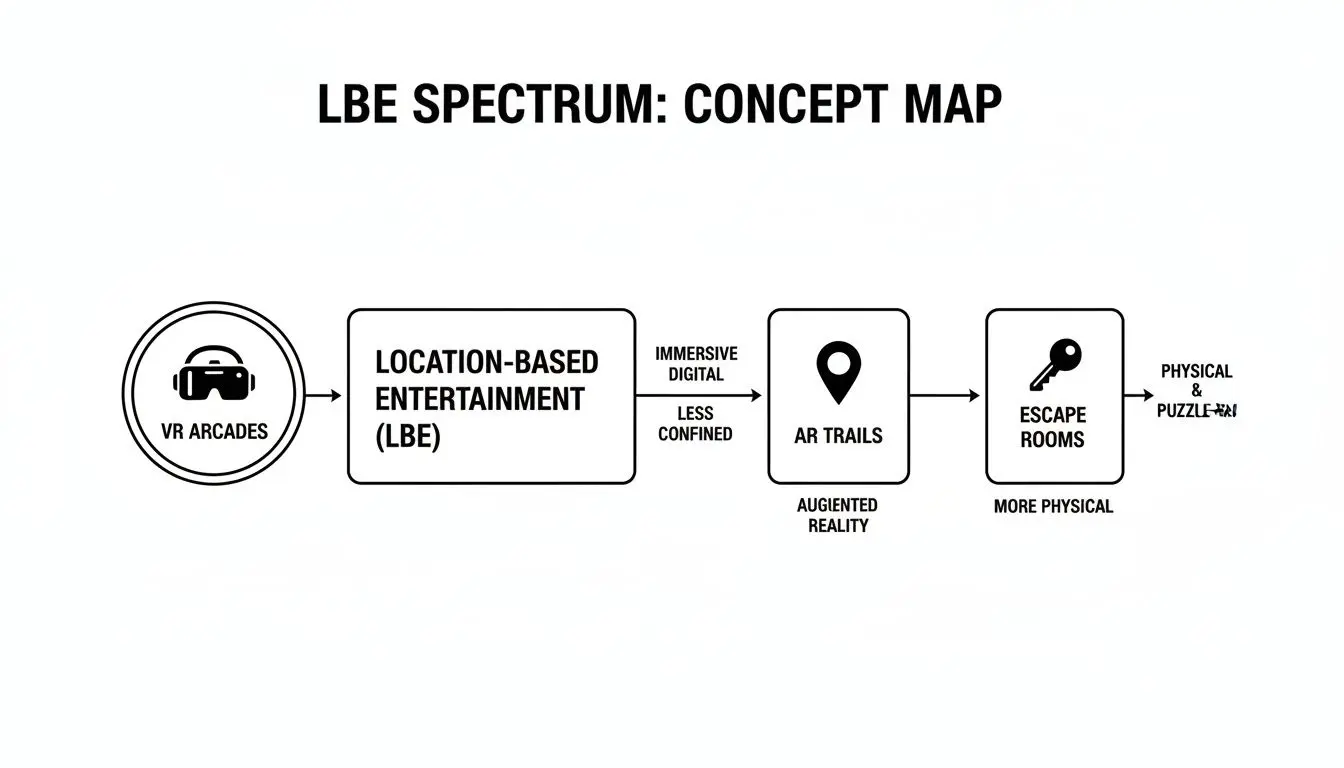
As you can see, different formats, from a fully digital VR arcade to a tech-boosted escape room, demand different levels and types of technology to hit the mark.
The Hardware Foundation
The hardware is all the physical kit your guests will see, touch, and wear. It's the tangible bridge connecting them to the digital world you’ve so carefully crafted. Picking the right gear is crucial, not just for immersion, but for smooth day-to-day operations. Key hardware components usually include:
- •Headsets and Displays: For VR, this means headsets like the Meta Quest or HTC Vive that completely transport a user to another reality. For AR and mixed reality, it might involve specialised glasses or simply using the screens of tablets and smartphones to overlay digital information onto the physical space. You can get a deeper dive into this in our guide to augmented reality experiences.
- •Tracking Systems: This is the unsung hero of immersion. Systems like inside-out tracking (using cameras on the headset) or outside-in tracking (using external sensors) are what allow a guest's real-world movements to be perfectly mirrored in the virtual one. Smooth, accurate tracking is completely non-negotiable for a believable experience.
- •Haptics and Peripherals: These are the brilliant tools that add a sense of touch and physical interaction. Think haptic vests that vibrate on impact, custom controllers shaped like wands or weapons, and motion platforms. They all help sell the illusion and make the immersion that much deeper.
A well-chosen hardware stack should feel almost invisible to the guest. The goal is for the technology to melt away, leaving only the experience itself. High operational costs for setup and maintenance are a major consideration, making robust, commercial-grade gear a very wise investment.
The Creative Software Engines
If hardware is the stage, then software is the performance itself. This is where the creative vision is spun into interactive reality, mostly using powerful real-time 3D platforms we call game engines. The two titans in the LBE space are:
- •Unity: Known for its incredible flexibility and huge asset store, Unity is a versatile engine that powers a massive number of VR and AR experiences. It's often praised for having a gentler learning curve and fantastic cross-platform support.
- •Unreal Engine: Famed for its breathtaking visual fidelity, Unreal Engine is the go-to for projects that demand photorealistic environments. It excels at creating the kind of jaw-dropping visuals that define many high-end LBE attractions.
Honestly, choosing between them comes down to your project's specific needs, it's a balancing act between visual ambition, development timelines, and your team's expertise. Beyond the engine, the audio experience is just as vital. For LBEs aiming for peak immersion, understanding how to use spatial audio can completely change the game, creating a truly believable sonic environment. It's the difference between just hearing a sound and feeling like you're truly _inside_ the soundscape. An experienced technical partner is crucial for navigating these choices and building a cohesive, reliable tech stack that brings your vision to life, flawlessly.
Designing for Throughput, Safety, and Engagement
A mind-blowing concept is a brilliant start, but it's the nuts and bolts of operations that turn a cool idea into a profitable, must-see destination. Success in LBVR really boils down to three things: getting guests through smoothly (throughput), keeping them safe and the equipment clean (safety & hygiene), and creating an experience so good they can't wait to come back. If you drop the ball on any one of these, the whole venture can falter. Operational design isn't just about managing queues. It's about choreographing the entire guest journey, from the moment they walk in to the second they leave. Every step needs to feel natural, efficient, and, most importantly, fun. This is where a great idea becomes a sustainable business.
Maximising Guest Throughput with a Solid Game Loop
Throughput is the engine of any LBE venue. Simply put, it’s how many people can enjoy the experience in a set amount of time. Higher throughput means more revenue, but it’s a delicate balance; you want efficiency that feels seamless, not rushed. The whole process kicks off with a frictionless onboarding sequence. This covers everything from clear instructions and getting people into VR gear quickly to tutorials that get them into the action without delay. A clunky or long-winded setup is a classic bottleneck and a huge source of frustration. A well-designed game loop is just as crucial. The experience needs a satisfying runtime, long enough to feel worth the money, but short enough to keep the line moving. For event-based attractions like _Dance! Dance! Dance!_, we designed a high-energy, quick-play loop that was perfect for getting as many people involved as possible without creating long waits.
Prioritising Safety, Hygiene, and Staffing
In a world that's more health-conscious than ever, visible and robust safety measures are non-negotiable. Guests need to feel completely at ease to immerse themselves in the fun. This is about more than just ticking health and safety boxes; it's about building trust from the ground up. Smart playspace design is your first line of defence. This means thinking about:
- •Physical Distancing: Making sure there's enough room for players to move freely and safely, which is especially important in free-roam VR where people are tuned out of their physical surroundings.
- •Guardian Systems: Using clear digital boundaries inside the virtual experience to warn users before they walk into a wall or another player.
- •Hardware Sanitation: Having rigorous and visible cleaning procedures for all shared equipment like VR headsets, controllers, and haptic vests.
Safety isn’t just a checklist; it's a core part of the guest experience. When visitors see a clean, well-managed environment and staff who are attentive and well-trained, they can relax and fully commit to the fun.
Great staffing is the final piece of the puzzle. Your team needs to be brilliant at guiding guests, fixing technical hiccups on the fly, and responding quickly to any situation. They are the human face of your technology and are critical for ensuring everyone feels secure and supported throughout their visit.
Building Lasting Engagement
Ultimately, you want to create fans, not just one-time customers. Real engagement is what drives repeat visits and, just as importantly, sparks powerful word-of-mouth marketing. It’s about crafting an experience that sticks with people long after they’ve left. A compelling story or a competitive hook is key. Whether guests are trying to smash their own high score, unlock the next chapter of a story, or go head-to-head with friends, you have to give them a reason to come back. This creates a cycle of re-engagement that fuels long-term success. On top of that, weaving in social elements can make an attraction massively more appealing. Things like leaderboards, team-based goals, and photo opportunities that are easy to splash across social media turn your guests into your best marketers. When someone shares an amazing photo or video of their time with you, they’re giving you an authentic, trusted endorsement. This user-generated content is pure gold for pulling in new crowds and building a real community around your venue.
Decoding Monetization Models and ROI
A jaw-dropping concept for your location-based experience is a brilliant start, but it's the financial plan that turns that vision into a lasting business. You need to get serious about how you'll make money and calculate your potential return on investment (ROI). This isn’t about plucking numbers from thin air; it’s about building a solid business case with a clear, realistic strategy. Let’s unpack the common monetisation models, separate the big upfront costs from the day-to-day running expenses, and walk through a simple way to measure success. Think of this as the financial playbook you need _before_ you spend your first pound.
Choosing Your Monetisation Model
There’s no magic bullet for monetising LBE. The right model comes down to your specific venue, the audience you’re trying to attract, and the kind of experience you're selling. Each approach creates a different rhythm and taps into different customer behaviours. Here are the most common strategies on the table:
- •Pay-Per-Play: This is the classic arcade model. Customers pay for each go, round, or session. It’s a low-commitment option that’s fantastic for pulling in casual visitors and works best for experiences with short, repeatable gameplay.
- •Time-Based Ticketing: This is the go-to for escape rooms and a huge number of VR arcades. Visitors buy a ticket for a set time slot, usually 30 or 60 minutes. This approach gives you predictable revenue and makes managing guest flow and staff rotas much, much easier.
- •Premium Ticketed Events: This strategy positions your LBE as a special, unmissable event. Think of exclusive, story-driven attractions or competitive e-sports tournaments that command a higher ticket price. It’s perfect for generating hype and attracting a dedicated crowd willing to pay more for something unique.
Choosing your model is a strategic decision. A pay-per-play arcade encourages spontaneous fun, while a premium ticketed event builds anticipation and a sense of exclusivity. Your model should align perfectly with the experience you are selling.
An emerging, though less common, option is the subscription model. Here, members pay a monthly fee for a certain number of visits or special access. This can build a fiercely loyal community, but it demands a constant stream of new content to keep people from cancelling. For a wider view on revenue options, our guide on proven mobile app monetization models has some great insights that can easily be adapted for LBE.
Comparing LBE Monetization Models
To help you decide, let's break down how these primary models stack up against each other. Each has its own strengths and is better suited to different types of experiences and business goals.
| Model | How It Works | Best For | Pros | Cons |
|---|---|---|---|---|
| Pay-Per-Play | Customers pay for each individual game or attempt. | Arcades, short-loop games, high-footfall areas. | Low barrier to entry for customers; encourages repeat plays. | Revenue can be unpredictable; lower average spend per visitor. |
| Time-Based Ticketing | Customers book a specific time slot for a fixed price. | VR arcades, escape rooms, structured experiences. | Predictable revenue stream; simplifies scheduling and staffing. | Can feel restrictive for some customers; potential for empty slots. |
| Premium Ticketed Events | Higher-priced tickets for exclusive, one-off, or limited-run events. | Immersive theatre, e-sports tournaments, narrative attractions. | High revenue per ticket; creates buzz and exclusivity. | Requires significant marketing effort; higher pressure to deliver. |
| Subscription | Members pay a recurring fee for access. | Venues with a loyal local community and evolving content. | Creates stable, recurring revenue; fosters a strong community. | Needs constant new content to justify the cost; high churn risk. |
Ultimately, the best model is the one that fits the story you're telling and the audience you're serving. You can even blend models, offering standard ticketing alongside special premium events to capture different segments of the market.
Understanding Your Cost Structure
To figure out your ROI, you first need a brutally honest picture of your costs. High operational expenses are a real challenge in the LBE market, so it's vital to separate what you spend to open the doors from what you spend to keep them open. Upfront Capital Expenses (CapEx) This is your initial, one-time investment to get everything up and running.
- •Development & Content: The cost of partnering with a studio to design, build, and test your custom software and the interactive experience at its core.
- •Hardware & Fit-Out: All the gear, VR headsets, tracking systems, PCs, haptic suits, plus any physical construction needed to create the playspace.
Ongoing Operational Expenses (OpEx) These are the recurring costs of running the business day in, and day out.
- •Staffing: Wages for your guides, technicians, and front-of-house team.
- •Rent & Utilities: The cost of your physical location and the electricity to power it all.
- •Maintenance & Licensing: Ongoing software licences and a support plan to keep your hardware in perfect working order.
- •Marketing: The budget you need to get people through the door consistently.
Calculating Your Potential Return on Investment
Once you have a clear view of your revenue model and your costs, you can start forecasting your ROI. A simple way to tackle this is to calculate your break-even point and then project your path to profitability. Start by working out your maximum potential daily revenue. For a time-based ticketing model, the formula is nice and straightforward: (Ticket Price) x (Guests Per Session) x (Sessions Per Day) = Max Daily Revenue Next, calculate your daily operational cost. Once you have those two numbers, you can work out how many tickets you need to sell each day just to cover your OpEx. Any revenue beyond that point starts paying back your initial capital investment and, eventually, becomes pure profit. This simple calculation gives you a powerful benchmark to see if your LBE project is financially viable from the get-go.
Choosing the Right Production Partner for Your LBE Project
Taking a brilliant idea for location-based entertainment and turning it into a packed-out venue hinges on one thing: finding the right creative and technical partner. Think of your production studio as more than just a supplier; they’re the architects and engineers bringing your vision to life. Finding a team that gets your commercial goals is every bit as important as finding one with dazzling technical skills. The real work starts long before anyone writes a single line of code. It all kicks off with collaboration, usually beginning with an initial concept and feasibility workshop. This is where a great studio immediately proves its worth, pressure-testing ideas and exploring what’s genuinely possible within your budget and physical space. They should be asking the tough questions about your business model, not just fawning over the creative brief.
What to Look for in a Studio
When you're vetting potential partners, a solid portfolio of proven work is non-negotiable. You need to see a studio with a clear track record of creating high-quality, interactive experiences that people actually want to engage with. Their showreel should get you excited, but it's their case studies that should give you confidence. Beyond their past projects, you’ll want to dig into their core capabilities:
- •Technical Skills: Deep expertise in industry-standard engines like Unity and Unreal Engine is a must. Ask them about their development pipeline and, crucially, their experience with the specific hardware you're thinking of using.
- •Collaborative Spirit: The best results come from partnerships built on open communication and a shared passion for the project. You need a team that will listen, but also challenge you, working together to make the final product even better than the initial concept.
- •Commercial Acumen: A truly great studio understands that LBE is a business. They should be just as focused on operational realities, like guest throughput, safety, and your return on investment, as they are on the creative execution.
Choosing a partner is really about finding a team that sees the bigger picture. They should be as invested in the long-term success of your attraction as they are in building something cool. This blend of artistry and commercial focus is the hallmark of a top-tier studio.
From Prototyping to On-Site Support
Once you’ve found the right fit, the process typically moves into prototyping, which is your chance to test the core mechanics and map out the user journey. This is followed by full-scale development, asset creation, and rigorous testing before the big launch. A dedicated partner won't stop there; they’ll provide on-site installation and ongoing support to ensure everything runs flawlessly from day one. For more tips, check out our guide on how to choose the right VR game development company. The UK’s appetite for shared experiences is only getting stronger. Cinema revenues alone are projected to climb from £1.14 billion to £1.37 billion by 2029, proving the enduring power of getting people together for some fun. A studio with a heritage in film, TV, and XR is perfectly placed to tap into this demand, creating location-based entertainment that captures that same magic. You can discover more insights about this trend and the UK's entertainment and media landscape on PWC.co.uk. Selecting a partner with this breadth of experience ensures your vision is not just built, but built to succeed.
Common Questions About LBE Production
If you're looking to dip your toe into the world of location-based entertainment, you’re probably juggling a few big questions. It's only natural. Getting your head around the practicalities early on is the key to building a solid business case and making sure launch day goes off without a hitch. Let's break down some of the most common queries we get from producers and venue owners.
How Much Does a Custom LBE Experience Cost?
This is the big one, and the honest answer is: it varies wildly. A simple, single-user interactive kiosk might be in the low thousands, but a sprawling, multi-user, free-roam VR adventure? That could easily climb into six or even seven figures. So, what moves the needle on the price tag? It usually boils down to a few key things:
- •Graphical Fidelity: Are we talking hyper-realistic environments or something more stylised? The more detail and realism you want, the more it costs.
- •Interactivity & Duration: A short, simple interaction is one thing. A complex, branching narrative that lasts 20 minutes is another beast entirely.
- •Hardware Requirements: The cost of headsets, tracking systems, haptic vests, or any custom-built controllers all play a big part.
The only way to get a real number is to talk specifics. A detailed production scoping call is where we can pin down a precise quote based on your vision.
What Is a Typical Development Timeline?
Just like cost, the timeline is completely tied to the project's complexity. A straightforward AR app or a contained VR game could be up and running in as little as 3-4 months. On the other hand, if you're dreaming up a flagship theme park attraction with bespoke hardware and a deep story, you could be looking at a development cycle of over a year.
We always break production down into clear phases: concept design, prototyping, asset creation, full development, and finally, on-site testing and installation. Critically, we build buffer time into that schedule for feedback and tweaks. Trust us, you’ll be glad it’s there.
What Are the Biggest Operational Challenges?
Once you're open, the challenges shift. The three hurdles we see most venues face are managing guest flow, keeping the tech spotless and working perfectly, and training your staff to be brilliant guides, not just operators. A slick, well-designed onboarding process is your best friend here , it gets people into the fun quickly and cuts down on confusion. Also, don't skimp on the hardware. Investing in robust, commercial-grade equipment and having a solid support plan in place will save you a world of headaches, minimise downtime, and keep your visitors coming back for more.
Ready to turn your LBE concept into a commercial reality? Studio Liddell has the technical expertise and creative vision to guide you from pitch to launch. Request an LBVR feasibility worksheet