Our World Games: Digital Worlds for Engagement & ROI
If your team says it wants a game, do they really mean a game, or do they mean a digital world that can teach, sell, onboard, and retain attention far longer than a landing page ever will? That distinction matters. A lot of executives still group immersive worlds with consumer entertainment, novelty VR demos, or youth platforms. In practice, Our World games can operate as structured business assets. They can become training environments, branded education spaces, community hubs, or persistent product experiences that keep working after launch.
Beyond the Hype What Are Our World Games
The first thing to clear up is the name. Our World games are not the same thing as The World Games sports event. The World Games is a real international multi-sport event held every four years under the International World Games Association. It features 25, 34 non-Olympic sports, including ferris, taekwondo, and squash, and the 2025 Birmingham edition delivered over £12M in UK regional economic impact, according to the cited summary at The World Games overview.
That event matters in its own right, but it isn't what decision-makers usually mean when they talk about building a persistent digital world.
A business asset, not a novelty build
In studio terms, an Our World game is a persistent interactive environment built around a defined outcome. That outcome could be training staff, helping customers understand a complex product, building long-term loyalty around an IP, or creating an educational space people return to repeatedly. A brochure site presents information. An app often solves a narrow task. An Our World experience does something different. It creates a place users can enter, act within, learn from, and revisit.
Practical rule: If the project only needs a single passive interaction, it probably doesn't need a world. If it needs memory, progression, repeat use, and shared behaviour, a world starts to make sense.
Where buyers often get it wrong
The common mistake is treating immersive worlds like oversized marketing campaigns. That usually leads to budget being spent on visual spectacle before anyone defines why users would return. The better approach is to ask four blunt questions early:
- •Who returns, and why? A world without repeat value becomes an expensive one-off.
- •What changes over time? Persistent spaces need state, progression, or evolving content.
- •What behaviour matters? Training completion, product exploration, community participation, or knowledge retention each shape the build differently.
- •What lives after launch? Content updates, moderation, analytics, and support aren't optional extras.
A useful way to frame it is this. A traditional campaign tries to win attention for a moment. An Our World game tries to earn a place in someone's routine. That's why these projects sit closer to digital product thinking than campaign thinking. They need a purpose, a systems plan, and a realistic operating model from day one.
Defining the Our World Experience
An Our World experience works best when clients stop thinking about levels and start thinking about digital place-making. The strongest comparison is not a short-term activation. It's a permanent digital headquarters.
Persistence matters more than spectacle
Persistence is the feature many non-technical buyers underestimate. In a persistent world, the environment keeps its state. Users can return to progress, areas made available, saved achievements, custom spaces, or community changes. That single design choice changes everything. It affects data structure, content planning, moderation, and live support. A polished one-off VR app can look impressive in a pitch room. It often disappoints after launch if there's no reason to come back. Persistence is what turns immersion into habit.
Four pillars that separate a world from a demo
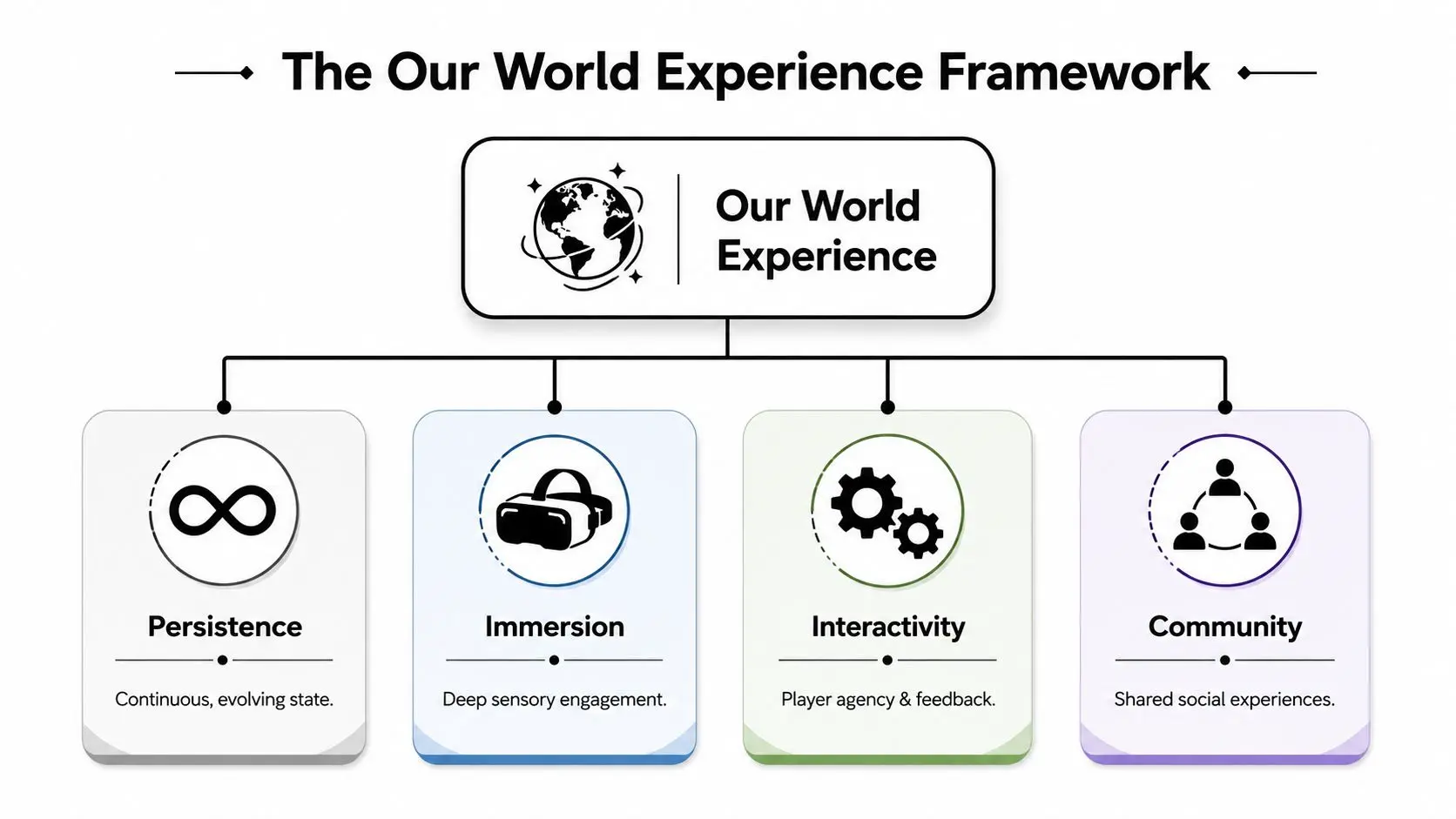
The core architecture usually rests on four pillars:
- •Persistence means the space has continuity. Things are saved, updated, and revisited.
- •Immersion means the world feels coherent. Art direction, sound, camera logic, and UI all support presence.
- •Interactivity means users can do more than watch. They can manipulate, test, build, choose, or collaborate.
- •Community means people don't just consume the experience alone. They can share, compare, co-operate, or compete.
Those pillars don't need equal weight. A training world may prioritise persistence and interactivity over community. A branded fan environment may lead with community and immersion. What matters is that the mix is intentional.
A world fails when one pillar is sold in the deck but missing in the build.
What it is not
An Our World game is not merely a linear title with a menu screen and a few explorable scenes. It also isn't just a standalone headset experience with limited replay value. That distinction helps in procurement. Buyers often compare unlike-for-like proposals because suppliers package them all as immersive. A guided simulation, a digital twin, a multiplayer world, and a narrative VR short are not the same product category. A practical test helps. If the project depends on users revisiting the same digital environment and finding new value there, you're commissioning a world. If the project is complete after one pass, you're probably commissioning a contained experience.
Purpose is the organising principle
The final pillar is purpose, even if it sits behind the other four. Strong Our World games are coherent because every design decision answers a business or learning objective. If the purpose is training, mechanics should reinforce safe repetition, assessment, and recall. If the purpose is brand loyalty, the world should reward exploration, identity, and ongoing participation. If the purpose is education, the environment should support understanding, not just visual novelty. Without that central purpose, teams overbuild environment art and underbuild systems. That's one of the costliest mistakes in immersive production.
Strategic Use Cases for Business and Education
The UK market context matters because it shows this isn't fringe behaviour. The sector is projected to reach £8.2 billion by 2026, 10.84 million people in the UK played online video games in 2023, and 91% of children aged 3, 15 are active players, according to IBISWorld's UK video games industry profile. For commissioners, that means digital world logic is already culturally familiar across age groups. The more useful question is where that familiarity converts into practical value.
Our World game applications by sector
| Sector | Primary Goal | Key Features | Example Scenario |
|---|---|---|---|
| Corporate | Training and operational readiness | Persistent progress, repeatable scenarios, assessment loops | A safety onboarding world where staff rehearse procedures and managers review completion |
| Education | Active learning and retention | Interactive experiments, role-play, teacher controls | A history environment where learners explore a reconstructed site and complete guided tasks |
| Marketing and brand | Loyalty and product understanding | Social spaces, unlockable content, product interaction | A branded product world where customers explore features and attend virtual launches |
Corporate use cases that justify the spend
In enterprise settings, the strongest projects focus on repetition and consequence. That usually means onboarding, process training, equipment familiarisation, or scenario rehearsal. A flat e-learning module can tell someone what to do. A world can let them practise the sequence, make mistakes safely, and repeat the task until behaviour sticks. That changes the value conversation from content production to capability building. What doesn't work is importing consumer game mechanics with no operational relevance. Points, badges, and cosmetic rewards won't rescue a weak training model.
Education works when interaction serves the lesson
Schools, universities, museums, and learning publishers have a stronger opportunity than many realise. Learners don't need an open-ended sandbox every time. They need environments where agency supports comprehension. For educators exploring game-led teaching structures, mastering classroom games is a useful external read because it grounds game-based learning in classroom practice rather than hype. A strong education world usually includes:
- •Guided exploration so learners know what to investigate first.
- •Meaningful actions such as assembling, testing, comparing, or role-playing.
- •Visible feedback so learners understand why a choice worked or failed.
- •Teacher control over pace, access, and review.
Brand and loyalty use cases
Marketing teams often approach immersive worlds too late. They start with a campaign concept and then try to stretch it into a persistent environment. The better route is to define the post-campaign value. Will users return to discover product updates, community events, collectables, tutorials, or utility features? If not, a world may be the wrong format.
The commercial advantage isn't just attention. It's sustained participation around a brand, product, or subject area.
For complex products, the upside is especially clear. When buyers need to understand how something works, static visuals often stall at explanation. Interactive environments let users inspect, compare, test, and revisit. That's a stronger foundation for informed purchase behaviour and stakeholder buy-in.
Key Technical and Design Considerations
Most project risk sits in a handful of early choices. Clients often think the hard part starts in production. It starts earlier, when the team decides what platform to support, what visual fidelity to aim for, and how much systemic complexity to put inside the world.
Platform choice changes the whole project
A mobile-first build reaches more people but forces stricter decisions on rendering, control schemes, and session length. A PC build gives more visual and simulation headroom but narrows access. VR delivers stronger presence, though hardware friction, comfort, and deployment logistics become real constraints. That means the right platform isn't the most exciting one. It's the one that best fits the audience, the environment of use, and the business goal.
Art style is a production decision, not just a creative one
Photorealism sounds attractive in stakeholder meetings. It also raises the bar on modelling, texturing, lighting, optimisation, and device performance. Stylised art can be the smarter choice when a world needs to scale, update regularly, or run across mixed hardware. It also tends to age better. Highly realistic worlds can look dated quickly if the budget doesn't sustain the full quality level across every asset. A good producer asks whether realism is doing useful work. In training, it may improve recognition and transfer. In education or branded experiences, clarity and consistency often matter more.
Systems design deserves board-level attention
A persistent world is as much a systems problem as a creative one. Account logic, data persistence, multiplayer rules, moderation tools, admin controls, telemetry, and content delivery all affect the user experience. Teams that need a plain-English refresher on structuring those choices can get value from this practical system design guide, especially when preparing for technical scoping conversations. Here are the trade-offs that usually matter most:
- •Open interaction vs guided paths. Freedom increases discovery, but it can also dilute outcomes.
- •Real-time multiplayer vs asynchronous use. Shared presence can deepen engagement, but it adds operational complexity.
- •Dense mechanics vs simple loops. Rich systems can improve depth, though they increase onboarding effort and production overhead.
- •Centralised content vs user-generated input. User agency can extend life, but moderation and quality control become harder.
A lot of failed immersive builds aren't creatively weak. They're structurally over-scoped.
The smartest early decision is often restraint. A tightly designed world with clear loops will outperform a sprawling environment with too many unfinished systems.
The Production Pipeline and AI-Enhanced Workflows
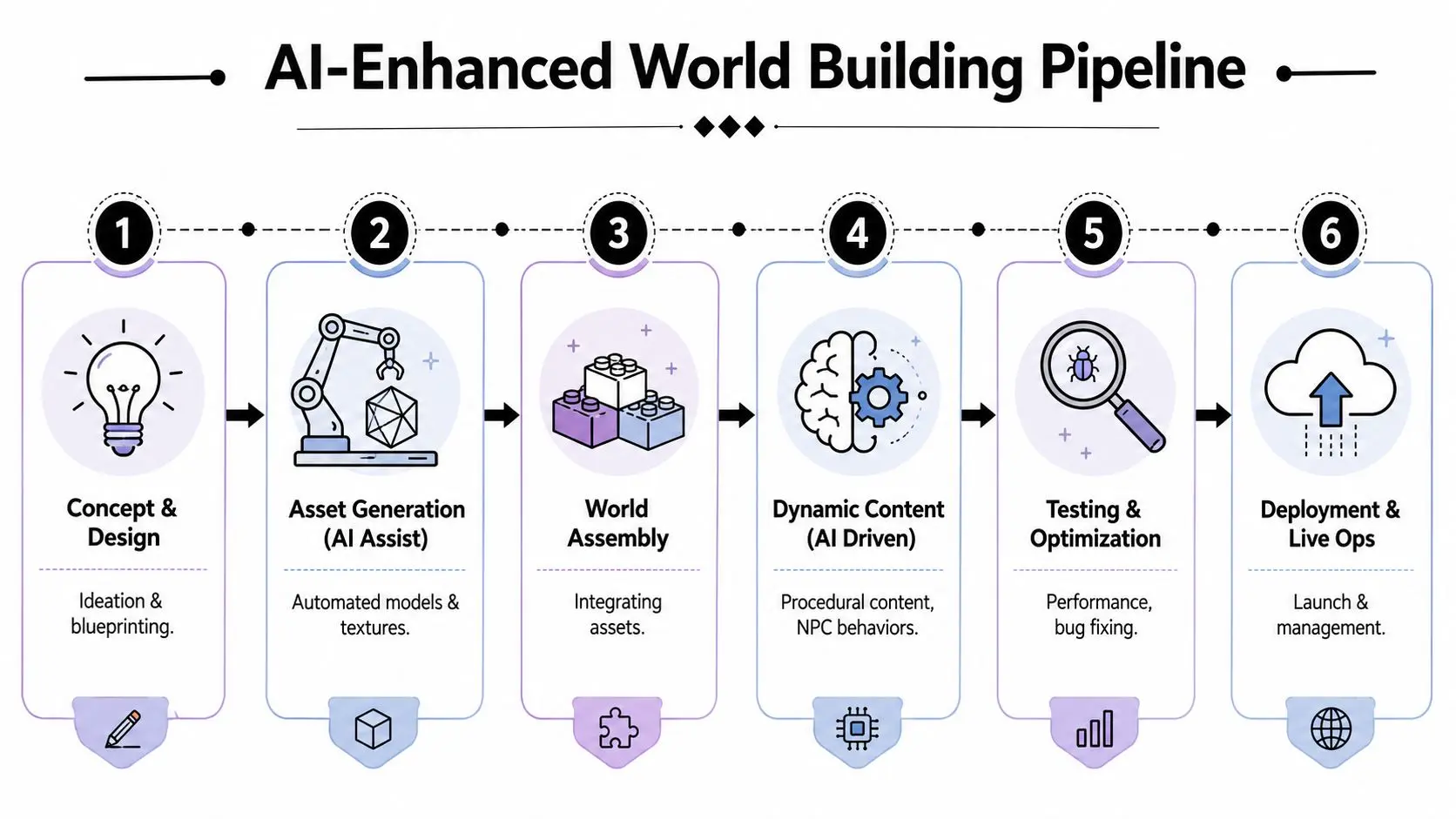
Teams that haven't commissioned interactive production before often assume world-building is a single design pass followed by coding. In reality, it's a phased pipeline with a lot of dependency between creative, technical, and operational work.
Pre-production is where cost control starts
The most valuable documents are rarely glamorous. A solid brief, game design document, technical specification, content map, and analytics plan save more budget than late-stage visual fixes ever will. This is the point where the team decides:
- Core loop. What users do every session.
- World rules. What persists, what resets, what becomes available.
- Content scope. What must ship now, and what can wait.
- Success criteria. What behaviour proves the world is working.
Production combines asset craft and engineering discipline
Once the blueprint is stable, production splits across parallel tracks. Artists build environments, props, characters, interfaces, and effects. Designers prototype interactions and progression. Engineers wire systems, persistence, networking, and platform-specific behaviour. In UK production, C++ for Unreal Engine and C# for Unity are core competencies, and when teams integrate AI-powered tools into Unity and Unreal pipelines, production time can be reduced by 40%, according to the cited summary at the Brighton overview referencing XR game development skills and AI-enhanced workflow gains. That matters because AI isn't replacing pipeline fundamentals. It's helping teams move faster inside them.Where AI genuinely helps, and where it doesn't
Used well, AI can speed up concept iteration, support texture and asset variation, assist scene dressing, automate parts of QA, and help teams test content combinations faster. For creators exploring visual ideation workflows, this guide to AI scenes for creators is a useful companion read. It doesn't remove the need for art direction, engineering review, or human QA. In world production, that's the line many buyers need to understand. AI can accelerate throughput. It doesn't solve coherence by itself. Useful AI-assisted areas often include:- •Early concepting for visual directions and layout options.
- •Asset support for draft geometry, variants, and material exploration.
- •Content iteration for larger libraries of props, scenes, or simple behaviours.
- •Testing support for repetitive checks and issue spotting.
The strongest teams combine those gains with established process. For a more business-facing view of that operational shift, AI development services and business potential gives helpful context.
Launch isn't the finish line
Persistent worlds become products after release. They need monitoring, analytics, updates, support, and occasional content refreshes.
Ship day is when the operating model starts proving itself.
If the commission includes no post-launch ownership plan, the world may still launch successfully, but it won't mature. That's the gap between a polished build and a durable platform.
Measuring Success and Calculating ROI
Immersive projects get judged badly when stakeholders use the wrong yardstick. Page views and download counts don't tell you much about whether a world is doing its job.

The metrics that actually matter
For most Our World games, performance comes down to behaviour over time. The KPI set should match the project's purpose. For example:
- •Adoption asks whether the intended audience entered the world at all.
- •Session quality looks at repeat visits, depth of interaction, and progression.
- •Completion measures whether users finished the task, lesson, or flow.
- •Outcome linkage connects in-world behaviour to a business result outside the platform.
That last point is the one senior stakeholders care about. If the world is for training, did it reduce error rates or improve readiness? If it's for marketing, did it improve product understanding and move prospects forward? If it's for education, did learners complete the intended activities and demonstrate comprehension?
Use immersion where explanation is hard
There's a strong commercial logic behind product-led immersive experiences. Product videos and 3D visualisations can boost conversion rates by up to 80%, because they help people understand what they're buying, according to Hatch Studios on 3D animation production and marketing conversion. A persistent world can extend that same principle by giving users a place to explore rather than a clip to watch once. That doesn't mean every product needs a world. It means a world becomes compelling when understanding, trust, and repeat engagement are central to the sale.
Build the ROI model before production starts
A basic ROI framework should be agreed before anyone commissions full production:
| Measure type | What to track | Why it matters |
|---|---|---|
| Engagement | Return visits, session depth, feature use | Shows whether the world has durable value |
| Learning or task success | Completion, retries, accuracy, decision paths | Indicates whether users are actually improving |
| Commercial impact | Lead progression, assisted sales, stakeholder approval | Connects interaction to revenue or procurement movement |
| Operational efficiency | Support reduction, training delivery consistency, content reuse | Captures savings that don't show up in campaign metrics |
For teams comparing immersive formats, augmented reality advantages for ROI and engagement is a useful internal reference point because it frames return in business terms, not novelty terms. The key discipline is simple. Decide what success looks like before the first asset is built. If ROI is only discussed after launch, the project was governed like a campaign, not a product.
Commissioning Your Own World How to Choose a Studio
A credible production partner should be able to discuss world design, not just visuals. That's the first filter. When you're vetting suppliers, ask for evidence of real-time engine capability, live environment thinking, and cross-disciplinary delivery. If a studio can only show pre-rendered work, it may still be excellent at film craft, but that isn't enough for a persistent interactive build. Studio history matters here. Studio Liddell, based in Manchester, was founded in 1996 and has delivered animation across series, ads, and trailers with a broadcast-quality heritage, as noted in the Studio Liddell overview. That kind of background is useful because immersive work benefits from studios that already understand production discipline, review cycles, and delivery standards. A practical shortlist should include these questions:
- •Engine fluency. Can the team explain when it would use Unity or Unreal, and why?
- •Systems thinking. How does it approach persistence, analytics, and live updates?
- •Content governance. Who owns moderation, versioning, and post-launch changes?
- •Prototype discipline. Will it validate the core loop before full asset production?
- •Cross-functional delivery. Are design, art, engineering, and QA integrated from the start?
A strong partner should also be candid about constraints. If a supplier says yes to every feature in the first meeting, caution is warranted. Good producers narrow scope before they expand it. If you're reviewing options for immersive delivery specifically, how to choose the right VR game development company for your project is a practical reference for framing those conversations. --- If you're exploring Our World games as a training platform, branded environment, or educational product, Studio Liddell is worth speaking to. Their mix of animation craft, interactive production, and XR capability makes them a strong fit for organisations that need more than a concept deck. They can help scope the right format, challenge weak assumptions early, and turn an immersive idea into a production-ready plan.