Augmented Reality Advantages: ROI, Engagement & Efficiency
Mobile AR was valued at $11.9 billion in 2024 and was forecast to reach $13.8 billion in 2025, according to Skillademia's AR statistics roundup. That matters because it kills the lazy argument that augmented reality is still a lab experiment. It isn't. It's a commercial medium, an operational tool, and in the right hands, a revenue lever. Most articles about augmented reality advantages waste your time with futuristic hype. That's the wrong frame. If you're a business decision-maker, the useful question isn't whether AR is impressive. It's whether AR can reduce friction, improve buying confidence, train people faster, and help your team do more with less. In many cases, the answer is yes. The core issue is whether you apply it to a problem worth solving.
Why Augmented Reality Is No Longer a Future Technology
UK businesses are no longer asking whether AR is real. They are asking where it pays. That is the right question. Augmented reality has moved out of the experimental phase because the delivery model is already practical. Customers can access it on the phones they already own. Teams can deploy it on tablets already used on site, in store, or on the warehouse floor. You do not need to wait for mass headset adoption to commission work that improves sales, service, or training. What changed is simple. AR stopped being a demo and started solving expensive business problems. Used properly, it reduces uncertainty at the exact point where uncertainty slows decisions. A buyer wants to know if a product fits their space. A technician needs the next correct action without flipping through manuals. A trainee needs repeatable practice without tying up senior staff or physical stock. AR handles those moments within existing environments, which is why it now earns serious budget. If you want proof that this is already being used across sectors, these top augmented reality examples changing industries show where AR is producing practical outcomes rather than attention for its own sake. For decision-makers, the commercial case usually sits in three areas:
- •Operational performance: faster task completion, fewer errors, less rework
- •Revenue performance: stronger buyer confidence, better product understanding, higher conversion potential
- •Workforce capability: quicker onboarding, more consistent training, better knowledge retention
Those are board-level outcomes. They affect cost, speed, margin, and output. AR also fits the way projects are commissioned now. You can start with one use case, prove the return, and expand from there. That matters for UK organisations trying to control risk while still backing innovation with a measurable business case. The smartest first projects are narrow, expensive problems with visible success criteria. Content quality decides whether that project works. Poor 3D assets make the experience feel disposable and undermine trust fast. If your use case depends on accurate product visualisation, FurnitureConnect's guide to photogrammetry is a useful reference for understanding how teams create usable 3D models from real objects. The point is straightforward. AR now belongs in the same conversation as any other business investment. If it cuts friction, shortens time to competence, or helps customers commit faster, it deserves evaluation and, in many cases, a commissioned pilot.
Understanding How Augmented Reality Works
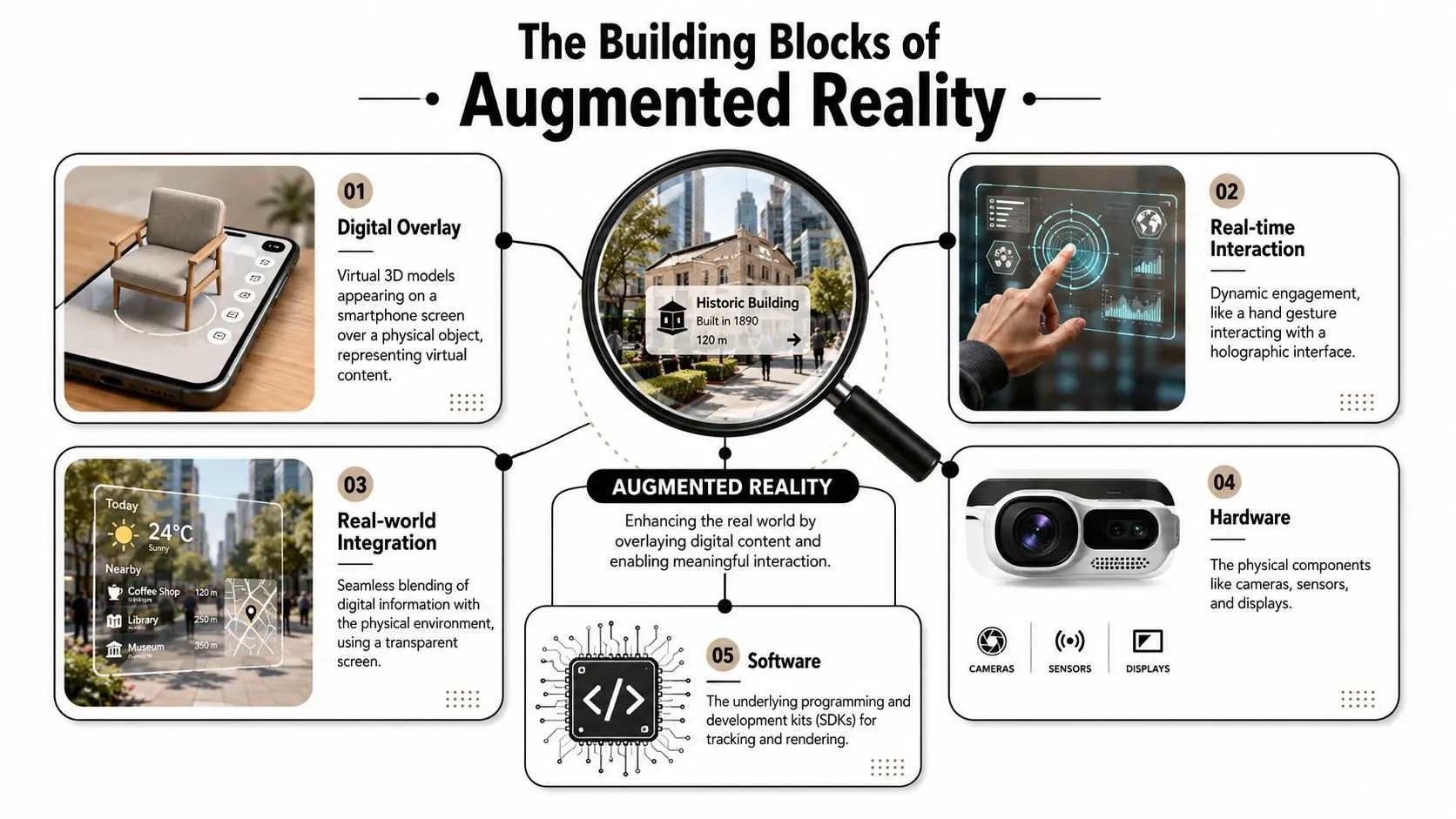
At business level, AR is best understood as a digital layer placed over the physical world. You point a phone, tablet, or headset at a physical space. Software recognises what it's looking at. Then digital content appears in the right place and responds as the user moves. That's the core mechanism. Not magic. Not science fiction. A camera, sensors, software, and well-made content working together.
The parts that actually matter
You don't need an engineering degree to evaluate AR. You do need to understand the moving parts:
- •Device: Usually a smartphone, tablet, or wearable headset.
- •Tracking: Software figures out surfaces, position, and movement.
- •Content: 3D models, animation, labels, instructions, or interactive prompts.
- •Rendering: The system places that content into the live camera view.
- •Interaction: The user taps, moves, scans, rotates, or follows guidance.
This is why content quality matters so much. If the 3D asset is poor, the experience feels cheap. If the tracking slips, trust disappears. If the interaction is clumsy, users quit. For teams building product-led AR, FurnitureConnect's guide to photogrammetry is a useful primer on turning photographs into 3D models. That's especially relevant when you need accurate digital objects for product visualisation rather than rough concept art.
The real technical advantage
The most important concept is situated instruction. Coursera's overview of AR benefits notes that digital annotations, 3D models, and contextual overlays let users act on information in the exact physical environment where tasks occur, reducing cognitive load compared with screen-only manuals. That's why AR often outperforms static PDFs, slide decks, and disconnected training screens. It puts information where the decision happens.
AR versus VR in one practical line
Use AR when people need to stay connected to their physical environment. Use VR when you need full immersion in a simulated one.
If the task depends on the physical world in front of the user, AR is usually the right starting point.
That's why AR works so well for guided maintenance, retail visualisation, museum interpretation, event activations, and assisted learning on the job.
Boosting Operational Efficiency with AR
If your main concern is cost pressure, labour efficiency, or process variation, AR merits attention. The strongest operational case for augmented reality advantages isn't brand theatre. It's workflow control. In industrial settings, AR overlays can guide inspection, assembly, maintenance, and handoff tasks directly in the workspace. That reduces the back-and-forth between physical work and external reference material.
Where the savings come from
In industrial use cases, augmented reality systems can cut inspection time by up to 84% and improve traceability by capturing “as-built” data automatically, according to DELMIA's industrial AR overview. That's the kind of number senior operations teams pay attention to, because inspection time isn't abstract. It's labour, throughput, and delay. A typical gain pattern looks like this:
| Operational pressure | How AR helps |
|---|---|
| Repeated manual checks | Overlays show what to inspect and where |
| Inconsistent execution | Teams follow the same guided sequence |
| Slow defect identification | Visual prompts speed up issue spotting |
| Weak handoff records | Systems capture “as-built” information during the process |
AR also works well when a skilled expert can't be everywhere at once. A field engineer can share a live view, receive contextual guidance, and complete tasks with fewer escalations. In sectors where site visits are expensive or specialists are stretched thin, that matters.
Good AR operations projects start narrow
Don't start with a grand “digital transformation” brief. Start with one expensive workflow that suffers from delay, rework, or inconsistency. Good candidates include:
- •Inspection-heavy processes: Quality checks, snagging, asset verification.
- •Complex assembly: Tasks where sequence errors create downstream cost.
- •Maintenance support: Jobs requiring occasional specialist judgement.
- •Documentation gaps: Environments where records are messy or delayed.
Practical rule: If your staff constantly switch between the task and the manual, AR is worth testing.
The commercial logic is straightforward. If AR removes repeated interpretation, it can reduce cycle time. If it captures cleaner data during the task, it can reduce rework later. If it helps less experienced staff perform with more confidence, it can ease pressure on scarce specialists. That doesn't mean every process needs a headset. In many organisations, a phone or tablet is the right first deployment. The point isn't to maximise technical sophistication. The point is to remove friction from high-value work.
Driving Growth with AR in Marketing and Retail
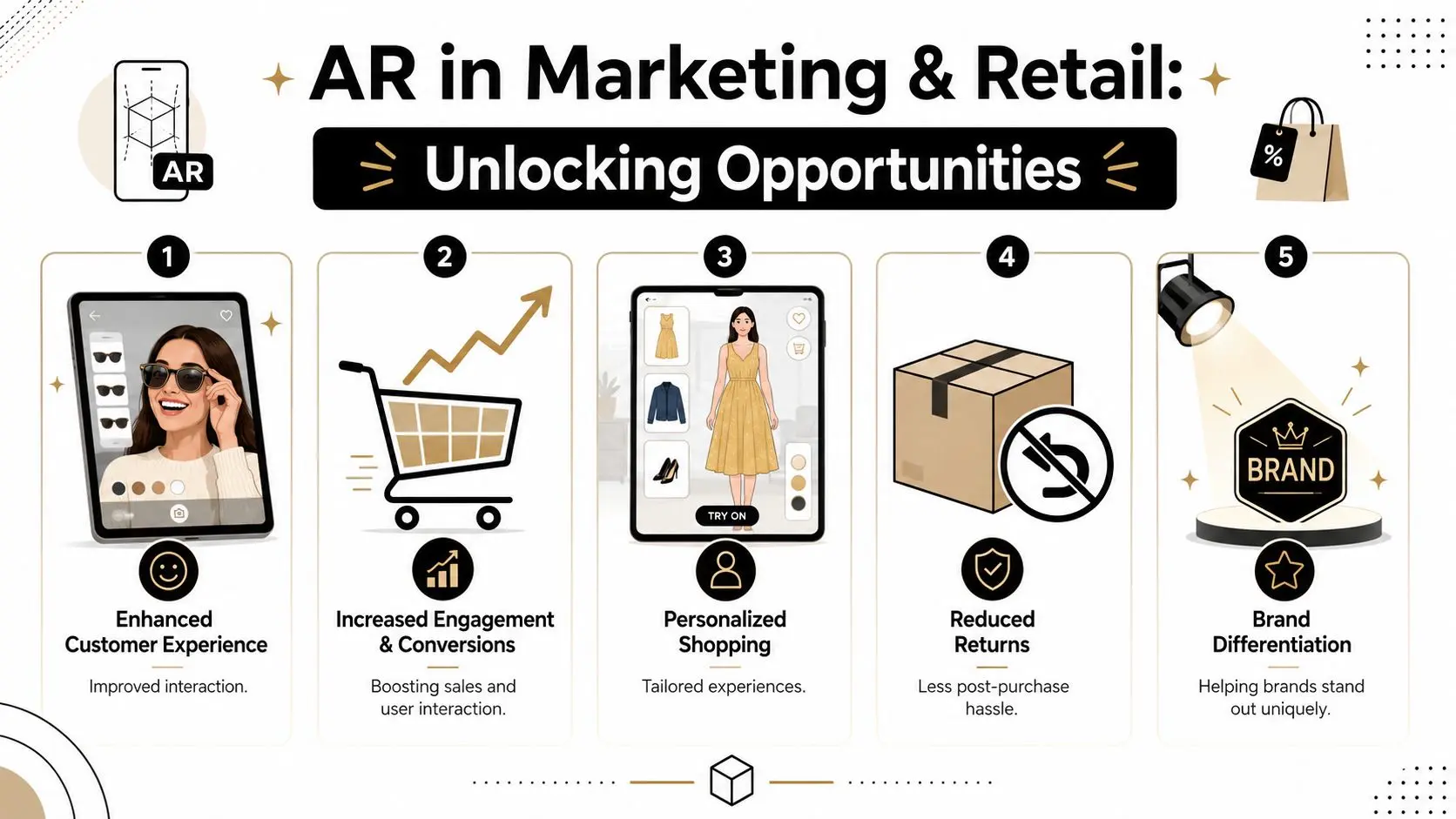
Retail buyers abandon purchases for predictable reasons. They cannot judge fit, scale, finish, or value with enough confidence to act. AR fixes that decision gap, which is why customer-facing AR often delivers faster commercial returns than broader innovation projects. As noted earlier, UK consumer research shows strong demand for AR shopping experiences, stronger brand preference when AR is available, and higher willingness to pay after a virtual trial. For a business leader, the implication is simple. AR can increase conversion quality, not just attention.
Where AR creates measurable retail value
AR performs best when it removes a specific purchase objection. In practice, that usually means helping the customer answer four commercial questions quickly:
- •Will this suit me
- •Will this fit here
- •What does this do
- •Is this worth the price
That makes AR a strong fit for:
- •Virtual try-ons: Fashion, eyewear, beauty, accessories.
- •Product visualisation: Furniture, interiors, appliances, packaging concepts.
- •Interactive demos: Trade shows, product launches, experiential retail.
- •Packaging and print activation: Cards, boxes, tickets, brochures, point-of-sale.
The right KPI depends on the use case. Try-ons should improve conversion and reduce returns. Product visualisation should raise buyer confidence and shorten decision time. Event-based AR should support lead capture, dwell time, and assisted sales. If you cannot tie the experience to one of those outcomes, do not commission it yet.
Build for utility first
Too many AR concepts still get approved because they look impressive in a pitch. That is a budget mistake. Buyers do not care about visual effects unless those effects help them choose faster or choose at a higher price point. A lipstick try-on that helps shade selection has value. A flashy portal with no product function does not. The same rule applies in B2B sales. If your AR product demo helps a procurement team understand footprint, workflow, or installation requirements, it supports revenue. If it exists only to entertain, it gets forgotten. Here's the standard to apply before you sign off any brief:
| Weak AR idea | Strong AR idea |
|---|---|
| Pure novelty with no product relevance | Experience tied directly to the buying decision |
| High friction app download for a tiny payoff | Web-based or lightweight access |
| One-off visual trick | Repeatable use in sales, retail, or events |
| No measurement plan | Defined conversion, dwell, or assisted-sales metrics |
UK businesses should also think beyond e-commerce. AR can support showroom sales, retail staff conversations, exhibition stands, distributor pitches, and pre-sales presentations. That wider deployment is where ROI improves. One well-scoped AR asset can serve marketing, sales, and retail operations at the same time. If you sell a product people need to see, compare, place, or try, AR deserves a commercial pilot. Start with one product line, one customer friction point, and one metric that matters to revenue. That is how augmented reality advantages turn into a funded project, not another innovation idea that stalls in planning.
Transforming Outcomes in Education and Training
Training is where weak technology gets exposed quickly. If it doesn't help people learn, perform, or stay safe, it gets abandoned. AR holds up well because it links instruction to environment. People don't just read about a process. They see the step in context, interact with the object, and build memory around doing rather than just watching.
Beyond engagement
A 2025 review in Frontiers in Computer Science states that AR and VR have been shown to teach new skills, improve health safety, increase learning, and raise satisfaction, with applications across education, healthcare simulations, manufacturing visualisation, and cultural heritage. The same review notes projections that AR/VR revenues are expected to exceed $100 billion by the end of 2025, with the broader market projected to reach $200.87 billion by 2030 and $589 billion by 2034, according to the Frontiers paper. That matters because it shows where the category is maturing. Learning and simulation aren't side uses. They're central use cases.
What measurable training gains look like
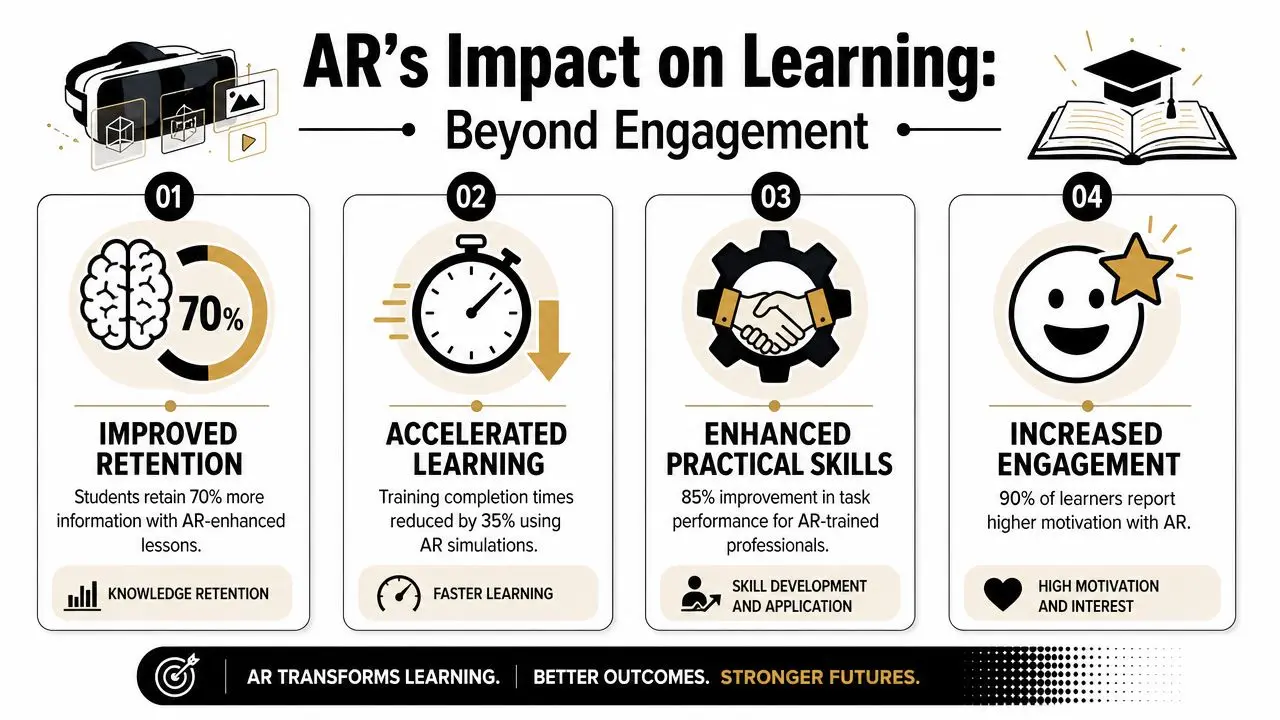
UK-focused research on immersive medical training reports a 42% improvement in success rate, a 45% reduction in mistakes, and a 25% boost in anatomy retention, based on the PMC-published research review. Those are the kinds of metrics that make training leaders pay attention. Not because they're flashy, but because they map directly to competence, safety, and readiness. The practical value of AR in training usually falls into four buckets:
- •High-risk practice: People can rehearse without exposing patients, equipment, or facilities to unnecessary risk.
- •Complex visualisation: Anatomy, machinery, systems, and hidden structures become easier to understand.
- •Consistency: Every learner receives the same guided process.
- •Assessment: Trainers can build more structured observation around applied tasks.
In training, the best AR content doesn't entertain. It reduces mistakes before they happen in the real world.
Strong sectors for AR learning
AR is especially well suited to environments where physical context matters:
- •Healthcare: Procedure support, anatomical learning, simulation.
- •Engineering: Maintenance guidance, assembly, diagnostics.
- •Heritage and museums: Layered interpretation of sites, artefacts, and inaccessible spaces.
- •Corporate L&D: Product knowledge, field support, onboarding for equipment-heavy roles.
For UK organisations dealing with skills shortages, AR can be more than an engagement tool. It can become a capability multiplier. When expertise is scarce, guided learning in context becomes operationally valuable very quickly.
Measuring ROI and Integrating AR into Your Strategy
Most AR projects don't fail because the tech is impossible. They fail because the business case is vague. If you want AR budget approved, tie it to one problem with one measurable outcome. Don't pitch immersion. Pitch a bottleneck. Don't promise transformation. Promise a pilot that can be judged properly.
The right KPI depends on the job
Different AR use cases demand different measures:
- •Operations: Inspection time, rework, completion consistency, support escalations.
- •Retail and sales: Product interaction, assisted conversion, buyer confidence signals.
- •Training: Task accuracy, error reduction, assessment performance, time to competence.
- •Service delivery: Access improvement, fewer unnecessary trips, faster specialist input.
A useful UK lens comes from healthcare and access. The Information Technology and Innovation Foundation's review of AR and VR in healthcare argues that immersive tools can reduce transport logistics and improve access for patients and clients in underserved areas. That's a serious strategic point. Sometimes the strongest AR ROI isn't content performance. It's service reach.
A workable implementation framework
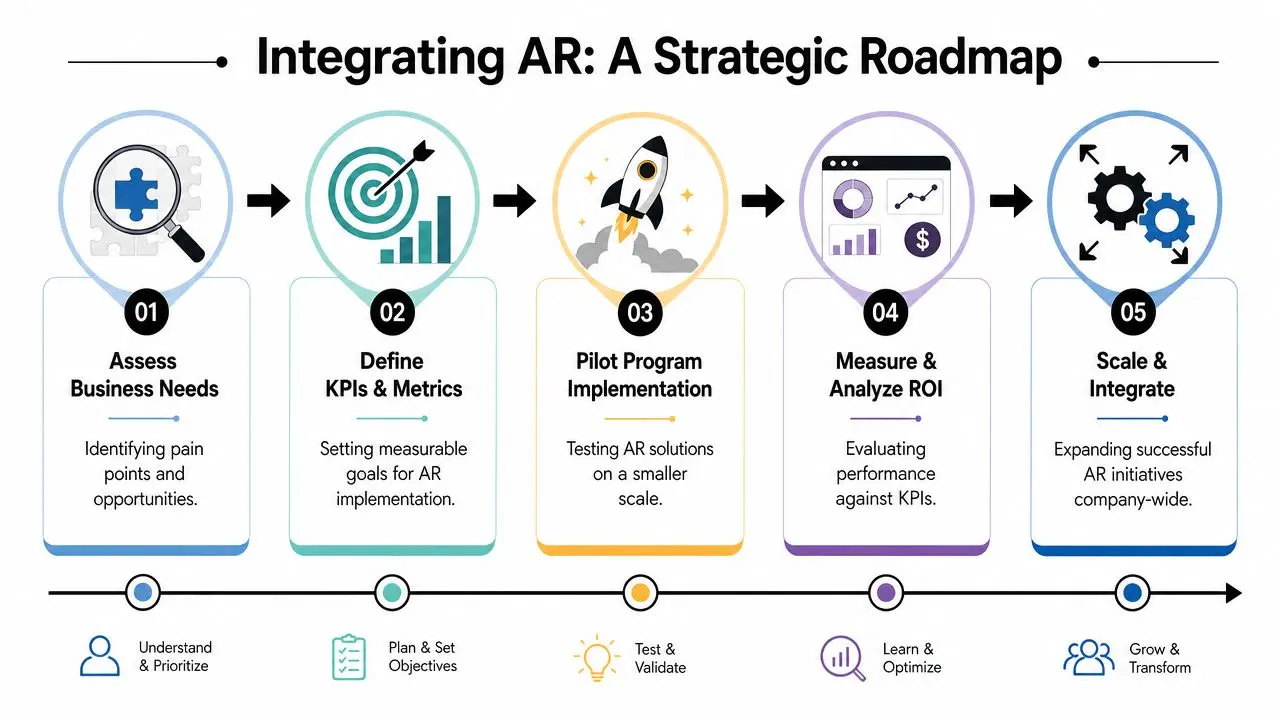
I recommend a five-part decision sequence:
- Pick one pain point
- Match the delivery format
- Define success before production
- Pilot in a real environment
- Scale only after proof
Don't treat content as an afterthought
AR is only as effective as the assets, interaction design, and workflow logic behind it. Many internal teams often underestimate the effort involved in these areas. A rough 3D model, unclear interface, or poorly structured user journey can sink an otherwise good idea. That's why businesses often combine internal stakeholders, engine developers, 3D artists, and production partners. For example, Studio Liddell produces AR experiences including smartphone-based and web-based activations, which is one route if you need external production support rather than building the entire pipeline in-house.Commissioning Your First Augmented Reality Project
Your first AR project shouldn't be the biggest idea in the room. It should be the clearest. Pick one use case where you can see the commercial logic without a heroic leap of faith. A retail visualiser. A guided maintenance flow. A training module for a high-error task. A packaging activation tied to product education. If the use case is fuzzy, stop there and fix the brief.What to put in the brief
A strong AR brief needs five things:- •Business problem: What friction are you trying to remove?
- •Users: Customers, staff, trainees, visitors, or field teams.
- •Context of use: In-store, on-site, at home, in class, on a device, at an event.
- •Content requirements: 3D assets, animation, UI overlays, voice, analytics, copy.
- •Success criteria: What you'll measure once it goes live.
The production conversation gets much easier when those basics are clear. If you're still deciding on platform approach, this guide to AR mobile app development from concept to launch gives a practical view of what sits between idea and deployment.
The fastest way to waste budget is to commission AR before deciding what user behaviour you want to change.
What to look for in a partner
Don't just ask whether a studio can build AR. Ask whether they can shape the experience around a measurable business objective. You want a team that understands real-time production, 3D asset standards, device constraints, and the ugly realities of rollout. The augmented reality advantages worth paying for are the ones that survive contact with real users, real environments, and real business pressure.
If you're assessing whether AR fits your sales, training, or operational goals, a focused scoping conversation is the right next step. Studio Liddell can help define the use case, shape the production brief, and map an AR concept to a practical delivery plan.