AI Development Services: Unlocking Your Business Potential
Let's cut through the buzzwords. At its heart, AI development is about building a custom-built brain for a specific task. Think of it like commissioning a bespoke tool for a master craftsman versus grabbing a generic one off the shelf. Sure, the standard tool might get the job done. But the custom-built one is designed for perfect efficiency, superior results, and a seamless fit into how _you_ work. This is the essence of AI development services: creating and rolling out unique AI solutions that give you a real competitive edge.
What Are AI Development Services, Really?
AI isn't just for Silicon Valley giants anymore. Today, it's a powerful, practical investment for creative agencies, entertainment companies, and pretty much any forward-thinking business. These services can automate fiddly animation pipelines, help create more believable characters in XR experiences, and pull out valuable insights from mountains of production data.
From Tech Hubs to Creative Studios
This shift has been massive, especially here in the UK. The UK's AI sector has absolutely exploded, cementing its spot as the third-largest market in the world, right behind the US and China. It's now valued at over £72 billion and is home to more than 5,800 AI companies. That's an 85% surge in just a few years, which shows just how many businesses are getting on board.
Understanding The Core Components
To really get what AI development services can do, you have to look at the building blocks. The best AI tools for software development are the foundation, but it's how they're put together that creates something special. These services usually fall into a few key categories, each designed to solve different kinds of problems. From understanding language to spotting patterns in video footage, each piece of the puzzle has a distinct role to play.
AI development isn't about replacing artists or developers; it's about giving them superpowers. It takes care of the repetitive, data-heavy lifting, freeing up human talent to focus on what they do best: creativity, strategy, and storytelling.
We've seen first-hand how intelligent systems can completely change creative workflows for the better. By bringing AI into the process, studios can take on more ambitious projects without needing to proportionally inflate their budgets or timelines. We've shared more of our thoughts on the role of artificially intelligent systems in creative production before. To make this a bit more concrete, the table below breaks down the main types of AI services and shows how they translate into tangible value for creative industries.
Core AI Development Service Categories
| Service Category | Core Function | Example Application (Creative Industries) |
|---|---|---|
| Machine Learning (ML) | Trains models to find patterns in large datasets to make predictions. | Predicting rendering times for complex 3D scenes based on asset complexity. |
| Natural Language Processing (NLP) | Enables machines to understand, interpret, and generate human language. | Automatically generating subtitles or analysing script sentiment. |
| Computer Vision | Allows systems to derive meaningful information from digital images and videos. | AI-powered motion capture cleanup or automated object tracking in footage. |
| Generative AI | Creates new content, such as images, music, or text, based on training data. | Rapidly concepting character designs or generating environmental textures. |
As you can see, what starts as abstract tech quickly becomes a practical tool for solving real-world production challenges.
How AI Is Actually Changing Creative Production
This is where the rubber meets the road. The real magic of AI development isn't in the buzzwords; it's in how these tools fundamentally change the day-to-day grind of making creative projects. We're talking about a tangible shift in animation, gaming, and immersive experiences that you can see and feel. Think about the painstaking process of character rigging or cleaning up raw motion capture data. An AI-powered tool can chew through that work in a fraction of the time. This doesn't put animators out of a job. Quite the opposite, it frees them from the tedious, repetitive grunt work, letting them pour all their energy into what truly matters: the performance, the emotion, and the story. Hours of manual labour shrink down to minutes of supervised processing, which has a massive knock-on effect on both timelines and creative freedom.
Smarter Tools for More Ambitious Ideas
AI’s impact ripples across the entire production pipeline. Take generative AI, for instance. It's like having a tireless concept artist on your team who can spit out hundreds of variations for a new world, a set of characters, or vehicle designs almost instantly. This helps the creative team visualise and refine their ideas much faster than ever before. This kind of rapid iteration means the pre-production phase is incredibly efficient, helping to lock down a stronger, more polished vision before any serious money gets spent.
You can think of AI as a creative multiplier. It handles the procedural heavy lifting, which lets your human talent focus on the high-value, soulful decisions that truly define a project's quality. This shift is what makes wildly ambitious creative visions possible on a realistic budget.
It goes even further. Machine learning algorithms are becoming essential for optimising experiences in real-time. Imagine a VR training simulation for a complex piece of machinery. An AI can watch how a user is performing, spot where they're struggling, and dynamically adjust the difficulty or introduce new scenarios to help them learn. You get a personalised, highly effective training environment that would be impossible to script by hand.
Supercharging Real-Time Engines Like Unity and Unreal
When you plug AI into powerful real-time engines like Unity and Unreal Engine, you start seeing new benchmarks for quality and immersion. Specialised AI plugins and custom-built tools aren't just nice-to-haves anymore; they're becoming core to building the next generation of interactive content. These tools are helping us create:
- •Smarter Non-Player Characters (NPCs): Instead of walking in predictable loops, AI-driven NPCs can exhibit complex behaviours, react believably to what a player does, and make game worlds feel alive and unpredictable.
- •More Realistic Physics and Environments: Machine learning can simulate natural phenomena with incredible accuracy. We're talking about everything from how water flows to how a crowd behaves, making virtual worlds far more convincing.
- •Procedural Content Generation (PCG): AI can generate vast, detailed game levels, landscapes, and assets on the fly. This allows smaller teams to create expansive experiences that would have previously required an army of artists.
Ultimately, these advancements deliver huge value to our clients by dramatically raising the production quality of their projects. Whether it's a game, an architectural fly-through, or a cinematic animation, AI-driven tools bring a level of detail and dynamism that audiences can’t help but notice. To see how these ideas build on more traditional methods, have a look at our guide to animation services for modern businesses. By automating the mundane and augmenting the creative, AI development isn't just tweaking old workflows, it's unlocking completely new possibilities for what we can even imagine, let alone create. This whole shift empowers studios like ours to deliver higher-quality content more efficiently, turning bold ideas into stunning reality.
Your AI Project Journey: From Concept to Launch
Starting a custom AI project can feel like a big undertaking, but it’s really a structured, collaborative journey. Think of it less like navigating uncharted territory and more like building a bespoke piece of architecture; it all begins with a solid blueprint and ends with a structure that perfectly integrates with your business. It’s a partnership, from the first conversation to the final launch. We break the entire process down into four distinct, logical phases. Each stage has its own goals, clear deliverables, and a well-defined role for everyone involved, both our team and yours. This keeps the project on track, ensures it’s always aligned with your business goals, and, most importantly, delivers real-world value.
Phase 1: Discovery and Strategy
This first phase is easily the most important. It’s the foundation for everything that comes next. We don't jump into talking about algorithms or lines of code. Instead, we start by getting to the heart of the problem you're looking to solve. What’s the specific business challenge? What does a successful outcome actually look like, and how will we measure it? During this stage, we’ll work closely together to:
- •Define the Core Problem: We'll pinpoint the exact inefficiency, creative bottleneck, or user experience issue the AI needs to tackle.
- •Establish Key Performance Indicators (KPIs): We agree on concrete, measurable goals. This could be something like "reduce character rigging time by 30%" or "increase player engagement by 15%."
- •Assess Feasibility: We take a look at your existing data and technical setup to confirm the project is viable and map out a high-level technical path forward.
The main takeaway from this phase is a comprehensive project brief and a strategic roadmap. This document becomes our shared compass, making sure everyone is fully aligned on the 'why' before we even think about the 'how'.
Phase 2: Data Preparation and Sourcing
If AI is the engine, then data is its fuel. The quality and relevance of the data we use to train an AI model will directly dictate how well it performs. Simple as that. This phase is all about gathering, cleaning, and organising that information so the AI learns what it needs to learn, correctly. Your role here is crucial because you're the expert on your own data. Whether it's production logs, 3D asset libraries, or user analytics, you provide the raw materials. Our team then steps in to do the technical heavy lifting, cleaning up inconsistencies and structuring it all properly so it’s ready for the model.
An AI model is only as smart as the data it learns from. Investing time in meticulous data preparation is the single most important factor in preventing biased or inaccurate results down the line.
The deliverable for this stage is a polished, high-quality dataset, ready for model training. We're essentially making sure the 'fuel' we use is pure, potent, and perfectly suited for the job.
Phase 3: Model Development and Training
With a clear strategy in place and clean data at the ready, our AI developers and data scientists get to work. This is where we build the core intelligence of your solution. It’s an iterative process of experimentation, training, and refinement. We select the best algorithms for your specific needs and start training the model on the dataset we prepared. This isn't a "black box" process where we disappear for weeks. We'll give you regular updates on the model's performance against the KPIs we set back in the discovery phase. This loop of training, testing, and tweaking continues until the model consistently hits or exceeds the performance benchmarks we agreed upon. The key outcome is a trained, validated AI model that’s ready for the real world. This infographic shows how AI slots into the creative pipeline, shifting the focus from laborious work to genuine innovation.
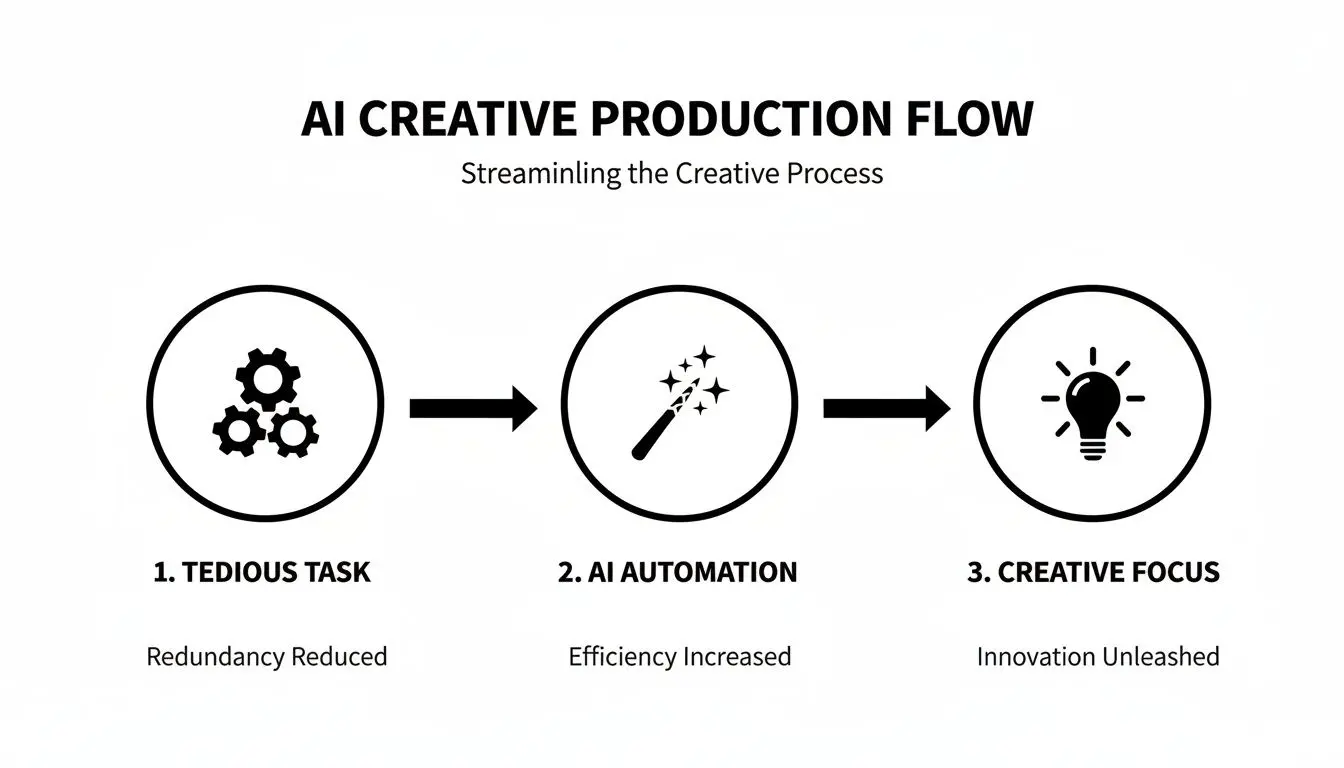
As you can see, it’s all about moving away from manual effort towards intelligent automation, which ultimately frees up artists for the high-value creative tasks they do best.
Phase 4: Integration and Deployment
Finally, it’s time to integrate the trained AI model into your existing systems and workflows. After all, a powerful AI is useless if your team can't easily use it. Our focus here is on creating a seamless connection. This might mean building a custom plugin for an animation suite, an API for your game engine, or a simple, user-friendly dashboard. Once it's deployed, we conduct thorough testing to make sure everything works perfectly in your live environment. We also provide full training and documentation for your team. The project wraps up with the successful launch of your new AI-powered solution, fully embedded in your operations and delivering the value we set out to achieve from day one. To get a better feel for how these stages fit into a timeline, you can check out our guide on understanding the app development timeline.
Choosing the Right AI Development Partner
Picking an AI partner is easily one of the most important calls you'll make for your project. This isn't just about hiring a team that can tick off a list of technical skills. The real goal is to find a strategic partner, someone who digs deep into _why_ your business needs this solution before they even touch a line of code. This choice is what separates a one-off project from a long-term competitive advantage. It’s about finding a team that will not only build what you ask for but will also align with your bigger goals and deliver a genuine return on your investment.
Looking Beyond the Code
Technical skill is the bare minimum; it's the price of entry. The best AI development services providers are the ones who can translate complex tech into clear business outcomes. They should be just as comfortable talking about your KPIs as they are about machine learning models. When you're looking at different teams, their portfolio is your best source of truth. Don't just look for flashy tech demos. Look for projects that show a real understanding of the user experience and the client’s commercial goals.
A great AI partner doesn't just ask, "What do you want us to build?" They ask, "What business problem are you trying to solve?" This subtle shift in focus is the hallmark of a team that will deliver strategic value, not just code.
This way of thinking makes sure every technical decision links back to what you actually want to achieve, whether that's making a game more engaging or speeding up an animation pipeline. It’s about building the _right_ thing, not just _a_ thing.
Key Criteria for Evaluating Partners
As you start vetting potential studios, zero in on a few key areas that tell you what they’re really made of. A solid partner will be open and proactive in all of these conversations. Here are the essential questions you should be asking:
- •Industry and Domain Expertise: Have they actually worked in creative sectors like entertainment or training before? They need to get the unique challenges and opportunities that exist in your world.
- •Technical Stack Mastery: Do they have genuine, proven experience with core platforms like Unity and Unreal Engine? Ask for concrete examples of how they’ve woven AI into these environments.
- •Project Management and Communication: What’s their process like day-to-day? A reliable partner will have a clear, transparent way of managing the project, with regular check-ins and a single point of contact to keep things simple for you.
- •Focus on Business Outcomes: Can they show you how their past AI projects delivered measurable ROI? They should have case studies ready with real numbers, like cost savings, efficiency boosts, or better user retention.
Doing this level of homework helps you sift through the vendors who are just technicians and find the ones who are true strategic partners, ready to help you grow.
The UK AI Development Scene
There’s a lot to be said for choosing a local partner. It can make a huge difference in communication and just being on the same page culturally. The UK market for AI development isn't just growing; it’s a thriving hub of specialised expertise. Government investment is putting rocket fuel into AI development services in the UK. The sector has seen a massive 58% jump in its number of dedicated and diversified companies in recent years, which speaks volumes about the business opportunities here. A recent AI Sector Study found that revenue shot up to £23.9 billion, and the Gross Value Added from specialist AI firms nearly doubled from £1.2 billion to £2.2 billion , that's an 83% increase. You can dig deeper into the booming UK AI market's growth and investment trends to see the full picture. This strong ecosystem means you have access to world-class talent right on your doorstep, people who understand the nuances of the local market. It creates a collaborative environment where innovation can really take off, all backed by a strong national strategy. Finding a partner who is part of this dynamic scene ensures you’re working with a team right at the forefront of the industry.
Real-World Impact: Stories From AI Implementation
Talking about the potential of AI is one thing, but seeing it deliver tangible results is where the real magic happens. This is the point where abstract ideas turn into measurable proof. So let’s move beyond the theory and look at how custom AI actually delivers a solid return on investment across different creative and technical fields. At the heart of every success story is a simple idea: using intelligent automation to solve a specific, high-value business problem. The results usually speak for themselves, with clear wins in cost savings, better user experiences, or greater creative freedom.
Slashing Rendering Times in Animation
Picture a studio working on a multi-episode animated series. They’re up against a tight production schedule and an even tighter budget. Rendering, the process of turning 3D models into final video frames, is a notorious time and money sink. A single creative tweak can mean hours, or even days, of re-rendering, eating away at both the budget and the time needed for polishing the final look. By bringing in a custom AI solution, a studio can completely change this dynamic. An AI model, trained on the studio’s own asset library and render farm data, can learn to predict render times with incredible accuracy and smartly allocate computing resources where they’re needed most. This intelligent scheduling led to some fantastic results:
- •A 30% reduction in overall rendering times, which freed up the team to attempt more complex shots and iterate on creative ideas without blowing the budget.
- •Significant cost savings on cloud computing, as the AI made sure no processing power ever went to waste.
- •Greater creative flexibility for directors and artists, who could experiment with lighting and effects without constantly worrying about crippling render delays.
This is a perfect example of how targeted AI development services can directly improve a project’s creative quality and its financial health.
Boosting Learner Retention with Adaptive XR Training
Now, let's switch gears to an XR training simulation for complex industrial procedures. Most traditional simulations are rigid and follow a pre-scripted path. It’s a one-size-fits-all approach that doesn’t always work, some trainees get bored, while others get left behind. This is where machine learning comes in to create a truly personal and adaptive learning environment. An AI model analyses a user's performance in real-time, tracking their movements, how quickly they make decisions, and what mistakes they make. Based on what it sees, the simulation dynamically adjusts the difficulty and focus of the scenario.
AI's ability to create responsive, individualised experiences is a game-changer for training and education. It shifts the model from static instruction to a dynamic dialogue between the user and the system, leading to deeper understanding and skill mastery.
The results were clear and measurable. The client saw a 40% improvement in learning retention and skill mastery compared to their old training methods. Trainees were far more engaged, and the organisation ended up with a more competent and confident workforce, all thanks to a smarter, more responsive simulation. This kind of project relies on a strong technical backbone. In the UK, AI services already command the largest revenue share at over 52% and are poised for the fastest growth. Enterprises are building hybrid AI data centres valued at over USD 5 billion, creating the powerful infrastructure needed for today's creative AI pipelines. You can explore the UK's fast-growing AI market to get a sense of the scale of this trend.
Driving Engagement in Mobile Gaming
Finally, think about a mobile game that’s struggling to keep players coming back. A classic challenge is getting the difficulty right. If it’s too easy, players get bored and drift away. Too hard, and they get frustrated and quit. By integrating AI-driven analytics, the developers built a dynamic difficulty adjustment system. The AI continuously monitored player behaviour, things like how long they played, their level completion rates, and the choices they made in-game. It then tweaked the game’s difficulty in real-time for each individual, keeping them in that perfect sweet spot of being challenged but not overwhelmed. The outcome was a major lift in key engagement metrics, which ultimately gave the game a much longer and more profitable commercial life.
Answering Your Questions About AI Development
Diving into AI development for the first time naturally brings up a lot of practical questions. You're thinking about the cost, the timeframes, and what you actually need to know to get started. It's a serious investment, so getting clear, straightforward answers upfront is essential before you commit to anything. Let's cut through the jargon and tackle the most common questions we hear from businesses just like yours.
How Much Do Custom AI Development Services Cost?
This is always the first question, and the honest answer is: it really depends. The final cost comes down to a few key things: how complex your idea is, the amount and quality of data needed to train the AI, and how deeply it needs to be integrated into your current systems. A simpler project, maybe one that adapts an existing AI model for a specific task, could start in the low five-figure range. On the other hand, building a completely custom AI solution from the ground up to solve a really unique, complex problem can easily run into six figures or more. It’s better to think of it not as a cost, but as an investment with a clear return, like dramatically speeding up your production pipeline or boosting user engagement. Any partner worth their salt will never give you a vague number off the cuff. They'll insist on a proper discovery phase to get under the skin of your goals before providing a detailed quote. That way, you have total budget clarity from day one.
Do I Need to Be a Tech Expert to Start an AI Project?
Absolutely not. In fact, it often works better when you're not. The best AI projects are true partnerships. You bring the deep industry knowledge and a clear business goal, and your development partner brings the AI expertise. They're the bridge between what you want to achieve commercially and how to make it happen technically. A great AI partner will walk you through the entire process. They should be able to break down complicated ideas into simple terms and always steer the conversation back to how the tech is solving _your_ specific problem, whether that’s making a game more immersive or an animation workflow more efficient. Your job is to be the expert in your world; their job is to turn that expertise into a powerful AI tool.
The best AI collaborations happen when the client is an expert on the 'what' and 'why,' and the development partner is the expert on the 'how.' You bring the vision; they bring the technical roadmap to make it a reality.
This teamwork ensures the final product isn't just a clever piece of tech, but something that’s perfectly aligned with what you're trying to achieve.
What Is a Typical Timeline for AI Development?
Just like cost, the timeline is tied directly to the project's complexity. The process is almost always iterative, designed to deliver value in stages. You won't be waiting for a single "big bang" launch at the very end; you'll see progress and results along the way. Here’s a rough guide to what you can expect:
- •Proof-of-Concept (PoC): This is a small-scale project to test the core idea and make sure it's technically possible. This usually takes around 4-8 weeks.
- •Minimum Viable Product (MVP): Here, we build the core features of the AI solution so it can be used and tested in a real-world setting. An MVP phase typically lasts between 3-6 months.
- •Full-Scale Integration: A large-scale, enterprise-level project that becomes a core part of your operations can take a year or more to fully develop and roll out.
A reliable partner will always give you a detailed project roadmap right from the start, broken down into clear phases with milestones and deliverables. You'll always know exactly what to expect and when.
How Is the Success of an AI Project Measured?
This is a massive one, and it needs to be sorted out right at the beginning. The success of an AI project should never be a matter of opinion. It must be tied to concrete, pre-agreed business goals. Before a single line of code is written, you and your partner need to define the Key Performance Indicators (KPIs) that will prove it worked. For creative projects, these metrics could be things like:
- •A 25% reduction in the time spent on manual animation cleanup.
- •A 40% increase in how long users spend inside a VR experience.
- •A 15% boost in player retention for a new mobile game.
For internal tools, success might be measured in direct cost savings, higher production output, or fewer errors. Setting these clear, measurable KPIs is the only way to accurately show the return on your investment in AI development services. For more detailed answers, many find a provider's page of frequently asked questions about AI development to be a useful resource.
Ready to explore how a custom AI solution can give your creative projects a decisive edge? The team at Studio Liddell combines years of production experience with cutting-edge AI expertise to deliver real-world results. Let's discuss how we can turn your vision into an intelligent, high-performing reality. Book a production scoping call today.