Online Games on Facebook: A Guide for Brands
The worst advice on Facebook gaming is also the most common: that it either died with FarmVille or still works the way it did a decade ago. Neither is useful if you're a brand, publisher, or agency trying to decide whether Facebook is worth budget and production time. What matters now is understanding that online games on Facebook aren't one product category. They're a mix of social discovery, lightweight interactive formats, externally hosted play, and platform-adjacent gaming experiences. If you treat all of that as one channel, you'll either overbuild the wrong thing or dismiss a viable opportunity because you're looking at an outdated model. For brands, the practical question isn't whether Facebook games are back. It's whether Facebook still helps people discover, share, sample, and return to interactive experiences. In many cases, it does. The trade-off is that success now depends less on copying old social game mechanics and more on choosing the right format for the job.
What Online Games on Facebook Mean in 2026
If your mental picture of Facebook gaming is crop timers, spam invites, and desktop browser tabs, you're solving the wrong problem. Facebook's gaming emphasis has shifted away from the old FarmVille-style app economy and towards watch-and-play social discovery, creator-led gaming content, and mobile-shaped engagement patterns, as noted in Meta gaming commentary referenced here. That shift changes how brands should think about the platform. Facebook is no longer one neat storefront for a single type of social game. It's a distribution environment where game content can appear as a shared post, a lightweight playable experience, a creator-led stream, a cloud-delivered session, or a campaign mechanic wrapped around community interaction.
What brands usually get wrong
Most commercial teams make one of two mistakes:
- •They chase nostalgia: They ask for the modern equivalent of a classic Facebook app without checking whether the audience still wants desktop-heavy, permission-driven play.
- •They ignore social context: They build a good game loop, then forget that Facebook behaviour is shaped by feed browsing, mobile sessions, comments, shares, and drop-off between interruptions.
- •They overestimate intent: People on Facebook often aren't arriving with the same mindset they bring to Steam, console stores, or app marketplaces.
- •They treat Facebook as owned media only: In practice, it's often more valuable as a discovery and re-engagement layer than as the sole destination.
Practical rule: On Facebook, the container matters almost as much as the game. Format, friction, and social visibility decide whether anyone starts playing at all.
What online games on Facebook actually include now
For a brand manager, the modern map is simpler if you separate it into three buckets:
| Format | Best used for | Main constraint |
|---|---|---|
| Lightweight in-platform or web-linked play | Fast engagement and campaign reach | Session drop-off if onboarding is slow |
| Cloud-delivered game access | Higher-fidelity play without traditional install friction | Latency and streaming stability |
| Socially shared game content and gamified marketing | Discovery, participation, and audience interaction | Weak retention if the concept is only promotional |
That distinction matters because the production approach changes with it. So do the budget assumptions, the analytics model, and the definition of success. A short-session branded quiz shared through Facebook posts isn't competing with a streamed native game. It serves a different business outcome.
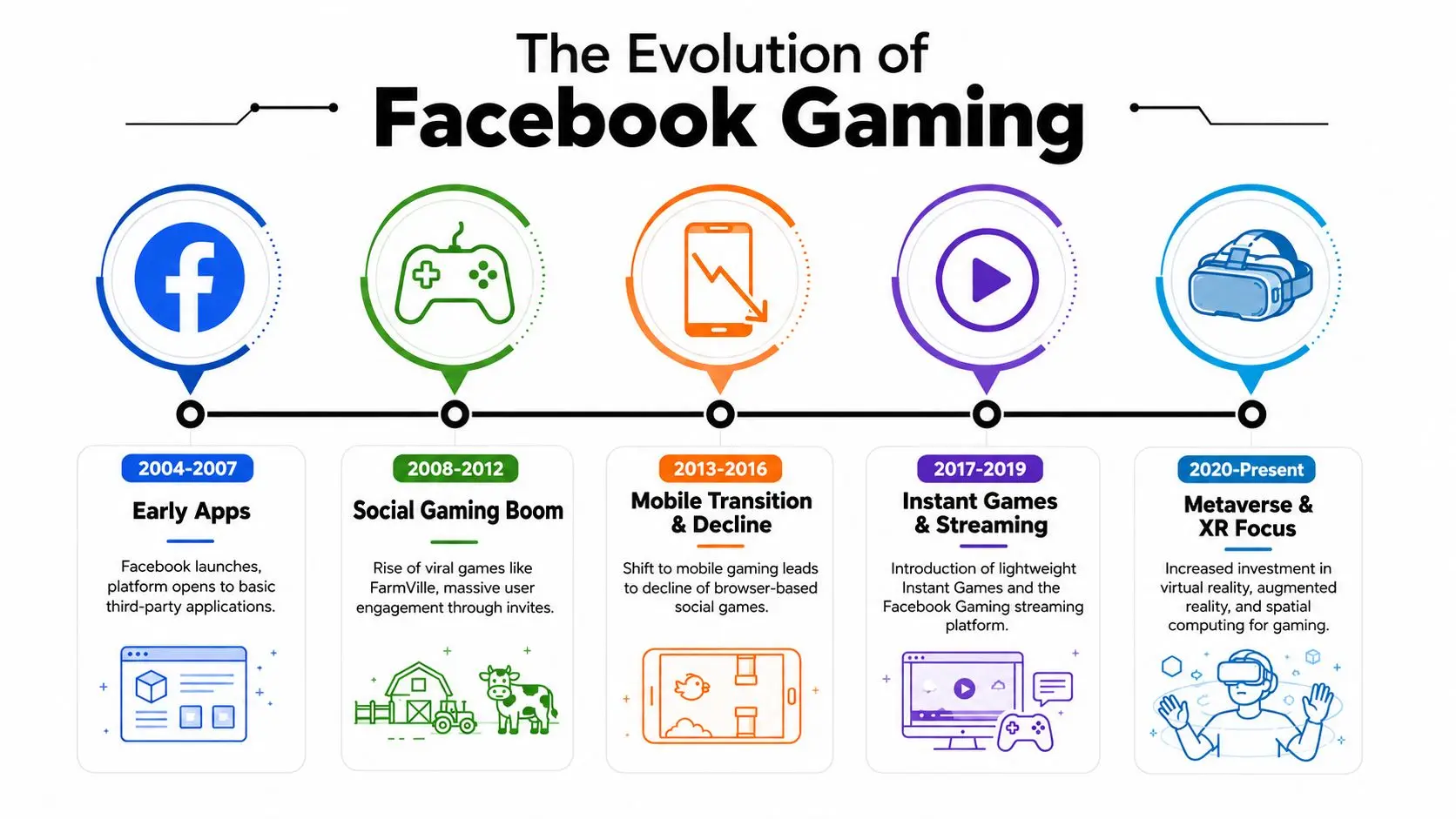
The Evolution from Social Apps to Social Play
Facebook earned its reputation in games by doing something unusually powerful for its time. It made game discovery social before most publishers had well-developed direct channels of their own. A player didn't need to browse a specialist storefront. They saw activity from friends, clicked through from the feed, and entered a loop designed for frequent return visits. That model produced genuine scale. In 2019, 8 Ball Pool and Candy Crush Saga each reached 10 million daily active users, according to Statista's ranking of the most popular Facebook social games. The same source notes that Candy Crush Saga launched on Facebook in 2012 and generated $945 million in worldwide revenue in 2018. Those aren't nostalgic footnotes. They show that Facebook functioned as a serious commercial launchpad, not just a casual pastime. A timeline makes the transition easier to read.
Why the old model peaked
The classic Facebook app boom depended on a few conditions that no longer dominate in the same way:
- •Desktop-first behaviour: Players spent longer in browser sessions and tolerated more overt social prompts.
- •Viral mechanics: Invites, wall posts, and visible friend activity did a lot of acquisition work.
- •Simple loops: Energy systems, gifting, and asynchronous progression worked because friction was low and sessions were frequent.
That model didn't vanish overnight. It was squeezed from several directions. Mobile gaming matured. Platform policies changed. Player expectations rose. Dedicated app stores became stronger destinations, and browser-based social play stopped feeling novel.
What survived the shift
The important lesson isn't that Facebook lost all gaming relevance. It's that the strongest part of the original proposition survived in a different form: discovery through social context.
Facebook stopped being one dominant game arcade. It became a set of touchpoints where game discovery, community interaction, and lightweight play overlap.
For brands, that's a healthier frame than chasing the old app economy. The historical win wasn't the browser tab itself. It was Facebook's ability to connect visibility, recommendation, and repeat exposure. That's still useful. The difference is that the execution now has to fit mobile habits, shorter attention windows, and a more fragmented journey from interest to play.
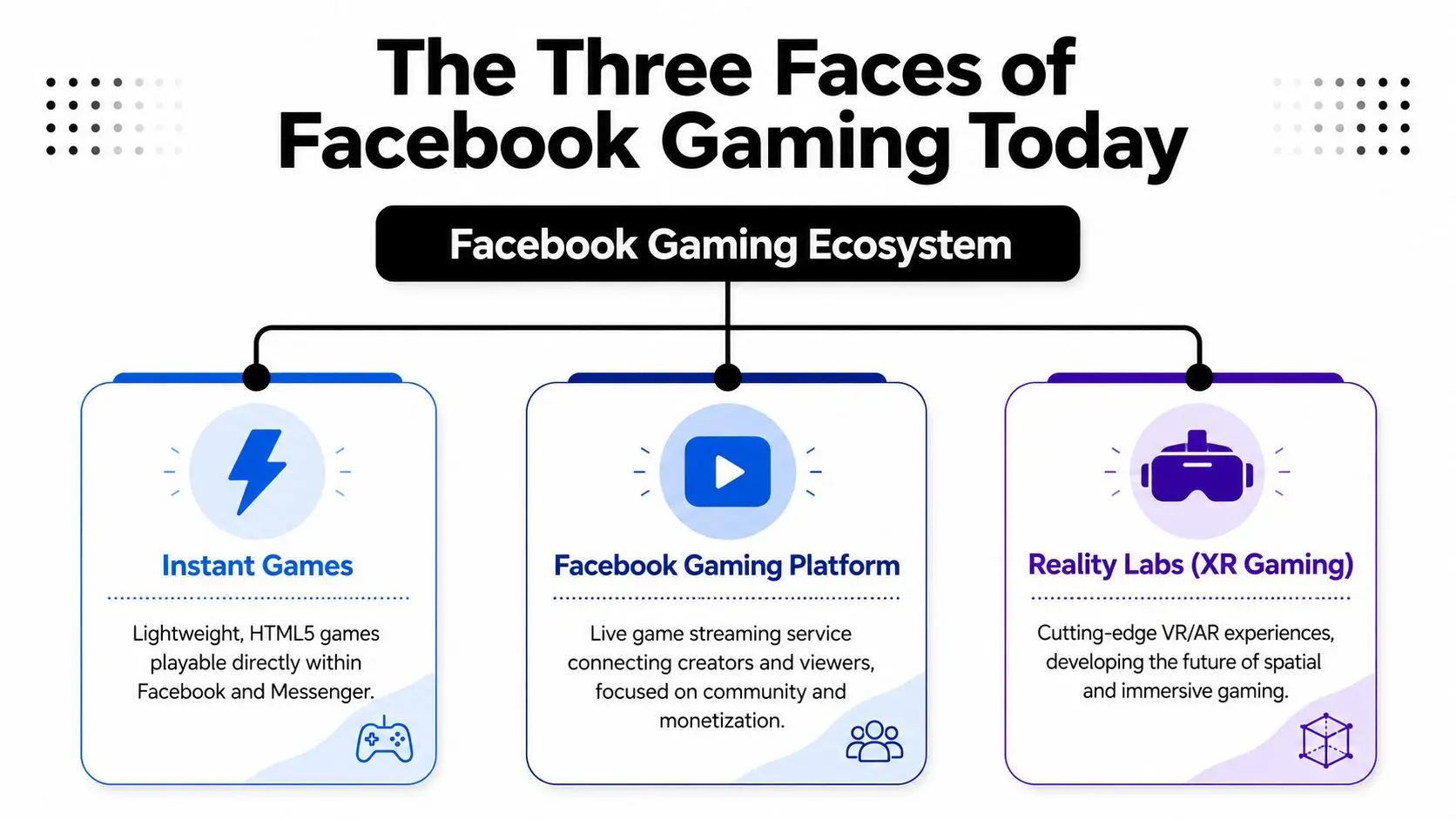
The Three Faces of Facebook Gaming Today
The easiest way to make sense of online games on Facebook is to stop treating them as one product. There are really three practical routes, each with a different role in the funnel.
Social discovery and lightweight play
This is the closest descendant of classic Facebook gaming, but the emphasis is different. Think quick-entry experiences, simple interactions, and content people can try without committing to a deep install-and-learn process. For marketers, this is often the most useful layer because the audience doesn't need to arrive with high intent. A small challenge, quiz, competitive score loop, or branded mini-game can work if the opening seconds are clear and the interaction feels native to feed and mobile behaviour. The strategic reason this still matters is reach. A 2026 industry survey found that 35% of gamers rely on Facebook for gaming updates and news, while Facebook still operates at huge scale with around 3 billion monthly active users globally, according to the UK gaming statistics summary published here. That doesn't mean every game should launch on Facebook first. It does mean Facebook still matters as a discovery layer.
Cloud-delivered game access
This is a different proposition entirely. Instead of a lightweight social toy, cloud gaming on Facebook aims to remove install friction for more substantial experiences by delivering the session remotely. For the right project, that changes the business case. You can preserve richer game logic and native runtime qualities without asking every player to complete a traditional download journey first. But you also inherit a different set of risks. Session start speed, connection quality, and sustained responsiveness become commercial issues, not just technical ones. This route suits brands and publishers with stronger content, clearer player motivation, and a need to reduce entry friction without flattening the product into a tiny mini-game.
Games as marketing systems
The third face of Facebook gaming isn't a standalone game product at all. It's the use of game mechanics inside campaigns, community activations, and social participation loops. That can include:
- •Playable creative: A short mechanic that previews a larger product or promotes an event.
- •AR-led interaction: A social effect or interactive layer built to trigger sharing and participation.
- •Community competition: Score challenges, prediction mechanics, or creator-led participation.
- •Retention hooks: Lightweight reasons for audiences to come back between larger launches or content beats.
Many brands get the best return, not because the experiences are simpler, but because the KPI is clearer. You're not pretending a campaign mini-game is a premium game release. You're using interaction to improve recall, dwell time, and repeat touchpoints.
Technical Stacks and Production Pipelines
The technical split behind Facebook gaming is sharper than many non-technical stakeholders expect. In practice, you're usually choosing between a self-hosted web game model and a server-rendered cloud delivery model. Those are different pipelines, different performance risks, and different budget conversations.

Web-hosted games through Facebook as a portal
For legacy Facebook web games, Meta's developer documentation states that the game is hosted on the developer's own server while Facebook acts as a portal, as outlined in Meta's documentation for legacy web games. That sounds simple, but it has practical consequences. Your team controls the runtime behaviour, hosting setup, asset delivery, and update cadence. That gives you flexibility. It also means performance problems are usually your problems. Heavy initial payloads, delayed script execution, overbuilt menus, and poor asset prioritisation will hurt entry rates fast. A good web pipeline usually focuses on:
- •Critical asset loading: Get the first meaningful interaction on screen quickly.
- •Lean state sync: Only pass what Facebook entry points need.
- •Session resilience: Assume interruptions, tab switching, and inconsistent connections.
- •Device pragmatism: Optimise for ordinary phones first, not ideal test hardware.
Teams building in Unity for web-facing outputs often need to make hard decisions about texture budgets, scene complexity, and plugin discipline early. A practical reference for that production thinking is this guide to game development using Unity from start to finish.
Cloud gaming changes the bottleneck
Meta's cloud gaming stack was built to deliver native Android and Windows games instantly across screens and browsers through a server-rendered, low-latency streaming architecture, according to Meta Engineering's overview of its cloud gaming infrastructure. Once you move into that model, local rendering is no longer the main concern. The bottleneck becomes the full path from encode to network to decode. That shifts production priorities.
| Delivery model | Main optimisation target | Common production mistake |
|---|---|---|
| Self-hosted web game | Payload size and asset delivery | Building as if players will tolerate a long first load |
| Cloud-rendered native game | Latency, stream startup, bitrate adaptation | Treating frame rate alone as the key quality metric |
If the player waits too long to start, or the first interaction feels unstable, they won't care that the back-end architecture is sophisticated.
This is why producers need to define the format before the feature list. Too many teams scope a product first and only later discover that the delivery method makes half the assumptions invalid.
Monetisation and Marketing Strategies
On Facebook, monetisation and marketing can't be planned separately. The way players discover the experience shapes what they will tolerate, how long they'll stay, and whether they'll ever spend. A classic mistake is to import a monetisation model from mobile free-to-play without adjusting for platform context. If the session begins through a shared post, a feed click, or a low-intent promo touchpoint, aggressive conversion pressure usually lands badly. The better approach is to align commercial design with session depth.
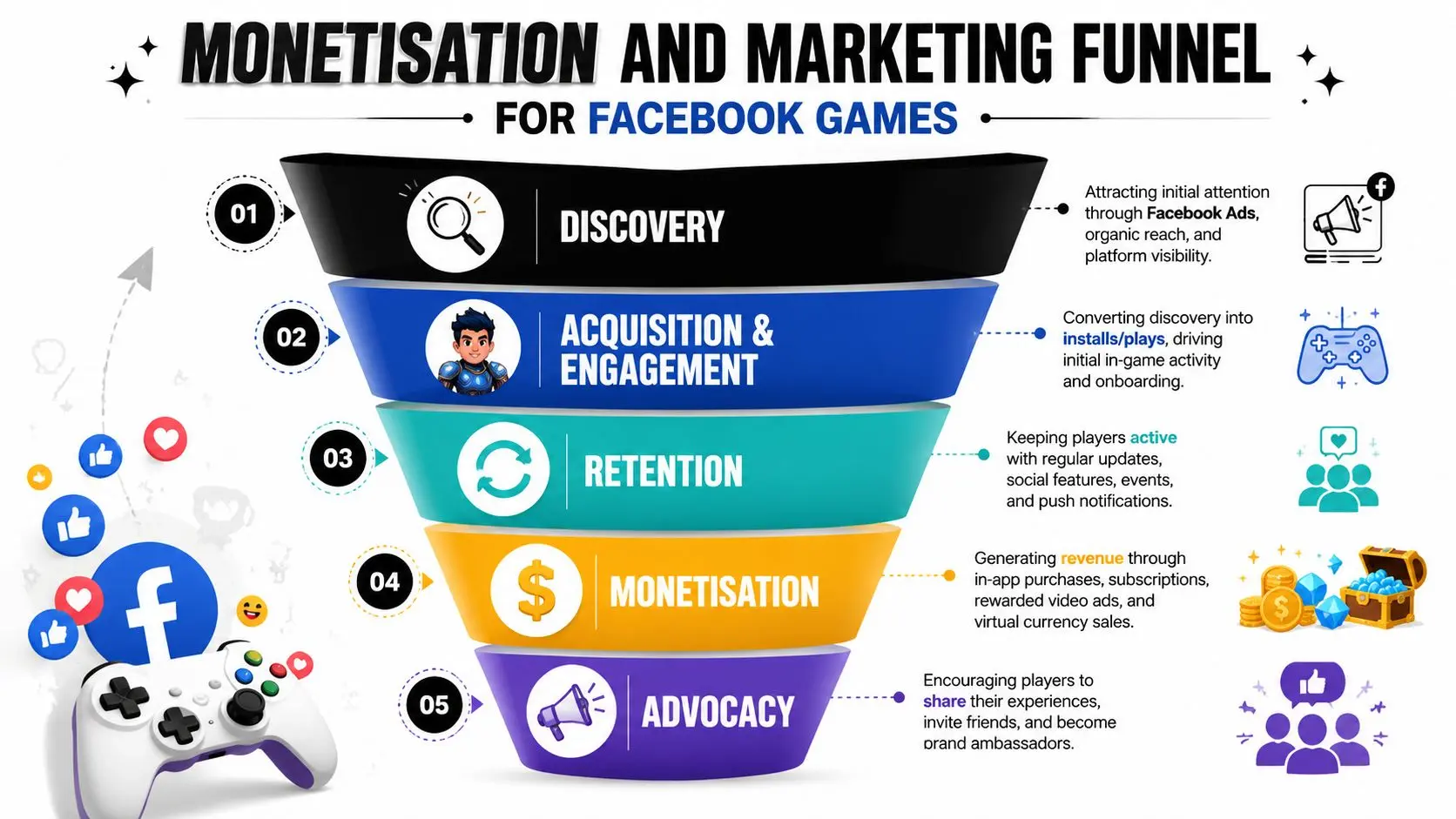
Match the model to the player journey
A practical Facebook gaming funnel usually looks like this:
- Discovery happens socially through posts, ads, creators, groups, or recommendation loops.
- The first session proves the concept in very little time.
- Retention depends on re-entry cues such as events, rivalry, progression, or community prompts.
- Monetisation only works if the value exchange fits the session pattern.
- Advocacy grows when players have a reason to share outcomes, not just the existence of the game.
What tends to work
Different Facebook formats support different commercial tactics:- •Rewarded ad moments: Best when the player already understands the loop and sees a clear benefit for opting in.
- •Cosmetic or convenience purchases: More natural in retained experiences than in one-off campaign games.
- •Playable acquisition creative: Useful when the ad itself previews the game accurately.
- •Creator and community amplification: Strong when the product has spectatable moments or social competition.
- •Event-driven updates: Effective for games that need regular reasons to return.
For teams weighing ad formats and commercial design choices, this complete guide to in-game ad formats and strategy is a useful operational reference.
What usually fails
The weaker patterns are predictable:
Commercial warning: If the game loop exists only to force ad views or rush purchases, players feel it immediately.
- •Front-loaded monetisation: Asking for spend before habit forms.
- •Misleading acquisition creative: Winning the click, then losing trust in the first minute.
- •No social reason to return: A decent mechanic with no community or event wrapper.
- •Campaign thinking without live thinking: Launching once, then leaving the product static.
The strongest Facebook game marketing still uses an old truth from social gaming. People don't just discover through ads. They discover through seeing other people play, react, compare, and share. Commercial design works better when it supports that behaviour instead of interrupting it.
UX and Compliance for a Social Platform
Good Facebook game UX starts with respect for interruption. Players are browsing, messaging, watching, comparing, and dropping in from different contexts. If your onboarding assumes deep concentration from the first tap, the platform will punish you. The right design pattern is usually short-session clarity. The player should understand the goal quickly, recover easily after a break, and know what happens if they share, return, or dismiss the experience. Notifications, reminders, and social prompts need restraint. Overusing them doesn't create retention. It trains people to ignore the game.
Trust is part of the product
Safety is not a side issue on this platform. A key concern for UK players is fraud and deception on social networks, and the source material provided for this brief notes that a majority of internet users have encountered online scams while the National Cyber Security Centre warns that social platforms are a common route for fraud, which is why legitimate games need to explain data collection, data use, and reporting pathways clearly, as referenced in this source cited in the brief. That has direct design implications:
- •Permission requests should be minimal: Ask only for what the game needs.
- •Data language should be plain: Replace vague legalese with usable explanations.
- •Reporting should be visible: Players shouldn't have to hunt for abuse, billing, or account help.
- •Promotional creative should match reality: Scam-adjacent presentation often starts with bait-and-switch expectations.
Operational habits that improve confidence
Brands running social campaigns around games also need content discipline outside the game itself. Community posts, paid creative variations, moderation responses, and reactive updates all shape player trust. Teams managing those moving parts can benefit from workflow guidance such as Direct AI's social media tools guide, especially when multiple stakeholders are publishing across social channels. Visual identity matters too. Avatars, profile surfaces, and branded character presence often become the player's first trust signal long before they understand the mechanics. That's one reason this guide to mastering avatars for Facebook is useful reading for teams thinking about recognisability and consistency.
The safest-looking game isn't always the safest one. The trustworthy game is the one that explains itself clearly and behaves consistently wherever the player meets it.
Your Partner for Navigating the Facebook Gaming Ecosystem
Facebook gaming is still commercially relevant, but only if you stop treating it like a single channel with a single build strategy. Some projects need a lightweight playable built for rapid uptake. Others need a richer game experience with lower access friction. Others work best when game design supports a broader social campaign, creator activation, or branded community loop. That fragmented reality is where many projects go off course. Teams scope the wrong format, optimise for the wrong metric, or build a technically sound product with no fit for how Facebook users behave. The winning work usually comes from joining strategy, UX, production, and distribution planning early instead of treating them as separate handovers. Studio Liddell is built for that kind of joined-up delivery. The studio combines animation craft, game production, XR capability, and real-time development experience across branded content, interactive experiences, apps, and immersive work. For clients exploring online games on Facebook, that matters because the brief often sits between disciplines. It's not just a game build. It's audience design, technical fit, creative execution, and commercial thinking in one production stream. Whether the need is a social-first mini-game, a branded interactive campaign, a game-adjacent content system, or a broader cross-platform entertainment idea, the right partner should be able to shape the concept before they start building it.
If you're weighing a Facebook game, playable campaign, or social interactive concept, Studio Liddell can help scope the right format, production pathway, and audience strategy before budget gets wasted on the wrong build.