Mastering Avatars For Facebook
Those creating avatars for Facebook often begin from an incorrect starting point. They see stickers, profile art, or a novelty layer inside Meta's ecosystem. Then the campaign goes live, the avatar appears in a few posts, and nothing much happens because the asset was never built to carry brand meaning, platform constraints, or performance intent. The stronger approach is to treat the avatar as a production asset with a job to do. It might need to humanise a service brand, front short-form creative, localise paid campaigns, or create continuity across Facebook, Messenger, Stories, and immersive touchpoints. Once you frame it that way, the decisions get sharper. Style, rigging, export formats, expressions, wardrobe, and compliance all stop being cosmetic choices and start behaving like commercial ones.
The Strategic Value of Brand Avatars on Meta's Platforms
A lot of brands are facing the same problem. Their content is technically fine, but it feels interchangeable. The posts are on-brand, the paid media is organised, and the audience still scrolls past because nothing in the creative gives the brand a distinct digital presence. That's where avatars earn their place. A well-designed avatar gives a brand a repeatable character system. It can show up in stickers, short-form video, comments, Messenger interactions, and paid creative without forcing the audience to relearn who's speaking.
Why the opportunity is too large to ignore
Scale matters here. Facebook has 3.070 billion monthly active users as of 2026, the 25 to 34 segment is its largest demographic, average engagement across all accounts is 0.15%, and Reels lasting 90 to 120 seconds generate the most user interactions, with 48% of Facebook users engaging most with this format, according to Sprout Social's Facebook statistics for marketers. That combination changes the brief. If your audience is already on-platform at that scale, the question isn't whether avatars for facebook are viable. Instead, consider whether your brand has built an avatar system that can perform in the formats people use. A practical mistake I see often is treating an avatar as a single illustration. That's rarely enough. Brands usually need a kit of expressions, poses, crops, and motion states. Without that range, the asset becomes repetitive fast and can't support campaign rotation.
Practical rule: If the avatar only works as a profile image, it isn't a strategic asset yet.
What avatars do well for brands
Avatars work best when they sit between branding and performance. They can make abstract businesses feel more legible. They can also create consistency across fragmented placements where static design systems often lose personality. Three strong use cases show up repeatedly:
- •Brand personification: A service business can turn a dry proposition into a recognisable voice by giving the brand a character with defined expressions and behavioural rules.
- •Creative continuity: The same avatar can anchor Reels, Story frames, Messenger stickers, and comments, which helps a campaign feel connected rather than assembled from separate assets.
- •Audience relevance: When the wardrobe, styling, and motion language reflect the audience's world, the avatar stops feeling decorative and starts feeling situated.
Where brands get the value wrong
The trade-off is simple. Cheap avatars are quick to produce, but they often flatten personality and reduce flexibility. High-quality avatars take more thought, more review discipline, and more technical planning, but they travel further across channels. That matters because the best brand avatars don't behave like one-off campaign art. They behave like reusable IP.
An avatar should reduce creative friction, not add another approval bottleneck.
Designing Your Avatar Concept and Creative Brief
Most avatar problems begin before production. The brief is vague, the stakeholder group hasn't aligned on purpose, and the team starts discussing hair, outfits, or rendering style before anyone has defined what the avatar is meant to accomplish. That's backwards. A good brief narrows choices early, which is what protects budget and avoids expensive redesign later.
Start with role before style
Define the job first. Is the avatar a brand spokesperson, a campaign device, a customer support persona, or a creator-facing mascot? Each role changes the design logic. Then answer the harder questions that teams often skip:
- •Audience fit: Who needs to recognise themselves, or their aspirations, in this character?
- •Tone range: Should the avatar handle warmth, authority, humour, excitement, or restraint?
- •Platform behaviour: Will it appear mostly in static crops, sticker packs, vertical video, or interactive environments?
- •Brand boundaries: What must never appear in wardrobe, pose, gesture, or expression?
These answers should sit in the same document as visual references. If you need a clean starting point, a solid template for marketing agencies helps structure the strategic questions before design begins.
Identity has to survive simplification
User behaviour makes this stage more important than many teams assume. 58% of users say avatar customisation options influence their choice of platform, and 36% actively match their avatar's fashion to real-world trends, as noted in Social Media Today's coverage of Facebook Avatars. That tells you two things. First, people care about representation details. Second, surface styling is not superficial. Wardrobe, proportions, hair, and accessories all carry identity signals. A strong brief usually specifies:
| Brief element | What to lock down |
|---|---|
| Personality | Calm expert, playful guide, bold disruptor, trusted helper |
| Visual language | Flat 2D, cel-shaded 3D, soft 3D, graphic mascot, realistic stylisation |
| Motion style | Minimal loops, expressive gestures, presenter performance, reactive emotes |
| Wardrobe system | Core outfit, seasonal variants, campaign-specific looks |
| Expression set | Neutral, excited, concerned, celebratory, explanatory |
For teams developing a more character-led asset, this guide to character design fundamentals is useful because it forces the design conversation beyond surface decoration.
The best avatar briefs read like casting documents. They describe behaviour, not just appearance.
Decide early between 2D and 3D
A 2D avatar is usually faster to approve and easier to adapt into social graphics. A 3D avatar gives you more camera flexibility, reusable posing, lighting control, and stronger crossover into AR, VR, and real-time content. Neither route is automatically better. It depends on what the asset needs to do repeatedly. If the character must live in animation, immersive media, or multiple viewing angles, 3D usually pays back the extra setup. If the need is mainly stickers, social crops, and graphic overlays, 2D can be the cleaner choice.
The Production Pipeline for 2D and 3D Avatars
The production pipeline decides whether the avatar becomes a durable brand asset or a fragile file that only one designer can edit. Good production creates flexibility. Poor production creates rework.
The 2D route
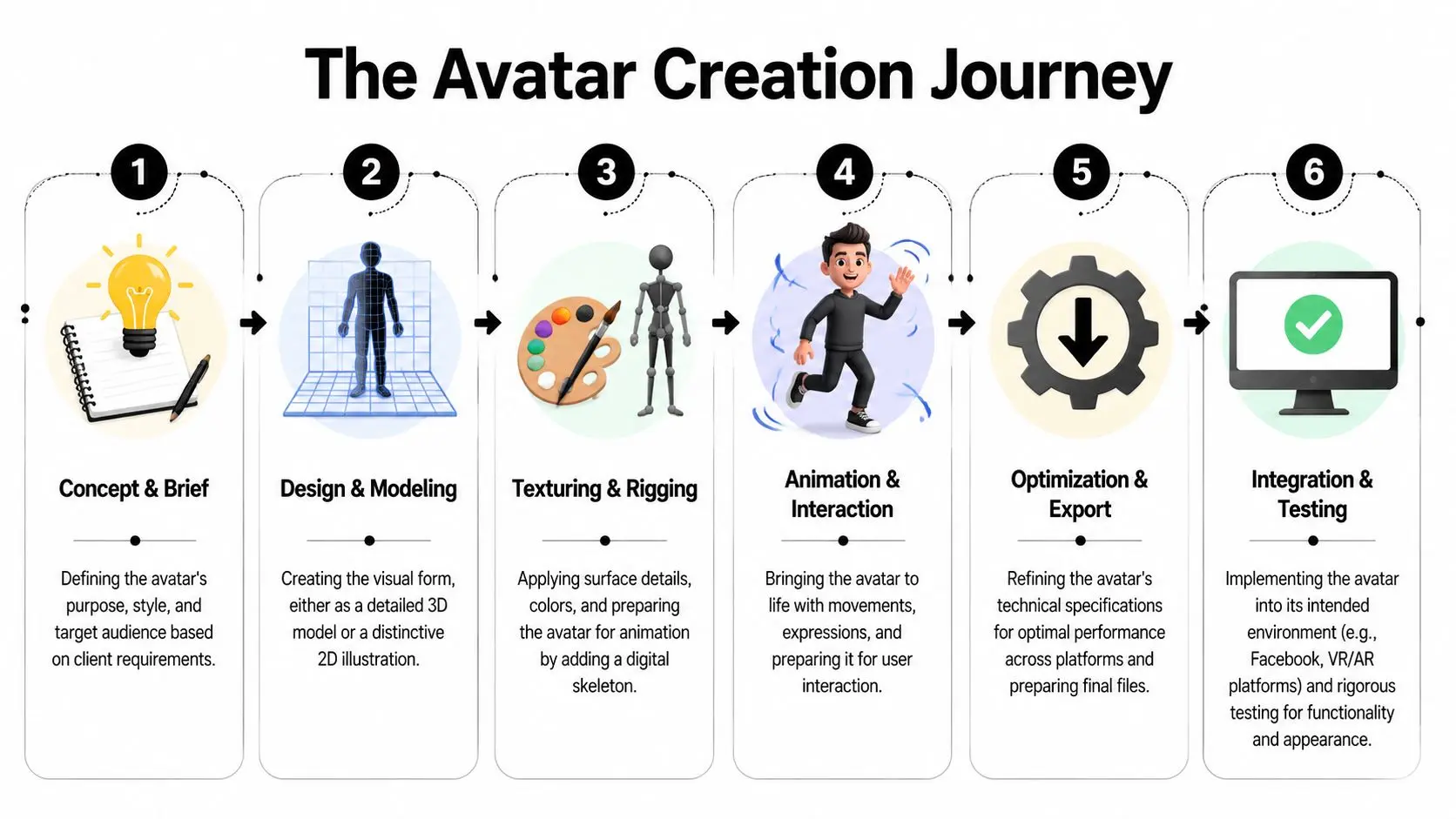
A professional 2D pipeline is not just sketch, colour, export. It usually runs through concept sheets, silhouette testing, expression boards, turnaround poses, final illustration, then asset slicing for platform use. The benefit is control. You can preserve a very specific graphic style, which is useful for editorial brands, family entertainment, product mascots, or campaigns that need a strong art-directed look. The weakness is scalability in motion. If the team suddenly wants more angles, more gestures, or richer animation, a purely illustrative build can become labour-heavy. A solid 2D pipeline often includes:
- •Concept pass: broad visual directions with different shape languages and tone
- •Expression development: face and body language tested before final polish
- •Master artwork: approved character build with clean layers for adaptation
- •Deployment assets: sticker variants, cut-down crops, animated loops, and pose library
The 3D route
A 3D avatar pipeline is more technical, but that setup is what gives the asset longer life. The standard path is concept, modelling, texturing, rigging, skinning, animation, optimisation, and export. Each stage has a business implication. If modelling is weak, the silhouette won't hold up in close shots. If rigging is too basic, the avatar won't emote properly. If optimisation is left until the end, performance falls apart when the asset hits real deployment. Here's the practical split:
| Stage | What happens | Why it matters |
|---|---|---|
| Modelling | Build the avatar's form and proportions | Determines silhouette and reuse across angles |
| Texturing | Apply colour, material response, surface detail | Carries brand finish and visual quality |
| Rigging | Add digital controls and skeleton | Enables posing, facial movement, animation |
| Skinning | Bind the model to the rig | Prevents broken deformation in motion |
| Animation | Create performance and expression | Turns a design into a communicator |
| Optimisation | Reduce technical weight without visual collapse | Keeps assets usable across outputs |
For marketers exploring presenter-style synthetic performance alongside character pipelines, this overview of Synthesia for content creators is a useful reference point because it highlights where AI-generated talking-head workflows differ from purpose-built avatar production.
A good rig saves money later. It gives the team new poses, new clips, and new edits without rebuilding the character each time.
Motion capture versus keyframe
This is one of the most misunderstood choices in avatar production. Motion capture is useful when you need natural body performance fast, especially for presenter motion or realistic interaction. Keyframe animation is usually better when the avatar is stylised, exaggerated, or tightly art-directed. For many brand avatars, the right answer is hybrid. Capture broad body timing if needed, then refine with keyframe passes so the performance matches the design language. That's especially relevant when the avatar needs to feel polished in social placements. Raw captured motion often looks too loose for brand work. Keyframed performance can look cleaner, but it takes a stronger animation pass.
Real-time pipelines and review discipline
Unity and Unreal matter when the avatar has to do more than appear in exported media. If the character needs live interaction, AR filtering, or crossover into immersive content, real-time engines make iteration much faster. The production discipline around them matters just as much. Use version control. Lock naming conventions. Separate hero assets from delivery variants. Run approval gates at concept, rig test, look-dev, and deployment-ready stages. For teams building more advanced motion-led assets, this end-to-end look at 3D motion graphics production is a good companion to avatar workflows because the same production logic applies.
Technical Specs and Optimisation for Facebook
A polished avatar can still fail on-platform if the exports are wrong. Cropping, compression, and weak file prep are where a lot of otherwise strong work loses impact.
The core export rules
For UK campaign work, the practical baseline is clear. Use 1080x1080 pixels in PNG at 1:1 for Feed posts and 1440x2560 pixels at 9:16 for Stories. According to Sprout Social's Facebook ad size guidance, UK campaigns using correctly formatted avatars in Stories recorded 22% higher engagement and a 15% CTR uplift compared with static images. That isn't just a formatting note. It's a production instruction. Create layout-safe variants for each placement rather than stretching one master asset across every channel.
What breaks most often
The most common failures are predictable:
- •Wrong aspect ratio: The avatar's face or gesture gets cropped in Reels or Stories because the safe area wasn't planned at design stage.
- •Over-detailed composition: Fine textures and small accessories disappear on mobile screens.
- •Single-pose delivery: One export leaves paid media teams with nothing to test.
- •Weak contrast: Background and character values collapse together in-feed.
A lot of this can be avoided if the team designs for platform framing instead of retrofitting at the export stage.
Build the crop into the storyboard. Don't design a beautiful full-frame asset and hope Facebook will respect it.
A practical delivery checklist
Before an avatar package goes live, check the following:
- Feed readiness
- Story framing
- File hygiene
- Variation set
- Mobile proofing
Deploying Avatars in Marketing Campaigns
Once the avatar is built properly, it needs a role in the media plan. Too many brands stop at asset creation. They launch the character, post it a few times, and assume the job is done. It isn't.
Where avatars perform best in the funnel
At the top of funnel, avatars work well in short-form awareness creative. They give the audience a recognisable focal point and can hold together a series of Reels or Stories without making each ad feel disconnected. Mid-funnel is where expression range starts to matter. Different poses, reactions, and wardrobe variants let the campaign respond to different audience segments while preserving brand continuity. At the bottom of funnel, the avatar needs to do more than look charming. It has to support a clear offer, stronger hook, and tighter message hierarchy.Niching beats generic character work
The performance case for localisation is strong. According to 2025 UK Facebook Ads Council data referenced here, UK-niched avatar ads reached revenue goals such as $10k+ days three times faster, delivered a 35% ROAS improvement, and relevant avatar hooks can reduce CPA by as much as 28%. That matches what experienced producers already know. Generic mascot creative tends to get approved because it offends no one. Specific creative performs because it feels intended for someone. A useful testing structure looks like this:| Test area | Version A | Version B |
|---|---|---|
| Hook | General brand line | Audience-specific UK phrasing |
| Pose | Neutral presenter stance | Active gesture tied to offer |
| Background | Brand colour field | Contextual environment |
| Expression | Friendly neutral | Enthusiastic or problem-solving |
How to run the tests sensibly
Don't test everything at once. Hold most variables steady and change one meaningful element per iteration. If the hook, pose, background, copy, and CTA all change together, you won't know what caused the result. Good deployment also means using the avatar where it adds clarity. If the message is already visually crowded, adding a character can dilute the ad. If the message needs a human or semi-human anchor, the avatar can sharpen it.The avatar should carry recognition and emotional tone. It shouldn't compete with the offer.For teams planning animated paid work around character assets, this guide to adverts with animation that drive real engagement is a helpful reference because it shows how motion, pacing, and design choices affect campaign output.
Privacy Branding and Future Trends in 2026
The creative side gets most of the attention, but the governance side is where long-term value is protected. Once a brand avatar starts appearing across paid media, community interactions, personalisation layers, or AI-assisted workflows, it stops being a simple design asset and starts becoming a managed brand entity.Brand rules need to be explicit
Most companies have visual guidelines for logos. Far fewer have usage rules for avatars. That gap creates inconsistency fast. An avatar governance pack should define:- •Approved tone ranges: when the avatar can be playful, formal, empathetic, or assertive
- •Visual restrictions: banned gestures, expressions, props, and styling choices
- •Context rules: where the avatar can appear and where it should not
- •Team permissions: who can modify, export, localise, or animate the asset
Without that structure, the asset drifts. Different teams create off-model versions, platform outputs lose consistency, and the character becomes less trustworthy over time.
AI personalisation creates compliance pressure
The year 2026 presents additional complications. AI-enhanced avatars are becoming more responsive and more personalised, but that creates legal and operational risk if the organisation hasn't prepared for it. According to this discussion of AI avatar privacy and UK compliance risks, the UK's ICO saw a 25% rise in complaints related to AI avatars in 2026, issued £2.1m in fines for non-transparent data use, and 73% of UK firms planning avatar adoption were unaware of DPIA requirements under GDPR Article 35. Those figures matter because many teams still treat avatar systems as harmless creative tooling. They aren't harmless when personalisation relies on behavioural data, inferred traits, or opaque AI processes.
If an avatar changes based on user data, privacy review has to happen before creative rollout, not after launch.
Accessibility and representation are part of brand safety
There's also a wider issue that creative teams can't ignore. Representation options shape whether people feel included by the system. If an avatar framework can't credibly reflect the audience it's addressing, the brand loses trust even when the art direction is polished. That doesn't mean every brand needs the most elaborate feature set possible. It does mean the team should review inclusivity, localisation, and accessibility implications with the same seriousness they give colour, wardrobe, and motion.
What's next for avatars for facebook
The next phase is likely to be more dynamic, more data-aware, and more integrated with real-time content systems. That opens useful possibilities. Brands will be able to adapt messaging faster, localise character performance more precisely, and bridge campaign assets into AR, XR, and interactive environments with less friction. It also raises the bar. The teams that do this well will combine three disciplines that don't always sit together: character design, production engineering, and compliance thinking. That's the true future of avatars for facebook. Not novelty. Operationally sound digital characters that can hold brand meaning across multiple channels without creating legal, technical, or creative debt.
If you're planning a brand avatar system that needs to work across animation, advertising, social, and immersive media, Studio Liddell can help scope the creative, technical, and delivery requirements properly from the start.