A Complete Guide to In Game Ad Formats and Strategy
An in game ad is promotional content placed directly within a video game. But forget annoying, disruptive pop-ups. Modern in-game advertising focuses on ads that feel like part of the furniture, such as virtual billboards, branded gear for your character, or even videos you can choose to watch for an in-game reward. This guide will explore the formats, technology, and strategy behind effective in-game ads.
What Is In Game Advertising and Why It Matters Now
At its heart, in-game advertising is about strategically placing a brand’s message inside a game. Think of it as product placement for the interactive generation. Instead of seeing a movie character sip a certain brand of fizzy drink, a player in a racing game might zoom past a billboard advertising that same drink. It’s a way for brands to get in front of a highly engaged audience in an environment where they are completely focused and receptive. Why the sudden buzz? Gaming is no longer a niche hobby; it’s a global cultural powerhouse. This shift has opened up a massive opportunity for marketers to reach audiences who are increasingly difficult to capture with traditional TV or print ads. The real goal here is to stop interrupting the fun and start creating brand experiences that feel like they genuinely belong in the game's world.
The Two Fundamental Approaches
To get a handle on how these ads actually work, it helps to split them into two main camps. Nailing this distinction is the first step to building a strategy that works for your brand without wrecking the player’s experience.
- •Intrinsic Ads: These are the chameleons of the ad world, designed to blend seamlessly into the game environment. A branded football shirt in a sports sim or a movie poster plastered on a wall in a virtual city are perfect examples. They add a layer of realism without yanking you out of the moment.
- •Extrinsic Ads: These ads live outside the main action and are clearly promotions. The most common formats you’ll see are rewarded videos, where you watch a short clip to earn in-game cash or items, or full-screen ads that pop up between levels.
To make these concepts even clearer, here’s a quick breakdown of the core types of in-game advertising.
Table: Key In Game Ad Concepts at a Glance
| Ad Concept | Primary Characteristic | Best For |
|---|---|---|
| Intrinsic In-Game Ads | Integrated directly into the 3D game environment (e.g., billboards, posters). | Building brand awareness and enhancing realism without disrupting gameplay. |
| Rewarded Video Ads | Player-initiated videos that offer an in-game reward upon completion. | Driving high engagement and monetising free-to-play games effectively. |
| Interstitial Ads | Full-screen ads that appear at natural breaks in gameplay (e.g., between levels). | Capturing full player attention for high-impact brand messaging. |
| Playable Ads | Interactive mini-games that let users try an app or game before installing. | Acquiring high-quality users by offering a "try before you buy" experience. |
This table shows how different ad formats serve different purposes, from subtle brand integration to direct calls-to-action, allowing for a flexible and player-friendly monetisation strategy.
A Rapidly Expanding Market
The UK in-game advertising scene is absolutely booming, thanks largely to the explosion of mobile gaming and brands diving headfirst into immersive experiences. With the UK gaming market predicted to hit a massive £8.4 billion by 2028, in-game ads have become a critical piece of the puzzle for monetisation, especially for free-to-play games. And the audience is huge. There are over 39 million gamers in the UK, spending an average of £110 each year. Well-placed, non-intrusive ads are proving to be a brilliant way to blend entertainment and commerce without stepping on anyone's toes. If you want to dig deeper, you can find out more about the UK's in-game ad market growth.
In-game advertising, when done right, frames marketing not as an interruption to be endured, but as a component that can add authenticity and value to a virtual world.
By getting to grips with these basics, brands can start to see video games for what they are: not just a pastime for a few, but a vital and growing platform for building real connections with millions of dedicated fans.
Exploring the Spectrum of In-Game Ad Formats
When people talk about "in-game ads," they’re not talking about just one thing. It's a whole creative landscape, with a ton of different options, each with its own game plan. To get it right, you have to move past a one-size-fits-all mindset. The most impactful campaigns are the ones that pick an ad type that clicks perfectly with the brand’s goals and the player’s experience. At the highest level, the formats are split by how they play with the game itself. Some are designed to be part of the furniture, blending right into the virtual world. Others are meant to pop, offering a clear-cut deal in exchange for a player's attention. Understanding this distinction is crucial because it shapes everything that follows, from the creative brief to what you measure at the end.
Intrinsic Ads: The Art of Blending In
Intrinsic ads are the masters of subtlety. They're woven directly into the game's environment, becoming a native part of the world the player is exploring. Think of them as the digital version of product placement in a film; they add a layer of realism without yanking you out of the story. When a player zips past a branded billboard in a racing game or spots a real-world logo on a stadium banner in a sports sim, they're seeing an intrinsic ad. These formats are brilliant for building brand awareness and recall without ever feeling like an interruption. The real win here is authenticity. Because these ads exist within the logic of the game world, they don’t feel jarring or out of place. This helps build a much more positive (or at least neutral) feeling toward the brand, all because the player’s immersion is respected. This diagram shows how brands, developers, and gamers all connect within this ecosystem.
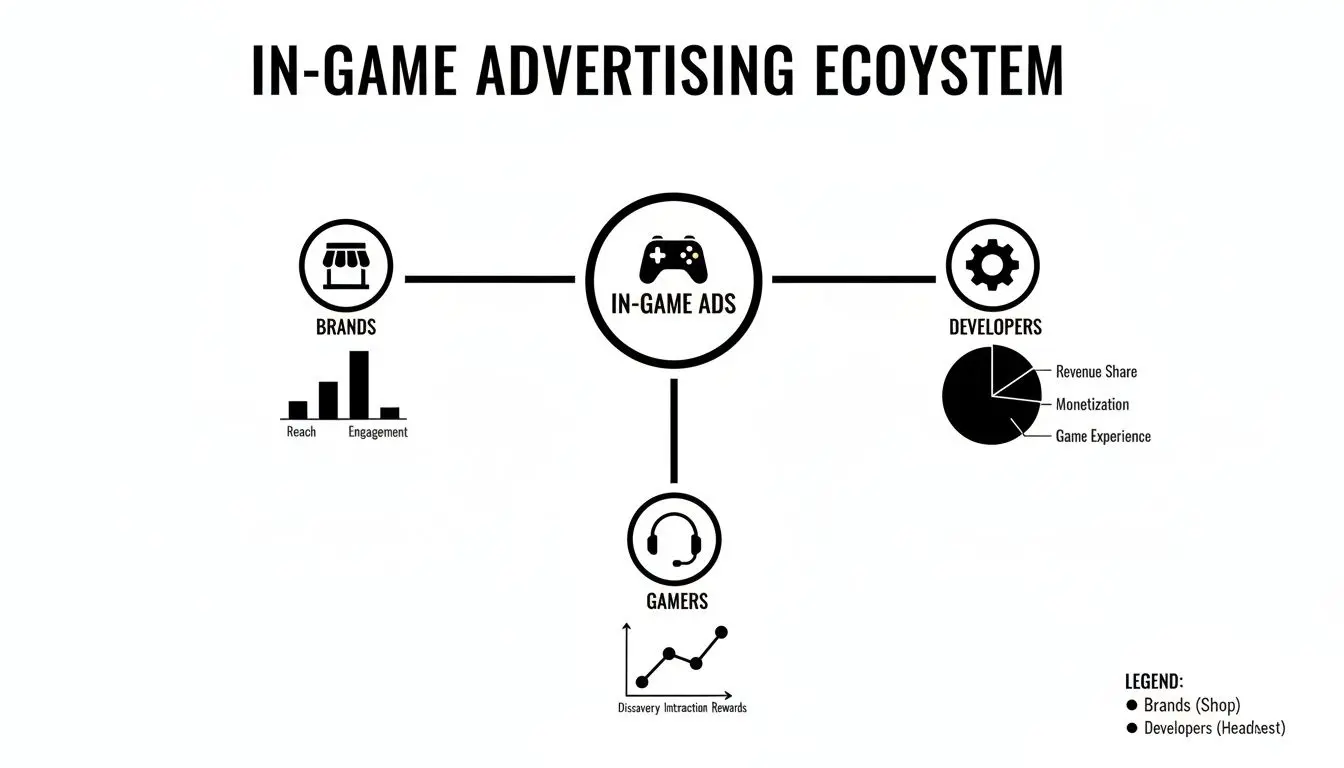
It’s a symbiotic relationship: developers monetise their games, brands get in front of engaged audiences, and players often get to enjoy free content.
Extrinsic Ads: The Clear Value Exchange
On the flip side, extrinsic ads are presented outside the core gameplay. They are clearly and unapologetically advertisements, but their success hangs on offering the player something valuable in return for their attention. It’s a transaction, and when it’s balanced right, everyone walks away happy. The most common formats you’ll see are:
- •Rewarded Video Ads: These are opt-in videos that players choose to watch. In return, they get an in-game reward, maybe some extra coins, another life, or a temporary power-up. A massive 79% of mobile players say they’re happy to watch this kind of ad.
- •Interstitial Ads: These are full-screen ads, either static images or videos, that show up at natural breaks in the action, like between levels or after a mission. For a short burst, they have the player's undivided attention.
- •Playable Ads: This is a more interactive format that serves up a mini-game, basically a "try before you buy" for another game or app. They’re super effective for acquiring new users because they filter for people who are already engaged and willing to play.
The golden rule for extrinsic advertising is consent and value. Players are way more open to an ad when they start the interaction and get a clear benefit. It turns a potential annoyance into a welcome boost.
Advergames: When the Game Is the Ad
Finally, we have advergames. This is where the entire game is the advertisement. Instead of putting a brand in a game, the brand creates the game. This approach gives you the deepest brand integration possible, weaving the product’s message into the core mechanics, story, and art style. Think of a simple mobile game from a food brand where you have to catch falling ingredients. Advergames are less common than the other formats, but for a big product launch or a major brand campaign, they can be incredibly powerful. They create a memorable and deeply engaging experience that players actively seek out. Ultimately, choosing between these formats comes down to what you’re trying to achieve, be it subtle awareness, a direct response, or immersive brand storytelling.
How In Game Advertising Actually Makes Money
To understand the in game ad world, you first need to follow the money. It's not as simple as just slapping an ad in a game and hoping for the best; there's a proper system built on specific financial models that dictates how developers get paid and how advertisers pay for players' attention. The whole ecosystem is set up to match the cost with the campaign's end goal. A brand that just wants to get its name out there will use a completely different payment model than a game studio trying to get people to download its new release. Grasping these financial mechanics is vital, whether you're an advertiser planning your next move or a developer trying to build a solid monetisation strategy.
The Core Pricing Models Explained
Most in game ad deals boil down to a few core pricing models, each one a different tool for a different job. Some are for casting a wide net, others for surgical strikes.
- •Cost Per Mille (CPM): "Mille" is just Latin for a thousand. So, CPM is simply the price an advertiser pays for one thousand views or impressions of their ad. This is the classic model for brand awareness campaigns. If you want to get your brand in front of as many eyeballs as possible, think virtual billboards in a racing game, you pay for those impressions.
- •Cost Per Click (CPC): With the CPC model, the advertiser only pays when a player actually clicks on their ad. This is all about getting a direct response and is perfect for ads with a clear call-to-action, like interstitial or banner ads that send players to a website. It’s about engagement, not just views.
- •Cost Per Install (CPI): This one is massive in the mobile gaming scene. Here, an advertiser, often another game developer, only shells out cash when a user clicks an ad and goes on to install their game or app. It’s a performance-based model focused entirely on getting new users.
To see how in-game advertising fits into the bigger picture of how apps make money, it's worth checking out these 10 Proven Mobile App Monetization Strategies. It gives you a wider view of the financial landscape that in-game ads are a part of.
Balancing Ads with Other Revenue Streams
For many developers, particularly in the massive free-to-play market, ad revenue is just one slice of the pie. Putting all your eggs in the ad basket can be a bit risky, which is why so many studios go for a hybrid monetisation model. This approach is all about cleverly mixing advertising with other income sources, usually In-App Purchases (IAPs).
A successful hybrid model is a delicate balancing act. The aim is to bring in the most revenue possible without wrecking the player's experience. You might let players watch a rewarded video ad to earn some in-game cash, or they can just buy it directly.
This strategy puts players in the driver's seat. Some will happily spend their time watching ads to get ahead for free, while others will pay real money to skip the grind. By offering both options, developers can appeal to different kinds of players, creating a much more stable and reliable revenue stream. For a closer look at building winning campaigns, you should explore some proven strategies to boost your campaigns. At the end of the day, these financial models are the scaffolding that holds up the entire in game advertising industry. They give brands a way to run campaigns they can actually measure and provide developers with the cash they need to keep building the amazing worlds we all love to get lost in.
The Technology That Makes In Game Ads Work
Behind every seamless in game ad, there's a complex but fascinating technical engine chugging away. It’s the hidden machinery that allows a virtual billboard in a digital London to show a relevant ad to a player in Manchester, all in the blink of an eye. Getting to grips with this tech is the key to understanding how modern in-game advertising really operates. The whole process starts with a Software Development Kit (SDK). Think of an SDK as a pre-packaged toolkit that a game developer slots into their game's code. This kit contains everything needed, from the logic for displaying ads to the functions for tracking data, to let the game talk to the wider ad world. Without an SDK, connecting a game to the global advertising market would be a long, manual slog. With it, developers can essentially plug their game's ad inventory straight into a global marketplace.

The Digital Marketplace for Ad Space
Once an SDK is installed, the game’s ad space, whether it’s a banner, a rewarded video slot, or a 3D object, is officially on the market. This is where a dynamic, automated auction house kicks into gear, run by a few key platforms working in harmony. The main players in this digital auction are:
- •Supply-Side Platform (SSP): This is the developer's agent. The SSP takes the game’s available ad inventory and offers it up to a huge pool of potential buyers. Its main job is to get the best price for the developer by finding the highest-paying advertiser for every single ad impression.
- •Demand-Side Platform (DSP): This is the advertiser's agent. Brands and their agencies use DSPs to buy ad space across thousands of games at once. They set their campaign rules, budget, target audience, performance goals, and the DSP automates the bidding to find the most effective spots for their ads.
Together, SSPs and DSPs create an automated, real-time bidding (RTB) environment. In the milliseconds it takes for a game to load a new level, an auction happens where advertisers bid for the right to show their ad to that specific player.
This programmatic approach means ad space is filled efficiently and the ads shown are as relevant as possible to the player, which is a win for everyone involved.
Technical Hurdles Across Different Platforms
Placing an ad inside a game isn't a one-size-fits-all job. The technical challenges vary hugely depending on the gaming platform, ranging from relatively simple on mobile to incredibly complex in console and VR worlds. For in-game advertising that needs to look truly at home in a game world, the underlying tech often relies on sophisticated 3D modelling and rendering tools. Having a grasp of what the top architectural rendering software can do gives you a sense of the craft involved in creating stunning 3D assets for these ads. Here’s a quick look at the different integration challenges:
| Platform | Key Technical Challenges |
|---|---|
| Mobile | Standardised SDKs make integration fairly straightforward. The main hurdles are navigating data privacy (like ATT on iOS) and making sure ads don't drain battery life or slow down game performance on thousands of different devices. |
| PC & Console | Integration is far more complex here. These are often closed ecosystems with strict quality assurance (QA) processes from platform holders like Sony and Microsoft. Intrinsic ads must be built to match high-fidelity graphics and can't cause any frame rate drops or bugs. |
| VR/AR (XR) | This is the most demanding environment of all. Ads have to be seamlessly woven into a 3D spatial world without causing motion sickness or breaking the feeling of immersion. Developers must consider player movement, gaze tracking, and interaction, making it a highly specialised skill. |
At the end of the day, the technology behind modern in game ads is a sophisticated dance between SDKs, platforms, and real-time auctions. It’s this powerful engine that lets brands reach players with precision and helps developers fund their creative work across a massive range of gaming experiences.
Designing In Game Ads Players Actually Like
Great in-game advertising should feel like it belongs. It’s part of the experience, not a clumsy interruption. The campaigns that truly connect are the ones that respect the player, fit naturally into the game world, and maybe even add a little something to the session. This isn't about just dropping an ad in; it's a creative balancing act that puts context, aesthetics, and the player’s mindset first. When an ad is creatively lazy or just feels wrong, it does more than just get ignored, it can actively damage how players see your brand. Think about it: a photorealistic car ad plonked into a cartoonish fantasy RPG completely shatters the illusion. It’s a fast track to annoying your audience and wasting your budget. The aim is to make your brand feel like it’s part of the world, not like it’s crashing the party.
Match The Medium And The Moment
The first rule of thumb for effective in-game creative is simple: make it fit the game’s environment. This goes way beyond just matching the art style. It’s about truly understanding the context of where the ad will appear and what the player is likely feeling in that exact moment. Keep these core creative principles in mind:
- •Aesthetic Cohesion: Your ad should look like the game developers made it themselves. If the game has a cel-shaded art style, your ad needs to follow suit. If it's a hyper-realistic world, your 3D assets must meet that same standard of quality.
- •Logical Placement: A poster for a fizzy drink on a bus stop in a city-builder game? Makes perfect sense. A branded sword in a fantasy epic? Feels natural. A massive banner for an insurance company floating in the sky? Not so much.
- •Clear, Unobtrusive Messaging: The brand’s message must be instantly gettable without being distracting. Players are locked in on their objectives, so ads with tons of text or complicated designs will just be ignored. A strong logo and a punchy tagline work far better.
The real test of a great intrinsic ad is whether it actually enhances the game's sense of realism and atmosphere. It should feel so natural that players might not even consciously register it as an 'ad', but the brand impression is still powerfully made.
Crafting Rewarded Ads That Players Seek Out
With extrinsic formats like rewarded video, the creative puzzle is a bit different. Here, the player is actively choosing to pause their game in exchange for a clear reward. The focus shifts from seamless integration to delivering a snappy, high-value experience that feels like a fair trade for their time. The best rewarded video ads are short, energetic, and often interactive. Playable ads, which offer a bite-sized demo of another game, are a brilliant example. They perform incredibly well because they respect why the player is there in the first place, they enjoy playing games, and offer an engaging mini-experience instead of a passive video.
Practical Tips For High-Impact Creative
To really nail your in-game ad design, your creative team needs to be asking the right questions from day one. Building campaigns that resonate means getting a deep feel for the gaming environment you’re stepping into. Here are a few actionable tips for your next project:
- Request a "Creative Bible": Before you even think about design, ask the game developer for their art style guide. This is the holy grail, containing the colour palettes, fonts, and aesthetic rules that define their world.
- Think in 3D: For intrinsic ads in 3D worlds, your assets need to look good from all angles. A simple flat texture can look really odd when a player walks past it. Always try to provide 3D models or layered files.
- Prioritise Clarity: Keep your branding bold and simple. A player might only glance at your ad for a split second while chasing an enemy down a corridor. Make sure your logo and key message can be understood in an instant.
Measuring Success and Navigating the Rules
Launching an in-game ad campaign is one thing, but knowing if it actually worked? That’s a whole different ball game. To get beyond pure guesswork, you need a solid handle on the numbers to measure performance and a clear understanding of the rules to keep your campaign compliant, ethical, and effective. Success in this world isn't just about counting clicks. It’s about looking at a blend of standard advertising metrics and game-specific signs that show the real impact on player behaviour. This dual focus helps you see the immediate return on your investment and the long-term effect on how players feel about your brand.Key Performance Indicators to Track
To get the full picture of how your campaign is doing, you need to track a variety of metrics. Each KPI tells a different part of the story, from whether the ad was seen at all to its lasting impact on player loyalty. A few of the essentials include:- •Viewability and Impressions: This is your starting point. It confirms that your ads were actually seen by players, an absolute must for intrinsic ads like virtual billboards that don't rely on clicks.
- •Click-Through Rate (CTR): For any ad with a clickable element, CTR measures how many players were curious enough to interact. It’s a direct signal of how appealing your creative is and whether your call-to-action landed.
- •Return on Ad Spend (ROAS): The big one for the finance team. This calculates the revenue generated for every pound spent on the campaign, giving you a direct measure of profitability.
- •Player Retention: A vital game-specific KPI. This tracks whether players stick around after seeing your ads. If retention stays stable or even goes up, it’s a great sign your ads feel like part of the game, not an annoying interruption.
- •Brand Lift and Recall: Often measured with post-campaign surveys, this tells you if players actually remember your brand and if their opinion of it has improved.
An effective in-game ad campaign doesn't just drive sales; it becomes a positive and memorable part of the player's world. Tracking both performance and sentiment is the only way to know if you've hit that sweet spot.
For a deeper dive into the tools and methods used to gather this data, exploring a comprehensive guide to mobile apps tracking can provide valuable context on how information is collected and analysed in this ecosystem.
Navigating the Regulatory Landscape
Beyond the numbers, getting the legal and ethical rules right is completely non-negotiable. The industry is governed by strict data privacy and child protection laws that every advertiser and developer must follow to the letter. Get it wrong, and you could face serious penalties and major damage to your brand’s reputation. The two most critical frameworks to get your head around are:
- General Data Protection Regulation (GDPR): This UK and EU law dictates how personal data is collected, used, and stored. For in-game ads, it means you absolutely must get clear and informed consent from users before collecting their data for ad personalisation. Transparency is everything.
- Children's Online Privacy Protection Act (COPPA): While it's a US law, its principles are considered best practice worldwide. It places strict limits on collecting personal data from children under 13. Any game or ad campaign aimed at this audience must have solid age-gating and steer clear of behavioural advertising.
Answering Your Top In-Game Ad Questions
As in-game advertising finds its footing, it's only natural that brands, developers, and even players have a lot of questions. We hear them all the time. Let's clear up some of the most common queries and cut through the noise.How Can a Small Brand Start with In-Game Advertising?
Getting started is probably easier than you think. The simplest way for a smaller business to dip a toe in the water is through programmatic ad networks that focus on mobile games. Many of these platforms are built to be self-serve, which means you can start with a modest budget and get really specific with targeting certain game genres or player demographics. I'd recommend beginning with proven formats like rewarded video or interstitial ads. They're well-understood, and the performance metrics are straightforward, making it much simpler to track what you're getting for your money. The most important thing? Make sure your creative is top-notch, looks great on a mobile screen, and actually fits the vibe of the games you're targeting.Does In-Game Advertising Annoy Players?
The honest answer? It absolutely can, but only when it's done badly. The secret to getting it right is to be respectful of the player and, whenever you can, add some real value to their experience. Take rewarded video ads, for example. Players often genuinely like these because they get something useful in return for a few seconds of their time, a fair trade. Likewise, intrinsic ads like in-game billboards or posters usually go unnoticed in the best way possible because they just feel like part of the world.The ads that get the most hate are almost always the ones that abruptly interrupt gameplay or feel jarringly out of place. If you put the player's experience first, you'll avoid churn and might even build some positive feelings towards your brand. It's that simple.