Metaverse Development Company: What It Builds and Costs
You've been asked to investigate a virtual space for your organisation, and the quotes in your inbox don't look like they're pricing the same thing. One supplier talks about a platform. Another talks about a world. A third sends a link to a headset game and calls it a metaverse strategy. That confusion is normal. The term covers browser-based 3D, mobile AR, standalone VR and multi-user virtual worlds, and those four options differ sharply in cost, audience and upkeep. This guide walks through what a Metaverse development company builds, which services you might need, where the money goes, and how to judge a provider before you sign anything.
What a Metaverse Development Company Actually Builds
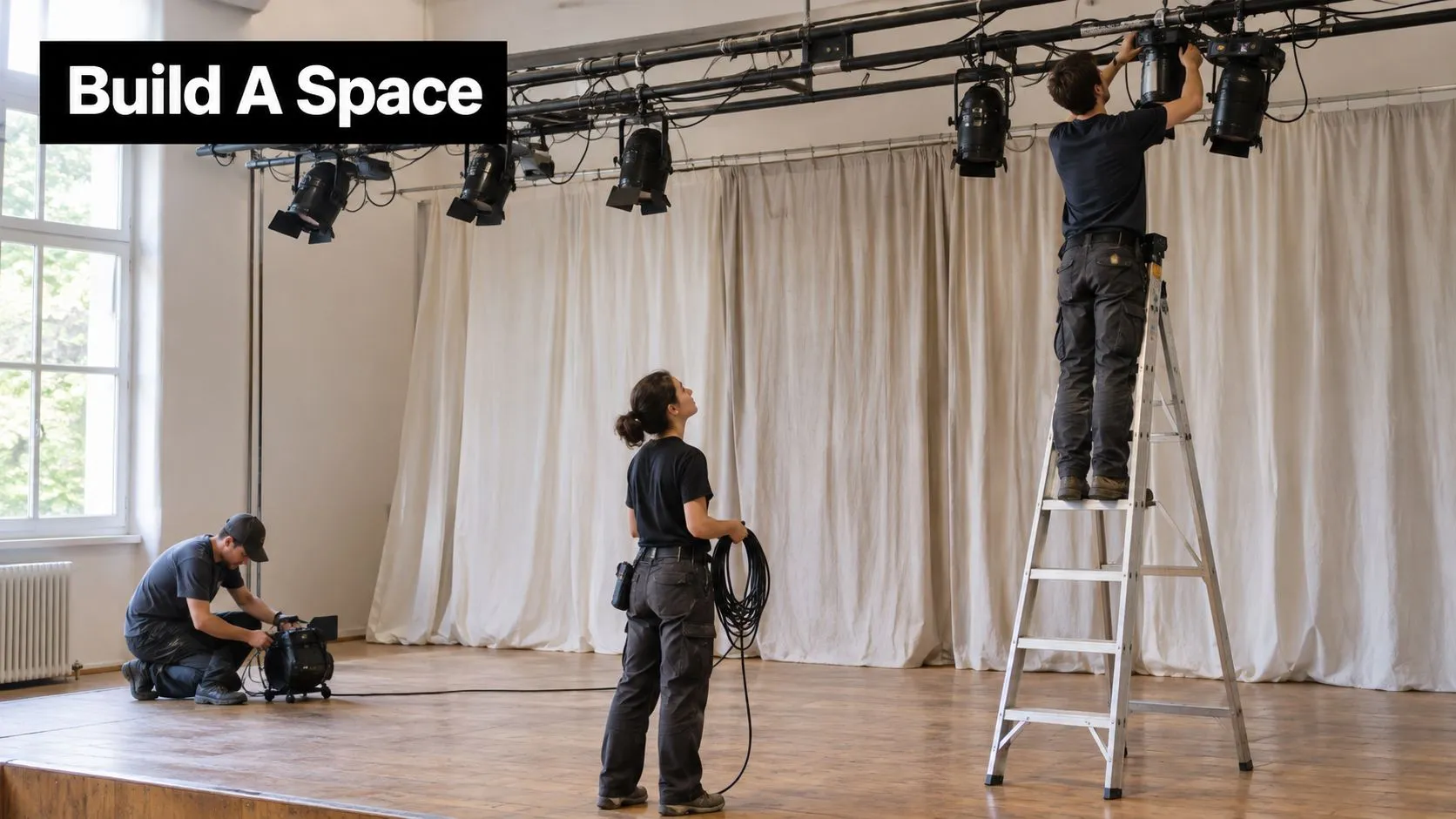
A Metaverse development company works like a theatre production team rather than a web agency. A website shows people pages. A metaverse build gives them a space to walk into, with characters who move, rules that hold, and servers that keep everyone in the same room.
A Metaverse development company designs and builds interactive 3D spaces where people can move, meet and act together, and it supplies the hosting, identity and upkeep those spaces need.
That definition separates a working space from a one-off 3D model. A space nobody can enter, move through or change is content. What you're paying for is the ability for visitors to act inside it.
The Three Layers Every Project Shares
- •Presentation: The 3D environments, animation, sound and interface your visitors see and hear.
- •Interaction: Avatars, controls, multiplayer sessions and voice, so people can act rather than just watch.
- •Infrastructure: Hosting, identity, data and analytics, which keep the space running and measurable.
Briefs that go wrong usually cover only the first layer. The second and third decide whether the space holds up with real visitors, and they're where budgets tend to grow without anyone noticing.
Who's Buying This Work
Demand in the UK isn't hypothetical. In EY's 2023 UK Metaverse Readiness Survey, 47% of business leaders were already investing in or using metaverse-related technology and 61% believed their organisations could not afford to be absent from the sector. Buyers sit across training, healthcare, manufacturing, architecture, transport, entertainment and marketing, alongside consumer brands. Before you brief a studio, it helps to know how audiences behave inside these spaces once they're live. This practical guide to immersive experience design covers that in plain terms.
Services a Metaverse Development Company Provides
A provider's services page can read like a menu where everything is listed and nothing is priced. The table below separates the seven service lines so you can order only what your brief needs.
| Service line | What it covers | Typical deliverable | Where it matters most |
|---|---|---|---|
| XR design and build (AR, VR, mixed reality) | Concepting, interaction design, headset and phone builds | Standalone VR app or WebAR experience | Product demos, training, events |
| Virtual worlds and 3D environments | Modelled spaces, lighting, navigation, zoning | Explorable venue or branded 3D space | Retail, tourism, showrooms |
| Avatars and characters | Rigging, appearance options, locomotion and gesture sets | Rigged avatar kit | Social spaces, guides, presenters |
| Multiplayer and networking | Object sync, voice chat, session hosting, matchmaking | Shared session for small groups | Events, team training, games |
| Blockchain and interoperability | Portable identity, asset standards, ownership records | Exportable asset packages and identity layer | Digital collectibles, cross-platform IP |
| AI-assisted content | Asset generation, retopology, motion clean-up, localisation | Faster asset pipelines with human review | High-volume content, multi-language releases |
| Animation and motion graphics | Character animation, previz, title and trailer sequences | Animated intros, trailers, cutscenes | Brand films, series tie-ins |
Most projects need three or four of these lines, not all seven. A product demo usually needs XR design and 3D environments. A training scenario adds animation and scenario logic on top of XR design, while a launch event puts more weight on avatars and multiplayer so visitors can share the space. Blockchain is often requested without a clear need behind it. Buyers hear that virtual worlds involve digital ownership, so it lands in the brief by default. It earns its place only where owning or trading digital items is the point of the experience. If your visitors never need to own, sell or carry an item between platforms, you can leave it out.
Interoperability Is an Architecture Decision
Interoperability means your avatars, assets and permissions can move to another environment without a rebuild. It works like a plug standard: agree the connector before you build, because rewiring a finished system costs more than the original wiring. A UK expert Delphi study on metaverse standards development found emerging consensus that the UK should promote open, accessible standards over proprietary solutions. That's a procurement instruction as much as a policy view. In practical terms, your delivery specification should name platform-neutral schemas, documented REST or GraphQL services, exportable glTF asset packages, versioned APIs, and explicit ownership and consent controls. Without those, proprietary identity, scene and commerce layers hold avatars, digital objects and transactional data in place, which raises redevelopment cost and shrinks your addressable audience.
Acceptance test: Ask the provider to migrate a representative avatar and asset set into a second environment and confirm that permissions survive the move.
If a provider can't describe that test, portability is a promise rather than a feature. One way to keep assets portable is to keep production under one roof: Studio Liddell covers these lines in a single team, from 3D animation and XR design to multi-episode CGI and Unity and Unreal development, so the same assets can feed web, headset and broadcast outputs.
Technology Stacks and How the Pieces Fit
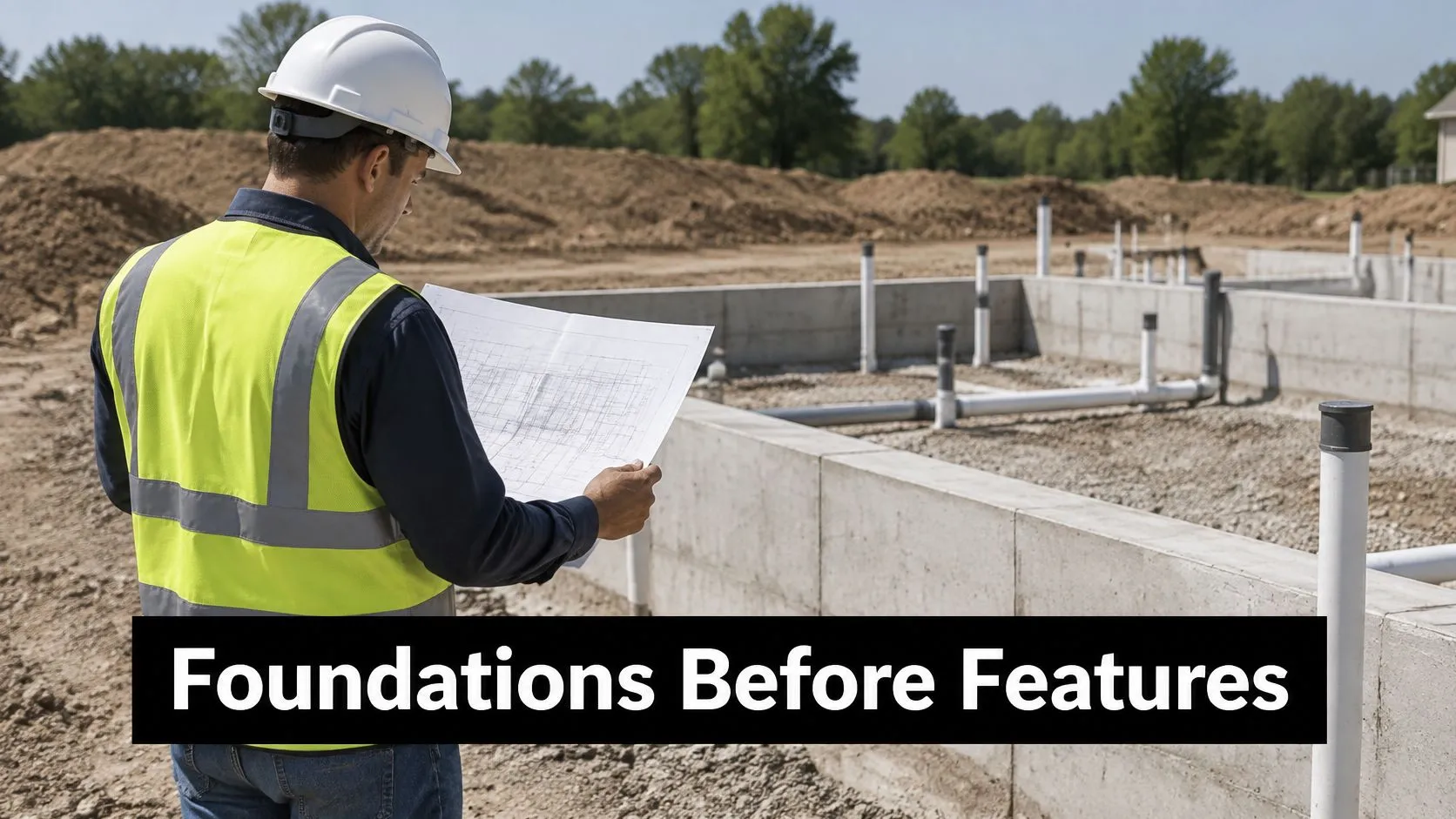
A building analogy helps here. The game engine is the foundation. Networking is the plumbing. The backend is the utilities supply that everything else depends on. You choose the foundation first, because it limits everything built on top of it.
Choosing the Engine
Unity covers the widest device range, from phones to standalone headsets, and it has a large plugin ecosystem. The trade-off is discipline. Complex scenes need a careful performance budget or they'll stutter on cheaper hardware. If you're weighing it up, this overview of Unity development for business and XR sets out where it fits. Unreal Engine delivers high-fidelity real-time rendering and suits cinematic or premium visual work. That fidelity costs you device performance, so it's a weaker fit for lower-powered standalone headsets or older phones. WebXR runs in a browser with no install, which gives you reach for marketing and education. The limits are real too. You're constrained by device APIs and by how much a browser can render, so scene complexity has to stay modest.
Networking, Backend and AI Tools
Multiplayer isn't a single product. Photon and Mirror serve Unity projects, and Unreal has built-in replication. Choose based on player count, latency tolerance and session length, and ask how each option behaves when a connection drops mid-session. Behind that sits the backend, which handles accounts, saved data, content delivery and analytics. Buyers often forget to ask who owns that data and how it exports. Ask early. AI tools work best as accelerators inside a pipeline, for draft asset generation, retopology, motion clean-up, captioning and localisation. They don't remove the need for review.
Every AI-generated asset should pass a human review and a rights check before it ships.
The decision rule is simple. The stack follows your target device list, not the studio's favourite tool. Write the device list into the brief, then make each bidder justify the engine against it.
Production Pipeline and Timelines
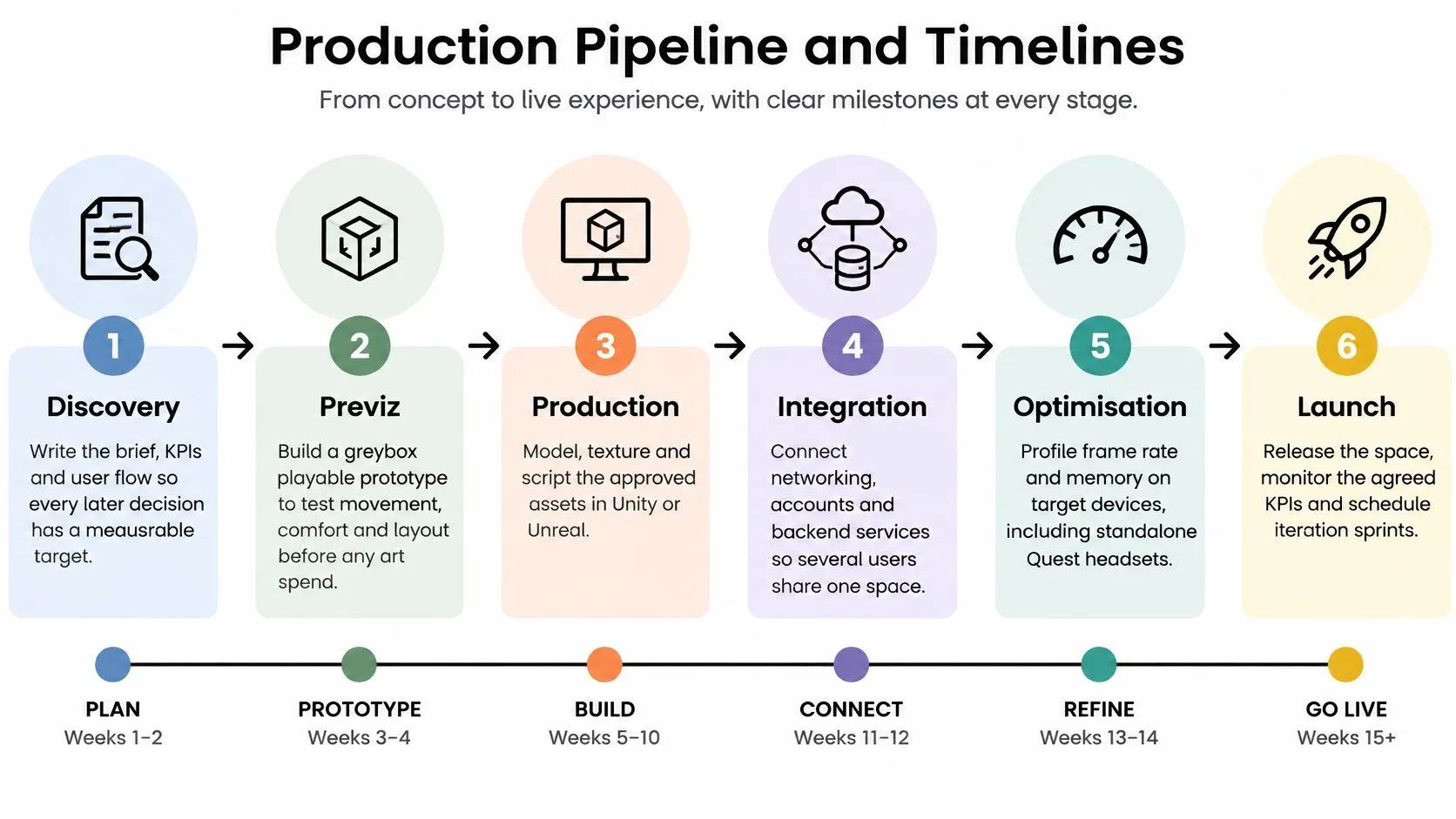
A metaverse build follows the same logic as animation or game production. Each stage exists to catch a specific kind of expensive mistake while it's still cheap to fix.
- Discovery: Write the brief, KPIs and user flow, so every later decision has a measurable target.
- Previz: Build a greybox playable prototype to test movement, comfort and layout before any art spend.
- Asset creation: Model, texture and rig avatars and environments to the approved designs.
- Engine integration: Connect systems, accounts and multiplayer sync so several users share one space.
- Optimisation and QA: Benchmark each target device and run accessibility checks.
- Deployment: Release to the store or web host and hand over documentation.
Standards That Keep the Pipeline Repeatable
Good studios standardise the unglamorous parts. That means consistent asset naming, level-of-detail generation, texture compression, lighting profiles, motion-capture clean-up, automated builds and device-specific performance tests. Each release should be benchmarked separately for frame time, memory, loading time, network latency and thermal behaviour across target headsets and desktop or mobile clients. A visually strong environment still fails if scene complexity exceeds the device budget, because unstable frame delivery is what makes people feel unwell. For a sense of the sector's scale, a UKRI-focused baseline on immersive XR innovation recorded 529 projects involving immersive technologies between 2006 and 2024, with total funding of £231,159,278, an average of approximately £437,000 per project. The distribution is likely uneven, so read that as a marker of funding volume rather than a typical project budget. Timelines shift with scope, so treat the ranges below as planning guides rather than promises.| Phase | Typical duration | Output at end of phase |
|---|---|---|
| Discovery and concept sprint | 2 to 4 weeks | Brief, KPIs, concept art, user flow |
| Previz and greybox prototype | 3 to 6 weeks | Playable prototype for movement and comfort tests |
| Asset creation and rigging | Depends on asset volume | Models, textures, rigged avatars |
| Engine integration and multiplayer | 6 to 10 weeks | Working build with synced objects and sessions |
| Optimisation and QA | 3 to 6 weeks | Device benchmark report and accessibility checks |
| Deployment and handover | 1 to 3 weeks | Live release, source files, documentation |
| Full build (total) | Roughly five to nine months for mid-scope work | Launch-ready build with handover |
What Metaverse Projects Cost and Where the Money Goes
The honest answer is that price follows scope, device count and content volume. A figure without a scope list tells you nothing, so the table below compares build types rather than quoting numbers. Ask every provider for an itemised quote against your own brief.| Build option | Indicative build budget (GBP) | Typical timeline | Ongoing costs to plan for |
|---|---|---|---|
| Browser-based 3D experience (WebXR or WebGL) | Scope-dependent, lowest entry point of the four | Shortest of the four options | Low hosting, content updates |
| Mobile AR app or web AR | Scope-dependent, mid-range | 2 to 4 months | App store fees, device testing |
| Standalone VR experience | Scope-dependent, higher due to optimisation | 4 to 8 months | Store submission, headset testing, updates |
| Multi-user virtual world | Scope-dependent, highest of the four | Longest, driven by networking and live operations | Servers, moderation, live operations, retainer |
| Ongoing maintenance | No standard figure applies across studios, so get it quoted as a separate annual line | Ongoing | Engine upgrades, device updates, hosting |
The Costs Buyers Miss
- •Device testing: Each headset and browser you support adds QA time.
- •Accessibility work: Captions, alternative controls and low-spec versions need design hours.
- •Third-party licences: Plugins, fonts, music and stock assets aren't always included.
- •Cloud hosting: Costs rise with concurrent users, so success can increase your bill.
- •Content updates and moderation: Social spaces need people, not just servers.
These aren't extras invented by suppliers. A 2025 UK Government study reported via Digital Catapult's UK convergence research found that initial implementation costs, ongoing maintenance and subscription fees were important constraints, and some businesses feared being locked into contracts with rising future costs.
The Contrarian Choice and the Tax Question
The best metaverse investment may not be a persistent virtual world. A focused interactive 3D or XR experience with a defined outcome, such as qualified leads, training completion, dwell time, conversion or travel avoided, is often cheaper to deploy, measure and scale. Whatever you choose, insist on three contract protections before work starts. You need source-file access, data export and a named switching-cost clause. Animated content adds a UK-specific variable, because expenditure credits exist for some qualifying productions. Which lines qualify, and at what rate, depends on rules that HMRC revises, so treat any tax benefit as something to verify rather than a number to build a budget around. Check the current HMRC guidance on expenditure credits, take advice from a qualified tax adviser, and ask each provider to mark which quote lines they believe may qualify before you sign.
Studio Liddell Projects as Worked Examples
A portfolio page works like a menu. A worked example is the dish that actually arrived, with enough detail to judge the kitchen. The useful question is which build type each project resembles, because that tells you what evidence to ask for next. These examples span four kinds of work: an IP asset pipeline, an event mixed-reality game, a headset VR narrative, and a stakeholder-reviewed technical visualisation.
BooSnoo for Sky Kids
Build type: children's IP pipeline across series and digital shorts. The hard part is consistency at volume, because characters, rigs and animation style have to survive repeat use without drifting into a different look. BooSnoo, made for Sky Kids, is relevant less as a virtual world and more as proof of asset discipline. For a buyer planning an IP-led space, ask for the equivalent evidence: model sheets, rig rules, naming conventions, and a sample of the same character reused across episodes, shorts and interactive scenes.
Dance! Dance! Dance!
Build type: mixed-reality event game. Event work reverses the usual priorities, since the win is short sessions, quick onboarding and a queue that keeps moving. Dance! Dance! Dance! was built around throughput and session length, so the mechanics and technical choices follow crowd flow rather than world size. If your project is an exhibition stand or brand activation, ask for setup time, staffing needs, reset time between players, expected plays per hour, and what happens when Wi-Fi drops.
Aurora
Build type: headset VR narrative. Story-led VR carries a specific risk: presence breaks when performance, timing or sound feels wrong, so direction matters as much as rendering. Aurora runs from script through direction and performance capture to spatial sound and headset optimisation. That makes it a useful test for narrative buyers. Ask to hear a scene in headset, ask which capture choices were made for presence rather than convenience, and ask how the team protected frame rate during emotional beats.
GeoEnergy NI
Build type: technical visualisation for stakeholder review. GeoEnergy NI shows complex systems explained visually through strategy, iteration and specialist sign-off. No public device or format is stated, so treat it as evidence of communication process rather than proof of a specific XR category. For training or technical communications, ask how many review rounds were planned, which specialists approved accuracy, and what changed between drafts. Outcome figures for client work are shared in case-study detail on request rather than assumed here. Ask for them directly, and ask what was measured.
Evaluate Providers and Book a Concept Sprint
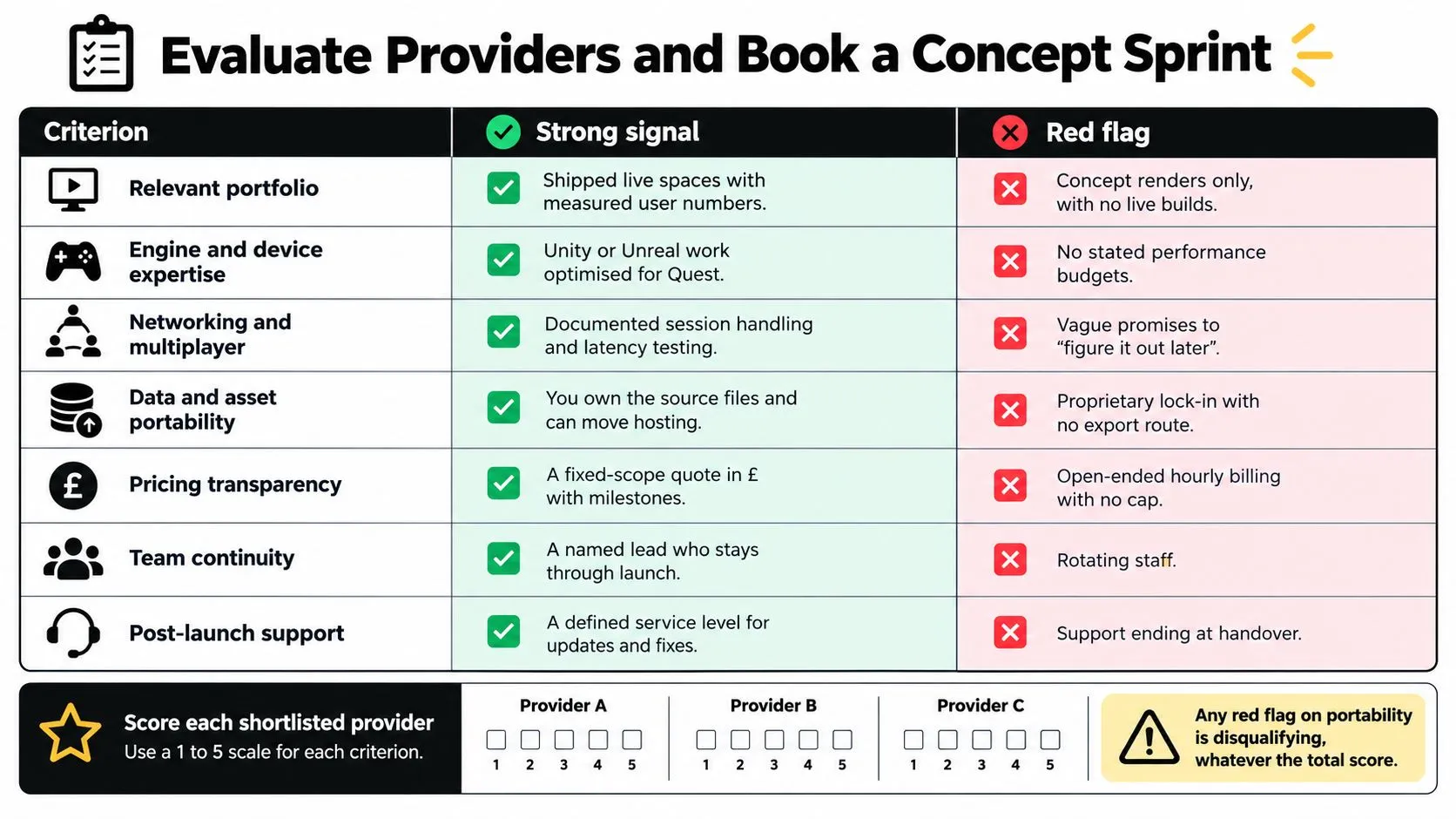
Score each shortlisted provider from one to five on every criterion below. A red flag on portability or accessibility disqualifies a studio until it is answered, whatever the total score says.
| Criterion | Strong signal | Red flag |
|---|---|---|
| Shipped work on your target device | Released builds on named headsets or browsers | Renders and concepts only, no live builds |
| Engine depth | Named Unity or Unreal projects with optimisation notes | Generic answers to performance questions |
| Portability and ownership | Source files, glTF exports and open APIs included | Assets locked to one proprietary platform |
| Accessibility practice | Captions, seated controls, low-spec option, tested with disabled users | Accessibility added as a final checklist item |
| Performance benchmarking | Frame time, memory and latency reported per device | No device budget defined |
| Data and safeguarding | Consent controls, clear privacy policy, age-appropriate design | Vague data flows or no safeguarding plan |
| Pricing transparency | Itemised quote with separate hosting and maintenance lines | One lump sum with no scope list |
Accessibility Decides Whether People Can Use It
Accessibility determines whether your project reaches its intended audience at all. XR experiences that skip inclusive design routinely shut out blind and partially sighted users, along with anyone who cannot tolerate a headset for a full session. Ask specifically about captions and transcripts, audio description, screen-reader-compatible companion interfaces, seated and one-handed controls, motion-sickness reduction, adjustable text and contrast, and low-spec or non-headset participation. Then ask who tested it. A studio that can name disabled testers and describe what changed afterwards has a practice. A studio that answers with a checklist has a gap.
The RFP Checklist and Your Next Five Steps
Paste these questions into your request for proposals:
- •Devices: Which headsets, phones and browsers have you shipped to?
- •Ownership: What files do we own at handover, including source assets?
- •Comfort and access: How do you test for motion sickness and access needs?
- •Maintenance: Who maintains the build after launch, and at what cost?
- •Exit terms: Will you itemise hosting and maintenance with a named switching-cost clause?
Then follow a low-risk path. Write a one-page brief naming audience, outcome KPI and target devices. Choose a build type from the cost table. Shortlist three providers and score them. Send the RFP. Finally, commission a paid two-to-four-week concept sprint to test the idea with real users before funding the full build. That last step caps your losses if the idea fails, and it produces evidence from real users before the full budget is committed. Studio Liddell's XR concept sprint scopes a build against this checklist in Unity or Unreal, with portability and accessibility terms included in the proposal. --- If you're weighing a browser-based 3D experience against a full multi-user world, Studio Liddell can scope both against your audience, device list and KPI in a paid concept sprint, with source-file ownership and accessibility terms written into the proposal. Bring a one-page brief and you'll leave with a build type, an itemised budget shape and a testable prototype plan instead of a platform pitch.