Adverts with Animation That Drive Real Engagement
When you think of animated adverts, you might picture simple cartoons. But they’ve evolved into something far more powerful, a strategic tool for brands to cut through the digital clutter, make complicated ideas easy to grasp, and build real emotional connections with their audience. The beauty of animation is its limitless creative freedom. You can literally build entire worlds and characters from scratch, crafting a story that perfectly captures your brand’s message and fires up the imagination.
Why Animated Ads Capture Audience Attention

In today's crowded media space, animation gives brands a serious edge. Live-action is fantastic, but it's constrained by things like physics, budgets, and logistics. Animation, on the other hand, throws the rulebook out the window. This creative runway allows brands to weave narratives and create visuals that are not just memorable but genuinely resonate on an emotional level.
Simplifying the Complex
One of animation's biggest strengths is its ability to make complicated topics feel simple. Think about explaining how a new fintech app works, or the science behind a groundbreaking healthcare product. It can get dense, fast. Animation breaks it all down using clever visual metaphors and clean graphics. It conveys that vital information clearly and concisely, making sure the message actually sticks with the viewer long after they’ve moved on.
Forging Emotional Connections
This is where animation truly shines. Animated characters can create an incredibly strong bond with an audience. By giving your brand a voice and a personality, these characters become relatable storytellers that build trust and loyalty. They can express a whole spectrum of emotions and embody your brand's core values in a way that feels authentic and human, making your brand feel much more approachable. The market data backs this up completely. The animation advertising sector has seen a staggering 800% global increase in ad-supported videos in just one year. That kind of growth points to a massive shift in how people consume content and make purchasing decisions, they're drawn to compelling visual stories.
Animation gives you the ultimate creative control. You can build entire worlds, design unforgettable characters, and tell stories that would be impossible or prohibitively expensive to produce with live-action.
This level of control means every single element, from the colour palette to the subtlest facial expression, is perfectly aligned with your brand identity. It’s about creating a cohesive and impactful campaign that doesn’t just look good, but also boosts engagement and delivers real, measurable results. You can learn more about how to captivate your audience with motion design right here on our blog.
Choosing the Right Animation Style for Your Brand
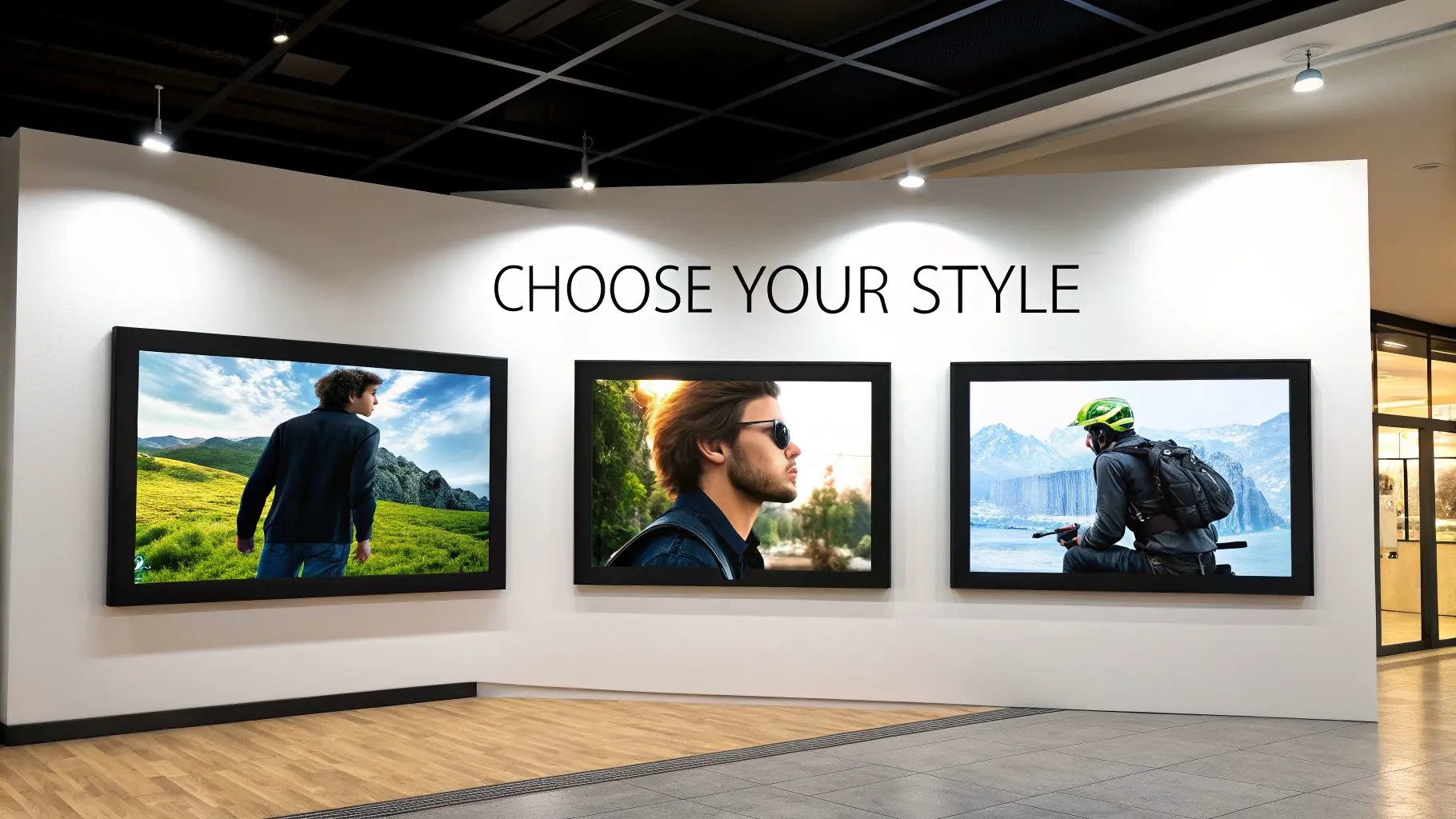
Picking an animation style isn't just about what looks good; it's a strategic move that fundamentally shapes how your audience feels about your message. The three main pillars of animated adverts are 2D, 3D, and motion graphics. Each has its own distinct flavour and really shines in different situations. Think of it like choosing the right lens for a camera. A wide-angle lens is brilliant for capturing those epic landscapes, while a macro lens gets you up close to see all the tiny, intricate details. In the same way, your choice of animation will frame your brand’s story and bring a specific perspective to life.
The Charm of 2D Animation
When people think of cartoons, they're usually picturing classic 2D animation. It’s created on a flat plane and is absolutely perfect for character-driven stories and emotional narratives. By simplifying reality, it helps viewers focus purely on the story, expressions, and message without getting bogged down in unnecessary detail. This style is incredibly versatile, too. It can be anything from simple, stylised graphics to highly detailed, artistic creations. It’s often the go-to choice for adverts that want to feel authentic, heartfelt, or charmingly simple.
The Depth of 3D Animation
3D animation is all about adding depth, realism, and a real sense of physicality. Imagine being able to rotate a product in mid-air, show its inner workings, or build a world that feels tangible and immersive. That’s the power of 3D. It's the natural choice for product visualisations, architectural fly-throughs, and action-packed sequences that need a cinematic punch. While it's certainly more complex to produce, the results can be breathtakingly realistic, making it ideal for brands that want to communicate quality, innovation, and a premium feel. For a deeper dive, check out our guide on the differences between 2D vs 3D animation.
The Energy of Motion Graphics
Motion graphics is where we animate text, logos, and abstract shapes to communicate information in a dynamic way. If your advert is heavy on data, needs to explain a process, or is built around a powerful key message, motion graphics will be your best friend.
Motion graphics is the art of making information move. It combines the principles of graphic design with animation to create energetic, clear, and visually compelling adverts that get straight to the point.
This style is often used for explainer videos, logo stings, and social media ads where grabbing attention in the first few seconds is everything. It’s direct, efficient, and fits perfectly with a clean, modern brand identity.
Which Animation Style Fits Your Advert?
Deciding which style to use ultimately comes down to what you want to achieve. Each one offers a different way to connect with your audience. This table breaks down the core strengths of each to help you make the right call.
| Animation Style | Best For | Visual Feel | Example Use Case |
|---|---|---|---|
| 2D Animation | Storytelling, emotional connection, and character-led narratives. | Flat, stylistic, and artistic. | An advert featuring a relatable mascot explaining a service. |
| 3D Animation | Product showcases, complex demonstrations, and immersive worlds. | Realistic, cinematic, and tangible. | A dynamic visualisation of a new car model driving on a scenic road. |
| Motion Graphics | Explaining data, highlighting key messages, and brand identities. | Energetic, clean, and informational. | An upbeat video using animated text to show impressive user statistics. |
Ultimately, the best choice aligns perfectly with your brand's personality and the core goal of your campaign. Whether you're aiming for the heart with a character, impressing with realism, or informing with clarity, there's an animation style ready to bring your vision to life.
The Real Return on an Animated Ad Campaign
While the creative side of animation is exciting, what every marketing manager truly needs to know is the return on investment. The good news is that animated content isn't just a creative luxury; it's a powerful commercial tool that can have a direct, positive impact on your bottom line. Animation has a unique ability to simplify complex ideas and create memorable characters. This translates directly into stronger performance across key metrics. Animated videos consistently deliver higher click-through rates, increased social shares, and significantly improved brand recall compared to many other formats.
Cutting Through the Noise and Boosting Recall
Your audience is far more likely to remember a charming character or a clear visual explanation than another generic live-action ad. This enhanced recall means your brand stays top-of-mind long after they've scrolled away, building crucial brand equity over time. This isn't just theory; it's proven in the real world. When a brand commits to a strong animated strategy, the commercial results can be phenomenal. The key is to see animation not as a one-off project, but as a consistent part of your brand’s identity, forging a lasting connection with your customers.
The iconic Compare the Market meerkat campaign is a masterclass in this. What started as a simple animated concept became a cultural phenomenon in the UK, directly driving 70% of the company's growth. It turned a price comparison website into a multi-million-pound empire. To see just how deep the impact goes, you can read more about the power of animation in UK industry.
A Case Study in Commercial Success
The meerkat campaign demonstrates how a brilliantly executed animated advert can become much more than just an ad. It evolved into a beloved piece of intellectual property, spawning merchandise, celebrity tie-ins, and a level of public engagement that fuelled massive business growth for over a decade. This is tangible ROI in action. An initial investment in character design and storytelling pays for itself many times over by creating a valuable asset that builds fierce brand loyalty and, most importantly, drives sales. It's the ultimate proof of how creative animation translates directly into commercial gold. Investing in high-quality animation for your own products can be a complete game-changer. By bringing your items to life, you can showcase their features and benefits in a way that truly connects with people. If you're curious about how this could work for you, check out our guide on how product animation services can skyrocket your sales. At the end of the day, the right animated campaign isn't an expense; it's a strategic investment in the future of your brand.
The Animation Production Process: From Brief to Final Delivery
Turning a concept into a polished animated advert is a structured process built on collaboration. This ensures your vision evolves into a final product that hits every objective, stays on schedule, and aligns with your budget. Think of this production pipeline not as a series of isolated steps, but as a creative partnership. Each stage builds on the last, ensuring your core message is embedded in every single frame.
From Initial Brief to Visual Blueprint
It all begins with the creative brief. This is the most crucial document in the entire process. Here, you define your goals, target audience, key messages, and the desired tone of the ad. A comprehensive brief acts as our North Star, guiding every creative decision. With the brief approved, we move to the script, where the narrative takes shape and the call-to-action is refined. The script is then translated into a storyboard, a comic-book-style visualisation of your advert, shot by shot.
The storyboard is your first real glimpse of how the final animation will look and feel. It’s the blueprint mapping out everything from camera angles to character movements, giving us a chance to make changes before a single second of animation is created.
For anyone new to this world, understanding the nuts and bolts of production is key. A good guide to producing TV commercials can offer some fantastic insights into these crucial early stages.
Bringing the Vision to Life
Once you’ve signed off on the storyboard, the main production phase begins. This is a multi-layered process where different creative streams converge.
- •Character and Asset Design: We design the visual identity of every element, from your main characters to the worlds they inhabit.
- •Animation: Our artists breathe life and movement into the characters and scenes. This is often the most time-intensive part of the project.
- •Sound Design and Music: A critical stage where we record voiceovers, add immersive sound effects, and compose a musical score to amplify the emotional impact.
Finally, all these elements are brought together in compositing. Here, we combine all the layers, grade the colours, and add any final visual effects. The result is a polished, high-quality animated advert, fully optimised and ready to capture your audience’s attention on any platform.
How to Budget for Your Animated Advert
Budgeting for an animated advert can seem complex, but it becomes clearer when you understand the key factors that influence cost. Getting a handle on these variables is the first step toward creating a realistic financial plan. The primary cost drivers are the animation style, the overall complexity, and the advert's length. A sharp, 15-second 2D motion graphics video will have a faster production timeline and a lower price point than a detailed, 60-second 3D character-driven story. The level of detail in characters, environments, and special effects also plays a significant role.
Realistic Budget Tiers
To give you a clearer idea, let's look at what's generally possible at different investment levels. These are not fixed prices, but they provide a helpful guide for matching your creative ambitions with a realistic budget.
- •Entry-Level (Under £5,000): This bracket is ideal for high-quality motion graphics videos. It's perfect for simple explainers, logo animations, or dynamic social media ads that rely on animated text and shapes.
- •Mid-Range (£5,000 - £20,000): This budget opens the door to more advanced 2D animation, often including custom character designs and more developed scenes. It’s a great range for compelling brand stories or product explainers that need a touch of personality.
- •Premium-Level (£20,000+): This is the top tier, where high-end 2D and impressive 3D productions come to life. Budgets here can accommodate complex character animation, photorealistic product renders, detailed world-building, and a cinematic quality suitable for broadcast or major digital campaigns.
The image below shows you the core stages that every project, and therefore every budget, needs to cover.
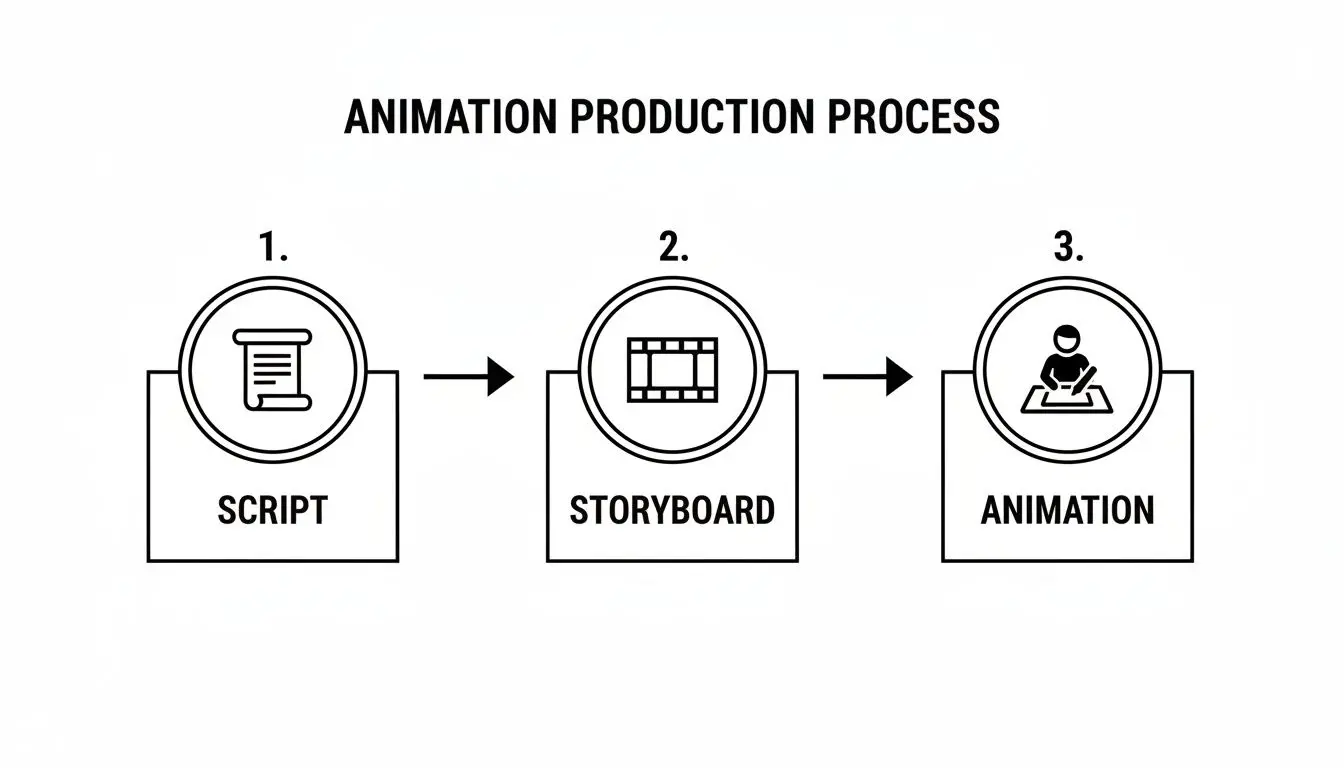
This process highlights how each phase logically builds on the previous one, ensuring production remains structured and efficient. The best approach is to have an open discussion about your budget with a studio. This collaborative approach allows you to find a creative solution that delivers maximum impact for your investment.
The Future of Advertising with Immersive AR and VR
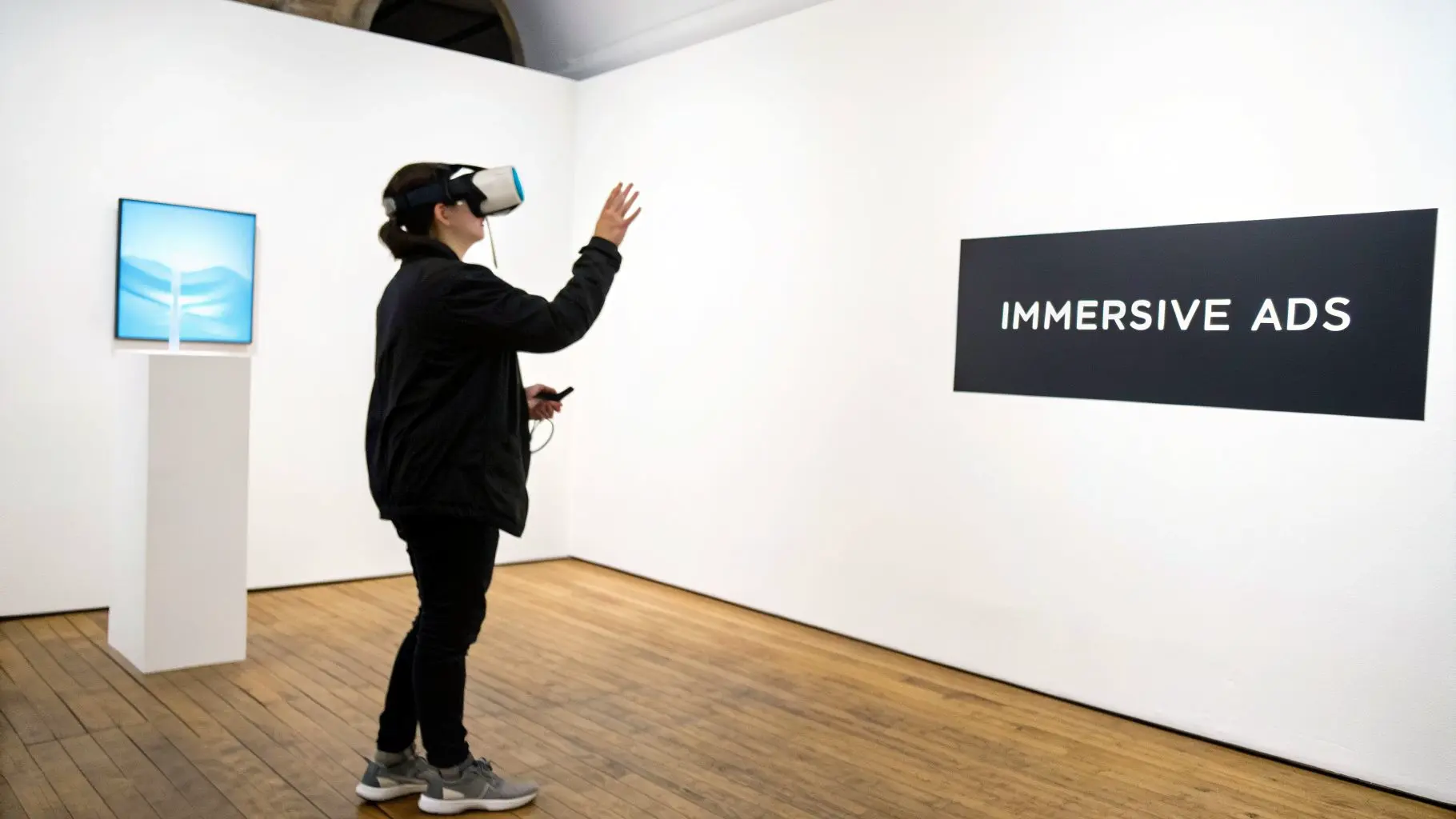
While screens remain dominant, the next frontier in animated advertising is already here. Immersive technologies like Augmented Reality (AR) and Virtual Reality (VR) are no longer science fiction; they are rapidly becoming powerful tools for brands to create deep, meaningful connections. This represents a shift from passive viewing to active participation. Imagine pointing your phone at a magazine ad and seeing a 3D animated product appear on the page, ready for you to inspect from any angle. That is happening now.
From Passive Ads to Interactive Experiences
The power of AR and VR lies in creating memorable, interactive experiences. Instead of just _watching_ a story, your audience can step inside it. This changes the goal from simple storytelling to what could be called "storyliving." Creating these next-generation adverts requires a different skillset, blending traditional animation principles with real-time game development.
- •AR-Powered Product Demos: At an exhibition, AR can overlay animated diagrams onto a physical machine to show its inner workings. A retail app could let you see how a new sofa looks in your own living room.
- •Immersive VR Brand Worlds: VR allows you to build entire virtual spaces where customers can walk through a digital showroom, interact with products, and experience your brand’s atmosphere in a fully curated world.
This level of deep, personal engagement forges a connection that a standard 30-second TV spot simply can't match.
The Technology Powering Immersive Ads
Delivering these sophisticated experiences requires mastery of game engines like Unity and Unreal Engine. These platforms are the foundation for building interactive 3D worlds, managing complex animations, and ensuring everything runs smoothly on a Meta Quest headset or a standard smartphone.
Looking ahead, cutting-edge technologies like Augmented Reality Marketing are set to revolutionise advertising, offering immersive experiences that push creative boundaries.
The UK's animation market is expanding rapidly to meet this demand. The 3D animation sector alone was valued at USD 1.9 billion in 2023 and is projected to reach USD 4.7 billion by 2030, with a significant portion of that growth driven by advertising. This trend highlights the industry's shift towards more dynamic and interactive adverts with animation.
Got Questions About Animated Ads?
We understand that diving into the world of animation can bring up many questions. To help, we’ve answered some of the most common queries businesses have when considering animation for their next campaign.
How Long Does It Take to Produce a 60-Second Animated Advert?
While every project is unique, a typical 60-second animated advert usually takes 4 to 16 weeks from initial brief to final delivery. The timeline varies based on complexity. A clean, 2D motion graphics video will be on the shorter end of that scale. In contrast, a detailed 3D character animation with intricate environments and visual effects will require more time. The process covers scriptwriting, storyboarding, design, animation, and sound. We always create a clear production schedule from the start to align with your campaign launch.
Is 3D Animation Always More Expensive Than 2D Animation?
Generally, yes, 3D animation often has a higher upfront cost due to specialised tasks like 3D modelling, rigging (creating a digital skeleton for movement), and texturing. However, it’s not always black and white. A highly detailed, frame-by-frame 2D animation can be as labour-intensive, and therefore as costly, as some simpler 3D projects.
The real secret weapon of 3D is asset reusability. Once we've built a 3D model of your product, it's yours to use forever. We can pop it into future campaigns, show it from new angles, or place it in completely different scenarios. This can dramatically lower your costs over the long run.
The best approach is an open discussion about your creative goals. This allows a studio like ours to recommend the most cost-effective method to achieve the visual impact you desire without exceeding your budget.
How Do You Measure the Success of an Animated Advertising Campaign?
We measure the success of an animated ad using the same robust digital marketing KPIs you already track, focusing on tangible metrics that demonstrate a clear return on investment. Key performance indicators we monitor include:
- •Video View-Through Rate (VTR): This shows how many viewers watched your entire advert, indicating high engagement.
- •Click-Through Rate (CTR): We track clicks on your call-to-action to link the ad's performance directly to website visits, leads, or sales.
- •Social Media Engagement: We analyse shares, comments, and likes to measure how well the message is resonating with your audience.
- •Brand Recall Surveys: These post-campaign surveys measure how memorable your advert was and whether it improved brand recognition.
Ultimately, we tie these metrics to bottom-line results like conversion rates and an overall increase in sales. Because animation is so effective at capturing attention and making messages memorable, it often drives stronger performance across all these crucial areas.
Ready to bring your brand's story to life with an animated advert? The team at Studio Liddell has been creating award-winning animations for global brands since 2019. Book a production scoping call with our experts today to discuss your vision.