IP Design Explained: How Brands Build Memorable Worlds
You've got a character sketch, a promising premise and perhaps a client asking whether the idea could become a series, a game, a product or an immersive experience. The temptation is to move straight into polished artwork. That's where many properties become expensive before anyone has tested whether the idea can travel. IP design is the production discipline that turns a creative spark into a coherent, recognisable and extendable property. It connects character, world, story, brand, technology and commercial use, then gives each part rules that a wider team can follow. The strongest properties aren't merely attractive. They're clear enough to animate, flexible enough to prototype, and documented well enough to license.
What IP Design Means in Modern Studios
When a character sketch must survive animation, games and merchandise, it stops being a sketch and becomes a system. A fixed silhouette helps artists recognise it. A defined voice, movement style and backstory help writers, animators and designers extend it without making the character feel inconsistent. That system needs decisions beyond appearance. A studio defines what the character looks like, what the character believes, how the character reacts, which environments belong to the world, and which actions would break its canon. The same framework can support a mascot, fictional universe, digital companion, branded product world, or original format for animation and XR.
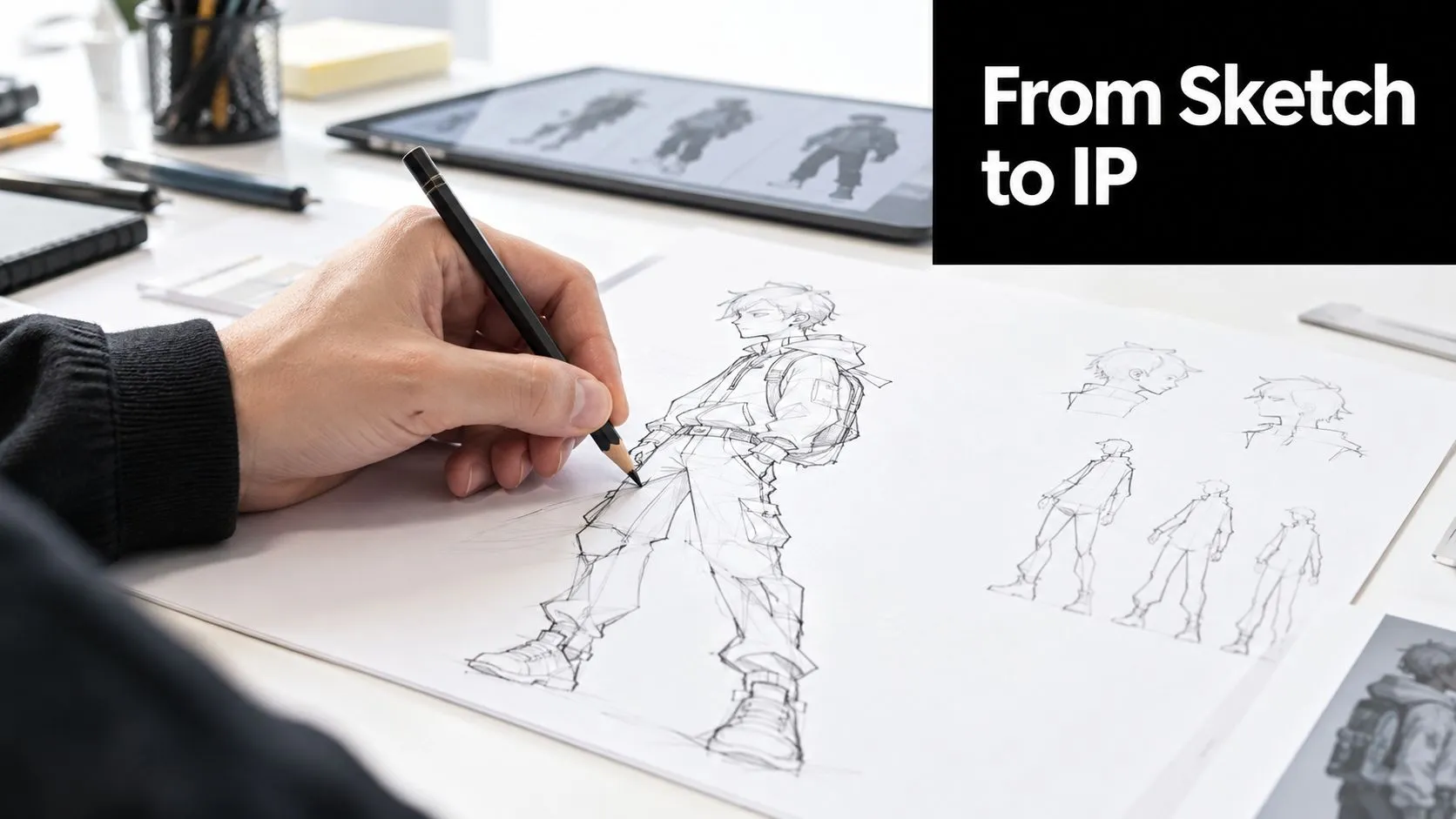
From artwork to a working system
A modern studio usually develops the property through connected production systems:
- •Visual identity: Silhouette, proportion, colour, materials, environments and graphic language.
- •Narrative identity: Premise, relationships, world history, conflicts and repeatable story engines.
- •Performance identity: Voice, gesture, timing, facial expression and physical behaviour.
- •Production identity: Model sheets, rigs, styleframes, asset standards and delivery rules.
- •Commercial identity: Audience, format opportunities, licensing boundaries and partner requirements.
These systems turn creative choices into instructions that a wider team can reuse. A character built for one illustration may offer little guidance for movement, rigging or alternate formats. A character tested with those constraints in mind has a clearer path into animation, games, apps, merchandise and immersive experiences. The production pipeline therefore runs from the first brief through prototypes, an IP bible, pitch materials and defined usage rights. The IP bible records the property's visual, narrative and performance rules, while prototypes expose problems before a full production commits to them. Pitch materials show how the property can be presented, and usage rights establish where others may reproduce or extend it. Every deliverable answers a practical question: Can another person understand this property, reproduce it accurately and extend it without weakening its identity? That question separates a reusable IP from artwork that works only in its original context.
The Core Building Blocks of a Strong IP
Think of an IP as a restaurant rather than a single dish. The dish is the part customers see first, so the characters, colour palette and key images need to create immediate recognition. But a restaurant survives because the kitchen follows a recipe, the staff understand the service style and the business knows who it wants to serve. IP design sits across three connected layers:
- Art is the visible dish. Characters, environments, props, logos and animation attract attention. They give the audience something to remember and give a production team something concrete to build.
- Brand is the recipe and plating. Tone, voice, values, audience fit and visual consistency determine whether new material still feels like the same property.
- Product strategy is the kitchen operation. It decides where the IP can appear, which formats make sense, how assets should be built, and what the property could support commercially.
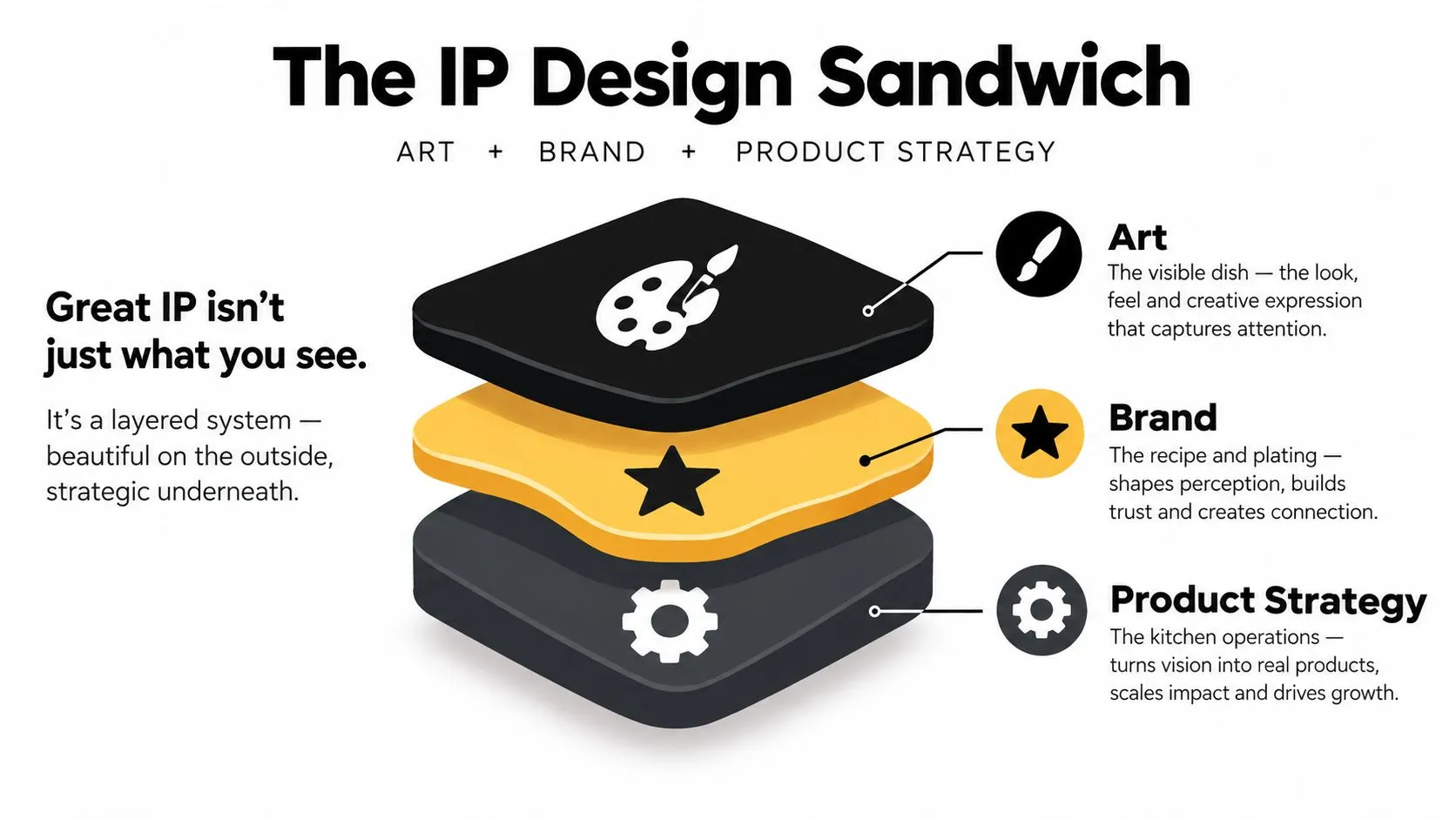 A property with strong art but no narrative system may look appealing and still collapse when a writer needs a new story. A property with detailed lore but no distinct visual language may be difficult for an audience to recognise. A property with both but no product strategy can drift into formats that don't suit its audience or production model.
 The practical connection
A useful early workshop should ask questions across all three layers. Who is this for? What should the audience feel? What can the main character do repeatedly? Which parts must remain fixed, and which parts can partners adapt? How does the property work as a still image, a sequence, an interactive asset or a physical object? Designers can also use AI product design tools during early exploration, provided the team treats generated material as a starting point rather than approved IP. Human direction remains essential for originality, consistency, rights review and production feasibility. For character fundamentals, the Studio Liddell guide to character design offers a useful companion to the wider process. The strongest result comes from keeping the layers aligned, so the artwork attracts attention, the brand gives it meaning and the product plan gives it somewhere useful to go.The Five Stages of IP Development
IP development works best when every stage produces a tangible asset. A meeting can create alignment, but a deliverable gives the next discipline something to test, challenge and improve.1. Concept
Start with a concise logline, an audience profile and a tone document. The logline explains the repeatable premise. The audience profile clarifies who the property must serve, while the tone document gives writers, designers and directors a shared emotional range. A good concept document also identifies the core promise. Is the pleasure in discovery, mischief, friendship, competition, transformation or world exploration? That promise becomes a filter for later decisions.2. Character and world design
The next stage turns the promise into a visual language. Character sheets establish shape, proportion, costume, expression and pose. Styleframes set colour, lighting, texture and composition. Environment art shows how the world supports the story rather than functioning as decoration. At this point, teams should test whether the visual rules work beyond a hero image. Can the character be drawn from different angles? Can a supporting character belong to the same world without becoming a copy? Can the environment support a story beat, a game space or an XR interaction?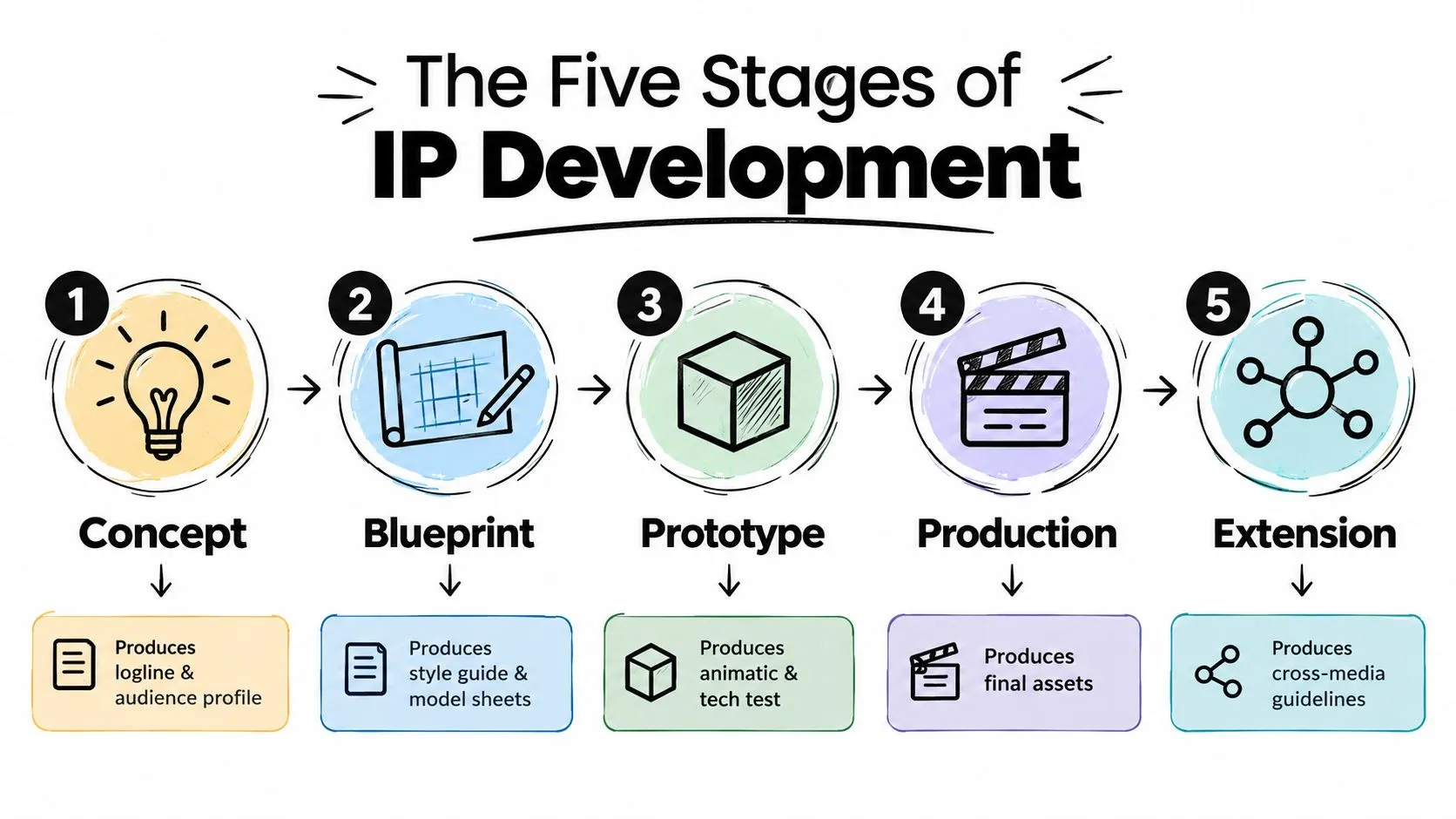
3. Prototyping
Prototypes expose weaknesses before full production. An animatic tests timing and story rhythm. A rough animation tests performance. A game mock-up tests whether the property remains interesting when the audience makes choices. An XR test checks scale, spatial behaviour and comfort. The prototype doesn't need final polish. It needs to answer a specific risk question. If the character's appeal depends on a subtle facial reaction, test that reaction. If the world depends on exploration, test navigation. If the property is intended for multiple platforms, test the most demanding transition early.4. The IP bible
The bible brings canon, visual rules, voice, character behaviour, world logic and usage guardrails into one reference document. It should help a partner make an informed decision without requiring the original creator to explain every page verbally. A practical bible may include approved poses, colour references, naming rules, sample dialogue, prohibited interpretations, story principles and adaptation notes. It should distinguish between core identity and adaptable detail, because licensees need freedom within boundaries.5. Monetisation and licensing
The final stage prepares the property for partners and products. Style guides, pitch decks, asset packs and rights information help a broadcaster, publisher, developer or manufacturer understand what's available and what approval process applies. Licensing shouldn't be treated as an afterthought. The decisions made during modelling, naming, character design and worldbuilding affect whether the property can be adapted cleanly. A well-organised asset library also makes later conversations more efficient, because partners can see the property in a form they can evaluate.Why IP Design Has Become a Strategic Priority
UK design activity shows how far formal design protection has moved into mainstream business practice. The UK IPO reported 81,215 design applications in 2023, 77,486 in 2024 and 79,542 in 2025, alongside 77,254 registrations in 2023, 74,619 in 2024 and 73,774 in 2025 in its 2025 facts and figures. The same source states that applications increased by 1,129.0% between 2015 and 2025, a sharp long-term expansion.| Metric | Recent Figure | Strategic Implication for Studios |
|---|---|---|
| UK design applications in 2023 | 81,215 | Formal design protection operates at substantial national scale. |
| UK design applications in 2024 | 77,486 | Filing activity remained high after the 2023 peak. |
| UK design applications in 2025 | 79,542 | Demand continued at a level far above the mid-2010s baseline. |
| UK design registrations in 2025 | 73,774 | Registration remains a significant route for documenting visual assets. |
| Change in applications, 2015 to 2025 | 1,129.0% | Studios should consider protection during development, not after launch. |
What the numbers mean for creative teams
The figures don't prove that every filing represents a successful commercial property. They do show that visual design is being treated as an asset worth documenting and protecting. In 2022, 28,646 applications came from UK applicants, representing 42.6% of all UK IPO design applications, according to the UK IPO's 2022 dataset. For an animation, game or XR team, the practical lesson is timing. Early filing and clear ownership records can support a property before public release, while a documented design system helps distinguish the protected asset from an evolving production file. Legal advice still matters, and registration isn't a substitute for originality, contracts or clearance, but treating protection as part of the pipeline reduces avoidable uncertainty.Best Practices That Make IP Travel Across Formats
Most properties don't fail because the original design was weak. They fail when the team asks that design to work in a new format without preparing it for the change. A character built for a widescreen close-up may lose its expression in a vertical feed. A beautifully scripted world may feel empty when a player needs meaningful choices.Plan the shape before the movement
Decide early how the main character and important environments read in 16:9, 9:16 and 1:1. These are common motion deliverable formats identified by a UK motion-design studio, alongside broadcast masters, web outputs, social cutdowns, editable templates and source files on request in its motion design service outline. Use styleframes to lock colour, line weight, texture and lighting before animation begins. Then use an animatic to test pacing and tone against the IP bible. A UK animation-production pipeline places brief and research before concept and treatment, followed by styleframes and an animatic, specifically to lock the look and timing before production.Build assets for reuse
Modular construction gives a technical team options. Separate clothing, hair, accessories and facial controls can make it easier to adapt a character for a game engine or an XR experience. That doesn't mean every asset must be over-engineered. It means the team should identify which parts are likely to change before committing to a costly rebuild. A tone-of-voice sheet belongs beside the visual bible. The audience recognises an IP through language as much as through colour and silhouette, so writers and performers need guidance on vocabulary, rhythm, humour, emotional limits and character-specific speech.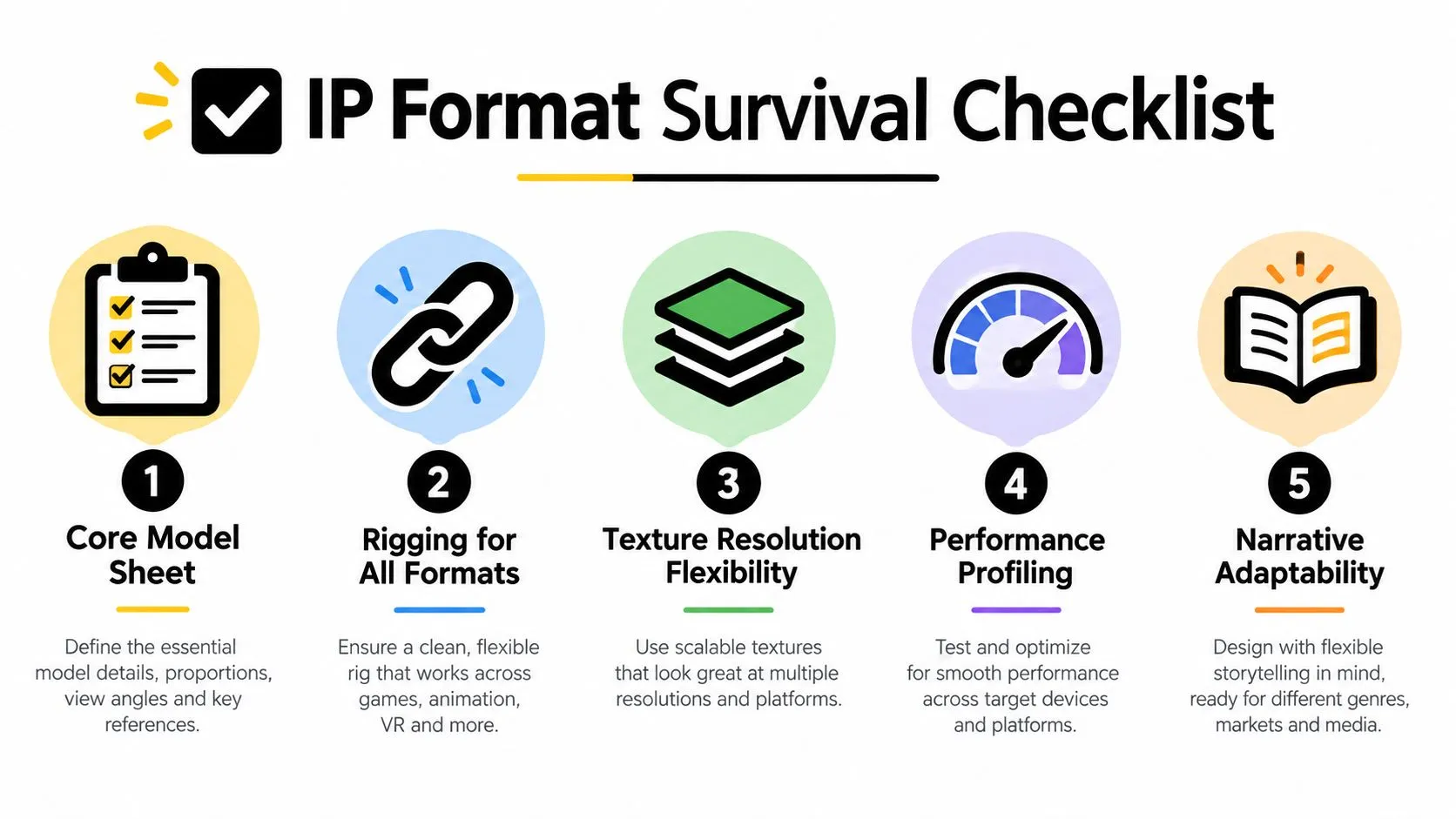
Production rule: Test the most difficult format while the design is still cheap to change.A review process should also be explicit. Storyboards can map every scene, a first-cut animation can use clear timecodes for feedback, and final files can be prepared for the required destinations, from web-ready MP4s to event-screen resolutions, as described in this motion-design and storyboarding workflow. For a broader view of how properties move between media, the guide to transmedia storytelling provides useful strategic context. These practices add planning time, but skipping them often forces redesign when the IP leaves its original screen.
Extending an IP Across Animation, Games, and XR
Every format simplifies an IP in a different way. Animation simplifies through authored selection. Games simplify through rules and player choice. XR simplifies through spatial interaction, while live experiences simplify through repeatable physical moments. Animation is the strongest home for authored performance and controlled tone. The director decides the exact pause, reveal, camera move and emotional beat. That makes animation useful when the property's main signal is character feeling, comic timing or a carefully shaped narrative. Games need a different foundation. A character can't rely only on being likeable on screen. The player needs agency, progression, collectability or a satisfying repeatable action. A game extension therefore demands mechanics, reward structures, interface decisions and systems design that an animation pipeline cannot supply by itself. XR rewards properties built around space, discovery and tactile play. It can make a world feel present, but it can also expose weaknesses in a tightly scripted concept. If the experience depends on long dialogue scenes or a single camera angle, the audience may feel constrained rather than immersed. Live experiences need another kind of clarity. Strong iconography, costume potential, physical props and repeatable rituals help an audience understand the property quickly in a busy venue. The format may involve performers, screens, sensors, queues or shared play, so production planning must account for the behaviour of groups rather than a single viewer. A useful decision rule is to identify the IP's strongest signal:- •Emotion: Build from animation and authored performance.
- •Agency: Explore games and interactive systems.
- •Space: Consider XR and spatial storytelling.
- •Icon: Test live experiences, physical products or collectibles.
The property doesn't need to appear everywhere. The guide to extending children's brands from TV IP to games and XR reinforces the value of choosing formats that preserve the core appeal rather than stretching a brand across every channel by default.
How Studio Liddell Supports the IP Design Process
IP design often breaks at the handoffs. An illustrator creates a compelling sketch, but the modeller can't interpret the construction. A writer develops an engaging premise, but the pitch deck doesn't show how the world behaves. A game team builds an interaction loop that ignores the character's established emotional logic. A full-service partner can reduce those gaps by keeping the disciplines connected from the start. In practice, that means a producer shapes the brief with the client, an art director establishes the visual language, writers and worldbuilders develop the lore, technical artists test the look in 3D or real time, and the production team turns approved decisions into usable assets.
What continuity looks like on the floor
The same property may pass through concept art, styleframes, an animatic, a rig, a game engine and an immersive prototype. Each transition creates a risk of drift. A shared review process helps the team identify whether a change is an intentional adaptation or an accidental loss of identity. Studio Liddell works across 3D CGI film and television, 2D and 3D animation, XR design and development, games, apps and IP development, making it one possible production partner for teams that need those disciplines connected. Its published production work includes projects associated with Sky Kids, BBC, Nelvana, Manchester United, Nat Geo and other brand and entertainment organisations.
Producer's test: Every handoff should answer two questions. What must remain recognisable, and what can change to suit the new medium?
That distinction protects both creativity and commercial value. A game may need a different camera and a more active character loop. An XR experience may need shorter dialogue and clearer spatial cues. A licensed product may require simplified shapes and manufacturing-aware artwork. Adaptation becomes safer when the bible records the original identity and the team agrees where interpretation is allowed. A licensing strategist can then map character expression across animation, games, XR and physical merchandise. That planning doesn't guarantee a deal, but it gives partners a clearer property to evaluate and gives the owner a more organised basis for approvals, asset delivery and future extension.
Knowing When an IP Is Ready to Scale
Scale-readiness isn't a feeling you get when the artwork looks polished. It's a practical assessment of whether the property can leave its founding team without losing its identity. Start with the IP bible. It should be complete enough for a licensee, partner studio or manufacturer to produce on-brand work without constant supervision. If every important decision still lives in the creator's head, the property isn't ready for broad extension. Next, test recognition at different sizes. The central character or symbol should remain legible as an app icon, a small interface element, a poster image and a large display. It should also survive reduction into a silhouette and a single-colour mark. Simplification reveals whether the identity depends on surface detail or has a strong underlying shape. The third signal comes from audience response. Testing one format can show whether people recognise the property and feel something about it, rather than merely noticing that it exists. Recognition and emotional pull are more useful indicators than awareness alone because future extensions need an audience connection to carry forward.
A practical readiness check
Ask three questions:
- •Can another team use the bible accurately? If not, document the missing rules.
- •Does the identity survive reduction and enlargement? If not, strengthen the silhouette, symbol or colour logic.
- •Has an audience responded emotionally in a real format? If not, prototype and test before scaling.
The next step is a structured IP audit with a studio partner. Score the property against these signals, identify the weakest link and plan one controlled extension that tests the right assumption. IP design is a long-term investment, so disciplined development is usually safer than expanding into every possible channel at once. --- Studio Liddell supports original IP development through character and world design, animation, real-time production, games and XR experiences, helping teams connect creative decisions to practical deliverables. Visit Studio Liddell to discuss an IP audit, a prototype or a structured development plan for taking your property from first spark to scalable world.