From TV IP to Games & XR: Extending Children’s Brands Across Platforms
Intellectual property (IP) development isn't just about legal paperwork. It’s the art of transforming a single creative spark, a character, a story, a world, into a valuable asset that can grow and make money for years to come. Think of it as building something with the potential to span television shows, video games, merchandise, and even immersive experiences.
What Is IP Development and Why It Matters
Forget dry, legal definitions for a moment. Picture IP development as planting a creative seed. With the right care, that one idea can flourish into a massive tree with countless branches. Each branch is a new way to connect with an audience and generate revenue, turning a one-off project into an enduring franchise. In a market overflowing with content, this is your secret weapon. Owning a unique and expandable IP is what sets a lasting brand apart from a fleeting trend.
Building Lasting Brand Equity
A solid IP development strategy is the foundation for genuine brand equity. When an audience forms a real connection with a character or story, that emotional investment creates powerful loyalty. It's what makes them follow an IP from a Sky Kids series to a mobile game, or from a film to a virtual reality world. A strategic approach delivers some serious benefits:
- •Long-Term Revenue Streams: Instead of gambling on a single project, a well-built IP opens up multiple, ongoing sources of income through licensing, merchandise, and new adaptations.
- •Audience Ownership: You cultivate a dedicated fanbase that actually looks forward to your next launch, which drastically cuts down on future marketing spend.
- •Creative Freedom: When you own the IP, you have total control. You get to guide its direction, ensuring the quality and consistency remains high as it expands into new formats.
A successful IP becomes a self-sustaining ecosystem. The core story fuels interest in spin-offs, and every new addition, whether it’s a game, a book, or an animated short, pulls the audience deeper into the world you’ve built.
Unlocking Future Opportunities
Good IP development is really all about future-proofing your creative work. The story bible you create today becomes the blueprint for a video game script tomorrow. Character designs for an animated short can be repurposed for AR filters or interactive installations at an event. Having this foresight is absolutely crucial. To truly get IP development right and turn your ideas into multi-platform hits, you need to implement proven content development strategies. By planning for these extensions from day one, you create a flexible and resilient property that can pivot to new technologies and audience demands. It’s the difference between just making a piece of content and launching an entire universe.
The Four Core Stages of IP Development
Turning a great idea into a valuable intellectual property is a journey, not a single leap. It's a structured process that methodically transforms a spark of imagination into a tangible, market-ready asset. Getting this right is how you manage risk, attract investment, and build a property with real franchise potential. Each stage logically builds on the one before it, giving shape and substance to the creative vision. You can think of it as a clear path from the initial idea, through rigorous development, and ultimately towards monetisation.
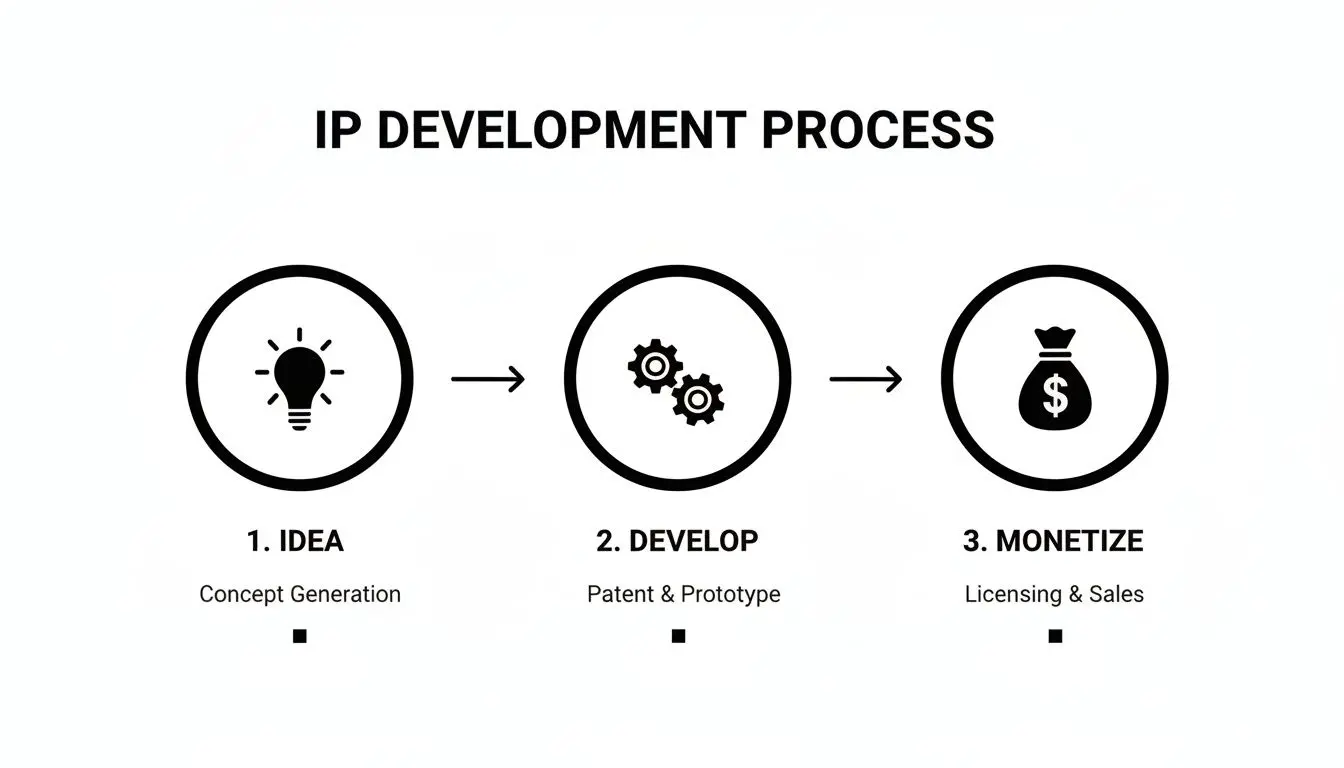
This journey shows that successful monetisation isn't just a lucky break. It’s the result of a deliberate, carefully managed development process. Let's break down the four essential stages that make it happen. To help you get a clearer picture of the IP development lifecycle, here's a quick overview of the stages and what comes out of each one.
IP Development Lifecycle Stages and Key Deliverables
| Stage | Primary Objective | Example Deliverables |
|---|---|---|
| 1. Concept & World-Building | To define the core narrative, characters, and rules of the universe. | Story bible, world guide, core lore documentation. |
| 2. Visual & Narrative Dev | To establish a unique and recognisable look, feel, and voice for the IP. | Concept art, character model sheets, colour scripts, pilot script. |
| 3. Prototyping & Testing | To create a tangible MVP to validate audience appeal and commercial viability. | Animated short, playable game demo, interactive proof-of-concept. |
| 4. Strategic Rollout | To launch the IP and execute a long-term plan for cross-platform expansion. | Launch marketing plan, transmedia strategy, merchandising plan. |
Each of these stages is a critical step in building a robust and lasting creative franchise.
Stage 1: Concept and World-Building
This is where it all begins. The main goal here is to lay the foundations that make your universe feel special and alive. It's all about answering the big questions: Who lives here? What drives them? What are the fundamental rules of this world? During this phase, we focus on:
- •Core Story Creation: Nailing down the central plot, the key conflicts, and the themes that will be the engine for all future stories.
- •Character Development: Crafting rich backstories, distinct personalities, and meaningful arcs for your main characters.
- •World-Building: Establishing the laws, history, cultures, and technology of your universe, whether it’s a sprawling fantasy kingdom or a gritty sci-fi metropolis.
The key deliverable from this stage is a story bible or world guide. This document becomes the single source of truth, the blueprint for every creative who touches the project.
Stage 2: Visual and Narrative Development
With a solid concept in place, it's time to give your world a face and a voice. This is where your IP starts to develop its signature identity, moving from words on a page to tangible creative assets. The focus shifts to defining the aesthetic and the overall tone. We create concept art for characters and environments, write initial scripts, and lock down the art direction. The objective is to build a unique visual and narrative language that is instantly recognisable.
This is the magic moment where a character stops being just a description and starts having a face, a posture, and a personality. It’s when your world gets its unique colour palette and architectural style.
Deliverables from this stage typically include character model sheets, detailed environment designs, a colour script, and early storyboards. This work ensures that every piece of content, no matter the format, feels like it belongs to the same cohesive universe.
Stage 3: Prototyping and Audience Testing
Now that we have a clear creative direction, it's time to see if the idea has legs. This stage is all about creating a minimum viable product (MVP) to test with real audiences and prove the IP's commercial potential before you commit to a full-scale production budget. A prototype can take many forms, depending on the end goal:
- •An animated pilot or short for a potential series.
- •A playable demo for a new video game.
- •An interactive proof-of-concept for an XR experience.
We then put this prototype in front of your target audience to gather honest feedback. This testing is crucial; it tells you what’s resonating, what’s confusing, and where the real emotional hooks are. It's your chance to fine-tune the idea and massively reduce risk before you ask it to run a marathon.
Stage 4: Strategic Rollout and Extension
The final stage is about bringing your IP to the world and planning for its long-term growth. The work shifts from pure creation to smart execution, focusing on distribution, marketing, and what we call transmedia IP development. A strong launch needs a carefully orchestrated plan to build buzz and capture an initial, passionate audience. After the launch, the focus turns to strategic extension. This means actively looking for and developing opportunities to expand the IP across different platforms and formats. Think about:
- •Spinning a TV series into a companion mobile game.
- •Turning a beloved game character into a line of merchandise.
- •Creating a location-based VR experience based on the world’s lore.
This is where the true, long-term value of your IP is unlocked. Each new extension deepens audience engagement and opens up fresh revenue streams, transforming a single project into a sustainable, multi-faceted creative franchise.
Bringing Your IP to Life With Animation and XR
An incredible idea for a new world or character is just the start. The real magic of IP development begins when you give that idea a form people can see, hear, and emotionally connect with. This is where tools like Animation and eXtended Reality (XR) come in, turning abstract concepts into tangible, living creations. Animation is the process of giving your IP its soul. It takes character sketches and world-building documents and transforms them into moving, breathing personalities and vivid, story-filled settings. This is where the core identity of your IP is forged. XR, which covers both Virtual Reality (VR) and Augmented Reality (AR), pushes this even further. It breaks down the screen between your audience and your world, inviting them to step inside and become active participants rather than passive viewers.
Using Animation to Build Your Foundation
Think of animation as the bedrock of your IP's narrative. Whether you opt for 2D or 3D, the goal is the same: to create the definitive, foundational version of your characters and their universe that will inform every future project. This initial content is absolutely vital. It’s the audience's first handshake with your heroes, their first lesson in the rules of your world, and the moment they decide whether they're in for the long haul. Key animation formats that bring an IP to life include:
- •TV Series and Shorts: Perfect for building a loyal fanbase over time. An episodic format gives you the space to truly flesh out character arcs and explore the far corners of your world.
- •Feature Films: The ultimate high-impact launchpad. A feature film can tell a powerful, self-contained story that catapults a new IP into the global consciousness.
- •Promotional Trailers: These are your IP’s calling card. A sharp, exciting trailer is essential for pitching to networks or generating that crucial first wave of audience hype before a big release.
The visual style you lock down here becomes the signature look of the IP. A beautifully executed piece of animation doesn't just look good; it proves the concept and makes the vision real for stakeholders, investors, and future fans. You can find out more about the different styles and their uses in our guide to animation services.
Extending Your IP with Immersive XR
Once your audience loves the world you've built, XR lets them actually live in it. VR and AR provide powerful ways to deepen engagement by creating interactive experiences that go far beyond what traditional media can offer. This is how you turn fans into explorers. With VR, you can drop users right into the most breathtaking locations from your story or let them stand face-to-face with its characters. AR, on the other hand, can bring characters and objects from your IP into the real world, creating fun, shareable experiences.
Instead of just watching a story unfold, your audience gets to be part of it. They can solve a puzzle inside a virtual castle or see a beloved character appear in their own living room.
Making the Right Production Choices
Your choice of technology is a major strategic decision that will define your IP’s potential for years to come. For projects that involve real-time rendering, like games and interactive XR, the two dominant game engines are Unity and Unreal Engine. This isn't just a technical detail; it’s a choice that needs to align with your long-term creative and commercial goals.
- •Unreal Engine is the go-to for high-fidelity, cinematic visuals. It’s a fantastic choice for IPs aiming for photorealistic 3D animation or visually spectacular VR stories.
- •Unity is celebrated for its incredible versatility and huge developer community. This makes it a smart option for building games, mobile AR apps, and other interactive content designed to run smoothly across a wide variety of devices.
Choosing the right engine and, just as importantly, the right creative partner is a cornerstone of successful IP development. The growth in this space is tangible, especially here in the UK. In fact, UK design applications hit 1,452 in January 2024, a 12% increase on the previous year, showing a real boom in studios protecting their visual creations. This trend gives studios the confidence to turn brilliant ideas into globally recognised series and apps.
Expanding Your Universe With Transmedia Storytelling
A truly great piece of content isn't the end of your IP development journey. It's the beginning. The most valuable, enduring brands are the ones that grow beyond their original format, creating a whole ecosystem for audiences to get lost in. This is the magic of transmedia storytelling. But transmedia isn't just about plopping the same story onto different devices. It's the art of carefully weaving a single, sprawling narrative across multiple platforms, with each piece adding something new and vital to the bigger picture. Your TV show tells one part of the story, a video game lets fans explore another, and an AR app could bring a fan-favourite character right into their living room.
Suddenly, your IP isn't just a show to watch; it's a living, breathing universe. This approach turns passive viewers into active explorers, piecing together the world you've built. With every interaction, their connection, and loyalty, to your brand deepens.
Weaving a Cohesive Narrative Web
At the heart of any effective transmedia strategy is a strong, central narrative. Each platform needs to offer a fresh entry point into your world while adding another unique piece to the overall puzzle. This creates a deeply satisfying experience that rewards the most dedicated fans for exploring every corner of your IP. Some of the most powerful platforms for extending your universe include:
- •Video Games: Let players step into your world and become active participants. They can make choices that shape the story or witness key events through a different character's eyes.
- •Books and Comics: These are perfect for deep dives into lore, character backstories, and fascinating side-plots that wouldn't fit into a film or TV series.
- •XR Experiences: Allow your audience to literally step inside the world you've built. A VR experience could place them in an iconic location, while an AR app could have a beloved creature running around their own home.
Often, the work involved in developing comic book and graphic novel IP serves as a fantastic foundation, providing a rich source of story for multi-platform expansion. It’s this kind of strategic planning that turns a single hit project into a franchise that lasts for decades.
Audience and Age Gates
As your world grows, keeping everything consistent is absolutely vital. The universe must feel coherent, and characters need to behave in ways that are true to their established personalities, no matter what platform they appear on. This takes serious planning and a central "story bible" that acts as the ultimate authority on the entire universe. You also have to think carefully about your audience. Each new platform must be perfectly suited to its user base while staying true to the IP's core identity. If you're working with a children's brand, this means ensuring game mechanics are age-appropriate and all interactive content reflects the brand’s core values.
A transmedia strategy succeeds when each platform feels both authentic to the IP and native to the medium. The goal is to create a seamless experience where a fan can move from watching a show to playing a game without feeling any creative disconnect.
Our work on BooSnoo for Sky Kids is a perfect example of this in action. We took a cherished TV IP and thoughtfully extended it into the digital world with a series of interactive shorts. This gave young audiences a new, playful way to engage with the characters, forging an even stronger connection to the brand. It shows just how powerful thoughtful transmedia can be. You can learn more about the details in our article on what is transmedia storytelling.
Production Planning and Licensing
Pulling off a successful transmedia strategy means working with a production partner who thinks bigger than just one deliverable. Right from the very start of the IP development process, the production pipeline needs to be designed for efficiency and consistency across all potential platforms. This means creating 3D models, environments, and other creative assets in a smart, adaptable way. For example, a high-detail character model built for a cinematic trailer can be optimised for use in a real-time game engine or a mobile AR app. This "create once, use many" approach is a game-changer, saving huge amounts of time and money while keeping the visuals consistent across the entire brand ecosystem. It’s this kind of foresight that separates a collection of one-off projects from a truly integrated and immensely valuable intellectual property.
How to Measure Success and Choose the Right Partner
Creating a brilliant piece of IP development is one thing. Building it into a valuable, long-term asset is another game entirely. So, how do you actually measure that value, and more importantly, how do you find a partner who understands how to get you there? It all comes down to looking past easy wins like views and downloads. Instead, we need to focus on the Key Performance Indicators (KPIs) that signal genuine, lasting potential. At the same time, picking your development partner is probably the single most important call you’ll make. You don’t just need a production house; you need a strategic guide with a proven history of building creative properties from scratch.
Defining and Measuring Real Success
It’s easy to get distracted by vanity metrics. A million views on a short-form video is fantastic, but it doesn’t guarantee you have a sustainable brand on your hands. To get a real sense of your IP’s health, you need to be tracking a mix of audience, commercial, and brand-focused KPIs. Key Performance Indicators for IP Health:
- •Audience Engagement Rate: Go deeper than view counts. Track comments, shares, and how long people are watching or playing. High engagement means an audience is forming a real bond, not just scrolling past.
- •Audience Retention: Are viewers coming back for the next episode? Are players logging in day after day? Strong retention is the clearest sign you have a ‘sticky’ IP with real franchise potential.
- •Brand Sentiment Analysis: Get on social media and forums to see _how_ people are talking about your IP. When the sentiment is positive and fans are driving the conversation themselves, you’re building serious brand equity.
- •Inbound Licensing Enquiries: Are toy companies, publishers, or other media firms starting to knock on your door? Unsolicited commercial interest is one of the most powerful validations of your IP's appeal in the market.
An IP's true value is revealed when the audience doesn't just watch it, they adopt it. When they start creating fan art, writing their own stories, and asking "what's next?", you know you're building more than just content; you're building a culture.
Choosing Your Development Partner
Selecting the right studio is about finding a team that gets your long-term vision. It's a decision that goes well beyond a flashy showreel or a simple price quote. You’re handing over the creative DNA of your future, so you need to do your homework. The aim is to find a team that marries creative brilliance with strategic market awareness and technical mastery. For a really deep dive into the right questions to ask, take a look at our complete guide on how to choose an animation and visual effects studio.
A Buyer's Checklist for Your IP Partner
When you're sizing up potential studios, run them through this checklist. It will help you see if they're cut out to be a long-term IP partner.
- Strategic IP Thinking: Are they asking about the five-year plan for the IP, or just the first project? A true partner wants to understand the transmedia potential from day one and build towards it.
- Proven Track Record: Ask for case studies showing they haven’t just produced content, but have actively developed and grown an IP across different platforms. You want proof they can take a concept and turn it into a multi-faceted reality.
- Technical Versatility: Do they have genuine expertise in the technology your roadmap requires, like Unreal Engine for cinematic visuals or Unity for interactive apps? Their tech stack needs to match your IP's ambitions.
- Collaborative Process: What's their process for feedback and changes? A great partner works _with_ you, offering their expert guidance while always respecting your core vision. They should feel like an extension of your own team.
Ultimately, the right partner has a rich heritage in both creative production and strategic IP development. They get that a character designed today might need to work in a film, a game, and an AR filter tomorrow. This blend of artistry, technical skill, and forward-thinking strategy is the hallmark of a studio that doesn’t just finish projects, it builds universes.
Common Questions About IP Development
Turning a great idea into a living, breathing world is an exciting journey, but it naturally comes with a lot of questions. To help clear things up, we've put together answers to some of the most common queries we hear from creators and brands.
How Long Does the IP Development Process Take?
There's no single timeline, as it all comes down to the scale of your vision. A project's scope and ambition are the biggest factors. For a focused project, like creating a series of animated shorts for a digital platform, you could be looking at a 6-9 month timeframe. That would typically cover everything from the initial world-building and character design right through to delivering the first batch of content. On the other hand, if you're aiming for something much bigger, a full television series with a companion game or an XR experience, you'll need a longer runway. The foundational work alone, like building out the world, creating a comprehensive design package, and producing a pilot, can easily take 18-24 months before you have a complete package ready to take to market.
We're big believers in a phased approach. A short, sharp 'concept sprint' can validate an idea's core appeal in just a few weeks. This gives you the confidence to commit to the longer production cycle, knowing you're building on solid ground.
At Studio Liddell, we build a realistic, milestone-based roadmap from day one. This makes sure every step is tied to your goals and launch targets, bringing clarity and predictability to the entire process.
What Is the Difference Between IP Development and Animation Production?
This is a really important distinction. While they often go hand-in-hand, they serve completely different strategic functions. Think of animation production as a task. Its job is to create a specific piece of finished content, whether that's a one-off animated commercial, a music video, or a single season of a show. The focus is purely on execution. IP development, however, is a strategic process. It's about building an entire universe. The goal is to create the characters, the world, the rules, and the story engine that can fuel countless productions across many different formats, not just a single animation. For instance:
- •Production: Making a one-off explainer video for a new app.
- •IP Development: Creating a memorable character and a captivating world that could become a TV show, a video game, a line of toys, and a book series.
Ultimately, IP development is about building a valuable, long-term asset that you own and control. Animation production is just one of the tools we use to bring that asset to life.
How Much Does IP Development Cost?
It’s best to think of the cost not as a single price tag, but as a layered investment that grows with your project's complexity. The process is broken into distinct phases, each with its own manageable budget. The initial Concept & Design phase is the most accessible starting point. This is where we create the project's creative and strategic blueprint, the story bible, character designs, and world guides. This stage can range from a few thousand to tens of thousands of pounds. The Prototyping phase is a more significant step up in investment. Here, you're creating something tangible to prove the concept, like a broadcast-quality pilot episode or an interactive game demo. Costs for this can range from £50,000 to over £200,000, depending on the tech, length, and polish involved. We always recommend a phased funding approach. By using the success and assets from one stage to de-risk the project, you make it much easier to secure the investment needed for the next. This approach protects your upfront financial exposure while you strategically build your IP's value.
Who Owns the IP at the End of the Project?
This is probably the most critical question of all, and the answer has to be completely clear from the outset. In a standard relationship with a studio, the client who commissions and funds the work owns the final intellectual property. A development studio like Studio Liddell acts as your creative and strategic partner. We're brought on board to use our expertise to build out your IP and transform your vision into a concrete, valuable asset. Our agreements are always structured to ensure that once the project is complete and paid for, all rights to the characters, stories, designs, and worlds we've built are formally transferred to you. This gives you complete freedom and control to pursue licensing, distribution, and future expansions with full ownership. Put simply, our job is to be the expert partner that helps you build your asset, not to own it ourselves. Your success is our success.
Ready to turn your idea into a universe? At Studio Liddell, we specialise in the strategic and creative work needed to build successful, multi-platform IPs. Let's start the conversation about your vision. Book a production scoping call with our team today.