Immersive Learning Solutions: UK Schools Guide 2026
78% of UK post-16 institutions have invested in extended-reality technologies for learning and teaching, up from just 12% reporting use across five or more departments in 2019. Immersive learning has moved beyond isolated pilots, but proving durable impact, affordability and equitable access remains a genuine challenge. An education leader may already have headsets in a cupboard, a supplier demonstration booked, or a lecturer asking for a virtual simulation. The difficult question comes later: what will learners do better because this experience exists, and how will the institution prove it? That question changes the purchase conversation. Immersive learning solutions aren't automatically valuable because they feel exciting. They earn their place when they help learners practise a task, understand a difficult system, make decisions safely, or transfer knowledge into a real setting more effectively than a suitable 2D, physical or blended alternative.
What Immersive Learning Solutions Actually Mean Today
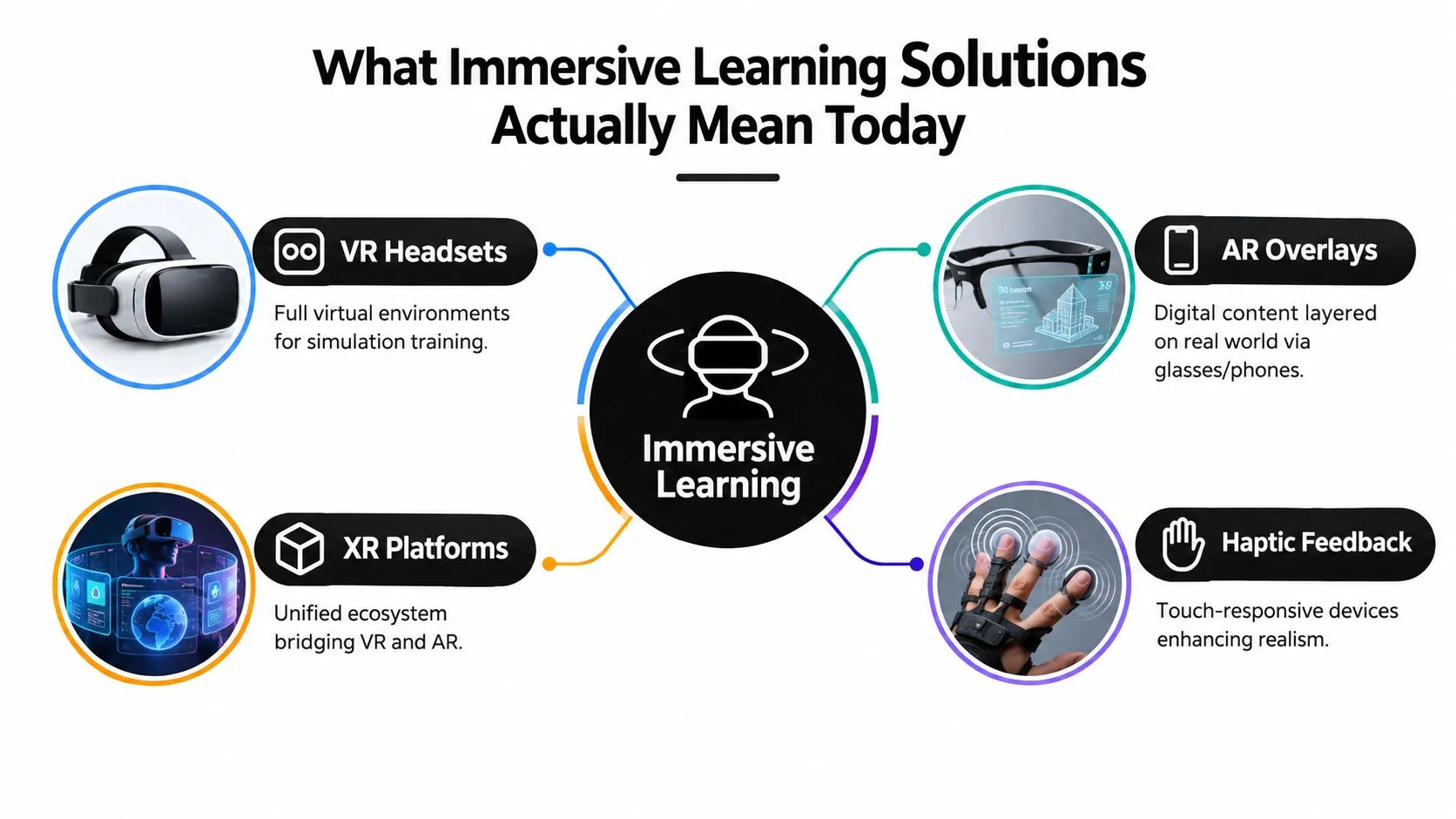
A college health tutor might use a virtual environment for a clinical scenario. A construction lecturer might overlay digital information on a physical component. A university team might build an interactive 360-degree tour that students explore from a laptop. All three activities can be described as immersive learning, but they don't require the same hardware, budget or teaching plan. Virtual reality, or VR, places the learner inside a computer-generated environment through a headset. It suits simulation, spatial practice and situations that would be expensive, dangerous or impractical to recreate. Augmented reality, or AR, adds digital content to the learner's view of the physical world through a phone, tablet or glasses. It can support object identification, guided procedures and product visualisation without removing the learner from the classroom. Extended reality, or XR, is the broader category that includes VR, AR and related spatial experiences. It can also include shared environments, interactive simulations and screen-based scenarios where the important feature is not the headset, but the learner's active role. A branching exercise can be immersive if students must interpret evidence, choose an action and see the consequences.
Start with the learning task
Avoid beginning with, “Which headset should we buy?” Begin with the learner's task:
- •Practise a procedure: VR or a screen-based simulation may provide a safe rehearsal environment.
- •Recognise objects in context: AR can connect labels, instructions or 3D models to physical equipment.
- •Explore a place or system: A 360-degree experience can work through a headset, browser or large classroom display.
- •Make and defend decisions: A branching scenario can use ordinary screens while still creating meaningful immersion.
- •Develop spatial understanding: A 3D model, physical prototype or shared virtual environment may be appropriate, depending on the outcome.
A useful practical guide to immersive experience design helps teams separate spatial presentation from interaction design. That distinction matters because a visually impressive environment can still produce passive learning. Teachers also need a manageable way to create supporting material. A training video generator can help teams turn explanations, demonstrations and onboarding content into reusable video resources that sit alongside an immersive activity, rather than forcing every learning objective into a headset. The most useful definition is therefore simple: immersive learning solutions place learners in an interactive context where they explore, practise, decide or receive feedback. The delivery format comes after the objective.
Why UK Institutions Are Moving Past the Pilot Phase
A college can own headsets and still lack a workable teaching model. The UK sector is moving beyond isolated demonstrations, but procurement teams now need evidence that a technology can support regular teaching, assessment and maintenance. Jisc's 2023/24 survey collected 157 responses from further-education and higher-education institutions across the UK, with most respondents representing further-education organisations in England. 78% reported institutional investment in extended-reality technologies for learning and teaching, while 55% said their organisation was getting moderate to extensive use from them, according to Jisc's survey of immersive learning adoption. These figures indicate adoption, not proof of learning impact. The scale of use has also changed. In Jisc's 2019 findings, 54% of respondents said AR or VR appeared in only one or two departments, while just 12% reported use across five or more departments. In the same Jisc survey, the shift towards wider provision gives institutions a reason to examine governance, shared infrastructure and repeatable teaching models rather than treating XR as a one-off experiment.
Adoption follows useful subjects
The strongest applications remain practical and discipline-specific. Further education uses XR mainly in health, public services, social care and STEM. Higher education applies it in those areas and also in arts, humanities and social sciences, where immersive environments can support interpretation, fieldwork, situated discussion and creative practice. Respondents associated XR with experiential and situated learning, accessibility and preparation for employment. 34% of further-education respondents and 41% of higher-education respondents believed it could support preparation for life and work, according to Jisc's findings. The figures show where educators see a plausible link between experience and future practice. They do not establish that every immersive activity improves employability. A separate Queen Mary University review cites a Jisc survey of more than 100 UK lecturers, researchers and educational technologists. 82% expressed interest in AR or VR, while respondents lacked credible examples of current or planned institutional use, as reported in the Queen Mary review of immersive technology. Interest therefore remains different from operational readiness.
The procurement implication: a supplier should explain how educators will use, assess, maintain and improve the experience, not only how realistic it looks.
Accessibility can determine whether adoption produces value. Jisc recorded concerns among 20% of further-education respondents and 53% of higher-education respondents, according to its UK XR adoption findings. A headset may be available, yet the lesson can still exclude learners who cannot wear it, experience discomfort or require another interaction route. Procurement should therefore compare immersive delivery with browser-based, physical and blended alternatives by learning outcome, access and ongoing use, not by novelty.
How to Decide Whether Immersive Delivery Is Worth the Cost
A college or university can spend heavily on a virtual reality setup and still struggle to show what learners gained. The business case should therefore begin with the learning outcome, then test whether immersive delivery achieves it better than a cheaper option. Start with four delivery choices: immersive, interactive 2D, physical and blended. Match the mode to the task. A clinical cohort rehearsing a high-risk decision may need repeated simulation. A large introductory class may achieve the same conceptual understanding through an accessible browser activity, followed by tutor-led practice.
Delivery Mode Decision Matrix
| Learning Objective | Recommended Mode | Best For | Cost Tier |
|---|---|---|---|
| Practise a hazardous or difficult-to-access procedure | Immersive or blended | Learners who need repeated, consequence-based rehearsal | Higher |
| Understand a spatial system or environment | Immersive, 3D or physical | Subjects where scale, movement and orientation matter | Higher to medium |
| Recall concepts and follow a sequence | Interactive 2D | Broad cohorts, independent study and accessible access | Lower |
| Develop hands-on dexterity | Physical or blended | Practical subjects requiring real tools and tactile feedback | Medium |
| Make decisions in a realistic scenario | Blended or interactive 2D | Learners who need branching choices and tutor discussion | Lower to medium |
| Demonstrate performance in context | Immersive with assessment support | Small cohorts where observed practice has clear value | Higher |
Use the matrix to frame procurement, not to settle it. Compare each option over a five-year total cost of ownership, including content updates, staff time, device management, storage, cleaning, technical support, accessibility alternatives and replacement hardware. For example, a £2,000 headset trolley used by one trained lecturer can become a stranded asset when that lecturer leaves. Budget for at least two trained facilitators per scenario, then test whether the expected learning benefit justifies the wider operating cost. School-sector evidence is the closest available UK access proxy. 63% of surveyed UK IT leaders considered VR and AR headsets fit for purpose, while reported availability was 15% in non-fee-paying schools and 20% in fee-paying schools, according to UK-linked research on VR and AR access. These figures do not describe every college or university. They still warn procurement teams that device access cannot be assumed across learners, rooms or partner placements. Financial capacity also differs between further-education providers. Written evidence to Parliament describes unequal opportunities, equipment and infrastructure challenges, and cultural barriers that can make it difficult for staff to demonstrate curricular value to senior leaders, as set out in written evidence to the UK Parliament on immersive technology. A viable proposal must show how the institution will staff, maintain and evaluate the experience, not merely purchase it. Before approval, ask four questions:
- What will learners do that they can't do as effectively through a cheaper route?
- Which learners need the experience, and who needs an equivalent alternative?
- How will teachers assess performance rather than enjoyment?
- What will the institution still need to fund after launch?
Designing a Phased Pilot That Actually Measures Learning
A credible pilot is small enough to manage and specific enough to evaluate. Choose a limited set of repeatable scenarios, use existing institutional infrastructure where possible, and define the evidence before production begins. The production brief should specify:- •Target learning objective: describe the observable capability, not the desired feeling.
- •Interaction model: state whether learners explore, manipulate, decide, explain or collaborate.
- •Session duration: define how long the activity should take and what happens before and after it.
- •Platform requirements: identify browsers, headsets, controllers, networks, accounts and device-management needs.
- •Evidence method: choose pre- and post-confidence measures, task accuracy or assessment performance that matches the objective.
A practical pilot sequence
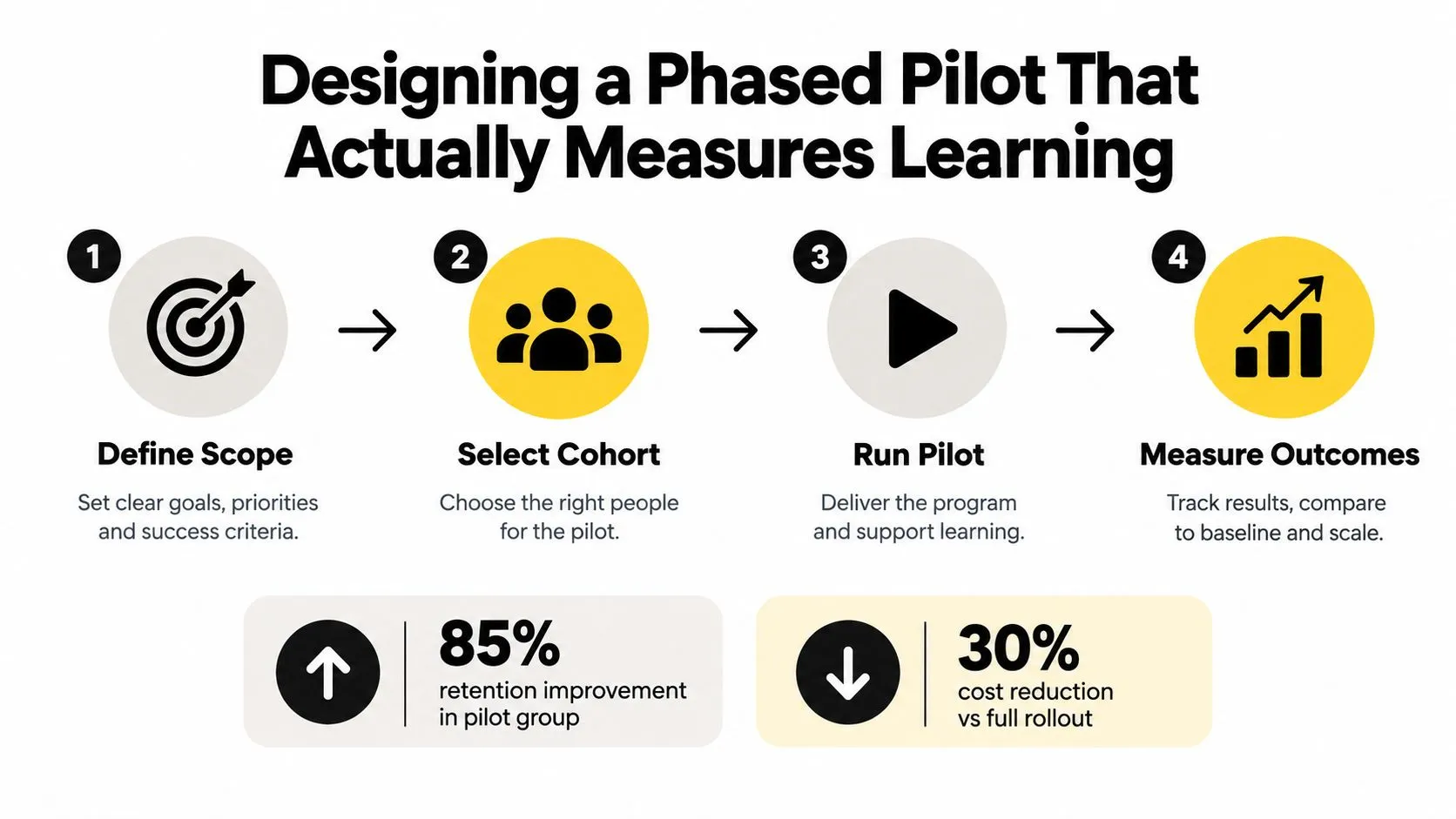
First, define the scope. Select one curriculum problem where context or consequence matters. “Improve clinical judgement” is too broad. A narrower brief might ask learners to identify relevant information and choose a safe next action in a controlled scenario. Then select the cohort. Include the educators who will run the activity, not just learners who are enthusiastic about new technology. Record baseline performance or confidence before the experience so later observations have a reference point. Run the pilot as a lesson, not a demonstration. Provide teacher guidance, a non-headset route, clear rotation instructions and time for discussion. Device management, safeguarding and accessibility provisions should be tested during the pilot, because a technically successful demonstration can still fail in a real classroom. Finally, measure the outcome. Compare the evidence with the stated objective. Task accuracy may matter more than time spent inside the environment. Assessment performance may matter more than a positive reaction form. Confidence can be useful, but it shouldn't stand alone as proof of competence. The review process should include teachers, learning technologists, procurement colleagues and accessibility specialists. They can identify different failure points, from unclear instructions to unsupported assistive technology. Independent UK sector analysis reported that XR prevalence in education grew by 80% over five years, while the immersive-technology education sector recorded £156 million in turnover in 2022, according to UK sector analysis of immersive technology in education. Market growth makes careful evaluation more important, not less. Institutions have more suppliers to consider, but they still need evidence that a particular experience fits their curriculum and operating model.
A useful guide to creating engaging interactive learning experiences can help teams think through interaction, feedback and learner flow before committing to a full build. Scale only when the pilot shows learning value, manageable delivery and an inclusive route through the activity.
The Hidden Barriers That Undermine Equitable Access
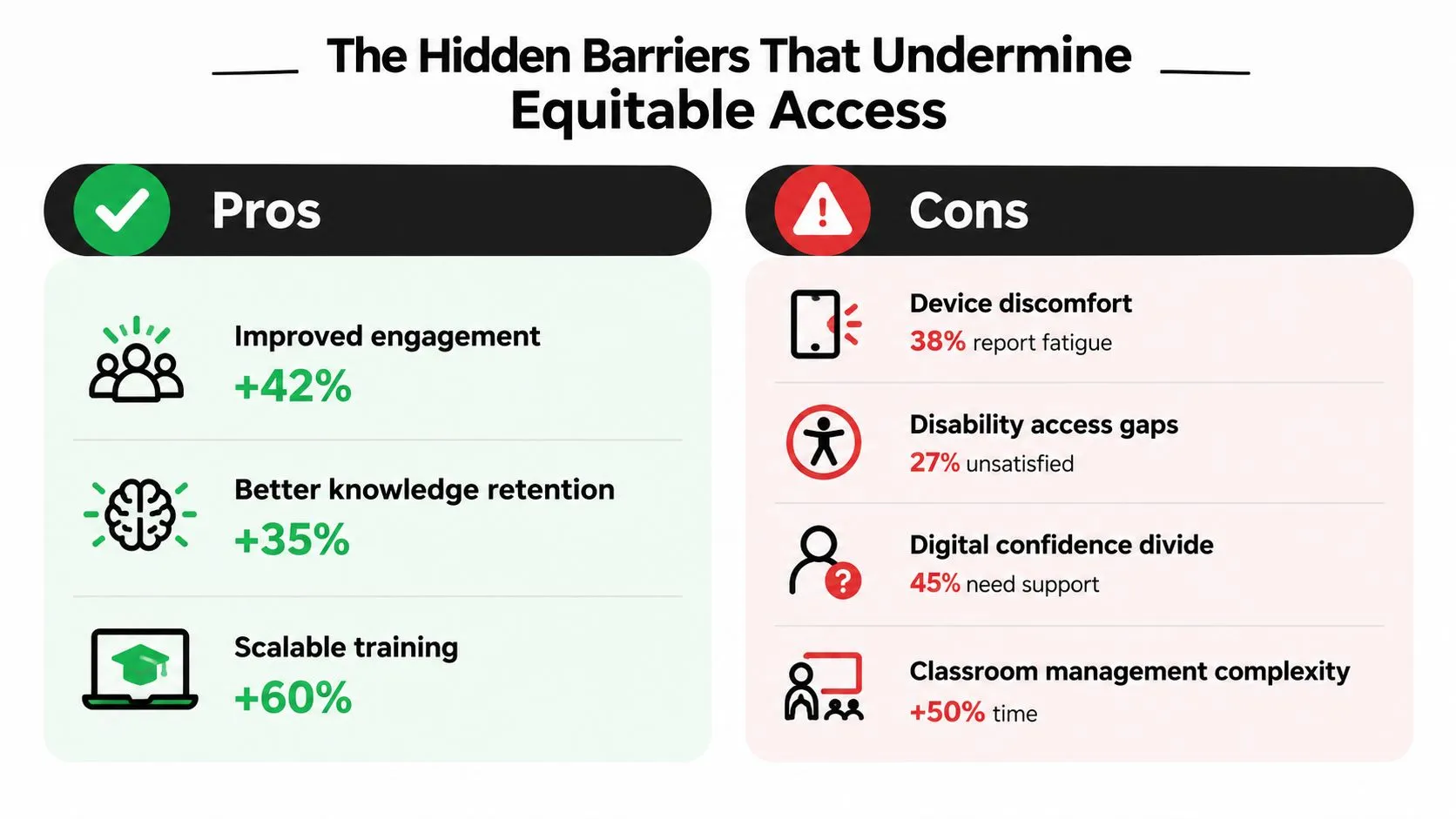
A class can have enough headsets and still exclude learners. Motion sickness, visual fatigue, unfamiliar controls, anxiety about performing in front of peers, and disabilities that require another interaction method can all turn device access into a barrier. Teachers carry a second set of constraints. They must supervise equipment, organise rotations, observe assessment, support learners who opt out and keep the rest of the class engaged. A supplier that explains only the virtual experience leaves educators to design the operating routine themselves.
Design the alternative before the headset lesson
Every immersive activity needs an equivalent route to the same learning objective. Depending on the task, that route could be a screen-based simulation, a 360-degree browser experience, a physical model, paired observation or a teacher-facilitated scenario. An alternative is not automatically a weaker version. A screen may work better for a learner who needs to control pace, magnification, captions or input method. A short, seated headset activity paired with a carefully designed screen route can support wider participation than a headset-only lesson. Use an access checklist before procurement:
- •Comfort: offer short sessions, seated use and clear stop procedures.
- •Motion sensitivity: avoid unnecessary movement and provide a stable screen alternative.
- •Disability access: test captions, audio descriptions, controller options, contrast and assistive technology compatibility.
- •Confidence: demonstrate controls privately or in pairs before assessment.
- •Safeguarding: define supervision, account access, content review and incident procedures.
- •Classroom management: plan cleaning, charging, rotation, observation and support for learners outside the headset.
- •Assessment: let teachers record decisions, explanations and task performance without relying on headset activity alone.
Accessibility should be tested with the actual learners and assistive technologies expected in the setting. A feature that appears available in a product description may fail in practice because of missing keyboard support, unclear audio, incompatible controllers or inaccessible menus. Record these findings during the pilot, then make them part of the supplier acceptance criteria. The wider UK situation supports a measured approach. Sector analysis cited earlier, by Public First, found that approximately one-third of UK adults hold positive views about immersive technology's potential in education. That attitude signal may support interest, but it does not prove that a particular activity is affordable, accessible or educationally effective.
Inclusion belongs in the brief
Ask suppliers to explain how the experience works for learners who cannot wear a headset, need additional time or require a non-visual route. Ask how teachers receive evidence from each learner and how accessibility features will be checked when content changes. A practical guide to augmented reality in the classroom can support discussions about lower-barrier spatial content. AR through a shared screen or familiar device may create a more workable lesson than headset deployment, depending on the objective.
The most immersive solution is not always the most educationally effective. The best solution lets the intended learners practise the intended capability through a fair route to participation.
Where UK Immersive Learning Stands and What Comes Next
A school may approve a headset pilot, only to discover that the actual decision comes later: can leaders show that the experience improved learning enough to justify its cost? The UK's immersive learning market has a stronger foundation than it did when AR and VR were treated as isolated experiments. In 2019, the Department for Education's Realising the Potential of Technology in Education report addressed teacher training and support for purchasing emerging tools, including XR. In 2022, its Future Opportunities for Education Technology in England report identified international XR education case studies and proposed digital resource centres where schools could borrow equipment such as VR headsets, as documented in UK sector analysis of immersive technology in education. These policy milestones indicate institutional interest, but they do not establish educational value. Adoption and sector growth can support a procurement case, yet neither proves that a particular simulation improves retention, decision-making or practical performance. The gap between purchase and impact must be closed with evidence from the intended learners and setting.
A more grounded route to scale
Education leaders can treat immersive learning as a service design decision rather than a hardware purchase. The brief should answer five questions:
- •What must learners demonstrate? Specify the procedure, judgement, concept or behaviour that matters.
- •Which delivery mode solves that problem? Compare VR or AR with interactive 2D content, physical practice and blended teaching. Choose the option that produces the required outcome at an acceptable total cost.
- •What evidence will count? Define checks for knowledge, performance, confidence and transfer into coursework, assessment or workplace practice.
- •What must the institution support? Assign responsibility for accessibility, safeguarding, data, devices, content updates, technical assistance and teacher preparation.
- •What happens after the pilot? Budget for maintenance, revisions, support and an equivalent participation route for learners who cannot use the primary format.
A short, seated VR scenario may justify its cost when learners need to rehearse a risky or difficult-to-stage situation. A browser simulation may serve a large cohort more efficiently. A physical model remains the better choice when touch and manipulation are the learning outcomes. Blended delivery can combine these routes without forcing one format to carry the whole lesson. Production quality matters, but implementation determines whether the investment reaches learning. Institutions should approve immersive delivery only when the measured improvement is stronger than the result from a cheaper suitable alternative, and when staff can run it reliably. Studio Liddell develops animation, interactive video, games and XR experiences for structured learning interactions, including guided simulations, decision-based scenarios and feedback-led content. Visit Studio Liddell to discuss an outcome-led immersive learning brief, a phased pilot or an experience that works across headset and screen-based routes.