How to Write a Series Bible: Template and Pitch Tips
You've got a finished pilot script, a folder of character sketches and an email from a development executive that ends, cheerfully, "Can you send the bible by Friday?" The script took four months. The bible feels like it should take an afternoon, and that's the trap. Most writers treat a series bible as a longer version of the pitch. More story, more backstory, more artwork. Commissioners read it as something else. They read it as evidence that the idea can survive a full season, a delivery schedule and a compliance review, and they decide in a single sitting whether it earns a second meeting. What follows is the document section by section, with the question each part has to answer, the length it usually runs to, and the failure that sinks it most often. There's also a working habit that turns the bible into a production plan while you draft, so the pages you write for the commissioner are the same pages that keep your episodes consistent.
What a Series Bible Must Prove to Commissioners
A commissioner reads your bible in one sitting, probably on a train, with four others in the same folder and twenty minutes before the next meeting. In that sitting they need five things: the hook, the audience, the episode mechanics, the production risk and the next-season potential. Miss any one of them and the document moves to the maybe pile, which rarely gets a second reading. The market explains the impatience. BBC commissioning data records that the broadcaster commissioned more than £1.6 billion of original television content in 2022/23, supported 258 companies through funded ideas development, commissioned 65 new television producers and took more than 4,000 submissions through its Open Call talent scheme, as the BBC commissioning supply report 2022/23 sets out. At that volume, a bible that makes the reader work gets closed. Regional relevance is part of the pitch in the UK. The same report shows 58% of network television commissioning spend fell outside London in 2022/23, so a story rooted in a real place, with a production base that can serve it, reads as more commissionable than a story set anywhere in particular.
The nine sections and the question each one answers
| Bible section | Question it answers | Typical length | Common failure |
|---|---|---|---|
| Logline and premise | What is this and who is it for? | 1 page | Vague hook with no situation or conflict |
| Format and audience | Where does it air and how long is each episode? | Half a page | No broadcaster or platform named |
| Series engine | What makes each episode repeatable? | 1-2 pages | Episodes repeat instead of escalate |
| Principal characters | What does each character do for the story? | 2-3 pages | Biographies with no dramatic function |
| Episode outlines | How does each story escalate? | 3-4 pages | Every episode uses the same structure |
| Series arc | Where does season one end and what returns in season two? | 1 page | No credible endpoint |
| Tone and visual references | What should the viewer feel and see? | 1-2 pages | Adjectives without examples |
| Production and delivery | How will it be made and delivered? | 1-2 pages | Technical innovation with no story purpose |
| Risk and platform plan | Who is it safe for and where will people find it? | 1 page | Compliance and discoverability left out |
Read the rows as a chain rather than a list. The logline gives the format something to describe. The format fixes the audience, the audience decides what the engine has to deliver every week, and the engine determines which characters earn a place in the breakdown. Break the chain at the top and the rest of the document drifts.
The one-page test: hand your first page to someone who has never heard the idea and ask them who it's for and what happens every week. If they can't answer both, the front of the document isn't finished, whatever else is in the folder.
The two checks that catch most problems take a minute each. Does the logline name a situation rather than a theme? "A family learns to heal" is a theme and can't be scheduled. "A widowed paramedic takes a job in the town her husband died in" is a situation, with a protagonist and a pressure built in. Then check whether each section stands alone. A commissioner who reads only the character pages and only the risk page should still understand the series. Before you write a word, look down the failure column and find the row you'd struggle to fill today. That row is the first thing to write, not the last. The lengths add up to roughly 11 to 17 pages, which tells you what kind of document this is. It sits closer to a production plan than to a long treatment.
Build the Core Document in Five Steps
The front section runs in a fixed order, because each step depends on the one before it. Draft them in any order you like and assemble them in this one.
- Write the logline as a situation, not a theme. One sentence naming a protagonist, a situation and a pressure. A theme can't be put on a schedule, a situation can, and the commissioner is reading for what happens at 7pm on a Sunday.
- Fix the format before the story. Episode length, episodes per season and the platform: linear, streaming, app or short-form. A bible with no named platform leaves the commissioner to guess where the series lives, and guessing is work they won't do.
- State the audience promise in viewing terms. Who watches, in what context and what brings them back next week. "All ages" isn't an audience. Name an age band and a viewing habit, such as co-viewing with a parent on a Saturday morning.
- Name the series engine in one sentence. The repeatable question each episode answers: a case, a mission, a competition, a relationship under strain. If you can't say it in a sentence, the series will feel different every week in the worst way.
- Write the world rules as fixed and flexible lists. What never changes (setting, tone limits, interaction rules for an app or XR layer) and what flexes episode to episode. This single list prevents the continuity drift that shows up around episode nine.
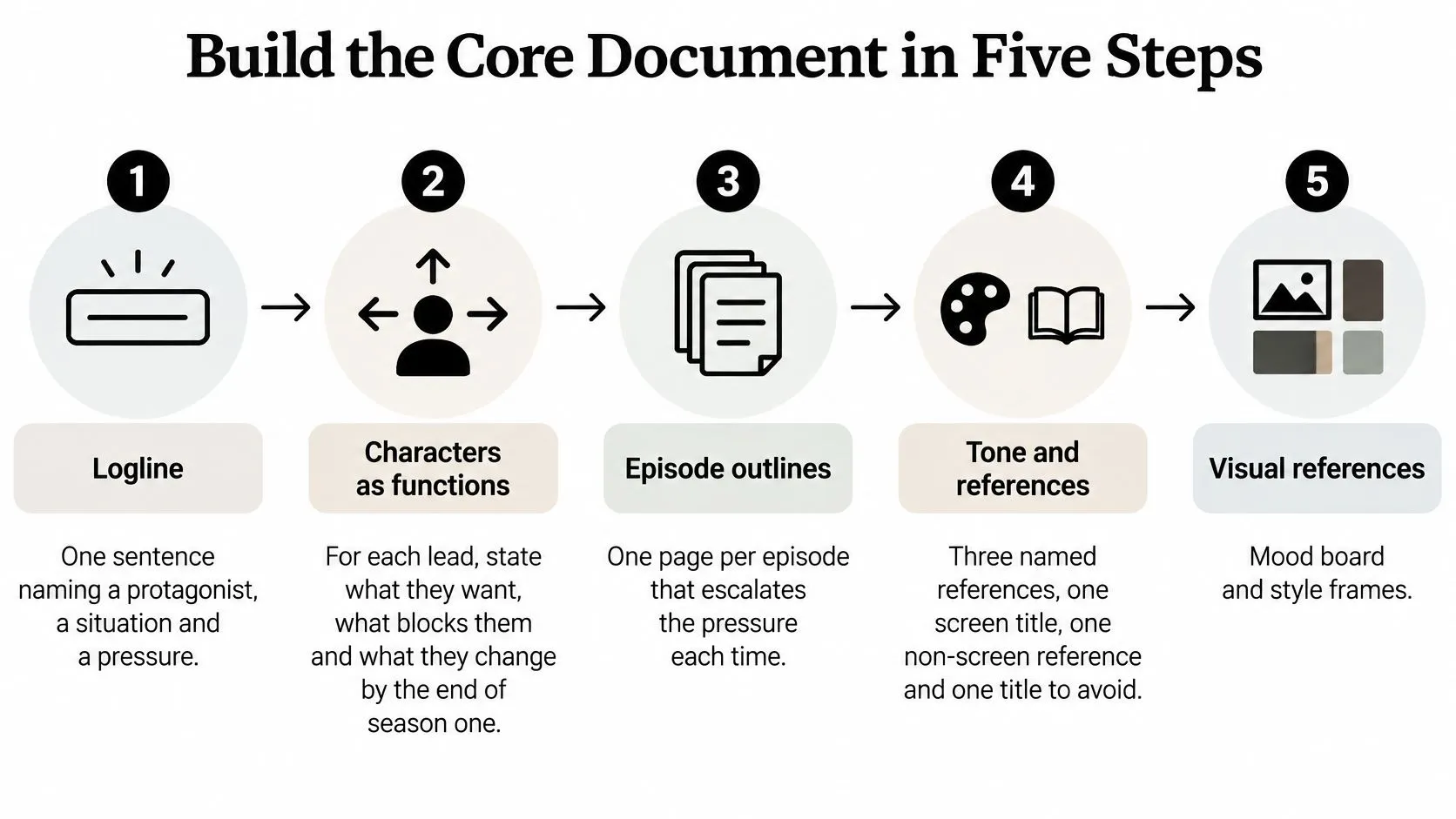 Here's a logline that passes. When a ten-year-old robot mechanic has 24 hours to restore the town's power grid, she must choose between her grandfather's workshop and the friends who depend on it. Protagonist, situation, pressure, all present. The engine follows without effort: a broken machine each week, a deadline, and a choice about who gets helped first. If your engine doesn't follow from your logline, rewrite the logline rather than the engine. Nine times out of ten the logline was describing a mood, and the engine was carrying the series on its own.
Working order: premise, format, audience, engine, world rules. Change one and you rewrite everything below it, which is why the first four pages deserve more drafts than the eight behind them.Budget about four pages for this front section, including the world rules. It's the only part of the bible a commissioner is guaranteed to read in full, so it should be the most edited part, not the quickest.
Character Breakdowns and Episode Outlines That Escalate
Start with a card, because a card is what the reader compares. Here is Episode 3 of the robot mechanic series, filled in. "The Silent Crane"- •Engine problem: the crane lifting the town's bridge parts has stopped and the mechanics have no spare
- •Turn: a trusted adult sabotaged it
- •Change: Mara and her rival Tom now share the workshop key
- •Closing question: who else holds a key
Five lines, and the commissioner can hold it against Episode 4 in ten seconds. That comparability is the whole point. Use one layout for every card: title, engine problem, turn, change, closing question.
Characters written as functions, not biographies
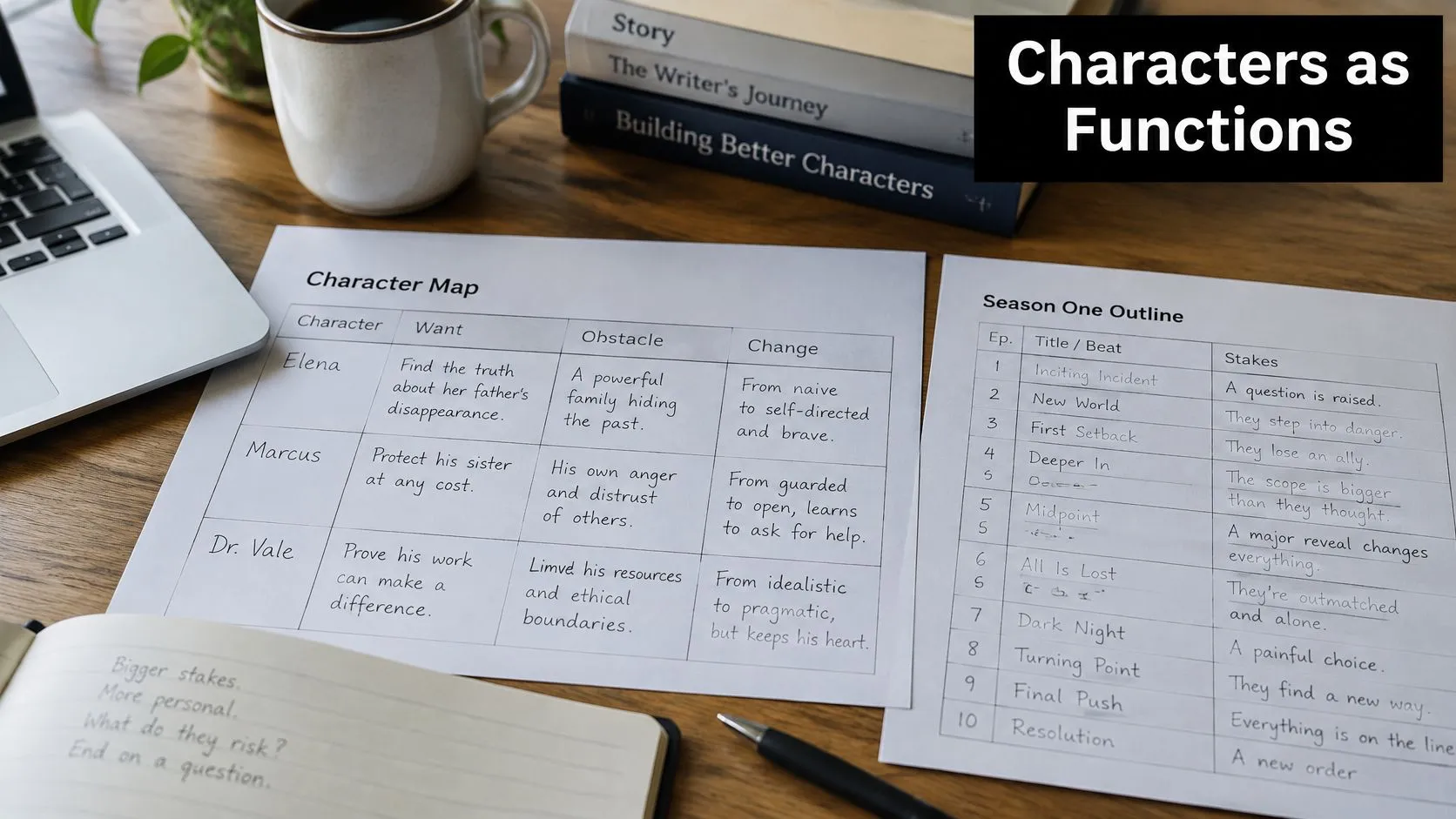
For each lead, four lines: what they want, what blocks them, what they change by the end of season one, and which other character tests them. A childhood in a lighthouse only earns space if it drives a decision on screen in episode two. When a character has no function, the outline sags and the reader notices without being able to say why. If you can delete a character and no episode beat changes, delete them.
Why escalation is the whole argument
Audience numbers show what durable structure is worth. Ofcom reported that the final episode of Line of Duty drew 12.1 million viewers in 2019 and the final episode of Bodyguard reached 14.3 million in 2018, while Line of Duty averaged 10.7 million viewers aged four and over across a recent six-episode series, according to Ofcom's Media Nations 2019 report. Viewers weren't turning up for a premise. They were turning up for characters, questions and rules that held across weeks. So each card must turn something. A reversal of expectation, a change to a relationship, a shift in the world's state. Six to eight cards is enough to prove a season. Twelve thin ones prove nothing except stamina. Then write the arc page: the endpoint of season one, the midpoint reversal, and the one thing season two would change without exhausting the premise. Animated and interactive projects need the same discipline applied to the repeatable interaction, not just the plot. Visual planning is part of that, and our guide to animation storyboarding for UK productions shows how a beat sheet becomes shots before anyone opens a 3D file. As you fill each card, map it to a promise from your traceability list. A card that can't be mapped is usually a card that repeats an earlier one.
Tone, Style and Visual References
Tone is where bibles get lazy. "Warm, funny and heartfelt" describes half the children's slate and tells a commissioner nothing. References do the work, and three are enough.
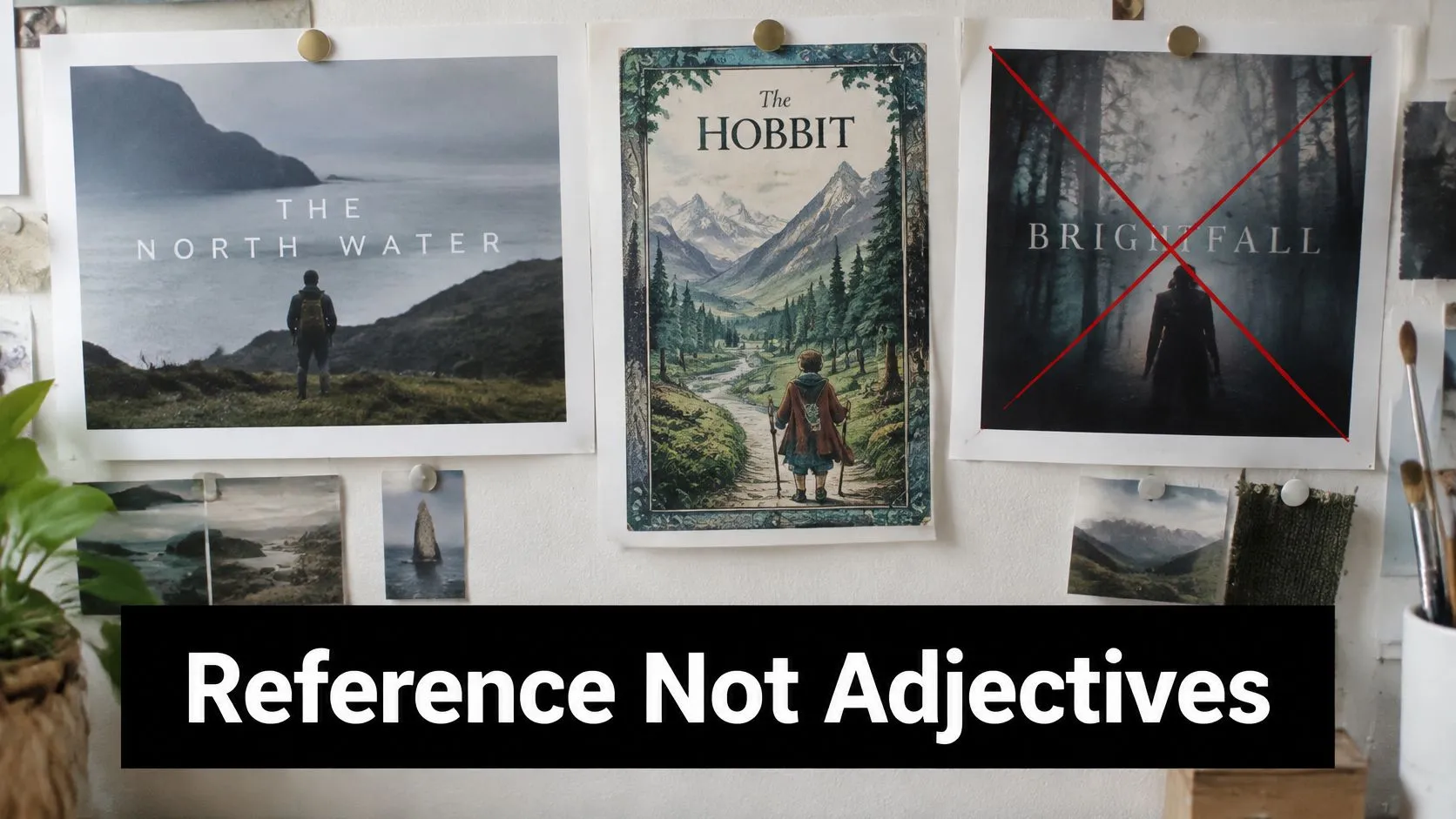
Pick one screen title and say what it contributes: the timing of its jokes, the length of its silences, the way its camera holds still. Pick one non-screen reference, a picture book, a game, an illustration style, and say what it contributes to palette or character shape. Then name one title you don't want to be mistaken for, and why. That third reference is the one writers resist and commissioners trust, because it shows you've made decisions rather than collected influences.
A tone rule that rules something out
Write one sentence that forbids a choice. Warm but never saccharine, and jokes come from character rather than slapstick. Now the reader knows what they won't get, which is more informative than a list of adjectives.
Tone rule template: [quality we want] but never [neighbouring quality we'd drift into]; humour comes from [source], not from [shortcut].
The visual language follows the same principle. State the technique (2D, 3D or hybrid), the palette in rough hues rather than hex codes, the silhouette logic that makes characters readable at thumbnail size, and how motion behaves in action versus quiet scenes. Six to ten captioned references is the sweet spot, each with a line saying why it was chosen. Use licensed or self-made images and say so on the page, because a commissioner will ask. Finish with two sentences of sample scene in the house voice, so the reader hears the series before they read the episodes.
Mara holds the torch steady while Tom counts the fuses. "Two left," he says, and neither of them looks at the workshop door, because the last time they did, it was already open.
That's a tone argument in thirty words, and it's harder to fake than a paragraph of adjectives.
Production, Delivery and Budget Notes for Animation
A commissioner has to believe the schedule before they can sell the idea, so the delivery format belongs in the bible as a decision, not a default. The BBC Scotland specification sets out the formats a UK broadcaster works to.
| Format | Resolution | Frame rate | Notes |
|---|---|---|---|
| HD | 1920 × 1080 (16:9) | 25 fps with 50 interlaced fields | Normally delivered this way |
| UHD progressive | 3840 × 2160 | 25p | Progressive scan |
| UHD progressive | 3840 × 2160 | 50p | Progressive scan |
| Moving graphics on 2160p/50 | 3840 × 2160 | Edit at 50 fps | Rollers, wipes, fades, dissolves and DVE moves |
Those figures come from the BBC Scotland technical delivery standards, which also states that frame rate must be agreed with the broadcaster before shooting begins. That one line moves delivery planning to the front of the pipeline. A 2160p/50 commission means electronically generated moving graphics and effects, including rollers, wipes, fades, dissolves and DVE moves, have to be edited at 50 frames per second to avoid unacceptable judder, and finding that out at online is expensive. State the methodology next: 2D, 3D, hybrid or real-time engine. If there's an XR or interactive layer, say what it does for the story rather than sitting beside it. Then outline the pipeline in stages with a review point at each one: brief, previz, animation, lighting, compositing, delivery. Our 2D vs 3D animation cost guide for buyers breaks down where each route spends its money. Budget drivers belong in bullets, plainly:
- •Episode count and length: the largest single multiplier on any series.
- •Number of principal characters: rigging, look development and continuity all scale with it.
- •Shot complexity: crowds, effects and water cost more than dialogue.
- •Interaction branches: each one is a build, not an edit.
- •Revision rounds: agree the number in writing.
Record rights and brand constraints too: licensed music, third-party characters, partner approvals. For a UK pipeline, the training route matters when you're staffing up, and this guide on how to train as an animator covers the portfolio and software expectations studios screen for.
Compliance and Platform Routes to Document
The first-meeting question isn't about story. It's who this is safe for, and what happens if a viewer or player meets something harmful. Most bibles have no page for it, which is why adding one is a competitive advantage rather than paperwork. Ofcom found that seven in ten UK 11 to 17-year-olds had encountered harmful online content in the previous four weeks, and child-protection rules introduced in July 2025 require platforms to address risks including suicide, self-harm, eating disorders, pornography, misogynistic material, bullying and dangerous challenges, as reported in Ofcom's 2025 online habits research. That's the environment your series will launch into, including the corners of it that live on apps and short-form video. So write a risk and responsibility section:
- •Intended age range, stated as a band with the reasoning behind it.
- •Prohibited portrayals, the things this world will never show.
- •Emotional intensity limits, and how far an episode can push before a scene needs softening.
- •Accessibility commitments, from captions to audio description to colour contrast.
- •Interactive-choice boundaries, for app, game or XR layers.
- •User-generated content exposure, and whether any exists.
- •Escalation procedure, who is contacted and how quickly.
Present these as guardrails that protect the world, not as legal cover. Clear limits tell a commissioner, an educator or a brand partner how far the property can travel safely, which is exactly the conversation you want to be having about season two. Then map the platform route. Parliament's inquiry into children's TV and video content has highlighted how hard it is to make original children's content both available and discoverable as viewing shifts away from television, and government analysis cited in that work found YouTube accounted for 28% of UK children's in-home video viewing. A property that travels usually needs a second route, and we've built one: our studio was asked to design and develop an accompanying Cloudbabies app to complement the Cloudbabies TV series, which meant world rules had to hold on a touchscreen as well as a television. Record which partner owns moderation, which owns the store listing and which owns the thumbnail test, so the bible shows who handles what.
Pitch Your Bible and Plan the Submission
A commissioner may see your one-page summary before opening the bible, so make the two documents work together. The summary gives the hook, audience and series engine. The bible provides the evidence behind those promises. Prepare a concise spoken pitch as well, so you can explain the same idea clearly in a meeting.
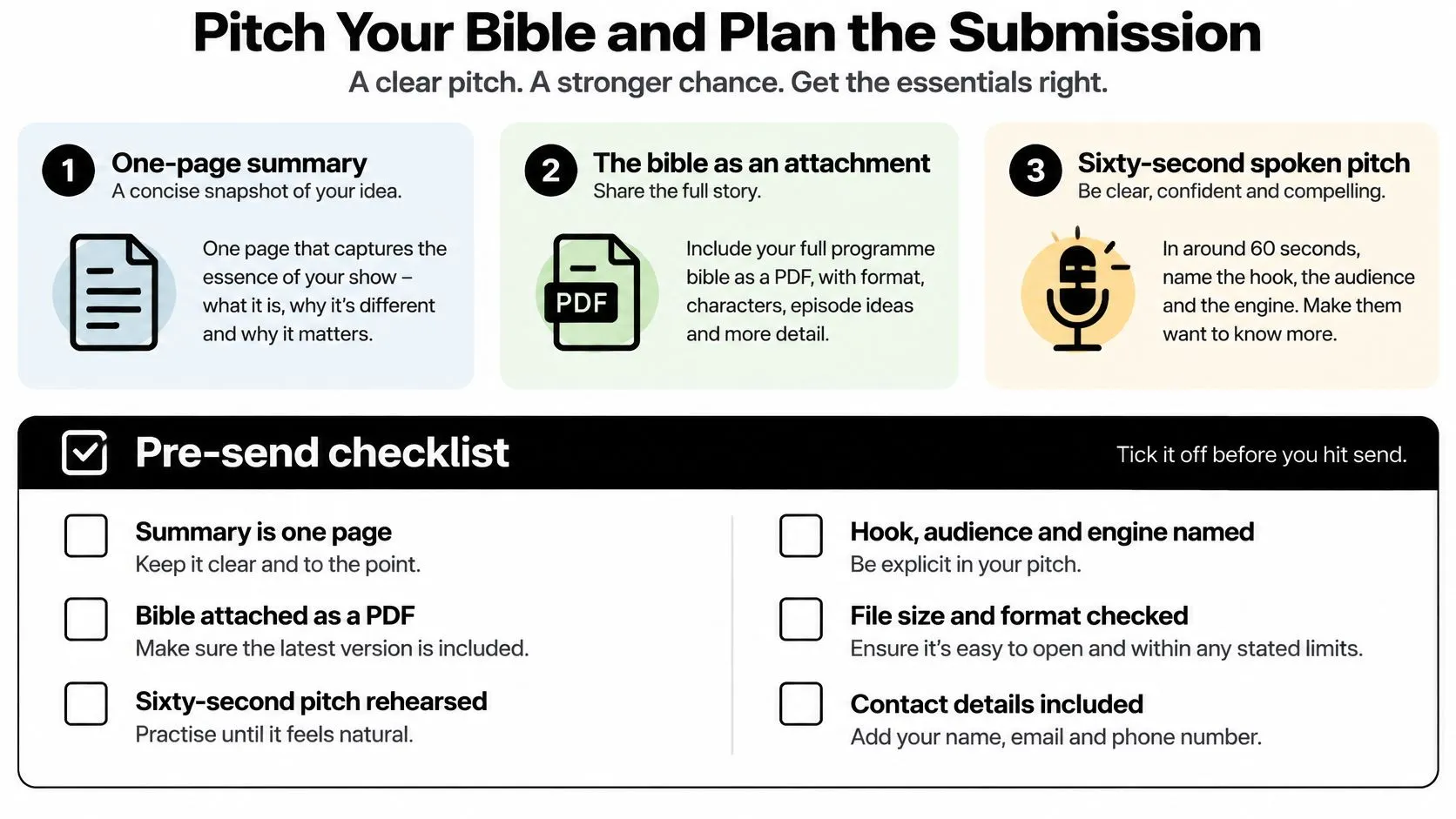
Before sending, run a traceability check. Match each promise to a character function, episode beat, required asset or measurable audience outcome. If a promise has no supporting detail, clarify how it will work or remove it. The BBC describes its decision-making in terms of the idea's strength, strategic fit and the production company's ability to deliver, across genre teams, channels and iPlayer, as set out in how the BBC commissions. Use those tests to check whether the bible makes the creative idea and its practical execution clear. Allow for the submission timeline. The same guidance says the BBC aims to acknowledge submissions within one week, make an initial decision within six weeks and reach a final commissioning decision within 20 weeks, except where paid development or formal tender processes apply. Number each draft and keep a change log that records which creative promises changed. That gives collaborators a clear record as the document develops. Before sending, check that the bible includes:
- •A one-sentence logline with a situation
- •A named platform and broadcaster
- •An age band and viewing context
- •A complete season arc with an endpoint
- •A delivery format agreed with the broadcaster
- •A risk and platform section
A scoping conversation can test whether the bible's promises fit a budget and delivery schedule. Studio Liddell begins each project with a thorough consultation, then creates a customized roadmap aligned with the client's vision. The studio covers work from initial conceptual development through to final project delivery. For a closer look at the pitch itself, read how to pitch an animated TV series that gets noticed. A bible that maps each creative promise to a character, episode beat or production asset can serve as both a pitch document and a practical starting point for development. Studio Liddell works across animation, games and XR properties, and takes a project from initial concept through to final delivery, so the document you send is one the studio can build from. Visit Studio Liddell to discuss how a project's concept and delivery needs can shape its roadmap.