Animation Storyboarding Explained for UK Productions
You're reviewing an animated advert, and the director wants to hold on the character's reaction while your marketing team wants the product revealed sooner. Both choices sound reasonable, but they produce different films. Before anyone starts animating, you need something more useful than competing descriptions of what the audience should see. That's where animation storyboarding earns its place. A useful board gives everyone a shared view of the proposed film, with enough information to make creative decisions and understand their production consequences.
Why a Storyboard Exists
Consider a hypothetical review at a UK studio. The client expects the product reveal immediately after a character opens a parcel, but the director has planned a pause for surprise. Looking at the relevant storyboard panels exposes the disagreement before the team has animated either version. Animation storyboarding translates a script into shot-by-shot visual decisions, including staging, pacing, continuity and instructions for production. The drawings matter because they make those decisions visible, not because every image needs to look finished.
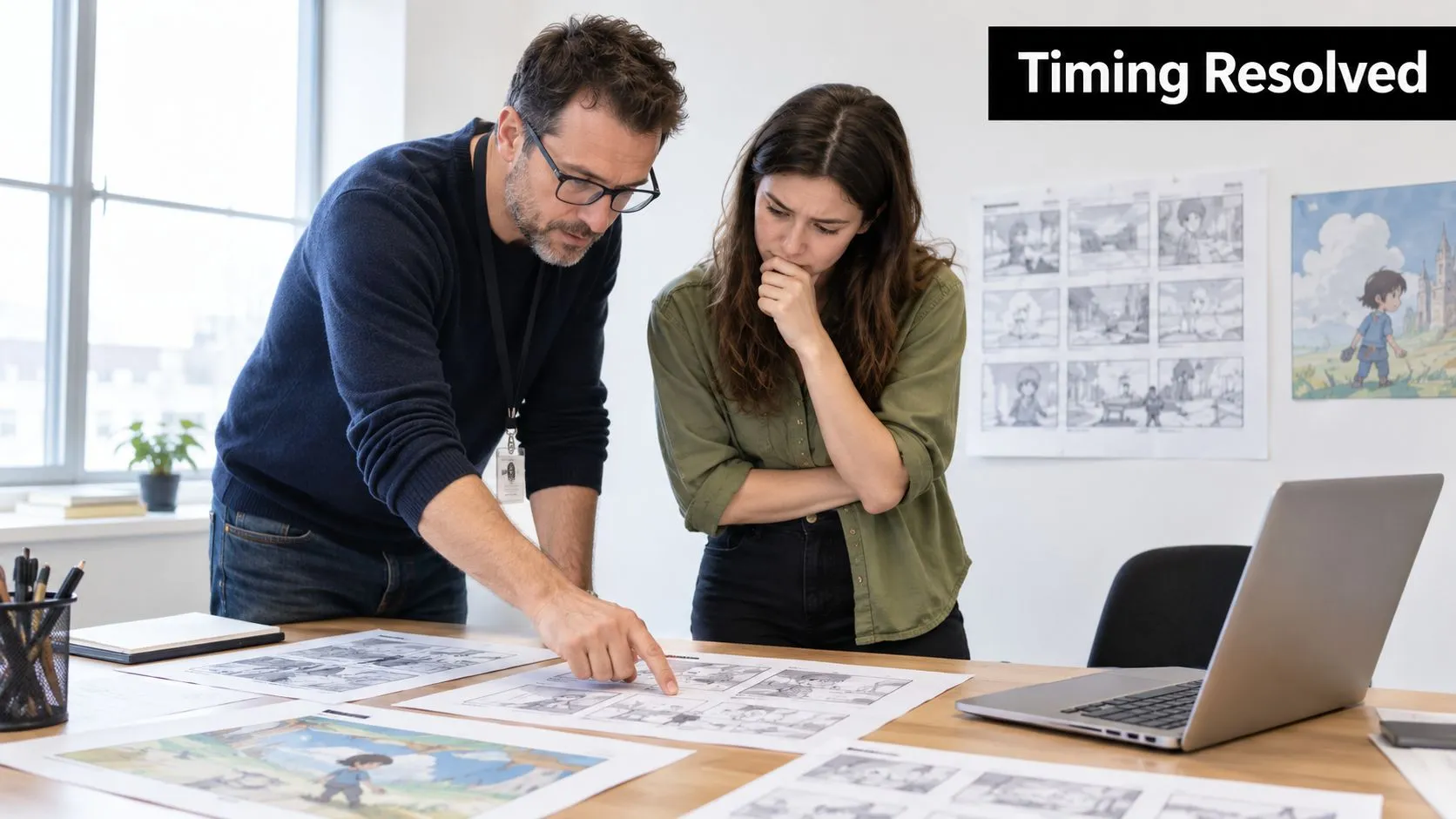
A shared document for different departments
Each person reads the same board with a different question in mind:
- •Directors assess whether the sequence communicates the intended story and performance.
- •Clients check messages, product visibility, tone and the order of information.
- •Layout artists and animators need readable staging, camera intentions and character actions.
- •Editors and production partners need continuity and an understandable sequence of events.
This coordination matters in an internationally connected industry. UK animation television production recorded £61 million in spend in 2020, comprising £16.2 million from domestic productions and £44.8 million through inward investment and co-productions, according to the BFI's official production statistics. Those are dated production figures, not a current market estimate. They nevertheless provide useful context for a discipline that must support domestic commissions and work shared across production partners.
Agreement before execution
A script might say that a character discovers something surprising. The board forces the team to decide what viewers see first, where the character looks and whether the audience discovers the object before or after them.
Practical rule: Approve what the audience will understand, not simply whether you like the drawings.
A storyboard doesn't eliminate interpretation. It gives the director and client a concrete place to resolve it, while the production team can still ask questions without undoing finished work.
What a Storyboard Panel Actually Contains
A storyboard panel isn't necessarily a complete shot. An artist may need several panels to explain a changing action within the same camera setup, while a simple held composition may need less visual coverage. The useful test is whether another department can understand the intention without asking the artist to perform the scene beside their desk.
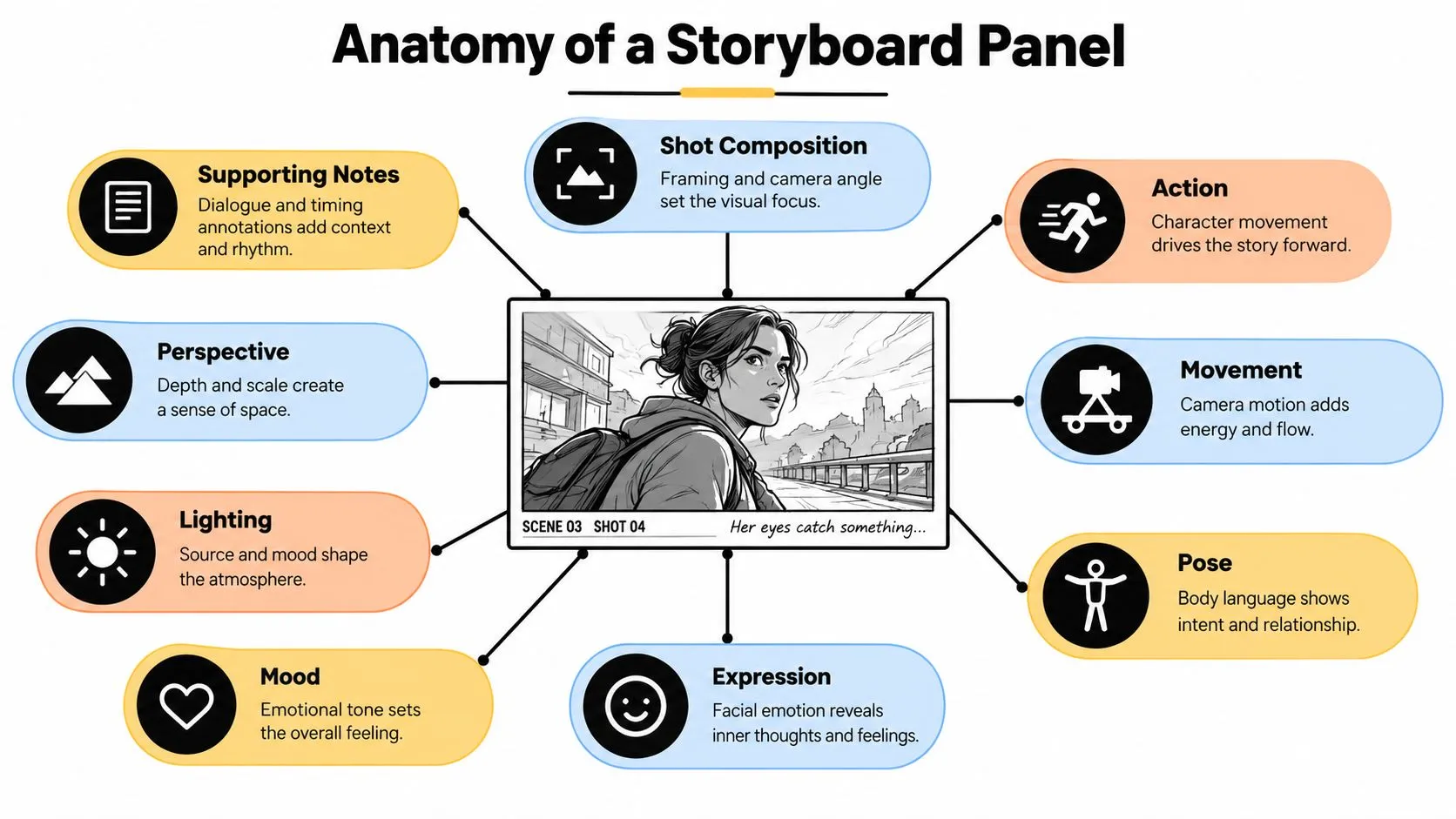
The image explains the visual decision
The panel should communicate the relationship between the camera, characters and environment. These elements work together rather than as independent drawing exercises.
| Component | What the reader needs to understand |
|---|---|
| Shot composition | Framing, camera angle and the intended point of attention |
| Action and pose | What happens and how the character's body communicates it |
| Expression | The emotional intention behind the performance |
| Movement | Whether the character moves, the camera moves, or both |
| Perspective | Depth, scale and spatial relationships |
| Lighting, colour and mood | Relevant visual emphasis and emotional atmosphere |
For example, a character leaning towards a control panel could indicate curiosity, anxiety or physical effort. Pose alone may not settle the meaning. Expression, framing and the accompanying action description should make the intended reading clear.
The notes explain what a still image cannot
Supporting notes should identify dialogue, important sounds, timing intentions and transitions. Separate camera instructions from character actions so a movement arrow doesn't leave the layout artist guessing whether to track the camera or move the performer. For the control-panel example, the annotation might specify that the character hesitates before pressing the switch, followed by an audible warning. That sequence matters even if the drawing itself remains simple.
- •Identify the shot with a stable reference that reviewers can use.
- •Describe the action in direct language rather than relying on ambiguous arrows.
- •Record dependencies such as a sound cue that triggers a reaction.
- •Mark unresolved decisions instead of making provisional details look approved.
A polished illustration can still be a poor production panel if nobody knows what happens next. Conversely, an economical sketch can be production-ready when its intent and annotations are clear. Keep the panel layout consistent so reviewers can find the same information throughout the document.
From Script to Animatic
Take a hypothetical explainer about a monitoring device. The script describes a fault, introduces the device and shows an operator responding. Before drawing detailed scenes, the writer, director and storyboard artist need to agree on what viewers must understand at each moment. The workflow below separates story decisions from presentation polish.
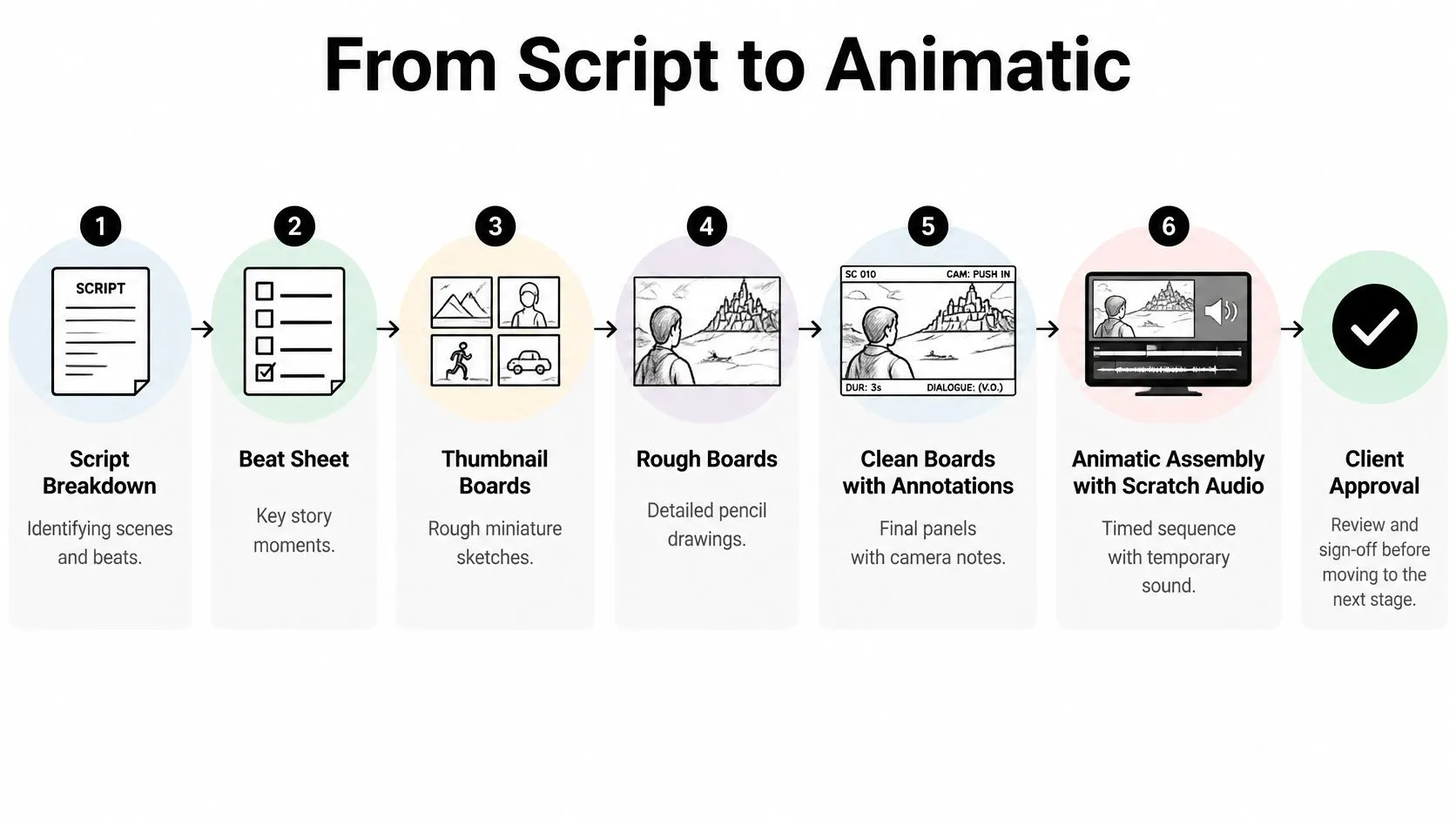
Establish the sequence before refining it
Script breakdown identifies locations, characters, props, actions and technical claims. For the monitoring-device explainer, the team should establish whether the fault is visible, whether viewers need a cutaway and who can approve the technical explanation. The beat sheet then captures the essential changes in understanding: the problem becomes apparent, the device detects it, and the operator acts. These aren't necessarily individual shots. They're the narrative steps that the shots must communicate.
- •Thumbnail boards let the artist explore alternative compositions without polishing an approach that may be rejected.
- •Rough boards develop the chosen sequence, clarifying performance, transitions and continuity.
- •Clean boards with annotations turn those decisions into legible review material, with supporting instructions attached.
The director leads the visual interpretation, but the client's subject-matter specialist should review any technical simplification. A persuasive visual metaphor isn't useful if it misrepresents the product.
Watch the proposal play through
The editor or storyboard team assembles the approved images into an animatic, adding provisional durations, scratch dialogue and temporary sound. Unlike a page of panels, the animatic lets everyone experience the proposed sequence over time. Here, the client may discover that an explanation feels rushed, or that a pause which looked unnecessary on paper helps viewers understand the action. Scratch audio should be clearly identified as temporary so nobody mistakes it for approved casting, music or final sound design.
An animatic is a decision point, not a promise that every temporary detail will survive into the finished film.
Client approval should identify what has been accepted: narrative order, approximate pacing, messaging and camera intentions. It should also list outstanding matters, such as final voice recording or specialist sign-off. The complete animation production pipeline guide provides wider context for connecting these pre-production artefacts to the departments that follow.
Panel Counts, Frame Rates and Technical Specs
Agree the scope of the board during script breakdown, not after the artist has started drawing. A panel target gives the producer a basis for estimating drawing, review and revision effort, but it needs to sit alongside sequence complexity and the expected level of finish. The Level 7 Storyboard Artist apprenticeship assessment specifies approximately 30, 40 panels for animation, 40, 60 for feature film or television, and 20, 30 for short-form or advertising work. These are assessment benchmarks, not universal panel quotas or panels-per-minute rules.
Distinguish coverage from technical detail
A brief should explain what the panel allowance covers. Does it include alternative treatments, revised sequences and presentation clean-up, or only the agreed narrative route?
| Specification | Decision to record |
|---|---|
| Frame rate | The agreed project timing basis for editorial and production |
| Screen ratio | The composition area and any separately commissioned formats |
| Shot naming | A consistent identification system across boards and files |
| Departmental constraints | Requirements that affect what can be built or animated |
| Motion capture and effects | Shots needing specialist planning or additional references |
The apprenticeship standard also addresses these technical considerations. Their practical value is consistency: a shot shouldn't acquire a different identity when it moves from the board into editorial or layout.
Put effort where uncertainty is highest
A static product close-up may need little explanation beyond framing and an action note. A camera move through machinery may require additional panels, spatial references and discussion with the technical team.
- •Add coverage for changing action when a single image cannot explain the sequence.
- •Add technical notes for difficult execution rather than drawing every panel to the same finish.
- •Flag alternative formats early where reframing could hide an essential action or caption.
- •Record timing assumptions so editorial doesn't interpret an approximate hold as a locked duration.
Don't confuse frame rate with panel count. Frame rate governs the project's timebase; panels describe selected visual moments. The artist isn't being commissioned to draw every finished animation frame. A useful technical brief makes these distinctions explicit before they become disagreements about scope.
2D Boards, 3D Previs and Engine Capture
Choose the method that answers the production's unresolved questions. If the central challenge is a character's reaction, drawn boards may be the clearest route. If it's whether a camera can move through a constrained environment, spatial previsualisation deserves consideration.
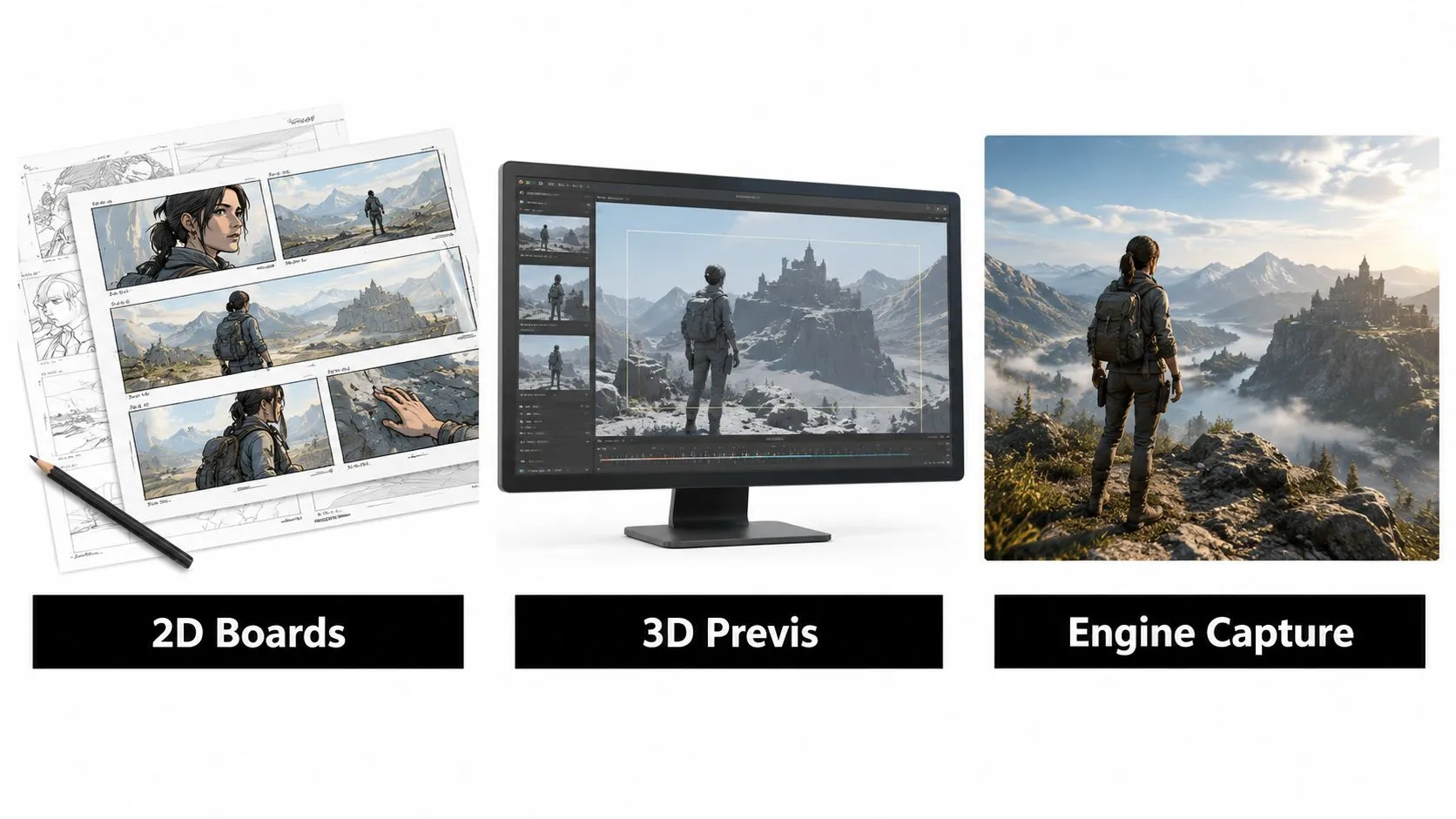
Drawn boards favour exploration
Traditional drawing and digital illustration let artists test silhouettes, gestures and compositions without first constructing a scene. They're useful when the director is still choosing how to tell the story, rather than validating the dimensions of a location. For artists considering tablet-based sketching, Tinymoose's guide to the best iPad illustration apps 2026 offers a starting point for exploring options. Evaluate any drawing tool against the actual handoff requirements, including readable exports and an annotation workflow, rather than choosing solely by brush selection.
Spatial previs answers different questions
Simple geometry can help the team examine camera placement, character scale and sightlines. The Arts University Bournemouth animation research collection includes work describing storyboards as shared coordination objects and related research on using scale-accurate assets in 3D storyboarding to support the transition into production. That doesn't mean every project benefits from building a previs scene. Someone still has to prepare the geometry, stage the action and maintain the files.
| Approach | Useful decision | Caution |
|---|---|---|
| Drawn boards | Story, expression and visual emphasis | Spatial assumptions may need later testing |
| 3D previs | Camera movement, scale and staging | Setup work can exceed the needs of a simple sequence |
| Engine capture | Viewpoint and interaction in a real-time scene | A captured route doesn't represent every possible user action |
Unity or Unreal may be appropriate when the production needs to test its intended real-time environment. The producer's comparison of Unreal and Unity for real-time animation can support that pipeline discussion. For XR, distinguish a directed sequence from a participant's experience. Record what happens if the participant looks elsewhere, waits or chooses a different action. Whatever method you use, retain the agreed shot references and metadata so the team can trace each visual test back to its approved intention.
Review Rounds and the Hand-off to Production
A review becomes inefficient when everyone gives every kind of feedback at once. Ask reviewers to assess a defined question, and name the person authorised to resolve conflicting comments. This is professional coordination work, not an administrative extra. ScreenSkills' animation career map explicitly identifies storyboard artists among the occupations experiencing a skills shortage.
Give each checkpoint a purpose
| Checkpoint | Main question | Recommended decision owner |
|---|---|---|
| Director pass | Does the sequence tell the intended story? | Director |
| Internal production review | Can the departments execute the proposal within scope? | Producer with department leads |
| Client review | Are the message, tone and represented details correct? | Named client approver |
| Locked board | Have accepted changes been incorporated and exceptions recorded? | Producer coordinating sign-off |
The director pass should resolve performance and visual storytelling before the client is asked to approve presentation details. Internal production review should expose missing assets, difficult effects or camera assumptions, rather than passing those questions downstream. For client review, consolidate comments into a shared response. If marketing requests a longer product hold while another stakeholder requests a shorter film, the producer needs an agreed priority, not separate instructions to the artist.
Approval discipline: Ask for decisions against identified shots, with a reason and a named approver.
Deliver a package, not an attachment
The handoff should contain the approved board, corresponding animatic, shot list and current decision record. Mark superseded versions clearly so nobody starts from an old export.
- •Layout teams need camera constraints, staging references and environment dependencies.
- •Animation teams need performance intentions and any approved timing restrictions.
- •Compositing teams need relevant layer, transition and effects expectations.
- •Game-engine and XR teams need triggers, interactive states and behaviour outside the preferred path.
Flag reusable assets where they appear, but distinguish intended reuse from confirmed suitability. An object designed for a background appearance may not support a later close-up without further work. Locking the board doesn't forbid changes. It establishes a baseline against which the producer can assess a proposed change, identify affected departments and obtain approval for its implications.
Pitfalls, Risks and Accessibility Checks
Ambiguity is a greater production risk than an unpolished drawing. A rough panel with clear instructions can support a reliable decision. A beautiful image with unclear timing, permissions or delivery requirements cannot. Avoid treating accessibility and rights checks as final-export tasks. Some problems begin in the proposed sequence itself, such as information conveyed only through an unexplained visual change or essential text placed where captions will compete with it.
Test accessibility against the commissioned standard
Accessibility specifications vary by commissioning context, so record which requirements apply rather than presenting a supplier's house rules as universal law.
- •Subtitle pacing, audio and flashing need explicit checks. The Government Commercial Agency's accessible-content guidance recommends subtitle reading speeds of 200, 250 words per minute, voice-over at least 20 decibels above background audio, and effects that don't blink more than three times per second.
- •Caption layout and delivery files should be agreed early. Torbay Council's video supplier guidelines specify a maximum of 38 characters per line and two lines per caption, alongside requirements including H.264 video, AAC-LC or equivalent audio, a standard 16:9 YouTube master unless otherwise commissioned, and separate SRT and transcript files.
- •Accessible alternatives need production planning. GOV.UK's video publishing guidance calls for closed captions and an HTML transcript, and identifies audio description as essential for explaining visual elements to blind or visually impaired audiences.
At board stage, reserve space for captions, identify meaningful non-dialogue sounds and flag visuals that require description. Test reading time in the animatic rather than assuming that text will be readable because it fits inside the frame.
Control scope and provenance
Vague panel allowances and late changes need the same response: identify what was approved, establish what has changed and agree the affected work before restarting production. AI-assisted material introduces a different uncertainty. Employer concerns about AI affecting storyboarding are documented in Animation UK's research and reports resources, but tool availability isn't permission to upload a client's script or approve generated imagery.
- •Confidentiality requires approval before scripts or unreleased designs enter an external tool.
- •Provenance and consent require records of supplied references, permissions and generated material.
- •Client disclosure should establish whether assisted methods are permitted.
- •Human sign-off should cover continuity, cultural interpretation, performance and final authorship.
Use generated imagery as supervised exploratory material where authorised, not as evidence that rights clearance or creative judgement has already been handled.
Where Boards Save the Most Money
The strongest reason to invest in boards is the opportunity to change a decision before other departments depend on it. Reconsidering a composition at thumbnail stage involves a different amount of work from revising it after animation, lighting and compositing have been built around it. That doesn't make storyboarding free. Drawing alternatives, staging previs and coordinating reviews all add time, especially when stakeholders haven't agreed on the message. The producer's job is to buy enough certainty without commissioning unnecessary polish. The BFI's More Films for Freedom application guidance notes that animation can cost more per minute than live action and asks applicants for a schedule and budget. Early planning therefore needs to become an executable cost plan, not remain an attractive proposal. Before commissioning, establish:
- •Deliverables including the board, animatic and technical handoff.
- •Approval gates with named decision-makers and recorded exceptions.
- •Risk allowances for complex shots, accessibility and authorised AI use.
Use the 2D versus 3D animation cost buyer's guide to frame the wider production discussion. Invest more boarding time where uncertainty affects execution, not where more drawings would look impressive. --- Studio Liddell offers storyboarding and animatic development within its animation production process, helping teams establish shot design, movement and pacing before full production. Visit Studio Liddell to book a production scoping call, and bring your script, intended formats and approval requirements so the team can discuss the right level of storyboard detail.