2D vs 3D Animation Cost A Buyer's Guide
You've got budget approval for a marketing video. Then a key question lands. Do you make it in 2D or 3D? Most buyers start with the wrong assumption. They think this is an art-style choice with a simple price answer. It isn't. It's a production decision that affects cost, lead time, revision pain, reuse value, and how credible your brand looks on screen. The lazy answer is that 2D is cheaper and 3D is expensive. Sometimes that's true. Sometimes it's completely wrong. A simple 3D product render can cost less than a detailed 2D explainer with custom illustration and heavy revision cycles. That's why a serious conversation about 2D vs 3D animation cost has to go beyond rate cards. Here's the practical comparison most buyers need at the start.
| Decision factor | 2D animation | 3D animation |
|---|---|---|
| Upfront cost | Usually lower for simple explainers and graphic-led work | Usually higher because of modelling, rigging, lighting, and rendering |
| Best use case | Abstract ideas, service explainers, stylised brand stories | Product visualisation, realistic demonstrations, reusable characters and environments |
| Revision behaviour | Can be efficient in simple styles, but expensive if custom illustration keeps changing | Can be efficient after assets are built, especially when camera moves or scenes are reused |
| Long-term asset value | Lower reuse in most cases | Stronger reuse potential across campaigns, interactive work, and XR |
| Budget risk | Scope creep through storyboard and illustration changes | Scope creep through extra assets, lighting, simulation, and render-heavy revisions |
| Strategic fit | Short campaign bursts and message clarity | Product ecosystems, franchise content, and multi-output pipelines |
Choosing Between 2D and 3D Animation
A marketing manager usually comes into this decision with a fixed number in mind and a loose brief. “We need a one-minute video.” That's not enough. One minute of icon-led 2D is a different job from one minute of character-driven 3D. One sells an idea fast. The other can build a world, show a product properly, and give you assets you can keep using. That's why the first call shouldn't be about style references. It should be about what the video has to do. Is it explaining software? Selling a physical product? Launching a character? Supporting paid social? Feeding a wider campaign? Those answers matter more than whether someone on the team says they “prefer the look of 3D”. There's also a brand question buyers often miss. If your audience needs clarity, 2D often wins because it strips things down and directs attention. If your audience needs confidence in a product, 3D often wins because it shows form, function, materials, and motion more convincingly. Different jobs. Different economics. A lot of buyers also underestimate what 3D means in a business setting. If that's where your head is, this guide to 3D computer graphics for modern businesses is a useful grounding before you ask for quotes.
Producer's rule: Don't ask “Which is cheaper?” Ask “Which format solves the problem with the least wasted production effort?”
That shift alone saves money. It stops teams from commissioning polished work in the wrong medium, then paying again to fix the strategic mistake.
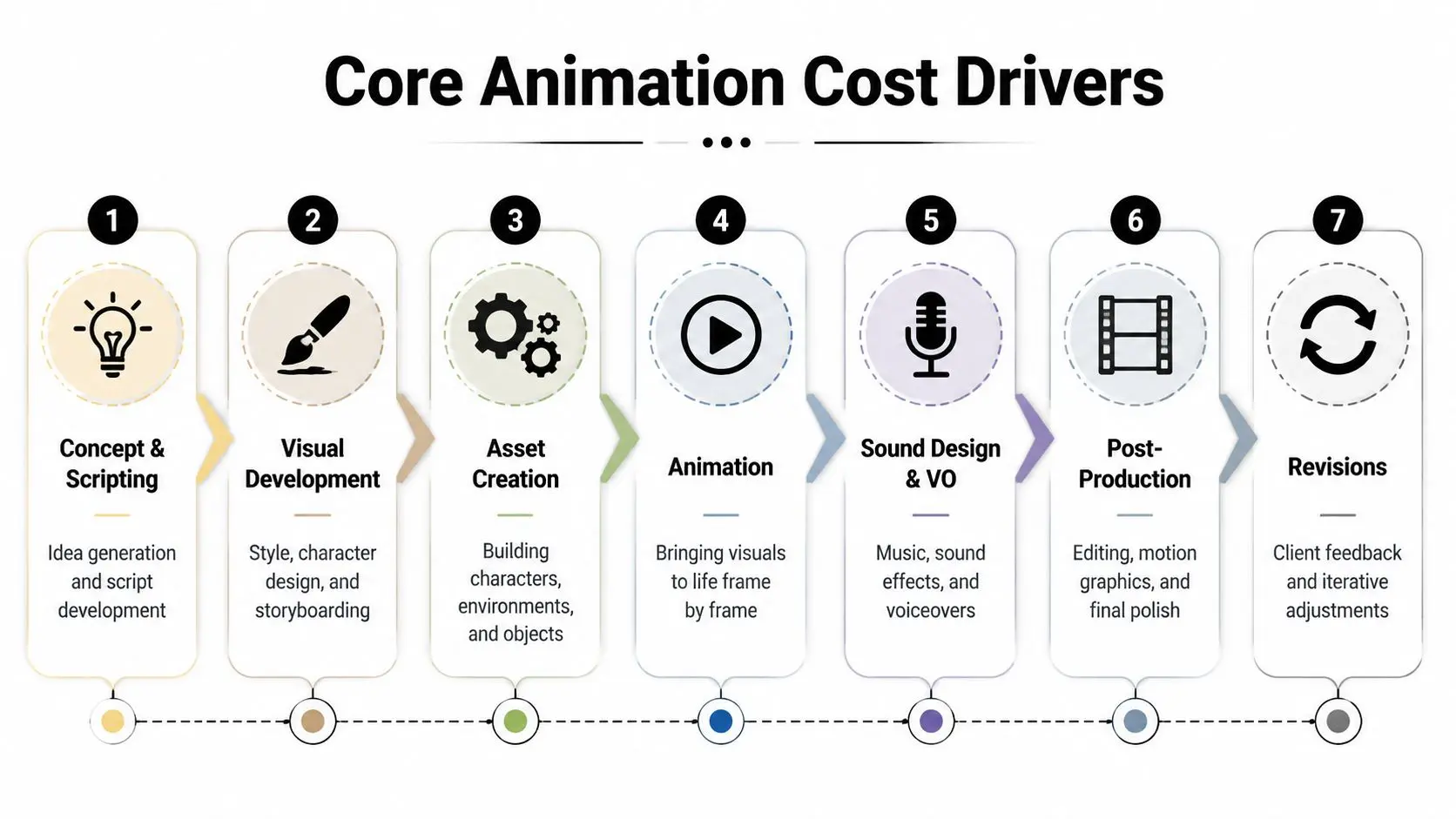
Understanding the Core Cost Drivers
Runtime matters. Complexity matters more. For planning, one reliable benchmark is that standard 3D animation projects often land at £5,000 to £10,000 per minute, and more complicated 3D character work can require 150 to 180 hours according to RocketBrush's 3D animation cost guide. This is why 3D usually costs more than 2D for the same finished length.
What you're paying for in 2D
2D budgets usually stack up around script development, storyboard clarity, illustration load, animation method, sound, and revision rounds. If the style is graphic and modular, costs stay controlled. If the work is hand-drawn, heavily customised, or full of scene changes, the budget rises quickly. In plain terms, 2D gets expensive when your team keeps changing the idea after illustration has started. Every new visual decision can ripple through boards, assets, animation, and edit.
What you're paying for in 3D
3D adds pipeline steps that 2D often doesn't need. Models must be built. Characters may need rigs. Materials, lighting, cameras, rendering, and compositing all add labour. If you need simulations, facial performance, or multiple unique environments, the budget climbs again. That's why buyers should stop thinking in price-per-minute alone. A short 3D film with multiple bespoke assets can cost more than a longer 2D piece. A simple 3D product spin with one hero object can be efficient.
The expensive part usually isn't the final minute on screen. It's the number of decisions, assets, and changes hidden behind that minute.
The cost levers buyers can actually control
A quote becomes easier to understand once you separate the project into production drivers:
- •Asset count: More characters, props, and environments increase labour.
- •Performance demands: Lip sync, facial acting, cloth, and creature movement raise complexity.
- •Visual finish: Stylised work is different from realistic shading and lighting.
- •Revision behaviour: Late-stage changes are where budgets get damaged.
- •Delivery spread: One master film is cheaper than a campaign with cut-downs, alternate formats, and localisation.
If you want the budget process to stay sane, track production decisions properly. Teams that already categorise spend cleanly tend to scope better and spot waste earlier. This guide to ReceiptsAI for expense management is useful if you're trying to organise animation costs alongside broader campaign spend. Performance style matters too. If your project involves digital actors, creature work, or body performance, motion capture can change both budget shape and schedule. This client guide to motion capture animation helps buyers understand where that fits.
Typical Price Ranges and Timelines for Animation
Here's the benchmark most UK buyers want up front. One UK-facing pricing guide places 2D animation at about £800 to £8,000 per minute and 3D animation at about £800 to £16,000 per minute, with the higher 3D ceiling driven by modelling, rigging, and rendering complexity rather than frame count, as outlined in Dizz Agency's pricing guide. That range is wide because “animation” covers wildly different jobs. A logo sting, a SaaS explainer, a product demo, and a cinematic character piece do not belong in the same budgeting conversation.
2D vs 3D animation cost and timeline comparison 2026
| Complexity tier | 2D animation | 3D animation |
|---|---|---|
| Simple | Around the lower end of £800 to £8,000 per minute. Best suited to icon-led explainers, simple motion graphics, and limited-scene storytelling. Usually faster to approve because there are fewer technical stages. | Can also start around the lower end of £800 to £16,000 per minute when the brief is tightly constrained, such as a basic product turntable or simple visualisation. Timelines stay manageable when asset count is low. |
| Standard | Mid-range projects sit somewhere within the same £800 to £8,000 per minute band and often include custom illustration, character rigs, branded transitions, and several scene changes. | Mid-range 3D typically rises faster because asset build and render effort increase. Product films, environment work, and character animation sit in this territory within the £800 to £16,000 per minute band. |
| Premium | Approaches the top end of £8,000 per minute when the style is highly bespoke, frame-dense, or revision-heavy. | Premium 3D can reach the top end of £16,000 per minute where realism, multiple environments, detailed character acting, or complex rendering are required. |
What these ranges mean in practice
Don't read those bands as shopping categories. Read them as scope warning signs. If your team says the film is “only 60 seconds” but also wants multiple characters, custom scenes, voiceover, localisation, alternate aspect ratios, and room for late stakeholder changes, you're not buying a cheap minute. You're buying a loaded pipeline. A more useful way to estimate budget is to ask these three questions:
- How many unique assets must be created?
- How polished must the movement and finish look?
- How many rounds of change are likely after storyboard approval?
Budgeting shortcut: If the brief is still moving, the quote is provisional no matter how confident it looks.Timelines follow the same logic. Simple work moves quickly because approval points are fewer. Premium work slows down because there are more dependencies, more specialist hands involved, and more room for late disruption. If you need help spotting whether a quote is realistic or padded, this buyer's guide to choosing an animation studio is worth reading before procurement starts.
When 2D Animation Delivers the Best ROI
2D is often the smarter business decision when the job is clarity, speed, and message control. If you're explaining a platform, service, workflow, policy, or technical concept, abstraction is an advantage. You don't need the audience admiring reflections on a product surface. You need them following the argument. Good 2D does that cleanly because it strips away physical detail and turns complexity into symbols, sequences, and visual metaphors.
Where 2D usually wins
For many marketing teams, 2D gives better return in a few specific situations:- •Abstract products: SaaS, fintech, telecoms, compliance, and B2B services often benefit from diagrams, icons, UI-inspired sequences, and simplified storytelling.
- •Brand-led campaigns: If your identity already uses illustration, graphic shapes, or editorial design, 2D keeps the campaign visually consistent.
- •Tight launch windows: A lean 2D pipeline can reduce technical overhead when compared with more asset-heavy production.
- •Frequent message changes: If the proposition is still evolving, stylised 2D often handles copy and scene edits more gracefully than a fully built 3D world.
Why 2D can outperform more expensive work
Buyers sometimes confuse production sophistication with marketing effectiveness. They're not the same thing. A sharp 2D explainer can outperform a prettier 3D film if your audience needs understanding before they need spectacle. This is especially true when internal alignment is the challenge. If multiple stakeholders are trying to agree on positioning, product language, or compliance wording, 2D gives you room to simplify the story without pretending the product itself is the hero.
Use 2D when the message is carrying the campaign. Use 3D when the object, space, or performance is carrying it.
That's the blunt version, and it holds up in most briefs.
When 3D Animation Is a Strategic Investment
You approve a 2D quote because it looks cheaper. Six months later, the product team wants new angles, the sales team needs trade show loops, and ecommerce needs fresh renders for a variant launch. Now you are paying to rebuild visuals that a 3D asset library would have handled from the start. That is why the simple rule of "2D costs less" leads buyers astray. Simple 3D can beat complex 2D on total cost, especially when the same product, character, or environment needs to appear across multiple assets. If the audience needs to inspect an object, trust its form, or understand how it works, 3D earns its budget fast. You can rotate the camera, separate parts, reveal internal mechanisms, swap materials, and place the same model into different scenes without starting over each time. That changes the economics of the project, not just the look.
Reuse is where 3D starts paying you back
The strongest business case for 3D is reuse. Mimic Productions' comparison of 2D and 3D animation explains that 3D characters, rigs, and environments can be repurposed across future outputs, which lowers the marginal cost of each new asset after the initial build. That matters if your campaign has a lifespan beyond one launch film. A single 3D build can support:
- •Campaign extensions: new edits, alternate camera paths, and seasonal refreshes
- •Sales content: product loops for events, presentations, and ecommerce pages
- •Interactive outputs: configurators, real-time demos, and XR-ready assets
- •Long-term brand systems: recurring characters, repeatable environments, and modular product visuals
This is also where the usual cost comparison breaks down. A stylised 2D film with custom illustration, frame-by-frame motion, and constant scene changes can cost more than a focused 3D piece built around one hero asset and a controlled set of shots.
Where 3D earns its budget
Choose 3D in these situations:
- You are selling a physical product.
- You need spatial credibility.
- You expect repeat use.
- Your roadmap includes interactive work.
Commercial reality: If the same product, character, or environment will appear more than once, judge 3D on total campaign lifespan, not the first invoice.That is the better buying lens. Compare systems, not just quotes.
Smarter Budgeting to Reduce Animation Costs
You don't control every cost variable, but you control more than most buyers think. Bad briefs, loose approvals, and endless “small tweaks” do more damage than the choice between 2D and 3D. The cleanest way to save money is to remove ambiguity before production starts. That means script locked, visual references agreed, stakeholders identified, deliverables defined, and revision rounds capped. If any of that is fuzzy, expect budget drift.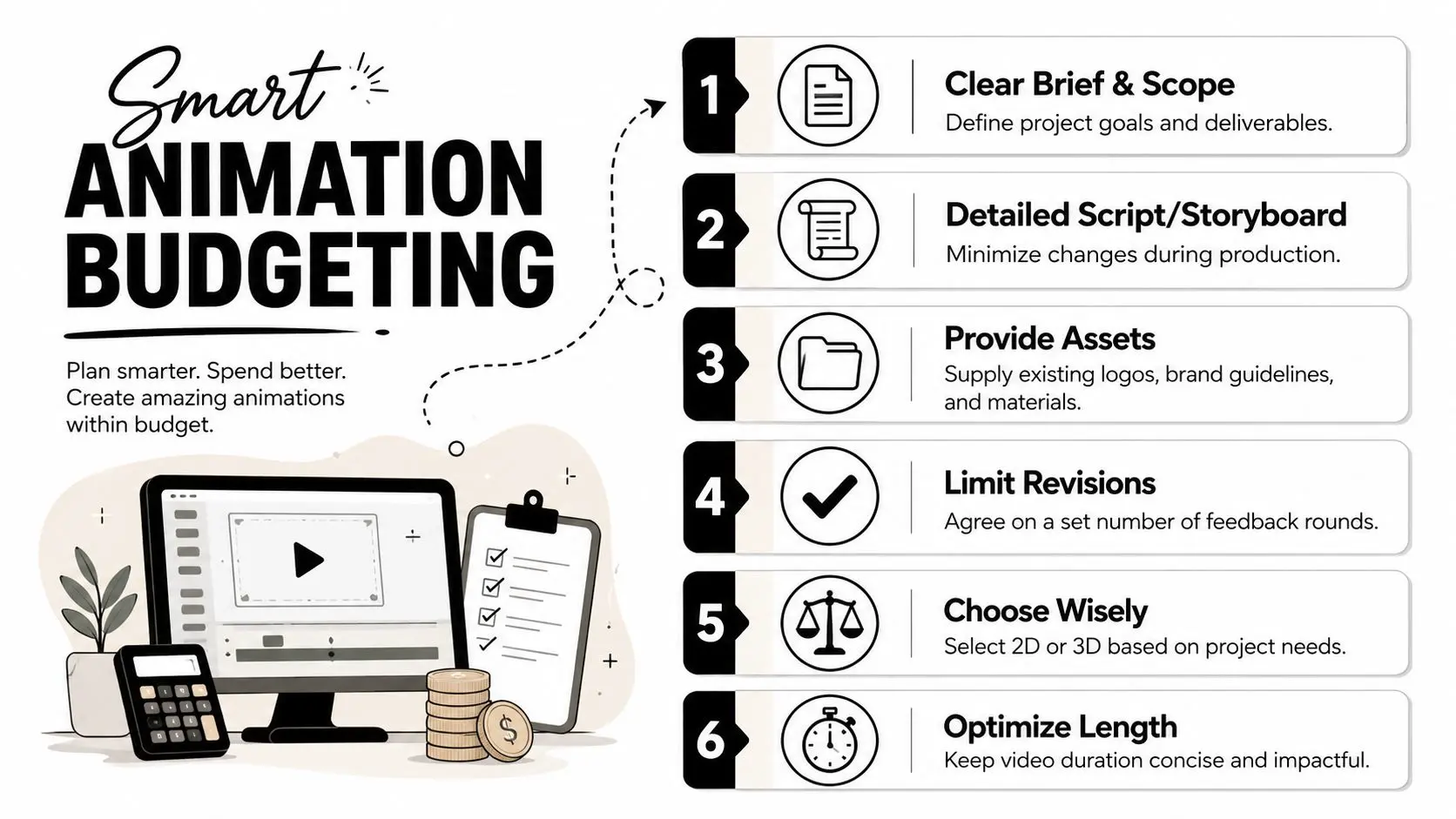
The cost-control checklist that actually works
- •Lock the brief early: If the audience, objective, and key message are still moving, wait. Starting early with a weak brief is how teams pay twice.
- •Reduce unique assets: Reusing one environment or one hero product view is cheaper than building five barely different scenes.
- •Choose the right motion style: In 2D, a rigged approach may be more efficient than frame-by-frame. In 3D, a simpler lighting setup may protect the budget without hurting the message.
- •Limit stakeholder access: Too many reviewers create contradictory feedback and needless revision loops.
- •Plan all outputs at the start: If you need social cut-downs, localisation, or multiple aspect ratios, include them in scope before production begins.
- •Supply usable source material: CAD files, brand guidelines, product photography, scripts, and references reduce avoidable setup work.
AI is changing some budget maths
AI tools are also changing the shape of production, particularly in immersive and 3D-related workflows. One industry source notes that AI integration has reduced 3D asset creation time by up to 55% and lowered production costs by 30% for some XR projects in the UK, bringing them closer to 2D costs, according to Animaker's overview of 2D vs 3D animation. That doesn't mean AI makes animation cheap. It means some pipeline stages can move faster when the project is structured well and the team knows where automation helps.
Faster tools don't rescue a bad brief. They just help a good pipeline move with less friction.
The practical takeaway is simple. Don't ask whether a studio uses AI. Ask where it uses AI, why, and whether that changes quality, approvals, or handoff files.
Making the Final Decision for Your Business
The right choice usually becomes obvious when you stop framing it as a style debate and start framing it as a business decision. Ask four questions.
Ask what the audience needs to understand
If the audience needs to grasp an abstract concept quickly, 2D is often the stronger choice. If they need to inspect, trust, or desire a product, 3D usually carries more weight.
Ask what you might reuse later
Many briefs go wrong when teams scope a “one-off” film, then six months later want cut-downs, product loops, event visuals, and interactive content. If that's even remotely likely, the 3D route deserves a harder look because the asset base can keep working.
Ask where complexity really sits
The biggest myth in this market is that 2D is always the budget option. It isn't. Simple 3D product renders in the UK average £1,200 to £2,500, while a detailed 2D explainer with custom illustration often ranges from £4,500 to £8,000, according to Prolific Studio's comparison of 2D and 3D animation cost. That should end the old “2D is always cheaper” argument.
Ask whether your brief is stable enough to price properly
If your internal team still disagrees on messaging, product focus, or audience priority, the smartest move isn't choosing 2D or 3D. It's fixing the brief first. A good studio will challenge your assumptions, simplify the scope, and tell you when the expensive-looking route is the efficient one.
If you're weighing 2D against 3D and want a straight answer on scope, budget, and the best production route, book a scoping conversation with Studio Liddell. Bring the script, the business goal, and any reference material you have. You'll get a clearer view of what should be made, what can be cut, and where the spend will deliver value.