How to Pitch an Animated TV Series That Gets Noticed
You've got the idea, the characters, and perhaps a beautiful teaser sitting on your hard drive. The problem is that a UK commissioner won't fund an idea because it looks expensive. They fund a project when they can see the audience, the editorial fit, the production route, the financing logic and the evidence that the team can deliver it. That distinction matters in a tighter, more opportunity-driven children's market. How to pitch an animated TV series now means reducing uncertainty without flattening the creative ambition. A concise deck, a sharp script and carefully scoped motion proof will usually do more work than a sprawling bible and an expensive reel.
What a Winning Animated TV Series Pitch Looks Like in 2026
A commissioner opens your deck between tightly scheduled meetings. The first slides must establish the audience, format, editorial fit and production route before visual polish earns attention. In the UK's opportunity-driven children's market, a winning pitch reduces uncertainty while protecting the idea's creative identity. Concise packaging, scoped proof and broadcast-ready materials beat a large reel with no clear commissioning case. The BBC still uses a formal route for television ideas. Proposals go through its online PiCoS system, and its commissioning guidance asks for a creative brief, production brief, delivery and technical requirements, plus OFCOM qualification status. Your pitch must therefore explain how the series could be made, delivered and assessed for UK requirements. The BBC's commissioning report records £140m in commissioning spend in 2024/25, while the number of commissioners changed from 125 to 138, evidence of substantial but formalised gatekeeping (BFI's official statistics release calendar).
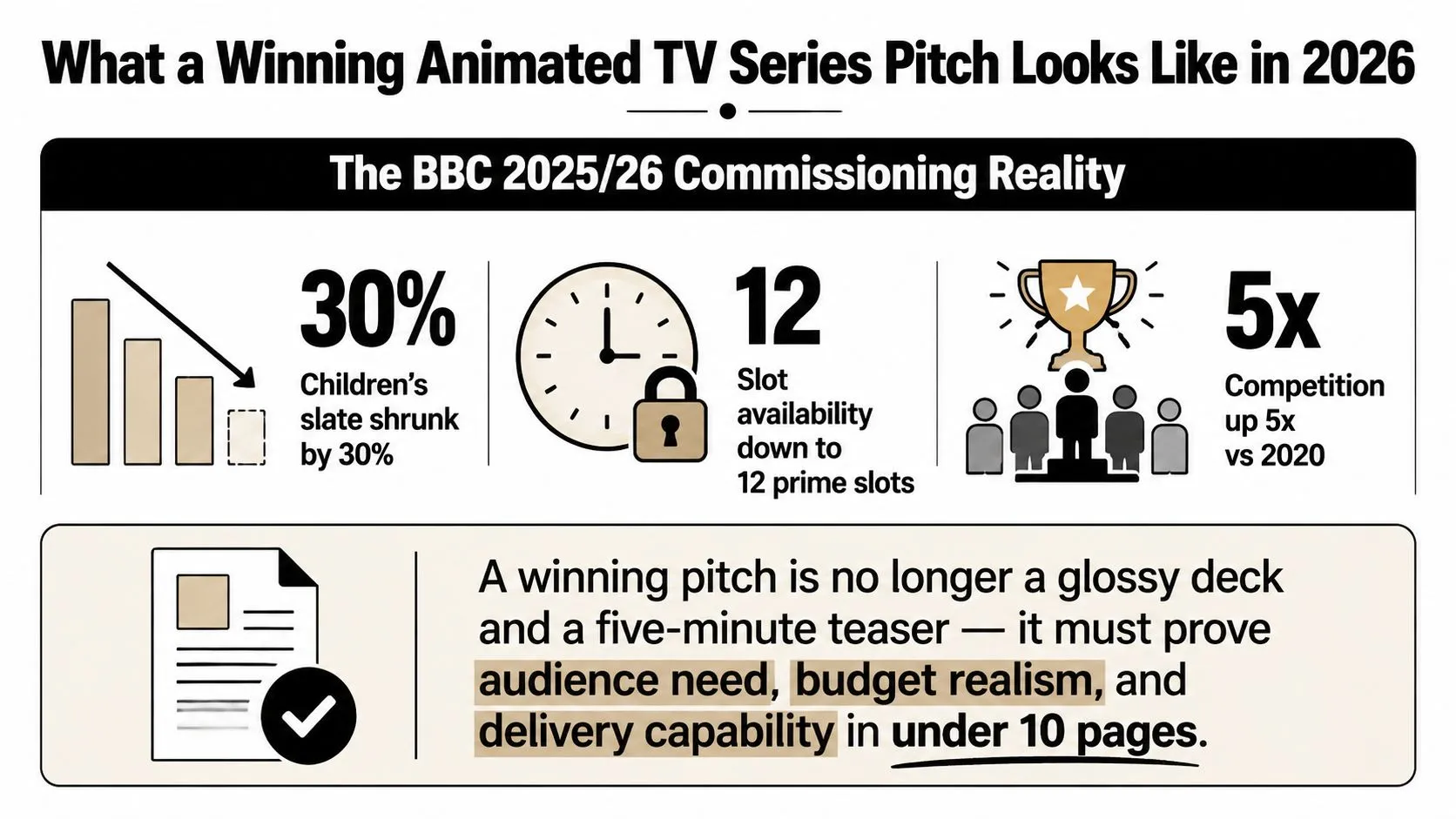
Use five risk checks:
- The enquiry must fit. State the audience, format and reason this buyer should want the project.
- The submission must be complete. Follow the requested route, provide the required metadata and make attachments easy to open.
- The project must sustain interest. Show the story engine, character relationships and repeatable episode potential.
- The production must feel plausible. Set out the technique, delivery assumptions, finance approach and relevant partners.
- The proof must earn its place. A script or short animatic should demonstrate voice, pacing and tone, rather than software capability.
Researching the Buyer Before You Write a Single Slide
A strong series can be rejected before its premise receives a fair hearing if it reaches the wrong buyer. Research is integral to the pitch itself. In a shrinking, opportunity-driven UK children's market, your first task is to identify where the project belongs. Start with the official route. The BBC asks UK independent producers to contact the relevant editorial lead before formal submission, then routes proposals through PiCoS. Use that sequence: pre-clear the fit, submit through the platform, then follow up through the appropriate channel. Keep the package light and easy to open. Administrative friction gives a busy team a reason to move on.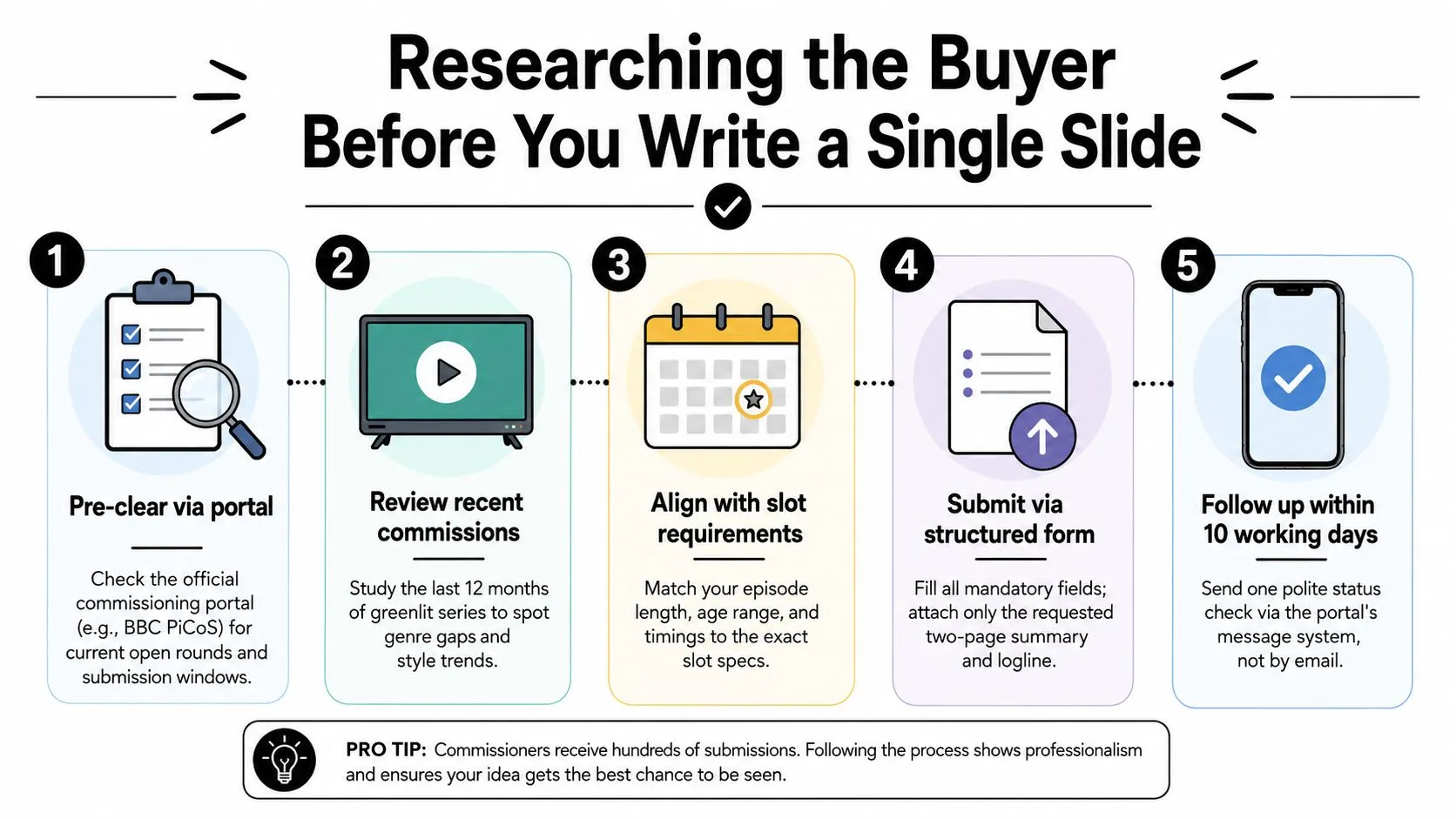 Build a buyer file before writing slides:
 - •Map the current slate: Identify the age bands, genres, formats and visual approaches already being commissioned.
- •Watch comparable programmes: Note the house tone, storytelling pace, humour level and degree of educational or public-service intent.
- •Find the editorial owner: Record the relevant commissioner or development lead, then check whether the project matches that person's remit.
- •Read the commissioning language: Terms such as “underserved audiences”, “international appeal” and “series potential” should shape your framing. They should not remain buried in a strategy document.
- •Confirm the route: Record the correct portal, contact sequence, required fields, file limits and requested format information.
This work may delay your first submission by a week. Sending the project to the wrong slot wastes more time, while a generic email forces the commissioner to work out why the idea belongs in their queue. Make the fit obvious before asking for a meeting. Give structured development opportunities particular attention. BBC Ignite Animation targets UK creators and producers through staged development. Coverage describes up to twenty ideas receiving first-stage funding, with further funding available at later stages. Its selection criteria include a fresh concept, audience relevance, value for underserved audiences, growth across a series and international appeal (BBC Ignite Animation coverage). Do not inflate the bible to chase every criterion. Show how the concept can become stronger through development, and package only the proof needed to demonstrate that path.
Writing a Logline and One-Pager That Survive a Thirty-Second Read
A commissioner scanning submissions between meetings should grasp the series before reaching the bottom of the first page. If the premise still feels vague, tighten the writing. In a shrinking UK children's commissioning market, a concise, broadcast-ready proposition has more value than a large visual reel that cannot explain the show. Write the logline in two sentences or fewer than forty words. Put the world and protagonist near the front, name the active conflict, then finish with the consequence or inciting image. Use verbs such as “escapes”, “builds”, “protects”, “investigates” or “hides”. Replace praise words such as “hilarious”, “ground-breaking” or “heart-warming” with actions that demonstrate the intended quality. A reliable pattern is:
In [specific world], [protagonist] must [active objective] when [disruptive conflict], but [obstacle or consequence] threatens [clear stake].
Keep the story engine ahead of broad theme language. “A celebration of friendship” describes an intention, not a series premise. “Three rival young inventors must repair the town's broken weather machine before every community celebration becomes a disaster” gives the reader a world, group dynamic and repeatable source of episodes. The one-pager must stay to one page without resorting to impossibly small type. Place the logline first, followed by format and length, audience, comparable titles, tone, character beats, episode structure and the timely hook. The page should make the commercial and editorial proposition clear while leaving deeper world and production detail for the series bible. Keep the format aligned with current broadcaster expectations (BBC children's commissioning guidance). Use the first read for clarity and the second for nuance. A sharp logline may simplify a layered concept, so let the body restore its emotional and thematic depth. Remove “hopefully”, “possibly” and “we think”. End with the image that makes the show tangible, then stop.
Building the Series Bible and Episode Outlines
A pitch bible is the document a commissioner keeps after the meeting. It shouldn't feel like a warehouse of ideas. It should function as a production and editorial reference that lets another person explain the project accurately when you aren't in the room. The Writers Guild describes an animation bible as a 5 to 20 page document covering characters, relationships, settings, world, themes and tone, and notes that bible development fees commonly start at £5,000 to £8,000 or more, depending on the work required (Writers Guild animation guidelines). Those figures aren't a production budget for every project. They're a useful reminder that a bible is professional development work, not decorative padding.
Start with the story engine
Open with a half-page overview that restates the logline in plain language. Follow it with the tone, world rules and the recurring mechanism that generates stories. If your characters solve a different community problem each episode, explain why new problems keep arriving and why these particular characters are forced to handle them. Character pages should combine visual anchors with psychological pressure points. A design sheet tells us what a character looks like. A useful character entry also tells us what they want, what they fear, how they behave under pressure and how their relationships create story. For the episode plan, use a season arc of 13 or 26 eleven-minute episodes where that format fits the intended buyer and slot. Prepare a concise outline for every episode, then write full scripts for only one or two flagship stories unless the commissioning route asks for more. BBC development requirements have included a short bible, a two-minute script, character designs and key background design at an early stage, followed later by a full pitch bible, another two-minute script, a two-minute animatic and an animated test (BBC Children's animation development call).
Make the appendix answer finance questions
Finish with animation style references, target age band, format compliance, delivery assumptions and a realistic per-minute budget band. Include schedule logic and finance dependencies. Paramount's UK production guide expects producers to provide a budget, schedule, finance plan and relevant agreements before commercial negotiations, with meetings before and after approval forming part of the process (Paramount UK production guide). Use a structured resource to build a story series bible, but don't let a template decide your storytelling. Character design deserves the same discipline as plot, and this guide to character design fundamentals is a useful reference when visual choices need to carry narrative information.
Decks, Animatics and Sizzle Reels Without Burning the Budget
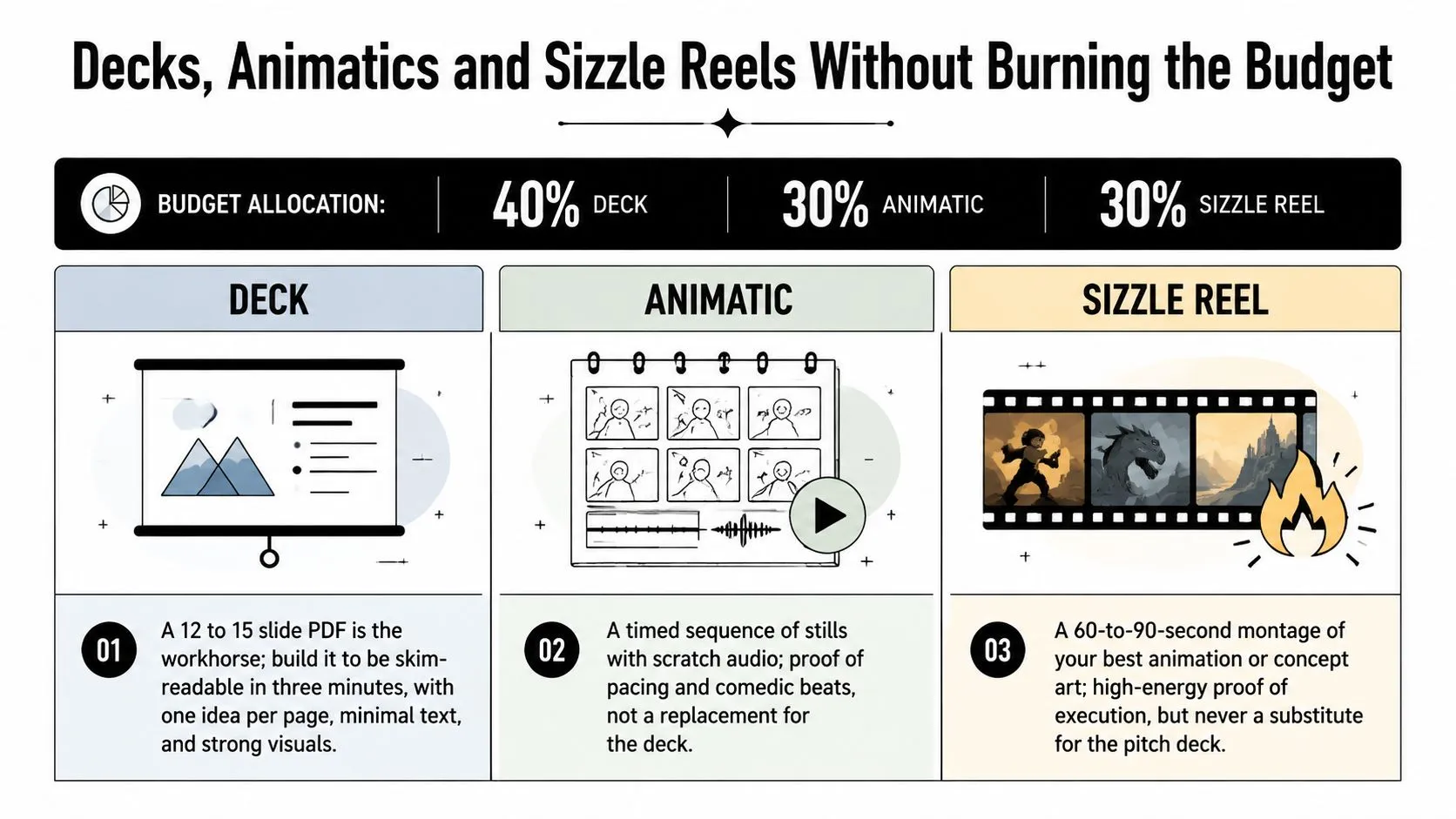
A concise deck gets the meeting started. Build a 12 to 15 slide PDF that a busy commissioner can skim in three minutes. Give each slide one job and attach one strong piece of evidence. A character frame, episode hook, visual rule or comparable title proves more than a paragraph claiming potential. In a selective UK children's market, clear packaging creates more opportunity than an oversized reel. A short animatic demonstrates timing, staging and comedic rhythm. Commission a 30 to 60 second sequence from the pilot's cold open, using storyboard panels, scratch dialogue and temporary sound where appropriate. Add a lead-character lip-sync test and two background animation tests if they answer a specific execution question. This scoped proof shows control without presenting a short clip as a finished episode.
| Deliverable | What it must prove | Main risk |
|---|---|---|
| Deck | Premise, audience, tone, format and production logic | Too much text or inconsistent design |
| Animatic | Pacing, staging, voice and story clarity | Spending before the concept is clear |
| Sizzle reel | Energy, finish and visual confidence | Turning the pitch into a montage with no story |
The infographic's percentage allocation is not a verified production rule. Costs vary with scope, team and finish level. Use it as a prompt for staging: strengthen the deck first, then commission motion proof that addresses a buyer's unanswered question. Commissioning guidance recognises that animatics can be useful but costly, so a large reel should not be your default first spend. A clean deck and short animatic can sit in the low thousands. Original music, complex editing and polished animation can push a sizzle reel up quickly. Keep the packaging broadcast-ready: consistent artwork, readable labels, clear format information and files that are easy to review. A bible should also earn its place through professional development work rather than decorative padding. Send the deck first. Offer the animatic after a meeting is booked, or when still images cannot prove timing and performance. Use a sizzle reel only when its energy and finish answer a real buyer need. For broader reel strategy, read this production guide for brands and studios.
Walking Into the Room and Handling the Finance Questions
Arrive fifteen minutes early. Bring three printed decks and a backup on a USB, but don't assume you'll control the presentation. Let the commissioner steer the order if they want to jump from the character page to the finance question. The opening questions usually test whether you understand the audience and the slot:
- •Who is it for? Give the exact age band and explain the viewing need, not merely the demographic label.
- •What is the week-one hook? State the repeatable promise that makes the first episode and the next episode feel connected.
- •Where does it sit? Explain how the project fits the CBBC or CBeebies slate, including tone, format and public-service value.
The second half exposes weak packaging. Buyers may ask about per-minute cost, delivery against PiCoS stages, OFCOM qualification and product placement rules. They may also test whether your proposed format can travel across broadcast, iPlayer and YouTube rights in a market where children's commissioning is increasingly selective. The Children's Media Foundation reports that UK PSB spending on children's content fell to £77m in 2024, more than 50% below 2002 levels, with original hours down by about 80% (Children's Media Foundation submission).
Keep finance on one page
Bring an A4 finance summary with the headline budget, international presales, confirmed commitments and the gap still to fill. Don't bring a thirty-page financial model unless someone has asked for it. The first document should help a commissioner understand the exposure and the route to closing it. If you don't know an answer, say so. Promise a written response that day, then send it. Guessing about compliance or delivery makes a small uncertainty look like a wider production-control problem. End by confirming the next action in writing. Name who sends the bible, which materials are included and the date they'll arrive. A meeting is not a result. A clearly owned next step is.
Protecting Your IP, Signing Agreements and Following Up
Protect the project before circulation, but don't confuse evidence of ownership with a substitute for legal advice. UK copyright arises automatically, and creators can create a dated record of the script, bible, artwork and development history. The US Copyright Office can add evidentiary weight, while ALCS or PRS for Music may provide useful logging routes for scripts and music-related material. Keep the practical file organised:
- •Create a dated package: Save the bible, pilot script, character artwork and development notes as stable files.
- •Use witnessed records: A solicitor can lodge the material on a dated, witnessed schedule.
- •Track contributors: Record who created each design, script, asset and piece of music.
- •Check character protection: Trademark questions depend on the mark and its use, so review character trademark eligibility tips with qualified legal counsel before investing in a brand strategy.
An option agreement isn't the same as a development deal. The commissioner may seek control while deciding whether to proceed, but you need to understand exactly what that control covers and when it ends. Don't sign away important rights without advice on the option fee, option term, renewal mechanics, underlying-rights reversion, sequel rights, format rights and credit.
Follow up with purpose
Send a written thank-you within twenty-four hours, confirming the points you understood and any promised materials. At four weeks, send a substantive update, such as revised character art, a clarified finance route or a stronger episode outline. At eight weeks, make a concise check-in, then move to a quarterly nurture rhythm if the project remains active but undecided. Avoid sending “just checking in” messages that contain no new information. A follow-up should make the project easier to remember and easier to assess.
The rule first-timers miss: Never let the conversation end without the next meeting on the calendar.
--- Studio Liddell helps creators turn early concepts into pitch-ready animated series packages, including character and world design, story development, animatics, trailers and final pitch bibles. Visit Studio Liddell to discuss the production scope, proof material and delivery plan your project needs before it reaches a UK buyer.