How to Choose an AI Video Production Company
You've got a script, a brand world that already has a look, and a date that won't move. The job might be a product ad, a children's short, or a film that has to explain a technical idea to a sceptical room. Searching for an ai video production company at that point isn't a hunt for a prompt box. It's a hunt for people who can finish the picture, the sound and the master. The UK already runs that kind of production economy. The British Film Institute reported in 2025 that film, high-end television and video games together employ more than 200,000 people and contribute an estimated £21 billion in gross value added. A specialist studio can add AI inside that established mix of animation, visual effects, television, games and immersive work, rather than treating the commission as a novelty.
What an AI Video Production Company Actually Delivers
A buyer usually arrives with three things already fixed: the message, the brand rules, and the day the film has to be usable. What they still need is a team that can turn those constraints into shots someone will approve. A tool-only vendor hands you generated clips and leaves the hard decisions with you. A studio still plans the film, designs the world, animates or assembles the scenes, reviews them, and delivers a master. AI sits inside that sequence where it shortens exploration or repetitive work. It doesn't replace the producer who has to say which version is the film. The same BFI and CoSTAR research, described as the first UK-wide look at generative AI across the screen sector, records early use rather than a forecast alone. A 2023 survey of 70 UK-based producers found that 17% had already used generative AI in production, while a further 40% planned to do so, as set out in the BFI's account of that research. Plenty of professional teams were still only preparing to adopt it. A proposal should not assume every client already runs the same workflow.
What belongs in the proposal
A useful proposal names the work, not the model.
- •Creative leadership: a director or lead who owns the story, the look and the cuts.
- •A named pipeline: storyboard, previs, animation or live action, lighting, edit, sound and checks, with AI marked only where it is used.
- •Human approval: gates before a look, a character or a claim is locked.
- •A finished asset: picture, sound and the file the platform or broadcaster needs.
If the film is heading for UK television, that last item is concrete. The BBC requires Network television programmes to be delivered as AS-11 DPP files, fully checked for picture, sound and clear dialogue before transmission, with audio as RIFF/WAV Linear PCM at 48 kHz and 16 bit or higher by agreement, under its delivery guidance. Teams who want a plain starting point for campaign films can read getting started with AI ad creation, then compare that with how a UK studio scopes a full job in this guide to video content production for UK businesses. You should leave the first meeting knowing who decides, where AI is allowed, and what file you will receive.
How AI Fits a Real Video Production Pipeline
A working pipeline is a sequence of decisions, not a single generate button. Each stage has a person who owns the judgement, and a short list of jobs AI may speed up.
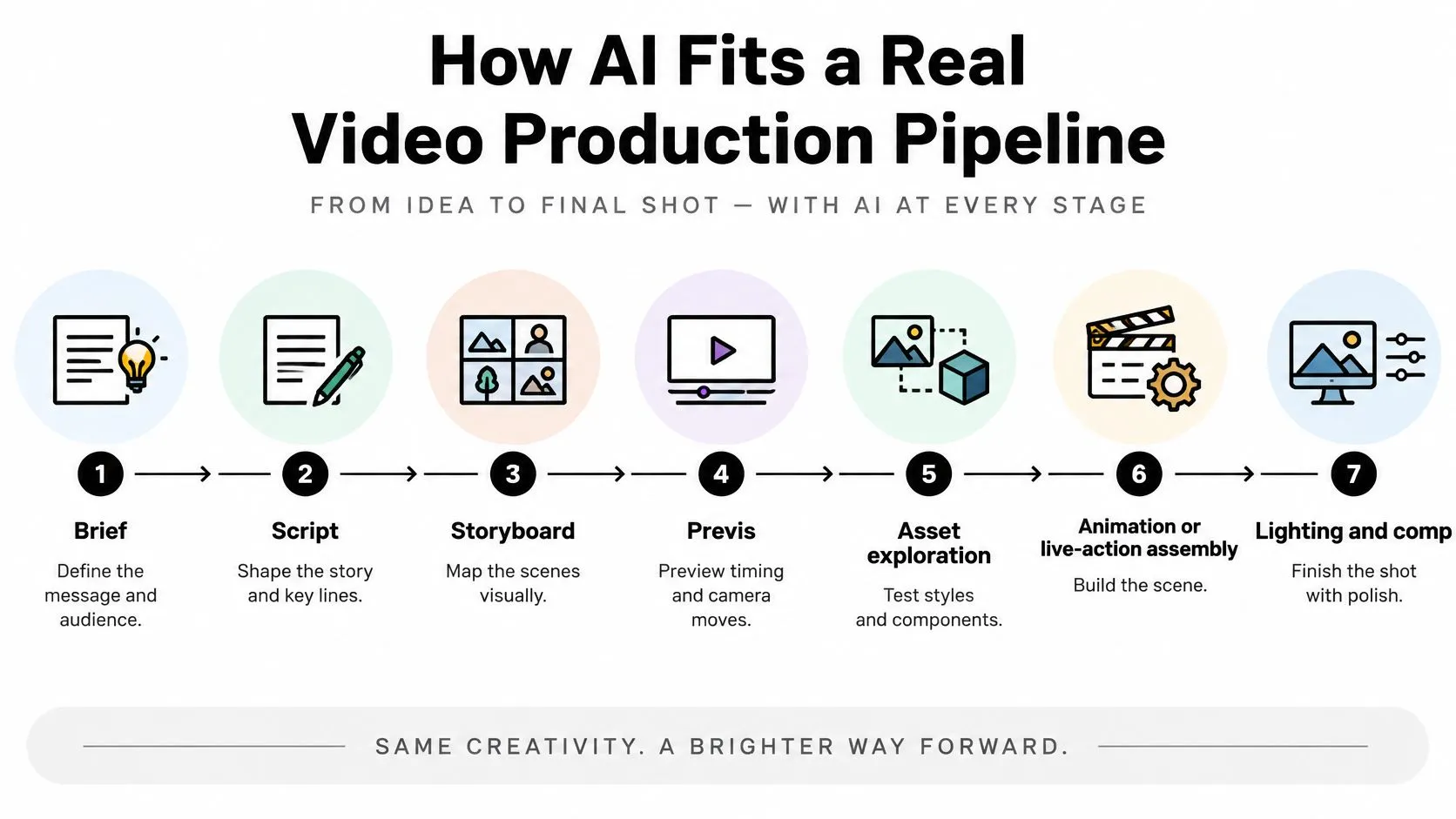
From brief to a reviewable scene
Brief and script. A producer and writer fix the audience, the claim and the lines that must survive. AI can offer alternate phrasings. It doesn't choose the argument. Storyboard and previs. Artists map scenes, timing and camera moves. Generated frames can supply extra storyboard options or background studies so stakeholders see a direction before expensive production time starts. This AI-powered video ad creation workflow is a useful contrast: software can draft variants quickly, while a studio still has to lock continuity. Assets, then assembly. Modelling, rigging, animation, or a live-action edit stays under conventional control when the client has never used AI. Generated material is for exploration, clean-up, rotoscoping, variant shots and tagging, not for an unreviewed final.
Why the review scene has to be stable
Real-time scenes in Unreal or Unity give directors a place to judge lighting, composition and environmental continuity while the camera is tracked. Parliamentary evidence describes the UK as arguably a global leader in virtual production, with expected growth of about 18.4% a year from 2024 to 2030, and notes that 60% of UK virtual-production companies and 54% of studios sit in London and the South-East. The same evidence records that only 9% of XR Stories and XR Network+ research projects explicitly addressed AI or machine learning, which is a useful warning in the written evidence on virtual production. The engines are mature. The AI layer is not. Before any generated shot is trusted, test temporal consistency, character identity, texture stability, camera tracking, latency, render cost and whether the file fits existing assets. If a character's face drifts between frame 40 and frame 41, the shot fails, however pretty the still was.
Practical rule: AI proposes. A specialist approves. The project log records which tool touched which shot.
A modular cut of this path is set out in the studio's animation production pipeline guide. Clients who want conventional 3D, editorial and visual effects to stay in charge can keep those stages human-led and use AI only on the steps they have tested.
Benefits and Limits of AI in Video Production
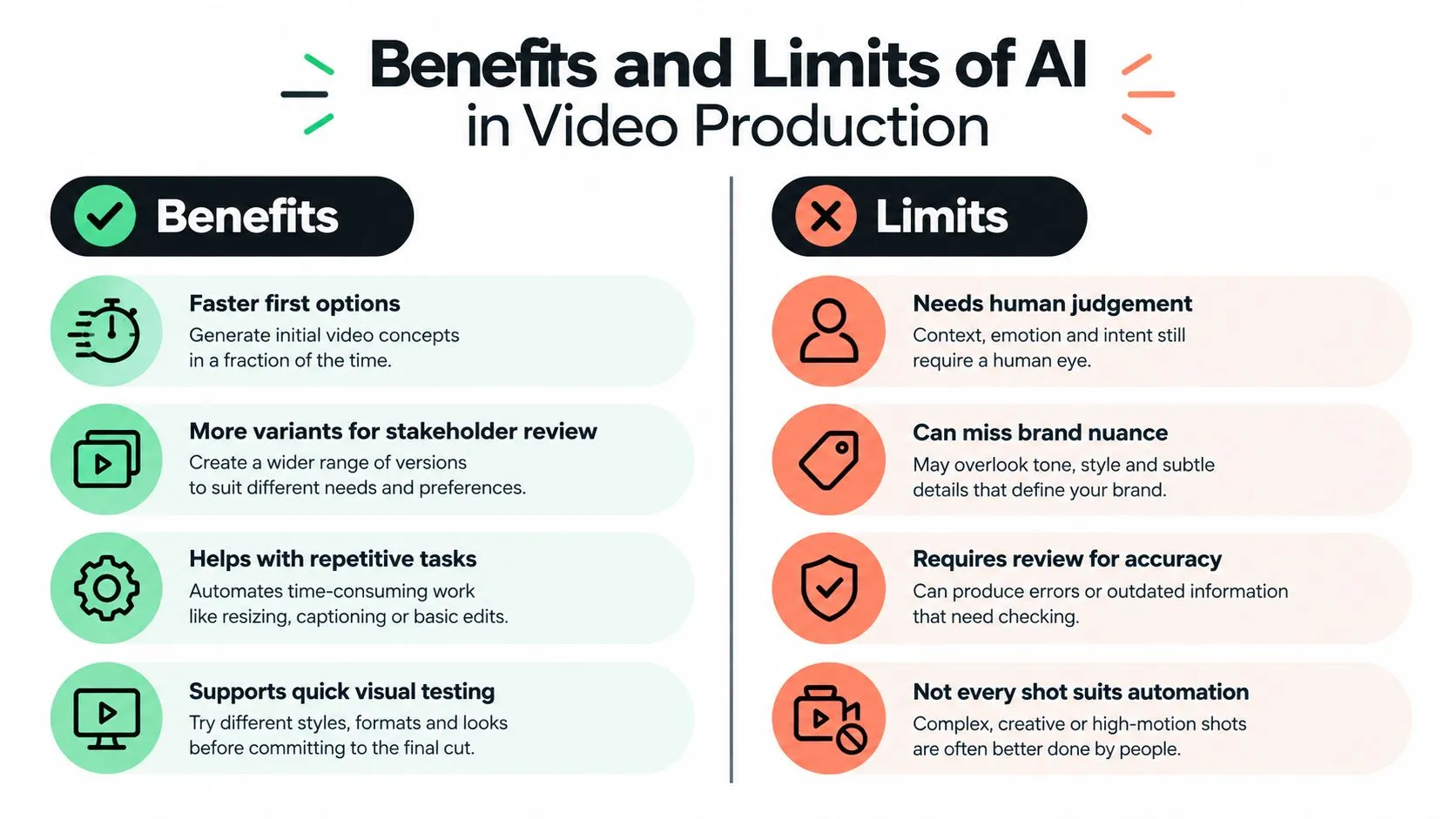
A team preparing a product advert can use AI to explore several backgrounds before commissioning the final shots. The benefit is faster exploration; the limit is that a person still needs to check every image against the product, the story and the intended audience.
Where the hours actually shrink
AI can produce early visual options for a stakeholder meeting, generate background variations, or help prepare social crops. It can also assist with repetitive clean-up, rotoscoping and simple asset tagging. These tasks can shorten parts of production, much like a rough sketch helps a director compare compositions before a set is built. The savings depend on the task and the review time. A generated background extra might break an eyeline. A product label might contain invented text. A child character's performance still needs an animator who understands acting and can keep it consistent from shot to shot.
Where human judgement remains
AI output is a proposal, not a finished production decision. A director or editor must judge whether a shot supports the story; specialists must check details such as product accuracy, performance and technical delivery. For example, a generated pack shot that changes the shape of a bottle may be unusable, even if its lighting looks convincing. The right question is which specific tasks AI can handle under review, and which decisions need a named person to approve them. A list of generators can help teams test tools, but it cannot replace a production process. This round-up of free AI video generator tools can support early experiments, while a finished master still needs creative and technical checks.
How to Choose an AI Video Production Company
The technology question is settled once you know what AI can and can't hold. The supplier question is whether this team has finished work like yours, and whether they can explain the gates in writing.
| Decision test | Weak answer | Strong answer |
|---|---|---|
| Showreel relevance | A montage of unrelated generated clips | Finished series, ads, games or immersive pieces in your category |
| Pipeline evidence | "We use AI throughout" | A stage list with AI marked, and human sign-off named |
| Creative direction | A prompt operator and a shared inbox | A director or lead who can reject a shot |
| Rights handling | "The tool's terms cover it" | Disclosures, licences, consent and a chain of title |
| Engine experience | No real-time or 3D path | Unity or Unreal where interaction or previs needs it |
| Delivery | A folder of mp4s | The master, edits, and responsibility for the agreed spec |
Read a promise of automation against evidence. A children's series needs continuity across episodes. A technical film needs reviewers who can spot a wrong diagram. An event piece needs throughput, not just a pretty trailer.
A UK studio you can score against the tests
Studio Liddell is one concrete option to put through that table, not a default winner. It is a full-service creative digital studio established in 2019, working across 3D and 2D animation, CGI for film and television, multi-episode series, advertising, games, XR and AI-enhanced production, with Unity and Unreal experience. Clients associated with that work include Sky Kids, BBC, Nat Geo, Merck and Manchester United, alongside others such as Nelvana, Digitas, TT Games and Historic Scotland. Match the brief, don't collect logos.
- •Children's brands suit a studio that has carried an IP across episodes and shorter digital pieces, because identity and safeguarding don't reset each week.
- •Technical explanation suits teams used to stakeholder review, where a wrong visual costs more than a slow render.
- •Events and training suit real-time experience, where interaction, staffing and deployment matter as much as the picture.
If a pitch can't show where a specialist still decides, you are buying software with a producer attached in name only.
Score fit. A studio that is excellent at volume social cuts may be the wrong room for a broadcast series, and the reverse is also true.
Rights Provenance and UK Advertising Rules
A faster render doesn't tell you what you own. An "AI" label doesn't make an advertisement true. UK clients, especially brands, broadcasters, universities and agencies, need a chain they can defend if someone challenges the film.
What you can own, and what can still infringe
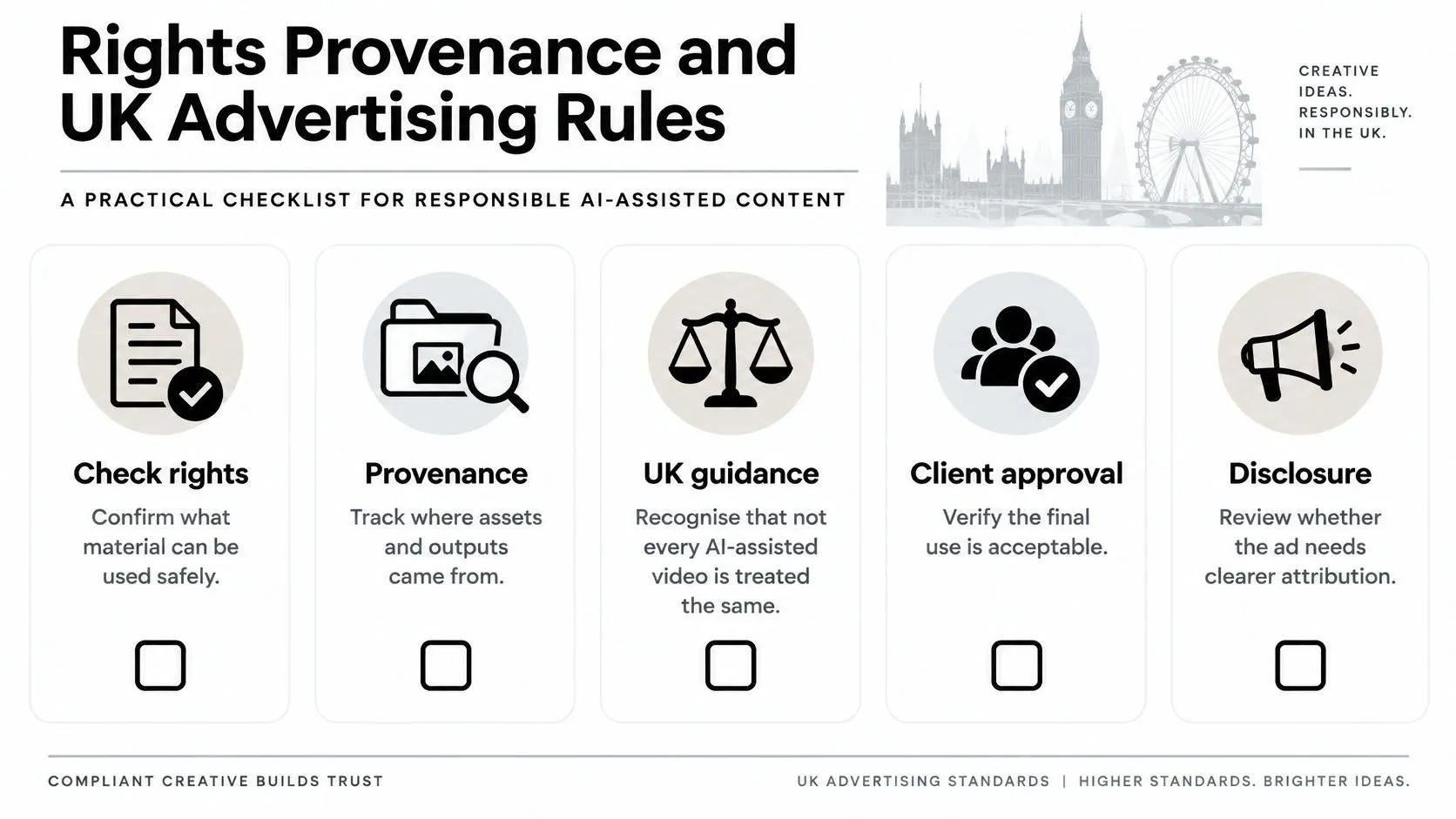
The UK Government states that AI output can receive copyright protection depending on how it is created, and that AI-assisted works with human creativity remain protected. It also warns that AI-generated content can infringe copyright if it reproduces a substantial part of a protected work. Current UK copyright offers only a narrow text-and-data-mining exception for non-commercial research, while proposed rules for commercial training remain contested. Those points are set out in the Government's copyright and artificial intelligence consultation. Don't treat a consultation as a settled commercial licence. Ask for a pack, not a slogan.
- •Chain of title: who made the creative choices, and who assigns the finished film.
- •Tool disclosures and provenance: which model or service touched which asset.
- •Licensed references: nothing scraped in as a "style of" a living artist or a rival brand.
- •Performer and likeness permissions: including voice, if a real person is imitated.
- •Editable project records: so a later version isn't trapped inside one vendor's export.
Disclosure is not the compliance control
The Advertising Standards Authority says there is no blanket UK requirement to disclose AI use in advertising. CAP and BCAP rules apply however an ad was generated, edited or targeted. Disclosure will not cure a misleading claim, a fake testimonial, or a person or event shown inaccurately. The ASA reported scanning 60 million online ads in 2025 with its AI-driven monitoring, and confirmed that UK rules cover ads made with AI, ads for AI, and ads placed in AI-based products, in its note on disclosure of AI in advertising. Rotoscoping or background clean-up is a production technique. A synthetic presenter, a simulated product demonstration, altered news-style footage or a cloned voice can change what the audience believes. The approval pack should record consent, the evidence behind factual claims, and who carries responsibility if a third party challenges the film.
Sample Workflows for Ads Explainers and XR
Three commissions show how the same gates change shape. Your job will sit closer to one of them than to a generic "AI video".
A brand film
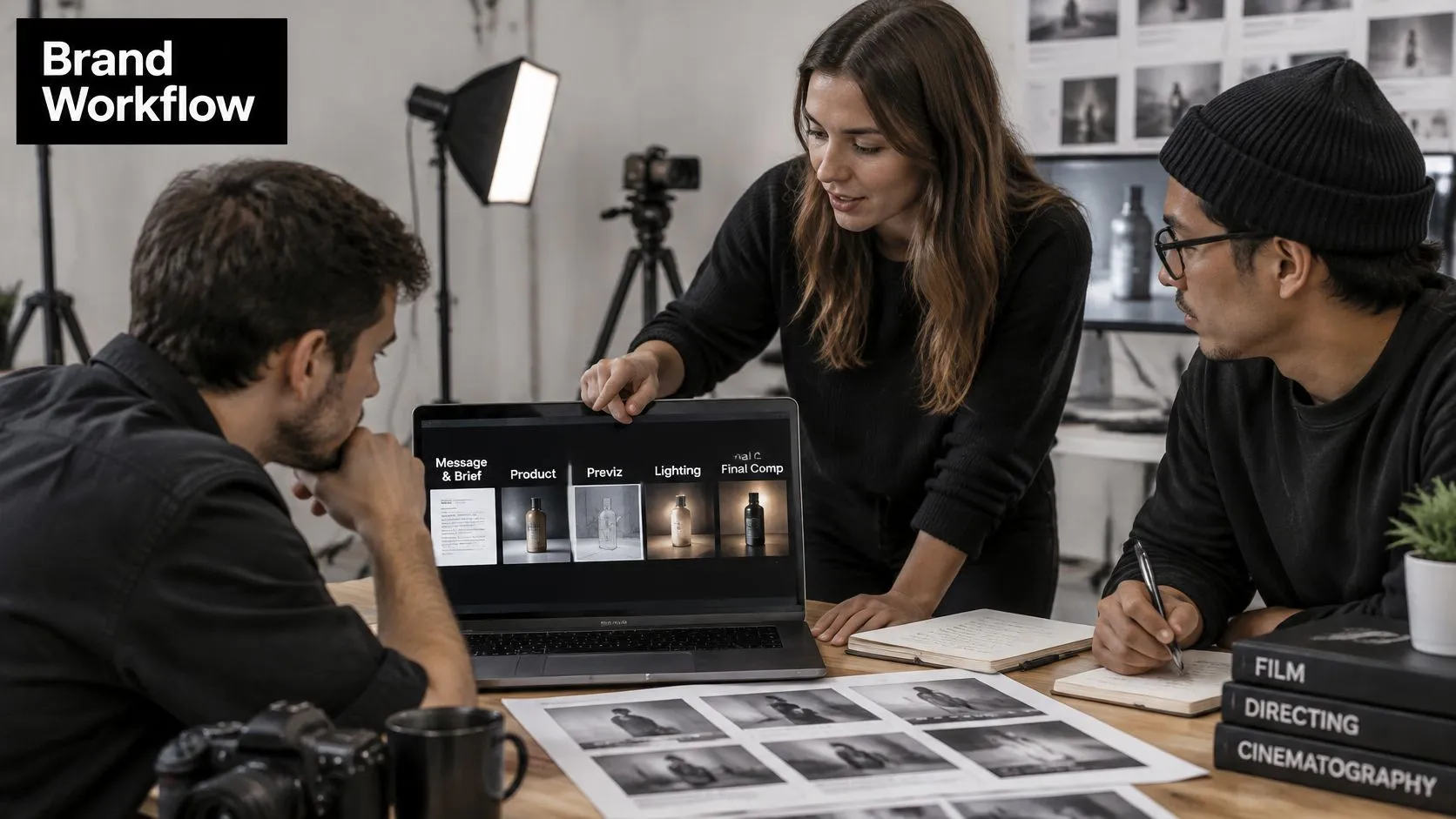
Start with the message and the product proof, not the look. Early visual alternatives can be generated so a marketing lead can reject a colour, a set or a camera height cheaply. Art direction, licensed assets and claims lock before animation or compositing. If a line says the product does something, that line needs evidence in the approval pack, not a prettier render. Tools that automate URL to video conversion can turn a page into a rough cut for internal sense-checking. They don't replace the lock on claims, logos and usage rights.
A complex-technology explainer
Build a message ladder: one idea per scene, in an order a non-specialist can follow. Choose metaphors that don't smuggle in a wrong mechanism. Check captions, contrast and pace for accessibility, and keep the technical reviewer in the cut, not only at the end. GeoEnergy NI is a useful reference for this shape of job: technical explanation aimed at stakeholders, where the visual strategy has to survive iteration, not just look impressive in a still.
An event, training or mixed-reality piece
Here the picture shares the brief with interaction. Unity or Unreal carries scene assembly and review. You also plan throughput, staffing and how the piece is deployed on a stand, in a venue or as an app. Published proof points show the range without invented results. BooSnoo for Sky Kids is an IP moving across episodes and digital shorts. Dance! Dance! Dance! is a high-throughput mixed-reality game built for events. Aurora is a VR short taken from script through to spatial sound. None of these is a prompt pasted into a generator. Each is a directed production with a different first question: identity across episodes, players per hour, or story in a headset. Bring that first question to the treatment. A brand film asks "what must the viewer believe?". An explainer asks "what must they understand?". An XR piece asks "what must they do, and how many people can do it in the time we have?".
Book a Production Scoping Call
You now have four tests. You need a team that finishes a film, not a tool you have to operate. You need named human approval points. You need evidence that matches the brief, whether that is a series, an ad, a game or an immersive piece. You need a written position on rights, provenance and advertising claims. Before the call, gather a short pack.
- •Story: the script or deck, plus the one line the film must land.
- •Audience and runtime: who it is for, how long it runs, and where it will be seen.
- •Assets and term: logos, product references, existing footage, and how long you need to use the master.
- •Constraints: broadcast delivery, captions, safeguarding, or a technical reviewer who must sign the picture.
On that call, ask whether the job needs 2D, 3D, motion graphics, real-time or XR production, and where AI is appropriate rather than fashionable. You should leave with a scoped route, the review stages, and a list of materials you still have to supply. That is a production decision. It isn't an invitation to "explore AI" with no owner and no master. --- Studio Liddell builds AI-enhanced animation, CGI, games and XR as a controlled UK production pipeline, with human approval, provenance and a deliverable master rather than a pile of generated clips. If you have a script, a brand world and a date, a production scoping call is the practical next step. Visit Studio Liddell and bring the pack above so the studio can say which route fits.