Grand Theft Auto GTA 6: Latest News & Updates
The most revealing GTA 6 data point in the UK isn't the hype. It's the contradiction inside the hype. The UK leads global GTA 6 search intensity with a perfect score of 100, yet nearly 50% of UK gamers are unlikely to purchase the game, according to a Statista-YouGov survey highlighted by GTA6Hype's analysis of UK search intensity and purchase hesitation. That gap matters because it changes how we should read every trailer, pre-order headline, and technical leak. Interest is abundant. Confidence is uneven. Some players are tracking every update because Grand Theft Auto is a cultural event. Others are watching carefully before they commit, weighing platform access, pricing, online rules, and whether the game will justify its place as the biggest release on the calendar. For educators, developers, and creative teams, GTA 6 is useful far beyond fandom. It's a live example of how blockbuster games are positioned, how next-generation hardware shapes design decisions, and how audience attention can surge faster than audience trust. If you teach game design, it offers a clean case study in worldbuilding, production scale, and marketing language. If you work in animation or XR, it opens a different question: how do you turn intense curiosity into understanding? Think of GTA 6 as a very large machine with several visible layers. One layer is official information: release date, platforms, editions, and trailer messaging. Another layer is technical expectation: storage, lighting, performance targets, and platform optimisation. A third layer is audience psychology: why players search, speculate, share, and still hesitate. That third layer is where many creative opportunities sit.
Introduction to Grand Theft Auto GTA 6
Grand Theft Auto GTA 6 sits at the intersection of entertainment, hardware, and public expectation. That's why it's worth studying slowly rather than reacting to each new rumour in isolation. When students first examine a major game launch, they often focus on the loudest elements, usually trailers or map speculation. The stronger habit is to separate what's confirmed, what's inferred, and what's still promotional fog. A useful classroom analogy is film production. A teaser trailer doesn't tell you the whole story. It tells you what the studio wants you to feel first. With GTA 6, that feeling has centred on place, character chemistry, and technical polish. The name Leonida, the return of Vice City, and the focus on Lucia and Jason aren't random details. They're the frame around the entire release.
Why the UK reaction is especially interesting
The UK response shows how attention and intent can diverge. People can be thoroughly engaged with a game's rollout and still hold back from buying. That can happen for simple reasons.
- •Platform friction means some players don't own the right hardware yet.
- •Price sensitivity matters more when a major title enters the upper end of AAA pricing.
- •Trust questions often appear when a launch is huge, heavily marketed, and discussed for years before release.
- •Online access concerns can make players cautious if they expect new compliance steps or account hurdles.
Practical rule: When search interest rises faster than purchase intent, the audience usually needs explanation, not more noise.
That's why GTA 6 is such a strong teaching example. It shows that a blockbuster doesn't just need spectacle. It needs clarity. Players want to know what they're buying, where they can play it, what kind of experience they're getting, and whether the friction around access is worth it.
How to read GTA 6 like a designer
If you're approaching this as a game design professor would, start with four lenses:
| Lens | What to examine | Why it matters |
|---|---|---|
| Release design | Timing, editions, platform exclusivity | These shape audience reach and early adoption |
| Narrative framing | Protagonists, setting, tone | This determines emotional identity |
| Technical design | Hardware targets, storage, rendering ambition | These constrain and enable features |
| Market interpretation | Search behaviour, hesitation, speculation | This reveals where communication is weak |
That framework makes GTA 6 easier to understand. It also makes it easier to spot opportunities for explainers, visualisation projects, and XR concepts built around the game's rollout.
Official GTA 6 Announcements and Trailers
The clearest official anchor is the launch information. Grand Theft Auto VI is officially scheduled to launch in the UK on Thursday, November 19, 2026, available exclusively on PlayStation 5 and Xbox Series X|S, with no confirmed PC or Nintendo Switch 2 release at launch. The standard edition is priced at £69.99 in the UK, while the premium Ultimate Edition costs £89.99, as reported by GB News on the UK launch date, platforms, and pricing. Those details do more than confirm availability. They define Rockstar's communication strategy. The message is narrow, controlled, and platform-specific. Instead of opening on every device category at once, the release is tied to current-generation consoles. That immediately tells us something about expected fidelity and production ambition. Rockstar wants the conversation anchored in hardware capable of supporting a dense, high-spec open world.
What the official messaging is doing
When students analyse trailers, I ask them to identify the “promise layer”. That's the layer where a publisher says, indirectly, what kind of experience you should expect. With GTA 6, the official presentation has leaned on a few promise signals:
- •Location as identity. Vice City returns as a recognisable cultural magnet.
- •Character pairing. Lucia and Jason suggest a relationship-driven structure rather than a lone antihero frame.
- •Atmosphere over systems. Early messaging emphasises mood, world texture, and social energy more than detailed feature breakdowns.
- •Platform confidence. Console-first launch language tells players where Rockstar wants the best first impression.
This is common in premium game marketing. Studios rarely explain the full system architecture in their first wave of communication. They sell emotional coherence first, then mechanical detail later.
How creatives can learn from the trailers
A trailer doesn't only advertise gameplay. It teaches the audience how to look at the game. Rockstar's official materials have treated GTA 6 as a world to observe before it becomes a world to master. That ordering is important.
Strong reveal campaigns often introduce environment, then character, then capability. They don't dump every mechanic on screen at once.
For animation and XR professionals, that sequencing is instructive. If you're building a concept trailer, immersive teaser, or visual explainer around a high-interest property, don't start with feature overload. Start with place. Then motion. Then interaction. Rockstar's rollout shows how powerful that hierarchy can be when a world has enough personality to carry it.
GTA 6 Confirmed Features and Platforms
The firmest confirmed gameplay-adjacent details sit around who players follow and where they play. Rockstar's narrative framing centres on Lucia and Jason in Leonida, with Vice City returning as the primary urban anchor. Even before a full mechanics breakdown, that tells us a lot. Dual-character storytelling usually creates contrast in rhythm, motive, and mission design. One protagonist can pull the player into risk. The other can shape restraint, loyalty, or escalation.
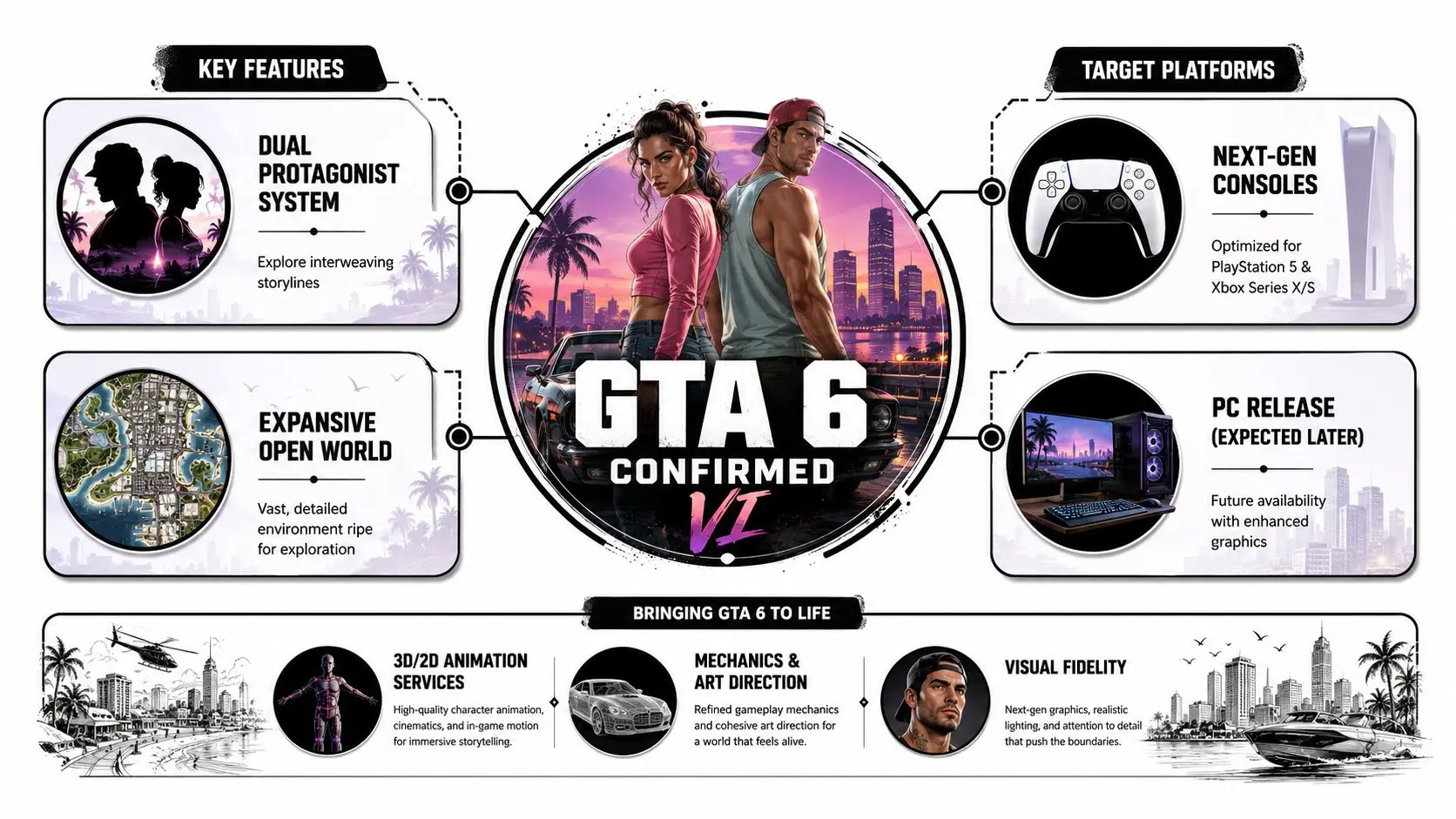
Grand Theft Auto VI is confirmed to launch on November 19, 2026, exclusively for PlayStation 5 and Xbox Series X/S in the UK, with no official PC version announced at launch. The standard edition is priced at £69.99, while the Ultimate Edition costs £89.99, inclusive of extra in-game assets, according to The Independent's GTA 6 UK pre-order guide.
What's confirmed in practical terms
Players often ask whether “confirmed” means a feature has been thoroughly documented. It doesn't. In game analysis, confirmation can be light but still meaningful. We know enough to identify the production and design direction. #### Narrative confirmation Lucia is the franchise's first playable female lead, paired with Jason, in a story set in Leonida. That matters because it shifts the dramatic centre of the series. Instead of reading the game through one dominant point of view, audiences are primed for interlocking motivations and alternating dramatic pressure. #### Platform confirmation The launch is tied to PlayStation 5 and Xbox Series X|S. No official PC launch version has been announced. That shapes everything from rendering assumptions to audience onboarding. A console-only launch simplifies the optimisation target and narrows early performance variables. #### Commercial confirmation The standard and Ultimate editions signal the familiar modern publishing model: a baseline purchase and a premium path with additional in-game content. That's useful to note not because it's unusual, but because it feeds the trust gap. Some players read edition structure as choice. Others read it as pressure.
Why these details matter to game educators and creators
A game's platform list is a design clue. If a title skips a launch-day PC version, analysts and educators should immediately think about consistency. Consoles give developers a tighter hardware envelope. That often supports more predictable asset quality, lighting targets, memory planning, and streaming behaviour. Here's the useful breakdown:
| Confirmed area | Design implication | Creative takeaway | |
|---|---|---|---|
| Lucia and Jason | Paired perspective and relational storytelling | Strong material for character studies and previz | |
| Leonida and Vice City | Regional identity with a recognisable city anchor | Rich spatial storytelling opportunities | |
| PS5 and Xbox Series X\ | S only at launch | Focused optimisation target | Cleaner assumptions for visual demos |
| Standard and Ultimate editions | Tiered purchase structure | Useful for analysing audience trust and value perception |
For anyone building companion content, the lesson is simple. Don't only talk about hype. Talk about framing. GTA 6 is being framed as a world with strong identity, a duo with dramatic tension, and a launch shaped around current-generation console capability.
GTA 6 Rumors and Release Timeline
When a game becomes this large in public imagination, rumour stops being background noise and becomes part of the event itself. The challenge is learning how to rank information. I teach students to sort reports into three bins: official, analyst-backed, and speculative. GTA 6 has examples of all three.
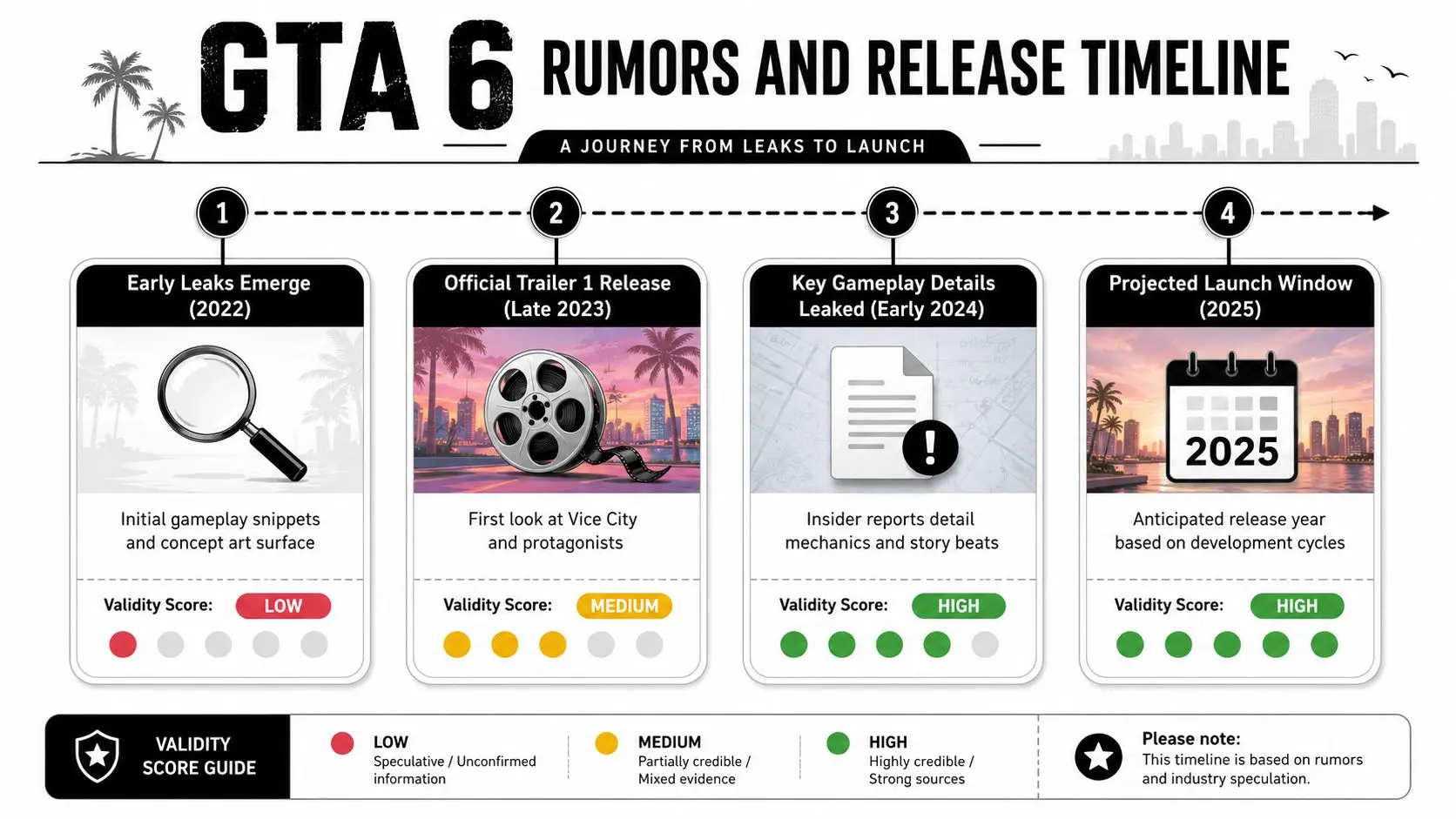
One of the strongest analyst-backed signals is commercial momentum. Analysts estimate that GTA 6 pre-orders have already surpassed 39 million units worldwide, generating over $3 billion in revenue ahead of its November 2026 launch, with reports indicating around $260 million in pre-orders during the first week of availability, as outlined by RockstarIntel's report on GTA 6 pre-orders and launch projections.
How to sort the timeline
A coherent GTA 6 timeline isn't just a list of dates. It's a ladder of confidence. #### Early leak phase This stage introduced broad public awareness that Rockstar's next Grand Theft Auto had a visible shape. Leaks and fragments usually do two things at once. They reveal something real, and they distort how people imagine the final product. Early material can expose tone, geography, or character direction without giving a stable view of polish. #### Official reveal phase Once Rockstar formalises a title, setting, or launch target, the discussion changes. The audience no longer debates whether the game exists in that form. It starts debating scale, quality, and missing details. At this point, rumours become more dangerous, because they attach themselves to real confirmed anchors. #### Commercial acceleration phase Pre-orders change the timeline again. They tell us the game is no longer just an object of curiosity. It's an economic event. That doesn't validate every rumour, but it does explain why the rumour ecosystem intensifies. More money in motion means more commentary, more opportunism, and more interpretation.
Treat rumours like greybox level design. Some walls will stay. Many surfaces will change before final art and final rules are applied.
The details that seem to carry the most weight
Some reported elements are more structurally believable because they align with Rockstar's official framing and wider industry logic.
- •Lucia and Jason fit the visible narrative direction.
- •Leonida and Vice City fit the setting language already associated with the game.
- •Console-first release logic fits the confirmed platform strategy.
- •Large-scale launch expectations fit the scale of pre-order reporting and franchise history.
What should readers avoid? Specific “feature lists” from unverified social posts that sound too neat. Real game development is messier than fan wishlists. Reliable signals tend to arrive as broad patterns, not perfect bullet-point manifests. For marketers and XR teams, the smartest move is timing. Build around confirmed milestones, not viral claims. Rumours are useful as mood indicators. They're poor foundations for production schedules.
Comparing GTA 6 to GTA V
The easiest bad comparison is “GTA 6 is bigger than GTA V.” That may prove broadly true in feeling, but it doesn't teach much. Better comparisons look at design intent. GTA V presented a satirical, multi-character crime drama built around a defined city-region fantasy and the technical limits of its original hardware moment. GTA 6 appears to push harder on social density, environmental detail, and intimate dual-character framing.
World and atmosphere
GTA V's Los Santos was designed as a broad parody machine. It invited the player to bounce between spectacle, absurdity, and open-world systems. GTA 6's Leonida and Vice City framing seems more tuned to texture. The visible emphasis is less “look how much chaos fits here” and more “look how alive and observant this place feels”. That distinction matters. A world can feel larger not because it is mathematically larger, but because it has more readable micro-behaviour. Crowds, lighting, ambient motion, and scene composition can all alter perceived scale.
Character structure
GTA V used multiple protagonists to create tonal variety through separation. GTA 6's Lucia and Jason pairing suggests something more relational. Instead of switching among distinct criminal archetypes for contrast alone, the drama may rely more heavily on connection, dependency, and consequence. Here's a useful comparison frame:
| Design area | GTA V tendency | GTA 6 apparent direction |
|---|---|---|
| Tone | Satirical spread across many social targets | More intimate and place-driven presentation |
| Character use | Multiple viewpoints for variety | Dual-protagonist chemistry as a narrative core |
| Visual emphasis | Large-scale urban parody and action | Denser world texture and environmental realism |
| Hardware moment | Cross-generation legacy | Current-generation console focus |
Rendering expectations
Many readers really mean visual fidelity when they ask how GTA 6 compares to GTA V. That's where art direction and technical ambition meet. Modern audiences notice lighting response, material behaviour, character surfaces, and crowd plausibility faster than they notice abstract engine terminology. A helpful companion read on that side of the craft is this guide to photorealism in games and lifelike rendering techniques.
GTA V often sold scale through breadth. GTA 6 appears to sell it through density.
That's a meaningful shift for creators. If you're preparing pitch decks, trailers, or visual studies inspired by next-generation open worlds, the target isn't just bigger maps. It's richer local detail, more convincing materials, and stronger behavioural cohesion.
GTA 6 Gameplay and Technical Advances
The most interesting technical conversation around GTA 6 is not “Will it look good?” It almost certainly will. The deeper question is what kind of production assumptions sit underneath that visual quality. Current discussion points toward a demanding asset footprint, strong lighting ambition, and hardware expectations that place the game firmly in contemporary high-end territory.
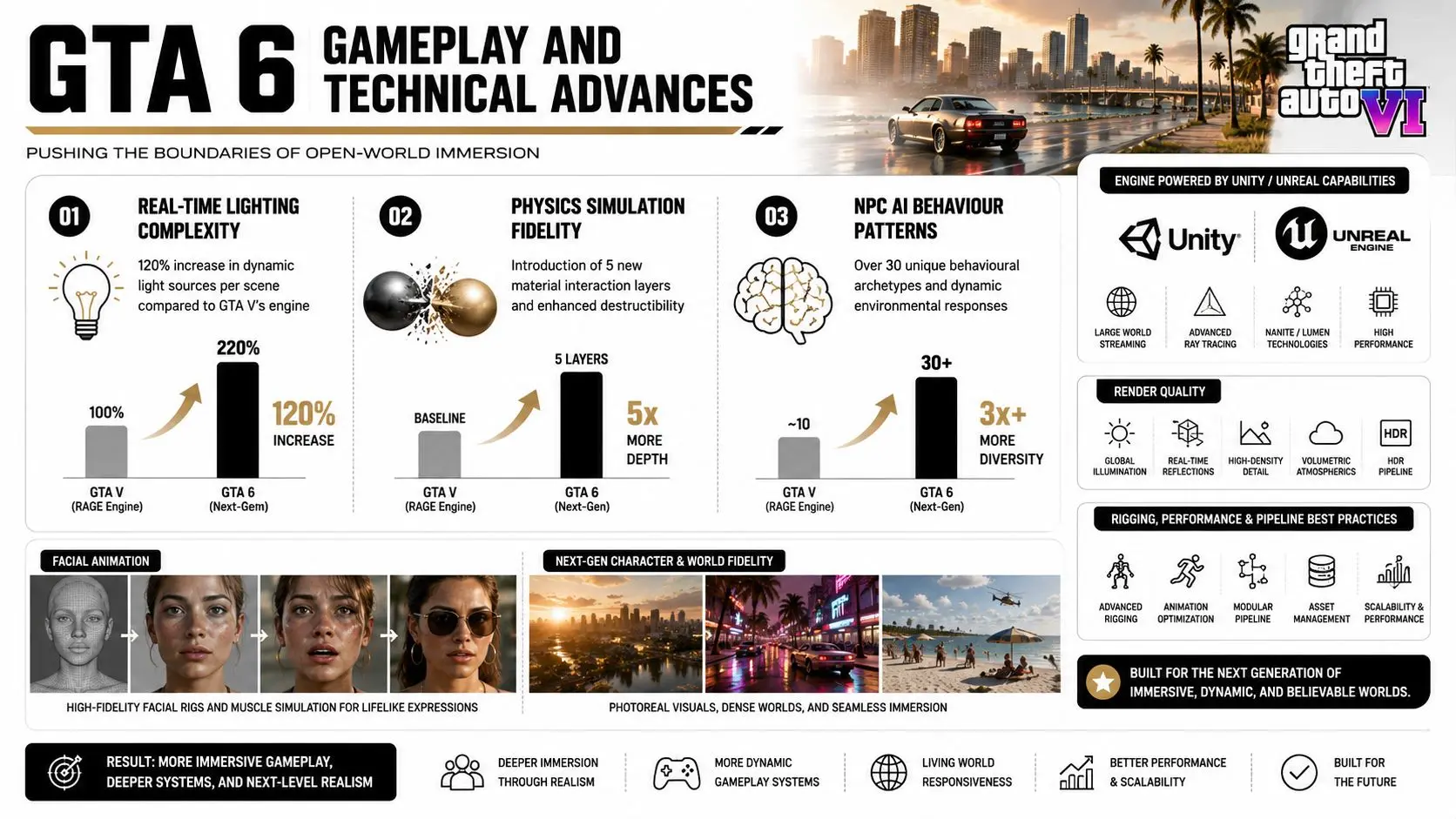
Although official PC requirements haven't been published, there are grounded estimates. Expert estimates suggest a minimum UK-relevant configuration of an NVIDIA GeForce RTX 3060 or AMD Radeon RX 6700 XT with 16 GB RAM and a 150 GB NVMe SSD, while recommended performance targets an RTX 3080 or RX 6800 XT with 32 GB RAM, based on XD Deals' summary of estimated GTA 6 PC requirements and hardware expectations.
How to read those hardware estimates
Students often see a GPU list and stop there. Don't. The more revealing line is the storage assumption. A 150 GB NVMe SSD estimate points to a game that likely depends on fast streaming, large assets, and rapid world delivery. In plain language, that means the world probably isn't built to politely wait for slow storage. The RAM estimates matter for a different reason. Moving from 16 GB to 32 GB in the recommended tier suggests a game expected to juggle substantial environmental, simulation, and rendering overhead. That doesn't prove any single feature, but it does reinforce the idea of a dense production target.
What that means for gameplay feel
Technical advances only matter if they change what the player feels. GTA 6's likely gains are easiest to understand through sensation:
- •Lighting quality affects mood, time-of-day identity, and the credibility of interiors versus exteriors.
- •Fast storage affects traversal rhythm. When loading friction drops, the city feels more continuous.
- •Higher memory headroom supports denser scenes, more detailed surfaces, and more stable systemic layering.
- •Stronger GPU targets allow richer materials, more screen complexity, and cleaner visual responses during motion.
A useful way to think about it is architectural. GTA V already gave players a large building. GTA 6 seems designed to furnish more rooms, polish more surfaces, and make transitions between spaces feel less staged.
Why this matters for XR and previs pipelines
Creative teams studying GTA 6 should pay attention to pipeline logic as much as player-facing features. A game that demands substantial storage and current-generation rendering assumptions rewards workflows that test fidelity early. Previsualisation, look development, and optimisation can't be left to the end. For studios building adjacent experiences, engine choice and production discipline are critical. Teams working in real-time environments can borrow useful production thinking from this breakdown of the GTA 6 release, features, and tech considerations.
If a world depends on fast streaming and high material richness, your prototype should test environment density before you test cosmetic polish.
That advice saves time. It also stops teams from building shiny but misleading demos. GTA 6's technical profile suggests that the “feel” of place comes from systems working together, not from one spectacular asset dropped into an empty scene.
GTA 6 Industry Opportunities for Creative and XR Studios
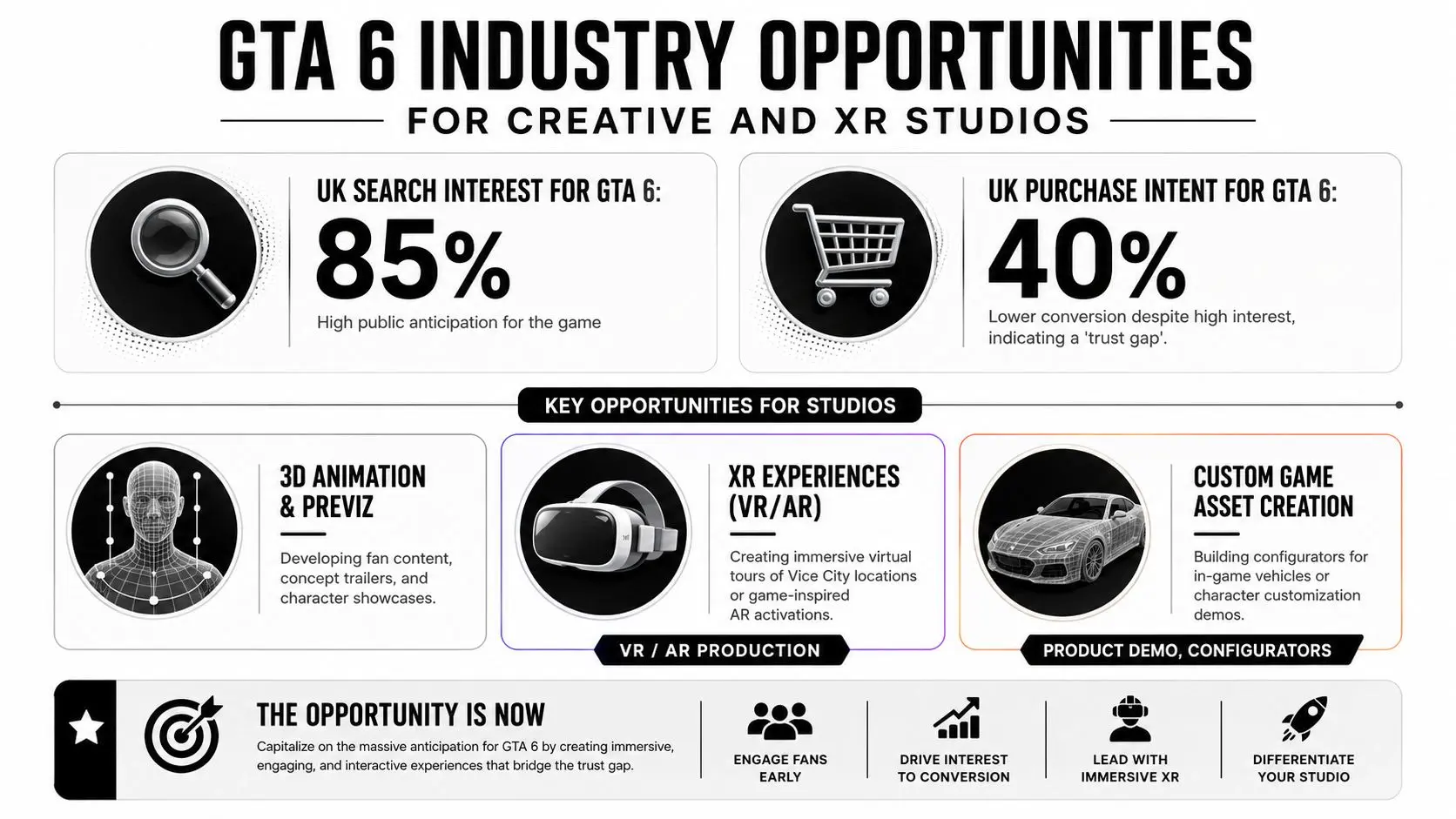
Nearly half of UK gamers say they are unlikely to buy GTA 6, even while interest remains unusually high. For creative and XR studios, that gap matters more than raw hype because it points to a communication problem, not just a marketing one. A useful comparison is a packed open day at a university. Lots of people show up, ask questions, and study the course list, but some still leave unconvinced. The issue is rarely awareness alone. It is usually uncertainty about cost, access, expectations, or whether the experience will match the promise. GTA 6 creates a similar brief for studios that build visual stories.
The trust gap is a design brief
Search intensity shows curiosity. Purchase hesitation shows doubt. Put together, they suggest an audience that wants clearer answers before committing. For creative teams, that opens a more interesting role than simple promotion. The job is to make abstract concerns visible. In practice, that could mean showing what current-generation access looks like, clarifying likely onboarding steps, or visualising the difference between cinematic expectation and real player experience. Studios that can map uncertainty into something people can see and follow have a strong angle. Recent reporting on UK age checks adds another layer. Z League's discussion of GTA 6 hesitation and UK age-check questions highlights how online verification concerns can shape audience confidence. That does not replace official guidance, but it does show why explanatory content can hold attention longer than another speculative trailer reaction.
Practical project ideas for creative teams
Animation and XR work best here when they answer a specific question. #### 2D and 3D explainers A short explainer can turn a messy launch conversation into a guided sequence. Start with platform access. Move to install expectations. End with likely online entry points. That structure works like a museum route. Visitors do better when the path is clear and the labels answer the next question before confusion builds. Budget and schedule affect the format choice. Educational Voice's guide to professional animation services in the UK outlines typical pricing ranges for explainer and specialist animation work. Studio Liddell's article on 3D animation production from pitch to delivery also shows why 2D explainers and 3D commercials often move on different timelines. That matters when public interest spikes around trailers, platform news, or release-window updates. #### AR activations for public engagement AR is useful when the audience needs orientation, not just spectacle. Retailers, event teams, and brands could build lightweight experiences that visualise city scale, vehicle culture, or mission-style decision paths inspired by the mood around GTA 6. The strongest activations answer a live question such as how a world feels, what kind of role a player occupies, or why a setting carries so much attention. #### VR concept spaces for trust-building VR can do something trailers cannot. It can stage context. Instead of copying GTA 6, a studio can build a guided concept space that communicates tone, density, and social atmosphere. That approach is closer to a walkable design thesis than a fan remake. It helps audiences understand why a world feels convincing, and it gives creative teams a safer, more original way to discuss genre expectations. For teams planning that kind of prototype, Studio Liddell's producer guide to development in Unity for XR and animation is useful because it connects creative ambition to production scope, tool choice, and delivery constraints.
Choosing the right format
| Need | Best-fit format | Why |
|---|---|---|
| Clarify platform and access questions | 2D explainer | Fast turnaround and clear information hierarchy |
| Show the trust gap visually | Motion infographic or animated social cutdown | Good for comparing interest, hesitation, and audience concerns |
| Sell atmosphere and world feel | 3D teaser or previs | Better for spatial mood and environmental detail |
| Engage event audiences | AR installation | Easy to frame around place and interaction |
| Explore narrative immersion | VR concept experience | Useful for emotional spatial storytelling |
The commercial opportunity for studios is not imitation. It is translation. UK interest in GTA 6 is intense, but hesitation remains visible. Teams that can visualise that trust gap clearly, and turn uncertainty into understandable experiences, have a better chance of producing work audiences will use.
Conclusion and Next Steps for GTA 6
Grand Theft Auto GTA 6 is easier to understand when you stop treating it as one giant news story. It's several overlapping systems. There's the official system of release dates, platforms, editions, and trailer framing. There's the technical system of hardware assumptions, storage demands, and likely rendering ambition. Then there's the audience system, which in the UK is especially revealing because intense search behaviour sits beside noticeable hesitation to buy. That last point is where many readers can sharpen their thinking. Hype doesn't always signal confidence. Sometimes it signals unresolved questions. Players might love the look of a world and still wonder about access, value, or online friction. For educators, that makes GTA 6 a rich case study in game communication. For creative teams, it creates a practical brief: make the complex parts visible.
A clean action plan for teams tracking GTA 6
If you're teaching, pitching, or prototyping around this release cycle, keep your work disciplined.
- Separate confirmed facts from projections. Build your documents around what's official first, then label analyst expectations clearly.
- Design for current-generation assumptions. The console-first launch tells you where the production centre of gravity sits.
- Use the trust gap as a creative brief. If audiences are watching closely but hesitating, explanatory content has real value.
- Choose format by question. Use 2D for clarity, 3D for atmosphere, AR for event interaction, and VR for immersion.
- Prototype environment feel early. Dense worlds depend on lighting, streaming logic, and asset cohesion more than isolated hero shots.
What to watch next
The next useful signals won't necessarily be the loudest ones. Look for official clarifications around online access, platform-specific experience details, and any further communication that explains how Rockstar wants players to interpret Leonida as a place rather than just a map. Those are the details that tell designers and producers how the final experience is being shaped.Good analysis of GTA 6 starts with one question: is this detail changing the player's understanding, or only feeding the speculation cycle?That question keeps your research honest. It also keeps your creative response practical. Whether you're a lecturer building a seminar, a producer planning an explainer, or a studio shaping an XR concept, the smartest move is the same. Follow confirmed signals, translate complexity into clear visuals, and focus on the audience questions that hype alone won't answer. --- If you need a partner to turn complex game, brand, or XR ideas into clear visual experiences, Studio Liddell can help with animation, immersive production, and technical storytelling. Book a production scoping call if you want to explore a treatment, prototype, or visual strategy.