GTA 6 : Official Release, Features & Tech Breakdown
Over 6.4 million online searches in the past 12 months, projected UK first-month sales above 10 million units, and a potential £600 million in direct UK retail revenue make Grand Theft Auto VI less a game launch than a market signal for everyone who builds digital experiences, from animators to XR teams to brand marketers, according to the verified industry data provided for this piece. Most coverage treats GTA 6 as consumer hype. That misses the more useful story. A launch of this scale resets audience expectations around real-time fidelity, environmental density, character performance, and rollout strategy. It also gives production leaders a live benchmark for how entertainment, technology, and marketing increasingly converge. If you track games as part of the wider content economy, GTA 6 belongs in the same commercial conversation as the highest-grossing video game titles of all time. The point isn't only that Rockstar is releasing a huge title. It's that the surrounding demand, platform choices, and technical ambition create downstream effects for agencies, studios, educators, and IP owners.
The Billion Dollar Launch More Than a Decade in the Making
Grand Theft Auto VI arrives with numbers that most media launches never approach. Verified data indicates global pre-order revenue is projected to exceed $1 billion, while the game is officially scheduled for November 19, 2026, more than 13 years after Grand Theft Auto V launched in 2013. That gap matters because it concentrates expectation. Rockstar hasn't just been absent from the mainline series. It has let demand compound. For business readers, the more revealing detail is how many markets GTA 6 touches at once. It's not only software sales. It's console demand, retailer activity, creator coverage, social distribution, merchandising attention, and knock-on work for studios trying to match a new visual standard. When one release dominates culture at that scale, every adjacent sector feels it.
Why this launch matters beyond games
Three implications stand out:
- •Attention concentration: Few releases can command sustained global search demand at this level.
- •Benchmark inflation: Audiences start comparing unrelated content against the polish of the most visible work they've seen.
- •Production spillover: Brands and institutions often ask for “game-quality” visuals long before they understand the pipeline required to create them.
GTA 6 isn't just competing with other games. It's competing for the definition of what premium digital content looks like in 2026.
That's why this launch deserves analysis through a production lens. The game's release timing, platform strategy, and technical direction tell us as much about the future of real-time content as they do about Rockstar itself.
GTA 6 Official Status and Release Timeline
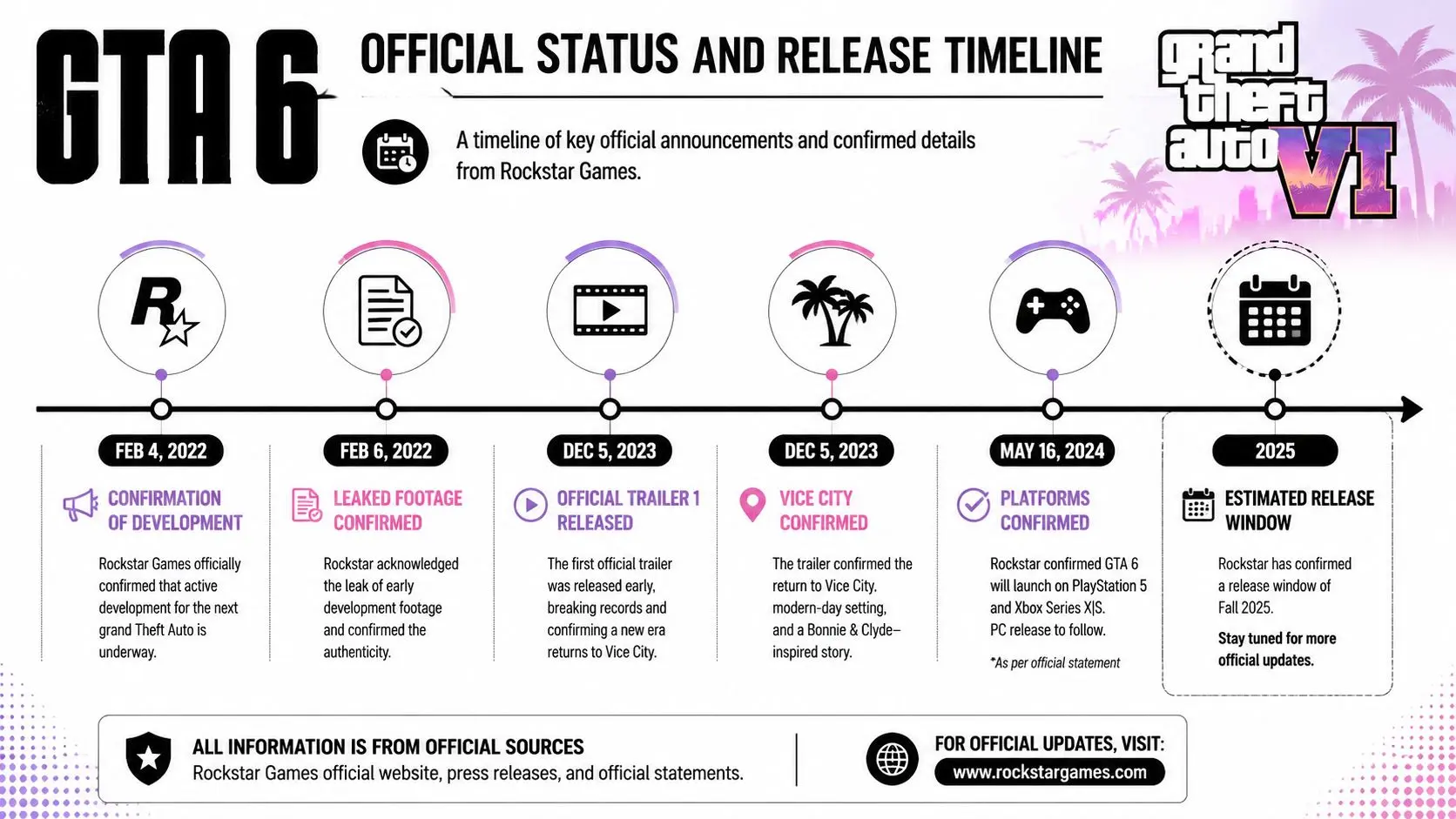
The cleanest place to start is with what's confirmed. Grand Theft Auto VI is officially scheduled for release on November 19, 2026, marking a gap of over 13 years since GTA V. Pre-order revenue is projected to exceed $1 billion globally, with the game debuting simultaneously on PlayStation 5 and Xbox Series X/S according to the verified data for this article.
What Rockstar has effectively locked in
The project is set in Leonida, a fictionalised take on Florida that includes Vice City, the Everglades, and the Florida Keys. The two protagonists are Jason Duval and Lucia Caminos. Those details matter because they confirm the design direction: a dual-lead structure inside a setting built for contrast between dense urban spaces, wetlands, and coastal zones. The release history also tells its own story. The title was formally revealed in December 2023. It was then narrowed to Fall 2025 in Take-Two's Q4 2024 earnings window, delayed to May 26, 2026, and then pushed again to November 2026 to ensure “the level of polish you have come to expect”, based on the verified timeline provided for this article.
Why the timeline matters
From a production standpoint, that sequence is unusually instructive. Teams rarely discuss delays as design signals, but in this case the schedule changes point to a familiar trade-off in high-end interactive work: scope versus polish. Rockstar chose polish. A few facts from the verified record sharpen that interpretation:
| Milestone | Confirmed status |
|---|---|
| Formal reveal | December 2023 |
| Initial narrowed launch window | Fall 2025 |
| Later target date | May 26, 2026 |
| Current official date | November 19, 2026 |
| Launch platforms | PS5 and Xbox Series X/S |
Production reading: when a publisher moves a title more than once and still holds the platform set steady, the likely priority is execution quality on known hardware, not feature expansion for every possible market at once.
That doesn't make the timeline chaotic. It makes it legible. Rockstar appears to be managing the launch around certainty, not broadest-day-one availability. For analysts and creative leads, that's a useful distinction. It suggests a release strategy designed to protect perception at launch, even if that means frustrating some audience segments in the short term.
The Technology Driving Next Generation Open Worlds
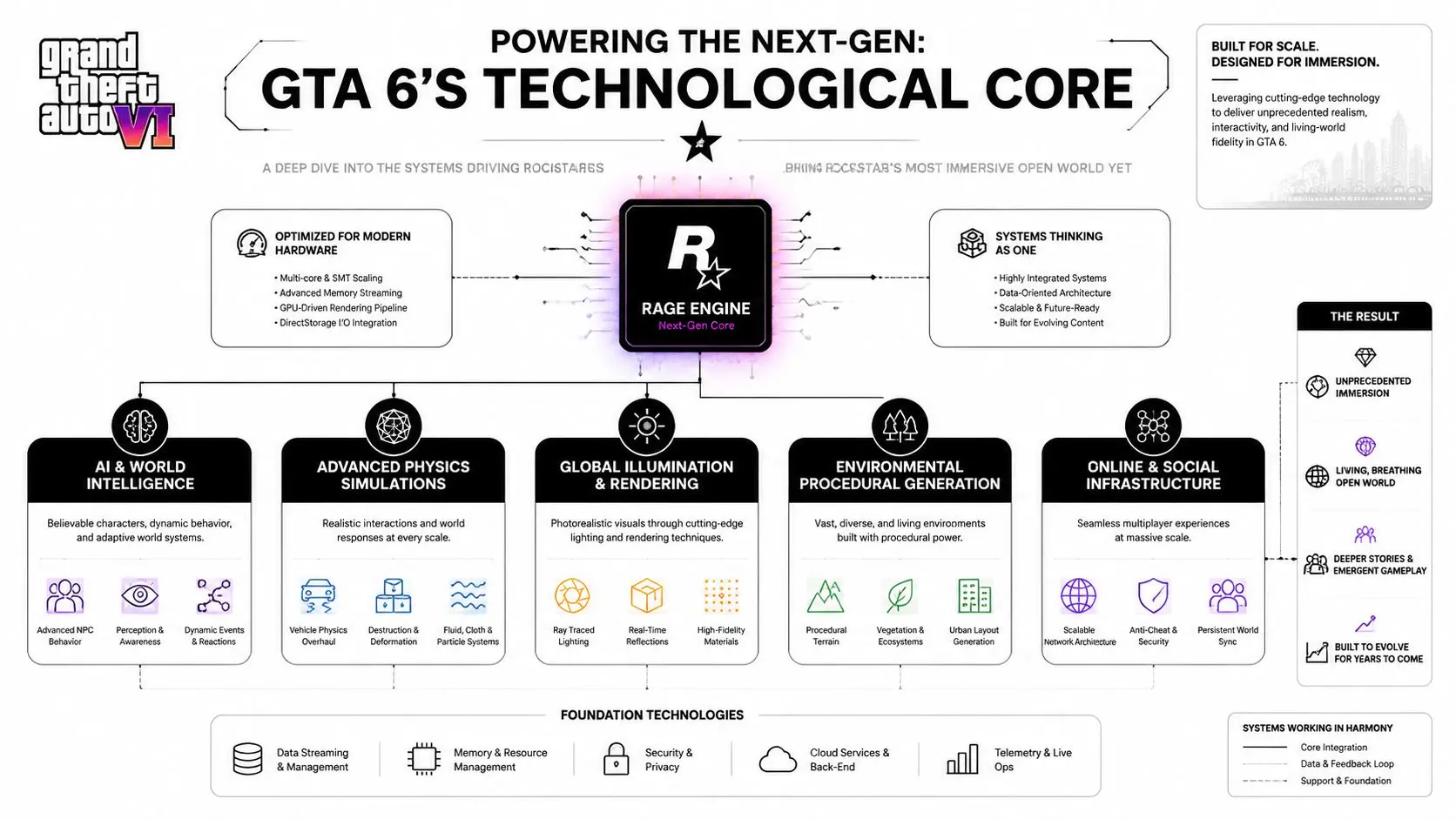
The most interesting technical question around GTA 6 isn't whether it looks better than GTA V. It's how Rockstar seems to be balancing density, interactivity, and hardware constraints at a scale that still has to ship on fixed consoles first. One clue comes from the projected PC profile. Projected PC system requirements for a future GTA 6 release suggest a minimum of an RTX 3060, 16GB RAM, and an NVMe SSD, with recommended specs including an RTX 4070 and 32GB RAM. Data shows 60% of UK gaming PCs currently fall below the 32GB RAM threshold according to the verified hardware summary from Dr Mem's GTA 6 PC requirements analysis. Even as a projection, that points to a game designed around heavy streaming, large assets, and sustained memory pressure.
What the world design suggests about the engine
Verified data indicates leaked development documents from 2022 mention at least 157 playable interiors as a floor rather than a ceiling, with suggestions the final count could exceed 700 robbable shops. The same verified material says the map is estimated to be over twice the size of GTA 5, with high population density. Taken together, those details imply a technical stack focused on four pressure points:
- •Streaming architecture: interiors, roads, crowds, and traversal speeds all demand aggressive asset management.
- •Simulation layers: large worlds feel shallow if NPC logic, traffic, and ambient systems don't scale with the geography.
- •Lighting consistency: a multi-zone map only works if interiors, swamps, coastlines, and neon cityscapes sit in the same visual language.
- •Animation blending: dual protagonists and high-density encounters usually require stronger transitions between authored and reactive performance.
Real-time production outside games should pay attention. A title like GTA 6 changes client language. Decision-makers who've seen that level of environmental coherence begin asking for similar qualities in branded worlds, product demos, and interactive explainers.
The spillover into studio pipelines
That doesn't mean every studio needs Rockstar's engine budget. It means more teams need smarter real-time workflows. If you work in Unreal or Unity, the lesson isn't “build a city the size of Leonida”. It's “design for efficient fidelity”. Teams that understand optimisation, modular assets, and interactive lighting will win more pitches than teams still treating real-time as a novelty. For producers looking at adjacent workflow changes, there's a useful parallel in how teams are already thinking about producing videos with AI. The overlap isn't aesthetic. It's operational. Both shifts reward studios that can combine creative judgement with pipeline efficiency. A related benchmark for visual ambition sits in broader game rendering practice. Studio teams trying to understand why audiences now expect richer materials, denser scenes, and more believable lighting should revisit this guide to photorealism in games.
Better hardware doesn't automatically produce better worlds. Coherent systems do.
That's the deeper takeaway from GTA 6's technical profile. The headline features matter less than the production discipline underneath them.
Debunking Major Rumours and Leaks
GTA 6 has been surrounded by speculation for so long that many readers no longer separate confirmed details from plausible inference. The safest way to assess rumours is to divide them into three buckets: confirmed, credible but unverified, and pure projection.
What has enough grounding to discuss
Some widely repeated claims do have a meaningful basis in the verified data set. The dual protagonists, the Leonida setting, and the presence of Vice City, the Everglades, and the Florida Keys belong in the confirmed column. So does the fact that leaked 2022 development material referenced at least 157 playable interiors. The often-repeated claim that the map is “more than twice the size of GTA 5” sits in a different category. The verified data attributes that to UK-based gaming industry reports as an estimate, not an official Rockstar confirmation. That makes it credible enough to analyse as an industry expectation, but not as settled fact.
Where readers should slow down
The same caution applies to highly specific gameplay theories. Lucia's ankle monitor is a good example. Verified data only supports that there has been speculation about it as a possible “locked map” mechanic. It does not confirm how that system works, how long it lasts, or whether it functions as a progression gate at all. A practical reading of leaks should follow this test:
- Is it official? Rockstar or Take-Two confirmation moves it into the strongest category.
- Is it in development material? That raises plausibility, but not certainty.
- Is it interpretation layered on top of footage? Then it's still theory.
The biggest mistake in GTA 6 coverage hasn't been enthusiasm. It's treating probability as confirmation.
The overlooked value of rumours
Not every rumour is useless. Even weakly sourced speculation can reveal what audiences are hungry for. In GTA 6's case, the recurring themes are telling: denser interiors, more responsive NPCs, bigger environmental contrast, stronger systemic immersion, and more freedom in traversal. That matters for creative businesses because it shows where public taste is moving. People aren't only asking for a bigger map. They're asking for a world that feels authored and alive at the same time. Whether you produce trailers, branded worlds, or interactive installations, that appetite for believable complexity is the signal worth tracking.Rockstars Platform Strategy and the PC Question
Rockstar's launch strategy is often framed as a consumer grievance. That's too narrow. It's better understood as a production and commercial decision built around control. GTA 6 is confirmed for release on PS5 and Xbox Series X/S, with no PC version announced for 2026. This affects the UK, where PC gaming penetration is approximately 35%, implying most players will be on console first and that PC-based modding or development opportunities will be delayed according to the verified analysis linked through the Grand Theft Auto VI reference entry.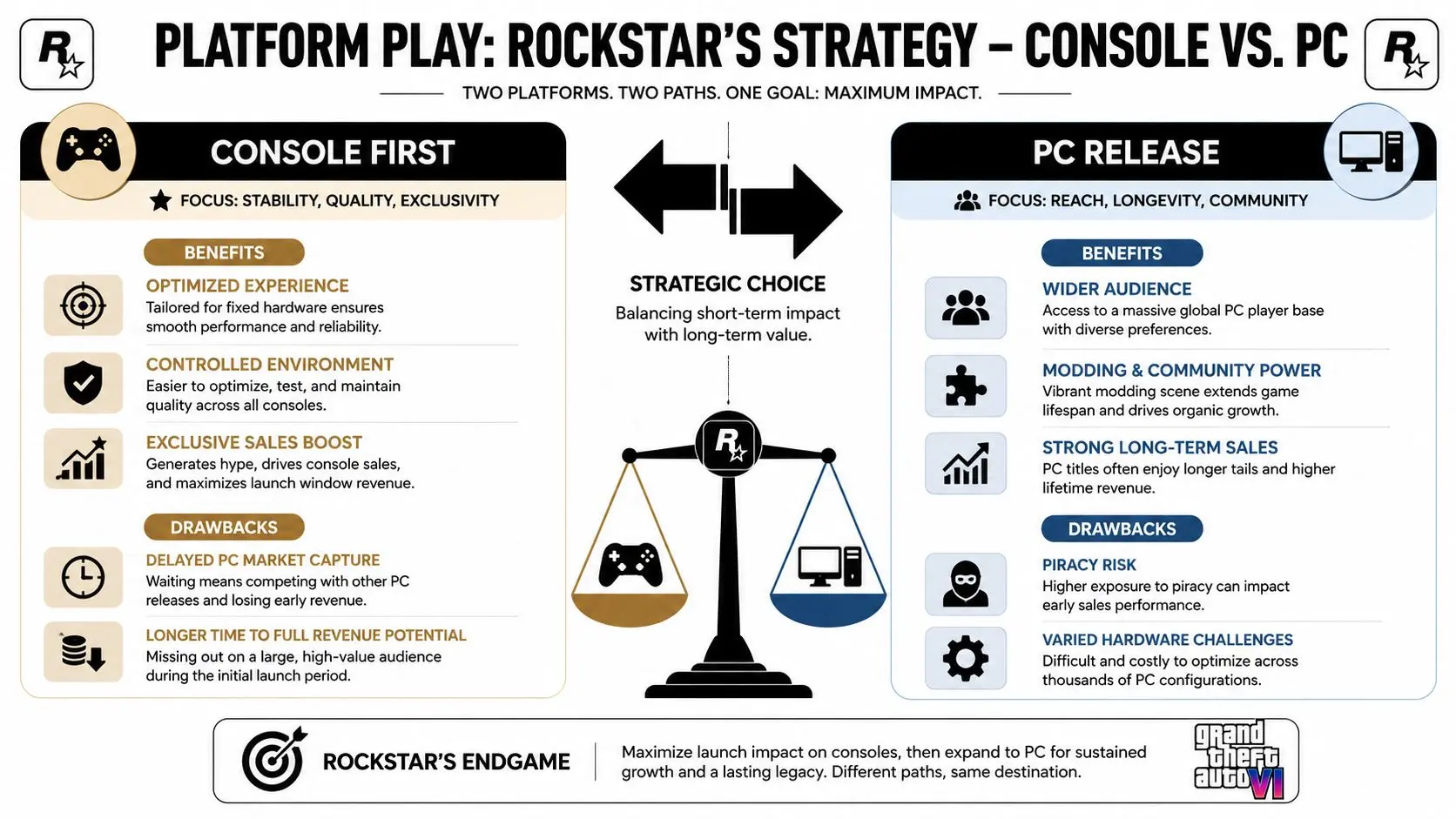
Why console first still makes strategic sense
Fixed hardware changes everything for launch execution. Teams know the baseline CPU, GPU, memory, storage behaviour, and controller environment. That reduces variables when the world itself is already complex. For a project of this scale, console-first release offers practical advantages:| Console-first benefit | Why it matters |
|---|---|
| Controlled hardware target | Optimisation work is more predictable |
| Simpler QA matrix | Fewer combinations to test before launch |
| Cleaner messaging | Audiences know exactly where the game runs |
| Strong retail coordination | Platform and retailer activity can align more tightly |
What the delay means for creators and studios
The absence of a PC version in 2026 has a quieter business consequence. It delays the moment when GTA 6 becomes a practical reference point for PC-side community creativity. Without public PC access, there's no immediate mass mod scene, no consumer-side graphics tinkering, and no near-term opportunity for studios to build around open asset or API workflows tied to the game. That matters especially for teams adjacent to XR, game marketing, and technical prototyping. Console exclusivity keeps the conversation focused on the finished product, not the platform's extensibility.Decision rule: if your launch depends on perception, prioritise the platform set you can fully control.This isn't a universal rule. Many products benefit from broad simultaneous release. But Rockstar's choice reinforces a lesson plenty of studios already know: if the experience itself is the marketing event, the first version has to feel definitive.
What GTA 6 Means for Animation and Marketing Studios
The business impact of GTA 6 isn't that brands will suddenly want crime games. It's that audiences will absorb a new baseline for digital polish, then carry that expectation into everything else they watch and use. That shift affects animation, motion design, real-time content, and XR in different ways. Broadcast-style linear work still has its place, but clients increasingly want assets that can travel across trailers, social clips, immersive demos, in-store installations, and interactive product storytelling. GTA 6 strengthens that convergence.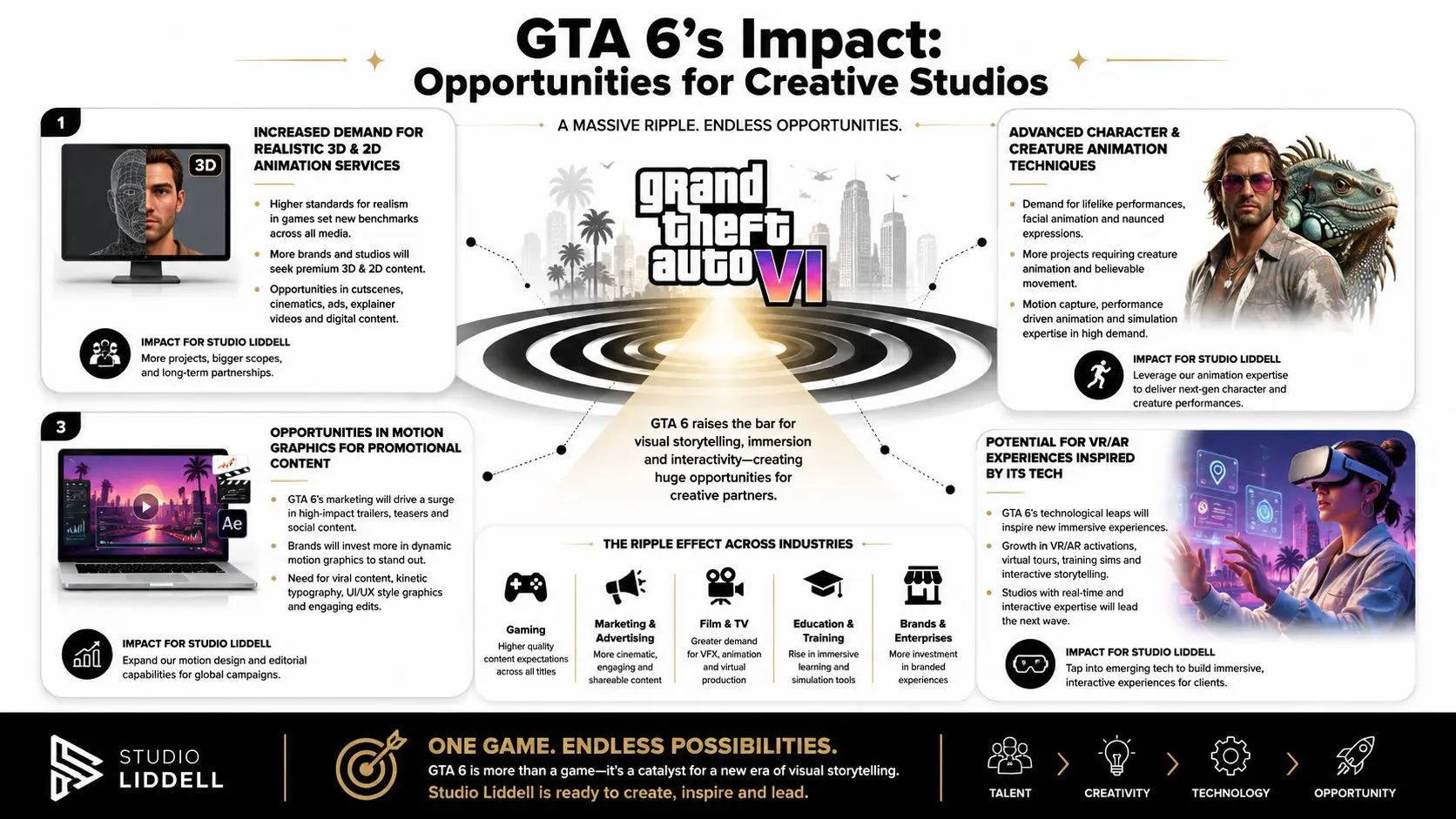
Rising expectations for visual production
Verified UK production data from outside the games sector already points in this direction. The UK Cinema Association's 2024 report says 78% of UK-based animation studios in the broadcast sector adopted end-to-end pipelines integrating previz, lighting, and comp phases by 2023, with an average project timeline reduction of 32% compared to segmented workflows. That matters because GTA 6's public impact lands in a market already moving towards integrated pipelines. Studios working across content types should expect more client pressure in four areas:- •Character credibility: audiences increasingly notice stiffness, weak facial performance, and poor motion blending.
- •Environmental depth: flat backdrops and generic asset libraries stand out more when high-fidelity worlds dominate cultural attention.
- •Real-time adaptability: clients want assets that don't stop at a single hero film.
- •Cross-platform consistency: a campaign now has to hold up in widescreen, mobile cut-downs, event screens, and immersive contexts.
Why this matters for marketers, not just makers
Marketing teams should look past GTA 6's spectacle and study its orchestration. Rockstar has turned scarcity, delay management, setting reveal, and platform focus into part of the narrative. That doesn't mean every brand should imitate the cadence. It means launch strategy now has creative value of its own. The most useful lesson for agencies is to think in systems rather than outputs. One campaign asset is no longer enough. The benchmark is a content ecosystem. A helpful framing sits in this producer's guide to animations in games, because it explains why animation decisions increasingly shape interaction, perception, and retention together rather than separately.
The studios that benefit most from the GTA 6 effect won't be the ones that copy its style. They'll be the ones that understand why its production choices changed audience expectations.
That applies equally to a trailer house, a motion team building launch creative, or an XR studio developing a live spatial experience for a brand activation.
Conclusion Preparing Your Studio for the GTA 6 Effect
GTA 6 should be read as a market event with technical consequences. The release timeline shows how much value Rockstar places on polish. The platform strategy shows the power of controlled execution. The likely hardware demands show where large-scale real-time production is heading. The rumour cycle shows what audiences now expect from digital worlds even before a product is in their hands. For creative businesses, that adds up to one clear shift. Clients will keep asking for richer, more interactive, more believable work, but they won't always know the production implications. The studios that lead won't just promise “cinematic quality”. They'll explain pipeline choices, engine trade-offs, optimisation realities, and delivery formats in business terms.
What teams should do next
A practical response looks less glamorous than the game itself:
- •Audit your pipeline: can your team move cleanly from concept to previz to final delivery without rebuilding assets at every stage?
- •Strengthen engine literacy: Unreal and Unity knowledge now matters beyond games because clients expect real-time options.
- •Treat optimisation as creative work: performance isn't just technical hygiene. It shapes what audiences feel.
- •Design for reuse: campaigns increasingly need one asset family that supports film, social, experiential, and interactive outputs.
There's also a product mindset shift worth borrowing from digital teams outside entertainment. The strongest studios now think in systems, iteration, and lifecycle planning, not only one-off deliverables. That's one reason broader reading on Refact's product development expertise is useful here. It reflects the same operational logic creative studios need when a single brief has to stretch across formats, platforms, and release phases.
The deeper opportunity
The biggest opportunity created by GTA 6 isn't imitation. It's translation. Brands, educators, rights holders, and agencies all want pieces of what premium interactive entertainment does well: worldbuilding, anticipation, immersion, and responsive storytelling. Studios that can translate those qualities into practical outputs will be in demand. That may mean a technical explainer with stronger environmental storytelling. It may mean an XR training module that borrows the readability of game space design. It may mean a campaign launch built around progressive reveals and real-time assets rather than one finished film. The headline lesson is simple. GTA 6 raises the ceiling, but it also raises the floor. Audiences have seen too much advanced digital craft to be impressed by generic execution for much longer.
If you're planning animation, interactive content, or XR work that needs to meet that higher bar, Studio Liddell can help scope the right production approach, from early concept planning to real-time delivery.