Photorealism in Games: A Guide to Mastering Lifelike Rendering Techniques
When we talk about photorealism in games, we're not just discussing graphics that look like a photograph. It’s about building a digital world that feels real. The goal is to convincingly simulate the subtle laws of light, physics, and materials to construct a reality that pulls the player in and doesn't let go.
What Defines Realism in Gaming?
At its heart, photorealism is the craft of erasing the subtle signals that constantly remind us we're playing a game. It's less about chasing a perfect, sterile image and more about creating an environment that feels lived-in, flawed, and authentic. This isn't just for show; it’s a powerful tool for deepening player immersion and forging a genuine emotional connection to the game's world and its story. Imagine it like a perfectly dressed film set. Every detail is there to sell the illusion:
- •Light and Shadow: How sunlight diffuses through a dusty window, or the way a single torch casts wild, dancing shadows across a damp dungeon wall.
- •Material Properties: The distinct look of worn, cracked leather on a jacket, the way polished metal warps the reflection of the room around it, or the slick sheen on wet cobblestones.
- •Subtle Imperfections: The believable mess on a detective's desk, the slight, natural asymmetry in a hero's face, or the tiny dust motes you see floating in a sunbeam.
Beyond Graphics to Deeper Immersion
These elements work together to convince our brains to accept the digital space as a plausible one. When a world follows the physical rules we instinctively understand, suspending disbelief becomes effortless. It's this desire for high-fidelity experiences that's fuelling huge growth in the gaming market. This is especially noticeable here in the UK, where the gaming market hit a value of roughly USD 32.15 billion in 2024. Forecasts see it climbing at a rate of 12.80% each year, potentially topping USD 95 billion by 2033. This surge is largely driven by players demanding more immersive, realistic worlds. The PC gaming segment, long the home of cutting-edge graphics, is growing even faster, showing a clear appetite for visuals that genuinely elevate the story and gameplay. You can find more insights into the UK gaming market and its growth on marketdataforecast.com.
The ultimate goal of photorealism is to make the technology disappear. When players stop noticing the graphics and start feeling the chill of the rain, or sensing the tension in a dimly lit room, that’s when the artists and developers have truly succeeded.
This foundation of believability turns a simple game into a memorable journey. It sets the stage for the advanced tech and artistic principles we’re about to explore, showing how every pixel is placed with purpose to build worlds that feel truly alive.
The Technical Pillars of Building Realistic Worlds
That jaw-dropping, "is-this-real?" moment in a modern game isn't magic. It's the result of a delicate dance between raw artistic talent and sophisticated technology. For years, the workhorse behind rendering 3D worlds onto our 2D screens has been rasterization. Think of it as a lightning-fast digital painter, taking 3D models and efficiently projecting them onto a flat canvas, one pixel at a time. But rasterization has always been a clever illusion. It's incredibly fast, but it has to "fake" the way light really behaves. This is where the real game-changers come in: ray tracing and its more powerful sibling, path tracing. Imagine flicking on a light switch. A single beam of light zips out, hits a glossy wooden floor, bounces off, refracts through a glass on the table, and finally hits your eye. Ray tracing painstakingly simulates that exact journey for millions of light rays, calculating every bounce, reflection, and shadow with astonishing physical accuracy. This simulation creates the kind of authentic lighting that older methods could only hint at. Suddenly, reflections in a puddle are crystal clear, shadows soften naturally the further they are from an object, and light spills into a room just like it would in real life.
The Developer's Toolkit for Realism
Beyond the core rendering engine, developers arm themselves with a suite of tools and methodologies to sell the illusion. These are the building blocks that make a digital world feel tangible.
- •Physically-Based Rendering (PBR): This isn't just a tool; it's a philosophy for creating materials. Instead of defining an object by its final colour, PBR defines it by its physical nature, how rough it is, whether it's metallic, how reflective it is. A PBR-driven engine knows that a rain-slicked tyre and a dusty brick wall will react to the same light source in completely different, yet predictable, ways. This ensures everything looks consistently realistic, no matter the lighting.
- •Global Illumination (GI): Light doesn't just hit a surface and die. It bounces around, filling spaces and colouring the world with reflected hues. GI is the tech that simulates this beautiful chaos. Modern systems like Unreal Engine's Lumen can calculate all this "bounced" light in real-time. It’s the reason light bleeds softly through a window to illuminate a dark corner, a phenomenon you can learn more about in our producer's guide to real-time VFX.
- •Photogrammetry: To get assets that are indistinguishable from reality, artists often turn to photogrammetry. The process involves snapping hundreds of high-res photos of a real-world object from every conceivable angle. Specialised software then stitches these images together to construct a breathtakingly detailed 3D model, capturing every crack, scratch, and imperfection of the original.
This is how the magic happens. The diagram below shows how these technical achievements are really just the first step on a much more important journey for the player.
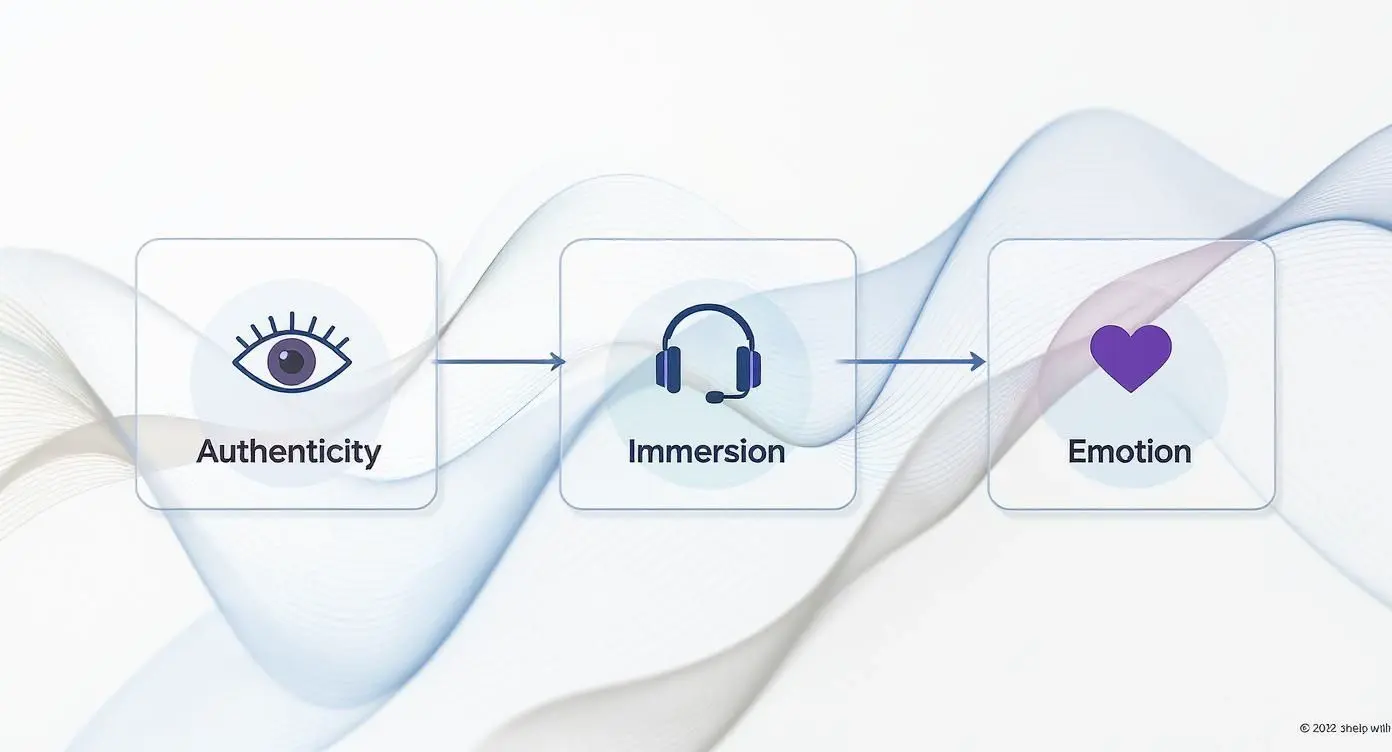
It all starts with technical authenticity. Get that right, and you create true immersion. And from that immersion, you can evoke genuine emotion.
Core Rendering Techniques Compared
Each of these technologies brings its own strengths, weaknesses, and hefty performance costs. The art of game development is often about striking the right balance between the pursuit of ultimate realism and the practical need for a smooth, playable experience. Here’s a quick breakdown of how the main rendering techniques stack up.
| Technique | How It Works (Simplified) | Key Advantage | Main Limitation |
|---|---|---|---|
| Rasterization | Projects 3D models onto a 2D screen; lighting and shadows are often "faked" with clever tricks. | Extremely fast performance, making it ideal for high-frame-rate games. | Struggles to produce physically accurate reflections, soft shadows, and indirect lighting. |
| Ray Tracing | Simulates the path of individual light rays as they bounce off surfaces. | Delivers incredibly realistic shadows, reflections, and ambient occlusion. | Computationally very expensive, often requiring powerful hardware and performance aids like DLSS or FSR. |
| Path Tracing | A more advanced form of ray tracing that simulates many light paths per pixel for a more complete lighting solution. | The gold standard for realism, capable of rendering scenes nearly indistinguishable from reality. | Exceptionally demanding on hardware; currently impractical for real-time rendering in most complex games without significant compromises. |
Ultimately, these technical pillars, from the rendering pipeline to the asset creation process, are what give artists the power to blur the line between a digital simulation and a world that feels undeniably real.
Unreal vs Unity for Photorealistic Projects
Picking a game engine is a crucial decision. It sets the foundation for your entire project, especially when you’re chasing photorealism. In that arena, two names dominate the conversation: Unreal Engine and Unity. Both are incredibly capable, but they approach the problem of creating believable worlds from different angles. Unreal Engine, from Epic Games, has earned its reputation as the go-to for jaw-dropping visuals right out of the box. It’s built from the ground up with integrated, powerful systems designed specifically for crafting hyper-realistic environments. Unity, on the other hand, is famous for its flexibility. It might take more tweaking to hit the same visual bar as Unreal, but its High Definition Render Pipeline (HDRP) is a seriously powerful toolkit. It gives developers fine-grained control over every aspect of how their game looks.
Out-of-the-Box Power versus Granular Control
The fundamental difference boils down to their core philosophies. Unreal Engine offers what you might call a "batteries-included" experience, getting you to a stunning level of visual quality with remarkable speed. Two of its standout features are absolute game-changers for realism:
- •Lumen: This is a fully dynamic, real-time global illumination system. In simple terms, it calculates how light bounces around a scene in real time, which is essential for realistic lighting, all without needing to pre-calculate lightmaps.
- •Nanite: Think of this as a virtualised geometry system. Nanite lets you import and use film-quality, ultra-high-polygon models directly in the engine without the usual performance hit. It essentially removes the headache of manually creating different Levels of Detail (LODs).
Because these systems are baked right in, Unreal often gives teams a faster route to photorealistic results, particularly for projects heavy on detailed environments. Unity’s HDRP, in contrast, is all about customisation. It’s a highly configurable pipeline that lets developers mould the rendering process to their exact needs. This can mean more work upfront, setting up lighting, post-processing, and shaders, but it also provides a level of creative freedom that many teams thrive on. For a closer look at how they stack up, see our guide on Unreal vs Unity for real-time animation.
Practical Considerations for Studios
Beyond the tech specs, the choice of engine has real-world consequences for your studio's workflow, budget, and hiring.
The best engine for a project isn’t just the one with the most impressive tech demo; it’s the one that aligns with your team's skills, production timeline, and artistic vision.
Learning Curve and Team Skills: Unreal, with its integrated systems and visual scripting tool (Blueprints), can feel approachable for artists and designers. However, its C++ core can be a steep climb for programmers who aren't already familiar with it. Unity’s reliance on C# is often seen as easier to pick up for a wider talent pool, and its massive community means finding skilled developers is generally easier. Asset Stores and Ecosystems: Both engines have bustling marketplaces that can save countless hours. The Unreal Marketplace is often praised for its high-quality, "AAA-ready" assets, not to mention the incredible Quixel Megascans library, which is free for all Unreal users. The Unity Asset Store is arguably bigger and more varied, offering a staggering range of tools, scripts, and art packs for projects of every conceivable scale. In the end, there’s no single "best" engine. It’s a strategic choice. Unreal offers a powerful, streamlined path to top-tier photorealism, while Unity provides a flexible, customisable foundation for teams who want to build their own visual pipeline from the ground up.
The Art of Believability Beyond Technical Fidelity
Powerful technology gives us the canvas, but it's artistry that breathes life into the pixels. You can have a technically perfect render that feels completely cold and sterile. It’s the careful, deliberate application of artistic principles that turns a mere simulation into a world with a soul. Photorealism in games isn't just about copying reality, it’s about crafting an emotional experience.

Master artists rely on a classic toolkit of techniques to build atmosphere and guide the player's eye. Composition directs their focus, colour theory sets the mood, and environmental storytelling can convey years of history without a single line of dialogue. All these elements must work in concert to evoke a specific feeling, whether that's the oppressive dread of a horror game or the awe-inspiring wonder of a fantasy landscape.
Embracing Organised Chaos
Let's face it, the real world is messy. It's full of dust, decay, and the beautiful randomness of nature. One of the biggest giveaways of a digital environment is its clinical perfection, flawless textures, perfectly aligned objects, and an unnatural sense of order. The true art of making a world believable lies in disrupting this perfection. This is a concept we often call organised chaos, where artists add the subtle imperfections that make a scene feel authentic and genuinely lived-in.
- •Wear and Tear: Scuff marks on a floor, chipped paint on a wall, or rust stains on metal all tell a story of use and the passage of time. They suggest the world existed long before the player ever showed up.
- •Asymmetry and Randomness: No two trees grow identically, and no two rocks have the exact same shape. Introducing slight variations and asymmetrical details breaks up repetitive, computer-generated patterns and mimics the organic feel of reality.
- •Environmental Details: A forgotten coffee mug, a trail of muddy footprints, or leaves scattered across a pavement, these small additions make a space feel occupied and dynamic.
These details are never accidental; they are deliberately placed to build a narrative layer. In The Last of Us Part II, for instance, the overgrown, decaying cityscapes aren't just backdrops. They are characters in their own right, silently telling the story of a world reclaimed by nature after humanity's fall.
A world feels real not when it’s perfect, but when it’s perfectly imperfect. The artistry is in knowing which details to add and which to leave out to create a cohesive, believable whole.
Guiding the Player's Experience
Ultimately, all these artistic choices in photorealistic games must serve a crucial gameplay function. Lighting is the perfect example. It goes far beyond simply illuminating a scene; it’s expertly used to draw the player’s attention to key objects, highlight pathways, or even signal impending danger. Think about the stark contrast between a brightly lit, safe room and a dark, foreboding corridor. The artist is using light and shadow to manipulate the player's emotional state, building tension one moment and providing a sense of relief the next. This seamless blend of technical execution and artistic intent is what elevates a game from a collection of assets into an unforgettable experience. It’s the difference between a sterile tech demo and a world that truly pulls you in and makes you believe.
Pushing Boundaries with VR and AR Experiences
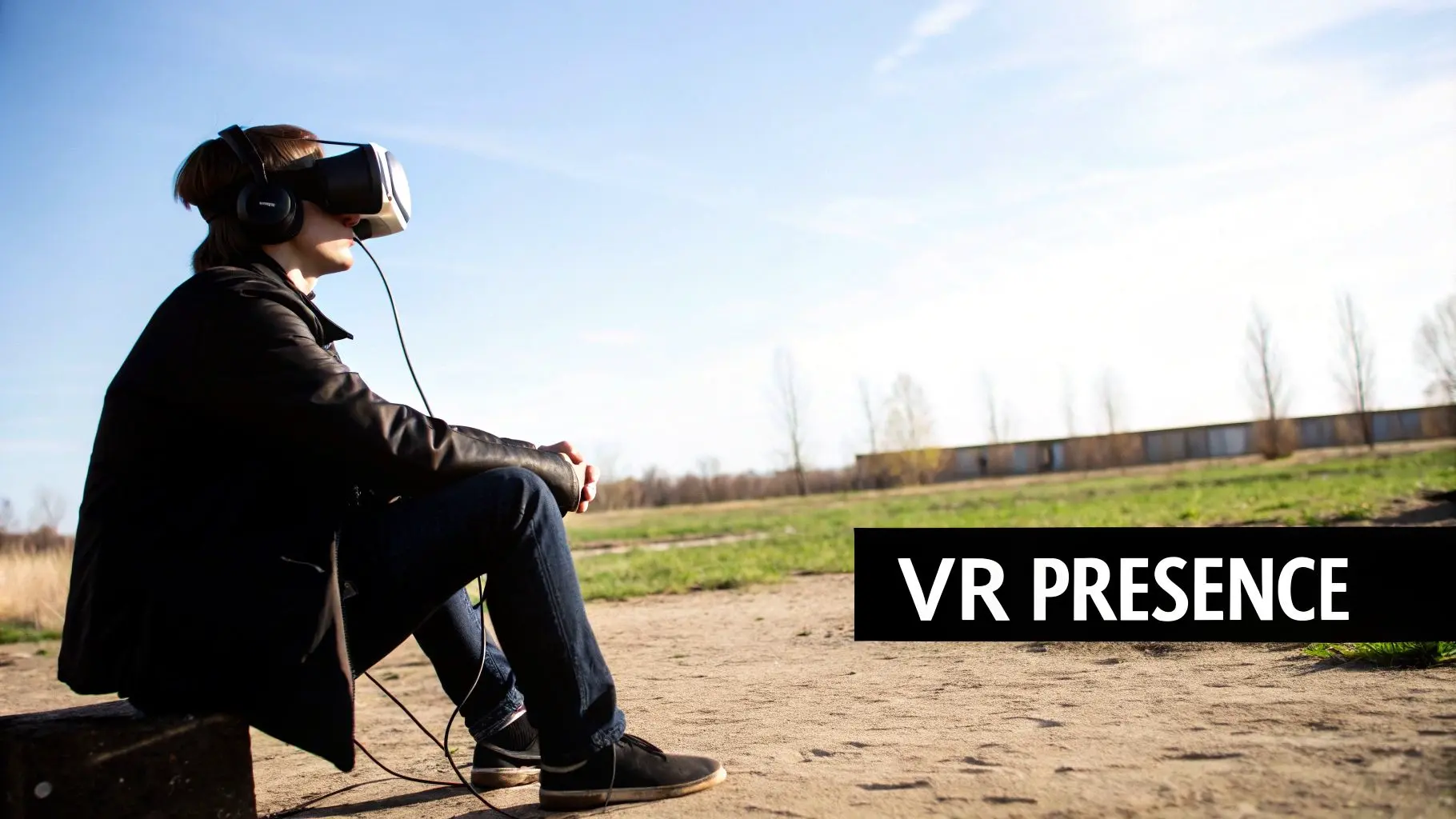
When it comes to photorealism, Virtual and Augmented Reality are the final frontier. In these deeply immersive formats, realism isn’t just a nice visual touch, it's the bedrock of the entire experience. The ultimate goal is achieving "presence," that powerful, subconscious click where your brain truly believes you're somewhere else. Get that right, and the boundary between the player and the digital world simply melts away. But this pursuit throws up a brutal set of technical hurdles. VR headsets track your head movement with incredible precision, and the digital world must keep up flawlessly. The slightest stutter, lag, or visual hiccup instantly shatters the illusion. Worse, it can leave the user feeling dizzy and sick.
The Unforgiving Demands of Immersive Realism
The biggest obstacle for photorealism in VR and AR boils down to one word: performance. While a PC game running at 60 frames per second (FPS) is perfectly fine, VR demands a much higher, non-negotiable standard.
- •Rock-Solid Frame Rates: To avoid motion sickness and maintain immersion, VR experiences need to hold a steady 90 FPS or higher. Dropping below this, even for a split second, is a jarring, uncomfortable deal-breaker.
- •Dual-Screen Rendering: A VR headset is essentially two screens. The game engine has to render the entire scene twice, once for each eye, instantly doubling the rendering workload compared to a traditional monitor.
- •High-Resolution Displays: Today’s headsets have high-resolution screens just inches from your eyes. Any low-quality textures, models, or rendering shortcuts become painfully obvious.
This relentless pressure means developers must pull every optimisation trick out of the bag. Techniques like foveated rendering, where only the exact spot the user is looking is rendered in full detail, are becoming essential. You can get a deeper sense of these complexities in our producer's guide to virtual reality game development.
Seamlessly Blending Digital and Physical Worlds
Augmented Reality cranks the difficulty up another notch. Now, the challenge is to blend photorealistic digital objects into our real, physical environment so seamlessly that they look like they're actually there. If an AR app lets you place a virtual sofa in your living room, that sofa needs to look real. Its lighting must match your room's lighting, its shadows must fall correctly, and its materials have to react to the light just as a real sofa would. This is the new frontier where UK studios are making real headway. The UK's Virtual Reality gaming market was valued at around USD 495.86 million in 2025 and is projected to climb to USD 785.08 million by 2035. This isn't just a number; it shows a massive appetite for the kinds of believable, immersive experiences that only VR and AR can deliver, pushing developers to constantly innovate.
In VR and AR, photorealism is not an aesthetic choice; it is a functional requirement. The entire user experience, from comfort to immersion, hinges on the ability to create a world that the brain accepts as real, without hesitation.
Whether for a game, a training simulation, or a retail app, the quest for photorealism in immersive tech is about far more than pretty pictures. It’s about building experiences that are not only believable but also comfortable, useful, and genuinely impactful.
Photorealism vs Stylisation: Making the Right Creative Choice
The relentless march towards photorealism is a stunning technical feat, but is it always the right creative move? Chasing maximum realism is a powerful tool, but it's far from the only one. Sometimes, a strategic pivot to a stylised art direction is the smarter, more impactful choice. Choosing stylisation isn't about cutting corners; it's a deliberate artistic decision that comes with its own perks. It gives artists immense creative freedom, letting them craft worlds that aren't shackled by the rules of reality. More importantly, a unique aesthetic can achieve a timeless quality, stopping a game from looking "dated" the moment the next big rendering technique comes along.
Weighing the Strategic Factors
You only need to look at the classic showdown between Call of Duty and Fortnite to see this strategic divide in action. Call of Duty leans heavily into photorealism to pull players into its gritty, authentic-feeling military sandboxes. That sense of realism is what dials up the tension. Fortnite, on the other hand, uses its bright, cartoonish style to build a world that’s playful and instantly accessible. This wasn't just a random aesthetic choice; it's fundamental to its global success:
- •Wider Audience Appeal: The friendly, non-threatening visuals are a welcome mat for players of all ages.
- •Creative Freedom: The stylised world can absorb bizarre character skins and absurd live events that would shatter the illusion in a photorealistic game.
- •Performance: The less demanding graphics mean the game runs smoothly on a huge range of hardware, from top-tier gaming PCs to mobile phones.
This proves the "right" choice is never about which style is technically better. It’s about which style best serves the game's core purpose.
The most successful art direction isn't the one that looks the most real. It's the one that most effectively communicates the game's intended experience, tone, and gameplay to its target audience.
Making an Informed Decision
Deciding between photorealism and stylisation demands a hard look at the project's foundational goals. Before anyone gets attached to a visual direction, producers and creative leads need to ask critical questions to ensure the art style is pulling in the same direction as everything else. A simple framework can help guide this crucial choice:
- Who are we making this for? A younger audience might gravitate towards bright, stylised visuals. A game aiming for mature, dramatic storytelling, however, might need the gravitas that realism brings.
- What is our core gameplay loop? Fast-paced, competitive games often work better with clean, readable stylised graphics where targets are clear. Slower, exploration-focused or narrative-heavy games can use realism to deepen that sense of immersion.
- What’s our real-world budget and timeline? Photorealism is a beast. It’s resource-intensive, demanding bigger teams, more development time, and highly specialised talent. A stylised approach can often be a more realistic goal for studios with tighter constraints, without sacrificing quality.
- How important is it that this game looks good in 10 years? Today's bleeding-edge realism will inevitably be tomorrow's "old graphics." But a strong, unique art style, think of games like Cuphead or The Legend of Zelda: Breath of the Wild, remains visually stunning for years.
A Few Final Questions About Photorealism
To wrap things up, let's tackle a few of the most common questions we hear from clients and developers when the topic of photorealism in games comes up. It’s one thing to discuss the tech and artistry, but another to deal with the practical side of things.So, How Much Does a Photorealistic Game Actually Cost?
There’s no single price tag, but one thing is certain: photorealistic games sit at the top of the budget food chain. The cost can swing wildly depending on the project's scale and ambition. What really drives the price up is the need for highly experienced senior artists and engineers, pricey software licences for rendering and asset creation, and, most of all, time. Building and optimising every high-fidelity asset is a monumental task. A smaller, contained project might land in the hundreds of thousands of pounds. A sprawling AAA epic can easily soar past £100 million. Techniques like photogrammetry can help manage costs by capturing real-world assets, which is often more efficient than building everything from scratch.What Kind of Hardware Do I Need to Run These Games?
To get the full experience of a modern photorealistic game, you need a beefy gaming PC or one of the latest consoles, like a PlayStation 5 or Xbox Series X. There's no getting around the fact that they are demanding. If you're going the PC route, here's what you should be looking at:- •A high-end graphics card (GPU), especially one from NVIDIA's RTX or AMD's RX series. You'll want one that has dedicated hardware for ray tracing.
- •A fast, multi-core processor (CPU) to keep up with all the complex physics and game logic.
- •You'll want at least 16GB of RAM as a baseline. This helps the system juggle all those huge, detailed assets without stuttering.
And for the best visual payoff, a high-resolution monitor (1440p or 4K) is a must. Don't forget technologies like NVIDIA's DLSS and AMD's FSR, which are absolute game-changers. They use clever AI upscaling to keep your frame rates smooth without sacrificing too much visual quality.
Where Is Photorealism in Games Headed Next?
The next frontier is real-time path tracing. This is where lighting simulations become so accurate they are virtually indistinguishable from real life. We're not quite there yet, but as GPUs become exponentially more powerful and AI-driven denoising gets smarter, it's getting closer every year. Beyond lighting, expect to see far more believable physics simulations. We're talking about materials and environments that react to every player action with true-to-life accuracy. Characters will also continue to push boundaries, as developers chase breakthroughs in real-time hair, more nuanced facial animations, and skin rendering that finally escapes the uncanny valley. The end goal? To craft completely dynamic, interactive worlds that never break the photorealistic illusion, blurring the line between game and reality for good. At Studio Liddell, we live at the intersection of technology and artistry, creating visually stunning experiences that captivate audiences. Whether you're exploring photorealism for a game, a simulation, or an animated series, our team has the expertise to bring your vision to life. Book a production scoping call