Corporate Animation Video: The Complete UK Buyer's Guide
UK digital advertising reached £35.53 billion in 2024, while video display advertising reached £8.3 billion, according to the UK digital video benchmarks. Corporate animation video now sits inside that mainstream commercial environment, not at its creative margins. The production decision is no longer whether animation looks distinctive. It's whether the format, message, duration, delivery platform and production method will help a buyer understand, remember and act. A strong commission starts with a business problem. An explainer may need to simplify a technical product. A training film may need to guide behaviour consistently. A product animation may need to show an internal mechanism that live action can't capture. The right studio will connect those communication requirements to a practical pipeline, a defensible budget and deliverables that work across the channels where your audience watches.
Why Corporate Animation Video Dominates UK Business Communication
Digital advertising reached £35.53 billion in 2024, while video display advertising reached £8.3 billion, according to UK video marketing benchmarks. For UK marketing directors, that places corporate animation video within an established media habit rather than a niche creative experiment. The commercial question is how well the film supports understanding, recall and action. Viewers rarely separate an animated explainer from other video content. They judge it by whether the message is clear, the opening earns attention and the edit suits the platform. A polished production can still underperform if it explains the wrong feature, uses an unsuitable aspect ratio or asks a cold prospect to absorb too much information before showing the value.
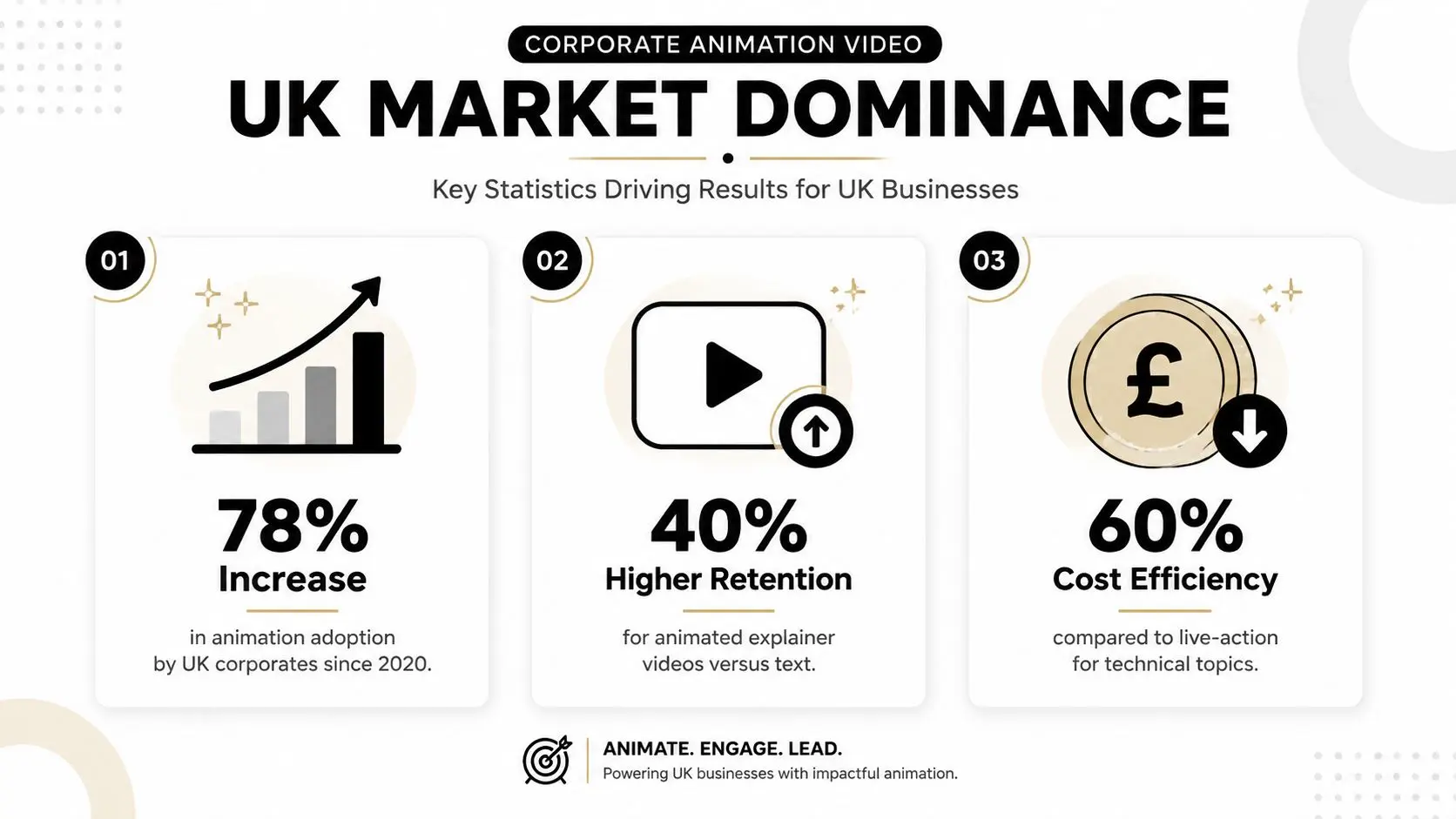
The case for measurable communication
UK-facing benchmarks report that 91% of businesses use video in their marketing mix, while 93% report positive ROI from video. The same benchmark places animation at 23% of business video content, with 71% of marketers identifying 30 seconds to 2 minutes as the optimal length for business video. These figures support animation as an established business format, but they do not guarantee results for every commission. Set the measurement plan before approving the storyboard:
- •What must the audience understand? Define the single decision or action the film should support.
- •Where will the film appear? LinkedIn, a sales presentation, an exhibition screen and an onboarding portal require different edits, aspect ratios and pacing.
- •What evidence will matter? Views indicate distribution. Qualified enquiries, completion behaviour, sales enablement use or training assessment may offer stronger evidence of business value.
- •What should remain reusable? A modular visual system can support cut-downs, product updates and localised versions without rebuilding the entire film.
Producer's rule: Treat animation as a communication system with a visual front end, not decoration added after the message has been approved.
The UK also has a production base capable of supporting this work. The BFI's mapping of animation activity across the UK economy recorded £97.1 million spent on UK-qualifying animation programmes in 2016, including £38.3 million from inward investment and co-productions and £58.8 million from domestic production. In 2021, UK production spend was £73 million, with 67% from domestic programmes, 25% from inward investment and 8% from co-productions. For corporate buyers, that history indicates an ecosystem able to support different production scales, from short-form motion design to complex animation pipelines.
Choosing Between 2D, 3D, and Motion Graphics
Format choice should reflect the explanation the audience needs and the result the film must support. Motion graphics suit brand announcements, data visualisation and title sequences because designers can animate typography, diagrams and existing brand assets without constructing a physical world. 2D animation creates more space for illustrated characters, visual metaphors and narrative scenes. 3D earns its higher production cost when volume, material, depth, movement or product accuracy affects understanding. The budget and schedule differences are substantial. UK planning guidance places motion graphics at £1,500 to £5,000 per minute, with typical lead times of 2 to 4 weeks. Two-dimensional animation commonly costs £3,500 to £8,000 per minute over 4 to 6 weeks, while 3D can range from £6,000 to more than £20,000 per minute and take 8 to 16 weeks, as outlined in this UK animated video production guide.
| Animation Format | Cost per Minute | Lead Time | Best For |
|---|---|---|---|
| Motion graphics | £1,500 to £5,000 | 2 to 4 weeks | Brand films, diagrams, data, title sequences and social cut-downs |
| 2D animation | £3,500 to £8,000 | 4 to 6 weeks | Explainers, illustrated stories, characters and training content |
| 3D animation | £6,000 to £20,000+ | 8 to 16 weeks | Product visualisation, technical demonstrations and premium brand storytelling |
When 2D is the smarter choice
Choose 2D when the audience needs a clear conceptual journey rather than a detailed physical simulation. Flat illustration can organise an abstract service, process or policy on screen, while a distinctive editorial style can strengthen recall without requiring every object, surface and light source to be modelled. 2D is not automatically basic. Strong art direction, disciplined storyboarding, expressive timing and sound design can give a simple visual language considerable authority. For a practical comparison of the commercial trade-offs, see this buyer's guide to 2D versus 3D animation cost. Format decisions should also reflect audience behaviour, message structure and the call to action, as explained in how to make videos that convert viewers.
When 3D earns the investment
3D works best when viewers need to understand scale, assembly, material behaviour, spatial relationships or an unseen process. It can show the inside of a machine, rotate a product under controlled lighting or place a branded object in a designed environment. The trade-off is production complexity. Modelling, texturing, rigging, lighting, rendering and compositing add approval points, so late changes can become expensive. A hybrid treatment can keep technical detail focused where it improves comprehension. For example, motion-led scenes may carry the main narrative while selected 2D or 3D elements demonstrate a product feature. That approach avoids assigning the highest production burden to every shot, but it still requires a clear visual system and disciplined asset planning. The right measure is not visual sophistication alone. Compare the production cost with the platform, audience action and business outcome the film is expected to influence.
The Production Pipeline from Brief to Delivery
A corporate animation project becomes expensive when decisions stay vague after production has started. The cleanest pipeline locks the message first, then the visual design, then movement and finish. A standard animated video project commonly takes 4 to 8 weeks from concept to delivery, according to this UK animation pricing and timeline guide.
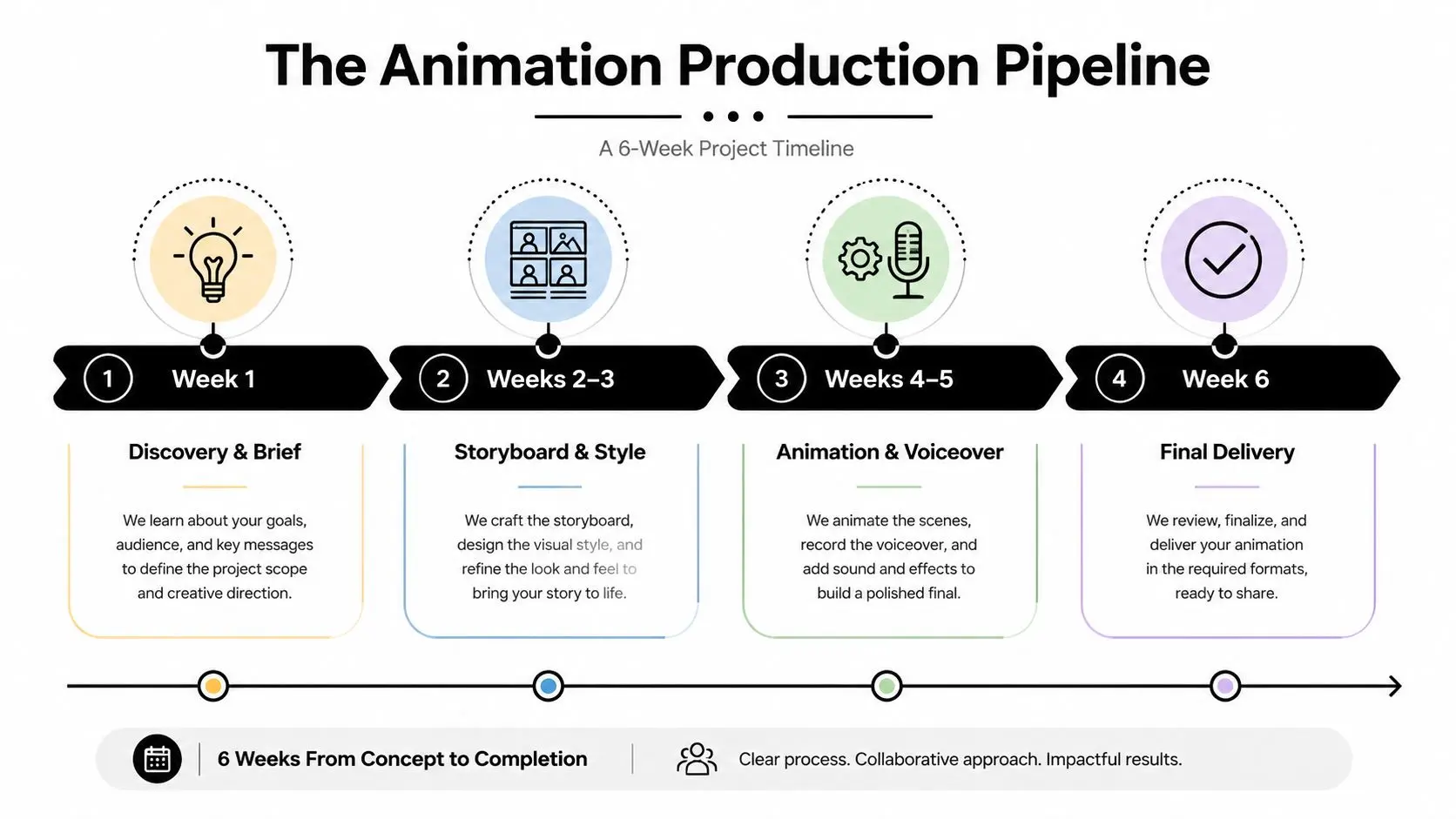
Where the decisions happen
Discovery and brief: The producer clarifies the audience, objective, distribution channels, mandatory claims, brand constraints and approval group. A useful brief also identifies what success will look like. “Raise awareness” is too broad to guide a treatment. “Help sales teams explain the product's three-stage workflow” gives the script and storyboard a job. Script and storyboard: Script and storyboard development typically occupy weeks 1 and 2 in the standard process described by the same UK guide. The team tests the order of information, narration length, visual metaphors and calls to action at this stage. Approve this stage carefully. Rewriting after animation begins can affect voiceover, scene timing, illustration and edit structure at once. Design and animation: Illustration and animation follow the approved plan. Character work introduces additional technical preparation because the team must build rigs that allow limbs and other controls to move consistently. A UK character animation guide identifies about 8 weeks as a common sweet spot for standard character projects, while 3D projects are often planned around 12 weeks, reflecting their additional production stages. Sound and finishing: Voiceover, music, sound effects, compositing, colour treatment, captions and final edits shape how polished and usable the film feels. A technically strong animation with weak sound can still lose attention, especially when viewers watch on mobile devices or in environments where captions carry the message.
Approval discipline saves money: Give one accountable stakeholder authority to consolidate feedback. A committee that sends contradictory notes creates revisions, not progress.
Delivery is part of production
A professional studio should ask where the master will be used before export begins. Web, social, presentation, exhibition and broadcast versions may require different dimensions, codecs, captions, audio treatments and file naming conventions. For UK network television, the BBC technical delivery requirements state that programmes must be delivered as AS-11 DPP files, with each high-definition programme supplied as a single MXF OP1a file conforming to AMWA AS-11 v1.0. Live commissions must deliver an AS-11 file within 48 hours of transmission, or as directed by the BBC. The complete animation production pipeline guide is useful when your internal team needs a shared view of these stages. The practical lesson is simple: delivery specifications belong in the brief, not in the final afternoon.
AI-Assisted Production vs Human Craft
AI assistance can remove repetitive work, but it can't decide what your audience should trust. That distinction matters in healthcare, education, public-facing information and B2B services, where a confident visual error or synthetic-sounding voice can damage credibility faster than a slow production process ever would. The wider UK animation, VFX and post-production market is projected to grow from USD 3.94 billion in 2025 to USD 9.36 billion by 2030, according to the market outlook cited in UK animation style trends. Growth in the market doesn't establish that an AI-first workflow will produce better communication. It does, however, explain why buyers are encountering more automation options across concept development, editing, asset generation and compositing.
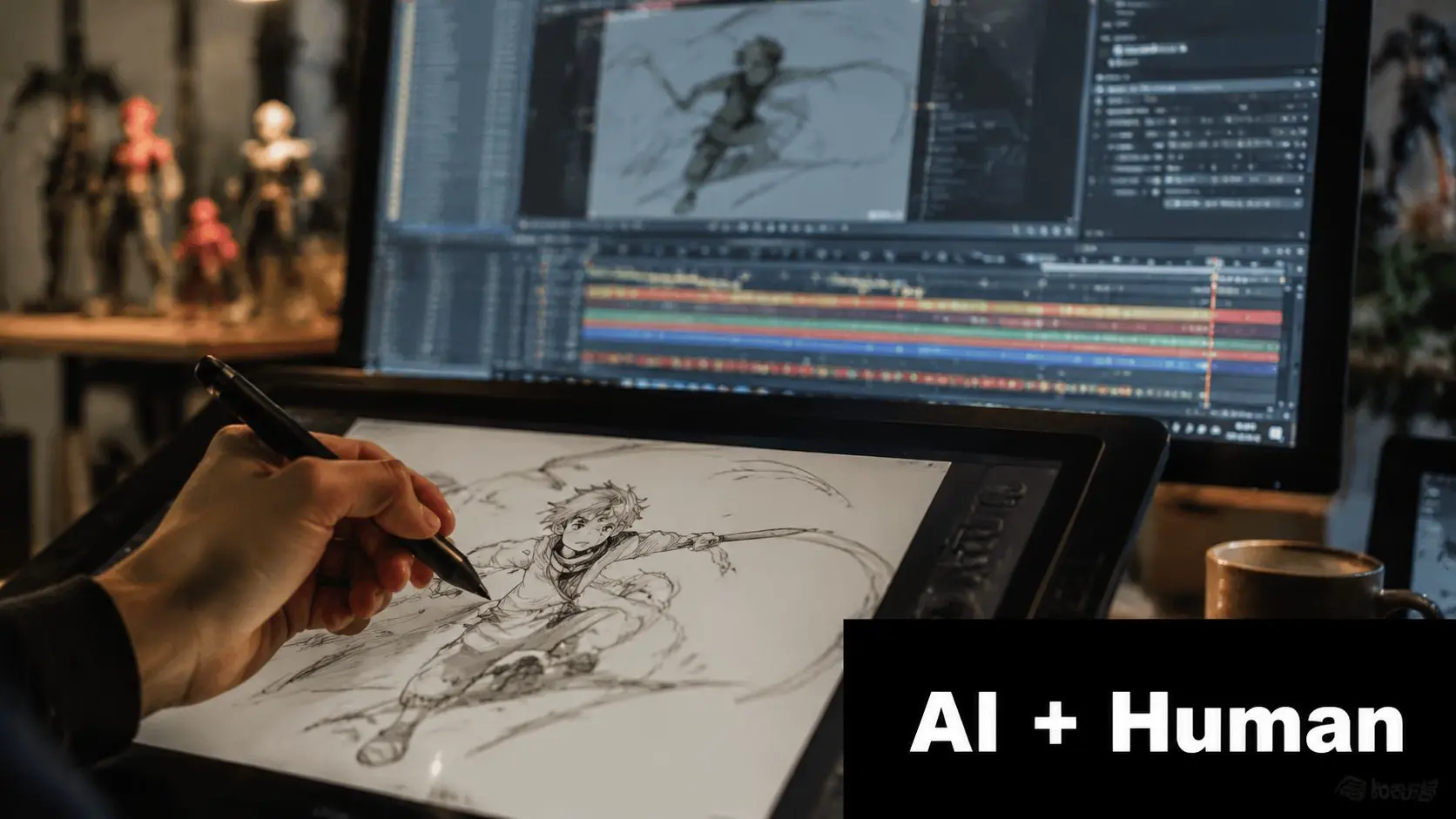
Use automation where judgement is low-risk
AI can assist with reference exploration, rough visual directions, transcription, version preparation, masking and repetitive editorial tasks. It can help a team test alternatives before committing to finished artwork. Tools such as ShortGenius AI video ad maker may also be useful for rapid concept exploration or short-form advertising tests, provided the organisation understands what is being generated and how the output will be governed. Human craft remains essential when the film depends on a precise brand voice, culturally sensitive character performance, accurate technical explanation or a carefully controlled emotional progression. A human director can challenge an unclear brief, remove a misleading metaphor and recognise when a visual feels impressive but says nothing useful. An animator can also preserve continuity across scenes, something automated image generation may not handle reliably without close supervision.
Make the decision on risk, not novelty
Ask the studio to identify which tasks will use AI, which source materials will enter the workflow and who will review the results. Check whether your legal, compliance and brand teams need approval for generated assets, synthetic voices or third-party reference material. If the project involves confidential product information, data handling and access controls should be explicit before production starts. The guide to AI animation software and production can support an informed discussion, but the buying decision should remain outcome-led. Faster delivery only helps when the final film is accurate, distinctive, approved and effective on its intended platform.
How to Evaluate and Select an Animation Studio
A portfolio shows taste. It doesn't, by itself, show whether a studio can protect your schedule, manage feedback or deliver the required master files. Selection should therefore begin with production evidence rather than visual preference.
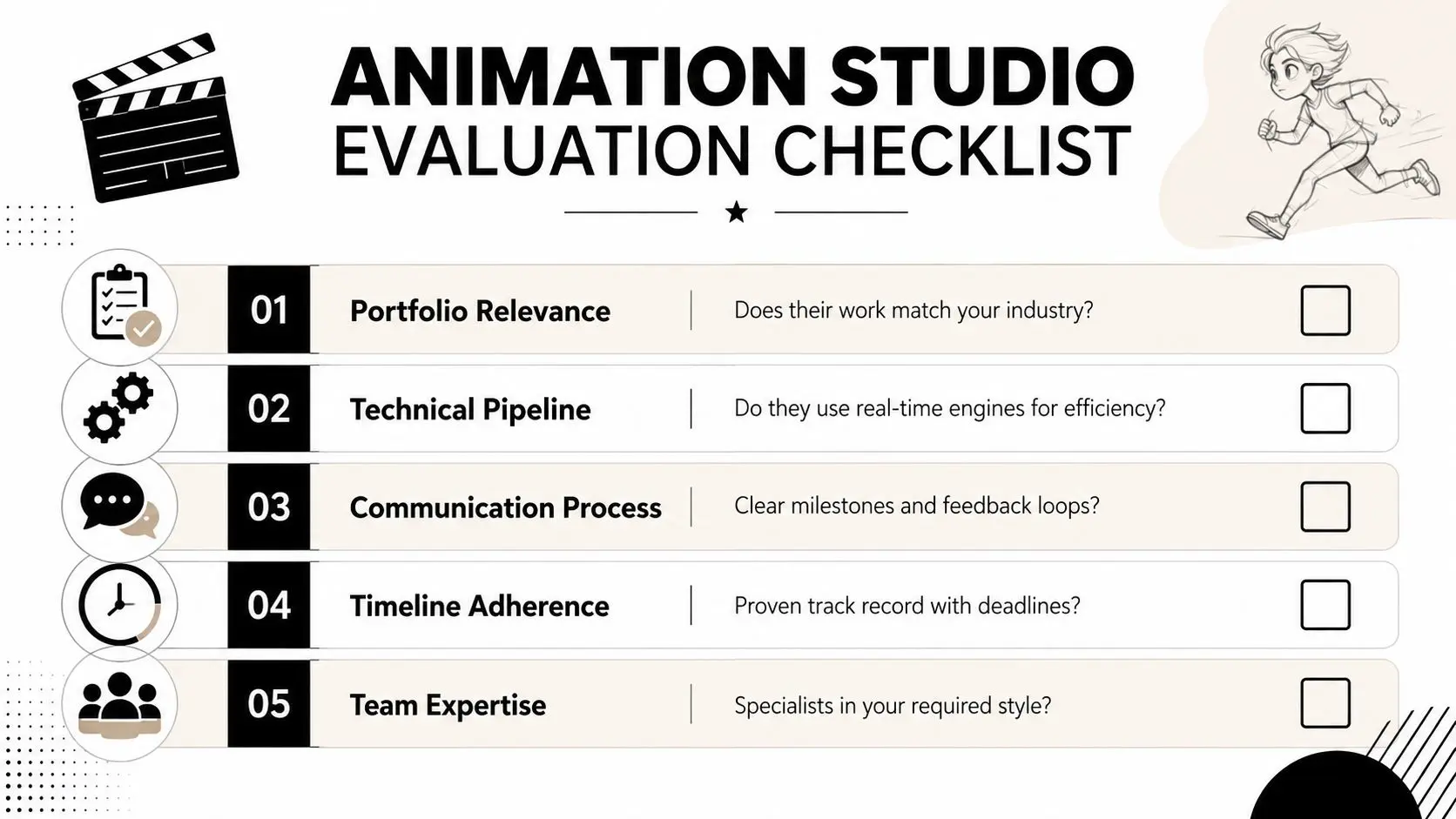
Five questions worth asking
- Can the studio show relevant work? Look for projects with a comparable audience, subject, approval environment or delivery challenge. A beautiful entertainment reel may not demonstrate the clarity required for technical training.
- Who owns the pipeline? Ask who writes, storyboards, designs, animates, composites, mixes sound and manages delivery. For character work, ask how rigs are built and tested. For 3D work, ask how modelling, lighting and rendering are scheduled.
- How does feedback work? You should see defined review points, version control and a clear method for consolidating notes. Ambiguous feedback processes often create the hidden cost in an otherwise reasonable quote.
- Can the studio deliver technically? Broadcast work may require AS-11 DPP delivery, while digital campaigns may need multiple aspect ratios, caption files and platform-specific edits. The supplier should discuss these requirements before pricing the project.
- How will success be assessed? A credible proposal should connect the film to an audience action, not only a view count. Depending on the brief, that might mean sales-team adoption, completed training, qualified enquiries or stakeholder understanding.
Due diligence beats reel envy: Ask to see a treatment, schedule and approval map for a project similar to yours, not just the most polished shots in the studio's showreel.Red flags include a quote with no assumptions, a timeline with no approval gates, a supplier that avoids technical questions or a proposal that promises every format without explaining how the production will adapt. Buyers exploring automated options can also review resources such as best AI video generator for business, but an AI tool isn't a substitute for a responsible production partner when accuracy, brand control and delivery standards matter. Studio Liddell is one option for organisations that need 2D and 3D animation, character and creature work, motion design, broadcast content or XR production, with experience spanning television, advertising, games and immersive experiences. Its published client and production background includes Sky Kids, BBC, Merck, Manchester United and other entertainment, technology and brand organisations. Compare that capability with your actual requirements, rather than treating company size or visual style as a proxy for fit.
Real-World Applications and Measurable Outcomes
The strongest corporate animation projects start with a communication bottleneck. A children's brand may have recognition on television but need shorter digital stories that suit online viewing. A technical organisation may need stakeholders to understand a process that can't be filmed easily. An event organiser may need an interactive experience that moves visitors through a space without creating queues or confusion. BooSnoo for Sky Kids illustrates the first challenge. Extending a familiar children's property into digital shorts requires more than reusing characters. The production has to preserve the identity of the original IP while adapting pacing, story scale and delivery for a different viewing context. The useful outcome is a repeatable content pipeline that protects the brand as it moves between formats.Technical communication needs visual structure
GeoEnergy NI represents a different corporate problem. Technical subjects can overwhelm stakeholders when presentations rely on specialist language and static diagrams. A carefully designed animation can establish the system, show relationships and control the order in which information appears. The value isn't complexity for its own sake. It's giving non-specialist viewers a visual route through the subject. That principle also applies to explainers for software, engineering, energy and healthcare. A good storyboard separates the messaging ladder into what the audience must know first, what supports the claim and what can wait until a later sales conversation. It uses visual metaphors only when they clarify the mechanism, not when they merely fill the screen.Immersion changes the success criteria
Dance! Dance! Dance! demonstrates why a mixed reality event game needs producer-level planning. The creative concept must work alongside throughput, staffing, device handling, physical safety and player onboarding. A visually impressive experience that leaves visitors waiting, confused or unable to complete the interaction has failed commercially, even if the individual assets look excellent. Aurora approaches the problem from the opposite direction, using a VR short film to develop story, direction, performance capture, post-production and spatial sound as one connected experience. Its award-calibre positioning is a creative reference, but corporate buyers can take a practical lesson from it: immersive work needs direction that understands where the viewer is looking, how sound guides attention and how technical optimisation protects the intended experience. For your own brief, write the outcome before the treatment. “Explain the product to procurement stakeholders”, “give visitors a guided interaction” or “extend an existing IP into short digital content” will produce better production decisions than “make something premium”. Then agree how your team will verify that outcome after launch.Your Next Steps for Commissioning Corporate Animation
Start with a one-page brief. State the audience, the decision you want to influence, the information viewers already understand, the information they find difficult and the action they should take next. Add every mandatory claim, brand rule, legal requirement and reference asset before a studio develops the treatment. Then define the distribution environment. A sales enablement film may need a clean master, captions and short extracts. A social campaign may need vertical adaptations and a faster opening. A broadcast commission needs the correct technical delivery route. Platform choice affects framing, pacing, text size, sound design and versioning, so it should shape the creative treatment from the beginning.Questions for the scoping call
- •What format fits the message? Ask the producer to justify motion graphics, 2D, 3D or a hybrid approach.
- •What will drive the schedule? Identify modelling, character rigging, approvals, voiceover, localisation and technical review.
- •What does the quote include? Check script, storyboard, design, animation, music, voice, sound mix, captions, revisions and exports.
- •How will performance be judged? Agree practical measures before publishing, and distinguish distribution metrics from business outcomes.
- •Who approves each stage? Name one decision-maker and set review windows that protect the production calendar.
Avoid choosing on the lowest price alone. A cheaper quote can become expensive when it excludes sound design, versioning, rights, technical exports or revision time. Equally, a high-end visual treatment isn't automatically the right investment if a clear motion graphics system would explain the message more quickly. Prepare your script, brand pack, product references and delivery requirements, then ask for a treatment that shows the proposed visual language and production route. A good scoping conversation should leave you with a realistic view of trade-offs, not just enthusiasm for a style. --- Studio Liddell offers 2D and 3D animation, motion graphics, character production and XR development for brands, broadcasters and technical organisations. Visit Studio Liddell to share your brief and book a focused conversation about the format, pipeline, budget and delivery plan your corporate animation video needs.