Animation Concept Art: Production Guide for 2026
You've got a strong animation idea, a pitch deck, and perhaps a script that reads well. Yet when the producer asks what the world looks like, how the characters move through it, or why the audience should care, words alone rarely settle the discussion. That gap between an abstract idea and a production-ready vision is where animation concept art earns its commercial value. Good concept art gives directors, producers, designers, animators, investors, and clients something concrete to assess before expensive production begins. It tests the mood, clarifies the story, exposes weak ideas early, and gives every department a shared visual reference. In the UK, that role matters across television, feature films, commercials, games, XR, and technical communication, not only traditional film production. The BFI's mapping of animation activity across the UK economy treats animation as a measurable national-sector activity, which reinforces the importance of strong upstream visual development.
Defining Animation Concept Art Beyond Pretty Pictures
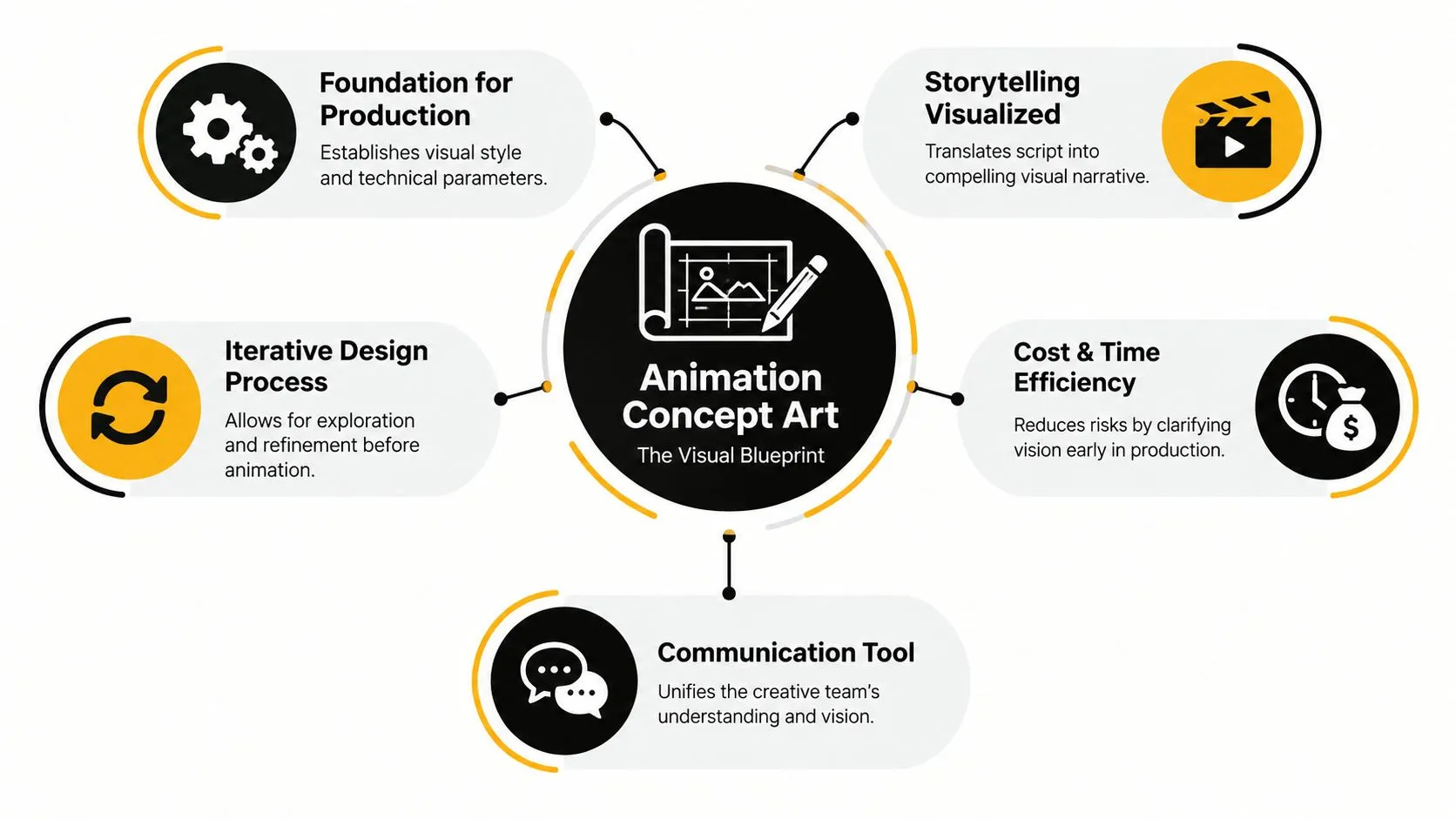
A business pitch might describe a curious robot exploring a flooded city, a children's character entering a digital world, or an engineer training in a simulated industrial environment. The description can be persuasive, but it leaves important questions unanswered. Is the world warm or threatening? Does the character feel comic, vulnerable, or authoritative? Can the visual style work in 3D, on a headset, across a broadcast master, or in a short social cutdown? Animation concept art turns those questions into visual decisions. It functions like an architect's blueprint. A blueprint isn't the finished building, but it tells the construction team what they're making, how the parts relate, and which decisions must be resolved before materials and labour are committed.
What the artwork needs to solve
At the earliest stage, a concept artist explores possibilities rather than polishing one answer. A project may need several silhouettes for a character, alternative layouts for a location, lighting studies for a key scene, or colour explorations that reveal whether the emotional tone is working. The practical questions include:
- •What does the audience feel first? Colour, shape, scale, contrast, and composition establish emotional direction before dialogue or movement begins.
- •What does the story require? A character's silhouette should communicate personality and function, while environments need to support action rather than merely decorate a frame.
- •Can the idea be produced? A design may look excellent as a painting but become difficult to model, rig, light, render, or adapt for real-time use.
- •What must every department understand? Modellers need construction logic, animators need readable forms, and compositors need a consistent approach to light, colour, and atmosphere.
In UK animation workflows, concept art sits in pre-production as the earliest visual exploration of look, tone, characters, settings, and story moments. These images establish visual rules while style decisions are still comparatively inexpensive to change, helping reduce later rework across layout, modelling, and animation. The Falmouth animation exhibition brochure provides the relevant production context.
The visual source of truth
Once approved, concept art becomes a reference system rather than a collection of attractive images. A character sheet can establish proportions, costume details, facial range, and silhouette. An environment painting can define architectural language, material choices, scale, and the way light behaves. A colour script can help the lighting and compositing teams maintain emotional continuity across scenes. That shared reference prevents a familiar production problem. One department interprets “friendly and playful” as soft pastel shapes, while another interprets it as saturated colour and exaggerated geometry. Both teams may produce competent work, but the project loses coherence. Concept art gives them a common target.
Practical rule: Approve the visual rules before asking a large production team to apply them.
The strongest concept art is more than beautiful. It's useful, communicative, testable, and aligned with the story. It gives a production something to build from, while preserving enough flexibility for the director and design team to improve the idea.
The Strategic Role in Modern Production Pipelines
Concept art is often treated as a creative expense because it appears before the visible production work. That framing is too narrow. For a producer, concept art is a risk-management asset that helps determine whether an idea can attract support, survive development, and translate into a workable pipeline. A written pitch asks stakeholders to imagine the finished experience. A visual development pack lets them inspect it. Investors can respond to the intended audience and tone. Broadcasters can judge whether the proposition has a distinctive identity. Brand teams can check whether the design language fits their values. Technical departments can identify production constraints while there's still time to address them. The commercial logic is straightforward. Early visual development turns an abstract idea into a testable visual brief before labour-intensive production starts. The BFI's UK sector research positions animation as a measurable part of the economy, and that makes upstream assets commercially relevant, not merely decorative. The animation production pipeline guide shows how visual decisions connect with later stages of production.
De-risking the green-light decision
A concept pack can answer questions that a script or treatment can't answer alone:
- •Does the project have a recognisable identity? A distinctive silhouette, palette, or environment language helps separate an idea from generic category work.
- •Can the scope be understood? Visuals reveal whether the world contains a manageable set of assets or demands a much larger design and production commitment.
- •Will the audience read the story? Keyframes and character poses expose confusing staging before animators spend time solving it in motion.
- •Can the visual approach travel across formats? A design may need to work in a broadcast episode, a game interface, an XR environment, or a technical explainer.
Concept art also reduces disagreement inside distributed teams. A director, modeller, layout artist, lighter, compositor, and client may use different professional language, but they can all assess the same image. The artwork becomes a meeting point for creative and technical conversations.
The first expression of an IP
For original entertainment, concept art is often the first tangible expression of intellectual property. A character design can reveal personality before a performance exists. A world design can establish the rules that later support episodes, games, merchandise, or immersive extensions. That makes the work useful in pitches and early audience-facing material, provided the images are presented with enough context to explain what the project promises. The trade-off is important. More detail isn't automatically better. A highly polished image can create false confidence if the underlying character logic, production method, or story purpose remains unresolved. Early work should answer the right questions in the right order, moving from broad visual direction to designs that production teams can reliably interpret. The best investment is therefore not “more concept art”. It's the right visual investigation before commitment. A small set of decisive explorations can protect a much larger budget from late-stage changes, while also giving stakeholders a reason to believe in the project.
Key Types of Concept Art Deliverables
A fictional project makes the workflow easy to see. Suppose a producer is developing an animated series about a young courier travelling between floating industrial islands. The initial brief may mention a bold lead character, mechanical birds, and a city powered by wind. That's a premise, not yet a visual system. The first deliverables should explore the project at different levels, from broad direction to assets that another department can build.
Character designs
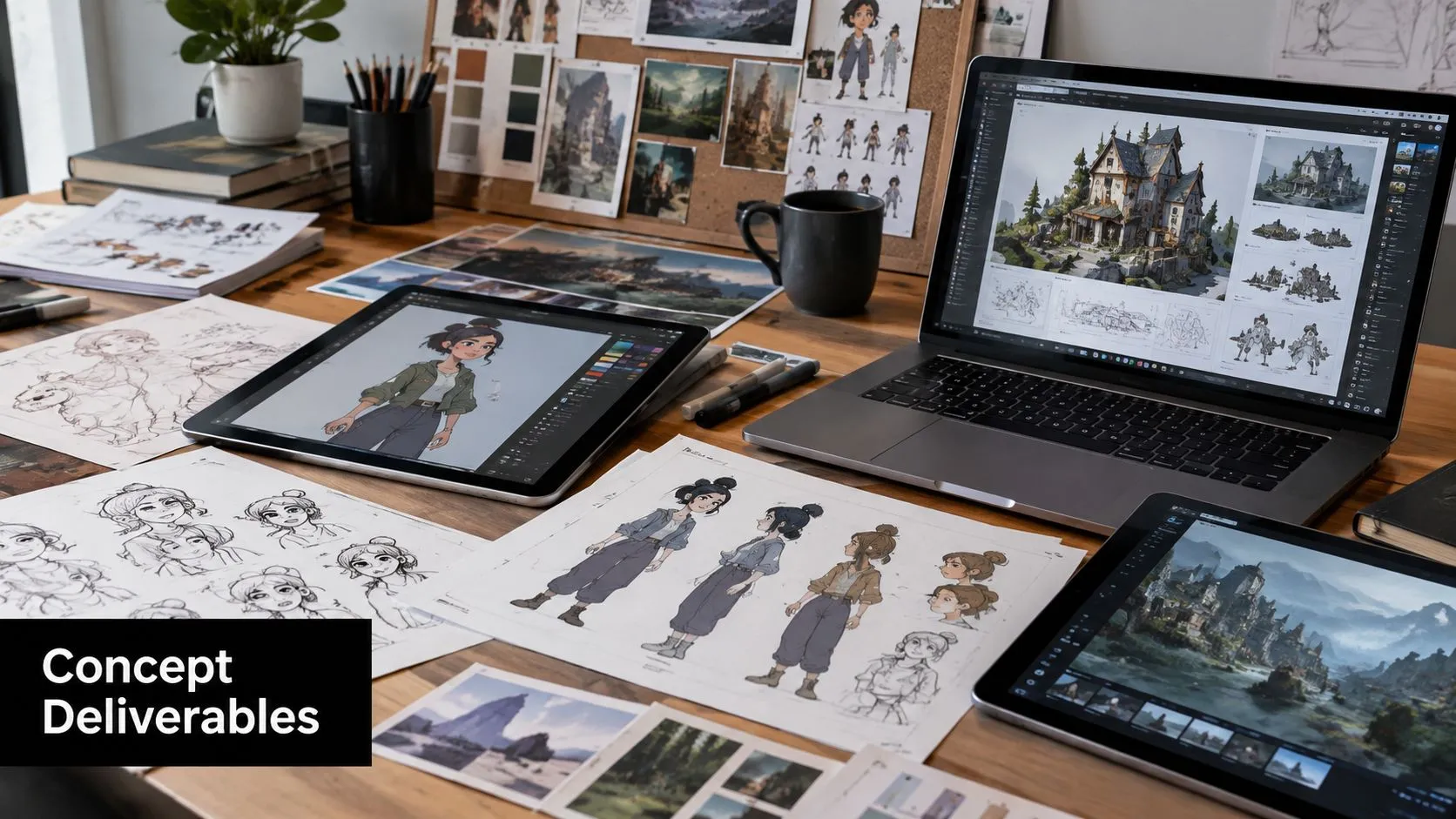
Character work usually starts with silhouette and attitude. The courier might be short and compact, with a large weatherproof coat, or tall and angular, with equipment that creates an unmistakable outline. Quick variations help the director compare personality without becoming distracted by surface detail. A selected direction can then develop into:
- •front, side, and rear turnarounds
- •expression and pose sheets
- •costume and prop callouts
- •scale comparisons
- •colour and material references
A turnaround isn't a beauty illustration. It gives a modeller enough information to construct the character consistently. Expression sheets help the animation team understand the intended range, while pose studies test whether the design remains readable during action. For a deeper breakdown of how silhouette, proportion, expression, and function work together, this guide to character design fundamentals is a useful companion resource.
Environment art
The floating islands need more than attractive vistas. Environment design establishes how people live, travel, work, and understand their surroundings. A broad establishing painting might show the scale of the city, while focused studies define the courier's workshop, a transit platform, and the maintenance tunnels beneath the turbines. Environment art can clarify:
- •Spatial rules, including scale, access routes, and sightlines
- •Material language, such as painted metal, exposed machinery, or weathered wood
- •Lighting direction, from soft morning haze to harsh industrial glare
- •Narrative function, showing whether a location feels safe, congested, abandoned, or unpredictable
This distinction matters in production. A location that looks impressive but offers no clear staging opportunities may force layout artists to redesign it later.
Prop designs and keyframes
Props connect characters to their world. The courier's delivery case might reveal the society's technology, while a mechanical bird could function as transport, companion, or surveillance device. Design sheets should show how objects open, move, attach, and scale against the characters who use them. Keyframe illustrations operate differently. They're cinematic images of important story moments, such as the courier discovering a damaged turbine during a storm. A successful keyframe tests composition, emotion, scale, colour, and narrative clarity at once. It can also expose whether the story's most important beat has enough visual force to justify the production effort. Britain's animation tradition has long connected hand-made visual development with screen storytelling. The BFI's Animated Britain collection describes artists who “drawn, sculpted, snipped, stamped, posed, clicked and scratched” their work into celluloid life. Modern tools have changed the medium, but the underlying discipline remains familiar: visual decisions come first, then production gives them movement.
The Modern Workflow AI and the Artist
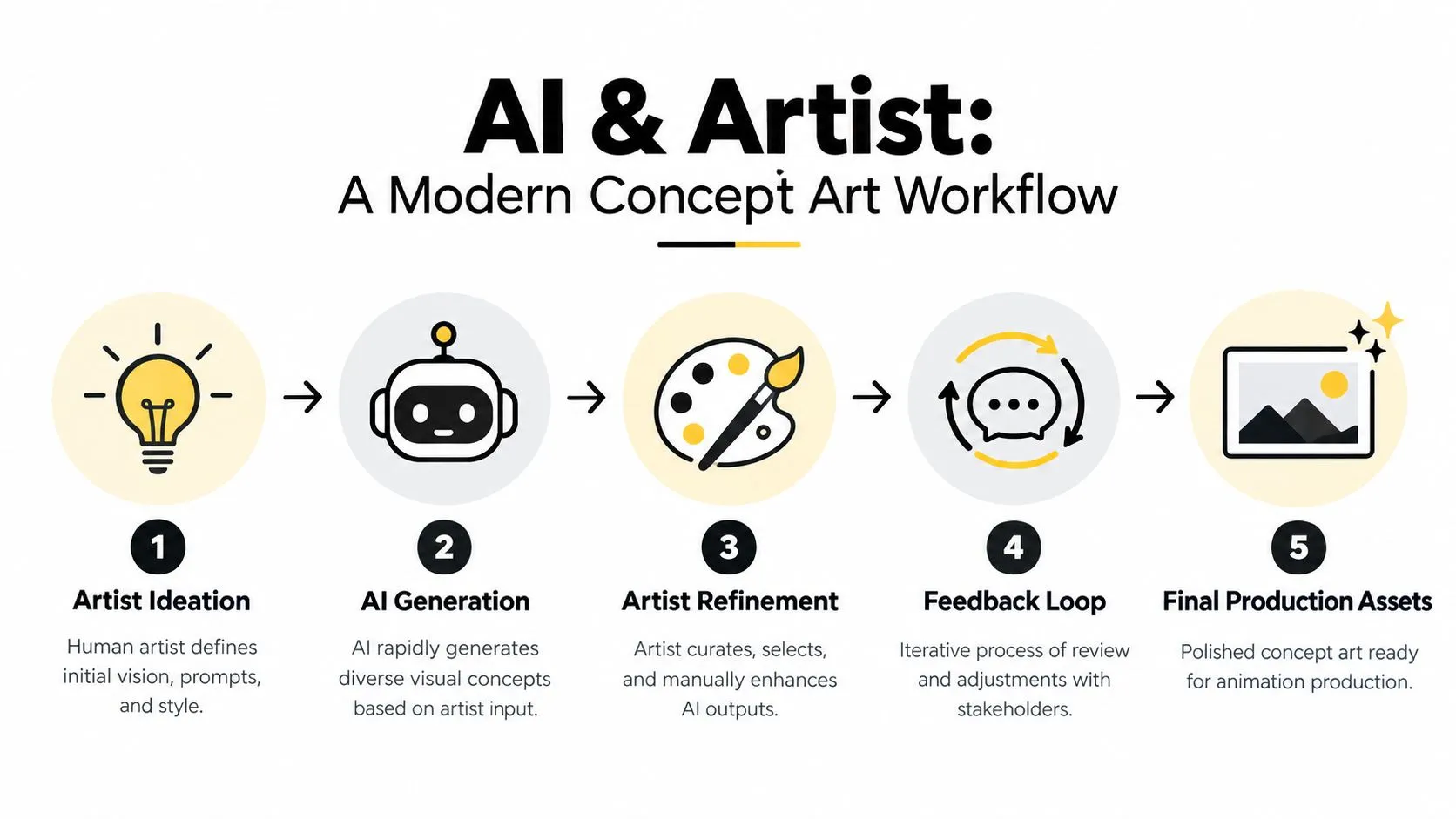
A producer preparing a pitch, XR prototype, or technical explainer may need several visual directions before a team can judge scope. AI-assisted tools can generate those options quickly, but an experienced artist must turn exploration into decisions the production can use. The tool does not know the story logic, asset requirements, audience, brand constraints, or technical pipeline without human direction. The artist starts by defining the visual problem, gathering references, setting the intended style, and shaping the generation task around the project. Studio Liddell's producer guide to Open Art AI provides useful context for assessing this kind of workflow, including its practical implications for production teams.
A practical collaboration model
- Artist ideation
- AI generation
- Artist refinement
- Feedback loop
- Final production assets
 The risks require the same discipline as the creative work. Teams should clarify tool permissions, reference ownership, client confidentiality, and whether generated material suits the intended distribution model. Studios should also preserve editable working files and record how final assets were developed. The UK's VFX and animation industry saw a 7.6% workforce contraction in H1 2025, according to the UK VFX and animation world atlas. In that situation, attractive images alone may not demonstrate production value. Art direction, pipeline literacy, visual problem-solving, and AI supervision show whether an artist can support decisions, manage revisions, and prepare material for delivery. AI works best as a co-pilot for iteration. A senior artist still decides what belongs in the world, serves the story, can be built, and will be understood by the audience.
 How to Commission Concept Art A Guide for Businesses
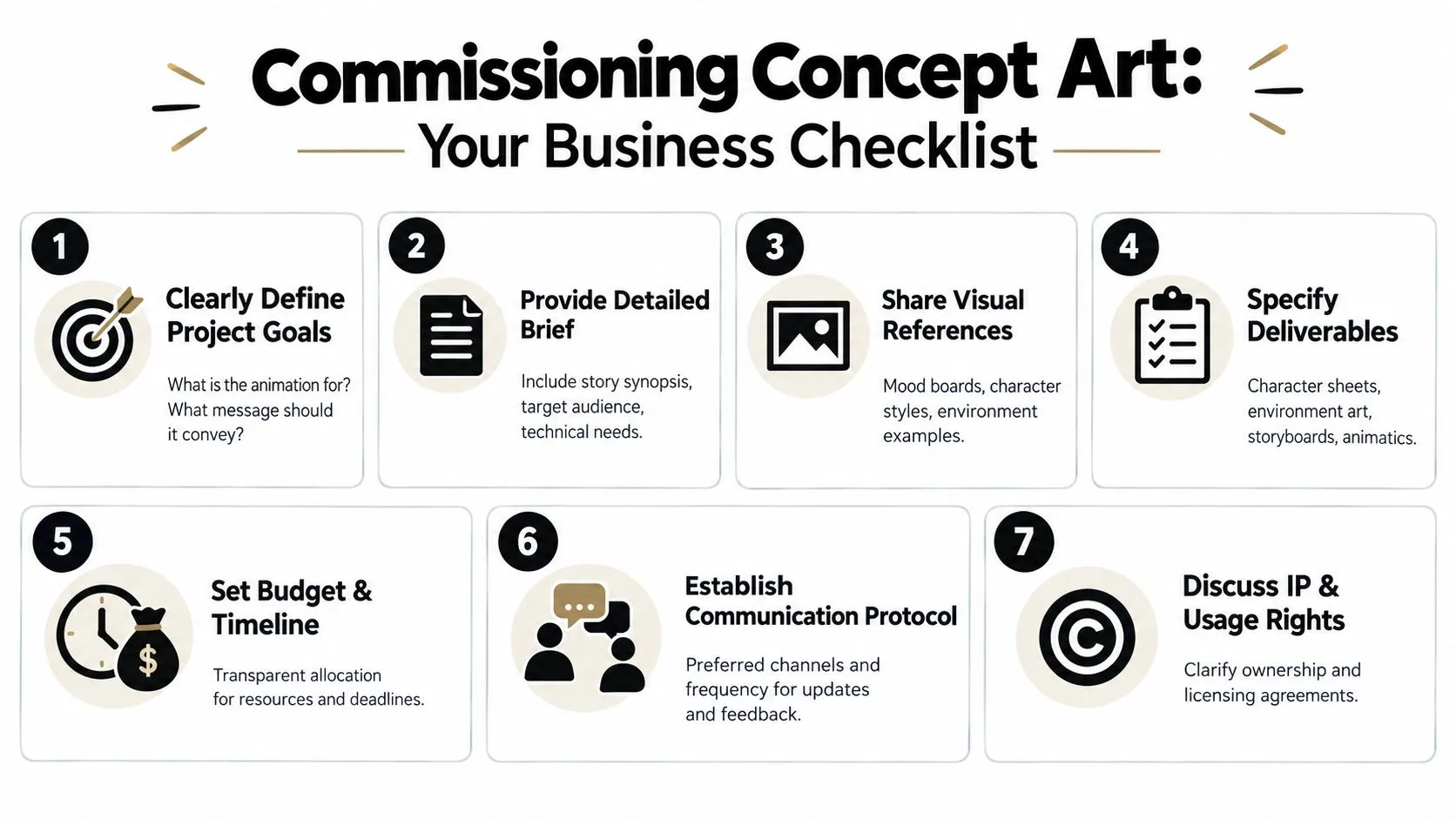
A non-creative commissioner doesn't need to write like an art director. They do need to provide enough information for an artist to make good decisions. A vague request such as “make it cinematic and modern” transfers the hardest strategic work to the studio without explaining what success means. Start with the outcome. Is the artwork for a funding pitch, a TV series bible, a game prototype, an XR experience, an explainer video, or an internal stakeholder presentation? The purpose determines the level of detail, the number of deliverables, the review process, and the technical information the artist needs.Build the brief around decisions
Use the following sequence when preparing a commission.- Define the project and audience
- Describe the visual ambition
- Set the narrative priorities
- Specify deliverables
- State technical constraints early
- Agree review points and feedback ownership
- Clarify rights and working files
Budget, schedule, and feedback
Set expectations around stages rather than asking for an undefined final image. A useful commission might move from rough explorations to selected directions, then to refined production references. The exact schedule depends on scope, revision rounds, complexity, and whether the work needs technical preparation for modelling, animation, or real-time development. Feedback becomes more efficient when comments are specific. “The character feels too old” is less useful than “The target audience needs to read the character as a young adult, so reduce the facial severity and adjust the posture.” “Make it more exciting” should become a clear request about contrast, scale, camera angle, colour, or action. For adjacent visual development work, TattoosAI's tattoo concept artist workflow offers a useful example of how an idea can move from reference and composition through refinement into a design intended for a particular physical application. The same principle applies here: the artwork must serve its eventual use, not exist only as an attractive standalone image.Choose deliverables that earn their place
A commissioner should challenge every requested image with one question: Who will use this, and what decision will it support? A keyframe may help secure approval, while a turnaround may be essential for modelling. A colour script may align the lighting team, while a rough spatial sketch may reveal that an XR interaction won't work from the intended player position. That discipline prevents two common failures. The first is commissioning polished images that don't guide production. The second is requesting a large volume of artwork before the core visual direction has been approved. Start with the decisions that enable the next stage, then add detail where it creates practical value.Concept Art Is Your First Step to Production
Animation concept art sits at the point where creative ambition meets production reality. It gives a producer a way to test a world before building it, gives a director a visual language to lead with, and gives every downstream department a reference they can interpret consistently. Its value changes with the project, but the principle remains stable. For an animated series, it can define character identity, environments, and the visual promise of an IP. For an XR training module, it can test spatial logic, interaction context, and the clarity of a simulated environment. For a technical explainer, it can turn an invisible process into a sequence of understandable visual metaphors. The UK's animation ecosystem has developed from early hand-made experimentation into a professional production industry supported by television, training, public policy, and commercial demand. That history matters because it shows that visual development has never been an afterthought. Artists have always had to decide what the audience will see before the production pipeline can make it move.The commercial test
A strong concept pack should help you answer four questions:- •Does the idea communicate immediately?
- •Does the visual identity distinguish the project?
- •Can the proposed world and assets be produced within the intended pipeline?
- •Can stakeholders agree on what they're approving?
If the answer to any of these is no, more rendering won't solve the problem. The team needs further visual investigation, better references, a clearer brief, or a more suitable production strategy. Concept art doesn't guarantee a successful final film or experience. It does something more practical. It exposes uncertainty while changes are still manageable, protects later departments from avoidable ambiguity, and gives the final work a coherent visual foundation. Whether you're developing children's content, a commercial campaign, a virtual reality simulation, a game, or a complex technical explanation, start by making the idea visible. Then invite the right people to challenge it before production locks the cost of being wrong. --- Studio Liddell develops character and world designs, refines 2D visual development before 3D modelling and rigging, and supports animation, real-time, and XR projects through AI-assisted production workflows. Visit Studio Liddell to arrange a visual strategy session or concept sprint for your next project.