Advertising in Games: A Practical Guide to advertising in games
When you hear "advertising in games," your mind might jump to those annoying, disruptive pop-ups that pull you right out of the action. But that’s a relic of the past. Today, it’s all about placing branded content so seamlessly into the game's world that it actually adds to the experience. Think of it like product placement in a film, but with a crucial interactive twist. For brands, this has opened up a brilliant way to connect with huge, deeply engaged audiences that are notoriously hard to reach.
Why Advertising in Games Is Your Next Growth Channel
Gaming isn't some niche hobby anymore; it’s a cultural juggernaut. It’s a dynamic, living ecosystem where your brand can build real, lasting connections. So, it's time to ditch that outdated stereotype of a teenager in a dark basement. The modern gamer is everyone, spanning every age, gender, and background imaginable. That’s what makes advertising in games such a powerful, and frankly essential, part of any modern marketing plan. The secret to getting it right is simple: value exchange, not interruption. The best campaigns don't break the spell; they become part of the magic. Picture a branded car in a racing game or a virtual billboard in a sprawling city adventure. These touches make the world feel more real and give players a natural way to discover your brand without feeling like they’re being sold to.
Tapping into a Thriving UK Market
Here in the UK, the scene is particularly ripe for this kind of marketing. The in-game advertising market is booming, driven by the explosion of mobile gaming and a flood of new brand investment. It’s all tied to the phenomenal growth of the UK games market as a whole. It jumped from £4.99 billion in 2022 to a massive £5.37 billion in 2023, that’s a 7.4% hike in just one year. British consumers are hungry for personalised, interactive ads that feel like a natural part of their gameplay. Now is the perfect time to get in on the action. You can explore more data on the surging number of gamers that's fuelling this growth.
The goal is to move beyond simply placing an ad and instead create a memorable brand moment. Whether it's through a custom-animated character, an immersive virtual reality experience, or a cleverly integrated product, the right creative approach makes your brand part of the story.
This guide is here to pull back the curtain for business leaders and marketers like you. We’re going to walk through everything you need to know. We will explore:
- •The Different Ad Formats: From static billboards to fully interactive advergames.
- •Creative & Technical Production: What it takes to create assets that look and feel authentic.
- •Measuring Success: How to prove ROI beyond simple impression counts.
- •Choosing a Partner: Why a creative studio with a pedigree in animation and interactive content is crucial.
By the end, you'll have a clear roadmap for bridging the gap between your brand and the vibrant world of gaming, unlocking a powerful new channel for growth and engagement.
What Are The Main Types of In-Game Advertising?
To really get a grip on advertising in games, you first need to understand the creative toolbox you have to work with. These different ad formats aren't just about showing a promotion; they represent completely different ways of talking to your audience. Each has its own unique strengths and impact on the player's experience. The big idea here is shifting from _interruption_ to _integration_. Think of a game's world as a digital stage. Does your brand want to be part of the scenery? A character in the play? Or the whole theatre itself? The choice you make will completely change how players see and feel about your message. Let's break down the three fundamental approaches: Intrinsic, Extrinsic, and Advergames. Getting your head around how each one works is the first step to matching your campaign goals with the right creative execution.
Intrinsic Advertising: A Seamless Part of the World
Intrinsic ads, sometimes called in-game environment ads, are the most natural form of advertising you'll find in games. They are woven directly into the game world, appearing as authentic elements that actually add to the realism rather than pulling you out of the experience. Picture a racing game where the cars are covered in real-world sponsor logos, or a football title where the stadium hoardings show off familiar brands. Those are classic examples. These ads exist within the game's 3D space, and players see them simply by playing the game. It's an incredibly powerful way to build brand awareness and positive feelings because it just feels right. When we talk about the core types of in-game advertising, it's vital to understand how native advertising fits in so perfectly. These ads take on the form and function of the game itself, making them feel like they belong. This is where high-quality 3D animation and modelling become absolutely essential, ensuring any branded items perfectly match the game's unique art style.
Extrinsic Advertising: A Clear Value Exchange
Extrinsic ads, on the other hand, exist outside the main gameplay. Unlike their intrinsic cousins, they are clearly identifiable as ads and usually show up during natural pauses in the action, think loading screens, menu pages, or between levels. By far the most successful type of extrinsic ad is the rewarded video. This format offers players a straightforward deal: watch a quick video ad, and in return, you get something valuable in the game, like extra lives, virtual cash, or a special item.
Rewarded video ads see a completion rate of around 90-95% because players are actively choosing to watch them. This opt-in model makes them a fantastic tool for performance-focused goals like driving app installs or generating leads, as you're reaching a motivated and receptive audience.
Other common extrinsic formats include:
- •Interstitial Ads: These are full-screen ads that pop up between gaming sessions or levels.
- •Offerwalls: A sort of menu where players can complete different tasks (like signing up for a service) to earn in-game rewards.
- •Playable Ads: Think of these as mini-game demos that give players a small taste of another game, tempting them to download it.
Advergames: The Brand _Is_ the Experience
Advergames are the deepest form of brand integration possible. Instead of just putting an ad _in_ a game, the brand commissions an entire game built from the ground up around its identity, products, or marketing message. It's the ultimate way to create an immersive and unforgettable brand experience. For a more detailed look, you can check out our complete guide to in-game ad formats and strategy. An advergame can be anything from a simple web-based puzzle game to a complex mobile or even VR experience. The goal is always to entertain the player while subtly reinforcing the brand's values and messages through the gameplay, characters, and storyline. A great advergame creates a fun, positive connection that can build serious brand loyalty long after the player has put it down.
How Mobile and Immersive Ads Are Changing the Game
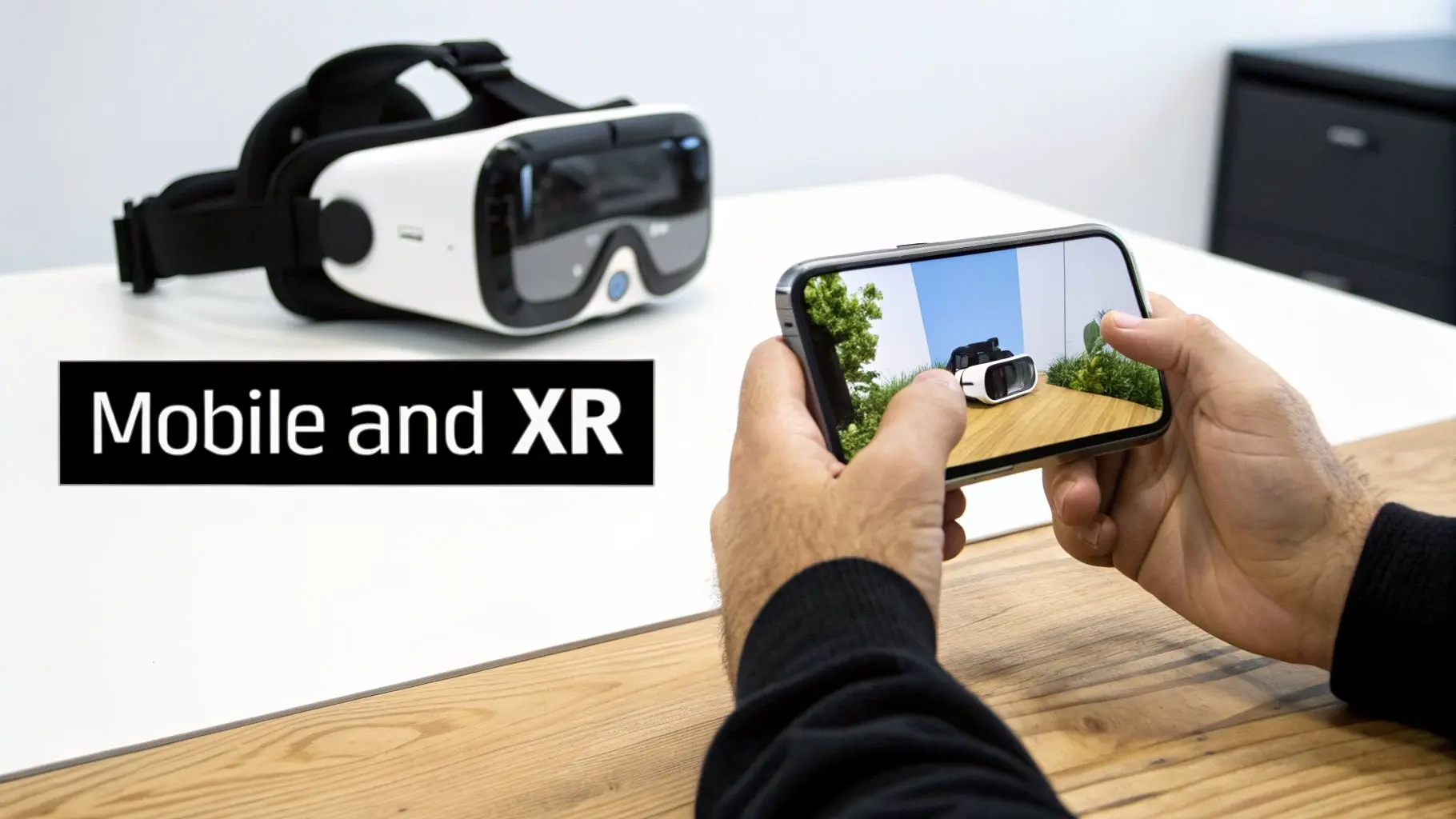
While the core ad formats we’ve covered are the bedrock of in-game advertising, two powerful forces are completely redrawing the map. The first is the sheer dominance of mobile gaming, which has put a high-powered arcade in every pocket. The second is the arrival of immersive tech like Virtual and Augmented Reality (XR), which lets brands create experiences that were, until recently, pure science fiction. Getting to grips with these trends is vital for any future-facing brand strategy. They aren't just new places to put an advert; they're new ways of thinking about how you interact with an audience. One offers incredible scale, the other delivers unparalleled depth and connection.
Mobile Gaming: The Undisputed Advertising Powerhouse
For a massive number of people, mobile gaming _is_ gaming. In the UK, more people play games on their phones than on consoles and PCs combined. This isn't just about reaching a lot of people; it's about connecting with an unbelievably diverse audience during moments of intense focus. This mobile-first world is the engine driving the growth of in-game advertising in the UK. Brands are finally waking up to the opportunity for personalised, mass-scale engagement. With European gamers racking up some of the highest playtimes in the world, it’s no surprise British brands are investing heavily. This reflects the global trend, with the market forecast to jump from $11.02 billion in 2023 to $18.17 billion by 2028. You can explore more on the future of in-game ads in 2025 on warc.com. The best mobile ads are the ones that respect the player’s experience. Intrinsic ads, like a branded billboard in a racing game, or rewarded video ads that offer in-game currency are ideal. They grab attention without derailing the fun. For a much deeper look, check out our complete guide to advertising in mobile games for growth and monetisation.
Immersive Advertising: The New Frontier of Brand Experience
Look beyond the smartphone screen and you'll find the next great frontier for advertising: immersive XR. This is where Augmented Reality (AR) and Virtual Reality (VR) stop being tech buzzwords and start becoming genuine platforms for powerful brand storytelling. Instead of just _showing_ someone your product, what if they could actually _experience_ it?
- •Augmented Reality (AR): This tech layers digital content onto the real world through a phone or tablet. For a brand, this could be an AR filter letting someone "try on" a new watch, or an app that places a virtual sofa in their living room to check the size and colour.
- •Virtual Reality (VR): VR plunges the user into a completely computer-generated world. It allows brands to build entire virtual showrooms, create compelling narrative experiences, or even develop training simulations that put users right in the heart of the action.
Immersive ads aren't about passively watching something. They’re about active participation. They create a feeling of "presence" that a static image or video could never hope to match, leading to far higher recall and a much stronger emotional connection to the brand.
This isn't just theory. Imagine a trade show where attendees use an AR app to see your complex machinery in full 3D on your stand, exploring it from every angle. Or picture a high-energy live event built around a mixed-reality game, where players physically interact with digital characters and branded challenges for a truly unforgettable time. This is exactly what we built for the event game _Dance! Dance! Dance!_, proving how immersive tech can create high-impact, high-throughput brand interactions. Producing these kinds of experiences needs a unique mix of creative vision and deep technical skill. It means designing for spatial environments, developing for platforms like Unity and Unreal, and optimising everything for hardware like the Meta Quest. For brands brave enough to step into this new space, immersive advertising is a chance to create something genuinely unforgettable.
A Producer’s Guide to Creating High-Quality In-Game Ads
An in-game ad is only as good as its creative. A brilliant idea can fall completely flat if the final asset looks out of place, feels clunky, or worse, causes the game to stutter. This is where the production process becomes absolutely critical. It’s a journey that takes a simple brand brief and transforms it into a polished, fully integrated piece of content. The kind that actually resonates with players and respects the world they’re immersed in. Studio-quality advertising assets demand a delicate mix of artistic talent and hardcore technical precision. It’s not just about making something look good; it’s about making it work flawlessly across a huge range of devices, from a top-spec gaming PC to a budget smartphone. The goal is always the same: create an ad that feels like it _truly belongs_ in the game.
The Production Pipeline: From Pitch to Polish
Creating an in-game ad is a multi-stage process, and skipping steps is a recipe for disaster. Think of it like building a house: you need a solid blueprint before you start laying bricks. A structured workflow like this prevents costly mistakes and ensures the final product hits every creative and technical target. A typical production journey breaks down into a few key phases:
- Concept & Storyboarding: This is where the core idea takes shape. We translate the campaign goals into a visual narrative with sketches and storyboards. It’s all about defining the ad's look, feel, and message before anyone commits to expensive production time.
- Asset Creation (2D/3D): Once the concept is green-lit, our artists get to work building the creative assets. This could be anything from 2D graphics and detailed 3D product models to fully rigged characters ready for animation.
- Animation & Motion: Now, we bring the static assets to life. For a rewarded video, this might mean a full, dynamic animated sequence. For an intrinsic ad, it could be as subtle as the gentle flicker of a branded neon sign in a sprawling virtual city.
- Integration & Optimisation: The finished asset is imported into a game engine like Unity or Unreal Engine. This stage is all about technical performance, making sure the ad runs silky smooth without tanking frame rates or dragging down loading times.
- Testing & QA: Finally, the ad is put through its paces. We test it rigorously across all target devices and platforms to catch any visual glitches, performance hitches, or integration problems _before_ it ever goes live.
Matching Creative Production to the Ad Format
Different ad formats have completely different creative and technical demands. A simple banner ad needs a vastly different skillset and workflow compared to, say, an immersive VR brand experience. Getting your head around these needs is the key to planning a project that runs smoothly and on budget. The table below gives you a sense of the production requirements for the main types of in-game ads. #### Creative Production Needs By Ad Format| Ad Format | Key Creative Assets | Typical Production Lead Time | Core Skills Required |
|---|---|---|---|
| Intrinsic Ads | 3D models, textures, environment art | 2, 6 weeks | 3D modelling, texturing, technical art |
| Rewarded Video | 2D/3D animation, motion graphics, sound design | 4, 8 weeks | Animation, storyboarding, video editing |
| Playable Ads | Mini-game loop, UI/UX design, simple 3D assets | 6, 10 weeks | Game design, programming, UI/UX design |
| Advergames | Full game design, character/world art, soundscape | 3, 9+ months | Full-stack game development, IP creation |
The most crucial element is authenticity. For an intrinsic ad, the real challenge is making a branded object, like a vending machine, match the game's unique art style perfectly. The skills needed for this, broadcast-quality animation and technical art, especially from fields like creating visual explainers for complex topics, are directly transferable to achieving this seamless integration.
Technical Specs for a Flawless Player Experience
Let’s be clear: a great-looking ad that slows the game down is a failure. Technical performance is completely non-negotiable. This means every single creative asset has to be meticulously optimised for its target platform, whether that’s mobile, PC, console, or VR. Here are a few of the technical things we obsess over:- •Polygon Count: For 3D models, keeping the "poly count" low is vital. It ensures they don’t put too much strain on the game engine and slow things down.
- •Texture Resolution: Textures need to look crisp and clear, but they also have to be compressed efficiently to manage memory usage. This is especially important on mobile devices where resources are limited.
- •Draw Calls: This is a technical term for how many times the game engine has to "draw" an object on screen. Optimising assets to reduce draw calls is absolutely essential for maintaining a smooth, high frame rate.
- •File Size: For rewarded videos or playable ads, the total file size must be kept as small as possible. This ensures quick loading times and minimises data usage for players on mobile networks.
Successfully juggling these creative and technical demands is what separates an amateur effort from a professional, high-impact in-game ad. It takes a partner with deep experience not just in creative production, but in the specific, often tricky, technical pipelines of game development. This is how you ensure your brand’s message is delivered beautifully and effectively, enhancing the game rather than getting in its way.
How to Measure Success and Prove Campaign ROI
A slick in-game ad is only half the battle. To justify your investment and sharpen your strategy, you need to prove it’s actually working. Measuring success in gaming goes way beyond surface-level metrics like impressions or clicks. It’s about understanding genuine player engagement and tangible brand impact. True measurement for advertising in games means looking at metrics that reflect the unique, interactive nature of the medium. You need to know if players are just _seeing_ your brand, or if they're actively engaging with it. Most importantly, is that engagement building a positive connection?
Beyond Impressions: Metrics That Truly Matter
To get a clear picture of how your campaign is doing, you have to set clear Key Performance Indicators (KPIs) right from the start. Different ad formats are built to achieve different goals, so your measurement strategy has to be tailored accordingly. Essential metrics to keep an eye on include:
- •Completion Rate: For rewarded videos, this is a massive one. A high completion rate, often over 90%, shows that players find the trade-off worthwhile and are actively watching your entire message.
- •Interaction Rate: For intrinsic ads or interactive elements, this tracks how many players actually engaged with the branded asset. Did they take the branded car for a spin? Did they click on the virtual billboard to learn more?
- •Brand Lift: This is the gold standard for awareness campaigns. Measured through surveys, it reveals changes in brand perception, awareness, and purchase intent among players who saw the ad versus a control group who didn't.
- •Player Sentiment: Keeping an ear to the ground on social media and gaming forums can provide priceless qualitative feedback. Are players talking positively about your integration, or are they complaining that it's disruptive?
This process shows the core production flow, ensuring that measurement and analytics are baked in from the very beginning.
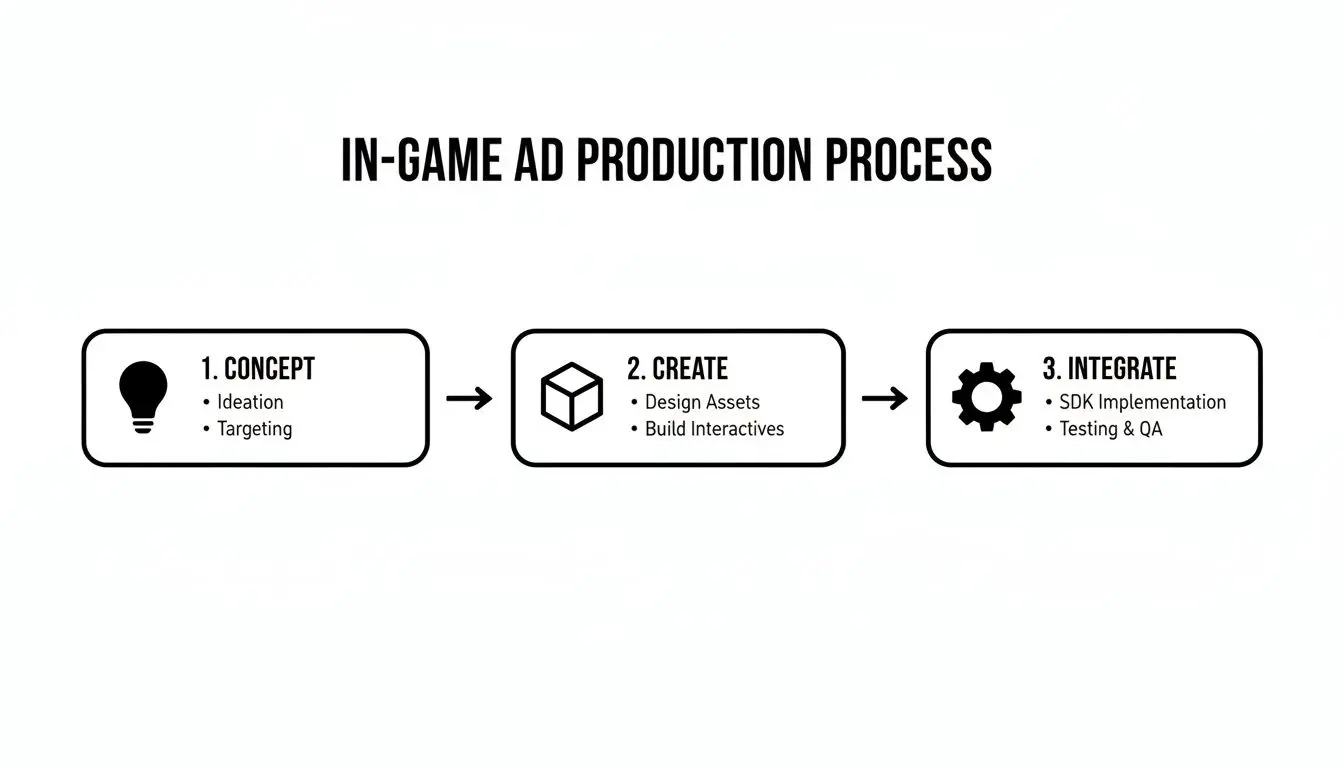
As the flowchart shows, a successful ad isn't just about a good idea. It needs a structured pipeline from concept all the way to integration, with analytics informing every single step.
Proving a direct financial return is often the ultimate goal. For a granular understanding of how your in-game advertising contributes to revenue, learn how to calculate your return on ad spend. This helps connect campaign data directly to bottom-line business impact.
Data Privacy and Compliance in Gaming
As soon as you start gathering data to measure success, you step into the critical territory of data privacy. Here in the UK and across Europe, the General Data Protection Regulation (GDPR) lays down strict rules for how user data can be collected, stored, and used. Getting this wrong isn't just a legal headache; it's a direct threat to your brand's reputation. Players are, quite rightly, protective of their data. Even a hint of misuse can spark a severe backlash, undoing all the positive brand sentiment you’ve worked so hard to build. This is precisely why partnering with a reputable studio that has a deep understanding of compliance is non-negotiable. An experienced partner will make sure all data collection methods are transparent and based on clear consent. They’ll navigate the technical and legal minefield to protect both your brand and the players, ensuring your campaign is not only effective but also ethical and secure. Understanding how data underpins monetisation is a key part of this. For more on this, check out our essential guide to app monetisation.
Choosing the Right Creative Partner for Your Campaign
Successfully launching an in-game advertising campaign pulls together everything we've talked about. It takes a rare mix of raw creative vision, deep technical know-how, and a genuine respect for the culture of gaming. Honestly, the single most critical decision you’ll make on this journey is picking the right creative partner to guide you. This isn't just about hiring someone to make an ad. It's about finding a guide who can navigate the entire, often complex, process with you. With the right studio in your corner, stepping into the gaming space transforms from a daunting challenge into a thrilling opportunity to connect with millions of engaged fans.
What to Look for in a Studio Partner
Your ideal partner should be more than a supplier; they need to operate as a strategic extension of your team. Their expertise should cover the full production pipeline, from the first spark of an idea and character design right through to the final technical integration and analysing performance. It’s this end-to-end capability that makes a complicated project manageable and, ultimately, a success. Look for a studio that can really show its strengths in these key areas:
- •A Broadcast Pedigree: A background creating top-tier animation for demanding formats like TV series or commercials shows they have the creative and technical discipline to deliver. Our work on BooSnoo for Sky Kids, for instance, proves that kind of rigour. It’s your assurance that your brand assets will meet the high visual standards players expect.
- •Technical Artistry: The skill to create assets that are both visually stunning and technically optimised for a game engine is absolutely vital. This covers everything from 3D modelling and character rigging to truly understanding the specific demands of engines like Unity and Unreal Engine.
- •Immersive Tech Expertise: Hands-on experience in AR and VR production is a massive green flag. It shows they're not just thinking about today, but about what's next. Our work on the mixed-reality game _Dance! Dance! Dance!_ is a good example of creating the kind of genuinely memorable brand experiences that make you stand out.
At the end of the day, you're looking for a partner who gets it. They need to understand that an in-game ad isn't just marketing collateral, it's a piece of entertainment. They must respect the player's experience above all else, making sure your brand adds something to the game's world instead of just taking up space.
From IP Development to Cross-Platform Success
The best partnerships grow beyond a single campaign. A truly versatile studio can help you think bigger, exploring how to build out your brand's own intellectual property across a whole range of platforms. This kind of strategic thinking is what turns a one-off ad placement into a long-term, brand-building exercise. Just imagine taking a character developed for an ad campaign and giving them their own series of animated shorts, or even a simple mobile advergame. That’s the real power of transmedia IP development; it’s how you turn a marketing asset into a beloved character. With the right guide, you can confidently brainstorm, produce, and launch in-game campaigns that leave a lasting, positive mark on one of the world's most passionate audiences.
Your Burning Questions About In-Game Advertising
Diving into the world of in-game advertising can feel like stepping into a new level. It's a fast-moving, dynamic space, and it's completely natural to have a few questions before you commit. We get it. Let's walk through some of the most common queries we hear from brands and clear things up.
Isn't Advertising in Games Just for Brands Targeting Young Men?
That's one of the biggest myths out there, and frankly, it's long been busted. The gaming audience today is incredibly diverse, spanning every age, gender, and walk of life you can imagine. Mobile gaming, in particular, has been a game-changer, bringing a huge female audience into the fold. The real secret isn't about targeting "gamers" as a monolith; it's about smart audience mapping. A great campaign kicks off by figuring out which specific games your ideal customer is already engrossed in. Once you know that, the work is about weaving your brand into those worlds in a way that feels right and gets your message to the people who matter.
What's the Real Cost of Advertising in Games?
This is a classic "how long is a piece of string?" question. The cost can swing wildly depending on what you’re trying to achieve. At one end, you have programmatic ad buys for simpler formats, like an in-game billboard (intrinsic advertising) or a video a player chooses to watch for a reward (extrinsic rewarded video). These can be surprisingly affordable, often sitting in the same ballpark as your typical digital ad spend. At the other end, you're looking at creating bespoke, custom creative. This is where the magic really happens, but it requires a more significant investment. Developing a stunning 3D animated model of your product for placement in a game, or even building a whole branded advergame from the ground up, is a studio-level production. It’s best to start with clear goals and then figure out the most effective path that fits your budget.
Here's the thing to remember: poor execution is way more damaging to your brand than doing nothing at all. In-game advertising today is all about respecting the player and adding to their experience, not jarring them out of it with something that feels cheap or tacked on.
Will In-Game Ads Just Annoy Players and Damage My Brand?
A totally valid worry, and the answer comes down to one thing: execution. The whole focus of modern advertising in games has shifted towards being non-disruptive. We call these "intrinsic" formats, and they're designed to feel like a natural part of the game's world. Think of a real-world brand on a billboard in a realistic city-based game, or your logo on a car in a racing simulator. It just fits. Even ads that aren't part of the scenery, like rewarded videos, are incredibly well-received. Why? Because they offer a clear value exchange. Players actively choose to watch an ad to get an in-game boost or item. The key is to avoid clunky, intrusive ads that shatter the immersion and to always, always put the player's experience first.
Ready to see how your brand could make a real impact in the gaming universe? Studio Liddell has the creative firepower and technical know-how to bring your vision to life. Book a production scoping call