Advertising Mobile Games: A Guide To Growth And Monetization
If you’ve ever wondered how a completely free mobile game can transform into a billion-pound business, you’re looking at the results of a powerful economic engine. It’s a finely-tuned system built on the relationship between game developers, players, and advertisers , and it’s what has made mobile gaming a true giant of the entertainment world. At the very heart of this system is the free-to-play (F2P) model. By dropping the upfront price tag, developers open their doors to millions of players across the globe. This massive audience is the foundation for making money, and advertising is the main pillar. Think of the mobile gaming space as a huge, bustling digital arcade; the ads are the bright, flashing signs that pull players in to try something new. This creates a powerful, self-fuelling cycle:
- •Developers run advertising campaigns to bring new users into their games.
- •Players get to enjoy high-quality entertainment without paying a penny to start.
- •The money made from ads and in-app purchases gets ploughed back into creating fresh content and, you guessed it, acquiring even more players.
This model is the rocket fuel behind the market's explosive growth. Just look at the UK's mobile game development industry, a major hub for this kind of activity. Revenue is on track to hit £1.8 billion in 2026, growing at a compound annual rate of 1.5% in the five years leading up to it, with a significant 3.8% jump expected in that final year alone. You can dive deeper into these figures in IBISWorld's report on the UK's mobile game development scene.
The Scale And Scope Of In-Game Advertising
The market for advertising inside games isn't just growing; it's becoming a go-to channel for brands that want to reach people who are genuinely paying attention. Mobile gamers aren't a niche group anymore. They span every age, gender, and interest imaginable, making this an incredibly valuable space for advertisers to play in. This chart from Statista paints a clear picture of just how much money is flowing into in-game ads in the United Kingdom, and how many people it's reaching. That steady, year-on-year climb shows the growing confidence advertisers have in this medium. This is about so much more than just sticking a banner at the bottom of the screen. It's about weaving brands into an immersive entertainment experience that commands undivided attention.
Building Your Player Acquisition Playbook
Getting a steady flow of new players, what we in the industry call User Acquisition or UA, is the absolute engine of a mobile game's growth. It’s not just a numbers game; it’s a smart blend of art and science. To succeed, you need a diverse strategy that doesn’t just lean on one channel. A resilient playbook is all about understanding what each platform does best and weaving them together to find your perfect audience. Think of it like a well-balanced investment portfolio. Relying on a single ad network or social platform is risky. A multi-channel approach not only widens your reach but also acts as a safety net, protecting your game from the whims of market shifts or a sudden algorithm change on any one platform. This is especially true in the Free-to-Play (F2P) model, where advertising is the financial lifeblood that supports the entire game economy.
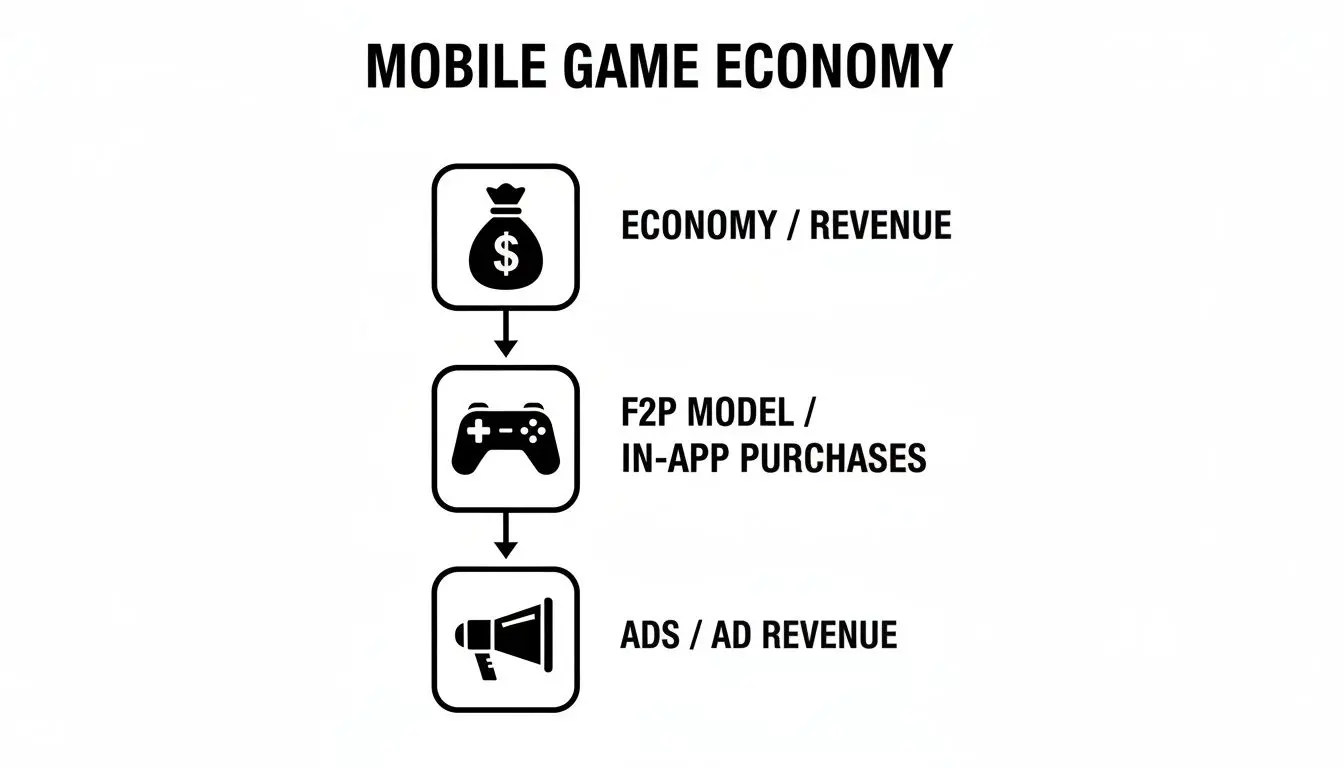
As the diagram shows, there’s a direct line from advertising to the F2P model’s viability, which in turn powers the whole ecosystem. Understanding this relationship is your first step in mastering player acquisition.
The Powerhouse Ad Networks
Mobile ad networks are the heavy-duty workhorses of UA. They’re massive marketplaces connecting game publishers with advertisers, built to deliver installs at an incredible scale. You'll hear names like AppLovin and ironSource thrown around a lot, and for good reason. These giants dominate the space, offering incredibly sophisticated tools to target users across thousands of other mobile apps. These platforms are your go-to for performance-based campaigns, where getting installs is the name of the game. Their algorithms are finely tuned to sniff out users who are most likely to download and play a new game based on their past behaviour. According to data from Tenjin, AppLovin commands a massive 37% of the ad revenue share on iOS. Over on Android, Google AdMob leads with 28%, but AppLovin isn't far behind at 24%.
Precision Targeting On Social Media
If ad networks are about scale, social media is all about surgical precision. Platforms like Facebook, Instagram, and especially TikTok let you dial in on players based on their demographics, interests, and what they do online. This is where having a crystal-clear idea of your ideal player persona really pays off. Is your game for a 35-year-old casual puzzle fan or a hyper-competitive 20-year-old strategy buff? Once you know who you’re talking to, you can craft ad campaigns that speak their language. As you build out your playbook, don't sleep on channels like TikTok. This platform has become essential for mobile games.
Authentic Connections Through Influencers
Influencer marketing flips the script. Instead of casting a wide net, you’re aiming for deep, authentic connections. Partnering with a streamer or content creator who already has the ear of your target audience is an incredibly powerful endorsement. When viewers see someone they trust genuinely having fun with your game, it’s worth more than any slick ad. The secret sauce here is finding the right fit. A creator whose personality and audience are a perfect match for your game’s vibe will drive far more valuable installs than a big-name influencer with a generic following.
The Foundation Of Organic Growth
App Store Optimization (ASO) is the unpaid, organic bedrock of your entire UA strategy. Think of it as SEO for the app stores. It's the craft of optimising your game's page on the Apple App Store and Google Play to climb the search rankings and, crucially, convince people to hit that 'download' button. ASO isn’t a set-it-and-forget-it task; it’s a constant process of tweaking and refining. Your ASO efforts should focus on a few key areas:
- •Keyword Optimisation: This means digging into what your potential players are actually searching for and weaving those keywords into your title, subtitle, and description.
- •Compelling Visuals: Your icon needs to pop. Your screenshots and preview videos need to be exciting, showcasing the very best moments of your gameplay to hook visitors instantly.
- •Positive Ratings and Reviews: Never underestimate the power of social proof. Encouraging happy players to leave good reviews massively influences both your store ranking and the decisions of prospective new players.
Creating Ad Assets That Actually Convert Players
Your user acquisition strategy, no matter how clever, is only as good as the ads you feed it. In the blink-and-you'll-miss-it world of mobile game advertising, your creative is your one shot to convince someone to hit 'download'. The battle for a player's attention is won or lost in the first three seconds. The best ad assets don't just show off gameplay; they tell a compelling micro-story that hooks a potential player and makes them _need_ to know what happens next. This is where high-quality production transforms a simple ad into a powerful conversion machine.

The Most Effective Ad Formats
Not all ad formats are created equal. The right choice hinges on your game's genre, your audience, and what you’re trying to achieve with your campaign. That said, a few formats consistently deliver knockout results for mobile games.
- •Playable Ads: Think of these as interactive, bite-sized demos. They give users a genuine taste of your core gameplay loop, letting them experience the fun for themselves. By lowering that barrier to entry, playables can deliver far higher conversion rates than static ads.
- •Rewarded Video: This format is a simple value exchange, players watch an ad to earn in-game cash, an extra life, or a coveted item. Because the player chooses to watch, engagement is sky-high.
- •Video Ads (Short-Form): These are the fast, punchy, and vertical videos tailor-made for platforms like TikTok and Instagram Reels. They have to grab attention instantly, often using exciting gameplay, funny moments, or dramatic "fail" scenarios to keep people watching.
These interactive formats are especially potent. In-game advertising is seeing huge growth in the UK as consumers get more comfortable with engaging, personalised ads. Rewarded and immersive formats in mobile games boast a near-perfect 99% viewability, a figure that leaves standard social media ads in the dust.
The Power Of A/B Testing
You can never assume you know what will work. The single most crucial part of your creative strategy should be relentless A/B testing. It’s a simple concept: create multiple versions of your ads and pit them against each other to see which one performs best.
A/B testing isn't about finding one "perfect" ad. It's about building a continuous cycle of improvement, where every test gives you data to make your next campaign smarter and more efficient.
You can test almost anything:
- •Characters and Visuals: Does a heroic knight get more clicks than a quirky wizard? Does a blue background outperform a red one?
- •Call-to-Action (CTA): Which works better, "Play Now" or "Download for Free"?
- •Gameplay Footage: Should you show an epic boss fight or a deeply satisfying puzzle-solving moment?
- •Ad Copy and Headlines: Test different hooks to see what really grabs people's attention.
To speed up the process of creating variations, many studios now use specialised tools like a Sora 2 ad creative generator to produce lots of high-quality assets for testing.
Why Localisation Matters More Than You Think
If you want to succeed globally, you have to think way beyond simple translation. True localisation means adapting your ads to fit the cultural nuances, humour, and visual tastes of each specific region. An ad that's a huge hit in the United States might completely miss the mark in Japan or Brazil. Proper localisation involves adapting:
- •Language and Slang: Using local colloquialisms so your ad feels like it was made by a native speaker.
- •Cultural References: Swapping out visuals or themes that might not make sense or could even be misinterpreted.
- •Colour Symbolism: Recognising that colours carry very different meanings from one culture to another.
Investing in proper localisation isn't just a nice-to-have; it shows respect for your international audience and dramatically boosts your ad's effectiveness. By combining these creative strategies, you can build a powerful portfolio of ads that don't just get seen, they consistently drive high-quality installs. To dive deeper, check out our guide to ads for games that win players.
Balancing Monetisation Without Breaking The Game
Getting players into your game is one thing, but building a business that lasts without chasing them away? That’s the real challenge. How do you actually make money without ruining the gameplay and alienating the very audience you worked so hard to build? The secret is a careful, balanced approach to monetisation. Success here isn’t about picking one method over the other. It’s about expertly blending two core revenue pillars: In-App Purchases (IAP) and Ad Monetisation. Nail this mix, and you'll have a game that's not just profitable for you, but genuinely enjoyable for your players.
The In-App Purchase Model
In-App Purchases are pretty straightforward: players spend real money to get something extra in the game. This model is incredibly effective because it targets your most engaged fans, the ones who are already invested and happy to pay for an even better experience. Common IAP strategies you'll see are:
- •Cosmetics: Selling cool character skins, unique outfits, or visual effects. These don't change the gameplay but let players show off their style.
- •Time-Savers: Offering a way to speed up progress, skip waiting times, or unlock content instantly. It's all about convenience.
- •Consumables: Things like extra lives, energy boosts, or piles of in-game currency that get used up and can be bought again.
- •Content Unlocks: Giving players access to new levels, exclusive characters, or entire game expansions for a one-time fee.
The golden rule for IAPs is to make sure paying players get convenience or a bit of flair, not a massive competitive advantage that makes the game unfair for everyone else.
The Ad Monetisation Model
While IAPs are aimed at a small percentage of high-spending "whales," ad monetisation lets you generate revenue from your entire player base. This way, every single person, whether they spend money or not, contributes to your game's bottom line. The UK mobile gaming scene really shows this potential, forming a huge chunk of the £7.16 billion video game market in 2021, where mobile spending alone hit £1.46 billion. This growth is powered by smart monetisation, and it's the hybrid models mixing ads and IAPs that are proving essential. You can learn more about the massive role of advertising in these online gaming statistics. The trick is to choose ad formats that feel like a natural part of the game, not a jarring interruption.
Smart Ad Formats For A Better Experience
- •Rewarded Videos: These are the gold standard for a reason. Players _choose_ to watch a short video ad in return for a valuable in-game reward. Because it’s opt-in, it feels like a fair exchange, not a forced ad break.
- •Interstitials: These are the full-screen ads that pop up at natural pauses, think between levels or after a round. Timing is absolutely everything here. A badly placed interstitial is just annoying, but one that appears when the player is taking a natural break is far more accepted.
- •Offerwalls: An offerwall is like a menu of tasks for players. They can choose to complete a survey, try another game, or sign up for something in exchange for bigger rewards. It puts them in control of how they engage with ads.
The Hybrid Model: The Best Of Both Worlds
The most successful mobile games today don't just pick one; they weave IAPs and ads together into a seamless hybrid model. This approach opens up multiple revenue streams and caters to all the different types of players you have.
Think of your game like a theme park. Some visitors will happily pay for a "fast pass" (IAP) to skip the queues. Others are content to enjoy the park for free, even with brand sponsorships (ads) visible all around them. A hybrid model serves both groups perfectly.
This strategy allows players who don't spend money to enjoy the full game by watching ads, while your "whales" can still buy items to boost their experience. It creates a balanced ecosystem that maximises your revenue potential from every single player. For a deeper dive, check out our guide on 9 proven mobile app monetization models. By carefully choosing your ad formats and IAP offerings, you can build a solid financial foundation that keeps your game going for years to come.
Measuring What Matters With The Right KPIs
In mobile game advertising, you can’t improve what you don’t measure. Throwing money at a campaign without understanding its performance is like trying to navigate a ship without a compass. This is where Key Performance Indicators (KPIs) come in, giving you the hard data you need to make smart, profitable decisions.

These metrics aren't just abstract numbers; they are the language of growth. They tell you exactly what's working, what's not, and where your money is being put to best use. Getting a firm grip on these KPIs gives you the financial framework to manage your ad budget effectively and scale your game with confidence.
The Core Trio Of User Acquisition Metrics
While there are dozens of data points you could track, a few core KPIs form the bedrock of any successful advertising strategy. Understanding how they all fit together is essential.
- •Cost Per Install (CPI): This is the most straightforward metric of the bunch. It tells you precisely how much you're paying to get one person to download your game from a specific ad campaign. The formula is simple: Total Ad Spend ÷ Total New Installs = CPI.
- •Lifetime Value (LTV): LTV is a prediction of the total revenue a single player will generate for you over their entire time playing your game. This includes everything from in-app purchases to revenue earned from them watching ads. It’s a powerful metric that looks beyond the initial download to measure a player’s long-term worth.
- •Return On Ad Spend (ROAS): This is the ultimate measure of profitability. ROAS tells you how much revenue you're earning back for every pound you spend on advertising. It's calculated as Total Revenue from Ad Campaign ÷ Total Cost of Ad Campaign. A ROAS above 100% means your campaign is officially in the black.
Think of it like running a high-street shop. Your CPI is the cost of the flyer that brought a new customer through the door. Your LTV is the total amount that customer spends in your shop over the next few years. And your ROAS tells you if the money you spent on those flyers was a good investment.
A high CPI isn't automatically a bad thing. If you pay £5 to acquire a player (CPI) who then goes on to spend £15 in your game (LTV), you've made a fantastic return on your ad spend. The goal isn't always the cheapest install, but the most valuable one.
Essential KPIs for Mobile Game Advertising
To get a complete picture of your game's health, it's crucial to track a handful of key metrics. Each one tells a different part of the story, from acquisition costs to long-term player value.
| KPI | What It Measures | Why It Matters |
|---|---|---|
| CPI (Cost Per Install) | The cost to acquire one new user from an ad. | Helps you understand the efficiency of your ad spend and compare performance across different channels. |
| LTV (Lifetime Value) | The total revenue a user generates over their lifetime. | Crucial for budgeting, as it tells you how much you can afford to spend to acquire a player and remain profitable. |
| ROAS (Return On Ad Spend) | The revenue generated for every pound spent on ads. | The single most important metric for determining if your advertising efforts are making or losing money. |
| Retention Rate | The percentage of players who return to your game over time. | High retention is a strong indicator of a healthy, engaging game and is directly linked to a higher LTV. |
| ARPU (Average Revenue Per User) | The average revenue generated per active user. | Provides a snapshot of your monetisation effectiveness across your entire player base, not just paying users. |
By keeping a close eye on these KPIs, you can shift from guesswork to a truly data-driven strategy. This focus allows you to pinpoint your most valuable player sources, cut spending on underperforming campaigns, and confidently scale the channels that deliver real, measurable growth for your game.
Finding The Right Creative Production Partner
Bringing your ad concepts to life isn't just another item on a to-do list. It demands a specific blend of artistic flair, technical know-how, and a deep understanding of what makes players tick. While your in-house team is brilliant at running the daily show, partnering with a dedicated creative production studio is often the secret ingredient to take your game’s advertising from merely good to truly unforgettable. This isn’t about just outsourcing a task. It's about building a strategic relationship with a team that lives and breathes this kind of work every single day. Think of it as a seamless workflow, managed by a studio with a broadcast-quality pedigree since 2019. Your initial brief is just the starting point, evolving through storyboarding, previz, animation, and technical optimisation until you have a high-impact ad that feels like a natural extension of your game.
Marrying Creativity With Technical Expertise
The very best mobile game ads are born where creative storytelling smashes into technical mastery. A genuine production partner brings both of these to the table, combining world-class expertise in 2D and 3D animation with a hands-on, practical grasp of real-time game engines. This dual skill set is absolutely essential for creating the kinds of ad assets that work today:
- •Broadcast-Quality Animation: They can produce visually breathtaking video ads, game trailers, and series content that capture the cinematic feel of your game, making it look completely irresistible on any screen.
- •Game Engine Fluency: Deep knowledge of engines like Unity and Unreal means they can build compelling, interactive playable ads that give players a real taste of your gameplay.
- •Optimisation Prowess: They know exactly how to tweak and tune these complex assets so they load in a flash and run smoothly on a huge range of mobile devices, guaranteeing a perfect user experience.
Choosing a production partner is about finding a team that can reflect the true quality and soul of your game in every ad they create. Their work becomes a direct reflection of your brand, making it a crucial decision for your marketing strategy.
From Brief To Broadcast: A Seamless Workflow
A seasoned creative partner takes the entire production process off your plate, transforming your marketing goals into polished, ready-to-launch assets. The journey usually kicks off with a detailed brief before moving into collaborative storyboarding and previz, where the first visual ideas start to take shape. From there, the production pipeline roars to life. Whether it’s the intricate process of character rigging for a 3D animation or crafting pixel-perfect sprites for a 2D sequence, every single step from lighting to final composite is managed with precision. This ensures the final creative not only looks spectacular but also hits the campaign's core objectives, driving installs and boosting your revenue. The value is clear: a great partnership delivers ad experiences that connect with players and make every penny of your ad spend count.
Common Questions About Advertising Mobile Games
Even with a solid plan, diving into the world of mobile game advertising can feel like navigating a maze. Lots of questions pop up. Let's tackle some of the most common ones we hear from game developers and marketing teams.
How Much Should I Spend on Advertising?
There’s no magic number here. Your budget is completely tied to your goals, your game’s genre, and how you make money from it. A much better question to ask is this: What is my target Cost Per Install (CPI), and is it lower than my player Lifetime Value (LTV)? You don't need to go all-in from day one. Start with a smaller, controlled budget to get a feel for things. This initial spend is all about gathering data on your CPI and seeing how players behave. Once you're confident your LTV is comfortably higher than your acquisition cost, you can start to open up the taps. A few thousand pounds is often a good starting point for a test campaign to nail down those all-important baseline numbers.
How Long Does It Take to See Results?
You'll see initial install data almost immediately, sometimes within hours of a campaign going live. But that's just the tip of the iceberg. The _real_ results, the ones that tell you if you're actually making money, take longer to surface. It can take weeks, or even months, to get a truly reliable LTV figure for your new players.
The key here is patience. It's so tempting to react to the first day's performance, but you have to resist. Meaningful trends only show up over time. Give it at least 30 days to collect solid LTV data before you think about making any big strategic changes.
What’s the Most Important Metric to Track?
While CPI, LTV, and retention are all crucial pieces of the puzzle, if you had to pick just one metric to rule them all, it would be Return On Ad Spend (ROAS). ROAS cuts through the noise and tells you one simple thing: is your advertising profitable? Think of it like this, everything else feeds into ROAS:
- •A low CPI makes it easier to achieve a good ROAS.
- •A high LTV is the engine that drives a positive ROAS.
- •Strong retention is what boosts your LTV, which in turn lifts your ROAS.
If your ROAS is consistently over 100%, your campaigns are in the black. It's the ultimate health check for your user acquisition strategy when advertising mobile games.
Studio Liddell can help you create the high-impact creative assets needed to drive a strong ROAS. Book a production scoping call to discuss your next campaign.