7 Interactive Storytelling Examples That Work
Interactive storytelling isn't defined by whether an experience uses a headset, a branching menu or a complex web stack. It works when the audience's action changes attention, empathy, discovery or consequence. The UK has a particularly useful history here: the BBC documents interactive narrative experiments from The Wheel of Fortune in 2001 through The Dark House in 2003 to The Inspection Chamber in 2017, showing how public-service broadcasting moved from audio branching to voice-controlled storytelling over a 16-year span (BBC Research & Development background). The seven interactive storytelling examples below span interactive film, VR, WebXR, scrollytelling and cultural exploration. Each is assessed through the same lens: format, audience action, narrative technique, evidence of reach or outcome, limitation and replicable production lesson. That comparison matters to brands, educators and entertainers choosing between animation, apps, games and XR. Studio Liddell's work across 2D and 3D animation, apps, games and Unity or Unreal immersive experiences provides relevant production context, but the examples themselves offer the sharper lesson: technology only earns its place when it supports the story.
1. Black Mirror Bandersnatch
Black Mirror: Bandersnatch remains a useful benchmark because it makes a complex production system feel simple to the viewer. Set in 1984, the Netflix interactive film asks audiences to determine the protagonist's path through on-screen decisions. The audience doesn't merely watch the character face a dilemma. It becomes responsible for selecting one. The choice interface works because it arrives inside the cinematic rhythm rather than interrupting it with a separate menu or technical explanation. Viewers receive a short decision window, select an option and continue watching. That action creates a direct relationship between choice, consequence and curiosity, while multiple endings and less obvious paths encourage people to revisit the experience. The Netflix title page for Bandersnatch presents the film as an interactive viewing experience, but the underlying production challenge is more substantial than a conventional branching video. Each decision requires reliable state tracking, scene selection and continuity management. The creative team needs to know what the audience has chosen, what information it has seen and which version of the next scene belongs on screen.
Why the system works
The film succeeds as a mainstream reference because it gives a large audience a clear action with an immediately legible effect. It doesn't ask viewers to learn a game system. It uses a familiar film language, then adds agency at carefully selected moments.
Production rule: A choice should reveal character or alter the story. If it only changes decoration, viewers quickly recognise the interaction as superficial.
The limitation is equally instructive. The experience is tied to Netflix, and its underlying authoring system isn't available for a branded project to license or extend. A producer building interactive video for another platform would need to plan the branching logic, asset versions, testing and delivery environment independently. Studio Liddell's interactive video workflow guide is relevant because the transferable lesson isn't the Netflix interface. It's the need to treat narrative state as part of production from the first brief.
2. Notes on Blindness Into Darkness
Notes on Blindness: Into Darkness takes a different approach to agency. Instead of asking the audience to select plot branches, the VR companion to the documentary Notes on Blindness translates John Hull's audio diaries into an embodied experience shaped by spatialised sound, abstract imagery and attention. That distinction matters. The audience doesn't control a character's fate, but it does control where it looks, how it listens and how it interprets a world that can't be represented through ordinary visual realism. The experience uses sensory design to communicate non-visual perception, making empathy a consequence of participation rather than a speech added on top of the story. The official Notes on Blindness production page describes the project as a VR companion to the documentary. Its availability across mobile VR and tethered headsets broadens access compared with an experience built for one specialist installation, although the strongest effect still depends on wearing a headset.
Designing for empathy
The project demonstrates why audio can carry narrative structure in immersive media. Spatial sound can direct attention without forcing the user to face a particular screen area. Abstract visuals can express uncertainty, memory and perception without pretending to reproduce another person's experience. That also creates a responsibility. Designers should avoid presenting disability as a spectacle or treating sensory limitation as a novelty. The audience needs purposeful guidance, readable onboarding and alternatives where hardware access, motion comfort or visual processing creates barriers.
- •Audience action: The user explores a sensory environment rather than selecting conventional branches.
- •Narrative technique: Audio diaries provide emotional and structural continuity.
- •Production lesson: Sound design, interaction and visual abstraction should be planned together, not passed between departments as separate finishing tasks.
The limitation is distribution. The experience is most effective in VR and has less impact on a flat browser, where spatial presence and embodied attention are reduced. For an educator or brand, that means the core story may need a web, film or audio companion rather than a single headset-only release. The project's strength lies in showing that interaction can mean perceptual participation, not only explicit choice.
3. Goliath Playing with Reality
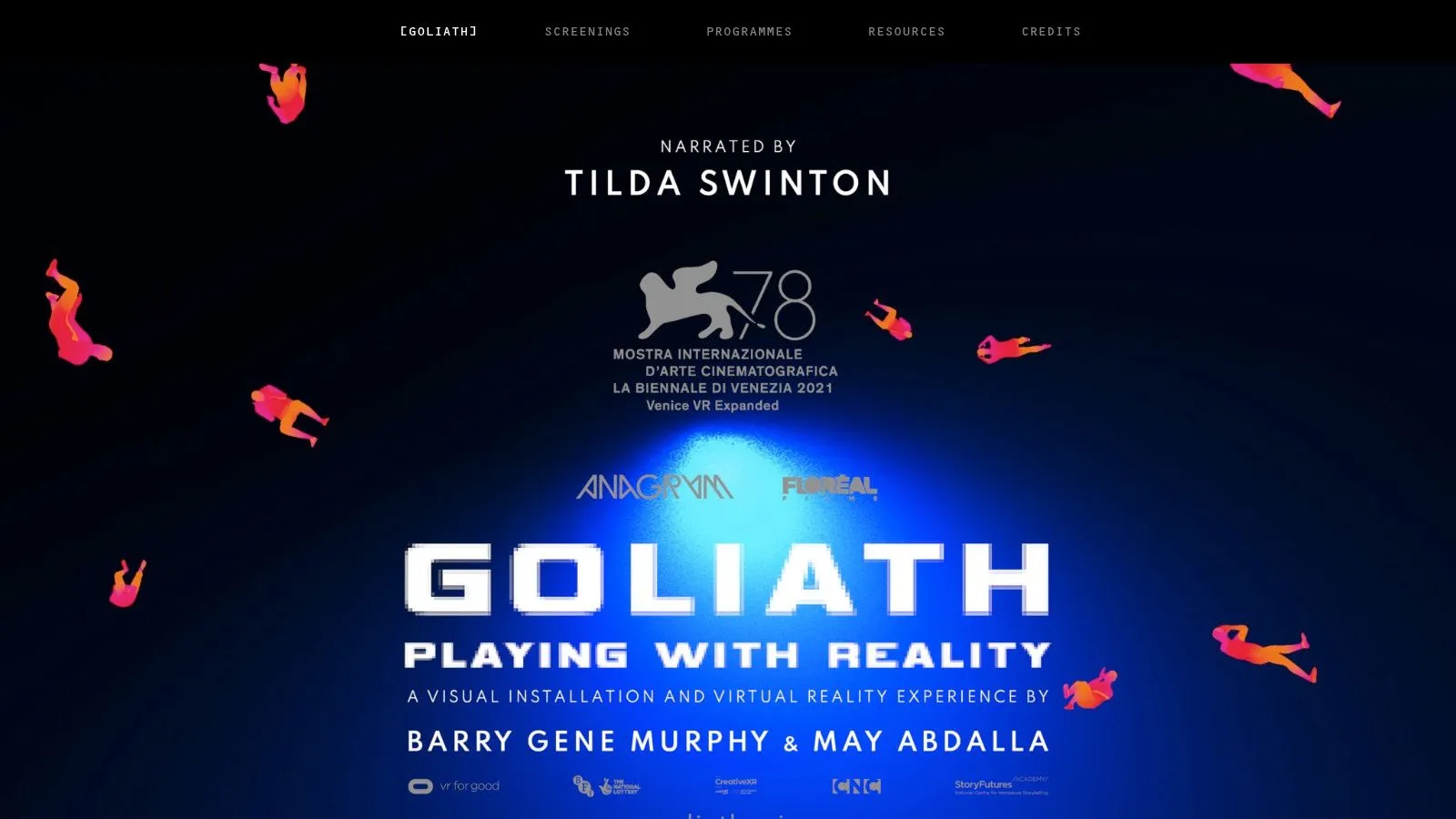
Goliath: Playing with Reality uses animation to address schizophrenia, gaming and human connection through a 25-minute animated VR story produced by UK studio Anagram. Tilda Swinton narrates the experience, while symbolic interactions and a stylised virtual environment give the subject room for emotional interpretation rather than forcing it into a literal reconstruction. The audience's behaviour is exploratory. It listens, looks and responds to a world where visual metaphor carries meaning. That makes the experience especially relevant to teams developing animated XR content. The production isn't a conventional short film placed inside a headset. The creators must consider where the user is standing, what can happen outside the immediate field of view and how narration can direct attention without breaking immersion. The official Goliath: Playing with Reality website provides the project's distribution and creative context. The experience is available through Meta and Steam endpoints, which gives it more than one route to an audience, but it still requires VR hardware and may require onboarding for motion or location comfort.
Animation as an interaction system
Animated environments offer a practical advantage in sensitive storytelling. A production team can control the visual language, exaggerate relationships and use recurring symbols without the logistical demands of live-action capture. That control also helps the director decide what must remain stable and what can respond to the user. The project has received strong festival recognition, including the Venice VR Grand Jury Prize, which is evidence of creative and cultural reach rather than proof of a particular commercial return. Buyers should separate those outcomes. Awards can validate craft and subject handling, but they don't replace testing with the intended audience or a plan for distribution.
A successful animated VR story doesn't make the viewer interact with everything. It gives interaction a clear emotional job.
The production lesson is to define the relationship between narration, performance and symbolic response early. If the audience's movement doesn't affect the emotional reading, a conventional animated film may be the more efficient format. If presence and perspective are central, VR can make the story's subject feel spatial rather than merely described.
4. 1943 Berlin Blitz
1943 Berlin Blitz shows how presence can create involvement without branching paths. Produced by BBC Northern Ireland and Immersive VR Education, the historical VR documentary places viewers inside a Lancaster bomber during a Second World War RAF mission. Authentic 1943 BBC audio anchors the experience, giving the historical setting a material connection to its period. The audience's main action is looking. Users inspect the aircraft, occupy its confined space and listen to archival voices while the story follows a largely linear sequence. This controlled structure suits museums and classrooms, where every learner needs access to the same historical framing and core material. The format therefore treats interaction as attention and spatial orientation rather than authoring a different plot. The Steam listing for 1943 Berlin Blitz identifies it as a PCVR experience. That deployment model fits heritage and education partners able to prepare a defined headset setup. It also narrows distribution, since the project is not designed for flat-screen browsers and requires compatible PCVR equipment.
Presence without branching
Original audio supplies authority and texture that newly recorded exposition may struggle to reproduce. The virtual aircraft adds spatial context, changing a historical account from information the audience receives into a situation it occupies. For Studio Liddell, the transferable production principle is to match the interaction to the audience's intended behaviour before choosing a platform. Agency can mean navigation, not narrative alteration. A learner can choose where to look, which object to inspect or which passage to revisit, while the author retains control over historical accuracy and sequence. That distinction helps brands, educators and entertainers avoid adding branching just to advertise interactivity. The limitation should remain explicit. A linear VR documentary should be presented as controlled immersion, not as a branching game. Its value depends on concise explanation, spatial presence and a setting where a facilitator can prepare the audience. The model is therefore well suited to museums, schools and exhibitions, while audiences seeking replayable game mechanics may need a different system.
5. The Shirt on Your Back
The Shirt on Your Back proves that interactive storytelling can reach audiences without an app, headset or specialist installation. The Guardian's investigative feature examines the human cost behind Bangladesh's garment industry through a web-native combination of video, graphics, text and data. Here, scrolling becomes the audience's main action. Each movement reveals another part of the investigation, allowing the page to pace information while connecting individual human stories to wider industrial context. The format works because the interaction mirrors the reader's role. Users move through evidence, follow the narrative sequence and decide how long to spend with particular material. The Guardian's interactive feature is a useful reference for brands, charities and public-interest organisations that need to communicate a cause without asking audiences to download software. It combines emotional testimony with explanatory media, reducing the risk that a data-heavy subject becomes either an impersonal chart or an unsupported personal anecdote.
The open web as a strategic choice
The feature's web accessibility is its clearest advantage. A browser-based experience can support sharing, search discovery and use across ordinary devices, although the original interaction patterns now feel more classic than cutting-edge and its desktop-first design creates mobile performance considerations. The production lesson is to make each medium carry a distinct part of the argument:
- •Video provides human presence: It gives the investigation faces, voices and emotional immediacy.
- •Graphics explain systems: Visual data can show relationships that prose would make slow to process.
- •Text supplies detail: Readers can move at their own pace and return to specific evidence.
- •Scrolling controls sequence: The page can introduce complexity gradually rather than presenting everything at once.
A 2022 Frontiers in Education paper on collaborative interactive digital storytelling for remote learners found that branching narrative and dialogue decision points were positively received, with joint decision-making helping children combine perspectives and reach consensus (the Frontiers in Education paper). That research supports a useful distinction for educational and cause-led work. Interaction should help people interpret and discuss, not merely click through visual effects.
6. Museum of the World
Museum of the World turns a museum collection into a system for audience-led discovery. The British Museum and Google Arts & Culture replace a conventional exhibition route with a browser timeline that connects artefacts across time, place and theme. Visitors do not follow a protagonist or select an ending. They construct a route through the collection by choosing what to examine next. The Museum of the World experience shows how interactive curation can create narrative movement without a conventional plot. Users select objects, follow relationships and hear curator commentary, assembling meaning from linked material. The underlying system resembles a content graph more than a branching screenplay. Curators define useful connections, while visitors determine the sequence and depth of exploration. The project is free and globally accessible through a browser. That reach suits education partners and cultural organisations serving people beyond a physical venue. Its trade-off is equally clear: an exploratory collection produces less character-driven emotion than a film, and the interface does not provide authoring tools for another organisation to customise directly.
Curating a content graph
The timeline earns attention because its relationships lead somewhere. A chronological index could function as a catalogue. Links between geography, themes and historical periods turn each artefact into a prompt for another question, comparison or discovery. Historic England's interactive history timeline provides a related UK example of making extensive chronology easier for learners to explore. Both projects show that visual presentation is only one production decision. Teams must select the metadata, audio, images and contextual links that deserve inclusion, then make those relationships legible to users. Studio Liddell's guide to interactive content creation points to the practical production lesson. Collection-led work requires a repeatable content pipeline. Curators, designers and developers need agreed fields, asset standards, accessibility requirements and publishing rules before the interface fills with one-off exceptions. The same structure can support an educational app, an animated archive, a game database or an XR exhibit. Its limitation is narrative intensity. Exploratory curation supports discovery, but it does not automatically create a film's emotional arc or a simulation's learning sequence. Use this model when audiences should connect evidence for themselves. Use guided branches when they must reach a defined interpretation or decision.
7. Bear 71 and Bear 71 VR
Bear 71 makes environmental surveillance personal by placing the audience alongside a collared grizzly moving through a monitored wilderness. The National Film Board of Canada's interactive documentary combines mapping, real data and narrative voice, then extends the same premise into a multi-user WebXR and VR experience. The audience chooses where to look and which relationships to follow. Users explore a mapped environment, observe connections and confront the gap between an animal's lived experience and the systems tracking it. The map therefore carries narrative meaning. It turns surveillance and habitat into spatial conditions rather than treating data as decoration around a fixed film. The Bear 71 VR website shows how the project supports browser and immersive routes. WebXR can widen access because audiences can enter through a browser instead of committing to a dedicated headset application, although WebGL dependencies may fail on some networks. The original presentation now appears dated visually, while the VR relaunch strengthens immersion.
Designing for distribution resilience
The production lesson is to define delivery conditions before building the ideal experience. Start with the audience's likely device and network, then decide which mapping, interaction and immersion layers can survive in both browser and VR formats. This approach also helps teams budget efficient assets. A producer's guide to VR and 360 experiences and a guide to optimizing Unity VR for enterprise teams can inform engine-side decisions and fallback planning.
Distribution test: If the central idea disappears when the audience loses the headset, the team has not defined the story's essential interaction.
Bear 71 also demonstrates that real data requires editorial selection. Raw mapping can overwhelm users, so the system should foreground evidence that changes perception and connect it to a voice, character or action. Brands can apply the same principle to product journeys, educators to heritage maps and entertainers to interactive worlds. Build the data structure around the emotional question, then decide which fields deserve visibility. This makes the audience's exploration purposeful across an app, animation, game or XR installation.
Interactive Storytelling: 7 Examples Compared
| Title | 🔄 Implementation Complexity | 💡 Resource Requirements | 📊 Expected Outcomes | Ideal Use Cases | ⭐ Key Advantages |
|---|---|---|---|---|---|
| Black Mirror: Bandersnatch | Very high, complex branching + platform integration | Very high, broadcast production, state-tracking systems, platform constraints | High engagement & re‑watchability; mainstream visibility | OTT interactive films, large-scale narrative experiments | Broadcast-quality UX; proven viability at scale |
| Notes on Blindness: Into Darkness | High, spatial audio + embodied VR design | High, VR audio/visual design, cross‑headset support | Strong empathy impact; critical/festival recognition | Empathy-driven experiences, accessibility-focused VR | Translates non‑visual perception; accessibility-led design |
| Goliath: Playing with Reality | High, animated VR with symbolic interactions | High, animation, narration talent, VR optimization | Cultural reach; award recognition | Impact-led VR narratives for festivals & stores (Quest/Steam) | Sensitive animated storytelling; measurable cultural impact |
| 1943 Berlin Blitz | Medium, room-scale VR with archival integration | Medium, archival audio, PCVR deployment | Educational engagement; museum‑ready delivery | Museums, heritage education, learning installations | High educational value; concise, deployable runtime |
| The Shirt on Your Back | Medium, scrollytelling & multimedia web UX | Medium, video, graphics, data‑journalism assets, web dev | Broad accessibility; investigative impact | Cause-driven journalism, NGO/brand storytelling on web | Web-native accessibility; strong data + human story mix |
| Museum of the World | Medium, non-linear web UX and content graphing | Medium‑High, large dataset, curator audio, high‑performance web tech | Scalable educational reach; exploratory learning | Cultural institutions, digital collections, education | Global access; scalable interactive curation |
| Bear 71 / Bear 71 VR | Medium‑High, WebXR + multi‑user mapping systems | Medium, WebGL/WebXR development, real data integration | Environmental empathy; pioneering interactive doc practices | Environmental storytelling, WebXR showcases, multi-user demos | Distinct POV storytelling; demonstrates WebGL/WebXR potential |
Turn Interaction Into a Repeatable Story System
These interactive storytelling examples use very different technologies, but their strongest decisions are consistent. Bandersnatch gives viewers meaningful narrative consequence. Notes on Blindness makes perception itself the interaction. Goliath uses animation and symbolism to support a sensitive subject. 1943 Berlin Blitz uses presence without pretending that every experience needs branching. The Shirt on Your Back makes scrolling carry investigative structure. Museum of the World turns curation into exploration. Bear 71 connects data, environment and empathy across browser and immersive formats. The first principle is simple: give the audience an action that matters to the story's purpose. A learner may need to make a decision, a museum visitor may need to compare objects and a brand audience may need to reveal a product configuration. More interaction isn't automatically better. A linear experience can be the right choice when accuracy, pacing or emotional focus matters more than agency. The second principle is to design for the actual distribution environment. UK interactive storytelling has already moved across broadcast, education, heritage and voice-led formats, while research on children's interactive VR has shown the value of combining movement, image, sound and verbal language when evaluating engagement and interaction patterns (UK research on children's interactive storytelling in VR). That means producers should plan measurement and accessibility alongside the experience, not after launch. Use this practical checklist before approving production:
- •Audience: Define what people should learn, feel or do, and identify their device, context and confidence.
- •Format: Choose web, animation, app, game, AR or VR according to the required action, not the novelty of the technology.
- •Narrative state: Map choices, conditions, access points and fallback routes before building scenes or screens.
- •Accessibility: Plan captions, transcripts, readable interfaces, audio alternatives, motion comfort and non-headset routes.
- •Onboarding: Explain the interaction quickly, then let the story demonstrate why the action matters.
- •Content pipeline: Establish asset naming, version control, metadata, localisation and delivery specifications early.
- •Testing: Test comprehension, device performance, navigation, comfort and failure states with representative users.
- •Measurement: Define outcomes such as completion, retention, decision quality, repeat exploration or stakeholder understanding before production begins.
For brands, web and scrollytelling often suit broad reach and cause-led explanation. Animation works when the story depends on controlled visual metaphor or a recognisable character. Apps and games are stronger when repeated decisions, progression or personalised feedback matter. AR can connect narrative to a physical product, exhibition or retail space. VR earns its place when presence, perspective or embodied practice is central, as in training, heritage and empathy-led work. The commercial case still needs discipline. UK coverage identifies cost, accessibility and staff training as barriers to applied XR, while projected growth in game-based learning indicates demand without proving that every implementation succeeds (UK game-based learning market coverage). Buyers should therefore request evidence plans, not just concept images. They should ask how the team will measure completion, learning impact, accessibility and operational readiness. Studio Liddell can support briefs that combine animation, interactive apps, Unity or Unreal XR and immersive game development. If your project has a defined audience, a clear outcome and a format decision still to make, branching narrative techniques can help shape the story logic before a production team turns it into an experience. --- Studio Liddell develops 2D and 3D animation, interactive apps, games and Unity or Unreal XR experiences for brands, educators and entertainment teams. Visit Studio Liddell to share your brief and discuss the right production route for your interactive story.