Interactive Content Creation: A UK Studio's Guide
A familiar brief lands on Monday morning. The campaign deck is polished, the product story is solid, and the assets already exist as a PDF, a landing page, and a neatly edited film. Then the results come back flat. People skim, bounce, and forget. The content isn't wrong. It's passive. That's where most conversations about interactive content creation now start. Not with novelty, but with frustration. Marketing teams want stronger lead signals. Educators want participation they can observe, not just assume. Entertainment brands want audiences to do something, not just watch. Static content still has a role, but it no longer carries enough of the load on its own. In practice, interactivity works when it gives the audience a meaningful action. A choice. A response. A path. Sometimes that's a one-question diagnostic on a product page. Sometimes it's a branching explainer, an AR retail experience, or a full VR simulation. The format matters less than the fit between user intent, production method, and business goal.
Beyond Static The Shift to Interactive Experiences
A marketing manager downloads the campaign report and sees the same pattern again. Good impressions, respectable reach, weak downstream action. The brochure was clear. The video looked expensive. The landing page matched the brand guidelines. Yet none of it asked the user to participate. That's the shift. Audiences have been trained by modern platforms to expect feedback loops. Tap, choose, rotate, compare, configure, answer, explore. When content doesn't respond, it feels older than it is. A lot of teams still treat interactivity as an add-on reserved for a big launch or an event build. That's usually the wrong starting point. The better question is simpler. Where does the audience need a decision, a test, or a guided route through information?
What static content often fails to do
- •Qualify intent: A brochure download tells you very little about what the prospect needs.
- •Reduce complexity: Long-form explanations often bury the moment where a buyer says, “Right, this is relevant to me.”
- •Create memorable behaviour: Watching is passive. Choosing creates recall.
Practical rule: If the audience has to compare, evaluate, learn by doing, or picture themselves using something, a static format is rarely the strongest option.
In creative production, this change has been building for years. It's visible in retail, learning, entertainment, and live experiences. It's also visible in how brands now borrow interaction patterns from apps and games, even when the final deliverable is a campaign asset or sales tool. Some of the clearest examples sit in spatial and mobile work, which is why looking at augmented reality examples brands should know is useful when you're thinking beyond banners and video. Interactivity isn't a gimmick when it solves a real communication problem. It becomes a gimmick when nobody can answer why the user should click, answer, scan, or step in.
The Spectrum of Interactive Content
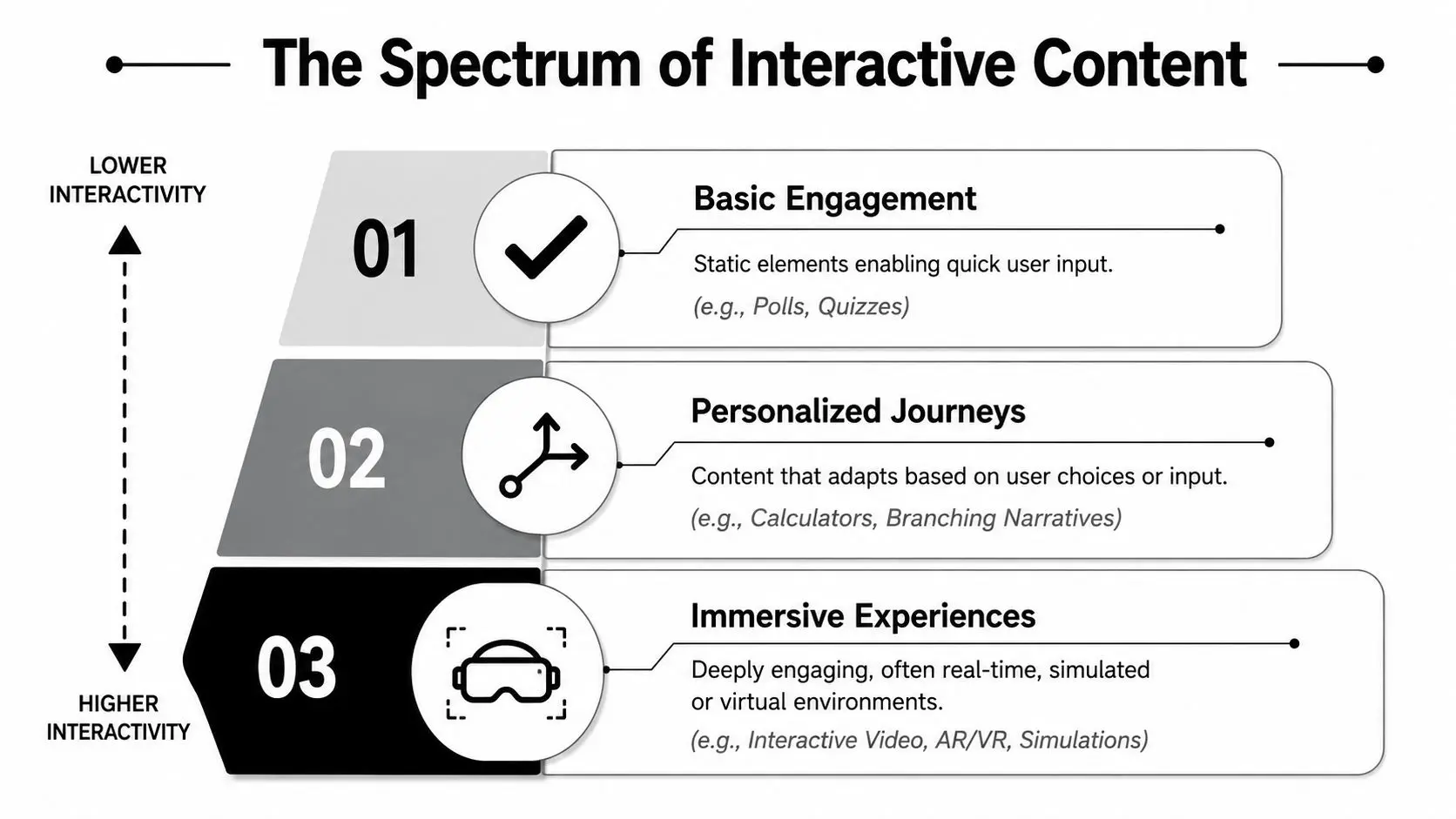
People often say “interactive” when they really mean “there's a button on it”. That's too loose to be useful. In production terms, interactive content sits on a spectrum. The lower end captures lightweight input. The middle adapts to the user. The upper end places them inside an experience.
Basic engagement
This is the low-friction layer. Polls, quizzes, sliders, single-question assessments, and simple calculators all sit here. They ask for very little effort, which is why they're useful at the top or middle of the funnel. These formats are often dismissed because they look simple. That's a mistake. A well-written quiz can surface user intent faster than a contact form, especially when the questions mirror buying criteria. In educational settings, the same principle applies. A short interaction can reveal where understanding breaks down.
Personalised journeys
At this stage, content begins to adapt. The user chooses an industry, challenge, product type, confidence level, or use case, and the next screen changes accordingly. Product configurators, branching narratives, decision trees, guided assessments, and interactive explainers belong here. The strength of this layer is relevance. You stop showing everyone the same story in the same order. Consider a technical service. One visitor wants procurement detail. Another needs operational proof. Another only wants to know whether the system will integrate with existing workflow. A personalised path respects those differences without forcing the studio or client to build three separate campaigns.
Good interactive content doesn't just collect input. It changes the experience in response to that input.
Immersive experiences
At the top end, the interaction is spatial, embodied, or real-time. This includes interactive video, AR product visualisation, virtual try-ons, mixed reality event experiences, and full VR simulations for training or entertainment. These projects can do things simpler formats can't. They let a learner rehearse a scenario. They let a buyer inspect a product at scale. They let a fan step into a world rather than merely observe it. That doesn't mean immersive always wins. It means immersive suits situations where physical context, procedural understanding, or sensory impact matter. A useful way to frame the spectrum is this:
| Level | Typical formats | Best use |
|---|---|---|
| Basic engagement | Polls, quizzes, short assessments | Fast input, early qualification, lightweight participation |
| Personalised journeys | Calculators, branching content, configurators | Tailored messaging, self-segmentation, guided decision-making |
| Immersive experiences | AR, VR, interactive video, simulations | Deep learning, spatial understanding, experiential brand moments |
Most businesses don't need to live at one end of the spectrum. They need to choose the right point on it for a specific objective.
Why Interactivity Drives Business and Learning Goals
Interactivity earns its place when it improves decision-making. That applies to sales, training, and audience development. The reason it keeps outperforming passive formats in the right context is straightforward. It turns attention into action.
For marketing teams
Interactive tools are useful because they reveal intent. A user who chooses “enterprise deployment”, “multi-site rollout”, or “need integration support” has already told you more than a generic form fill ever would. That's why strong interactive content creation often performs best when it sits close to a buying decision. A product selector, pricing estimator, or needs-assessment tool can also shorten the distance between curiosity and conversation. It gives the prospect a reason to stay long enough to understand the offer in practical terms. One useful signal from the UK market is that interactive quizzes generate 3X higher time-on-site than static content according to Interactive 365's interactive content overview. Time-on-site isn't the whole story, but it does tell you something important. People stay when the content asks them to do, choose, or discover something.
For educators and training teams
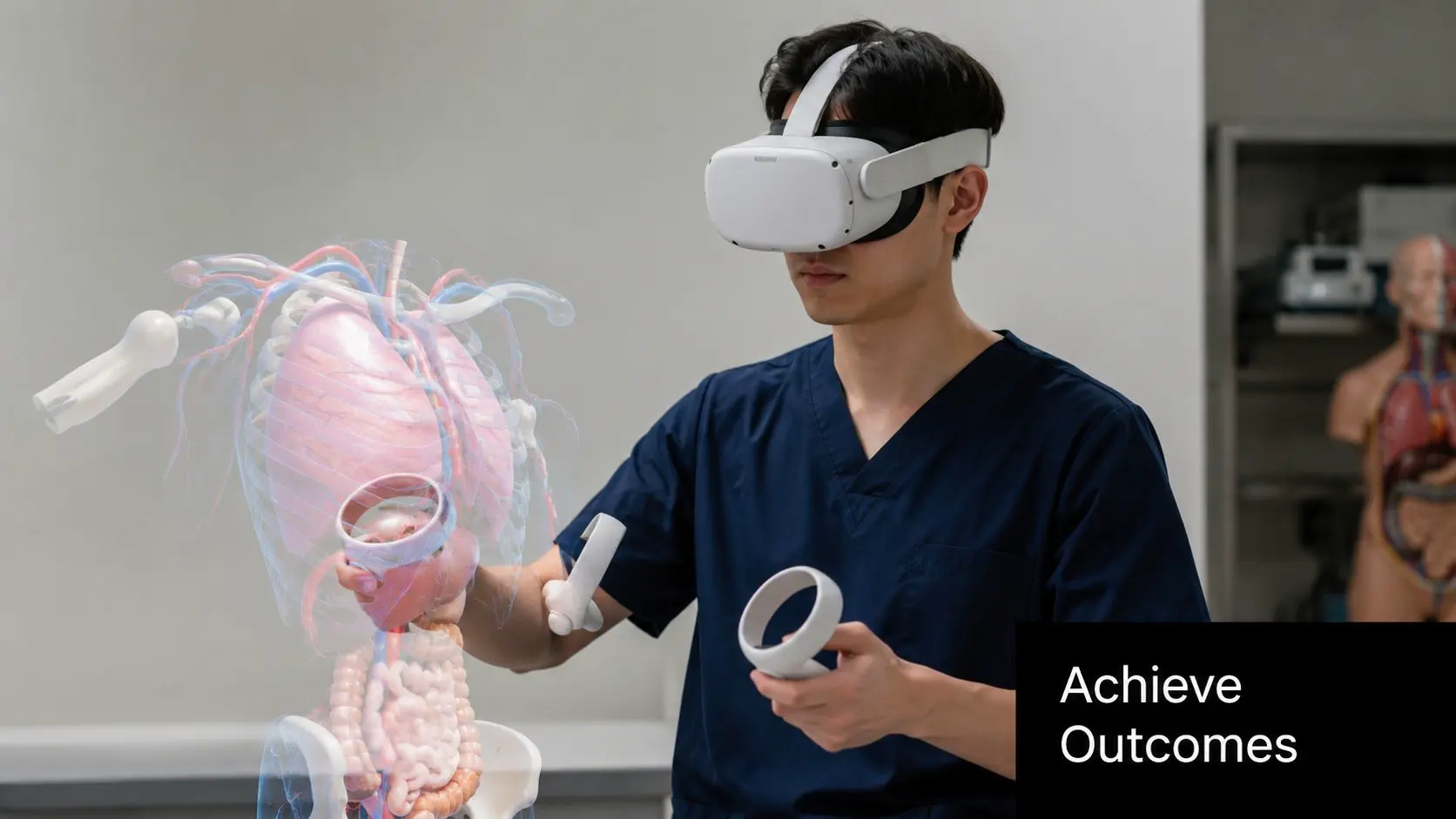
Learning content benefits from the same principle. Reading and watching matter, but they don't show whether someone can apply knowledge. Simulations, scenario-based interactions, and feedback-driven exercises do. In training, interactivity is useful when the learner must make a judgement under constraints. That might be a safety decision, a maintenance sequence, a customer response, or a medical procedure. The value isn't just engagement. It's observable behaviour.
If the real-world task involves decisions, consequences, or spatial understanding, the training asset should reflect that reality.
For entertainment and IP owners
Interactive formats can extend a world rather than merely advertise it. Children's brands, event activations, and fan-focused properties all benefit when audiences can play, explore, or influence an outcome. That's especially relevant now because audience behaviour is changing. A projected 41% of UK consumers creating content in Q4 2025 is highlighted in the source material tied to the creator economy and AI discussion. The practical takeaway isn't to chase every creator trend. It's to recognise that audiences increasingly expect participation, remixing, and self-directed engagement. For rights holders and commissioners, that means the brand experience can't stop at a trailer or key art pack. It has to create room for interaction without losing editorial control.
Choosing Your Format 2D vs 3D vs XR
Most format decisions go wrong for one of two reasons. Either the team chooses the most impressive option before defining the use case, or they choose the cheapest route and expect premium impact. The better approach is to match the production method to the communication problem.
Where 2D still does excellent work
2D animation remains one of the strongest formats for explainers, brand films, title sequences, social cut-downs, and motion-led storytelling where clarity matters more than realism. It's fast to understand, flexible in style, and efficient when the message is abstract or process-driven. For cost planning, a professional-quality 60-second 2D animation from a small UK studio typically costs between £4,500 and £7,500, while upgrading to 3D animation increases the price to £12,000, £28,000, according to Stormy Studio's animation cost guide. 2D is often the right answer when:
- •You need clarity first: Process explanation, service overviews, software walkthroughs.
- •Brand language matters more than physical realism: Graphic systems, typography, icon-led storytelling.
- •You need variants: Regional edits, multiple aspect ratios, or campaign cut-downs.
A separate comparison of 2D and 3D animation approaches is useful when you're weighing visual depth against simplicity.
When 3D earns the extra spend
3D works best when the object itself is part of the argument. Product detail, surface finish, exploded views, camera moves through machinery, and character performance all gain power from depth and dimensionality. It also creates stronger continuity when a project may later expand into configurators, spatial content, or real-time applications. That's one reason product teams often start with a 3D hero asset library even if the first deliverable is a film.
Where XR changes the brief
XR is not “3D, but more”. It's a different category. AR and VR are strongest when interaction, environment, or embodied learning are central to the outcome. Training simulations, event installations, retail visualisation, and experiential storytelling belong here. This is also where support systems matter. If you're working through product enrichment for commerce or omnichannel presentation, resources on rich media services for retail help frame how visual assets move from campaign work into practical sales environments.
Interactive content format comparison
| Format | Best For | Typical UK Budget | Lead Time |
|---|---|---|---|
| 2D animation | Explainers, motion graphics, brand storytelling | £4,500 to £7,500 for a professional-quality 60-second piece from a small UK studio, per Stormy Studio | Usually shorter than comparable 3D work, depending on revisions and asset scope |
| 3D animation | Product showcases, character work, cinematic visuals | £12,000 to £28,000 for a professional-quality 60-second 3D upgrade from the same source, per Stormy Studio | Longer due to modelling, surfacing, lighting, and rendering |
| XR including AR and VR | Training, exhibitions, immersive brand experiences | Budget varies by hardware, platform, tracking, and deployment model | Lead time varies widely because design, development, testing, and deployment are all format-critical |
The point isn't that one format is superior. It's that each one rewards the right brief and punishes the wrong one.
Modern Production Pipelines and Technologies
Clients often assume the expensive part of a project is the final polish. In reality, the earliest decisions usually determine whether the whole production runs cleanly or drifts into revision debt.
The pipeline still starts with the brief
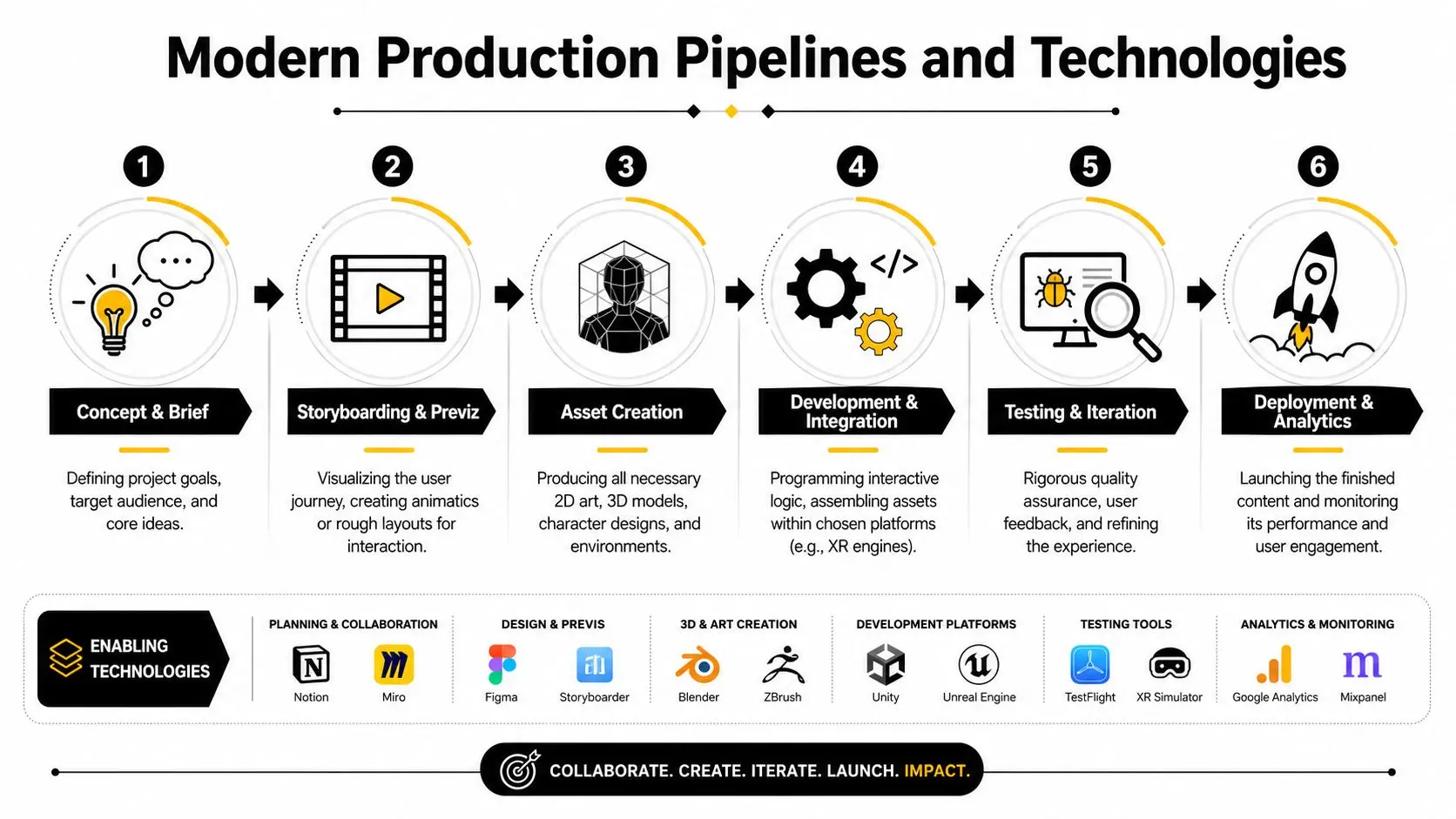
Interactive projects don't remove the need for disciplined production. They increase it. Before anyone opens Unreal, Unity, Blender, After Effects, Cinema 4D, or Figma, the team needs to define audience, use case, platform, success criteria, and constraints. That early phase has real budget implications. Pre-production phases like briefing, concept development, and previz typically account for 10, 20% of the total 3D animation budget, according to Motion The Agency's breakdown of 3D animation costs. If the brief is vague, that cost doesn't disappear. It just returns later as rework. A practical production flow usually looks like this:
- Concept and brief
- Storyboarding and previz
- Asset creation
- Development and integration
- Testing and iteration
- Deployment and analytics
What real-time engines changed
Unity and Unreal changed the conversation because they let teams test interactions, camera logic, and environments earlier. That's valuable in XR, but it also matters in pitches, previs, and client approvals. When stakeholders can move through an experience instead of imagining it from a PDF, decisions get sharper. One practical distinction matters. Real-time engines accelerate iteration. They do not replace direction. A weak concept rendered instantly is still a weak concept.Where AI helps and where it doesn't
The current AI conversation is noisy, but some uses are already practical. Reference generation, rough ideation, assistive editing, repetitive cycle support, and workflow automation can all reduce friction if the creative team stays in control. There's also a cultural shift behind that pressure. A projected 41% of UK consumers creating content in Q4 2025 points to a market where more people expect accessible creation tools, as reflected in the source material linked to the creator economy and AI discussion. That doesn't mean every brand should automate its voice. It means production teams need a clear standard for what can be accelerated and what still needs authored craft. If you're evaluating platforms before building a workflow, roundups of best AI video creation tools can be helpful for understanding the field. The important part is governance. Brand heritage, visual consistency, rights clearance, and UK data handling can't be left as afterthoughts. One practical option in that broader mix is Studio Liddell, which works across animation, games, apps, and XR using established pipelines with AI-supported efficiencies where they fit the brief.How to Measure Interactive Content ROI
Interactive work often gets approved for the wrong reason. People assume it will “engage better” and leave the measurement model vague. That's how good projects become hard to defend later. The UK-specific gap here is real. While global data states interactive content can boost engagement by up to 70%, a significant gap exists in UK-specific frameworks for measuring the ROI of different types of interactive assets, from low-code quizzes to full-scale XR experiences, as noted by Interactive 365. That matters because a single-question quiz and a VR training simulation should not be judged by the same yardstick.Match the metric to the format
A useful framework starts with the user action the experience is meant to produce.- •For low-barrier interactions: Track completion, answer quality, drop-off point, and what the response reveals about intent.
- •For guided tools and configurators: Measure pathway selection, data capture quality, sales handoff readiness, and whether the interaction reduces time spent explaining basics later.
- •For immersive training or XR: Focus on completion, assessment outcomes, error patterns, and whether users can perform the task more confidently afterwards.
The common mistake is to report only views or dwell time. Those numbers can be useful, but they don't tell you whether the content changed anything commercially or operationally.
Use a simple decision ledger
Create a short measurement sheet before production starts. It should include:
| Question | Why it matters |
|---|---|
| What business decision should this content influence? | Keeps the asset tied to a real outcome |
| What user action proves value? | Prevents vague “engagement” reporting |
| What data can we capture ethically and legally? | Avoids collecting information you can't use responsibly |
| What would success look like after launch? | Gives the team a baseline for iteration |
Measure the decision quality the content creates, not just the attention it attracts.
That's especially important when comparing low-code interactive tools against bespoke production. A simple assessment can be the right answer if it qualifies leads cleanly. A custom immersive build can be the right answer if procedural understanding, spatial context, or experiential impact are central. The ROI model has to respect the job the asset was hired to do.
Finding the Right Creative Production Partner
Choosing a production partner for interactive work is partly a craft decision and partly a risk decision. You're not just buying visuals. You're buying judgement about scope, pipeline, technology, feedback loops, and delivery. That's why scoping matters so much in 3D and interactive production. For 3D animation services in the UK, a 30-second product animation typically ranges from £3,000 to £10,000, while more complex character-driven spots can exceed £25,000, according to Clutch's UK 3D animation pricing overview. Those ranges aren't just about effort. They reflect differences in assets, performance demands, revision complexity, and final use.
What to check before you appoint anyone
- •Relevant portfolio: Look for work that resembles your problem, not just work that looks expensive.
- •Technical fit: If the project needs Unity, Unreal, WebGL, mobile deployment, or broadcast finishing, ask who handles that work.
- •Process discipline: The studio should be able to explain briefing, prototyping, review rounds, QA, and handoff without hand-waving.
- •Commercial realism: Good partners challenge under-scoped briefs early rather than promising everything and renegotiating later.
If your project leans toward product logic, dashboards, portals, or browser-based tools rather than film-led content, agency evaluation frameworks such as Arch's web app agency guide can help sharpen the questions you ask. The strongest partner is usually the one that can tell you when not to build the expensive thing. Sometimes the answer is a quiz, a calculator, or a branching explainer. Sometimes it's a full XR deployment. The quality of that recommendation is what protects the budget. --- If you're weighing low-code interactive tools against bespoke animation, AR, or VR, Studio Liddell is one place to start the conversation. A useful first step is to define the audience action you need, the level of production craft the brand requires, and the format that can be measured properly once it launches.