A Producer's Guide to VR 360 Experiences
Think about a normal photograph. It’s like looking at a scene through a window. Now, imagine stepping through that window and finding yourself standing right in the middle of that scene, free to look anywhere you please. That jump from passively viewing something to actively being present within it is exactly what makes a VR 360 experience such a game-changer.
What Is VR 360 and Why Does It Matter?
At its heart, VR 360 is content designed to be viewed inside a complete, 360-degree sphere. Unlike traditional film, where a director meticulously frames every single shot, VR 360 hands control of the viewpoint over to the audience. It’s a simple shift, but one with a massive impact, creating a sense of immersion that a flat screen just can't touch. This isn't just a novelty anymore. With accessible headsets like the Meta Quest becoming household items, VR 360 has firmly established itself as a commercially powerful tool for brands, educators, and storytellers alike. It’s moved past the experimental phase and is now a proven medium for crafting unforgettable experiences.
The Three Main Types of VR 360 Content
To plan a successful project, you first need to know your options. Each format offers a different flavour of immersion and interactivity, tailored to different strategic goals. To help break it down, here’s a quick comparison of the primary formats of VR 360 content. It should give you a clearer idea of their differences in complexity and application.
Understanding the Three Types of VR 360 Content
| Content Type | Description | Best Use Case |
|---|---|---|
| 360° Photos (Monoscopic) | These are static, spherical images, like a single moment frozen in time that you can explore from one fixed spot. | Perfect for virtual tours of real estate, event venues, or historical sites where the goal is to create a sense of place. |
| 360° Videos (Cinematic VR) | This takes the spherical concept and applies it to moving pictures. You’re placed right in the centre of a live-action or animated scene, looking around as the story unfolds. | A fantastic tool for narrative storytelling, event coverage, and brand experiences that need to pack a real emotional punch. |
| Interactive VR Experiences | This is the deepest level of immersion, blending 360° visuals with real-time interactivity, usually powered by game engines like Unity or Unreal Engine. | The foundation for complex training simulations, product configurators, and immersive games where users can move, touch, and influence the environment. |
Our own work in virtual and augmented reality production often dives deep into these rich, interactive worlds, building experiences that go far beyond simple viewing. This technology isn't just a niche interest in the UK; it has created a significant software market. The combined UK immersive market was estimated to be worth a hefty £338 million in 2023, showing just how commercially relevant it has become. With forecasts predicting that global revenue will shoot past USD 11.4 billion by 2030, the runway for growth in high-quality VR 360 content is undeniable. For a closer look, you can explore more data on the UK's VR software market growth on Statista.com.
How Industries Are Using VR 360 for Real Impact
The theory behind VR 360 is all well and good, but its real power shines when it's put to work solving actual business problems. We're past the point of it being just a novelty. Companies across the board are now using immersive experiences to tackle challenges, drive value, and connect with their audiences in ways that simply weren't possible before. Whether it’s breaking down geographical barriers or making high-stakes training safer and more effective, the applications are as practical as they are powerful. It all comes down to using that unique sense of presence VR 360 offers to deliver real, measurable results.
Marketing Unforgettable Brand Moments
Picture this: letting a customer test drive a new car from their living room or walk through a luxury hotel suite before they even think about booking. Immersive marketing campaigns leverage VR 360 to do one crucial thing: stop the endless scroll and create a genuine emotional connection. Instead of just telling someone about your product, you’re inviting them to step inside its world. This isn’t just about creating a cool gimmick. This approach hits several key goals:
- •Boosts Engagement: Interactive content holds a user's attention for far longer than a standard video ever could.
- •Drives Consideration: Actually experiencing a product, even virtually, can have a massive influence on the decision to buy.
- •Creates Buzz: Genuinely innovative campaigns get people talking and sharing on their own.
By placing the consumer directly within the brand story, VR 360 transforms passive viewing into an active, memorable experience. This shift from storytelling to "story-living" is where the real marketing magic happens.
Sales and Real Estate Breaking Down Borders
For sectors like real estate or high-value manufacturing, distance has always been a major hurdle in the sales process. VR 360 simply erases that barrier. It allows international buyers to tour a property or inspect complex machinery as if they were standing right there. A well-crafted virtual tour is so much more than a slideshow of static images. It’s a self-guided exploration that gives a true sense of scale, layout, and atmosphere. This capability dramatically speeds up the sales cycle, builds buyer confidence, and slashes the costs tied to physical site visits for everyone involved.
Training and Education Building Skills Safely
Perhaps the most profound use of VR 360 is in training and simulation. For high-risk industries like manufacturing, energy, and healthcare, it offers a safe, repeatable environment where people can practise complex procedures and emergency responses without any real-world danger. Think about the applications:
- Industrial Safety: An employee can learn to operate heavy machinery or respond to a chemical spill in a completely controlled virtual setting. This builds muscle memory and critical thinking skills. In fact, studies have shown that immersive learning can lead to up to 75% higher knowledge retention compared to old-school methods.
- Medical Training: Surgeons can walk through a complex operation step-by-step, and paramedics can run through triage drills in realistic, high-pressure scenarios.
- Customer Service: Staff can role-play difficult customer interactions to hone their soft skills and learn de-escalation techniques in a judgement-free zone.
A Look Inside the VR 360 Production Pipeline
Making a truly gripping VR 360 experience is a delicate dance between creative vision and deep technical know-how. It’s a world away from just setting up a fancy camera and hitting record. To get a professional result that feels genuinely immersive, every single step, from the first scribble on a storyboard to the final technical handover, needs to be handled with absolute precision. The entire process is designed to ensure the final product isn’t just a video you watch, but a world you can actually step inside. This infographic gives a quick overview of how VR 360 is being put to work across different parts of a business.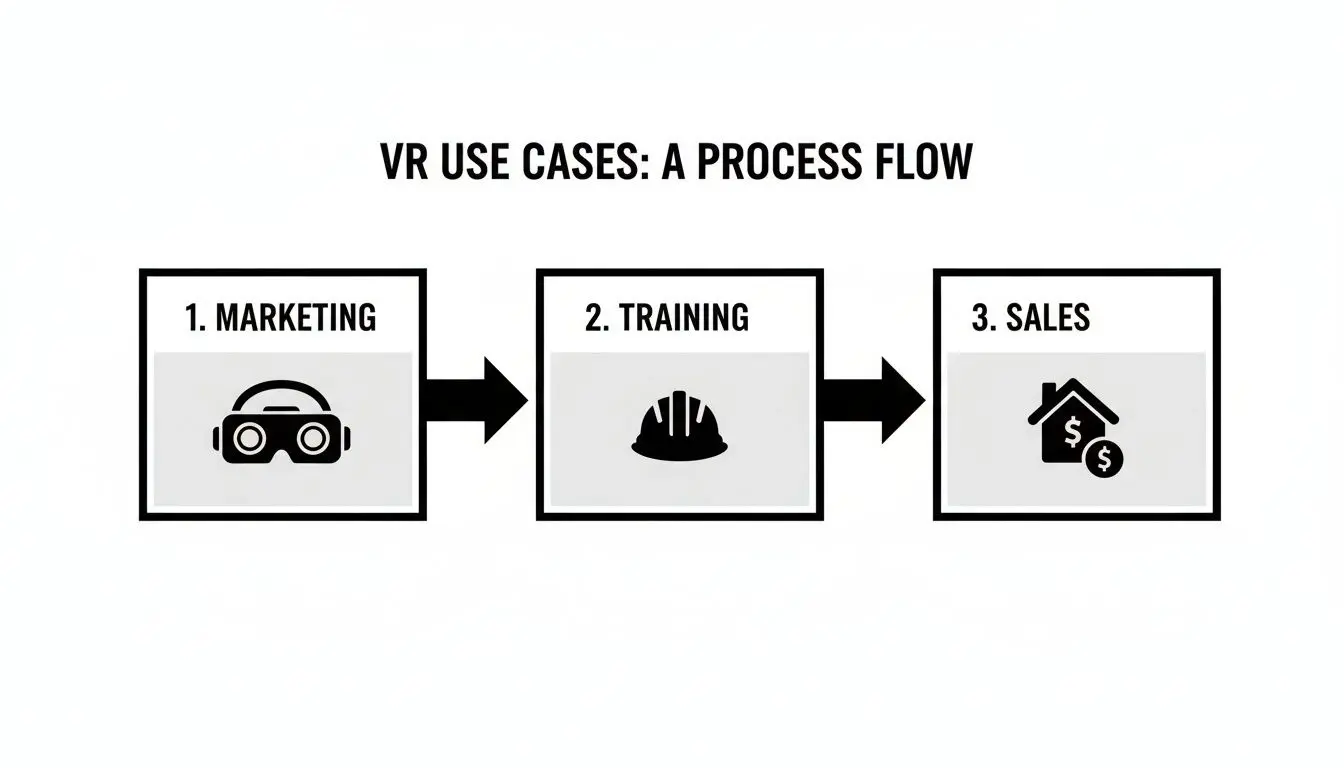 It shows how one technology can be adapted to solve very different commercial problems, from winning new customers to upskilling your own team.
 Concept and Storyboarding
This first stage is, without a doubt, the most important. When your audience can look absolutely anywhere they want, how do you tell a coherent story or guide their focus? The old rules of filmmaking get thrown out the window. Storyboarding for VR 360 means mapping out the action across a complete 360-degree canvas. We use subtle visual and audio cues to gently direct the viewer's gaze, making sure they don’t miss the crucial moments of the story. It's less about framing a single shot and more about designing an entire environment where a narrative can unfold naturally all around the person watching.Filming and Asset Creation
With the blueprint in place, we get to work creating the assets. This usually heads down one of two paths:- •Live-Action Capture: This involves using sophisticated multi-lens camera rigs to film real-world locations and actors. The key here is capturing clean, high-resolution footage from every angle at the same time.
- •CGI World-Building: For experiences that are set in fantastical worlds or just need perfect control over every detail, we build the entire environment from the ground up using 3D modelling and animation software.
In reality, many projects are a hybrid, blending real footage with computer-generated elements to bring the final vision to life.
Stitching and Post-Production
This is where all the raw footage is transformed into a seamless, spherical world. The video from each individual camera lens has to be meticulously "stitched" together.
The goal of stitching is to create a perfect, invisible blend between every camera view. We work to eliminate any seams or distortions that could shatter the viewer's sense of presence. It's a hugely technical process that demands both powerful software and a sharp artistic eye.
After stitching, the content goes through colour grading, visual effects, and general clean-up, much like a traditional film, but it's all done on a spherical canvas.
Spatial Audio Design
In VR, what you hear is just as vital as what you see. Spatial audio is designed to mimic how we hear sounds in the real world. If a door creaks open behind you, the sound comes from behind you in the headset. This is an incredibly powerful tool for guiding attention. A sudden noise off to the left will make a viewer instinctively turn their head, directing them towards the next part of the story without needing a single clunky arrow or pop-up. This level of quality is quickly becoming the industry standard. The UK's immersive tech economy brought in USD 2.24 billion in revenue in 2023 and is expected to rocket to USD 11.47 billion by 2030. Sectors like retail and education are fuelling the demand for high-end VR 360 content that feels more like a cinematic piece than a basic training video. You can delve into the projections and see the UK's immersive market growth for yourself.
Engine Integration and Delivery
For interactive projects, the last step is to bring all the video, audio, and CGI assets into a real-time game engine like Unity or Unreal Engine. This is where we build the logic that lets users interact with objects, navigate menus, or trigger different events. Finally, we optimise the whole experience for the target platforms, whether that's a web browser, a mobile app, or a dedicated VR headset like the Meta Quest. The aim is always smooth playback and a user experience that feels completely intuitive.
The Technical Decisions That Define a Great Experience
What separates a shaky, amateur 360 video from a professional VR 360 experience that feels genuinely transportive? It all comes down to the technical details. Getting these elements right is the difference between creating true immersion and, well, making your audience feel sick. High resolution and frame rate are completely non-negotiable. Inside a headset, low-resolution footage immediately falls apart into a blurry, pixelated mess, shattering the illusion. Similarly, a frame rate dipping below 60 frames per second (fps) feels choppy and is a primary trigger for motion sickness. For a smooth, believable experience, 8K resolution at 90fps is the gold standard we aim for.
Monoscopic Versus Stereoscopic Vision
Another huge decision point is whether to go monoscopic or stereoscopic. Think of it this way:
- •Monoscopic 360 is like having a single, spherical image wrapped around you. It gives you a sense of place, but everything feels flat, with no real depth. It’s simpler to produce and often good enough for web-based viewers like YouTube VR.
- •Stereoscopic 360 is the real deal. It delivers a separate, slightly different image to each eye, perfectly mimicking how we see the world. This creates a genuine sense of three-dimensional depth, making objects feel solid and real. This is absolutely essential for high-end VR where true presence is the ultimate goal.
The choice really hinges on your project’s goals and budget. While stereoscopic video delivers a far more immersive punch, it demands more complex camera rigs, generates significantly more data, and ramps up the intensity of post-production. To chew through the demanding rendering and processing of high-quality VR content, looking into powerful GPU server rental options becomes a critical step in the production pipeline.
Delivery Platforms and Codecs
How your audience will actually watch the final piece dictates a surprising number of technical choices. Will it be streamed on YouTube VR? Embedded on a website? Or pre-loaded onto a dedicated headset for a trade show or event? Each platform has its own rules for optimisation.
Choosing the right video codec (like H.264 or the more efficient H.265/HEVC) is a constant balancing act between visual quality and file size. A smaller file streams more easily, but over-compressing it can introduce ugly visual artefacts that look dreadful when stretched across a modern headset's display.
To help you navigate these choices, here's a quick rundown of what to consider for some common platforms. #### Platform and Codec Considerations for VR 360
| Platform/Headset | Recommended Resolution | Typical Codec | Key Advantage |
|---|---|---|---|
| Meta Quest 3 | 8K (7680x3840) | H.265 (HEVC) | Excellent balance of quality and file size for standalone playback. |
| Pico 4 Enterprise | 8K (7680x3840) | H.265 (HEVC) | High-resolution support for crisp corporate training and demos. |
| YouTube VR | 4K-8K | VP9 | Wide accessibility and good streaming performance, but less control. |
| WebVR (Browser) | 4K (3840x1920) | H.264 | Maximum compatibility across devices, but lower fidelity. |
This table is just a starting point, but it shows how the end platform shapes your entire workflow from the very beginning. Finally, any user interface elements, think menus or interactive hotspots, have to be built for a virtual space. They need to feel intuitive, be placed at a comfortable viewing distance, and not get in the way of the main experience. Our buyer's guide to the modern VR headset for business dives deeper into how different hardware can influence these crucial design choices. Getting a handle on these technical nuances gives you the language you need for smarter creative and strategic conversations, making sure the final product lands with the impact it deserves.
Measuring the ROI of Your VR 360 Project
An immersive experience is a powerful thing, but let's be honest, its real value in business comes down to measurable results. To justify the investment in a VR 360 project, you need to dig deeper than surface-level stats like view counts and find the data that proves you're making a real impact. It’s about moving past the initial "wow" factor. The focus has to be on specific, trackable key performance indicators (KPIs) that connect directly to your commercial goals. The beauty of VR is that it lets us gather rich behavioural data that traditional media just can't touch, giving us a much clearer picture of what your audience is actually doing.
Key Metrics for Proving Value
Whether you're building a VR experience for marketing, training, or sales, certain metrics give you incredible insight. These analytics don't just tell you if people are watching; they show you how they are interacting with the world you’ve built. Some of the most important engagement metrics include:
- •User Dwell Time: This is the total time someone spends inside the experience. Longer dwell times are a brilliant indicator that you've created a genuinely captivating and engaging environment.
- •Gaze Heatmaps: By tracking exactly where users are looking, we can generate heatmaps that show which parts of a scene grab the most attention. This is invaluable for optimising layouts and making sure your key messages or products are actually being seen.
- •Interaction Rates: If your experience has interactive elements, clickable buttons, objects to pick up, info points, tracking how often they’re used is a direct measure of their effectiveness.
The real power of VR analytics is its ability to translate user behaviour into actionable business insights. A heatmap showing that nobody is looking at your primary product placement tells you immediately that a design change is needed.
ROI in Training and Marketing
How you apply these metrics will naturally change depending on the project's goal. Proving a return on investment means connecting the data to specific business outcomes. For training and simulation, the focus shifts to competency and knowledge retention. Here, we can track:
- Completion Rates: What percentage of trainees successfully finish a module?
- Performance Data: How accurately do users perform specific tasks? We can measure things like error rates and time-to-completion to show tangible skill improvement.
- Assessment Scores: Building quizzes or practical tests right into the VR experience gives you hard data on how well the information has been absorbed.
- •Brand Lift: Running surveys before and after the experience can measure concrete shifts in brand perception, recall, and favourability.
- •Purchase Intent: Tracking how many people click through to a product page or add an item to their basket after a virtual demo creates a direct link between the experience and your sales figures.
By setting up a clear framework to track these outcomes right from the start, you can build a powerful business case for your VR 360 investment and prove its direct contribution to your bottom line.
Why Work With a VR Production Studio?
This guide shows you just what's possible with VR 360, but turning that vision into a reality requires a special kind of partner, one who gets both creative storytelling and the deep, often complex, tech behind it. Working with an experienced studio takes the guesswork out of the equation, turning a potentially rocky process into a smooth creative journey. At Studio Liddell, we handle the entire production pipeline, from kicking off initial concepts to deploying the final experience. Our roots are in high-end CGI and powerful real-time engines like Unity and Unreal Engine, which gives us the technical muscle needed to build genuinely immersive VR 360 content that actually works.
From Cinematic Films to Technical Simulations
Our portfolio is pretty varied. We’ve produced everything from cinematic VR films for clients like the BBC to intense mixed-reality games and practical training simulations. We know that each project has different needs, and our job is to make sure the final product isn't just a technical showpiece, but a strategic tool that delivers real results. If you want more advice on how to find the right creative partner, our buyer’s guide to choosing an animation studio is a great place to start. The market is certainly heating up. The UK virtual reality software market is expected to jump from USD 881.25 million in 2024 to a staggering USD 5.3 billion by 2035. This kind of growth puts studios with proven CGI and real-time skills in a prime position to build the next wave of interactive VR 360 platforms. You can explore the full market forecast here. Ready to chat about your ideas? Our creative and technical teams are here to help you figure out the next step.
Common Questions About VR 360 Production
Thinking about your first VR 360 project? You’ve probably got a few practical questions. It’s a common starting point, and we get asked these all the time. Let’s clear up some of the main ones.
How Much Does a VR 360 Project Cost?
This is the big one, and the honest answer is: it depends entirely on the concept. There’s a huge range. At one end, a simple 360 video tour of a single location is relatively straightforward and sits at the lower end of the budget. On the other end, a fully interactive VR simulation with custom CGI characters, complex story branches, and highly detailed environments is a much more significant investment. The final cost really comes down to a few key things:
- •The mix of live-action filming versus CGI elements.
- •How much interaction you want the user to have.
- •The complexity of the spatial audio design.
- •The number of different devices and platforms you need to support.
The best way to get a firm number is to sit down for a discovery workshop. That’s where we can properly scope out your vision and pin down a precise budget.
What Do Viewers Need to Watch It?
The great thing about VR 360 is how accessible it has become. For the absolute best, most immersive experience, nothing beats a dedicated VR headset like a Meta Quest or a Pico. That’s where you get the full effect. But you don’t need a headset. The content works brilliantly on the devices people use every day. Most 360 videos can be watched on a standard smartphone, you just move the phone around to look in different directions. They also work perfectly on a computer through platforms like YouTube, where you can simply click and drag with your mouse to explore the entire scene.
Is There a Difference Between VR 360 and True VR?
Yes, and it's a really important distinction to understand. VR 360 is what we call 3DoF (Three Degrees of Freedom). Think of it like being sat in a swivel chair. You’re in a fixed spot, but you can look up, down, left, right, anywhere you want from that single point. This is perfect for spherical videos and photo tours. 'True' VR, on the other hand, is 6DoF (Six Degrees of Freedom). This gives you the freedom to not only look around but also to physically move within the virtual space. You can walk forwards, backwards, duck down, and step from side to side. It’s what you get in most VR games and advanced simulations built in engines like Unity or Unreal Engine. Which one is right for you? It all comes down to what you want your audience to experience. Ready to explore what a VR 360 project could look like for you? Studio Liddell can help guide you through the whole creative and technical journey, from the first idea to the final launch. Book a production scoping call with our team.