2D Animation Service: Your Complete Guide for Business
What should a buyer expect from a 2D animation service before the first frame is ever drawn, and how do you tell the difference between a smooth production and an expensive round of revisions? A good commission starts with the right questions. In practice, a professional 2D animation service turns a business brief into a sequence of visual decisions, from concept and scripting through design, motion, sound, and final delivery. The value isn't just style, it's clarity, because 2D animation can make a message easier to understand, easier to remember, and easier to reuse across channels.
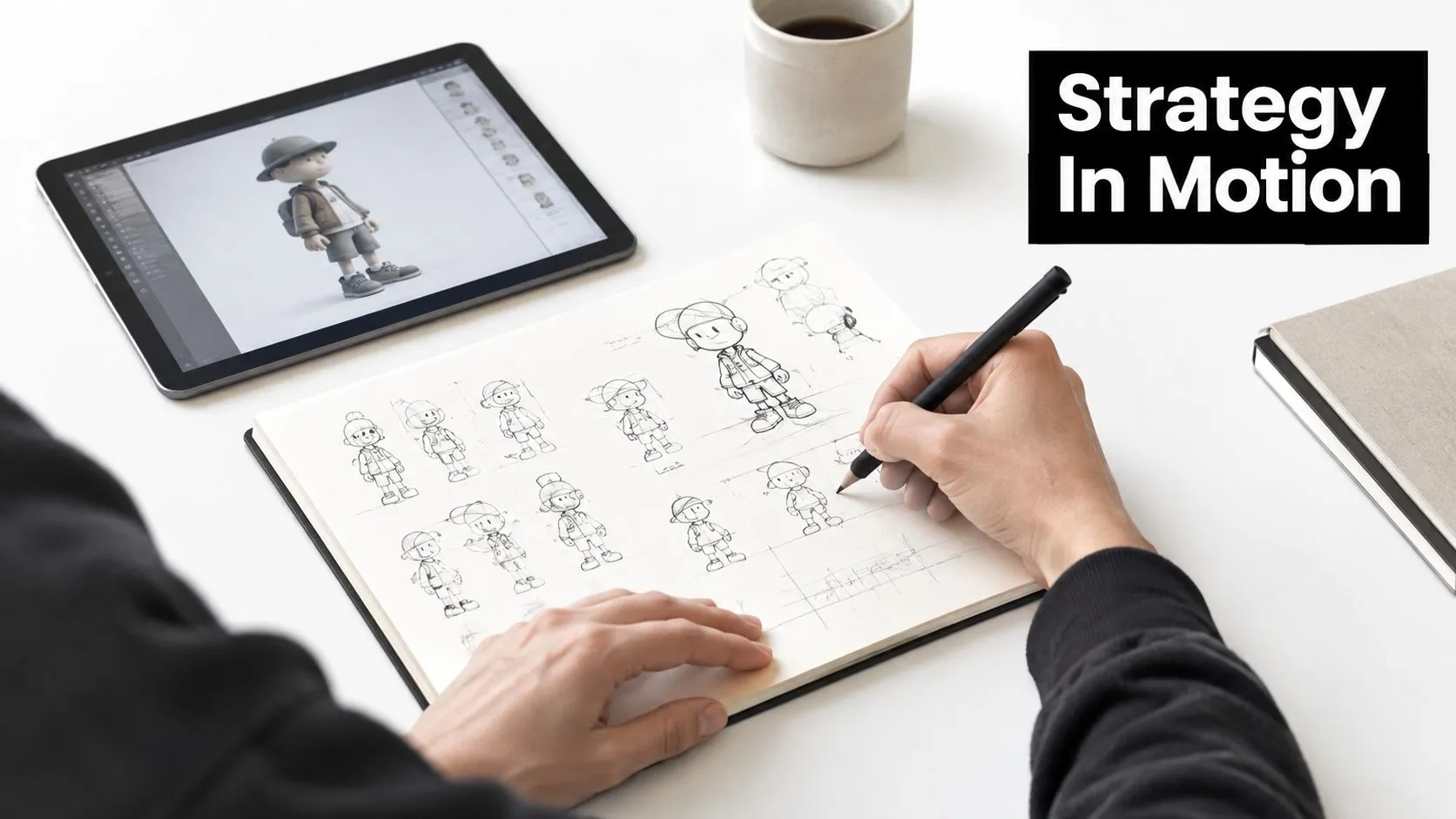
Understanding 2D Animation Services for Business
A business audience often asks for “animation” when what it really needs is a communication tool. A strong 2D animation service does more than make things move, it helps a brand explain an idea with timing, shape, and focus. That matters when the subject is abstract, technical, or too dense for a static graphic.
What clients are actually buying
A commercial 2D project usually includes message development, script support, visual design, motion, and final file preparation. The craft is in deciding what to show, what to leave out, and how long each idea should stay on screen so the viewer keeps up without effort.
Practical rule: if the viewer has to pause and decode a frame, the animation is working too hard.
That's why 2D remains useful even as real-time tools and AI-assisted workflows expand. It gives teams room to stylise a subject without losing the thread, which is useful for brand films, explainers, education, training, and social content. For a plain-language overview of the format itself, see how 2D animation works in practice. The business case is straightforward. 2D can communicate a process, humanise a product, and keep a visual identity consistent across multiple touchpoints. It's also easier to control than many mixed-format productions, which makes approvals cleaner when more than one stakeholder has to sign off.
Versatile Applications Across Industries
Different sectors use 2D for different reasons, and that's where commissioning gets clearer. A SaaS company might need a product walkthrough, a school may need an animated lesson, and a finance team may need a way to make a regulated offer feel understandable rather than intimidating. The format stays the same, but the job changes.
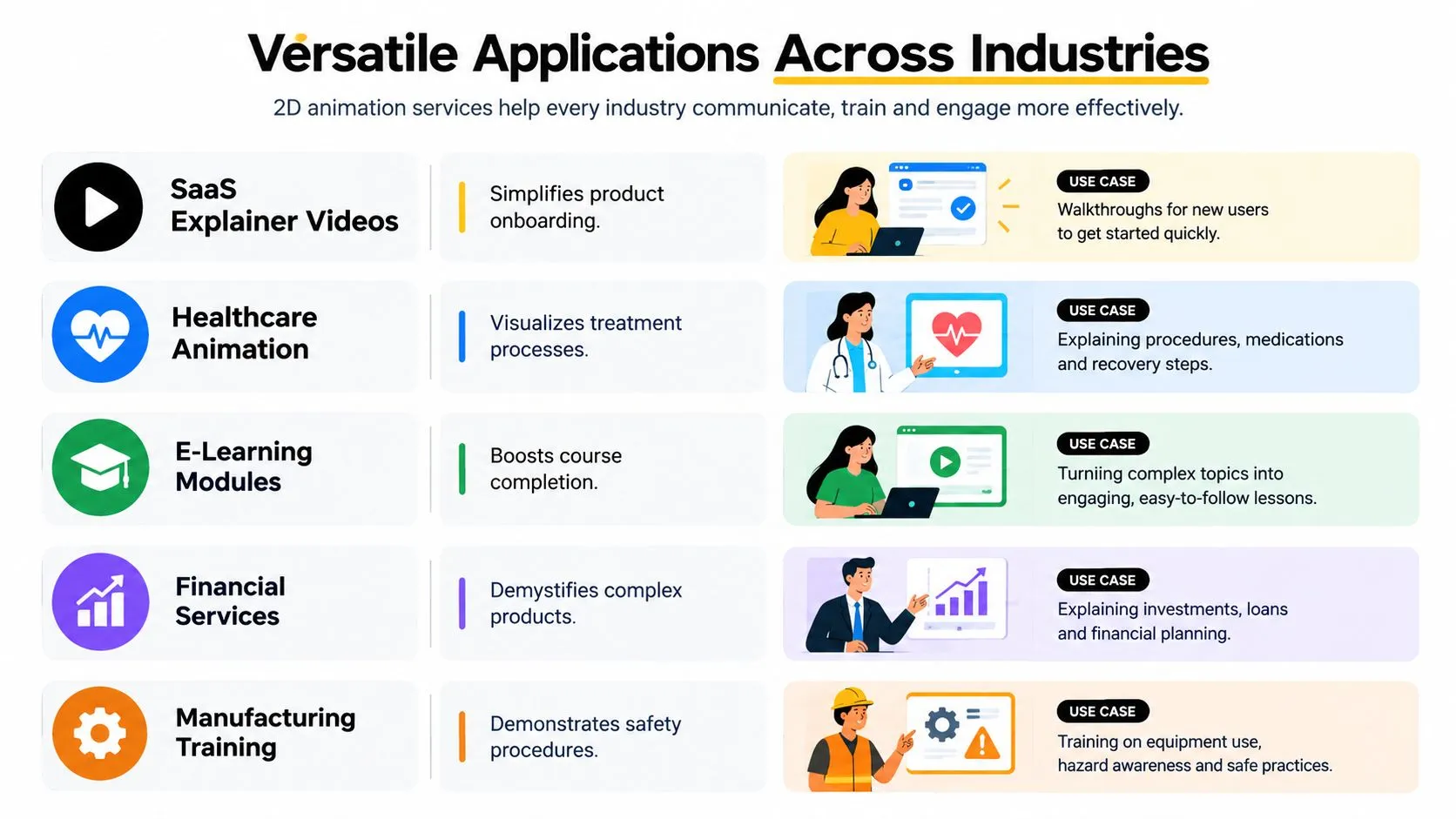
Where 2D earns its place
For SaaS, 2D is often the cleanest way to show workflows, onboarding, or a product's logic without asking the viewer to imagine too much at once. In healthcare, it can visualise a treatment journey or a process that's hard to film safely. In education, it supports recall because the learner can follow one change at a time rather than absorbing a flood of motion. Manufacturing and finance benefit for similar reasons, but the emphasis shifts. Manufacturing teams need process clarity, safety steps, and consistency across training. Finance teams need explanation without clutter, especially when products are complicated or unfamiliar. 2D also helps when a brand needs a shared look across multiple assets. A character-led campaign, a motion-graphic explainer, and a training module can all sit inside the same visual system, which makes the output feel joined up instead of piecemeal.
A useful test is simple, if the message gets clearer when motion is added, 2D is pulling its weight. If the motion distracts from the point, the concept needs tightening before production starts.
The Production Pipeline Explained
A reliable pipeline saves money because it prevents guesswork. The strongest projects move from brief to script, then to storyboard, asset design, animation, and sound, with approvals at each stage so nobody is surprised later by a frame that doesn't fit the plan.
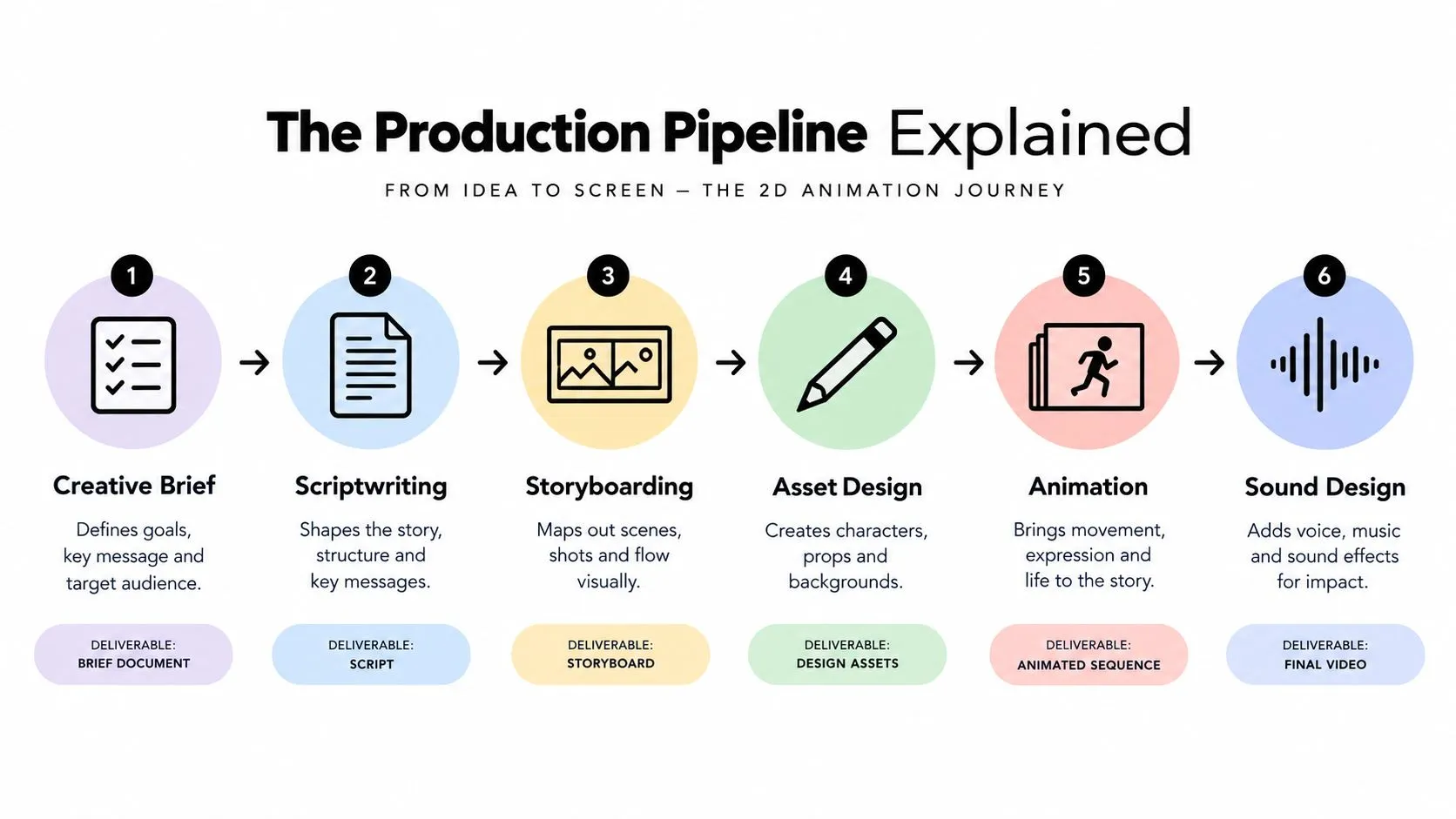
From brief to final mix
The creative brief should pin down audience, message, format, runtime, and any hard requirements. Scriptwriting then turns the brief into spoken or on-screen language, while storyboarding breaks that language into scenes so the client can see pacing before the labour-intensive work starts. Asset design follows. Characters, props, backgrounds, typography treatments, and colour decisions are then built in a way that can be animated, not just admired as still artwork. After that, the animation stage brings timing and performance together, and sound design gives the piece its final rhythm, clarity, and emotional shape. A common mistake is approving each stage too loosely. If the storyboard is vague, animation becomes guesswork. If the design system isn't set early, revisions multiply because the team keeps revisiting decisions that should already be locked. For teams also managing wider visual content, it can help to optimize your videography site as a reminder that the same project discipline applies across still, video, and animated output. The point is consistency, not format loyalty.
Navigating Budgets and Timelines
How much will a 2D animation cost, and how long will it take? The honest answer is that both depend on how many decisions the team must make, and how often those decisions change. A short piece with a simple asset set moves faster than a longer explainer with several scenes, custom characters, on-screen text, and repeated approval rounds.
What changes the price
Three things usually shape the budget: scope, detail, and revision discipline. A brief clip with a small asset library is very different from a longer production that needs multiple scenes and several stakeholder sign-offs. If the script keeps changing after storyboard approval, the team has to redo downstream work, and the schedule slips. UK commissioners also need to factor in funding structure from the start. The UK's Audio-Visual Expenditure Credit (AVEC) provides a taxable credit equal to 39% of qualifying expenditure for animated films, animated television programmes, and children's television programmes, with qualifying expenditure incurred from 1 January 2024. Productions commencing from 1 April 2025 generally need to use AVEC rather than the former system, and all productions are required to transition by 1 April 2027, according to the current UK government timeline. See the UK government's AVEC rules for the official guidance. That matters because animation budgets are shaped by how the work is set up, what qualifies, and how much rework the project creates. The UK animation tax framework also requires eligibility thresholds, including British certification, intended broadcast use, and at least 51% of core expenditure spent on animation, so the brief should be written with the production route in mind as set out in the government guidance. For commissioners, the safest habit is simple. Lock the storyboard before animation starts, then treat every new idea after that point as a scope change rather than a casual note. If you need a clearer breakdown of pricing inputs, animated video production cost explained for UK budgets is a useful reference.
Why Choose a Specialist Studio Like Studio Liddell
Specialist studios reduce friction because they already understand the handoffs that cause problems. A team with experience in broadcast, education, branded content, and interactive media knows how to keep a brief practical, how to protect the schedule, and how to avoid building assets that can't be delivered cleanly in the end. Studio Liddell is one option in that space. The studio's published capabilities include 2D animation, character animation, motion graphics, storyboarding, and asset-focused production, alongside broader digital work. That matters because a commissioner usually needs more than a style, they need a team that can move from concept to final output without losing the thread.
What specialist knowledge changes
A specialist team asks different questions at the start. Will the animation need versions for different channels. Does the dialogue still make sense with the sound off. Are the visuals safe for captions, overlays, and fast edits. Those questions save time later because they force the production to solve real delivery problems early. There's also a technical benefit to working with a studio that understands packaging. A project that starts as a web asset may need to be repurposed for social, education, or campaign use later, and the file structure has to support that. Without a disciplined pipeline, the same animation can become awkward to adapt. Specialist knowledge doesn't just improve polish. It improves briefing, approval, and reuse, which is where many projects either stay efficient or become expensive.
Real-World Impact and Success Stories
When 2D animation works, the result is usually easier comprehension, not just a prettier video. That's why the strongest examples are often the projects that had a difficult message to begin with. A product demo that would feel flat in live action can become clear through animated screens, while a children's brand can stay playful without losing control of the characters and pacing.
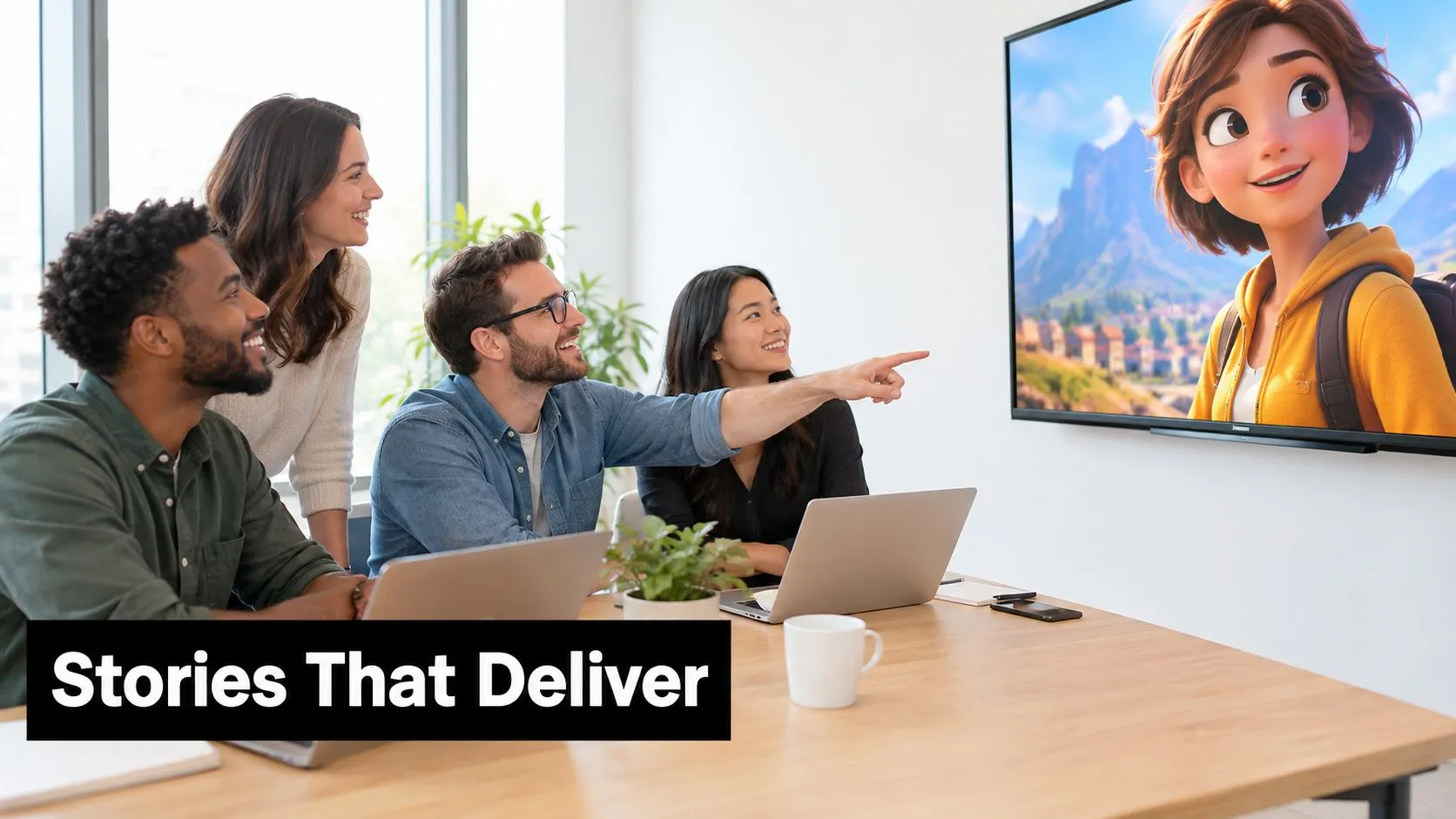
What good collaboration looks like
In practice, successful projects usually share the same pattern. The client brings the business problem, the studio translates it into scenes and visual beats, and both sides agree on what the viewer needs to understand by the end. That process suits children's content, technical explainers, internal training, and brand-led campaigns because it keeps the story focused. The value is especially obvious in projects where the subject is hard to show directly. A process that happens inside software, a service that can't be filmed neatly, or a concept that changes over time often becomes more persuasive when the animation gives it a clear shape. For teams in educational, corporate, and public-sector settings, that clarity can do more than make the work look professional. It can reduce confusion in stakeholder reviews and make the final asset easier to reuse across platforms, audiences, and formats.
Your Guide to Selecting the Right Partner
Choosing a studio gets easier when you judge it on process, not just visuals. A polished reel matters, but it doesn't tell you whether the team can manage feedback, protect scope, or deliver the right file package for your channels. That's why the best first step is to review how a studio works, not only what it posts online. A useful starting point is choosing a 2D animation studio by budgets, timelines, and red flags.
A simple commissioning checklist
Start with the portfolio. Look for work that matches your subject matter, not just your preferred style. A studio that has handled explainers, training content, or broadcast-style storytelling will usually ask sharper questions than one that only shows a showreel. Then test the pipeline. Ask who writes, who boards, who animates, and who handles final delivery. If the answer feels vague, the project will probably feel vague too. You also want to know how revisions are managed, because revision control is where many projects either stay calm or start drifting. Finally, look for evidence of fit. A strong partner should be able to explain the deliverables clearly, talk through timing realistically, and show that it understands your channel mix, whether that means web, social, internal comms, or broadcast. If you're comparing creative partners alongside automation or production support vendors, this AI agency guide for founders can help you think about evaluation criteria in a broader business context. The same principle applies here, judge the process, the communication, and the fit, then choose the team that can deliver the brief without unnecessary drama. --- If you're planning a 2D project and want a team that can help shape the brief, define the pipeline, and keep the delivery practical, visit Studio Liddell. They work across animation, storyboarding, and digital production, so they can help turn a rough idea into a clear production plan.