Animated Video Production Cost Explained for UK Budgets
Motion graphics typically cost £1,500, £6,000 per finished minute, 2D animation £2,500, £7,000, and 3D animation £6,000, £20,000+ in the UK. Most 60-second business animations fall between £3,000 and £10,000, while professional explainers commonly sit in the £8,000, £20,000 range. That may be the first useful answer, but it doesn't explain why two studios can quote very different prices for what appears to be the same one-minute video. One proposal might use animated typography, existing icons and a small number of scenes. Another might include original characters, a fully modelled product, multiple environments, complex lighting and several versions for different platforms. Both may deliver 60 seconds. They aren't delivering the same production. The practical way to understand animated video production cost is to stop treating runtime as the whole budget. Think of the finished video as the visible tip of a production iceberg. The seconds on screen matter, but the work underneath includes script development, storyboards, design, asset creation, rigging, animation, rendering, compositing, sound and delivery.
Introduction to Animated Video Production Cost in the UK
A first-time buyer often starts with a simple question: “How much is a 60-second animation?” That question is understandable, but it's a little like asking how much a house costs based only on its floor area. A compact flat and a bespoke house may have similar dimensions, yet the foundations, materials, fittings and construction process can be completely different. UK pricing guides place basic motion graphics at approximately £2,000, £6,000 per finished minute, 2D animation at £2,500, £7,000, and 3D animation at £6,000, £20,000 or more. The same UK animation pricing guide reports that most professional explainer videos land between £8,000 and £20,000. These are useful planning ranges, not fixed menus. The reason the ranges are broad is that studios price the production system behind the video. A short 3D product film may need accurate modelling, materials, lighting, camera work and rendering. A longer 2D explainer may rely on a controlled visual language, reusable elements and simpler movement. Runtime affects the quantity of work, but asset count, scene count and technical ambition usually explain the biggest differences between quotes.
Practical rule: Ask what the quote includes before asking whether it's expensive. A low figure may exclude scriptwriting, voiceover, sound design, revisions or final platform versions.
The UK market also has a project-specific character. Historical BFI figures show animation production spend varying considerably between reporting periods, including £73 million of UK production spend for animation programmes in 2021, £65.3 million in another BFI summary for 2021, and £29 million for 18 qualifying animation programmes in 2015. The BFI's screen business reporting also explains the qualifying framework around animation, including a minimum 51% core-expenditure animation threshold and at least 10% UK expenditure for relevant production credit purposes. You don't need to become a funding specialist to brief a studio well. You do need to understand what kind of visual world you're commissioning, how many original assets it requires and how much review the project will involve.
How Animation Styles Shape Cost and Creative Impact
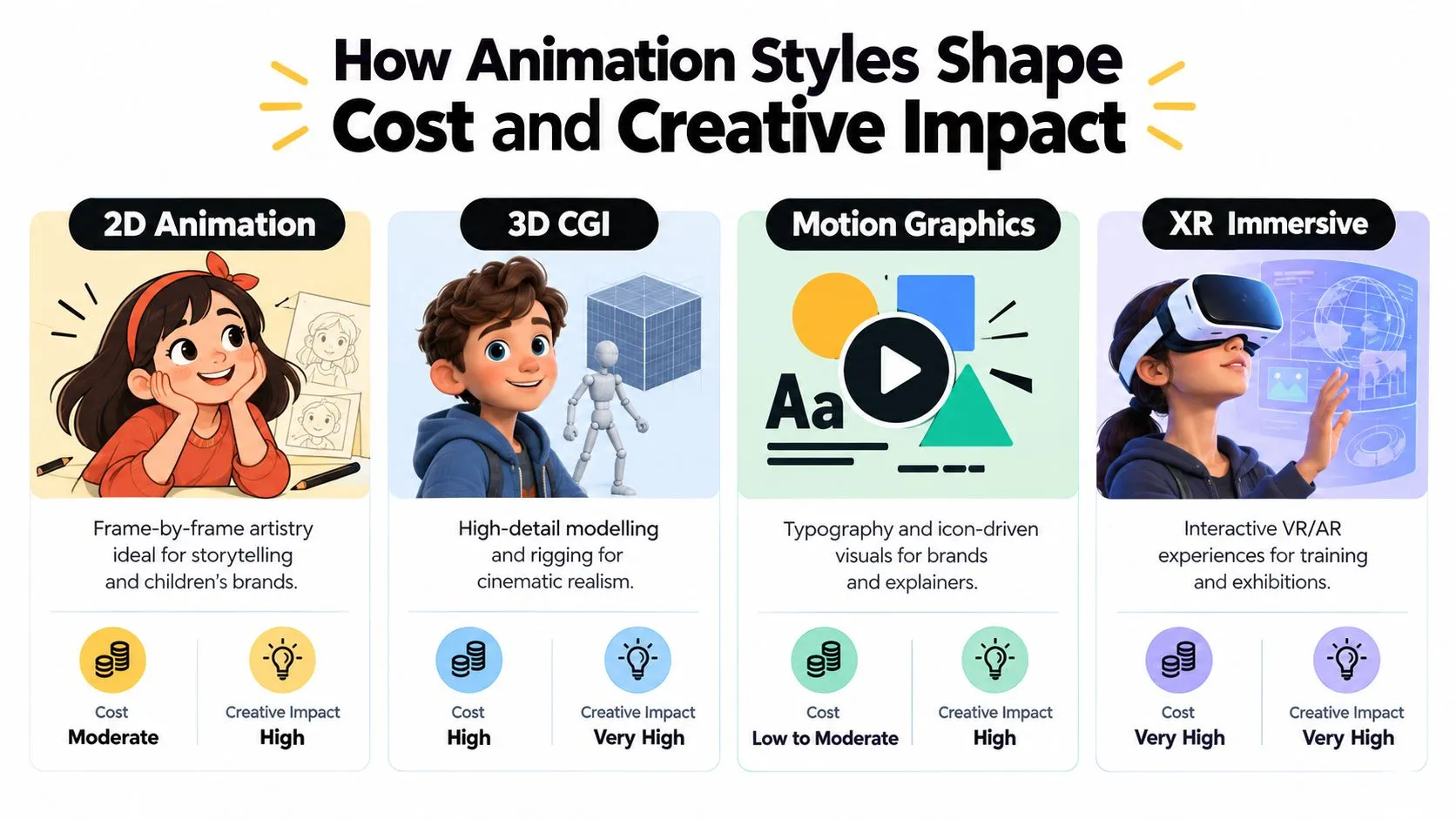
The visual style is often the first major budget decision. It determines what the team has to build, how much can be reused and how many technical stages sit between an approved storyboard and the final frame.
2D animation
2D animation is often the clearest route for explainers, educational content, editorial storytelling and character-led narratives. Artists create illustrated characters, props and backgrounds, then animate them through drawn movement, cut-out rigs or a combination of techniques. A simple 2D explainer can work like a well-designed illustrated book. The team may create a small cast, a controlled group of backgrounds and a graphic system that makes the message easy to follow. Character performance, hand-drawn movement and a large number of bespoke scenes increase the workload quickly. UK pricing commonly places 2D animation around £2,500, £7,000 per finished minute, according to UK animation cost-per-minute guidance. The right question isn't whether 2D is cheap. It's whether the visual language gives the audience enough clarity and emotional connection without building technical detail the message doesn't need.
3D CGI
3D animation behaves more like constructing a miniature film set. The production may involve modelling, texturing, rigging, lighting, camera animation, effects and rendering. A product visualisation might require accurate materials and carefully controlled reflections. A character film adds facial performance, body mechanics, clothing and environments. That layered process explains why 3D usually costs more than straightforward 2D work. The same pricing guidance places 3D at approximately £6,000, £20,000 or more per finished minute, because modelling, texturing, lighting and render time add stages that don't scale in a simple line with runtime. 3D wins when the audience needs to see a product from impossible angles, understand a spatial process or experience a polished cinematic world. It may be the wrong choice for a message that only needs typography, diagrams and a few transitions. A useful buyer's comparison of 2D and 3D animation costs can help teams test the creative need before committing to a more demanding pipeline.
Motion graphics and XR
Motion graphics focuses on design-led movement. Typography, icons, charts, logos and geometric shapes can communicate a complex point without the cost of building a cast of characters or a fully dimensional environment. Motion graphics often suit brand explainers, title sequences, product launches and social versions. XR, including VR and AR, adds interaction to the equation. The audience may choose where to look, manipulate an object or move through a real-time environment. The team therefore has to design not only what appears on screen, but also how the user behaves, how the experience responds and how the content performs on its target hardware. A useful analogy is the difference between watching a guided tour and exploring a building yourself. A linear animation controls every moment. An XR experience has to prepare for user choices, tracking conditions, device limits and deployment requirements. That extra design responsibility can justify the format, particularly for training, exhibitions and immersive brand experiences.
Inside the Production Pipeline and Where Money Is Spent
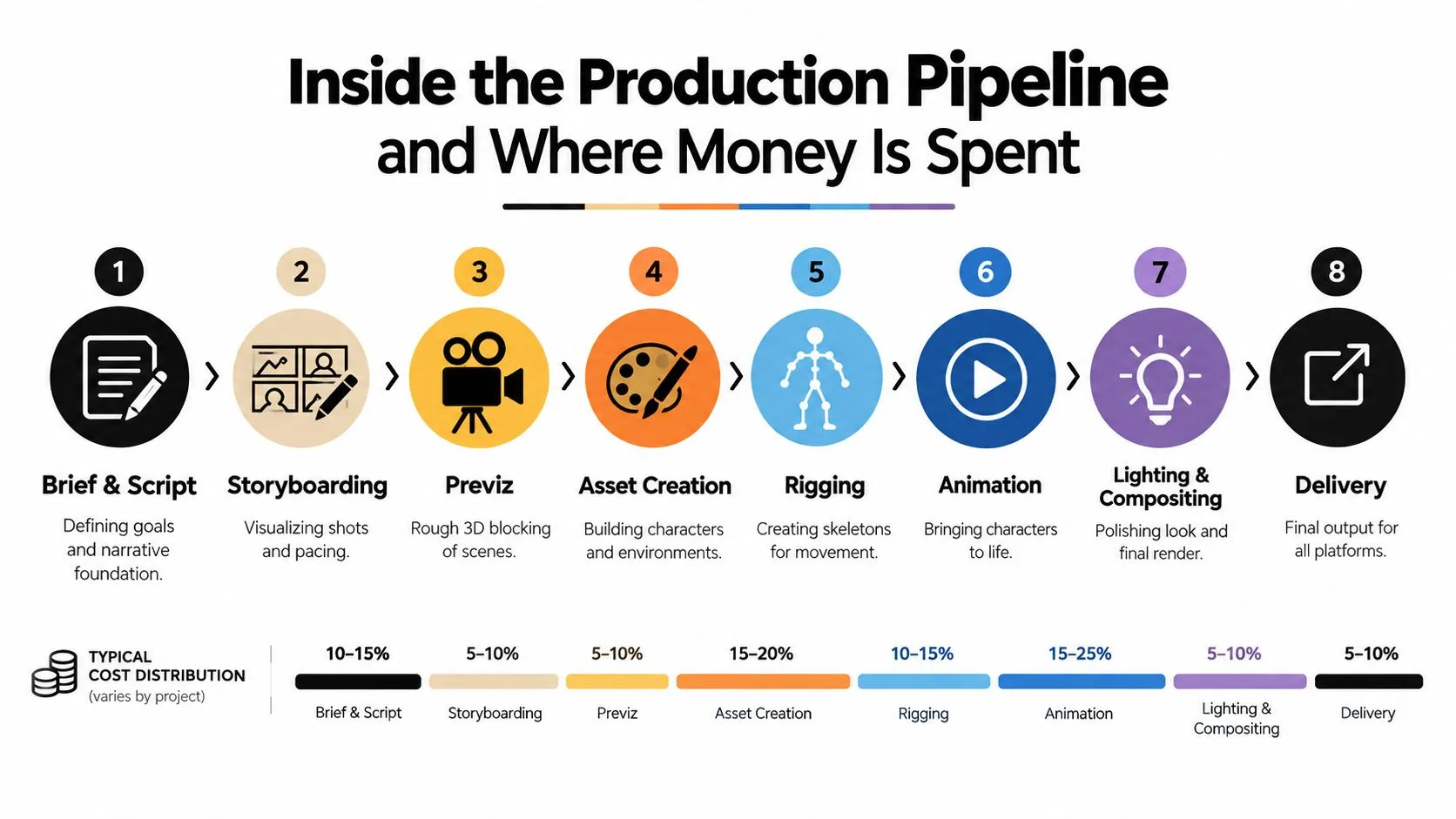
A professional quote makes more sense when you can map the figure to the work. The production usually moves through connected stages, and each approval affects the cost of everything that follows.
Start with the decisions that are expensive to change
Brief and script establish the audience, purpose, message and approximate structure. If the script keeps changing after animation begins, the team may have to rebuild scenes rather than edit a line of dialogue. Storyboarding turns the script into shots. It reveals pacing, camera direction, transitions, character entrances and visual metaphors before the studio invests heavily in finished assets. A storyboard is the production equivalent of an architectural plan. You can move a wall on paper far more easily than after construction. Previz provides rough blocking for cameras, characters and scene movement. It's especially valuable in 3D, where a director can test composition and timing before final modelling, lighting and rendering. Asset creation includes characters, props, products, environments and graphic elements. A quote based on a single reusable character is different from one requiring several bespoke characters, costumes, locations and technical objects.
Movement, polish and delivery add their own layers
Rigging creates the digital skeleton or control system that lets a character move. It can be simple for limited movement or more involved when the character needs expressive body mechanics, facial animation and interaction with props. Animation brings the approved designs to life. Character performance, physical interaction and complex camera moves require more attention than basic transitions. In 3D, the team may also manage simulations, materials and render tests. Lighting and compositing establish the final look. Artists balance colour, depth, atmosphere, effects and image clarity, then combine the rendered elements into finished shots. This stage often exposes problems that weren't visible in a rough preview, so a sensible schedule includes time for quality control. Delivery is more than pressing export. The studio may need to create master files, social cut-downs, subtitles, alternate aspect ratios or broadcast-ready packages. UKTV's branding delivery guidance, for example, specifies 32-bit Targa files with embedded alpha channels, uncompressed files, approximate file sizes of 1.6 MB for SD and 8 MB for HD, and animated sequences supplied as sequential Targa frames. The pricing step-up is clear when the work moves from design-led movement to character or broadcast production. UK guidance places motion graphics at about £1,500, £5,000 per minute, 2D character animation at £4,000, £12,000, and broadcast or TV commercial work at £15,000, £50,000 or more, as detailed in this animation production pipeline guide.
Pricing Models and Example Budgets From Simple to Complex
Studios generally choose a pricing model based on how predictable the scope is. A controlled explainer with an approved script can be priced as a project. A larger programme with repeatable modules may use a finished-minute approach. Specialist freelance support is often discussed through day rates.
Three common ways to price animation
Per finished minute is useful when the format, visual system and production conditions are consistent. It gives a fast planning reference, but it can hide the difference between a quiet minute of typography and a minute packed with character action. Per project works well when the studio can define the complete scope. The proposal should identify the number of scenes, characters, environments, deliverables, review rounds and inclusions. This approach makes the total easier to approve, provided the brief is specific. Day rate is more suitable for consulting, production support, revisions outside the agreed scope or a client supplying part of the pipeline. It can also help when the script or asset list remains uncertain, although the buyer carries more responsibility for controlling the total. A useful procurement reference is Bidwell's guide to cost estimation for tender responses. It encourages a more disciplined approach to defining scope, assumptions and exclusions, which is valuable when animation forms part of a wider tender.
Example UK budgets by complexity
| Project Type | Typical UK Cost Band | What Drives Cost | Best Pricing Model |
|---|---|---|---|
| Simple motion graphics explainer | £3,000, £10,000 for many 60-second business animations | Typography, icons, limited scenes, supplied brand assets and restrained movement | Per project |
| Professional explainer | £8,000, £20,000 | Script development, bespoke design, voiceover, several scenes and review management | Per project |
| 2D character explainer | £4,000, £12,000 per finished minute | Character design, rigging, performance, backgrounds and scene changes | Per minute or project |
| Premium 3D product or character piece | £6,000, £20,000+ per finished minute | Modelling, materials, lighting, rigging, camera work, rendering and compositing | Detailed project estimate |
The ranges above are planning tools, not interchangeable promises. The UK 60-second animation cost breakdown explains why asset count and scene count are often more useful than runtime alone. A 60-second film with one environment and a reusable object may be manageable. Another 60-second film with several characters, locations and complex interactions can require a much larger build. The same distinction explains why most business animations of this length are reported at £3,000, £10,000, while the wider professional explainer midpoint reaches £8,000, £20,000. Treat the first range as a broad buying context and the second as a useful foundation for a more developed production, rather than combining them into a single average.
Timelines You Can Expect and What Affects Delivery
A launch date is a production constraint, not a wish. Animation needs enough time for creative decisions, approvals and technical finishing, and the schedule changes according to the style and the number of assets.
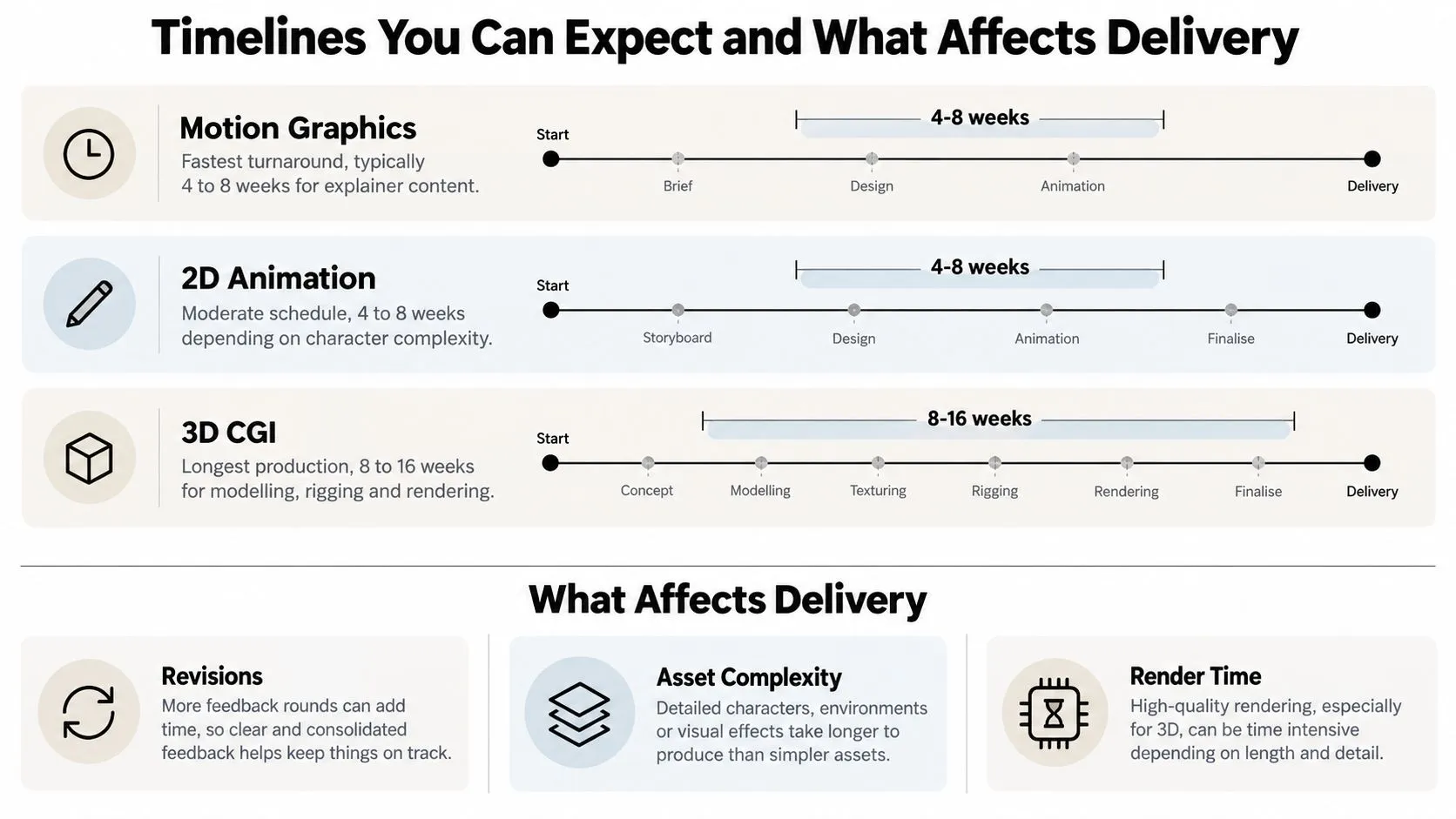
A UK pricing breakdown places typical 2D and motion graphics projects at four to eight weeks from brief to delivery, while 3D projects commonly take eight to sixteen weeks, as explained in this UK animated video production timeline guide. Those windows assume a workable brief, timely feedback and a scope that doesn't expand during production.
What speeds a project up
- •A locked script: The studio can storyboard and schedule confidently.
- •A prepared brand pack: Logos, colours, fonts, product references and existing assets reduce avoidable discovery work.
- •One organised feedback route: Consolidated comments prevent conflicting instructions from several stakeholders.
- •Early voiceover decisions: Timing and performance influence the edit, animation and sound design.
- •Planned deliverables: Aspect ratios, subtitles and cut-downs can be built into the workflow rather than added late.
What causes delay
Late script changes are especially disruptive because they can affect storyboards, voiceover, scene timing and animation. New characters or environments introduced after design approval create additional asset work. 3D projects also need time for modelling, lighting, test renders and final rendering. Rushing doesn't remove these tasks. It compresses them, often requiring more senior resource, priority rendering or parallel work. That can increase cost while reducing the time available for careful review.
Schedule advice: Work backwards from the date the audience must see the video, then allow time for approvals and delivery versions. Don't set the animation deadline as the launch date itself.
Smart Ways to Reduce Cost Without Cutting Quality
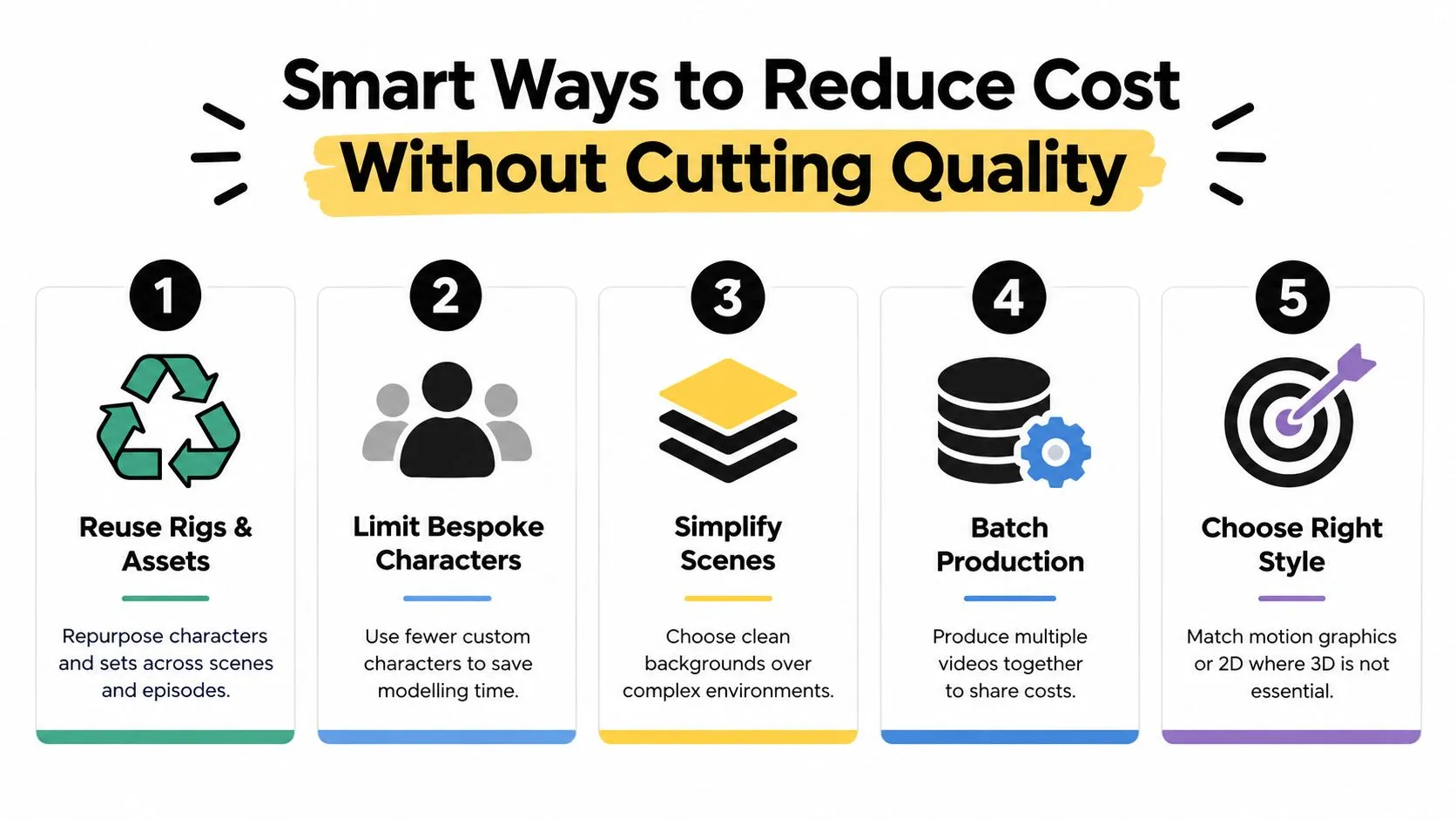
The safest savings come from reducing unnecessary production, not from asking artists to work faster. A well-scoped visual system lets the team reuse the right things while preserving the moments that carry the message.
Design the production system before building every shot
Reuse rigs and assets. A character rig, product model or environment can support several scenes when the story allows it. Series work benefits particularly from this approach because the team invests in a reusable foundation instead of rebuilding each episode. Limit bespoke characters. One strong character with clear performance may communicate more effectively than a crowded cast. Fewer custom characters reduce design, modelling, rigging and animation requirements. Simplify scenes. Clean backgrounds, controlled lighting and purposeful props can make a film feel deliberate rather than under-produced. Complexity should serve the message. A technically detailed environment that the viewer barely sees is an expensive distraction. Batch deliverables. If you need a master, social cut-downs, subtitles or alternate formats, plan them at the start. The team can frame and animate with those outputs in mind, rather than reopening completed scenes later. Choose the right style. Motion graphics or 2D may be the stronger answer when 3D realism doesn't add understanding, product confidence or emotional value. Choosing a less demanding format isn't a compromise if it better matches the communication problem.
Use AI as a production assistant, not a replacement for judgement
AI-assisted workflows can help with exploration, early iteration, reference gathering and rough development. They don't remove the need for creative direction, storyboarding, compositing, editorial judgement or final polish. The largest efficiency gains often appear before final delivery, when teams can test alternatives without fully producing each version. Talent mix also affects the budget. UK freelance animation discussions cite day rates of approximately £180, £300 for junior work, £300, £500 for mid-level work, and £500, £700 or more for senior work, according to UK freelance animation rate guidance. The sensible approach is to put senior judgement around the brief, visual direction and critical approvals, then match specialist production support to the task. Real-time tools such as Unity and Unreal can support efficient iteration for suitable animation and XR projects. They won't make every project cheaper, but they can make changes and previews more practical when the pipeline is designed for real-time output from the beginning.
Choosing a Studio Partner and Getting the Best Value
The lowest quote rarely gives you the clearest value. Compare proposals by asking what the studio will build, who will approve it, how revisions work and which files you'll receive at the end.
Questions to ask before you appoint a team
- •Scope: How many scenes, characters, environments and deliverables are included?
- •Pipeline: Who handles the script, storyboard, design, animation, sound and compositing?
- •Approvals: At which stages can you give feedback, and how many revision rounds are allowed?
- •Ownership: Which project files, models, rigs or assets are supplied, if any?
- •Delivery: Are subtitles, aspect-ratio versions, broadcast masters and platform exports included?
- •Schedule: What decisions must your team make, and by when, to protect the launch date?
Red flags include a per-minute figure with no asset list, a promise of a rapid 3D turnaround without explaining the pipeline, unlimited revisions presented as standard, or a proposal that doesn't distinguish creative development from final production. A good treatment should help you understand the intended visual approach before you commit to every finished shot. For a more detailed checklist covering budgets, timelines and supplier diligence, use this buyer's guide to choosing an animation studio. Studio Liddell is one UK option for teams comparing end-to-end 3D and 2D animation, motion graphics and XR production, with Unity and Unreal experience and AI-assisted production workflows. Its stated production heritage dates from 2019, with work spanning animation, games, television advertising, multi-episode series and immersive experiences. --- If you're planning an animated explainer, product film, character piece or XR experience, visit Studio Liddell with your script, brief or early concept. The team can help you define the asset scope, choose a practical pipeline and turn the creative ambition into a budget you can compare and approve.