What Is 2D Animation and How It Works
What is 2D animation, really, if the finished frame looks so polished that the labour disappears? That's the gap a lot of commissioning teams walk into, because they see the style first and miss the craft underneath. 2D animation is the discipline of turning separate drawings into motion, and that simple idea still shapes how UK studios plan, budget and deliver work today. The medium hasn't changed much since the early film era. An industry explainer notes that one second of finished animation typically required 24 individual drawings, and a 10-second shot can require roughly 240 drawings before cleanup, colouring and compositing are added, which shows why frame-based planning still matters for cost and scheduling in UK production (explainvisually.co). In practice, that means 2D isn't just a visual style. It's a production method built on timing, posing and sequencing.
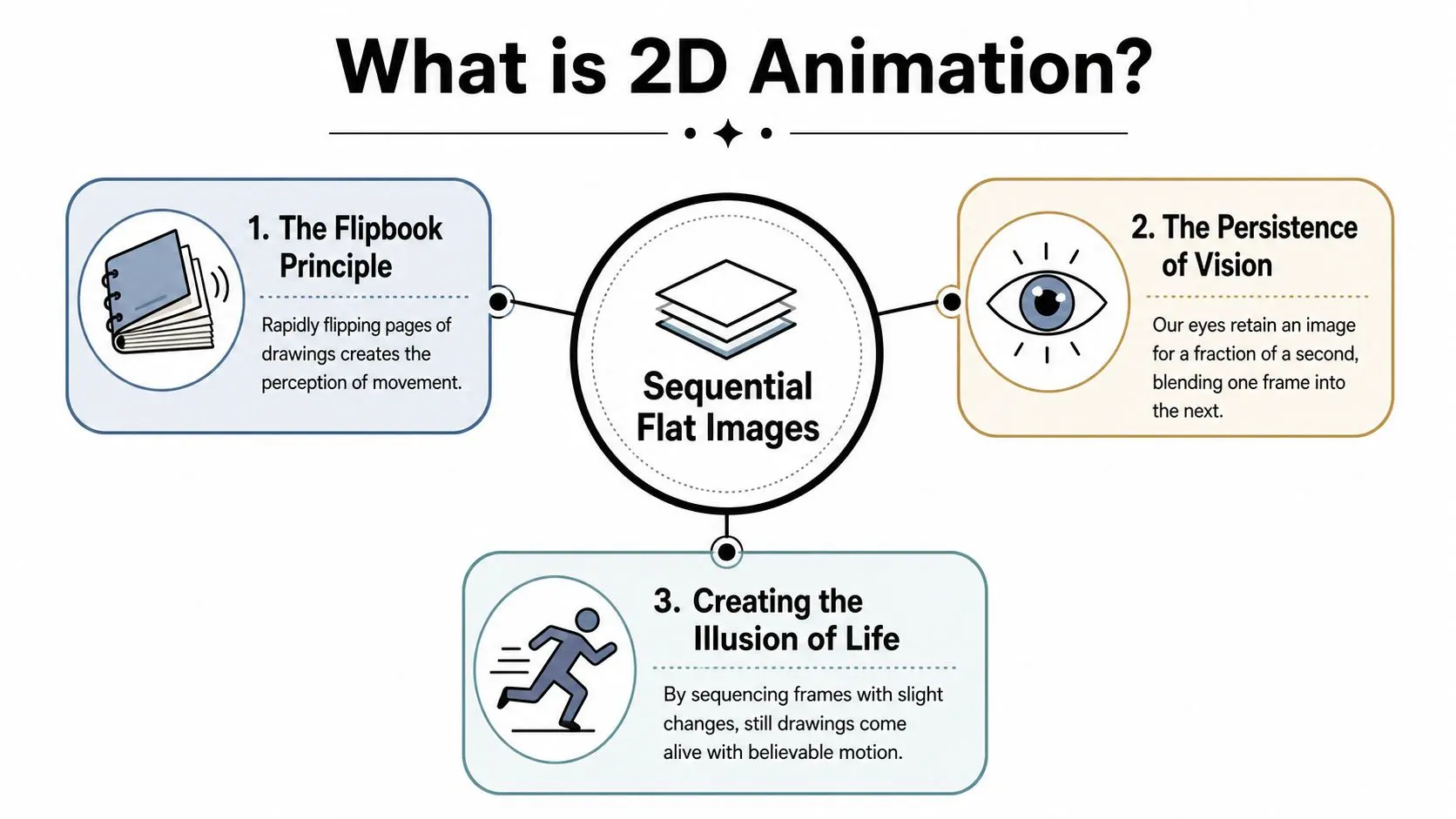
What 2D Animation Actually Means
If a commissioner asked for the shortest possible answer, I'd say this. 2D animation makes flat artwork appear to move by showing a series of images fast enough that the eye reads them as continuous motion. A flipbook does the same thing, each drawing changes a little, and your brain stitches the sequence together into movement.
Why the frame rate matters
Traditional production often orients around 24 frames per second, because that playback rate gives motion a familiar smoothness in broadcast and film pipelines (CG Spectrum). That benchmark also explains why the craft is organised around drawings, not around “a scene” in the abstract. If the playback rate is fixed, the team still has to decide how many unique drawings to create, where to hold them, and where to add movement.
Practical rule: if a shot feels stiff, the problem is usually timing or spacing, not the idea itself.
That's why 2D animation is better understood as a craft than a look. A hand-drawn TV bumper, a vector explainer in After Effects, and a cut-out social asset can all be 2D, because all three rely on flat image sequencing. The tools changed, but the logic didn't. For UK commissioners, this matters because 2D still fits real production needs, from children's television to short-form social content. Studios keep using it because it can carry character, humour and rhythm without forcing every project into a full 3D build. Once you understand the sequential-image principle, the rest of the pipeline starts to make sense.
Where 2D Animation Came From and Why It Still Matters
The modern form of 2D animation traces back to Émile Cohl's 1908 short Fantasmagorie, which is widely credited as one of the first fully animated films and is reported to have used about 700 hand-drawn cells photographed frame by frame (history of 2D animation PDF). That detail matters because it shows the medium's original operating system. Motion came from repeated drawing, not from a camera trick or a digital effect.
From paper tables to software timelines
British animation grew up inside broadcast, advertising and children's content, so the practical grammar of the medium stayed close to frame-by-frame timing. The move from paper and cels to digital workflows changed speed and revision control, but not the underlying logic of separate drawings viewed in rapid succession. Even now, modern UK teams still talk about drawing counts, poses and holds because those decisions shape both the feel and the cost of a project. That heritage is also why 2D still gets taught as a craft discipline. Students need to understand how motion reads before they can automate or simplify it. In a studio setting, that foundation affects briefs, because a client asking for “simple animation” may be asking for something that is structurally quite demanding. A good shorthand is this. 2D survived because it's useful, not because it's nostalgic. It stays relevant wherever a project needs character, fast visual communication or a deliberately graphic look. That's as true in a broadcast bumper as it is in a social campaign.
How Animators Make Drawings Move
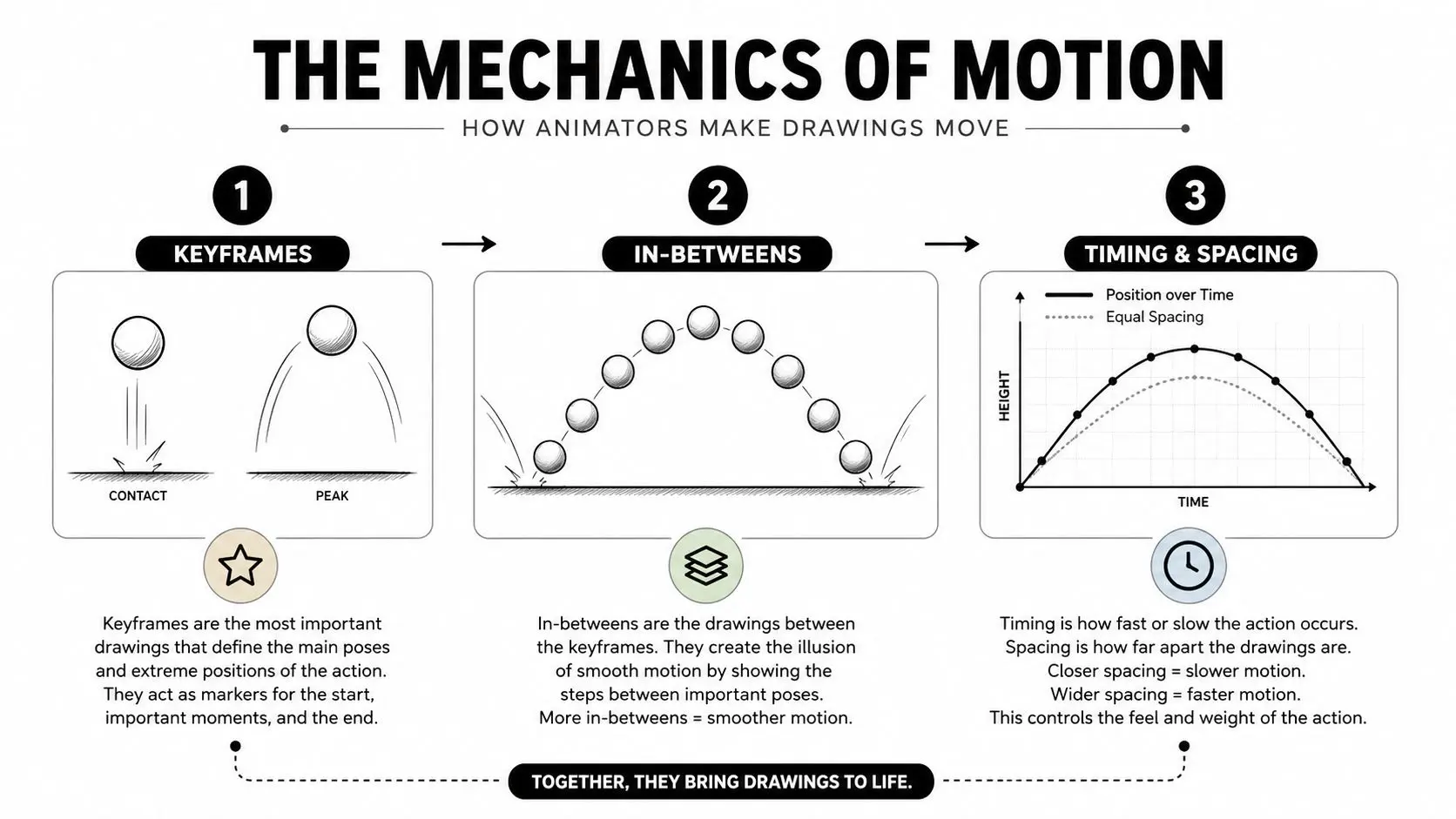
The motion you see on screen starts long before the final frames are polished. Animators begin with keyframes, then place in-betweens between those poses, and then adjust timing and spacing so the action reads as deliberate, not random. For commissioning teams, that matters because the same movement can feel crisp, heavy or airy depending on how the drawings are held and released, and a clear reference on playback speed is vitelnk on frames per second.
A simple mug lift shows the whole system
A character lifting a mug is a good test case. One keyframe might show the mug resting on the table, the next the hand reaching the top of the lift, and another the mug settling back down. Those poses set the intention. The in-betweens shape the arm arc, the wrist turn and the amount of acceleration in the move. A limited-animation shot often uses keyframes plus 10, 20 total drawings per shot, with in-betweens bridging the gaps between the extremes (Wikiversity). That is a production choice, not a compromise. It lets teams put drawing effort where viewers will notice it, which is one reason 2D stays practical for TV work and explainers where clarity matters more than physical realism.
A shot is only smooth if the spacing makes sense. Equal spacing feels mechanical. Varied spacing gives the impression of weight, hesitation or speed.
Animators also talk about working on 2s, which means one drawing is held for two frames. In practice, that gives 12 unique drawings per second while the playback still runs at 24 fps, and CG Spectrum explains why that approach remains common in production. It reduces drawing volume without changing the playback rate, so it is a useful planning tool when studios are balancing labour, schedule and revision time. For a clearer breakdown of how poses, holds and transitions are planned, Studio Liddell's guide to keyframe animation lays out the frame logic step by step. The short version is simple. Good 2D motion feels natural because someone designed the movement carefully before the software assembled it.
2D Animation Compared With 3D and Motion Graphics
A commissioning manager usually doesn't need a lecture on technique. They need to know which approach fits the brief. 2D, 3D and motion graphics can all solve communication problems, but they do it in different ways, and choosing the wrong one makes the work harder than it needs to be.
What each approach does best
2D is strongest when you want stylised storytelling, graphic clarity and a human, drawn feel. It suits brands that want personality without photoreal detail, and it can move quickly when the message is simple. 3D is stronger when the product needs depth, material realism, spatial navigation or repeated camera movement through an environment. Motion graphics works well when the job is typography-led, diagrammatic or built around brand elements rather than characters. If you're weighing those choices, Studio Liddell's comparison of 2D vs 3D animation is a useful reminder that 2D isn't a cheaper version of 3D. It's a different creative tool with its own strengths.
| Choosing Between 2D, 3D and Motion Graphics | Best For | Typical Lead Time | Relative Cost |
|---|---|---|---|
| 2D Animation | Character-led explainers, kids' content, stylised ads | Usually shorter when the design language is simple | Varies with drawing count and revision depth |
| 3D Animation | Products, worlds, camera-led storytelling, realism | Often longer because modelling and lighting add stages | Often higher when assets must be built from scratch |
| Motion Graphics | Logos, titles, data visuals, brand systems | Often efficient for modular campaigns | Often lower when the style is template-friendly |
The table is the cleanest way to think about it. If the story lives in performance, 2D usually has the edge. If the story lives in a physical object or environment, 3D often earns its place. If the message lives in text, shapes and brand systems, motion graphics may be the smartest commission.
The 2D Production Pipeline From Brief to Delivery
A proper 2D job isn't “draw some scenes and send the file.” Clients usually move through a sequence of decisions that begins with the brief and ends with delivery, and each step locks down a different part of the work. The earlier those decisions are clear, the fewer surprises appear later.
What the studio and client actually approve
A common pipeline starts with brief and treatment, then script and storyboard, then an animatic to test pacing and structure. After that comes design and asset build, then animation, then compositing, followed by sound design and final delivery. A practical overview of 2D character animation can help first-time commissioners understand where character work sits inside that sequence. AI-assisted tools now have a place in cleanup, in-between generation and asset preparation, but they don't replace judgement on acting, rhythm or editorial clarity. Those decisions still belong to people, because a machine can fill space without understanding intent. The studio lead still has to decide when a hold should breathe, when a gesture should tighten, and when a pose needs re-drawing.
If the storyboard is weak, everything downstream gets more expensive. The animatic is the cheapest place to fix timing, staging and scene length.
That's why review rounds matter. Clients should expect to comment on structure early, then on design and movement later, rather than trying to solve story problems after animation starts. The same applies to delivery, because broadcasters, platforms and social channels often want different exports and aspect ratios. A good studio builds those requirements into the plan rather than treating them as afterthoughts.
Where 2D Animation Works Best in 2026
The jobs that suit 2D in the UK market tend to share one quality, they benefit from a clear graphic identity. Explainers and product walkthroughs use 2D because it can simplify complex ideas without pretending to be a real environment. Brand stings and social cut-downs use it because flat motion reads quickly and keeps the look distinctive on small screens.
Real-world fit beats abstract style preference
Children's TV and digital shorts remain a natural home for 2D because performance, humour and clarity matter more than strict realism. Studio Liddell's own kids IP work, including BooSnoo, sits in that space where character appeal and episodic flexibility matter. In the wider UK context, the broadcast tradition still favours 2D for projects that need expressive design rather than heavy spatial realism. Training and e-learning also suit 2D when the goal is to explain a process, a policy or a behaviour change. The format lets the team draw attention to the right part of the screen, which is often more useful than showing every detail of a physical world. For stylised advertising, 2D is often chosen precisely because it looks designed rather than simulated. Mixed campaigns sometimes combine methods. A flat title sequence can hand off to a motion graphics section, or a 2D character can sit inside a larger branded toolkit. The key is matching the medium to the communication job, not forcing the brief into whichever software the team used last month.
Cost, Timelines and How to Commission 2D Work
What drives the price of 2D animation? Usually the answer is the same few things, labour, scope and revision. Drawing count, character complexity, scene length, voice-over, music rights, and the number of review cycles all shape the final cost. A short project with simple assets can move quickly. A longer piece with many characters, detailed scenes and multiple approval rounds needs more time from the studio at every stage. A scoping call is better than a rough guess because it lets the studio identify where the work is straightforward and where it becomes frame-heavy. That matters in UK production, where 2D often sits beside 3D and motion graphics in the same brief, and the team has to decide what belongs in each format before anyone starts drawing. If you want a practical reference for that first conversation, Studio Liddell's guide on choosing a 2D animation studio, budgets, timelines and red flags is a sensible place to start. The main point is simple. Good commissioning is not about asking for the cheapest version. It is about setting the right amount of motion for the message, so the work supports the brief instead of creating avoidable rework. A clear brief protects the creative team from back-and-forth that could have been avoided, and it helps the client avoid vague assumptions about what is included.
A clean script saves more money than a rushed revision later.
If you are commissioning 2D for the first time, bring a script, any visual references, the intended runtime, and a clear idea of where the piece will live. A studio can then judge workload more accurately and suggest the right approach, whether that is character-led animation, a more graphic treatment, or a mix of methods. The better the input, the easier it is to price the work and plan the schedule without surprises. A commissioning manager usually gets the most useful estimate by asking for the process as well as the price. Who is writing, boarding, animating and sound-designing the piece. How many rounds of feedback are included. What needs sign-off before production begins. Those questions make the brief sharper, and they help the studio separate creative decisions from production risks. If a project needs to sit across 2D, 3D and motion graphics, the studio should explain where each format adds value and where it only adds cost. That conversation is often where a good commission starts.