2D vs 3D Animation Cost A Buyer's Guide
You're in a UK studio scoping meeting. The director likes the clean readability of the 2D storyboard, the client wants the depth of the 3D render, and someone has suggested combining both. The creative possibility is obvious. The production question is harder: does a 2D 3D hybrid animation style improve the film enough to justify another specialist team, another round of look development, and more complicated reviews? The decision usually sits between three routes. Pure 2D keeps the image direct and graphic. Pure 3D offers consistent cameras, lighting, objects and spatial interaction. Hybrid animation assigns different jobs to both, then brings the results together in the final frame. Audience, brand language, duration and distribution all matter, whether the work will live on broadcast, a website, social feeds, an exhibition screen or an immersive installation. This isn't an aesthetic contest. It's a production decision. The useful question is not which style looks more impressive in a pitch deck, but which pipeline gives the audience the clearest and most persuasive experience without paying for complexity that never reaches the screen.
The Producer's Dilemma With 2D 3D Hybrid Animation Style
A producer can usually spot the moment a hybrid proposal becomes risky. The storyboard shows a hand-drawn character explaining a product, while the next frame reveals a beautifully lit 3D machine rotating through space. The director sees one coherent visual world. The production team sees character design, modelling, rigging, animation, lighting, compositing and two different kinds of client approval. The hybrid route can be the right answer, but it isn't automatically a creative upgrade. A simple 2D explainer may communicate a process more quickly because the viewer sees only the essential shapes, labels and movement. A fully 3D film may be more efficient when every shot depends on the same physical world, camera system and light rig. Hybrid earns its place when each medium solves a problem the other handles poorly.
The three routes on the table
Pure 2D is often the strongest fit for explainers, training content, editorial graphics and brand films built around typography or illustration. Artists can control shape, timing and visual emphasis directly, and the final image can remain clear across different screens. Pure 3D becomes useful when the audience needs to understand volume, rotation, mechanical interaction, reflections, depth or camera movement. Modelling an asset once can support multiple views, provided the project has enough scope to benefit from that investment. Hybrid combines those advantages selectively. A studio might build a product, room or vehicle in 3D, then place illustrated characters, hand-painted effects or graphic labels over the render. The audience sees one image, but the production team manages several linked layers.
Producer's rule: Choose hybrid because the brief needs two different kinds of control, not because the phrase sounds more premium.
The UK's animation history makes this approach feel less like a sudden fashion and more like a continuation of established practice. The BFI account of British animation production traces the country's path from early stop-motion and silhouette experiments through advertising, sponsored films, Channel 4's industry influence in 1982 and digital techniques in the 21st century. Today's mixed pipelines inherit that willingness to combine methods when the story demands it.
What a 2D 3D Hybrid Animation Style Actually Means
A 2D 3D hybrid animation style is a single production in which 2D and 3D elements share the same shot, camera plan, look development and compositing process. It's more specific than saying a film contains some 2D scenes and some 3D scenes. If the styles never interact and each appears in a separate block, the project uses multiple techniques, but it isn't necessarily hybrid at shot level. A useful analogy is a theatre set. The stage may be built in full 3D so the camera can move around furniture, walls and props. Artists then paint parts of the set flat, use illustrated backdrops and place hand-drawn performers into the scene. The audience experiences one world, while the crew preserves different kinds of control behind the curtain.
How the layers meet
A typical hybrid shot might contain:
- A 3D environment with a tracked camera and physically placed props.
- A 2D character or face animation designed to retain an illustrated performance.
- 2D effects, labels or painted textures added above the render.
- A composite that controls depth, colour, shadows, occlusion and final image treatment.
The Four Hybrid Approaches Studios Use Most
Studios tend to choose one of four structures, although a single project can combine them. The most reliable choice depends on what needs to feel physical and what needs to feel expressive.Four hybrid animation approaches compared
| Approach | Best For | Pipeline Complexity | Cost vs Pure 3D |
|---|---|---|---|
| 3D environments with 2D characters | Product walkthroughs, explainers and stylised worlds | Medium to high, because cameras, perspective and character integration must align | Often lower than fully 3D character production, but higher than simple 2D |
| 3D characters with 2D face or hand replacement | Preschool series, branded characters and dialogue-led work | High, because replacement animation must follow the 3D performance | Can reduce facial animation work, but adds rigging, tracking and compositing |
| Cel-shaded or non-photorealistic 3D | Stylised films, games, trailers and graphic action | High at look-development stage, then more repeatable once the rig and shader system are stable | May reduce some illustration work, but rendering and shader control remain significant |
| 2D painted effects or UI over 3D | Science, documentary, technical storytelling and immersive content | Medium, with careful layer management and screen-space integration | Usually lower than full 3D effects, though bespoke painting adds review time |
Inside the Hybrid Production Pipeline
A hybrid production starts with a question that belongs in the storyboard meeting: which asset needs which medium, and why? A production team can then test those choices against 3D blocking before committing to detailed design.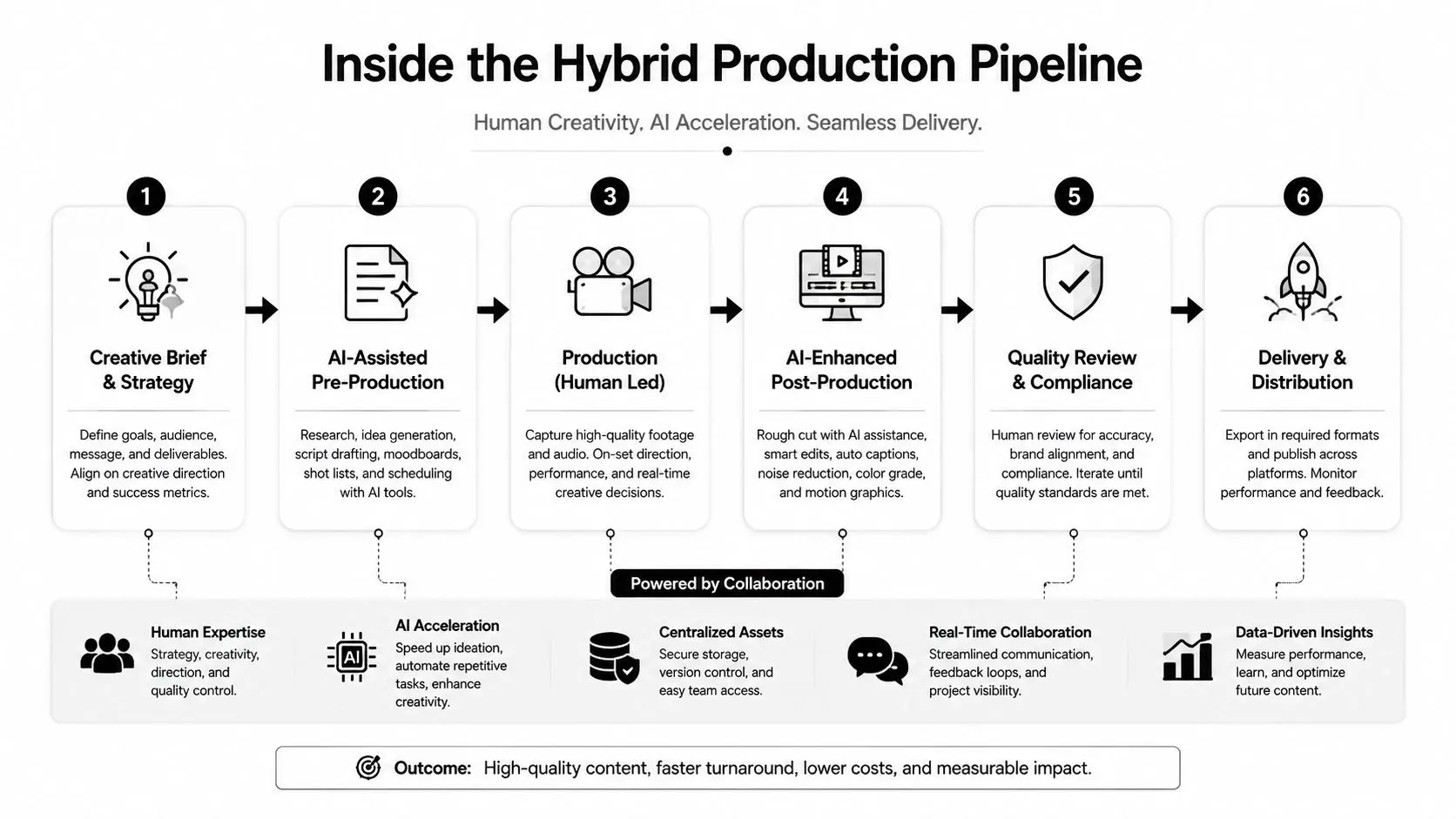
From board to block
The storyboard establishes action, composition and screen direction. The 3D team then blocks environments, props and cameras so the director can check parallax, scale and entrances before artists spend time on final assets. In parallel, 2D designers develop characters, poses, graphic treatments and effects that will survive the planned camera movement. Modelling and rigging may run alongside 2D character design, but the handoff must be explicit. A 2D character that will stand behind a 3D table needs a planned matte. A 3D prop that a drawn character picks up needs a clear contact pose, depth order and shadow strategy.Where the schedule becomes exposed
Layout uses 3D cameras to establish perspective and movement. Animation then splits by asset. A 3D vehicle may follow a rig through a complex turn, while a 2D character receives hand-drawn poses or replacement faces. The compositor combines those elements with shadow, reflection, atmospheric effects, painted marks and typography. The complete animation production pipeline guide is a useful reference for understanding why these handoffs need named owners. Hybrid adds pressure in four places:- •Technical direction: Someone must define software versions, colour management, camera conventions, render passes and file naming before production accelerates.
- •Compositing supervision: A compositor needs authority to solve depth, edge treatment, shadows and style consistency rather than receiving mismatched layers at the end.
- •Quality control: Broadcast and platform delivery may require separate checks for the 2D artwork, 3D render and final composite.
- •Client reviews: Approval works better when the client sees storyboard, blocked camera, design, animation and composite milestones in sequence.
A hybrid schedule rarely fails because an artist can't animate. It fails because the team approves a look before testing how that look behaves across moving cameras, overlapping layers and revisions.
What Hybrid Costs Versus Pure 2D or 3D
There isn't a reliable universal price per finished minute for hybrid animation. UK studios price it from the asset list, shot count, duration, design ambition, deliverables and the amount of original modelling or rigging required. The available UK benchmarks still provide a useful boundary for the conversation. A UK pricing guide places 2D motion graphics at £4,000 to £14,000 with a 4 to 6 week schedule, while 3D animation sits at £12,000 to £45,000 with an 8 to 14 week schedule for comparable explainer work, as detailed in this UK explainer video cost and process guide. Those figures describe broad 2D and 3D categories, not a guaranteed quote for any particular film.
| Style | Cost per finished minute (GBP) | Typical lead time | Main cost drivers |
|---|---|---|---|
| Simple 2D explainer | £1,500 to £3,000 for 30 to 60 seconds | About 3 to 4 weeks | Script, design, voiceover, animation and revisions |
| 2D motion graphics | £4,000 to £14,000 | 4 to 6 weeks | Bespoke design, animation, compositing and delivery |
| 3D animation | £12,000 to £45,000 | 8 to 14 weeks | Modelling, rigging, lighting, rendering and revisions |
| Hybrid | No fixed benchmark | Depends on the asset mix | Dual-specialist work, lookdev, integration and composite revisions |
The simple explainer range and schedule come from a UK animation pricing guide for 2026. A hybrid film can sit closer to 2D when 3D is limited to a small number of reusable objects. It can move towards 3D pricing when every shot needs a detailed environment, physically controlled lighting and a bespoke composite.
The hidden budget lines
The premium usually comes from parallel staffing, longer look development, extra technical direction, render or licence costs and revisions that cross the 2D and 3D boundary. A client change to the camera can force a new 3D render, a revised 2D performance and a fresh composite. A colour change may affect painted passes, shaders and grade decisions at the same time. For a 60-second explainer, a typical UK workflow can run from script and briefing in week 1 through styleframes and storyboard in weeks 1 to 2, voiceover in weeks 2 to 3, animation in weeks 3 to 6, then sound and delivery in weeks 6 to 8, according to this UK explainer production schedule. A five-minute brand film needs a bespoke schedule, not a simple multiplication of that example. No defensible percentage uplift applies to every hybrid project. The honest commercial position is to request the hybrid route as a separate option beside pure 2D and pure 3D, with integration, render and revision assumptions itemised. The 2D versus 3D animation cost buyer's guide can support that comparison, but the asset plan should decide the final figure.
Piripenguins and the UK Hybrid Pipeline in Practice
Wild Child Animation's Piripenguins offers a clear example of hybrid production solving a physical problem without abandoning a 2D-led identity. The production paired 3D environments and character bodies with 2D facial rigs inside a custom Unreal pipeline, as documented in the Bournemouth University production case study. The choice was practical. A character that sits on furniture, picks up a prop or moves through a lit environment benefits from 3D spatial consistency. A 2D facial system can preserve the illustrated expression and avoid committing the entire performance to fully 3D facial animation.
What the pipeline gained
The 3D side gave the team controllable sets, camera placement, contact points and lighting. The 2D face retained the brand's graphic character, while compositing brought the layers together so the final image didn't read as a collection of disconnected techniques. The research describes a setup in which Blender handled modelling, rigging and animation, while Unreal handled lighting, layout and rendering. That division illustrates a broader production principle: hybridisation works best when each stage is assigned to the software and specialists suited to it, rather than forcing one package to handle every task. Ice caves and water are useful examples of where the approach earns its keep. A 3D environment can support repeatable camera movement, surface depth, prop interaction and coherent shadows. A drawn facial performance can remain expressive on top of that structure. The trade-off appears when a camera, light or water interaction changes late. The 2D face, 3D render and composite may all need another pass. This is why episode planning matters. A producer can batch shots that need heavier environments, lighting or water work, then keep simpler dialogue shots moving through the 2D-led part of the pipeline. The method controls bottlenecks, but it doesn't remove them. Hybrid works when the production team identifies those expensive shot types before the schedule becomes a promise.
When Hybrid Pays Off and When It Does Not
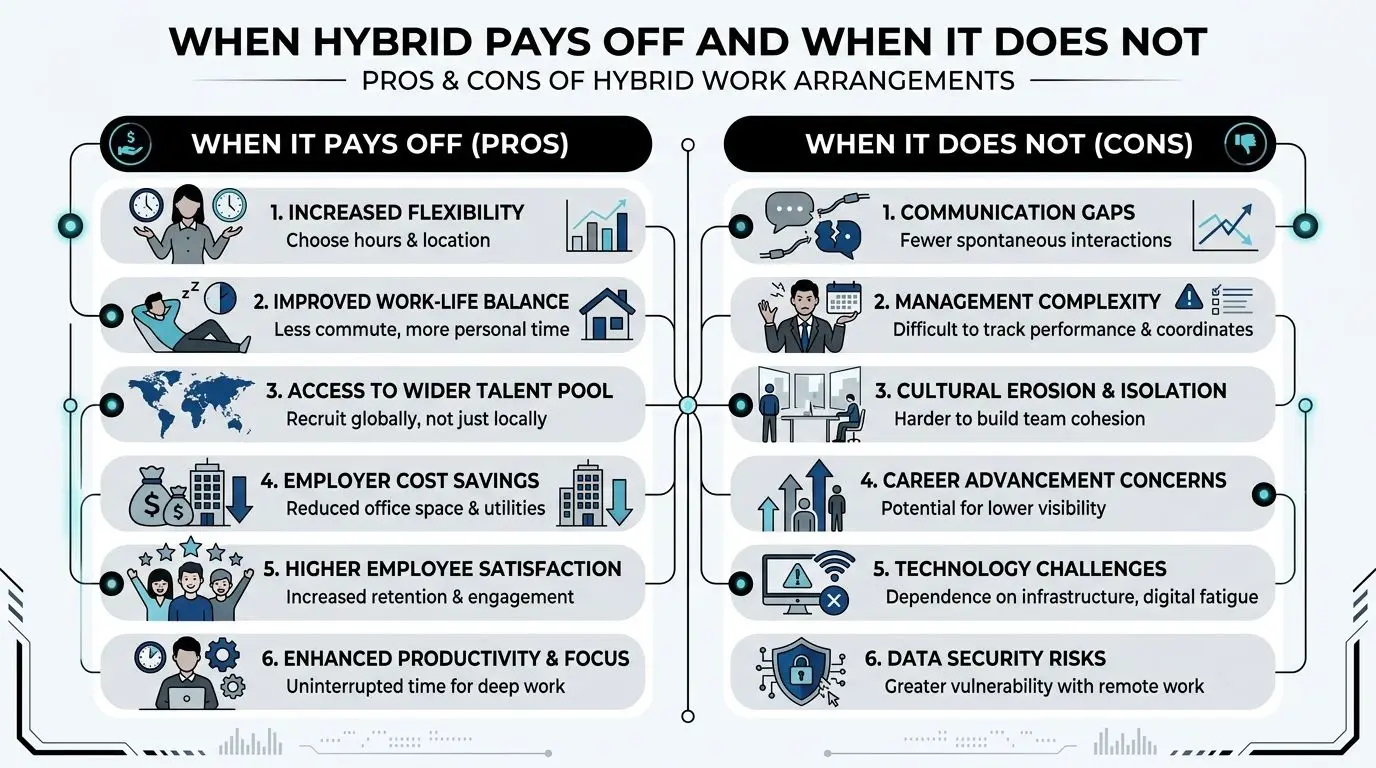
Hybrid animation pays when the two mediums give the audience different kinds of information. 3D should earn its place through function, such as rotation, depth, object interaction, spatial navigation or lighting. 2D should earn its place through communication, such as expressive character acting, visual shorthand, hand-drawn texture or clear graphic emphasis.
Strong cases for the hybrid route
A technical explainer may use a 3D model to reveal how a component fits together, then overlay 2D labels and animated diagrams that direct attention. A product demonstration can show a physical object turning in space while an illustrated presenter makes the explanation feel less clinical. Children's IP is another strong fit. A familiar 2D character can enter a new 3D world without losing the visual identity that audiences recognise. XR projects also benefit when graphic interfaces, annotations or illustrated effects sit naturally over 3D geometry. The UK market includes animation, VFX and post-production across 2D, 3D, stop-frame, XR and virtual production. A 2025 UK animation trends guide forecasts the UK animation, VFX and post-production market at USD 3.94 billion in 2025, with an 18.91% CAGR to 2030. Those projections indicate a growing field, but they don't remove the need to match the method to the brief.
Clear cases against it
Hybrid is usually difficult to justify for a very short social asset where the viewer needs one fast idea, a brand ident dominated by typography, or a project in which the 2D and 3D teams can't share reviews and delivery dates. In those cases, the second pipeline adds meetings and dependencies without improving the message. A studio also has to consider capacity. An Animation UK report on the Annecy industry panel cites global VFX and animation workforce growth of 9.3% in the second half of 2024, followed by a 7.6% contraction in the first half of 2025, resulting in 1% net growth over the last 12 months. That uneven environment makes a bespoke hybrid pipeline harder to staff consistently, particularly when a project needs rapid iteration. The producer in the opening meeting should therefore ask which route removes work. The cheapest option is often not the one with the lowest day rate. It's the one that eliminates an entire pipeline while preserving the audience benefit the brief needs.
Scoping a Hybrid Animation Project With Confidence
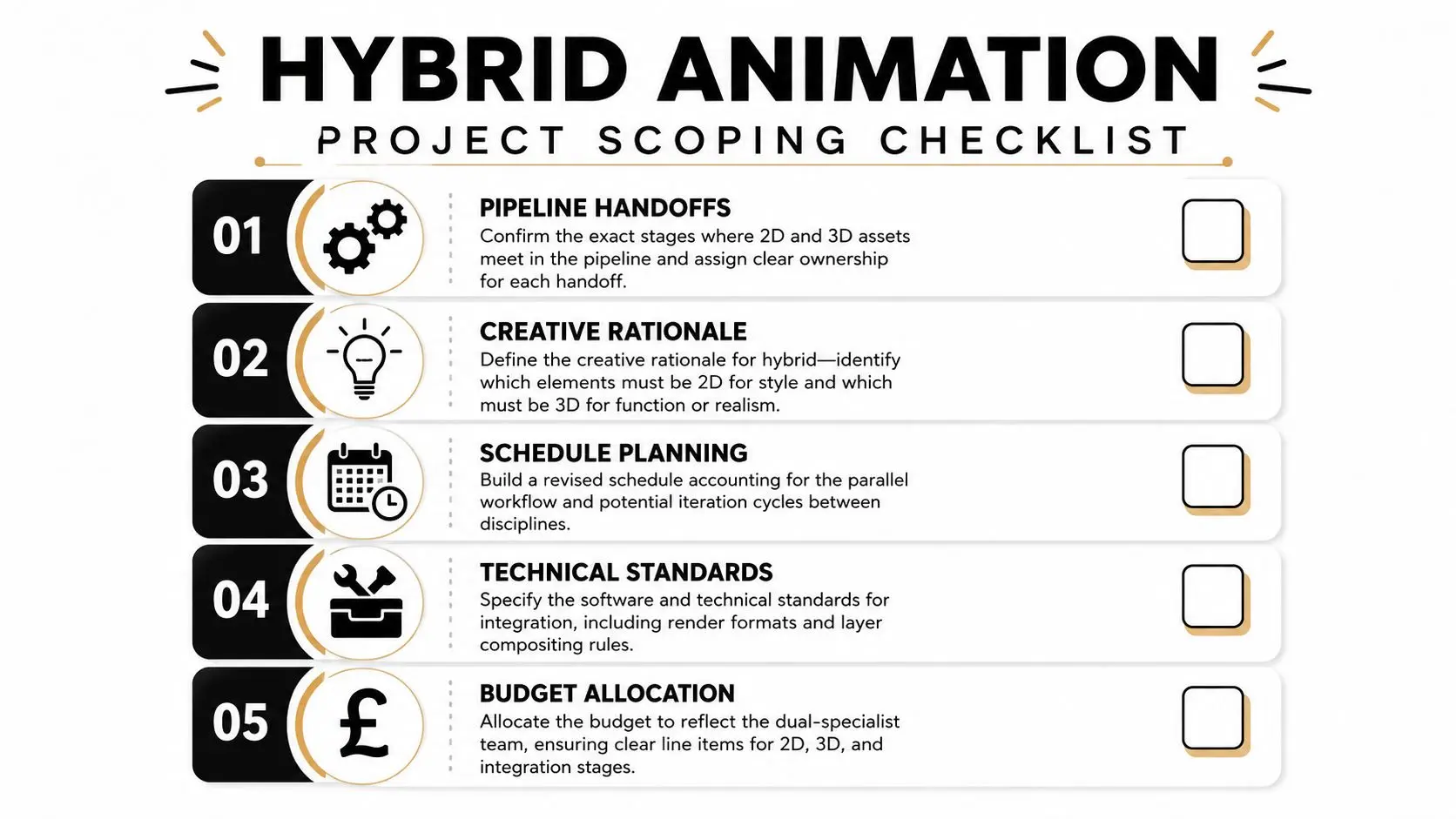
A good scoping call turns “make it feel 2D and 3D” into an accountable production plan. Start with the shot list, not the render style. Mark every asset as 2D, 3D or integrated, then identify the handoff that could create a delay.
The checklist for the first call
- •Assign ownership: Confirm exactly where 2D and 3D meet, and name the person responsible for each handoff.
- •Define the creative reason: State which elements must remain 2D for style or performance, and which need 3D for function, depth or realism.
- •Fix the technical target: Agree resolution, frame rate, aspect ratios, colour management and delivery formats before storyboards are approved.
- •Separate the costs: Request line items for 2D, 3D, integration, compositing, render farm use, licences, sound and revisions.
- •Protect the review plan: Schedule a revision round before the composite is locked, rather than waiting until every layer is finished.
Ask the studio which software sits at the 2D to 3D boundary. Blender and Unreal can divide modelling, rigging, animation, lighting, layout and rendering effectively, but the answer depends on the team's existing pipeline. Ask how the studio will handle source files, whether layered renders are included at delivery, and how changes are priced after the hybrid composite has been approved. You should also ask whether a technical director can attend the final mix and delivery review. A last-minute issue with colour, alpha channels, frame rate or layer order is easier to solve when the person who designed the pipeline is still involved. Studio Liddell offers 2D and 3D animation, character animation, CGI production and workflows that can carry 2D sketches into 3D modelling, rigging and animation. That makes it one option to discuss when a project needs a UK team to plan the creative and technical boundary together. The original dilemma becomes manageable once these variables are written down. You can compare pure 2D, pure 3D and hybrid on the same brief, with the same deliverables, assumptions and approval points. --- If you're planning a hybrid film, Studio Liddell can help scope the 2D and 3D handoffs, build the treatment and map the production risks before approval. Share your script, storyboard or rough brief to start a production scoping conversation focused on the right pipeline for the audience and delivery.