10 Best 3D Animated Films: Craft Lessons for 2026
British audiences met stereoscopic animation decades before a CGI feature filled a multiplex. In 1952, a programme of 3D films at the Festival Gardens on London's South Bank included Twirligig, an animated short from Canada's National Film Board by Norman McLaren with Gretta Ekman, as the BFI's account of that South Bank programme records. That screening sits about 57 years before Avatar in 2009 helped push 3D presentation into the mainstream. The strongest pictures still land because of production choices, not spend alone. The best 3D animated films below are read as production case studies. Each one changed how a studio plans previs, builds a character, designs a world, or locks a style before animation starts. If you commission a series, a trailer, an ad, or a branded world, the useful question is which decision you can put into the process. The selection runs across more than two decades of landmark features. Early CGI had to prove emotion could survive a plastic surface. Later films tightened action staging, wordless performance, creature flight, musical structure, city design, cultural research, and comic-book rendering. The last entry shows how song and architecture can carry one family story onto other platforms. Every entry closes with a practical lesson for high-quality digital production. Silhouette, previs, gesture, a single metaphor, camera planning, an effects rule, a secondary character built for short-form, consultant checkpoints, a style guide, and music treated as structure. Use them as briefing tools. If campaign art has to sit beside these titles, edit AI-generated movie posters only after the visual rule is agreed. Generated art should not set the style by accident.
1. Toy Story (1995)
Pixar's Toy Story, directed by John Lasseter, was the first feature made entirely with computer-generated animation. Woody, a cowboy doll, and Buzz Lightyear, a space-ranger figure, carry a rivalry that turns into friendship. A Special Achievement Academy Award followed, and the film became the benchmark for toy-led character design.
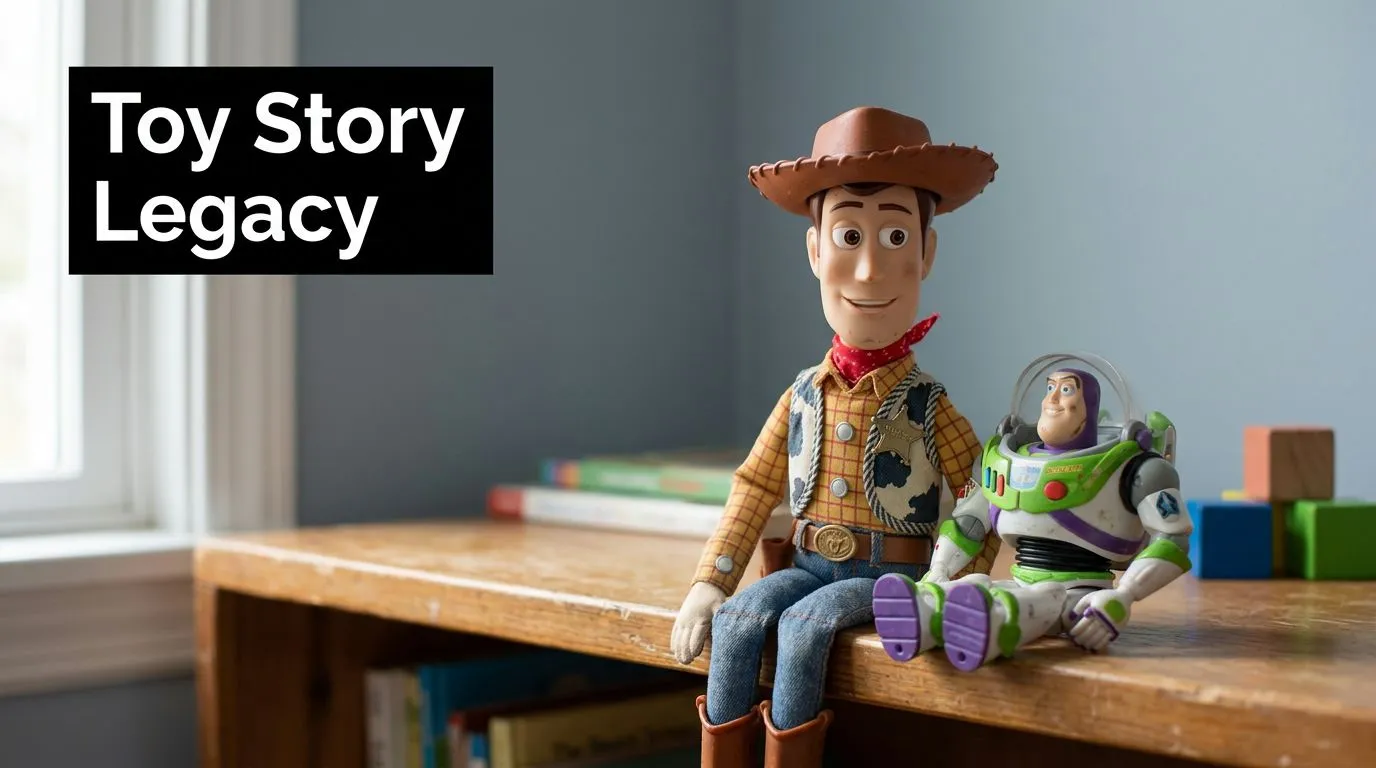
Andy's bedroom and the Pizza Planet sequences show what early environment and lighting could already do. The commercial lesson sits in the performances. Woody and Buzz read in a wide shot because their silhouettes are obvious, then the acting lives in the face and hands once the camera comes in. Say a cereal brand wants a 15-second mascot spot. If the hero only works in a beauty close-up, the pack shot fails. I would brief three tests before modelling finishes.
- •Silhouette at distance: The character must read against a busy shelf or a phone screen.
- •Simple controls: Keep the rig light enough that animators hit expressive shots on a broadcast schedule.
- •Toy logic: Joints, scuffs, and scale should feel like an object a child could own.
That discipline still sits under how 3D animation in films is planned and where the pipeline is heading. Pretty topology does not save a character that cannot act on time.
2. The Incredibles (2004)
Brad Bird wrote and directed The Incredibles as a family of retired superheroes dragged back into action. Superhero set pieces sit next to domestic comedy and mid-century design. It won the Academy Award for Best Animated Feature because the action is staged, not just loud, and the humour works for children and adults in the same scene. The Parr family's island mission and the final battle are layered choreography. You always know who is where, what they want, and what can hurt them. Edna Mode's costume scenes do a second job. Design becomes plot. A cape is not decoration. It is a decision with consequences.
Practical rule: Posture sells a character faster than a costume change. A slumped dad and a squared hero can be the same model if the acting is specific.
For a 30-second brand film, I would not approve full animation until previs and an animatic lock the beats. Late restaging is where revision cost hides. Study silhouette and performance basics in this guide to character design fundamentals before you spend on cloth and destruction. A short-form version of the island battle is three clear actions, one readable villain, and a button the audience can quote. Anything else is a showreel, not an ad.
3. WALL-E (2008)
Andrew Stanton's WALL-E follows a lonely waste-collecting robot on a deserted, rubbish-covered Earth. For long stretches there is almost no dialogue. Gesture, sound, and the state of the world do the writing. The film won the Academy Award for Best Animated Feature for that restraint. WALL-E's scenes with EVE, and with his cockroach companion, are built on timing. A head tilt, a pause, a failed reach. The opening Earth shots state the premise before anyone explains it. Props are backstory.
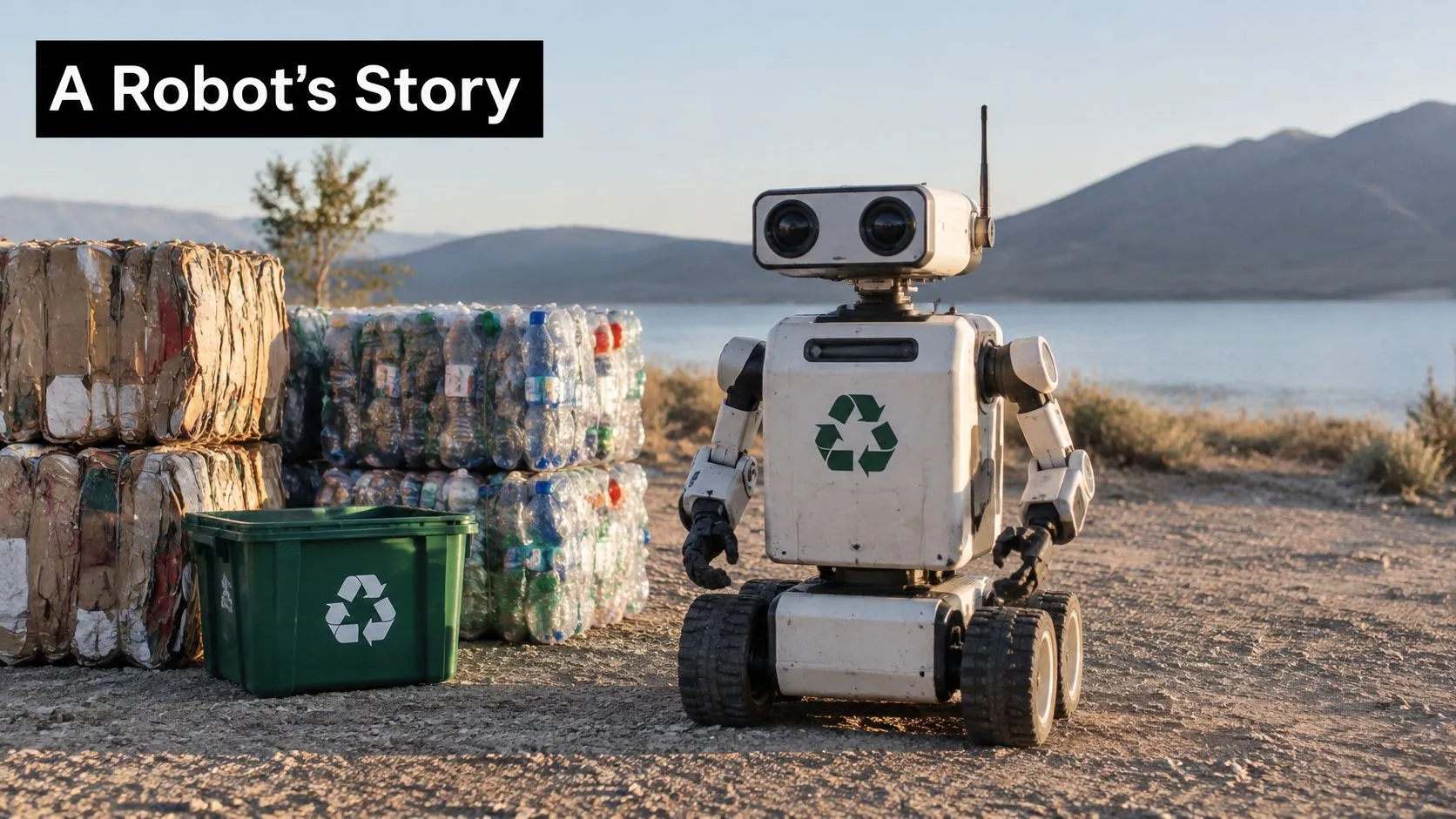
Branded animation often dies under voiceover. A 20-second product film can carry one beat with a hand, a click, and a sound, then use the environment to show the mess the product fixes. You can compare Wall-E poster formats and see the same idea in stills. One robot, one heap of waste, no paragraph required.
If the prop already tells the history, cut the line. Voiceover should add a fact the picture cannot hold.
What does not work is a silent opening bolted onto a script that still explains everything. Design the gesture first, then decide whether any words remain.
4. Up (2009)
Pete Docter's Up sends Carl Fredricksen, an elderly widower, toward South America in a house lifted by thousands of balloons. The film opened the Cannes Film Festival and won the Academy Award for Best Animated Feature. The adventure is high-concept. The emotional core is ordinary grief. The 'Married Life' montage is wordless storytelling at feature length. A shared life passes in cuts, and the audience is invested before the balloons leave the ground. The house is the metaphor. Carl is tied to a past he can carry, and that carrying has a cost. UK audiences were already deep into 3D exhibition by the time family animation became one of its clearest uses. Ipsos research published in 2012 found that, up to 14 October 2011, 3D accounted for 65% of total box office for UK releases shown in both 2D and 3D, and that parents' enjoyment uplift for 3D versus 2D reached 27%. Up sat in that wave. The same research also recorded falling interest in seeing another 3D film. Novelty did not hold the audience. Story did.
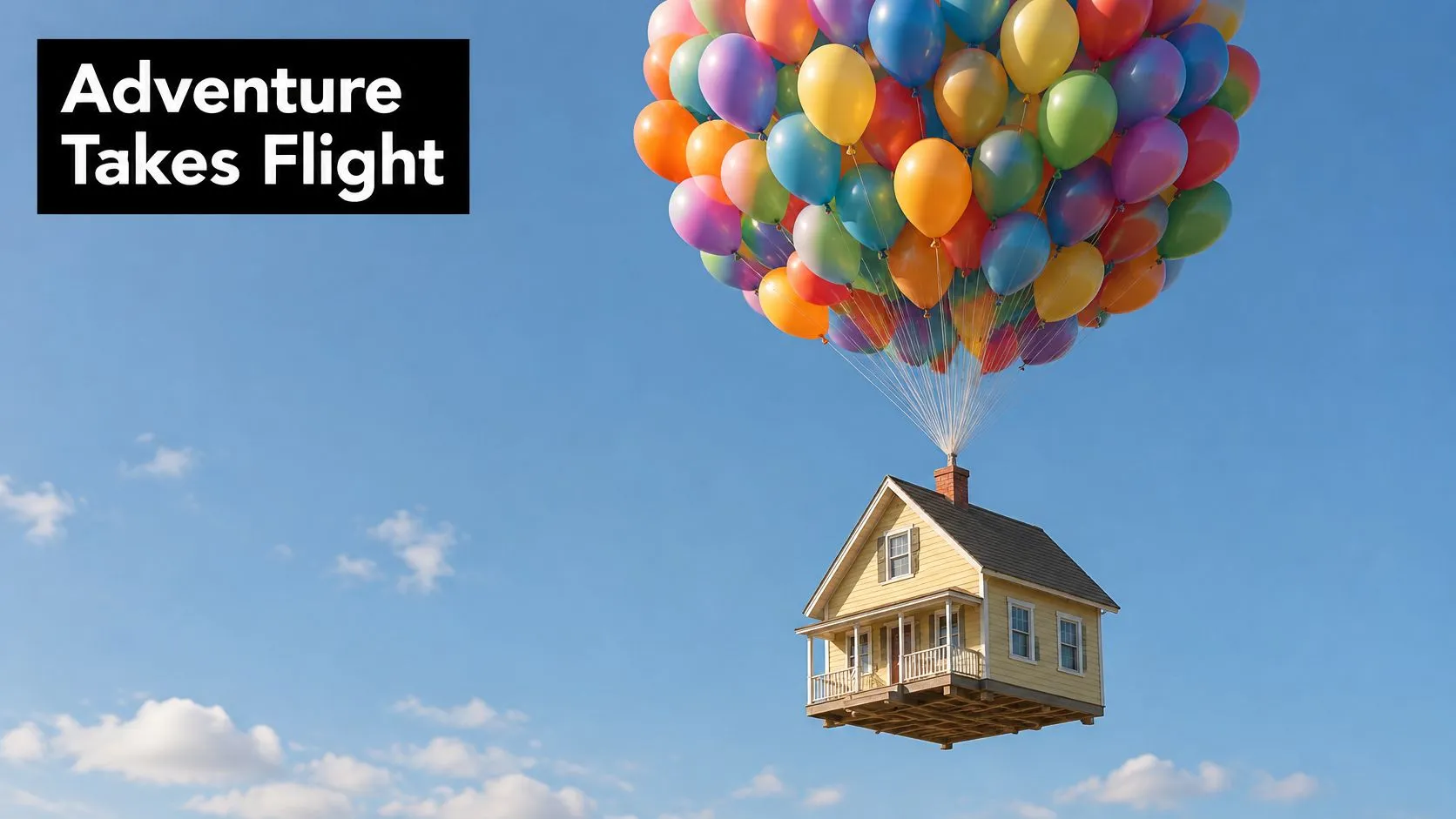
For a brand, pick one picture a stranger understands in a second, then earn attention with a short emotional prologue before the offer. A floating house with no life behind it is a poster, not a film.
5. How to Train Your Dragon (2010)
DreamWorks Animation's How to Train Your Dragon, directed by Dean DeBlois and Chris Sanders and drawn from Cressida Cowell's books, follows Hiccup, a young Viking, and Toothless, an injured dragon. Expressive creature performance, aerial photography, and John Powell's score carry the film. It earned an Academy Award nomination for Best Animated Feature and grew into a franchise. The first flight sets the visual language. Wind, wing, and camera agree on where danger and joy sit. Hiccup and Toothless bond through shared body language, not a speech about friendship. Eye darts, weight shifts, and reaction delays do the work a human face would do with a brow. A sports brand building a creature mascot for a game cinematic should lock personality in posture before fur and scales get expensive.
- •Eyes and delay: A late blink reads as thought. An instant blink reads as a puppet.
- •Camera first: Flight choreography drives schedule. Plan paths in previs or you will re-render the sky.
- •Score as timing: Music can mark a beat, but it cannot rescue unclear action.
Complex movement is where productions slip. A beautiful dragon that cannot hit its marks in the cut is a cost, not a character.
6. Frozen (2013)
Let the world show the feeling
Walt Disney Animation Studios' Frozen, directed by Chris Buck and Jennifer Lee, rebuilds a fairy tale around sisters Anna and Elsa. It became one of the highest-grossing animated films, won the Academy Award for Best Animated Feature, and 'Let It Go' won Best Original Song. Studios still study it because character, song, and effects were planned as one system. 'Let It Go' ties Elsa's decision to a visible change. The ice palace is not a location the plot visits. It is the decision, built in front of you. Snow behaves as a readable sign of her state. When the rule is clear, effects spend goes on story, not on extra spectacle. Say an energy brand wants a 45-second film about a founder who finally ships a product. Give the environment one rule. Lights warm when she commits, and they stay cold while she hesitates. You do not need a feature-film simulation budget if the rule is consistent. Treat music as structure from the outline, not as a track dropped on at the end. Late songs force recuts, new lip sync, and new camera. What fails is a ballad pasted over footage that was boarded as dialogue. Board the song, or do not promise one.
7. Big Hero 6 (2014)
Don Hall and Chris Williams directed Big Hero 6 for Walt Disney Animation Studios, loosely from a Marvel comic, in the invented city of San Fransokyo. A teenage robotics prodigy teams with Baymax, an inflatable healthcare robot. The film won the Academy Award for Best Animated Feature. Grief and recovery sit inside a neon city that mixes Japanese and American cues without a lecture. Baymax carries most of the feeling. The soft volume, the slow turn, the way he occupies a doorway. That silhouette also travels. It works on a poster, a short, and a product shot because you recognise him at a glance. San Fransokyo does the cultural job through streets, signage, and light, not through a narrator naming influences. A client building a fictional city for a game or a series should write the design logic before the first hero building. Transit, climate, and what people do at night will stop the skyline becoming a mood board. I would also design one secondary character whose shape survives a two-second cut-down. If that character only works inside a two-hour film, merchandise and social will stall. Readers comparing tone across the wider genre can look at superhero movies ranked by critical acclaim. The craft point here is narrower. City logic plus one unmistakable companion will outlast a pile of set pieces.
8. Coco (2017)
Lee Unkrich directed Pixar's Coco, with Adrian Molina as co-director. A young Mexican boy crosses into the Land of the Dead during Día de Muertos. Cultural research, colour, and a respectful treatment of family memory won the Academy Award for Best Animated Feature, plus Best Original Song for 'Remember Me'. It was a major commercial success in Mexico and internationally. Papel picado and marigolds are not sprinkled on at the end. They are how the Land of the Dead is built. 'Remember Me' returns as a motif, so the song and the plot share a job. Colour and light split the worlds, which is the same trick a multi-episode series or a game uses when the player must know, instantly, which realm they are in.
Bring cultural consultants in at concept, and put their reviews on the schedule. A note in week two is a drawing change. The same note in lighting is a reshoot.
A drinks brand borrowing festival imagery for a global spot should not treat research as a legal pass at the end. Build two or three review gates, show the references, and change the boards when the advice says the symbol is wrong. What does not work is a vibrant palette with no one in the room who knows the tradition.
9. Spider-Man: Into the Spider-Verse (2018)
Sony Pictures Animation's Spider-Man: Into the Spider-Verse, directed by Bob Persichetti, Peter Ramsey, and Rodney Rothman, follows Miles Morales as he meets Spider-People from other universes. Halftone dots, inked lines, and shifts in frame rate sit on top of CGI. It won the Academy Award for Best Animated Feature and reset what stylised 3D was allowed to look like. Miles's first use of his powers arrives through comic panels and motion blur, so the technique is the story beat. Each alternate Spider-Person has a distinct render style, which tells you the universe has changed without a caption.
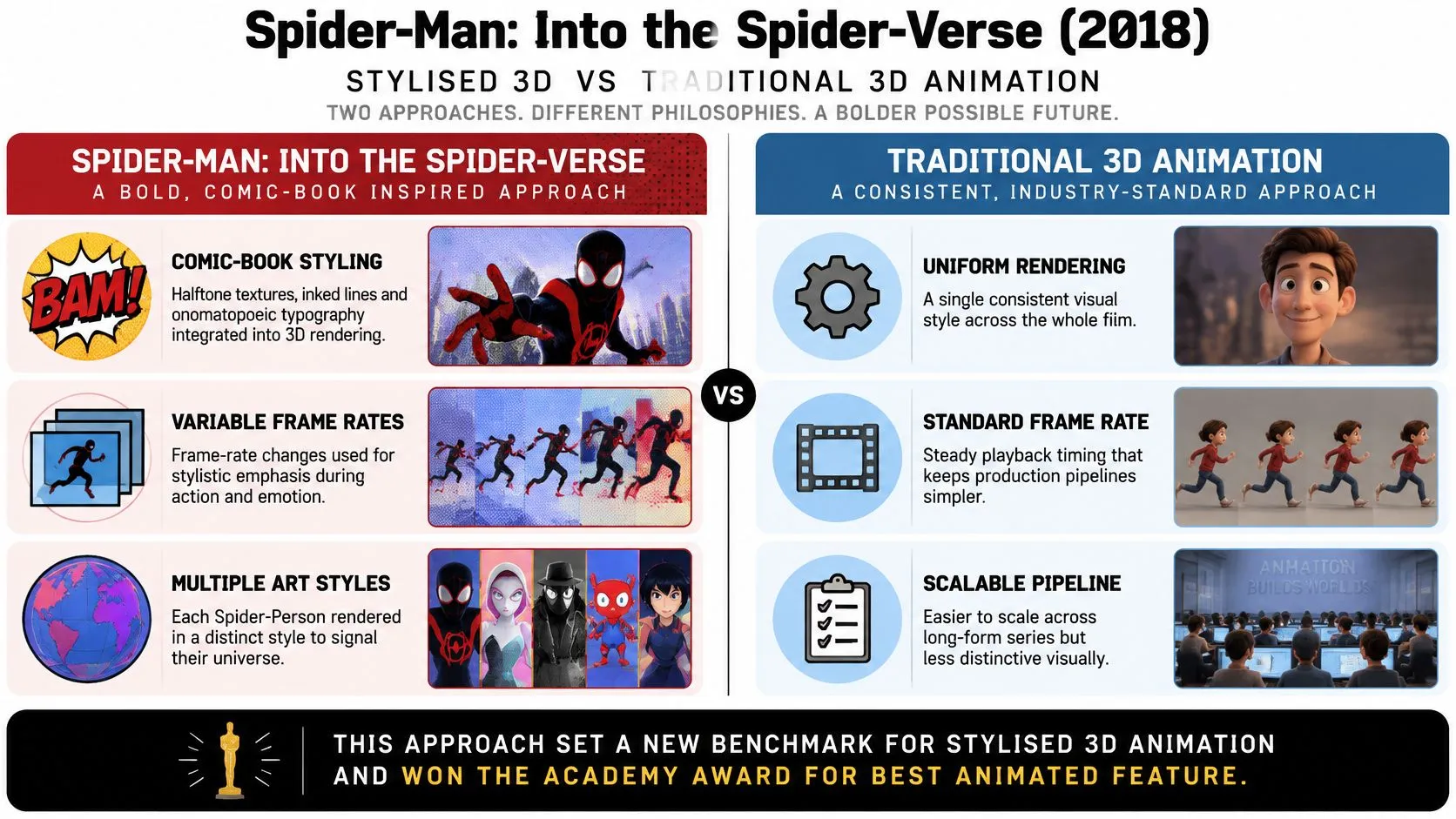
A hybrid look fails when it is invented during animation. Write the style guide first. Line weight, texture, colour limits, and where the frame rate may break. Then use the break rarely, on a hit or a choice, so it points at story instead of decorating every shot. Teams weighing that trade-off can read how 2D and 3D hybrid animation techniques behave in real production. A style guide agreed in week one is cheaper than a look that art direction keeps renegotiating in shot production.
10. Encanto (2021)
Byron Howard and Jared Bush directed Encanto for Walt Disney Animation Studios, with Charise Castro Smith. A Colombian family lives in a magical house that has given each child a gift, except one. Colombian-inspired design, Latin American musical colour, and songs by Lin-Manuel Miranda carry it. The film won the Academy Award for Best Animated Feature, and 'We Don't Talk About Bruno' became a wider cultural hit. 'The Family Madrigal' introduces the household and the premise inside the song, so the opening number is also the exposition. Cracks in the walls show strain the family will not say aloud. Music and architecture share the emotional load, which is why the story travels into songs people already know, and why the same assets can seed games or XR without a new plot. Put culturally specific research into the first concept art, not into a polish pass. A producer extending a children's brand should decide, early, which layer is the film, which layer is the song, and which layer can live in an interactive build.
- •One research pack: References, consultants, and approval gates before modelling.
- •Complementary layers: If the wall cracks, the lyric should not explain the crack.
- •Platform test: Ask which shot still works as a spatial experience, not only as a cinema frame.
A house that only looks magical in a still will not hold a series, a game, or a location-based piece.
Studio, director and award recognition across the ten films
| Item | Studio | Director | Award recognition |
|---|---|---|---|
| Toy Story (1995) | Pixar Animation Studios | John Lasseter | Special Achievement Academy Award |
| The Incredibles (2004) | Pixar Animation Studios | Brad Bird | Academy Award for Best Animated Feature |
| WALL-E (2008) | Pixar Animation Studios | Andrew Stanton | Academy Award for Best Animated Feature |
| Up (2009) | Pixar Animation Studios | Pete Docter | Academy Award for Best Animated Feature; opened Cannes Film Festival |
| How to Train Your Dragon (2010) | DreamWorks Animation | Dean DeBlois and Chris Sanders | Academy Award nomination for Best Animated Feature |
| Frozen (2013) | Walt Disney Animation Studios | Chris Buck and Jennifer Lee | Academy Awards for Best Animated Feature and Best Original Song |
| Big Hero 6 (2014) | Walt Disney Animation Studios | Don Hall and Chris Williams | Academy Award for Best Animated Feature |
| Coco (2017) | Pixar Animation Studios | Lee Unkrich; co-directed by Adrian Molina | Academy Awards for Best Animated Feature and Best Original Song |
| Spider-Man: Into the Spider-Verse (2018) | Sony Pictures Animation | Bob Persichetti, Peter Ramsey and Rodney Rothman | Academy Award for Best Animated Feature |
| Encanto (2021) | Walt Disney Animation Studios | Byron Howard, Jared Bush and Charise Castro Smith | Academy Award for Best Animated Feature |
Turning Landmark Craft Into Your Next Production Brief
Across these ten films, style, performance, world-building, and cultural research work when they are decided early and tested. Toy Story's silhouettes, The Incredibles' previs, WALL-E's gesture, Up's single metaphor, Toothless's eyes, Frozen's effects rule, Baymax's shape, Coco's review gates, Spider-Verse's style guide, and Encanto's split between song and architecture are the same kind of decision. They are made before the expensive shots, then checked again. Theatrical animation is a harsh market if the only plan is a pretty picture. In the UK and Ireland, official BFI statistics for 2025 show 62 new animated releases generated £114.2 million, against £232.5 million from 71 releases in 2024. Releases fell far less than revenue, so the average title had less room. For a studio or a brand, that means distribution, a recognisable idea, and a release plan matter as much as render quality. Cinema cannot be the only route. Streaming, broadcast, games, and immersive cuts should also be considered. UK finance can shape that plan if the paperwork is real. HMRC's creative industries commentary records that animated productions may qualify for the Audio-Visual Expenditure Credit at 39% on qualifying expenditure, five percentage points above the standard rate. Document development, assets, animation, lighting, compositing, and delivery as you go. A relief claim is not something you reconstruct in the last week. Before you commission 3D work, write three things down. The visual rule, the performance approach, and the review schedule. Name who approves culture, music, and style, and when. Then pick a partner who can deliver for UK-based work and for clients elsewhere. Studio Liddell is a UK-based creative production studio. We make 2D and 3D animation, develop IP with partners, and build game-engine projects in Unity and Unreal, including series, explainers, and XR. The founding team has more than twenty years across animation, interactive media, and immersive storytelling, and we work with clients worldwide. Those film lessons become a scoping call, a style frame, and a pipeline your stakeholders can review. --- Studio Liddell builds 2D and 3D animation, character performance, motion design, and real-time work in Unity and Unreal for brands, broadcasters, and entertainment partners. If you are briefing a film, a series, or a branded world, bring the visual rule and the review dates and we will scope the pipeline with you. Visit Studio Liddell to start that conversation.