3D Animation in Films: How It Works and Where It's Going
You're sitting in a production meeting with a script, a visual reference, and a difficult question: should the film be made in 2D, 3D, live action with visual effects, or a mixture of all three? The answer affects far more than the look. It changes how artists build assets, how directors approve shots, how long revisions take, and where the budget goes. 3D animation in films is often described through its finished image, the digital creature, the impossible camera move, or the convincing light on a virtual set. The more useful way to understand it is as a connected production system. A successful shot depends on design, modelling, rigging, animation, lighting, rendering, compositing, software, and the people who hand work from one stage to the next. This guide follows that journey in practical terms. It separates 3D animation from 2D and live-action VFX, explains the pipeline through a single film shot, then connects the craft to UK production economics, pricing, audience behaviour, and the choices producers need to make before a team starts building.
Why 3D Animation in Films Captivates Audiences
The most revealing moment in a 3D animated film arrives when the audience stops thinking about the technique. They notice the character's weight instead of the rig, the softness of digital fur instead of the hair system, and the way light catches an eye instead of the shader that created its reflection. That illusion depends on hundreds of deliberate decisions. An animator gives a character a slight delay before a turn. A lighting artist places a soft source outside a virtual window. A compositor balances the rendered layers so the character belongs in the room rather than appearing to float inside it. A viewer might see a few seconds of screen time. The production team sees a chain of approvals, handoffs, tests, revisions, and technical checks. The work has a creative centre, but it also needs the discipline of an organised manufacturing process. If the character's proportions change after rigging, or the camera changes after animation, several departments may need to revisit their work.
The shot behind the illusion
Take a simple scene. A small character enters a dark room, pauses beside a table, and notices something glowing in the corner. The director needs the pause to feel curious rather than frightened. The modeller must supply a form that can carry the performance. The rigger needs controls that let the animator shift the character's weight naturally. Lighting and compositing then shape the emotional emphasis. That's why technical quality alone isn't enough. A beautifully rendered character can still fail if the staging is unclear or the performance has no intention. The strongest 3D animation serves the story first, then uses technology to make the story believable. For visual references across film, XR, and advertising, these 3D animation examples show how different production choices create different audience experiences.
What 3D Animation in Films Really Means
Think of a 3D animated character as a digital puppet inside a virtual film studio. First, an artist builds the puppet's outer form. Another artist adds an internal skeleton and a set of controls. The animator then poses that character, while the virtual camera and lights record the action as a sequence of images. The analogy is useful, but it needs one qualification. A physical puppet has limits determined by its materials and joints. A digital puppet can be designed with flexible facial controls, stretchy limbs, simulated cloth, or entirely impossible anatomy. Those freedoms give the director more expressive options, but they also create more work for the pipeline.
3D, 2D, and VFX are related but different
2D animation creates movement on a flat visual plane. Artists may draw each pose, move illustrated elements, or use digital puppets built from layered artwork. It can be graphic, painterly, economical, or highly detailed. 3D animation creates objects in a virtual space with depth, surfaces, cameras, and lights. The same model can be viewed from different angles, reused in later shots, and relit for a new mood. That flexibility is valuable when a film needs recurring characters, environments, or controlled camera movement. Live-action VFX starts with filmed material and adds, replaces, or alters elements through computer-generated imagery and compositing. A digital creature placed into a photographed street is VFX. A fully digital character walking through a fully digital room is 3D animation. A production can use both in the same shot. Hybrid work is common because each method solves a different problem. A live-action plate can provide natural camera movement and performance reference, while 3D assets supply an impossible environment or creature. A 3D scene can also receive 2D effects such as dust, sparks, graphic overlays, or hand-painted accents during compositing.
Why animated films helped 3D cinema grow
Animated releases played a major role in establishing stereoscopic 3D in UK cinemas. In 2009, Screen Daily's report on early UK 3D releases recorded UK grosses of £21.3 million for Monsters vs. Aliens, £34.9 million for Ice Age: Dawn of the Dinosaurs, and £34.2 million for Up at the time covered. The report said 3D screenings generated 44%, 52%, and 60.5% of those respective totals, while A Christmas Carol opened on 281 3D screens. The lesson isn't that every animated film needs stereoscopic presentation. It's that animation helped audiences and exhibitors understand 3D as a mainstream film format, while giving filmmakers a production environment where depth, camera movement, and lighting could be designed together.
The 3D Animation Pipeline from Brief to Final Render
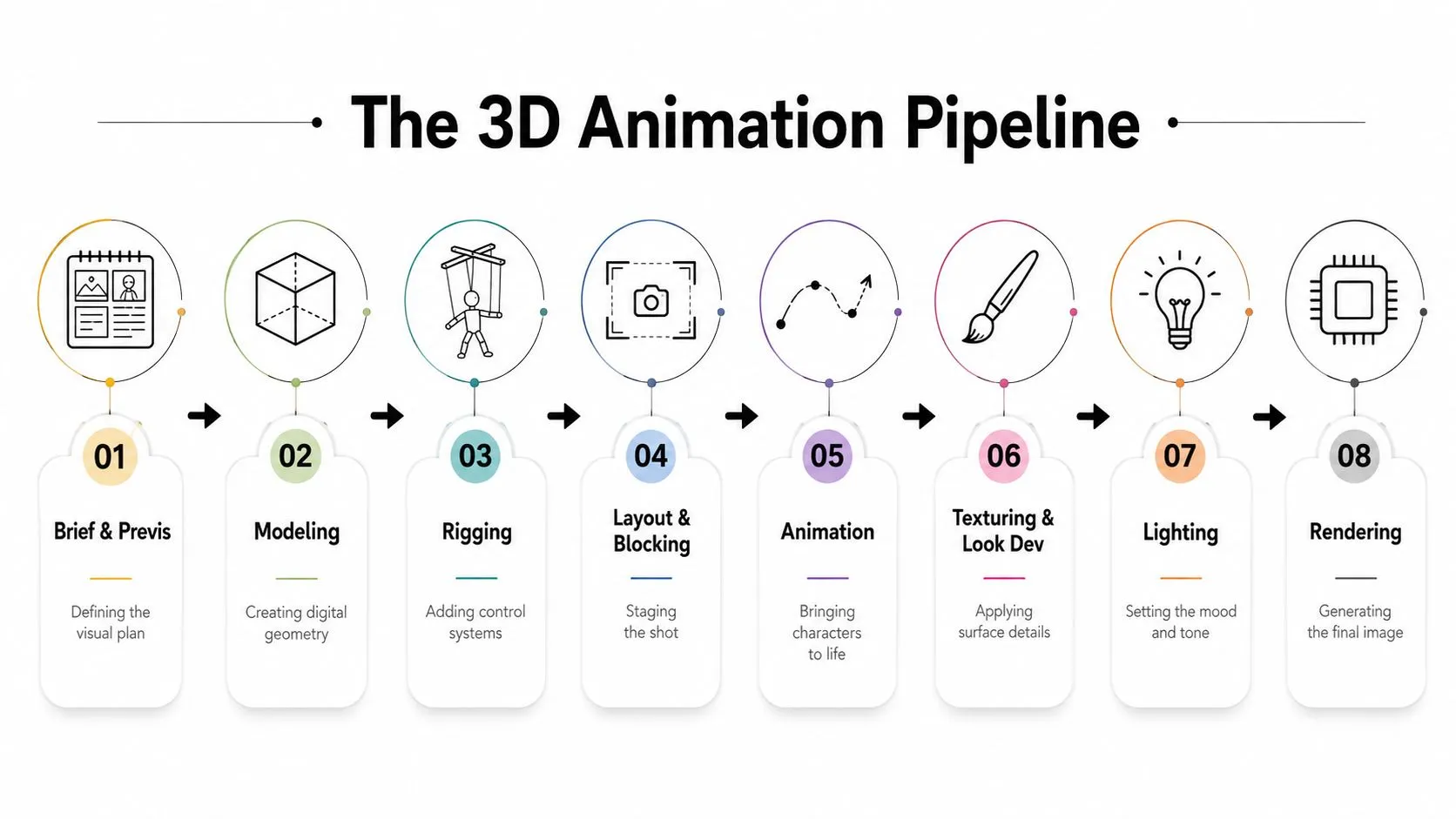
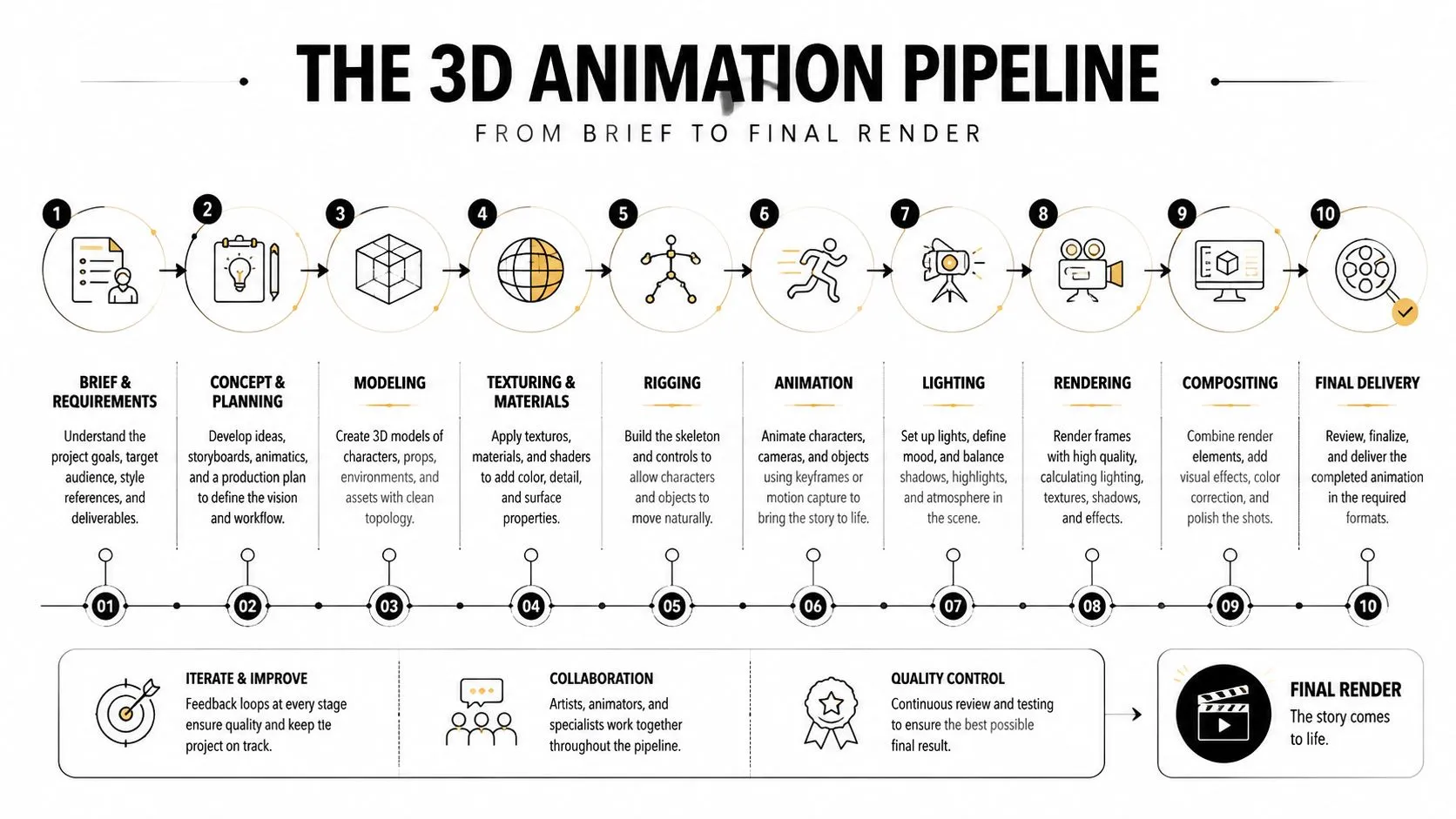
A production pipeline turns an idea into a repeatable sequence of decisions. To see how that works, follow one shot: a character walks into a moonlit room, crosses to a table, and reacts to a hidden object.
Planning the shot
The process begins with the brief, script, storyboard, and previsualisation. The director decides what the audience must understand, where the character enters, and when the reaction happens. A rough animatic tests timing before the team spends time on detailed assets. At the first approval gate, the production should confirm the story beat, camera intention, approximate duration, and essential staging. If the director changes the shot from a wide view to a close-up later, the team may need different modelling detail, animation choices, lighting, and render settings.
Building the digital set
Modellers create the character, table, walls, props, and other geometry. The character receives a rig, which is a controllable digital skeleton. The rig lets the animator bend the spine, shift the hips, turn the head, and shape facial expressions without manually moving every part of the mesh. Layout and blocking place the camera and rough character motion into the room. At this point, the animator may use simplified geometry and broad poses. The objective is clarity, not polish. The director can judge whether the entrance reads, whether the pause is long enough, and whether the glowing object attracts attention.
Practical rule: Approve the camera and the major poses before asking artists to polish surfaces, effects, or lighting.
Creating performance and appearance
Animation replaces the broad blocking with a deliberate performance. The character's feet need convincing contact with the floor, the torso needs believable balance, and the head turn must support the reaction. Facial animation adds the smaller choices that tell the audience whether the character feels cautious, amazed, or confused. Look development then defines the character's materials and the room's surfaces. Artists decide whether the table is rough wood, polished metal, or painted plastic. Textures, shaders, and surface response determine how the moonlight behaves when it reaches each object. Lighting establishes the scene's emotional structure. A cool source through the window might create the moonlit atmosphere, while a warmer glow from the hidden object becomes the visual point of interest. The lighting artist isn't just making the room visible. They're directing attention.
Rendering and compositing
Rendering converts the scene into image data. Productions often separate useful components into layers so the compositor can adjust characters, backgrounds, shadows, highlights, atmospheric effects, and colour without rebuilding the entire scene. Compositing brings those layers together. The compositor can soften a bright edge, add depth haze, integrate a glow, balance the contrast, or combine rendered material with filmed elements. Final colour work makes the shot sit consistently beside the rest of the sequence. A detailed animation production pipeline guide is useful when you're turning these stages into a schedule, approval plan, and delivery checklist.
Key Software and Technologies Behind Modern Film Animation
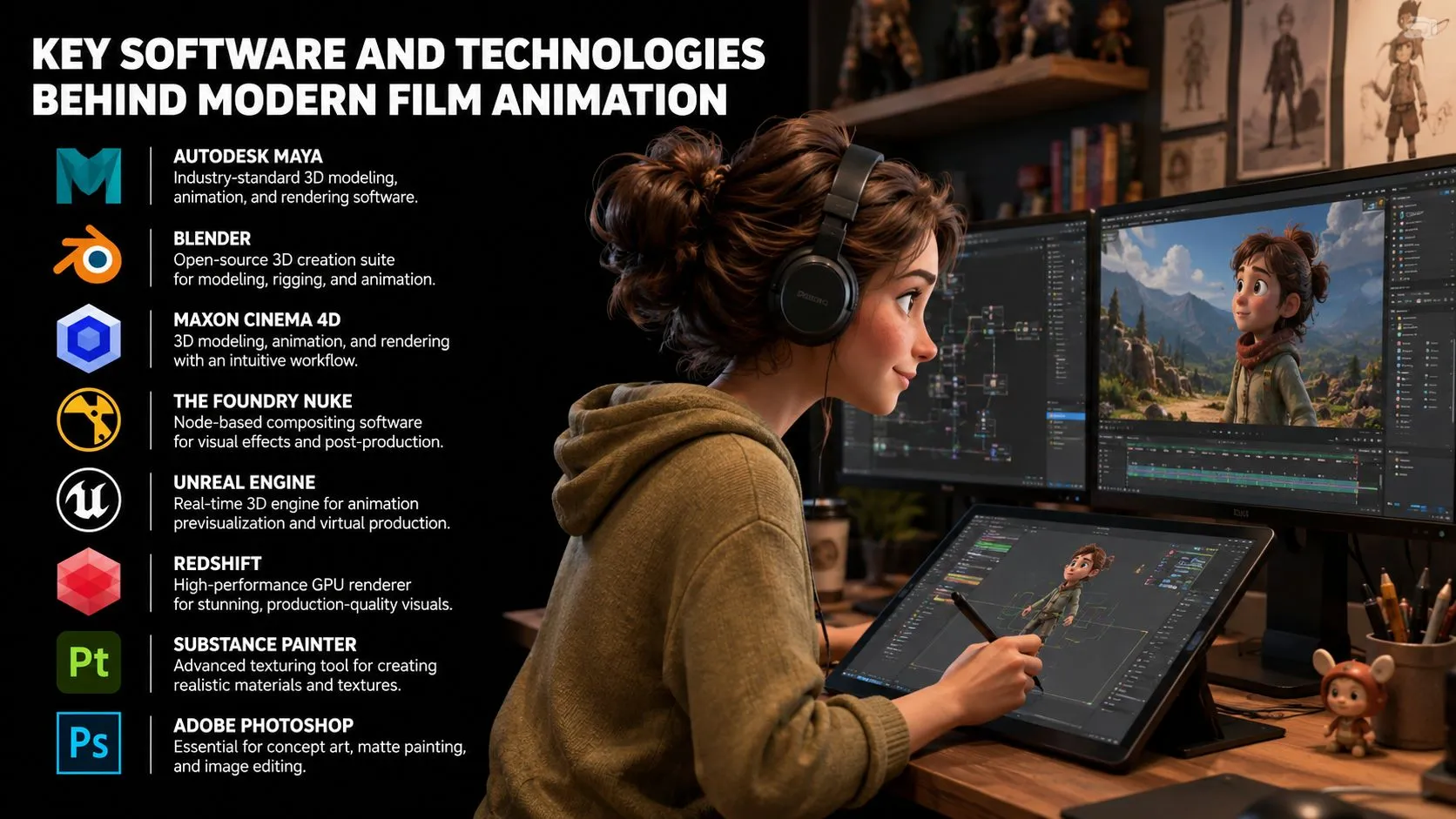
No single application makes a 3D film. Studios combine software according to the problem being solved. A digital content creation tool may handle modelling, rigging, and animation, while a renderer produces the final images and a compositor assembles the layers. For artists learning the field, a guide to free 2D and 3D animation apps for beginners can help clarify the difference between accessible learning tools and the systems used in larger production pipelines.
Offline rendering and real-time rendering
Offline rendering gives the computer more time to calculate complex light, reflections, shadows, hair, cloth, particles, and atmospheric detail. That makes it a strong choice when image quality and consistency matter more than immediate feedback. The trade-off is that rendering can become a schedule and infrastructure concern. Real-time rendering generates images quickly enough for interactive review and responsive camera work. Unity and Unreal are useful for previsualisation, virtual production, interactive experiences, and projects where the team needs to see a scene change immediately. Real-time output can also support film work, but artists still need to assess whether the chosen visual style, materials, effects, and final delivery requirements are appropriate. The right choice depends on the production rather than fashion. A director testing camera language may benefit from an engine's speed. A sequence built around intricate simulations may favour a more specialised offline path. Many teams use both, with real-time tools supporting planning and exploration while final shots move through a controlled render and compositing pipeline.
Tool choice is a producer decision
Engine choice affects more than the artist's workstation. It changes hiring requirements, asset handoff, technical supervision, revision speed, rendering costs, and the way the production reviews work with clients. AI-assisted tools are also entering established pipelines. They can help with repetitive tasks such as cleanup, lip-sync support, denoising, or version preparation, but artists still need to protect performance, continuity, authorship, and visual direction. Automation is most useful when it removes mechanical labour without replacing the approvals that keep a film coherent. For a focused comparison of applications used in production, see the best 3D animation software. The important question isn't which software has the longest feature list. It's whether the tool supports the project's creative goals and the team's existing skills.
The Production Roles That Bring 3D Films to Life
A 3D film is made by specialists who solve different parts of the same visual problem. The modeller builds the character's form. The rigger makes that form controllable. The animator creates performance. Look-development artists define surfaces, lighting artists shape attention, and compositors combine the rendered elements into a finished image. The handoffs matter as much as the individual disciplines. A modeller needs to understand how a character will deform. A rigger needs to provide controls that support the intended acting style. An animator needs to work within the camera and staging approved by the director. A lighting artist needs a stable scene and a clear visual target.
Who does what
- •Modellers create characters, environments, props, and the geometry that gives the film its physical language.
- •Riggers build control systems for bodies, faces, props, and sometimes mechanical objects.
- •Animators shape timing, weight, gesture, eye direction, lip movement, and acting choices.
- •Look-development artists create materials, textures, shaders, and the visual response of surfaces.
- •Lighting technical directors manage light rigs, shot continuity, render considerations, and practical scene behaviour.
- •Compositors combine layers, integrate effects, adjust colour, and prepare shots for final review.
- •Supervisors protect the creative and technical connection across departments, especially when a sequence involves complex assets or mixed techniques.
Why UK teams need flexible capacity
UK animation production spend was £73 million in 2021, across 30 animation programmes that started principal photography, with 70% domestic productions, according to the BFI-funded UK animation production study. The same study describes a workforce of about 1,000 direct employees, with 52% freelance. That structure affects how producers should assess a studio. A small permanent core can be efficient, but it needs reliable access to the specialists required at each phase. A studio may expand for character animation, simulation, or compositing, then reduce the team once delivery is complete. The pipeline must preserve naming, versioning, asset access, and review standards even as people join and leave. The wider UK VFX sector also provides important technical capacity. In 2019, it generated an estimated £1.68 billion in gross value added and supported 27,430 jobs across the film and television value chain, while £363.5 million was spent on UK VFX services for tax-relief-eligible productions, up 51.6% from 2016, according to Animation UK's economic value report. For a broader view of artist roles and compensation context, producers may consult ClearAudio artist salary insights. The practical takeaway is simple: ask who will supervise each handoff, not only which software the studio owns.
Case Studies and the Business Case for 3D
The business case for 3D has never depended on spectacle alone. A producer pays for 3D when its control of space, repeatable assets, camera movement, lighting, or character performance creates value that a simpler method can't provide as efficiently. UK exhibition history shows how strongly the format once grew. The BFI Statistical Yearbook data on UK and Republic of Ireland 3D cinema records 46 3D films released in 2013, up from 43 in 2012. Those titles generated £207 million from 3D screenings by 23 February 2014, representing 18% of all UK and Republic of Ireland box-office revenue. The share was 20% in 2011 and 24% in 2010. The infrastructure expanded quickly as well. UK 3D digital screens rose from 1,067 in 2010 to 1,564 in 2012, with 1,475 in 2011, according to the same BFI data. That history shows how animated films helped turn stereoscopic 3D into a major commercial exhibition format, but it doesn't prove that every modern project should carry the premium.
Cost and schedule are part of the creative decision
UK pricing guides show a clear spread between formats. GNU Films' UK explainer pricing guide places basic 2D work at £650 to £1,500, mid-range bespoke 2D at £1,750 to £6,000, and premium 3D or mixed-media work at £4,000 to £9,000 or more. A separate UK explainer video pricing guide gives approximate per-minute ranges of £3,000 to £8,000 for 2D and £5,000 to £20,000 or more for 3D, with typical timelines of 3 to 6 weeks for 2D and 6 to 12 weeks for 3D.
| Aspect | 2D Animation | 3D Animation |
|---|---|---|
| Best fit | Graphic storytelling, illustrated explainers, stylised campaigns | Character-led films, reusable worlds, dimensional product or environment work |
| Revision pattern | Often quick when artwork and timing are stable | Efficient after assets are approved, but expensive when core models or rigs change |
| Camera and lighting | Designed through layers, artwork, and compositing | Built into a controllable virtual space |
| Production investment | Usually lower for simple visual systems | Higher where modelling, rigging, simulation, and rendering are required |
| Hybrid option | Adds depth through 3D elements or composited effects | Uses 2D graphics and finishing to control complexity |
A typical UK workflow guide breaks production into 4 to 6 weeks, from discovery and script through storyboard, animatic, animation, sound, subtitles, revisions, masters, and aspect-ratio cutdowns, as outlined by Media Village. Another UK rate guide allocates 15% to 20% of budget to pre-production, 60% to 70% to production, and 10% to 15% to post-production, with production taking 2 to 3 weeks per minute, according to Moovie Makers' animation pricing guidance.
When 3D earns its premium
Choose 2D when the message depends on graphic clarity, illustration, typography, or rapid variation. Choose 3D when the film depends on a character's physical performance, a camera moving through a designed world, complex material behaviour, or assets that need to return across a series. Choose hybrid when you want dimensional hero moments without building every supporting element in full 3D. A 3D product, creature, or environment can carry the main visual, while 2D design and compositing keep the production focused. Studio examples such as BooSnoo for Sky Kids, the CGI series work represented in Studio Liddell's portfolio, and technical animation for GeoEnergy NI illustrate two different uses of the medium. Children's entertainment benefits from repeatable characters and worlds, while technical communication benefits from controlled camera views that reveal systems difficult to film or explain directly. The value comes from matching the production method to the communication problem.
Future Trends Shaping 3D Animation in Film
Real-time rendering is changing how directors explore shots. Unity and Unreal can let teams test camera positions, staging, lighting ideas, and interactive environments without waiting for a final offline render. That doesn't make offline rendering obsolete. It gives producers another layer of feedback before committing to final image-making. XR extends the same assets beyond the flat screen. A character, environment, or prop built for a film may also support an immersive installation, an interactive experience, or a location-based presentation when the original design and licensing plan allow it. The production opportunity is strongest when those formats are considered early rather than treated as an afterthought. AI-assisted tools are likely to remove more repetitive work from established pipelines. Cleanup, tracking support, version preparation, and certain forms of render processing can become faster, while artists retain responsibility for acting, design, continuity, and final approval. The producer's job will be to ask where automation reduces labour without weakening creative control or rights management.
The UK production paradox
UK film and high-end television production spend reached £6.8 billion in 2025, while UK film production spend alone reached a record £2.77 billion, according to Animation UK's report on the VFX and animation workforce. Yet the same source reports that the UK VFX and animation workforce grew 9.3% in H2 2024, then contracted 7.6% in H1 2025, with around 500 UK jobs lost and London down 5.1%. Record production volume doesn't mean every department has stable capacity. Producers should expect competition for experienced specialists, pressure on schedules, and a growing need for pipelines that reuse assets and reduce avoidable manual work. The future belongs less to a single “magic” tool than to studios that can combine real-time exploration, dependable asset management, efficient rendering, and human-led creative judgement.
Bringing 3D Animation into Your Next Film Project
A good 3D decision starts with the audience experience, not the software. Define what the viewer must feel or understand, then choose between 2D, 3D, and hybrid production based on the required performance, camera freedom, asset reuse, schedule, and budget. Producers should approve storyboards, animatics, designs, cameras, and rigs before late-stage polish begins. Filmmakers should choose tools that match the team and delivery environment. Brands and technical organisations should consider whether a 3D asset can serve more than one film, format, or audience. If you're planning a 3D animated film, series, trailer, or explainer, Studio Liddell can help translate the script into a practical pipeline plan, treatment, schedule, and budget. Book a production scoping call through Studio Liddell to discuss the right balance of 2D, 3D, real-time, and composited work for your project. --- Studio Liddell develops broadcast-quality 2D and 3D animation, CGI film and television content, motion graphics, and XR experiences from early concept through delivery. Visit Studio Liddell with your script, pitch, or production problem, and start a focused conversation about the assets, specialists, approvals, and budget your film will need.