What Is Sustainable Design and Why It Matters
What is sustainable design? It's a way of creating digital and physical work that meets today's needs without compromising the planet's ability to support future generations. In the UK, that matters in very concrete terms because buildings account for around 43% of national carbon emissions when construction, operation, and related infrastructure are included, and BREEAM has been shaping sustainable building decisions since 1990 as a major certification signal in the market UKGBC sustainable design guide, BREEAM history and UK coverage. You can feel the relevance on an ordinary production day. A render farm stays hot overnight, a temporary set gets stripped after one event, or a prototype build ships with more material than the brief really needed. Sustainable design starts when a producer, designer, or client looks at those choices and asks a simple question, what can we make leaner, longer-lasting, and easier to reuse without compromising quality?
The Real Meaning of Sustainable Design
Sustainable design is easiest to understand when you start with a familiar production decision. A team is choosing whether to rebuild a set from scratch, reuse a modular asset library, or send the whole thing to waste after one campaign. The right answer isn't just about appearances, it's about using fewer resources, creating less waste, and making something that still does its job well. The cleanest definition is this, sustainable design is a way of creating work that meets today's needs without compromising the planet's ability to support future generations. That applies to buildings, motion graphics, animation pipelines, XR builds, and physical installs alike. The common thread is that the design decision is judged across its full life, not only at launch.
Why the term matters now
By 2026, sustainable design isn't a niche creative preference. It's a quality marker, a cost lever, and in many sectors a procurement requirement. UK public-sector guidance now requires whole-life carbon to be assessed and reported for major projects, with thresholds set at £20 million for buildings and £10 million for infrastructure whole-life carbon guidance summary. That shift changes the studio conversation. A client doesn't just want a polished output, they want evidence that the work was specified responsibly, produced efficiently, and won't create avoidable waste later. If you need a simple working phrase, sustainable design is the practice of making better decisions earlier, so the project costs less in materials, energy, and clean-up later.
Practical rule: if a design can only look sustainable at the end, it probably wasn't designed sustainably in the first place.
Core Principles That Hold Every Framework Together
Think of sustainable design as a budgeting exercise across a project's whole life, not just the opening night. You don't only ask what something costs to make, you ask what it costs to run, maintain, repair, and eventually dismantle. That's why the core principles keep coming back to the same idea, reduce impact across the full life cycle.
Life cycle thinking and circular logic
Life cycle thinking starts with the blunt question, where does the impact sit? For a built environment project, that includes material extraction, manufacturing, transport, use, maintenance, and end-of-life. For a digital production pipeline, the same logic covers render loads, hardware replacement cycles, data storage, travel, and the fate of any physical prototype or activation. Circular-economy logic pushes the idea further. Waste stops being an acceptable by-product and becomes a design flaw. Engineering guidance frames sustainability around using resources no faster than they can regenerate, designing for longevity, repair, reuse, and recyclability, and treating waste as something the brief should avoid, not merely manage engineering sustainability principles.
What the principles look like in studio work
In practice, those ideas turn into concrete production choices. A modular set system is easier to reconfigure across episodes. A rig with lower material diversity is easier to maintain. A lighting setup that doesn't overcomplicate the scene lowers compute waste and speeds iteration. For a good primer on how this wider duty of care works in practice, the concept of what environmental stewardship means is worth reading alongside design planning. It's the same mentality, make fewer avoidable losses, keep useful things in circulation, and treat the full system as part of the design.
The strongest sustainability briefs don't ask for “green” as a style choice. They ask for durability, recoverability, and lower resource use from the start.
Why the Stakes Are Now Quantifiable
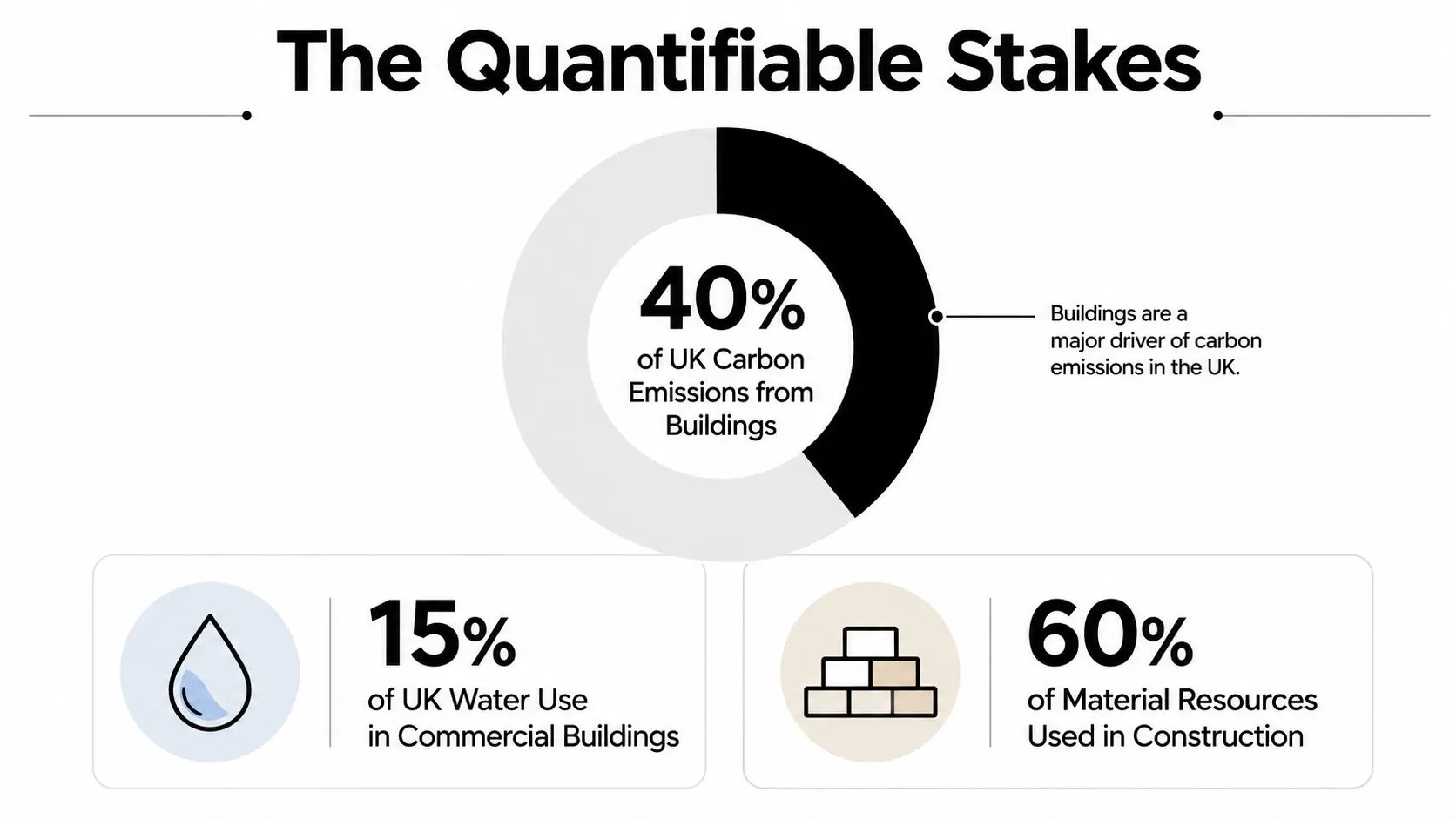
Sustainable design moved from philosophy to boardroom language because the impacts can now be measured. In the UK, the built environment is a major sustainability lever because around 43% of national carbon emissions sit in buildings once construction, operation, and related infrastructure are counted UKGBC sustainable design guide. That makes material choice, energy demand, and lifecycle planning impossible to treat as decorative concerns.
The numbers change the brief
Once a project is measured, weak assumptions show up quickly. A material that looks efficient on paper can carry a larger embodied burden than the team expected. A visually striking build can become a maintenance problem. A beautiful experiential install can create unnecessary waste if it is designed for one use only. Digital production has its own version of the same problem, even if the metrics look different. Render hours, device cycles, data handling, travel, and physical prototype waste all add up. Sustainable design does not separate the physical from the digital, it forces the team to ask where the hidden costs sit and which ones the brief can remove.
Procurement now backs up the logic
The pressure is not just cultural. Public-sector guidance now requires whole-life carbon assessment and reporting on major projects above the stated thresholds, so sustainability is tied to procurement, not just taste whole-life carbon guidance summary. That matters because it changes who has to care. Designers, producers, suppliers, and project managers all have a stake in the outcome. In studio work, the same logic shows up when a team scopes an AR or XR build. A route that uses fewer assets, fewer reworks, and a clearer deployment plan usually wins on both cost and waste. For a practical view of those trade-offs, see augmented reality advantages, ROI, engagement and efficiency.
Putting Sustainable Design Into Practice
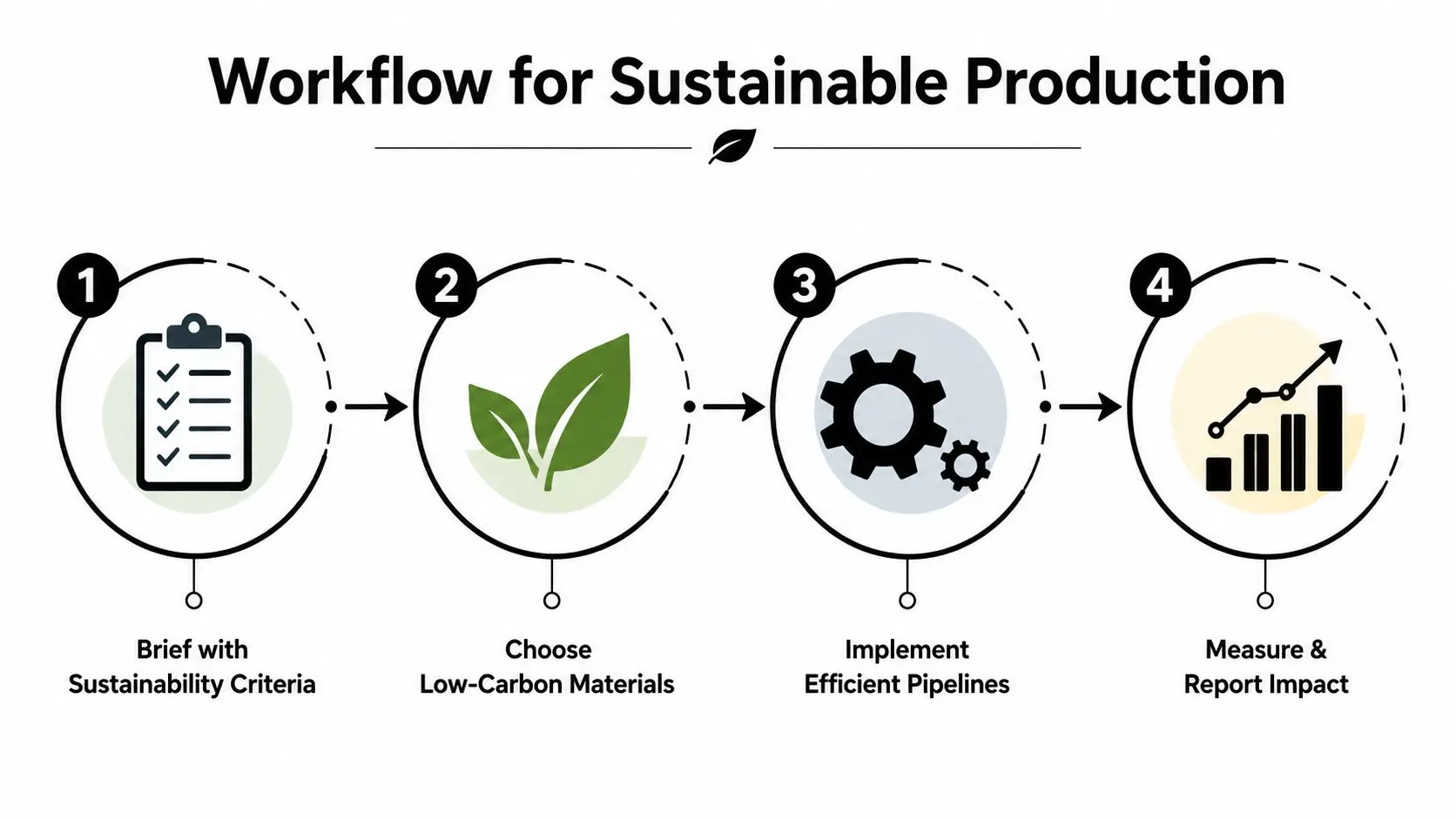
The practical workflow starts before any asset is modelled or any scene is animated. The brief needs sustainability criteria in the same way it needs audience, format, and delivery specs. If nobody writes those expectations down, the project will drift back towards convenience, and convenience is where waste usually sneaks in.
Build the brief around decisions, not slogans
The first move is to define what “better” means for this project. That might be reusable assets, lower-energy rendering, fewer physical prototypes, or a build that can be reconfigured for later use. Once that's clear, the team can choose the material, system, or pipeline that best matches the aim. The second move is to look for low-carbon substitutions and efficient workflows before committing to expensive fixes later. In concrete, that means thinking about supplementary cementitious materials or recycled aggregates where appropriate. In digital work, it means using AI-assisted layout, intelligent render optimisation, and asset reuse where they reduce repetition rather than adding novelty.
Measure what you can actually manage
A studio doesn't need a huge sustainability department to start. It needs a shortlist of simple checkpoints.
- •Energy-efficient render pipelines: track where you're wasting machine time and whether the same result could be reached with fewer passes.
- •Sustainable asset libraries: store approved models, materials, and templates so teams aren't rebuilding common elements from scratch.
- •VR experience optimisation: reduce unnecessary GPU load so builds are easier to deploy on lighter hardware.
- •Reusable digital assets: design components to travel across campaigns, episodes, or platforms instead of living once and disappearing.
Useful test: if a production decision creates a new asset, a new file type, or a new maintenance burden, ask whether it earns that extra weight.
The final step is reporting. Not a giant sustainability report, just enough to show what changed, what was reused, and where the team avoided needless production effort. That's how sustainable design becomes normal practice instead of a one-off talking point.
When Sustainable Design Saves Money and When It Costs More
Most clients want the honest version. Sustainable design can save money, but not every intervention is cheap, and pretending otherwise damages trust. The better way to frame it is to separate low-cost design moves from higher-cost interventions that need a stronger business case. The Green Building Institute argues that sustainable design doesn't need to cost more, and BCG's position is that companies have to balance environmental improvement, cost impact, and customer value rather than treating sustainability as a single-criterion goal sustainable design and cost. That's the right lens for a studio too. Some changes reduce spend by removing waste, while others improve the footprint but come with a premium. A practical comparison looks like this.
| Design Move | Typical Cost Impact | Sustainability Impact | Best Used When |
|---|---|---|---|
| Reuse existing assets | Usually lowers cost | Cuts duplication and material demand | The brief repeats across campaigns or episodes |
| Modular builds | Often lowers long-term cost | Extends asset life and supports reuse | The format may change over time |
| Energy-efficient workflows | Usually lowers operating cost | Reduces energy demand | Render-heavy or hardware-intensive production |
| AI-assisted automation | Can lower labour time on repetitive tasks | Can reduce wasted iterations | The task is procedural, not highly bespoke |
| Certified materials | Can add upfront cost | Improves material accountability | Procurement needs traceability |
| Full carbon-neutral build approaches | Often higher cost | Can reduce overall project emissions | High-visibility briefs with strong brand or public-sector expectations |
If you need to reduce production cost as well as impact, this internal guide on how to reduce production costs for animation and XR producers is a useful companion. The main lesson is straightforward, the cheapest sustainable wins usually come from reuse, efficiency, and fewer unnecessary handovers. The expensive moves are usually the ones that require a certification trail, a material shift, or a more ambitious carbon target.
What It Looks Like in Animation, XR, and CGI Production
A studio can make sustainable design visible long before the final frame ships. In animation and CGI, that often starts with a render choice nobody notices on screen, but everyone feels in the schedule. If a scene is lit, cached, or built to avoid brute-force compute, the team cuts energy use and shortens production time without weakening the shot. That is pipeline discipline, and it sits right alongside the same practical thinking behind our guide to CGI and animation for modern brands.
Examples that map directly to production choices
A modular virtual set can carry more than one episode. Backgrounds, props, and lighting states can be swapped instead of rebuilt, which matters most when a series keeps returning to the same environments. The workflow holds continuity together and reduces the amount of new asset production the team has to manage. Location-based VR has a different pressure point. The build has to be tuned for the hardware it will run on, not the most powerful machine in the studio. A careful Quest-targeted setup lowers device demand and makes deployment easier in live settings, where reliability matters more than visual excess. AR for retail or exhibitions usually asks for restraint. Sustainable design often means using spatial content to extend a physical experience rather than multiplying physical fixtures, screens, and printed hardware. A better build is usually the one that does more with less, with a clearer demo, a tighter interaction, and a content layer that can be updated without remaking the stand.
Why the same rule keeps winning
The pattern behind all three formats is asset longevity. Work should be designed so parts can move between channels, formats, or events instead of being discarded after one use. That is where circular thinking shows up in a digital production studio. The earlier point about AR ROI and efficiency note still applies here, because efficiency and engagement are connected in a well-run build. When a team reduces clutter, streamlines the asset set, and cuts pointless iteration, the client usually experiences the result as clarity rather than compromise.
In production terms, sustainable design often looks plain from the outside. Reused assets, tighter pipelines, and fewer redundant steps do not show off in the final deliverable, they just make the whole system work better.
The Road Ahead for Sustainable Production
Sustainable design is moving from a differentiator to a baseline expectation. Studios that wait for a client to demand it will already be behind the teams that have built it into specification, workflow, and close-out. Three shifts are already visible. First, procurement is becoming more specification-led, which means the brief will matter more than the polish. Second, AI-assisted efficiency is turning into normal production hygiene when it removes repetitive work without creating new waste. Third, lifecycle metrics are likely to become part of every serious project close-out, because clients want evidence, not just intent. By 2027, the most prepared studios will already be treating sustainability as part of delivery quality. That doesn't mean every project needs the same level of intervention. It does mean the team should know where impact lives, how to reduce it, and how to explain the trade-off when a premium is unavoidable.
Practical Questions Studios Ask About Sustainable Design
Does sustainable design always cost more? No. Reuse, modularity, and energy efficiency often reduce cost because they remove duplicate work and lower operational demand. The expensive part is usually the leap to certified materials, deeper reporting, or a more ambitious carbon target. How can a small studio start without a sustainability specialist? Start with the brief. Ask for reuse targets, asset-sharing expectations, lower-energy workflows, and a simple close-out note on what was reused or avoided. Small teams don't need perfect reporting to make better decisions. Which certifications matter most for digital production work? The ones that affect the project context matter most. For built-environment work, BREEAM remains a major market signal in the UK, while public-sector jobs increasingly care about whole-life carbon reporting BREEAM coverage, whole-life carbon guidance summary. For digital and XR production, the useful question is less about collecting badges and more about proving resource discipline. How do you talk to a client who only cares about price? Translate sustainability into fewer revisions, fewer assets, lower operating cost, and longer usable life. Clients usually respond once they see it as production efficiency rather than a moral lecture. --- If you want a studio partner that treats sustainability as part of production quality, talk to Studio Liddell about your next animation, XR, or digital content brief. We can help you scope a cleaner pipeline, a more reusable asset strategy, and a production plan that holds up in the world.