What Is Continuous Learning for Modern Studios?
83% of UK employees are more likely to choose an employer that prioritises continuous learning according to a 2024 Docebo survey covered by HR Review. In a creative technology studio, that shifts continuous learning out of the HR handbook and straight into production planning. That matters because animation, real-time pipelines, AI-assisted workflows, and XR delivery don't stand still. A team that learned one toolset well three years ago can still be highly capable, but capability alone doesn't protect delivery if the production environment keeps changing. The studios that keep moving are the ones that build learning into how they brief, test, review, and ship work. In practice, what is continuous learning? It's the habit of upgrading skills while the work is happening, not pausing the business for the occasional training day and hoping that's enough. It's producers spotting a pipeline bottleneck and turning it into a workshop. It's technical artists sharing rigging fixes across the team. It's XR developers documenting what worked on one headset build so the next project starts smarter.
What Is Continuous Learning Really
A lot of people hear the phrase and think of courses, certificates, or compliance modules. That's too narrow. Continuous learning is an ongoing way of working where people build knowledge, test it in live projects, reflect on the result, and carry the improvement forward. In a studio setting, that can include formal training. It also includes peer review, tool experiments, post-project retrospectives, technical playbooks, mentorship, and structured time to explore new production methods. If learning only happens off to the side, it rarely changes output. If it sits inside the workflow, it starts to affect quality, speed, and confidence.
It's not the same as occasional training
A one-off workshop can be useful. It doesn't create a learning culture on its own. Continuous learning usually has a few visible traits:
- •It's regular: learning happens throughout the year, not only when budgets allow a special event.
- •It's tied to real work: teams learn because a project demands sharper capability, whether that's previs, compositing, Unreal optimisation, or AI-assisted asset preparation.
- •It's shared: knowledge doesn't stay trapped with one lead artist, one TD, or one producer.
- •It's practical: the question isn't “what did we attend?” but “what changed in the work after we learned it?”
Practical rule: If a training activity can't be connected to a delivery problem, a quality issue, or a future capability the studio needs, it's probably education in the abstract rather than continuous learning in practice.
The UK picture shows both momentum and a gap. Research by the Learning and Work Institute published in 2023 found that 49% of UK residents over the age of 17 engaged in some form of learning within the past three years, while participation falls to 17% for those aged 75 and over, as reported in the ILC UK lifelong learning report. That tells you learning is already part of many adults' lives, but it isn't evenly embedded across the population.
What this means for modern studios
For creative businesses, the takeaway isn't to wait for some broad national shift. It's to formalise what good teams already do informally. The strongest producers I've seen don't separate delivery and development into two different worlds. They treat learning as part of production readiness. A useful companion read is the MyCulture.ai blog on learning culture, especially if you're trying to move from ad hoc effort to something more intentional across teams. Here's the practical definition I'd use inside a studio:
| Studio reality | Not continuous learning | Continuous learning |
|---|---|---|
| New tool enters pipeline | One person “figures it out” alone | Team tests, documents, and shares working methods |
| A project exposes a weakness | The issue gets patched and forgotten | The issue becomes a repeatable lesson |
| Junior staff need growth | Learning is left to spare time | Mentoring and review are built into delivery |
| Tech keeps changing | Training happens after skills are outdated | Skills are developed ahead of demand |
That's what continuous learning really is. Not a slogan. A production discipline.
The Business Case for a Learning Culture
A learning culture earns its budget on the production floor. Studios invest in learning because static teams become expensive. Pipeline decisions slow down. Estimates get less reliable. New tools sit underused. Senior staff carry too much of the technical problem-solving, while everyone else waits for answers. In a creative technology studio, that affects margin, delivery confidence, and the kind of work you can credibly pitch. The hiring and retention case matters too, and it was noted earlier in the article. People are more likely to join, and stay with, employers that make development part of the job rather than an extra done after hours. For studios competing for animators, XR developers, technical artists, and producers, that shapes the employment offer in a very direct way.
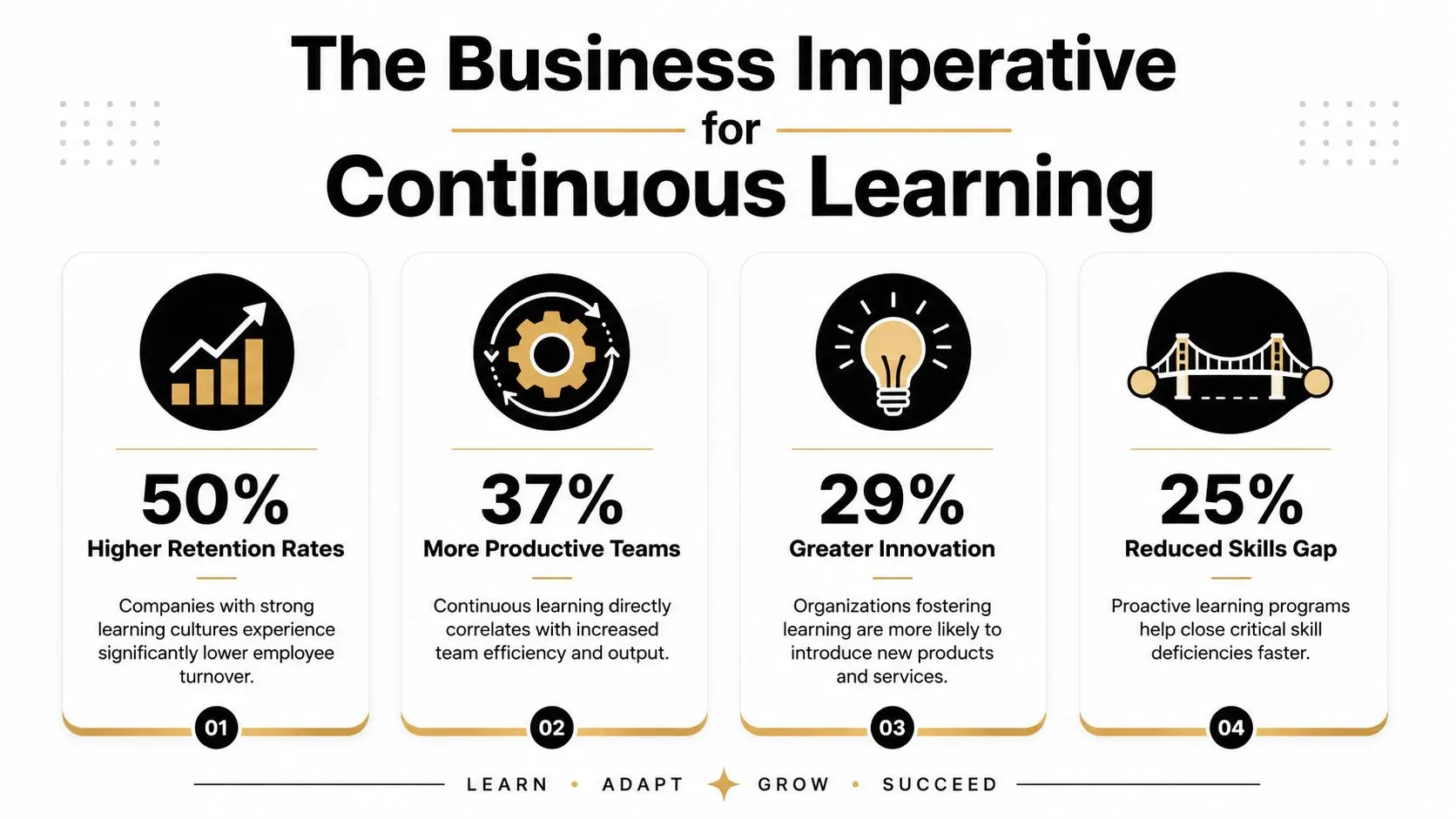
The image above includes extra figures as part of the supplied visual asset. The practical point is simpler. Studios with stronger learning cultures usually hold onto knowledge better, adapt faster when tools change, and build more repeatable quality across projects.
Retention changes when growth is visible
Creative and technical staff rarely leave for one reason alone. They leave when the gap between their current role and the work they want to do keeps widening. In animation and XR, that happens quickly if a studio talks about advanced projects but gives people no route into realtime workflows, simulation design, procedural systems, or AI-supported production. A learning culture makes career progression tangible. People can see how today's work connects to tomorrow's capability, and that changes whether they picture their future inside the studio or somewhere else. In practice, that usually shows up in a few specific ways:
- •Clear development routes: a motion designer can see a path into broadcast graphics, realtime previs, or interactive content.
- •Capability-based staffing: producers assign stretch work with support, instead of reserving every technical challenge for the same senior team.
- •Knowledge transfer habits: leads explain decisions, document methods, and turn project fixes into shared practice.
That last point matters more than many studios admit. If knowledge stays locked in a few people, delivery can keep working for a while. Scaling does not.
New capability comes from trained teams, not software licences
Buying software expands options. It does not create capability on its own. A licence for Unreal Engine, Unity, AI tools, a simulation package, or a stronger render setup only improves output when the team knows where it fits in the pipeline, what problems it solves, and what trade-offs it introduces. I've seen studios buy the right tools and still miss the opportunity because nobody had time to test workflows properly before a client deadline arrived. That is why learning has direct operational value. It turns experimentation into something repeatable. It also reduces pitching risk. If a studio wants to offer XR training simulators, interactive product demos, AI-assisted content pipelines, or realtime animation, the team needs rehearsal time before those promises appear in a scope of work. A current pipeline supports more confident bids than a studio relying on old habits and fresh branding.
Competitive advantage is built before the brief arrives
Demand shifts fast in this field. One month the pressure is faster versioning for campaign content. The next it is immersive event work, virtual production support, or technical explainers that have to work across screens, headsets, and spatial environments. Studios that keep learning are easier for clients to trust because the preparation happened before the enquiry landed. Producers have a clearer view of delivery risk. Artists know what quality control needs to catch. Developers know which optimisation compromises are acceptable and which ones will break the experience. Learning does not guarantee strong work. It does make strong work easier to repeat. For animation and XR studios trying to retain talent, adopt new technologies, and ship ambitious projects without exposing every job to avoidable risk, that is the business case.
Key Principles for Effective Learning Programmes
Most learning programmes fail for ordinary reasons. They're too broad, too detached from the work, or too dependent on goodwill after hours. People attend, nod, and go back to the same habits. The programme exists on paper, but the pipeline doesn't change. The ones that stick tend to share a few principles. They put the learner at the centre, but they don't confuse that with letting everyone drift in different directions. In a studio, learning needs both personal relevance and production relevance.
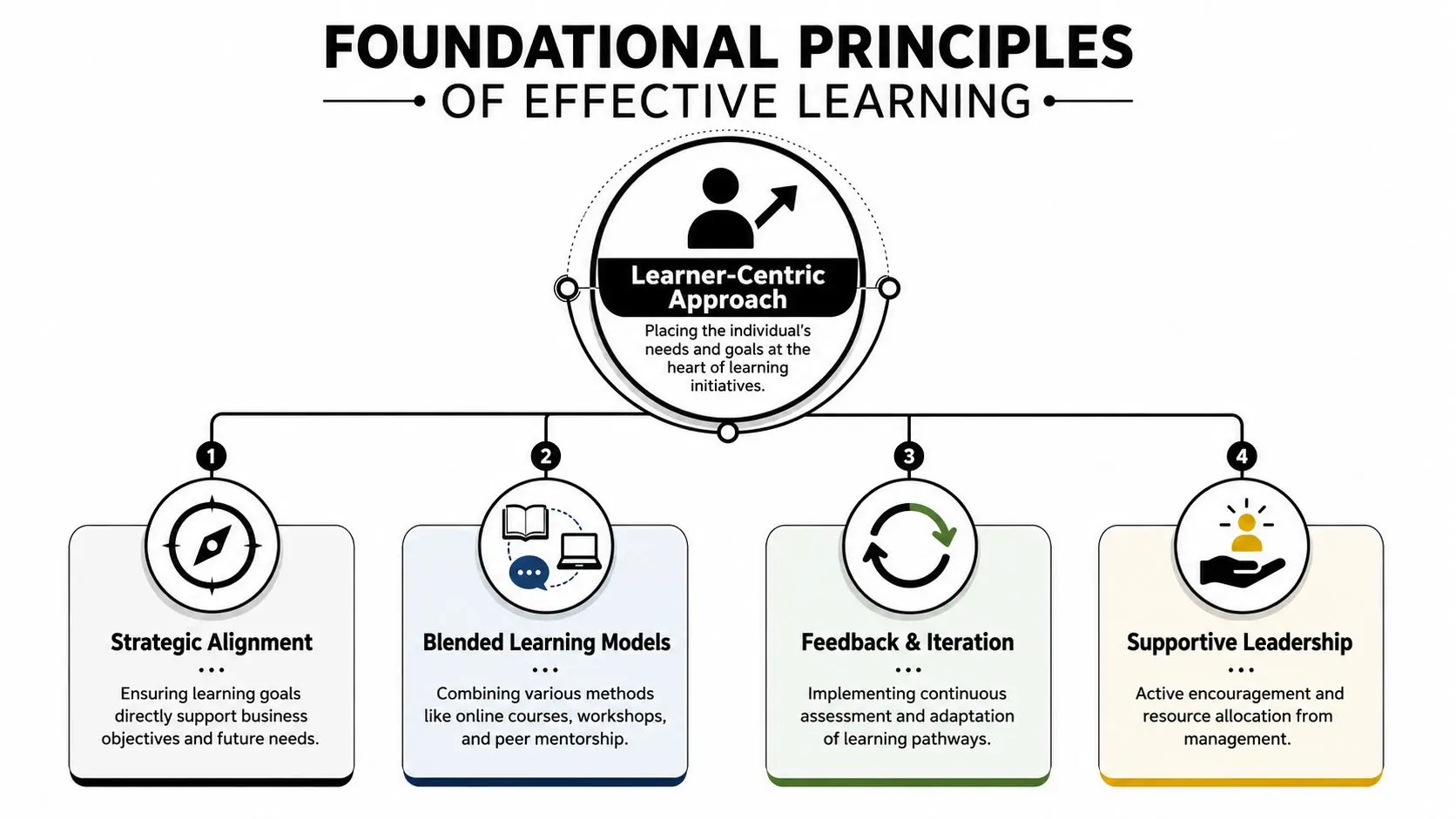
Use a blended model, not a single channel
A practical learning programme mixes several forms of development. Formal sessions matter, but they can't carry the whole load. A useful studio mix often looks like this:
- •Learning by doing: artists and developers apply a new method on a live or simulated task.
- •Learning through others: leads review files, demonstrate fixes, and explain decision-making.
- •Learning through structured input: workshops, documentation, webinars, and guided modules fill knowledge gaps efficiently.
People often refer to this as a blended approach, and that's the right instinct. Teams learn faster when theory, observation, and application reinforce each other.
Psychological safety matters more than polished training decks
No one learns much in a room where they're afraid to look inexperienced. This is especially true in creative technology work, where a junior developer may be unsure about performance budgets, or an experienced animator may be new to a real-time workflow. If managers punish uncertainty, staff hide it. Then the confusion shows up later as missed assumptions, weak handovers, and avoidable revisions. A healthier pattern looks like this:
| Weak learning environment | Strong learning environment |
|---|---|
| Questions are treated as lack of competence | Questions are treated as part of professional growth |
| Mistakes are hidden | Mistakes are reviewed and documented |
| Knowledge sits with senior specialists | Knowledge gets distributed through critique and mentoring |
| Training is an event | Learning is part of normal delivery practice |
Producer's note: If your team only feels safe admitting they don't know something after a project goes wrong, the learning culture is already too weak.
Self-direction works best inside clear boundaries
Studios sometimes swing between two bad extremes. One is rigid top-down training that ignores individual goals. The other is total freedom with no priorities, where people learn interesting things that never connect to the business. The better route is guided self-direction. Give people ownership, but set a frame. That frame should answer:
- What capability does the studio need next?
- What skill does this person want to build?
- Where can the project pipeline create practice opportunities?
- How will the team capture and reuse what's learned?
Leadership has to model the standard
Teams notice quickly whether managers value learning in theory or in real schedules. If producers expect people to grow but never leave room for review, experimentation, or post-mortems, the signal is obvious. Delivery wins every time, and learning becomes optional. Supportive leadership is less about speeches and more about operational decisions. Who gets protected time. Which experiments are allowed. Whether documentation is expected. Whether senior staff teach. That's what determines whether a programme survives contact with actual production pressure.How to Implement a Continuous Learning Framework
A workable framework starts with leadership, but it can't stop there. Once a studio decides learning matters, the next challenge is to make it operational. That means defining skills, assigning ownership, choosing tools, and building a rhythm people can sustain during delivery.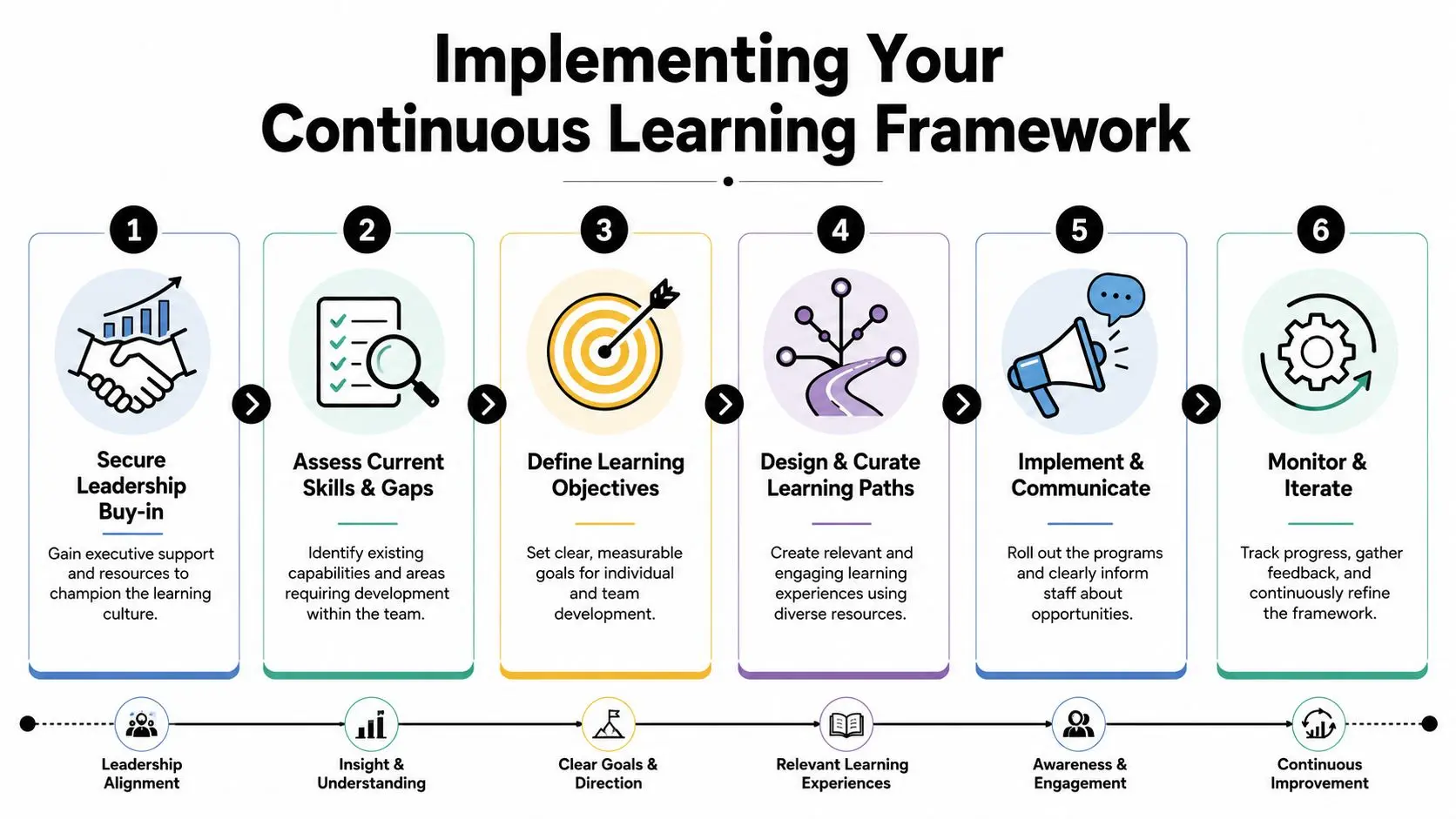
Start with gaps, not with content libraries
A common mistake is buying access to a huge learning platform before the studio has identified what it needs. Content abundance feels productive, but without priorities it usually leads to low completion and weak application. A better sequence is straightforward. Successful continuous learning strategies in the UK use Learning Management Systems to track participation and build learning around SMART objectives derived from skill-gap analysis, with microlearning linked to improved productivity and reduced error rates, as explained by My Learning Cloud's guidance on continuous learning. That approach works because it forces specificity. Instead of saying “the team should get better at XR,” you define whether the issue is optimisation, interaction design, shader workflow, device testing, or scenario authoring.Build the framework into normal studio rhythms
The strongest frameworks don't rely on heroic effort. They attach themselves to habits the studio already has. For example:- •During kick-off: identify capability risks before production starts.
- •During sprints or milestones: run short peer demos on tools or workflow improvements.
- •During reviews: note recurring technical or craft issues that need targeted support.
- •After delivery: capture what should become standard practice, not just what went wrong.
A good leadership lens helps here. The thinking in Synopsix leadership strategy insights is useful because it connects development to organisational capability rather than treating learning as a side programme.
Use different formats for different needs
Not every learning need deserves the same format. Some problems need a quick internal screen-share. Others need a structured pathway over weeks or months. Here's a practical decision guide:
| Learning need | Best-fit format |
|---|---|
| New software feature affecting active jobs | Short internal demo or microlearning module |
| Pipeline change across departments | Documented workflow, lead training, and follow-up QA |
| Junior capability growth | Mentoring, shadowing, and guided task ownership |
| Entry routes into the sector | Structured development support such as animation apprenticeships guidance |
Measure early, then adjust fast
A framework only becomes real when someone checks whether it's being used. LMS reporting can help, but participation alone isn't enough. Producers should also ask whether files are cleaner, handovers are smoother, revisions are dropping, or new capabilities are showing up in bids and delivery. One thing that works well in creative teams is keeping the feedback loop short. If a learning intervention doesn't change behaviour within a reasonable stretch of project work, redesign it. Shorter modules, better examples, clearer ownership, or stronger manager involvement usually help more than adding more content. Continuous learning frameworks don't need to be elaborate. They need to be specific, repeatable, and tied to work the studio does.
Continuous Learning in Animation and XR Studios
The theory gets clearer when you look at production problems. In animation and XR, learning usually starts because a team hits a practical limit. The old method is too slow, the brief has changed, or the expected quality bar has moved. That's where continuous learning proves itself. It solves capability gaps while building future strength.
Example one, pipeline shifts in animation
Say an animation team has a dependable traditional workflow for series work and branded content, but new briefs demand quicker iteration, more versioning, or closer collaboration between previs and final picture decisions. That doesn't mean throwing out the existing pipeline overnight. It means creating a learning path that helps the team test realtime methods in a controlled way. The practical pattern usually looks like this:
- •A lead or TD prototypes the workflow on a contained sequence.
- •Artists review where craft standards hold or slip, especially around lighting, motion polish, and compositing expectations.
- •Producers document where the new method saves time and where it adds complexity.
- •The team then decides what becomes part of the standard pipeline.
That's continuous learning in action. Not abstract upskilling. Targeted adaptation under production conditions.
Example two, XR optimisation is learned socially
XR teams run into a different set of issues. Performance budgets, interaction clarity, comfort, hardware constraints, and deployment realities all force trade-offs. Junior developers rarely absorb that just by reading documentation. They learn it by pairing with someone who's already shipped. A strong internal mentoring setup often covers things such as scene complexity, interaction feedback, testing discipline, and optimisation choices for standalone headsets. A useful technical reference point for teams working across immersive production is this guide to Unity development for XR and animation, because it reflects the kind of cross-disciplinary workflow thinking modern studios need.
“Good XR learning happens close to the build, close to the device, and close to the user test.”
For teams exploring training simulation or embodied interaction, adjacent fields can sharpen thinking too. The distinction in truelabel's data comparison insight is a useful reminder that viewpoint, context, and task design shape how systems learn and how humans experience digital environments.
Example three, onboarding through simulation
Some of the best learning tools in a creative technology business are the kinds of experiences the studio may already know how to build. XR can train staff as well as serve clients. If a role involves complex technical procedures, repeated environment setup, or nuanced decision-making, a structured simulation can reduce ambiguity and ease pressure on senior staff who would otherwise repeat the same onboarding explanation. That's especially relevant in studios that span animation, realtime tools, and immersive production. The more disciplines overlap, the more important it becomes to make tacit knowledge visible. Continuous learning helps teams do that before confusion turns into production friction.
Measuring the ROI of Your Learning Initiatives
If learning can't be measured, it gets cut when schedules tighten. The mistake is measuring only attendance. Completion tells you someone showed up. It doesn't tell you whether the studio got better. A more useful view starts with operational outcomes. Are handovers improving? Are fewer mistakes repeating across shots, builds, or review rounds? Are more team members able to work confidently across adjacent tools or stages of the pipeline? Those are the signs that learning is affecting delivery rather than sitting beside it.
What to track in practice
Studios usually get the clearest signal from a mix of indicators:
- •Capability indicators: who can now handle a task, tool, or review responsibility they couldn't manage before.
- •Production indicators: whether learning reduced recurring errors, bottlenecks, or dependency on a small number of specialists.
- •Retention indicators: whether people can see a path to grow without leaving.
- •Innovation indicators: whether the studio can credibly offer new forms of work because the team can deliver them.
In regulated sectors, the UK already offers a structured way to think about learning volume and record-keeping. Continuous learning can be quantified through the Continuing Professional Development cycle, where one CPD hour equals one hour of active learning, as outlined in this explanation of the CPD framework). Even if your studio isn't operating in a regulated profession, that principle is useful because it turns vague development talk into an auditable record of time, activity, and relevance.
The funding question is strategic
ROI also depends on how learning is funded. That's becoming more important as technical skills evolve faster than traditional degree cycles. One current policy challenge in the UK is that the planned 2027 Lifelong Learning Entitlement is projected to support access to specific degree modules, while excluding short courses, professional certificates, and CPD, according to Neil Mosley's analysis of lifelong learning policy. For studios, that means much of the practical upskilling needed for AI workflows, XR development, and specialist production training may still need employer-led funding. That's one reason internal capability planning matters. Businesses can't assume public policy will cover the kinds of short-form, production-relevant learning they need most. A good model is to connect learning measurement directly to business cases you already understand. If the studio is building simulation capability, for instance, assess whether better training design improved delivery quality, assessment thinking, and compliance readiness in work such as medical training simulations in XR.
Bottom line: the return on learning shows up when better skills reduce production risk and expand what the studio can confidently make.
--- Studios that want to stay sharp in animation, XR, and AI-enhanced production need a learning system, not just good intentions. If you're planning new digital content, immersive experiences, or technical storytelling and want a team that understands how modern pipelines operate, talk to Studio Liddell.