Virtual Production Training in the UK: Skills, Pipelines
The call time is early, the UK weather has changed again, and the director wants a sunrise that won't arrive for hours. On the LED stage, the background is ready, the camera is on the tracking system, and the Unreal scene is loaded. Then the horizon slips against the lens, the foreground no longer matches the virtual perspective, and three departments start solving different versions of the same problem. That situation explains why virtual production training can't be reduced to an Unreal Engine tutorial. A production-ready learner must understand the relationship between real-time rendering, LED stages, camera systems, lighting, art direction, performance and conventional production management. The technology matters, but the hand-offs between people determine whether a shoot stays controlled.
What Virtual Production Training Actually Covers
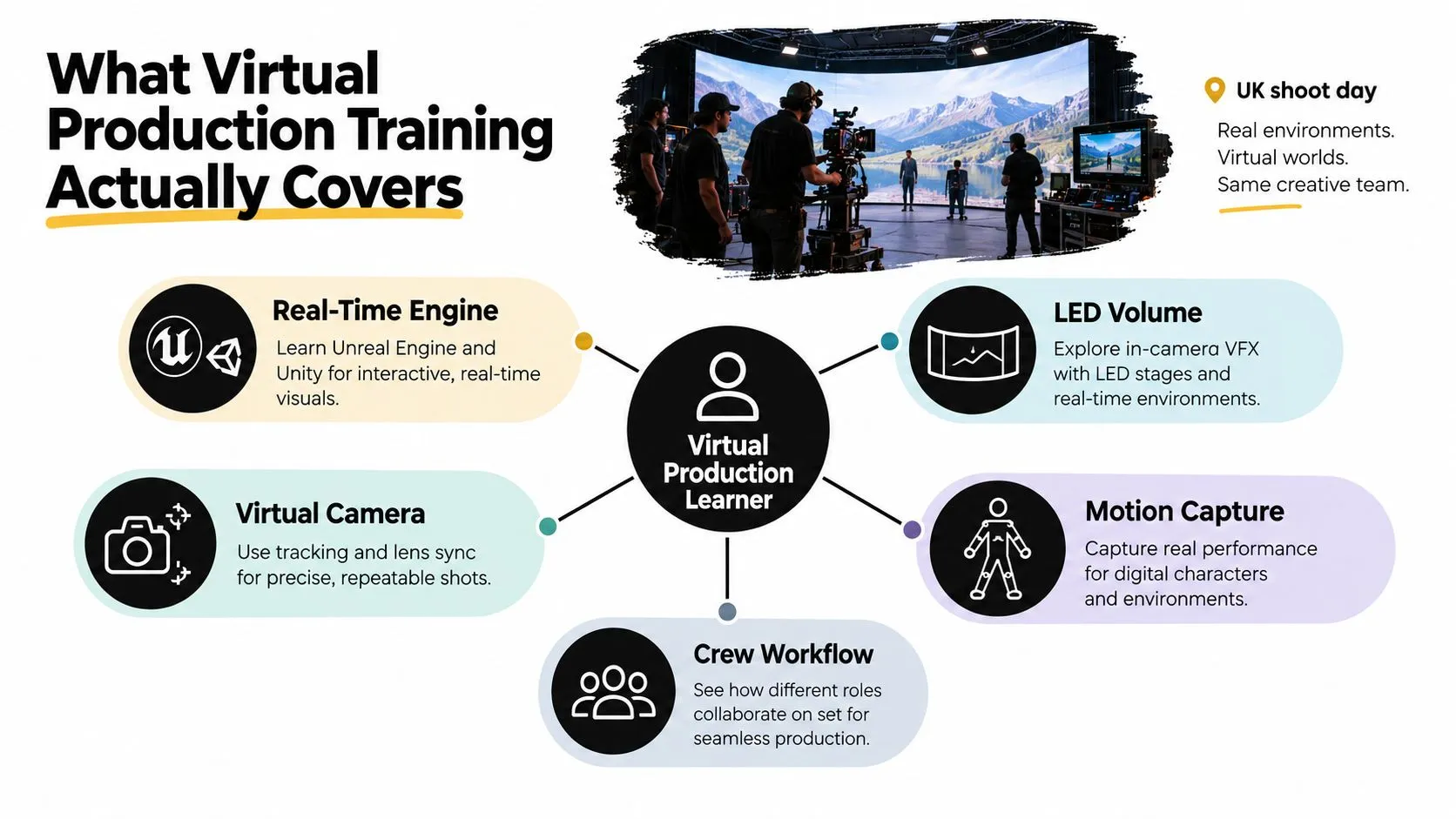
A useful programme starts with the shoot, not the software menu. Learners need to see how a director's framing decision affects the virtual art department, how a lens change affects camera tracking, how lighting must respond to both the physical set and the rendered environment, and how the producer protects stage time while those decisions are tested. The UK Parliament's written evidence describes Class 1 virtual production volumes as studio environments combining large LED displays, real-time game-engine technologies and in-camera graphics. That definition already points to the breadth of the discipline. Training must connect real-time engines, LED-volume workflows, cinematography, design, storytelling and established production practice, rather than treating VP as a purely technical specialism. A practical guide to virtual production workflows can help producers place those components in a wider studio pipeline.
The learner's job is to connect the departments
A strong course should teach a learner to:
- •Build the environment: Create, organise and optimise a scene in Unreal Engine or Unity so it can respond reliably during capture.
- •Prepare the stage: Understand LED-wall content, colour, brightness, reflections, moiré risks and the relationship between the wall and physical production design.
- •Synchronise the camera: Work with tracking, lens data and calibration so the virtual perspective follows the physical camera.
- •Shape the image: Combine virtual and practical lighting, then judge whether the result works through the lens rather than only on a monitor.
- •Manage the hand-offs: Record decisions, communicate changes and identify who owns each asset and final-pixel responsibility.
Motion capture and performance capture may also sit within the curriculum, particularly when a project combines live performers with digital characters. The important point is not that every learner becomes a specialist in every area. They need enough systems knowledge to understand dependencies, ask useful questions and act before a small mismatch becomes an expensive stage problem.
The UK Skills Gap in Numbers
The UK adopted virtual production quickly, and the workforce hasn't expanded at the same pace. Written evidence submitted to the UK Parliament reported that in 2022 the UK had more Class 1 virtual production volumes than any other territory, including the United States. The same evidence connected the expansion with a long-term skills challenge, requiring crews to combine real-time technical capability with creative expertise in design and storytelling. The UK Parliament evidence submission also records ScreenSkills' estimate that the sector would require an additional 15,000 to 20,000 crew members. StoryFutures' 2023 survey makes the operational problem clearer. More than one-third of surveyed organisations reported that their staff had less than six months' virtual production experience, while two-thirds of organisations already producing VP work said relevant skills in the employment market were in weak or very weak supply. This isn't just a recruitment problem. It means existing teams may be learning while delivering live commercial work.
Demand exists inside small and developing teams
The survey found that 79% of participating organisations were conducting research and development on live virtual production projects, but only 42% had an in-house team dedicated to VP. Most organisations were micro-businesses or small and medium-sized enterprises, and the survey recorded uneven access to funding and public support. Those conditions make employer-based learning important. A company may need to develop its pipeline, train staff and deliver a project without a separate VP department. The UK screen sector's wider recruitment pressure strengthens the case for practical pathways. ScreenSkills research identified communication and interpersonal skills as lacking for 41% of employers, while leadership and management were identified by 37%. For people planning workforce development, broader technology talent team insights are useful because VP capability depends on role design, progression and retention as much as on tool access. Training therefore needs several entry points. A beginner may need an overview of the stage and production language. An experienced cinematographer may need tracking and LED integration. A producer may need scheduling, risk management and decision ownership. Treating all three as the same learner wastes time and leaves the actual capacity problem unresolved.
Core Technologies Every Programme Must Cover
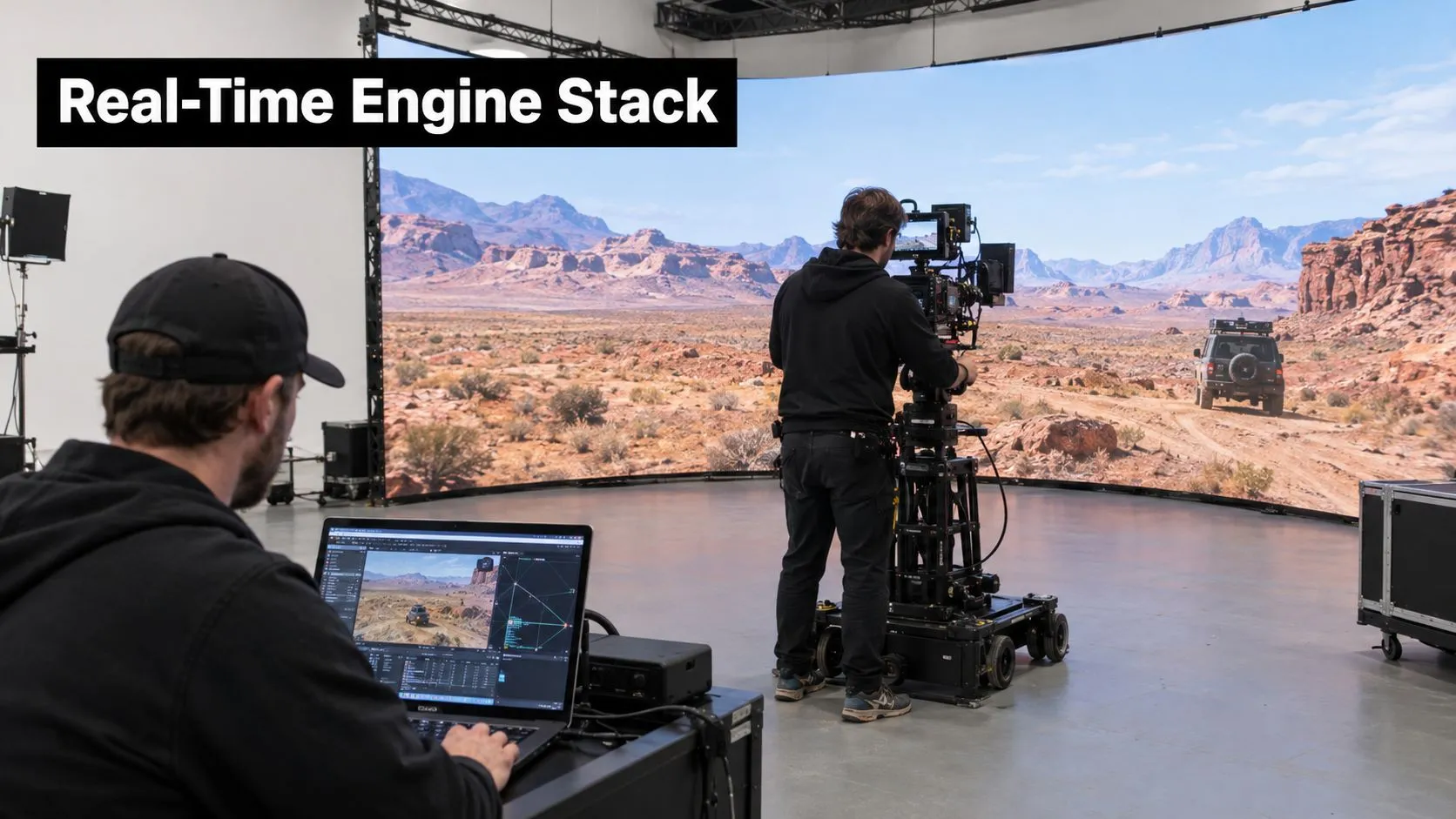
The technology stack makes sense when taught as a chain. The engine creates the world, the stage displays it, the camera system aligns it with the physical lens, and the crew captures the combined result. A learner should understand what each part contributes and what can fail at the connection between parts.
Start with the real-time engine
Unreal Engine and Unity are not interchangeable buttons labelled “render”. Learners should build a scene, organise assets, control lighting and understand optimisation choices that affect playback. They should also know how to prepare content for a particular display, camera move and production constraint. This overview of virtual production equipment for creative studios provides useful context for the relationship between software, stage hardware and crew practice. A competent learner can explain why a beautiful scene may still be unsuitable for an LED wall. Excessive geometry, poorly prepared textures, inefficient lighting or uncontrolled frame timing can make a scene unreliable when the camera is live. The assessment should focus on making a scene stable and usable, not on producing the most elaborate environment.
Treat the LED volume as part of the camera
An LED volume is more than a background screen. It contributes colour and light to the physical scene and can allow visual effects to appear in camera. Training should cover content preparation, screen characteristics, reflections, practical foreground elements and the difference between what looks correct to the eye and what reads correctly through the lens. Virtual cameras and tracking systems form the next connection. Learners need to calibrate the relationship between the physical camera, its lens and the virtual environment. They should recognise tracking drift, incorrect lens metadata, scale errors and parallax mismatches, then know which department needs to act.
Include performance and the full-time pipeline
Motion capture and performance capture are valuable when the production includes digital characters or recorded movement. The course should distinguish between capturing movement, cleaning it, retargeting it and making a performance serve the shot. Capture data isn't automatically animation. It becomes useful only after artists and directors shape it for the story. Finally, learners should rehearse the live pipeline. They can build a scene, prepare LED content, calibrate tracking, synchronise lighting and deliver a controlled in-camera composite. That sequence teaches cause and effect far better than isolated demonstrations.
Roles, Crews and the Multidisciplinary Shoot Day
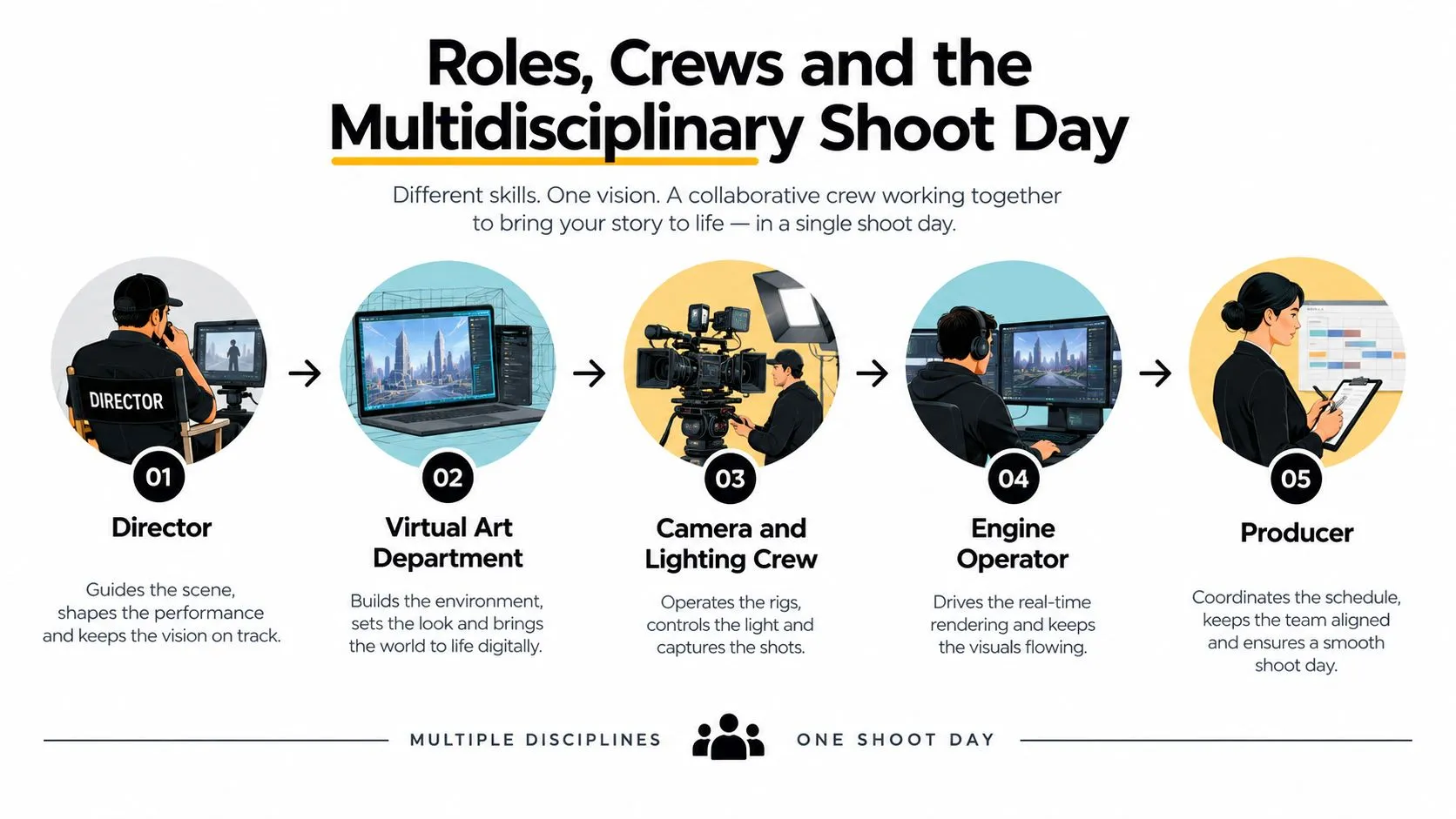
A Ravensbourne University London teaching case used a production team comprising a director and writer, Unreal Engine artists, a cinematographer, camera assistants, a gaffer or chief lighting technician and lighting technicians. That structure reflects what happens on a real stage. The engine artist isn't working in isolation, because a camera move, a lighting adjustment or a change in physical set dressing can alter the rendered image immediately.
Rotate responsibility through the day
A useful exercise gives learners a short scene and assigns rotating responsibilities. One learner directs the performance and protects the creative intention. Another builds or adjusts the virtual environment. The cinematographer and camera assistants manage framing, lenses and tracking. The gaffer integrates physical and virtual light, while the producer coordinates the schedule, decisions and escalation route. Suppose the virtual sun is coming from camera left, but the physical key light has been placed on camera right. The problem isn't solved by asking the Unreal operator to “make it look better”. The director, cinematographer, lighting team and engine artist must agree which visual fact matters, then make a coordinated change.
Practical rule: Train people to name the dependency before they change the setting.
Communication is a production skill
The Ravensbourne case identifies continued-learning capability as an explicit outcome because hardware, software and workflows evolve. A learner must be comfortable documenting a change, checking its effect and updating the team. That behaviour is as valuable as knowing where a setting lives. People entering the field can also benefit from wider guidance on art and design careers in film, particularly because VP creates hybrid roles between art, cinematography, technology and production. The strongest crews don't divide the stage into disconnected territories. They share enough vocabulary to make decisions together.
Delivery Formats Compared
Different formats prove different things. A workshop can create awareness, but it rarely verifies that someone can prepare a scene and operate it under pressure. An online module can teach terminology and planning, while a supervised stage session reveals whether a learner can communicate when tracking, lighting and content interact.
| Format | Best for | Typical length | Verifiable skill level |
|---|---|---|---|
| Awareness workshop | Producers, directors, educators and clients who need a common vocabulary | Short, single-session format | Can explain the workflow and make informed production decisions |
| Intensive bootcamp | New operators and creatives building tool familiarity | Concentrated practical programme | Can complete guided tasks in an engine or stage environment |
| Online modules | Distributed teams and learners needing flexible theory or preparation | Self-paced or scheduled remote study | Can demonstrate planning, terminology and selected offline exercises |
| Hybrid programme | Teams that need production readiness and supervised practice | Modular study combined with stage sessions | Can perform an end-to-end workflow under controlled supervision |
Match the format to the learner
A producer may gain substantial value from a workshop covering stage constraints, asset ownership and scheduling. They don't necessarily need to become an engine operator. A junior artist may need a bootcamp followed by a supervised brief, because software familiarity alone won't reveal whether they can prepare content for a particular wall or respond to a director's change. Online learning works well before stage time. Learners can study camera language, scene organisation, colour and production documentation before arriving with a shared baseline. It becomes less effective when used as the only evidence of operational competence, because the learner hasn't had to solve a live hand-off. Hybrid programmes offer the strongest route to job readiness when stage access is available. The important feature isn't the label. It's the opportunity to repeat a controlled workflow, receive feedback and show that the learner can make sound decisions with other departments present.
Assessment, Certification and Production Readiness
Attendance proves presence. It doesn't prove that a learner can keep a stage moving. A production-focused assessment should ask for observable outputs and evaluate the decisions behind them.
Assess the complete workflow
A practical assessment might require the learner to:
- Build and optimise an Unreal scene for a defined camera move and display environment.
- Prepare content for an LED wall, including the required assets, lighting and playback settings.
- Calibrate camera tracking and demonstrate that the virtual perspective responds correctly to physical movement.
- Synchronise lighting between the virtual environment and the practical set.
- Deliver a controlled in-camera composite and explain the remaining limitations or risks.
Build progression into certification
UK research supports separating foundation, upskilling and advanced-production pathways. A foundation level can establish stage language and engine basics. An upskilling level can focus on role-specific work for camera, lighting, art or production. An advanced level can assess pipeline integration, troubleshooting, supervision and team leadership. A portfolio should show more than polished images. It should reveal how the learner handled a constraint, recorded a change, communicated a decision and protected the brief. Those are the signals that distinguish a person who has followed a tutorial from someone who can contribute safely and usefully on a live production.When Virtual Production Is and Is Not the Right Choice
An LED volume isn't automatically the modern default. A producer should compare it with location shooting, green screen, conventional CGI and hybrid production against the needs of the specific project. The relevant questions are practical:- •Stage-day cost: Can the production justify the stage, crew and preparation time?
- •Asset reuse: Will the virtual environment serve further shots, episodes, campaigns or interactive formats?
- •Crew capability: Does the team have the people to prepare, operate and troubleshoot the pipeline?
- •Render and storage needs: Can the organisation manage scene complexity, media and version control?
- •Previsualisation: Will the project benefit from fixing camera and environment decisions before capture?
- •Accessibility and travel: Does a controlled stage reduce logistical barriers for the cast and crew?
- •Carbon impact: Could the chosen workflow reduce travel or create new technical and energy demands?
A school, SME or independent producer may benefit from real-time previs without hiring a full LED stage. A green-screen pipeline may be more appropriate where the background will be heavily replaced and the production doesn't need interactive reflections or in-camera lighting. A location may remain the best option when the physical environment carries the performance and the virtual asset would take longer to build than the shoot itself.
The right training teaches a producer when to say no to a volume.
The decision should also account for human capability. ScreenSkills' findings on communication and interpersonal skills, leadership and management show why production judgement can't be separated from technical learning. If the team can't agree who owns the asset pipeline, a larger technology footprint won't solve the underlying problem. For many projects, the answer is hybrid. The team might use real-time previs, camera-tracked greenscreen, a small-stage capture day, conventional CGI and remote collaboration in different parts of the same production. Training should help learners compare those routes rather than advocate for one technology.
Building a Training Plan and Where Studio Liddell Fits
A practical training plan starts with the people, not the equipment catalogue. Define the learner cohort, identify their current responsibilities and decide which production decisions they need to make confidently.
Use a simple planning checklist
- •Scope the cohort: Separate directors, producers, artists, camera teams, lighting technicians, educators and technical operators.
- •Choose the modules: Combine engine practice, LED workflows, camera tracking, lighting, performance capture, production management and decision-making.
- •Select the format: Use workshops for shared awareness, online preparation for theory and hybrid delivery for supervised production practice.
- •Define assessment: Specify the scene, wall content, tracking, lighting and composite outputs that learners must demonstrate.
- •Secure practical access: Arrange stage time, tracking hardware, engine access and a multidisciplinary crew model.
- •Plan continuing development: Reserve capacity for workflow changes, experimentation and R&D rather than treating training as a single event.
That last point matters for institutions and employers building a sustainable pathway. Guidance on training and development in HR can support the wider conversation about progression, skills mapping and organisational ownership. Studio Liddell can fit into that plan through awareness workshops, modular online content, supervised briefs and bespoke programmes. Its experience across animation, games, XR and AI-enabled production also creates a useful bridge for teams that need virtual production to work with existing creative pipelines, rather than sit apart from them. --- Studio Liddell offers practical virtual production training built around production decisions, multidisciplinary collaboration and observable stage competencies. Visit Studio Liddell to discuss a workshop, modular pathway or supervised brief for your team or learners.