UK Producer's Guide to IP in Software Development
A lot of IP trouble starts the same way. A producer gets a redlined MSA from a new client, legal asks who owns the code, the technical lead mentions a few open-source packages, someone has used an AI tool to speed up concepting, and suddenly a straightforward build has become a chain-of-title problem. That’s why ip in software development matters so much in creative production. In animation, XR, apps, games, and mixed-media builds, the value isn’t only in the final deliverable. It sits in the codebase, the art pipeline, the reusable tools, the brand assets, the underlying methods, and the rights to exploit all of it later. In the UK, that commercial reality is hard to ignore. The UK Intellectual Property Office recorded 18,709 patent applications in 2022/23, with computer technology accounting for approximately 12.3% of total filings, according to WIPO’s UK IP statistics overview. That tells you something important. Software-related IP isn’t a side issue. It’s part of how studios build enterprise value, protect margin, and stay investable. For creative digital companies, IP also affects delivery in very practical ways. It shapes what you can promise in a contract, how you brief freelancers, what you can reuse across projects, and whether a client can safely launch in multiple territories. If you’re designing original content, building bespoke apps, or extending a children’s brand into games and XR, rights ownership is part of production management. It isn’t a legal footnote. The studios that handle this well tend to do two things consistently. They treat IP as an operational discipline, and they document decisions early. The ones that don’t usually discover the problem at the worst moment: launch approval, publisher due diligence, or client procurement. If your work includes original worlds, software builds, and platform-specific experiences, IP development services sit closer to the centre of the business than is often first assumed.
Introduction Why IP Is Your Studio's Most Valuable Asset
A client signs off an XR activation for a public launch. The build is stable, the visuals are approved, and the install date is booked. Then procurement asks a simple question. Who owns the code, the interactive logic, the character animations, and the third-party plugins inside the project? If the answer is vague, the significant delay starts there. That is why IP sits at the centre of creative technology production. It decides what a studio can sell, license, adapt, localise, support, or reuse after delivery. In animation, games, XR, and mixed-media builds, the asset list is rarely clean enough for assumptions. A studio might deliver a game prototype, a museum touchscreen, a mobile app, and a pack of animated assets for the same client. Each part can carry a different rights position. Source code may be newly written by the studio. Character art may be based on client-owned brand guidelines. Plugins may come with third-party licence terms. Voice, music, stock elements, and middleware often arrive with their own usage limits. If those strands are not mapped at the start, they surface later in approvals, change requests, and launch planning.
Value sits in rights, not only in files
Creative teams focus on the work being made. Producers need to track what the studio and the client are allowed to do with that work once it exists. Can the client alter the build without the original team. Can the studio reuse generic tools or pipeline code. Can a publisher sublicense the product. Can a brand owner approve a port to another platform without fresh rights clearance. Those questions shape pricing and delivery. They also affect margin. I have seen rights clearance hold a project longer than bug fixing or content polish, especially where software, brand IP, performer releases, and licensed assets all meet in one build.
Practical rule: If ownership, licence scope, and permitted reuse are not clear before production starts, they become more expensive to resolve after the first milestone.
For UK studios, this is not just a legal admin issue. It affects how you scope work, how you contract freelancers, what you can retain as background technology, and how confidently a client can commission phase two. Teams doing IP development for creative technology projects need a working model for rights before they need a lawyer to clean up a dispute.
Why creative technology teams feel this more sharply
A pure software company may deal with one product, one codebase, and one ownership model. A creative technology studio usually does not. It pulls together developers, designers, animators, technical artists, external specialists, licensors, voice talent, agencies, and client stakeholders. It also relies on engines, DCC tools, repositories, plugin ecosystems, asset libraries, and platform-specific SDKs. Every handoff creates a rights question, and mixed-media projects create more handoffs than standard software builds. That is why experienced producers treat IP as part of delivery management. It belongs in estimates, onboarding, procurement, file structures, repository access, and sign-off. If it only appears at contract close or launch approval, the studio has already left it too late.
The Four Pillars of Software IP for Creative Projects
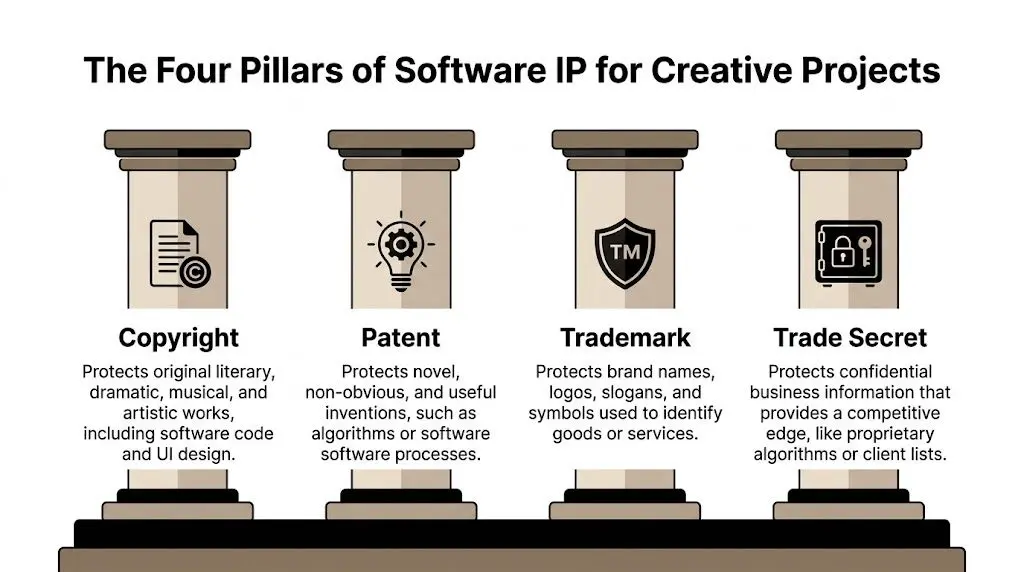
If you work in animation, XR, apps, or games, four IP categories come up repeatedly. Most delivery problems happen when teams confuse one for another.
Copyright
Copyright is usually the first layer producers deal with because it covers so much of the day-to-day output. In software projects, that includes source code. In creative projects, it also covers artwork, animation, UI layouts, scripts, storyboards, music, and motion graphics. Think of copyright as protection for the actual expression of the work. Not the broad idea for “an educational AR app about space”, but the specific code, specific interface, specific character poses, and specific asset files used to make it real. For a studio, that means version control and authorship records matter. If a client asks who created a sequence, a module, or a set of icons, you need an answer supported by contracts and production records.
Patent
Patent sits further away from most day-to-day studio output, but it matters when the software does something novel in a technical way. A routine app build usually won’t raise patent issues. A distinct technical method might. In creative technology, a patent question can arise around a new rendering workflow, a tracking process in XR, a novel interaction method, or software that solves a technical problem in a non-obvious way. The standard is higher than generally perceived, and many creative businesses won’t rely on patents as their main protection. But they can matter in specialist tools and platform technology. A useful producer test is simple:
| Question | If the answer is yes |
|---|---|
| Is this a technical invention rather than a content asset? | Patent may be relevant |
| Is it new and not just a project-specific implementation? | Get specialist advice early |
| Would disclosure damage your position? | Don’t publish details casually |
Trademark
Trademark protects the identifiers around the work. The series title. The app name. The studio brand. The logo on the splash screen. The phrase a campaign revolves around. Creative and commercial teams meet. You may produce a brilliant game or interactive experience, but if the title can’t be used safely in market, brand rollout gets complicated quickly. Naming checks should happen earlier than they often do. For client projects, trademark issues usually arise in two situations:
- •New branded products: A client wants a new app, game, or activation name cleared for launch.
- •Derivative use: The studio needs permission to use existing marks in promo reels, case studies, event displays, or internal decks.
Trade secret
Trade secrets protect confidential know-how that gives the business an edge. This is the least glamorous category and often the one with the most practical value. That can include internal tools, production workflows, bidding models, client lists, unreleased concepts, optimisation methods, or a proprietary XR deployment process that saves time every project. Unlike copyright, this protection depends heavily on secrecy and access control. If everyone has everything in an open drive, the studio is making that protection weaker.
The strongest studio IP often isn’t the headline brand asset. It’s the repeatable method nobody outside the building can see.
Who Owns the Code Default Rules and Contract Essentials
One of the most persistent myths in software production is that the party paying for the work automatically owns the IP. Under English law, that’s not the safe assumption.
The default position is more uncomfortable. IP rights in custom software development default to the creator unless explicitly assigned, stemming from the Copyright, Designs and Patents Act 1988. The brief also notes that, in UK legal practice, disputes arise in 20-30% of software projects involving freelancers where strong assignment provisions are missing, as summarised by Travers Smith on managing IP risks in software development.
Employees and contractors are not the same
This catches creative businesses all the time because teams are blended. Staff animators, technical artists, developers, shader specialists, sound designers, and external XR collaborators may all work on one production. Their legal positions are not identical. For employees creating work in the course of employment, the employer is generally in a stronger ownership position. For external contractors and freelancers, rights usually need to be assigned properly in writing. If that paperwork is weak, missing, or signed too late, you can end up paying for production without receiving the rights you assumed were included. That problem gets worse in creative technology because deliverables are layered. A freelance developer may write core app logic. A contractor may build the editor tooling. Another specialist may provide shaders or a rigging script. If even one important component sits outside the assignment chain, your client may not receive clean ownership.
The clauses that matter most
At producer level, I’d look for a handful of essentials in every MSA, SOW, and freelancer agreement.
- •Clear assignment language: The contract should say what is assigned, when it transfers, and whether payment is a condition of transfer.
- •Pre-existing IP wording: Teams often bring prior tools, libraries, templates, or workflows into a project. Those should usually be licensed, not accidentally assigned away.
- •Moral rights treatment: If a waiver is needed for certain creative contributions, it should be addressed expressly.
- •Warranties on originality and authority: Each contributor should confirm they have the right to provide what they’re providing.
- •Further assurance obligations: If paperwork needs tidying later, the contributor must cooperate.
A lot of outsourcing disputes start because none of those points were nailed down at the beginning. If you’re comparing delivery models, this practical software development outsourcing guide is useful as a commercial framing tool, especially for understanding where vendor structure and ownership expectations often diverge.
What works and what tends to fail
A short comparison is more useful than theory here.
| Approach | What usually happens |
|---|---|
| Rights discussed only in the MSA appendix | Everyone assumes alignment until legal review late in the job |
| Freelancer onboarded before signed assignment | Ownership risk sits inside the codebase from day one |
| Pre-existing toolkit not carved out | The studio may give away reusable know-how unintentionally |
| SOW defines deliverables and rights precisely | Fewer surprises at acceptance and launch |
If a contract says “all deliverables” but nobody has listed the reusable components underneath, you haven’t clarified ownership. You’ve hidden the argument for later.
For app, game, and interactive builds, that discipline should sit alongside product planning. A useful companion read is this complete guide to app development in the UK from concept to launch, because ownership questions are much easier to solve when they’re tied to scope, milestones, and technical architecture early.
Navigating the Open-Source Software Minefield
Open-source is normal in production. It saves time, gives access to mature tooling, and keeps teams from reinventing plumbing. The mistake is thinking “open” means “do whatever you like”.
For producers, the practical issue isn’t memorising every licence. It’s knowing which categories trigger legal or commercial review before code gets too embedded.
A traffic light way to think about it
This isn’t a substitute for legal advice, but it is a workable production model.
| Licence type | Traffic light | Producer view |
|---|---|---|
| Permissive licences such as MIT or Apache-style terms | Green | Usually manageable for commercial projects if notices and obligations are handled properly |
| Weak copyleft or file-level reciprocal licences | Amber | Review how the component links, ships, and interacts with proprietary code |
| Strong copyleft licences such as GPL-style terms | Red | Escalate before approval, especially for client-owned or closed commercial products |
The key point is reciprocity. Some licences are mostly about attribution and preservation of notices. Others can create obligations around derivative works, distribution, or source availability that may clash with a client contract.
Why this becomes risky in mixed-media work
Creative technology projects often include more than one runtime environment. You may have a mobile app, kiosk build, CMS layer, analytics wrapper, cloud service, and a custom Unity or Unreal component sitting in the same delivery chain. Different suppliers may have introduced dependencies at different moments. That’s where trouble starts. Nobody on the project intended to create a licence issue. A developer solved a problem quickly. Another package entered via transitive dependency. An external specialist dropped in a utility script. Months later, procurement asks for an OSS schedule and the team realises no one has a reliable inventory.
- •At build stage: The project feels fast because packages are easy to install.
- •At delivery stage: The legal team asks for provenance, notices, and licence obligations.
- •At reuse stage: The studio wants to port code to a second project and discovers restrictions.
- •At acquisition or due diligence stage: Weak records lower confidence in the asset.
“Free to use” and “safe to commercialise” are not the same thing.
What good governance looks like
The most useful habit is boring and repeatable. Keep a software bill of materials, review third-party packages before merge, and log who approved exceptions. If your studio uses GitHub, GitLab, Bitbucket, or package managers across multiple repos, make dependency review part of pull requests rather than a rescue mission before launch. Producers don’t need to classify every licence personally. They do need to ask the right questions:
- •What third-party code is shipping with this product
- •Which licences are attached to those components
- •Are any obligations incompatible with the client’s ownership model
- •Do we have notices, attributions, and source obligations documented
That’s what keeps open-source helpful instead of disruptive.
Embedding IP Protection in Contracts and Pipelines
A project is usually at its most exposed just before delivery. The build works. The demo lands. Then someone asks a simple question. Who owns the runtime code, the rigging tools, the trained model outputs, the stock audio edits, and the editor scripts that stitched the whole thing together?

That question shows up all the time in animation, XR, games, and mixed-media commissions. A contract can say the client owns the deliverable, but production rarely happens inside one neat asset type. The same job may involve Unreal project files, bespoke tools, mocap clean-up scripts, licensed plugins, storyboard frames, shaders, and AI-assisted concept work. If the rights position is not reflected in how the team builds and stores those materials, the paperwork and the pipeline drift apart.
Contract hygiene that saves projects later
Statements of work need to connect scope, outputs, and rights in plain English. If a client is buying bespoke software or interactive content, define exactly what sits inside that package. If the studio is retaining its own building blocks, say so clearly. Reusable code libraries, rig systems, editor extensions, deployment scripts, and internal templates should never be left to implication. A producer-side checklist usually includes:
- •Deliverable definitions: Tie rights to named outputs, not vague references to “all materials”.
- •Background IP carve-outs: Protect reusable frameworks, rig libraries, templates, and internal tooling.
- •Licence back terms: If the studio needs portfolio use, internal reuse, or demonstration rights, get them stated.
- •Third-party asset schedule: Capture stock, middleware, fonts, music, and external code in one place.
- •Acceptance and handover terms: Define what files, repositories, credentials, and documentation transfer at completion.
This level of detail can feel slow in procurement. It is much cheaper than arguing later about whether a Unity package, animation controller, or CMS module was part of the sale. The UK studio context adds another layer. Clients often assume “the app” or “the experience” includes everything used to make it. In practice, a creative technology production stack often contains studio-owned components that need to survive beyond one commission. If that distinction is not written down, teams end up giving away reusable production value by accident.
Pipeline hygiene that legal teams can trust
Rights control has to show up in the day-to-day workflow. Repository permissions, asset naming, folder structure, approval logs, and handover packs all affect whether a studio can prove what it owns, what it licensed, and what it was allowed to use for one client only. AI-assisted production makes this more critical, as it introduces rights uncertainty in places teams do not always spot early. That is especially true in creative pipelines where generated textures, code suggestions, voice drafts, or concept references can move from experiment to shipping asset in a matter of days. Teams using AI in production should treat usage records as part of normal delivery discipline. Our producer's guide to open art AI in production covers the sort of decision-making that needs documenting. #### A practical pipeline standard
- •Log AI-assisted outputs: Note where AI touched code, concept art, copy, textures, or audio.
- •Track source assets: Keep a register for client-supplied, licensed, created, and generated materials.
- •Gate merges and imports: Review dependencies and external assets before they become embedded.
- •Restrict access by role: Not everyone needs access to every repository, folder, or secret.
- •Archive approvals: Keep sign-off records for licence exceptions and rights-sensitive decisions.
The strongest setup is usually boring. Code scanning sits alongside asset registers. Repo permissions match contractual boundaries. Producers can see which files are client-confidential, which tools are studio background IP, and which third-party items need attribution or renewal. Tools such as Black Duck and FOSSology can help with software review, but they only solve part of the problem. Mixed-media work still needs human discipline around artwork, audio, animation, and generated assets. Studios handling Studio Liddell style cross-platform production often need that joined-up approach because the boundaries between animation, apps, games, and XR disappear quickly once a project is in flight. If contracts and pipelines are aligned from the start, delivery is cleaner, reuse is safer, and client conversations stay commercial rather than corrective.
Managing Client IP and Third-Party Assets
A museum sends over archive footage cleared for a single installation. A brand shares character files that cannot appear outside one campaign. A publisher hands over code tied to an older licence you have not seen yet. That is a normal Monday in creative technology production. Studios usually watch the IP they generate for obvious reasons. The harder production problem is handling rights that arrive from elsewhere, then pass through design, animation, engineering, audio, QA, and delivery without getting blurred. In mixed-media work, custody matters as much as creation. If a broadcaster, retailer, cultural institution, education partner, or agency gives you logos, scripts, rigged characters, app code, sound files, scans, or design system components, the job is to keep a clear record of what came in, who approved its use, and where it ended up. That matters even more on UK projects where the same asset pack may feed a film, an XR build, a web experience, and a game engine prototype inside one production schedule.
Why careful custody builds trust
Established clients rarely need convincing that a studio can animate, build, or optimise. They want to know whether their brand assets, confidential files, and licensed materials will stay contained. That concern is commercial, not fussy. As noted earlier, IP-heavy parts of the UK economy carry serious value. Clients ask hard questions about rights handling because mistakes here create real cost, especially when work is meant to travel across territories, platforms, or campaign phases. One wrongly reused texture, font, music stem, or SDK can hold up delivery long after the creative work is done. Studios that log incoming assets properly, separate client material from studio libraries, and avoid accidental reuse tend to get trusted with bigger remits. I have seen procurement teams relax once they can see that asset handling is controlled at production level rather than left as a vague legal promise.
The inbound IP questions worth asking early
Kickoff is the cheapest moment to sort this out. Once files are spread across repos, edit suites, cloud folders, and subcontractor machines, the clean answer gets harder to find. Ask these questions early:
- •What has the client supplied: Brand packs, editable source files, code repositories, scripts, audio stems, scan data, style guides, or reference-only material.
- •Do they control all of it: Some items may sit under separate licences from photographers, composers, publishers, stock libraries, or previous agencies.
- •What are you allowed to do with it: Build final deliverables only, create derivatives, localise, port, optimise, or adapt for other devices and formats.
- •Who can access it: Internal team only, named subcontractors, offshore partners, or specific disciplines under NDA.
- •What happens at the end: Return, deletion, client archive handover, retained backups, or limited storage for support purposes.
- •Can any part go in case studies or showreels: Never assume marketing rights come with production approval.
The safe working assumption is simple. Client permission is usually narrower than the team expects.
Third-party assets need production controls, not casual assumptions
Third-party inputs cause the same problems, often with less visibility. Fonts, stock illustration, voice packs, photogrammetry libraries, marketplace models, plugins, SDKs, and code snippets can all be valid to use in production but restricted in resale, transfer, modification, or public distribution. This catches studios on interactive work all the time. An asset may be licensed to your studio for development, but not transferable to the client at handover. A plugin may be fine inside a pitch prototype, but not for a shipped installation. A marketplace environment pack may allow commercial use, yet block use in a redistributable editor or template. Those are production questions before they become legal questions. A single rights ledger helps. Put inbound client assets and third-party materials in the same register, with source, licence position, approved use, expiry, attribution needs, and delivery restrictions. Producers, technical leads, and client services then have one working record instead of three partial ones. AI-generated material belongs in that same process. The rights issue is still provenance, permission, and reuse, even if the source looks newer. For teams dealing with generated visuals and mixed-source content, this producer’s guide to Open Art AI and rights-sensitive workflows is a useful companion.
Conclusion Building an IP-Aware Production Culture
The studios that stay out of avoidable IP trouble usually don’t have magical contracts. They have habits. They clarify ownership before kickoff, they vet third-party inputs before they spread through the build, and they document enough to answer difficult questions without panic. That matters because ip in software development isn’t only about legal protection after the fact. It shapes how confidently a studio can bid, build, launch, license, and scale. It affects client trust. It affects what the business can reuse. It affects whether an asset is clean enough to travel across platforms and territories. The practical standard is straightforward. Know who created what. Know what came from outside. Know what the contract says. Know what the pipeline contains. When that becomes part of production culture, IP stops feeling like friction. It becomes a commercial advantage. Clients notice the difference, especially when their own brands and software assets are on the line.
Frequently Asked Questions About Software IP
Does a client automatically own bespoke software if they paid for it
Not safely as a default assumption. Payment and ownership are related in commercial expectation, but they aren’t the same legal thing. The contract needs to say what is assigned, what is merely licensed, and what the studio retains as pre-existing IP.
Can a studio keep its internal tools while assigning the final product
Yes, if the paperwork is drafted properly. That’s a common and sensible arrangement. A client may own the bespoke deliverable while the studio retains its own rigging systems, templates, deployment utilities, reusable scripts, or pipeline know-how.
Is open-source software a problem for commercial client work
Not necessarily. The issue is compatibility between licence obligations and the delivery model. Some open-source components are relatively straightforward to use in commercial projects if obligations are followed. Others need much closer review because they may affect redistribution, disclosure, or derivative use.
What should a producer ask before approving a freelancer
Ask three things early. What are they creating, what prior material are they bringing with them, and when exactly do rights transfer. If those answers aren’t written into the agreement, the studio is relying on assumption rather than control.
Are ideas protected, or only the finished work
Usually the more concrete expression gets stronger protection. A high-level concept for an AR activation is one thing. The written script, visual development, code, assets, and build files are another. Producers should document concept development carefully, but they shouldn’t confuse broad ideas with fully protected deliverables.
How should AI-generated content be handled in production
Treat it as a rights-sensitive input, not a shortcut outside normal governance. Log where it was used, keep records of prompts and outputs where appropriate, review tool terms, and don’t let generated assets slip into final delivery without the same scrutiny you’d give stock or third-party material.
What is chain of title in practical studio terms
It means you can show a credible ownership and permission trail for the material in the project. Who created it. Under what contract. Whether it includes third-party inputs. Whether the client had the right to supply it. Whether the studio had the right to use and transfer it.
When should legal review happen
Earlier than typically preferred. Not necessarily for every asset decision, but certainly before signing the MSA, before onboarding key freelancers, before integrating risky dependencies, and before promising ownership positions that the paperwork may not support.
What records are worth keeping even on smaller projects
Keep signed agreements, asset source logs, repository access records, dependency lists, approval notes, and delivery manifests. Smaller projects have a habit of becoming larger opportunities later. If a client wants to expand, port, license, or acquire the work, clean records suddenly matter a great deal.
If you're developing brands, apps, games, animation, or XR experiences and want a production partner that understands the rights side as well as the creative and technical side, Studio Liddell is worth a look.