A Complete Guide to App Development in the UK: From Concept to Launch
As a business in the UK, you've likely noticed the buzz around app development. It's a dynamic, fast-moving space, fuelled by our nationwide obsession with smartphones and a real hunger for smart digital solutions in everything from fintech and retail to gaming. This isn't just a trend; it's a huge opportunity to connect with a switched-on audience, solve genuine problems, and get a serious leg up on the competition.
Why the UK App Market Is Ripe with Opportunity
The UK's digital economy is absolutely thriving, and mobile apps are at its heart. Whether it's London's fintech giants or Manchester's creative gaming studios, businesses are turning brilliant ideas into powerful apps that make life easier, keep us entertained, and generate serious revenue. Startups and established brands alike are finding success by homing in on a specific need and building a focused, beautifully simple solution. Just think about how apps have fundamentally changed our daily lives. A simple idea for ordering a takeaway exploded into a multi-billion-pound industry. A concept to make banking less of a headache grew into digital-first financial services used by millions. These stories prove that a well-made app can do more than just fill a gap, it can create and define a whole new market.
A Market Defined by Growth and Engagement
The numbers speak for themselves. While the wider UK software industry is growing steadily, the mobile app market is on another level entirely. Projections point to a compound annual growth rate (CAGR) of around 15.4% between 2025 and 2030, with the market value soaring into the tens of billions. This isn't just a small uptick; it's a clear signal that investment and innovation are pouring into mobile-first products. This incredible growth is being driven by a few key factors that make app development UK a smart move for any business:
- •High Smartphone Penetration: Nearly everyone in the UK has a smartphone, meaning your potential audience is massive.
- •A Digitally Native Audience: People here are comfortable running their lives from their devices, banking, shopping, entertainment, you name it. They expect a great digital experience.
- •Thriving Tech Hubs: Cities across the country are hotspots for innovation, giving you access to world-class talent in design, engineering, and product strategy.
In such a busy marketplace, just having an app isn't enough. Success comes from creating an experience that feels intuitive, genuinely useful, and sticks in the user's mind. The UK audience has high standards, and meeting them is the only way to win their attention and keep it.
Turning Your Vision into a UK Market Success
Whether your goal is to shake up an entire industry or just build a stronger connection with your existing customers, the first step is always the same: understand the playing field. A truly great app solves a real problem. It’s that perfect blend of a compelling idea, slick design, and rock-solid engineering that creates something people genuinely want to use over and over again. To dig deeper, check out our guide on how to make an app stand out in the UK market. Getting this strategic foundation right is absolutely vital if you want to build an app that not only launches with a bang but also has a lasting impact.
Choosing Your App Platform and Technology
You've nailed down your app idea and you're confident it's a winner. Now you're at your first big technical crossroads: which platform and technology should you build it on? This isn't just a techy decision for the developers to worry about; it fundamentally shapes everything that comes next , performance, user experience, your budget, and how quickly you can get to market. Are you building a Formula 1 car, engineered for blistering speed on a single, perfect track? Or do you need a rugged, reliable Land Rover that can confidently tackle any terrain? This simple analogy gets to the heart of the choice in app development UK. The F1 car is your Native App, built exclusively for Apple's iOS or Google's Android. The Land Rover? That's a Hybrid App, designed from a single blueprint to run on both.
Native Apps: The High-Performance Option
Native apps are crafted using the platform's own programming language, that's Swift or Objective-C for iOS, and Kotlin or Java for Android. This "speaking the local language" approach delivers unbeatable performance, reliability, and security. Because they're built for one specific operating system, native apps can tap into every feature a device has to offer, from the camera and GPS to push notifications. The result is a seamless, lightning-fast user experience that feels completely at home on the device. But this precision comes at a price. If you want to be on both iPhones and Android devices, you're essentially building and maintaining two separate apps, which means more time and a bigger budget.
Hybrid Apps: The Versatile All-Rounder
Hybrid, or cross-platform, apps are a compelling alternative. We can build from a single codebase that deploys to both the Apple App Store and Google Play Store. For most businesses, this is a game-changer, dramatically cutting down development time and cost. This efficiency is a massive advantage in the competitive UK market. With over 50.8 million smartphone users in the UK downloading billions of apps every year, getting your app in front of both Android and iOS audiences at the same time is huge. Hybrid frameworks can often get you to market in under five months, letting you tap into this huge user base much faster. You can get more insights into the latest UK mobile app trends on bestechsols.co.uk. Modern hybrid frameworks deliver performance that's virtually indistinguishable from native for most apps. The only time they might fall short is with graphically intense applications, like high-end games or complex animations, where the raw power of native development flexes its muscles.
Web Apps: The Accessible Choice
There's a third way: the Progressive Web App (PWA). A PWA is basically a website supercharged to look and feel just like a mobile app. You can access it through a browser on any device and even "install" it on a user's home screen, no app store needed. PWAs are brilliant for getting your content out to the widest possible audience quickly and cost-effectively. The trade-off is that they have more limited access to a device’s hardware features compared to their native or hybrid cousins.
This choice between Native, Hybrid, and Web isn't just about code; it's a core business decision. It forces you to get crystal clear on what matters most: an absolutely flawless user experience, getting to market as fast as possible, or reaching the biggest audience you can.
To make things clearer, here's a simple comparison of the different approaches.
App Development Approaches Compared
| Approach | Best For | Performance | Development Cost | Example Technologies |
|---|---|---|---|---|
| Native | High-performance, graphically intense apps needing full device access (e.g., premium games, AR experiences). | Highest | High | Swift (iOS), Kotlin (Android) |
| Hybrid | Most business apps, content platforms, and MVPs where reaching both iOS & Android quickly is key. | Very Good | Medium | React Native, Xamarin |
| Web App | Simple content delivery, informational apps, and tools where broad accessibility is the main goal. | Good | Low | HTML5, CSS, JavaScript |
Ultimately, there’s no single "best" technology stack. The right choice is the one that perfectly aligns with what your users need, your business goals, and the budget you have to work with. Get this foundation right, and you're well on your way to building a successful app.
Cracking the Code on App Development Costs and Timelines
Let’s get straight to it. The two questions on every client's mind are always: "How much is this going to cost?" and "How long will it take?" The honest answer? It depends. But that’s not a helpful answer without some context. Think of it like building a house. A tidy one-bedroom bungalow is a world away from a sprawling mansion with a home cinema and a pool. The fundamentals of construction are the same, but the scope, features, and level of finish will completely change the price tag and the build time. App development is no different.
Breaking Down App Complexity and Cost
In the UK app development scene, projects tend to fall into three general brackets. These aren’t set in stone, but they’re a solid starting point for figuring out your budget.
- •Simple Apps (£15,000 - £50,000): This is the territory of the Minimum Viable Product (MVP) or a single-purpose tool. Think basic calculators, information-led apps with static content, or apps with just a handful of screens and a standard user interface. There are no complicated backend systems here.
- •Mid-Range Apps (£50,000 - £125,000): Most business apps live in this bracket. You're looking at features like user logins, social media sign-ins, payment processing, and connecting to external data through APIs. The design is more bespoke, and the whole experience feels far more interactive.
- •Complex Apps (£125,000+): This is the top tier. These apps are packed with sophisticated features like custom animations, real-time data streaming, augmented reality (AR), AI-powered elements, or deeply complex backend architecture. Projects like these demand specialist skills and a whole lot of testing.
The platform you choose to build on also has a major impact on the final cost and schedule. This chart gives a quick overview of how different approaches stack up.
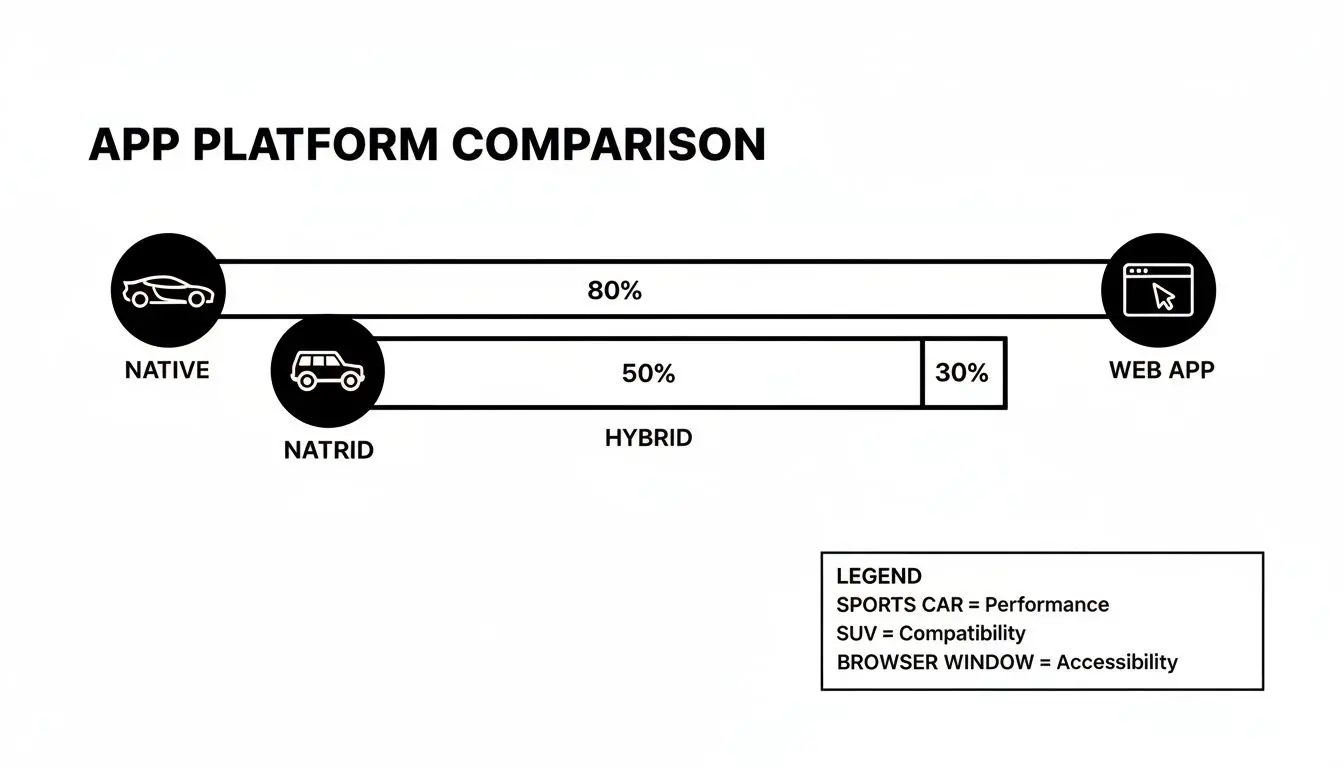
As you can see, native apps usually require a bigger investment to achieve their peak performance, while hybrid and web apps can often get you to market more cost-effectively.
Mapping the Project Timeline from Start to Finish
Just like the costs, timelines can vary wildly. A simple app could be designed, built, and launched in as little as 3-4 months. A more complex project, on the other hand, could easily take 9-18 months, or even longer. That time isn’t just spent on coding; it’s a structured process where every stage is vital. Here's what a typical project journey looks like:
- Discovery & Strategy (2-4 weeks): This is the crucial foundation. We run workshops, dive into market research, and conduct technical feasibility checks to nail down the project's goals, scope, and roadmap.
- UI/UX Design (4-8 weeks): Next, our designers get to work creating wireframes and pixel-perfect mockups. This is where we meticulously plan the app's look, feel, and user flow before a single line of code is even written.
- Development & Engineering (10-24+ weeks): This is the longest phase, where the developers bring the designs to life. They build the frontend (what you see and tap) and the backend (all the clever stuff happening on the server).
- Testing & Quality Assurance (3-6 weeks): We put the app through its paces. Rigorous testing is carried out to squash bugs and ensure everything is stable, secure, and works perfectly on different devices.
- Deployment & Launch: The moment of truth! We submit the finished app to the Apple App Store and Google Play Store for their review before it goes live to the world.
A quick word of advice: Launch day is the starting line, not the finish. A great app needs ongoing care. You should budget for maintenance, updates for new operating systems, and new features based on what your users are telling you. A good rule of thumb is to set aside around 15-20% of the initial development cost for annual maintenance.Getting your head around these financial and time commitments is the first step toward a successful project. For a more detailed breakdown based on your unique idea, have a look at our comprehensive UK app development pricing guide.
The App Production Journey: From Idea to Launch
 Turning a great idea into a slick, successful app isn't magic; it's a structured journey. Forget any images of chaotic coding sessions fuelled by caffeine. The reality is a clear, five-stage process designed to manage risk, ensure quality, and deliver a product that people genuinely want to use. This production pipeline is where the raw concept gets methodically shaped into a tangible, high-performing digital experience. Each stage builds on the last, creating a solid foundation for a strong launch and sustained growth.
 Stage 1: Discovery and Strategy
Before a single line of code is written or a pixel is placed, we define what we're actually trying to achieve. This first phase is a deep dive into your business goals, a proper look at your target audience, and a no-nonsense analysis of the competition. It’s all about asking the tough questions upfront to create a rock-solid vision. The main goal here is to de-risk the entire project. Through proper market research and technical feasibility checks, we make sure the idea isn't just a good one, but that it has a clear path to delivering a return on your investment. Key activities in this stage include:- •Stakeholder Workshops: Getting all the key decision-makers in a room (virtual or otherwise) to align on the project’s core objectives.
- •User Persona Development: Creating detailed profiles of your ideal users. These aren't just make-believe characters; they guide every single feature and design decision down the line.
- •Feature Prioritisation: Defining the scope of the Minimum Viable Product (MVP). We focus on the absolute essential features needed for launch to get to market faster and start learning from real users.
Stage 2: UI and UX Design
With a solid strategy in place, we shift our focus to how the app will look, feel, and function. This is where User Interface (UI) and User Experience (UX) design come into play. Think of UX as the invisible architecture, the logical flow that makes the app feel intuitive. UI is the visible stuff, the colours, fonts, and buttons that make it look great. We start with simple, low-fidelity wireframes, which are basically blueprints for each screen. These then evolve into high-fidelity, interactive prototypes that look and feel almost exactly like the finished product. This lets us get crucial user feedback before the expensive development work even begins.
This design phase is absolutely fundamental to creating something people will love. Just look at the GOV.UK app , they found that personalisation features were a massive hit, with over 80% of users customising their experience. It just goes to show how thoughtful UX directly boosts engagement.
Stage 3: Development and Engineering
This is where the plans and designs are transformed into a working app. Our engineering team gets to work building the two main parts: the frontend and the backend. The frontend is everything the user sees and interacts with. The backend is the engine under the bonnet, handling all the heavy lifting like databases, user logins, and business logic. This is also where our unique expertise in real-time engines really shines. By using powerful tools like Unity and Unreal Engine , technologies you might normally associate with high-end video games , we can build app experiences that are far more interactive and visually stunning. This means we can integrate fluid 3D models, complex data visualisations, or even augmented reality features right into your app, creating something genuinely memorable that stands out in the crowded UK market.
Stage 4: Quality Assurance Testing
Let's be honest: no app is perfect on the first go. That's why the Quality Assurance (QA) phase is so vital. Our dedicated testing team puts the app through its paces on a whole range of devices and operating systems to find and squash any bugs. And this isn't just about spotting crashes. Proper QA testing covers a lot of ground:
- •Functional Testing: Does every button, menu, and feature do what it's supposed to?
- •Performance Testing: Is the app quick and responsive? Does it drain the battery?
- •Security Testing: Is user data locked down and secure?
- •Usability Testing: Can a brand-new user figure out how to use it without a manual?
Stage 5: Deployment and Ongoing Maintenance
Once the app has been thoroughly tested, polished, and signed off, it's time for the big launch. This involves getting all the assets ready, screenshots, descriptions, the lot, and submitting the app to the Apple App Store and Google Play Store for review. But the work doesn't stop there. A successful app needs constant care and attention. We monitor its performance, fix any new bugs that pop up, release updates for new operating systems, and plan future features based on what your users are actually telling you. This continuous cycle of improvement is what keeps an app relevant and successful long after launch day.
How to Choose the Right UK App Development Agency
Picking the right partner for your app development in the UK is probably the single most important decision you'll make in this whole process. Get it right, and the agency becomes a genuine extension of your team, a strategic partner who's as invested in your success as you are. Get it wrong, and that path leads to missed deadlines, blown budgets, and a final product that just doesn't connect with your audience. The goal isn't just to find the cheapest quote. It’s about finding a true partner. This means you need to look past the slick sales pitch and really dig into their technical skills, how they communicate, and most importantly, their history of delivering brilliant, successful apps. You're looking for a team that not only gets your vision but has the chops to actually build it.
Assessing a Potential Agency's Portfolio
First things first: take a deep dive into their portfolio. A strong portfolio is so much more than a gallery of pretty screenshots, it's cold, hard proof of what they can do. As you look through their past projects, keep an eye out for a few key things:
- •Industry Relevance: Have they built apps in your sector before? An agency with fintech experience will already be up to speed on the unique security and compliance headaches, while a team focused on gaming will have a masterful grasp of user engagement and monetisation.
- •Technical Complexity: Check out the features in the apps they've built. Do they show experience with the kind of functionality you need? We're talking e-commerce, real-time data streaming, or even AR integration.
- •User Experience (UX): If you can, download and play with a few of their apps. Are they intuitive? Easy to get around? A polished UI is one thing, but a seamless, friction-free UX is what actually keeps people coming back for more.
Technical Expertise and Process Transparency
Beyond their finished work, you need to understand how they work. A great agency won't hide anything. They'll be totally open about their processes, why they choose certain technologies, and their approach to project management. Don't be shy about asking detailed questions about their tech stack. In your early chats, they should be able to explain, in plain English, why they might recommend a native build over a hybrid one for your specific project. They should also be clear about how they handle quality assurance and security testing. A big part of this process is understanding how to hire mobile app developers, and a good agency will give you complete confidence in their team.
A reliable partner will never hide behind technical jargon. They should be able to break down complex concepts and give you a clear, documented plan for how they'll manage your project from start to finish.
To help you structure your thinking, we've put together a checklist to compare potential partners. #### UK Development Agency Evaluation Checklist Use this table as a scorecard when you're talking to different agencies. It’ll help you compare them on a level playing field and spot the real contenders.
| Evaluation Area | What to Look For | Red Flags to Avoid |
|---|---|---|
| Portfolio & Case Studies | Relevant industry experience, similar project complexity, and apps with excellent user reviews. | A portfolio with only mockups, no live apps, or a focus on industries completely unrelated to yours. |
| Technical Expertise | Clear explanations of their tech stack, a defined development process (e.g., Agile), and in-house specialists. | Vague answers about technology, inability to justify their choices, or heavy reliance on outsourcing key development roles. |
| Communication | Proactive updates, a dedicated point of contact, and a clear communication schedule. They listen more than they talk. | Slow response times, generic automated replies, or constantly being passed between different people during the sales process. |
| Transparency | Detailed proposals with cost breakdowns, clear timelines with milestones, and an open approach to potential challenges. | "Too-good-to-be-true" pricing, refusal to provide a detailed scope of work, or vague promises without a concrete plan. |
| Team & Culture Fit | A collaborative spirit, genuine enthusiasm for your project, and a feeling that they could be an extension of your team. | Arrogance, a "one-size-fits-all" approach, or a clear lack of interest in understanding your business goals beyond the app itself. |
This checklist isn't exhaustive, but it’s a solid starting point. A good agency will score well across the board, making you feel confident and secure in your decision.
Red Flags to Watch Out For
Just as important as knowing what to look for is knowing what to run away from. There are a few tell-tale signs that should make you stop and think twice. Be very cautious of any agency that:
- •Offers an Unbelievably Low Price: If a quote seems way too good to be true, it is. This is often a sign of inexperienced developers, a pile of hidden costs waiting to surprise you, or a complete misunderstanding of what your project actually involves.
- •Is Vague on Details: Your proposal should be specific and thorough. If an agency can't give you a detailed breakdown of timelines, deliverables, and costs, it points to a lack of organisation.
- •Has Poor Communication: Pay very close attention to how they communicate before you've signed anything. If they're slow to reply or unclear now, just imagine what it'll be like when your project is underway.
Finding the right partner takes time and effort, but it pays off massively in the long run. For a more detailed look into this crucial step, you can explore our in-depth guide on how to find and choose the right mobile app development agency.
Getting to Grips with UK Legal & Compliance
Launching an app in the UK is about more than slick code and a killer design. You have to get your head around the legal and compliance side of things, and this isn't just a box-ticking exercise. It's about building a solid foundation of trust with your users and protecting your business right from the start. Getting this stuff right shows you’re serious about doing things ethically, which safeguards both your customers and your brand's reputation. Get it wrong, and you could be looking at hefty fines, a massive loss of user trust, and serious damage to your business.
Data Protection Under GDPR
First up, data protection. The UK General Data Protection Regulation (UK GDPR) is the big one, dictating exactly how you must handle personal data. If your app collects anything from a user, whether it’s an email address or their location, you are legally bound to comply. This means being completely transparent about what data you’re collecting, why you need it, and what you’re going to do with it. Users have to give you their explicit consent, and it’s on you to have robust security in place to protect that data from any breaches.
With GDPR, the mantra is "privacy by design." This isn't something you can tack on at the end. Data protection has to be baked into every single stage of the app development UK process, from the first sketch to the final launch.
If you're building AI into your app, the stakes are even higher. It's essential to follow a comprehensive practical AI GDPR compliance guide to make sure your product meets these strict standards. It’ll help you untangle the extra knots that machine learning adds to data processing.
Making Your App Accessible with WCAG
Your app has to be usable by everyone, and that includes people with disabilities. The Web Content Accessibility Guidelines (WCAG) are the globally recognised standards for this. While it might not be a strict legal must-have for every private app, hitting at least the AA standard is a commercial and ethical no-brainer. Meeting these standards is all about making your app:
- •Perceivable: Can text be resized? Are there text alternatives for images? Is the colour contrast good enough?
- •Operable: Can someone navigate the app using just a keyboard or other assistive tech?
- •Understandable: Is the language clear? Is the navigation predictable and consistent?
- •Robust: Does it play nicely with a wide range of assistive technologies?
An accessible app doesn't just expand your potential market, it sends a powerful message that your brand is for everyone.
Protecting Your Intellectual Property
Finally, you need to protect your brilliant idea. Your app's code, its name, the logo, the design, it's all your intellectual property (IP). Protecting this from day one is absolutely crucial for keeping your edge in the market. Before a single line of code is written, get Non-Disclosure Agreements (NDAs) signed with any agency or freelancer you bring on board. Once the app is built, think about trademarking its name and logo. The code itself is automatically covered by copyright, but having clear agreements in writing leaves no room for doubt about who owns what. Protecting your IP isn't just a defensive play; it’s how you build a seriously valuable business asset.
Your App Development Questions, Answered
Starting a new app project can feel like you're trying to solve a puzzle with a few pieces missing. No matter how solid your plan is, questions always come up. To give you more clarity and confidence, we’ve put together some straightforward answers to the questions we hear most often from UK businesses. This is your practical guide to navigating those common uncertainties and moving forward with your project.
How Long Does It Really Take to Build an App in the UK?
The timeline can stretch or shrink depending on what you’re trying to build. If you're starting with a simple app focused on core features , what we call a Minimum Viable Product (MVP) , you’re likely looking at around 3-4 months from the first sketch to launch day. For something more involved, say an app with user accounts, custom designs, and connections to other software (APIs), it's safer to budget for 5-9 months. This gives us the time to build and refine those extra layers of functionality. For ambitious projects with features like AI, real-time data streaming, or a complex backend system, the development journey can easily take 12 months or more. That extended timeframe is crucial for making sure every detail is built, rigorously tested, and polished to perfection.
What Is the Single Biggest Factor That Affects App Cost?
Hands down, the biggest driver of your budget is the scope of features. It’s a simple equation: the more features you want, and the more complex they are, the more hours and specialist skills it takes from our designers, developers, and testers. For instance, building a secure payment system or an AI-powered recommendation engine is a completely different ball game compared to creating a few simple information screens. The first requires deep expertise and thousands of lines of code; the second is far more straightforward.
The smartest way to manage your initial investment is to lock in a tightly defined Minimum Viable Product (MVP). Get to market with just the essential features. This lets you launch faster, see what real users actually do, and then make informed decisions about what to build next.
Do I Need Separate Apps for iPhone and Android?
Not necessarily. While building separate "native" apps for iOS and Android gives you the absolute best performance and access to every device feature, it's not the only way to go. In fact, cross-platform development has become a brilliant and popular choice for many businesses here in the UK. Our developers can write one set of code that works beautifully on both platforms. For most types of apps, this approach can seriously cut down the initial development time and cost for your app development UK project, without any major trade-offs in the user experience.
What Happens After My App Is Launched?
Launch day is a huge milestone, but it's really the starting line, not the finish line. To make sure your app has a long and successful life, ongoing support and maintenance are absolutely vital. This is what that typically looks like:
- •Bug Fixes: Quickly squashing any little issues that crop up once the app is in the wild.
- •OS Updates: Making sure your app runs smoothly on the latest versions of iOS and Android.
- •Security Patches: Protecting your app and your users' data from any new threats.
- •Feature Enhancements: Adding new value based on what your users are asking for and where your business is headed.
Most good agencies, including us, offer support retainers to handle all of this for you. It's the best way to ensure your app stays healthy, secure, and continues to deliver for your business. Ready to stop wondering and start building? Studio Liddell has been crafting top-tier digital experiences since 2019. Let's have a chat about your vision and create something truly exceptional together. Book a production scoping call