TV Ad Production Cost Explained with UK Budget Ranges
An animated TV spot in the UK can cost around £40,000 to £60,000, while a big-budget shoot can reach £450,000 or more. Airtime is a separate cost centre, with peak-time ITV airtime for a 30-second spot reaching about £35,000. You may be sitting on a strong script, a clear product message, and an audience your marketing team wants to reach. Then a production quote arrives, and the figure feels disconnected from the thirty seconds that will appear on screen. That reaction is common among first-time TV advertisers because the visible asset is short, but the work behind it can include creative development, casting, locations, animation, editing, music rights, compliance, mastering, and multiple versions. The useful question isn't, “How much does a TV advert cost?” It's, “What does this campaign need to achieve, and which costs create that value?” A carefully planned animated spot, a controlled live-action shoot, and a premium national campaign can all be valid choices. They're different production systems, not competing prices for the same product.
Introduction Why TV Ad Budgets Confuse First Time Buyers
A marketing manager commissioning a first TV advert often starts with one number in mind, the production budget. That number may cover the script, filming, editing, and final file, but it may not include media buying or technical delivery. Confusing those budgets is the fastest way to make a realistic quote look incomplete. UK guidance places straightforward animated commercials at around £40,000, while other estimates put animated commercials at about £60,000. At the other end, major national campaigns can reach £320,000 or more, and big-budget shoots can exceed £450,000 when the creative requires substantial filming, talent, music, and production scale. These ranges come from UK TV advertising cost guidance, and they describe production, not the cost of buying every desired slot. A peak-time ITV placement can separately reach about £35,000 for thirty seconds, according to the same guidance. That distinction matters. A production company makes the advert, while a media agency or broadcaster sells the opportunity to put it in front of a particular audience at a particular time.
The practical mindset: treat the advert as a product you build, the airtime as the distribution you buy, and delivery as the approval and packaging needed to make the asset usable.
A lean animated concept might use designed environments, a small cast of characters, and a modular visual system. A live-action concept may need several locations, a larger crew, wardrobe, props, sound recording, and visual effects. Neither is automatically the better investment. The right choice depends on the message, the brand, the audience, the number of versions required, and how long the assets need to work across TV, BVOD, CTV, social, and other channels.
What TV Ad Production Cost Covers
A first-time advertiser can receive three different figures for one campaign. Production builds the advert. Media buying pays for access to a chosen audience. Technical delivery and compliance are the inspections and certificates that make the finished asset legal to broadcast. The production budget may include:
- •Creative development: Concept development, scripting, treatments, storyboards, and approvals.
- •Pre-production: Casting, location planning, scheduling, art direction, previz, and logistics.
- •Production: Directors, artists, animators, crew, cameras, lighting, sound, sets, props, and software.
- •Post-production: Editing, compositing, colour, sound design, music, voiceover, graphics, visual effects, and mastering.
- •Versioning: Alternative durations, aspect ratios, captions, language versions, BVOD edits, CTV files, and social cut-downs.
A reusable animation or XR environment can shift spending from a single shoot into assets that support later versions and channels. That choice changes the campaign's total value, not just the price of one production day. A live-action advert may require more physical coordination, while a designed system may make future adaptations easier to produce. The media budget covers airtime, audience targeting, campaign scheduling, geography, reach, and frequency. UK television remains a major advertising category, with TV advertising spend reported at £5,271.4 million in 2024, up 3.8% year on year, in data from the Advertising Association and WARC. That scale helps explain why campaigns are planned around national reach, broadcast compliance, and several deliverables rather than one isolated edit. Delivery and compliance form the third budget. They may include Clearcast submission, technical checks, corrections, AS-11 DPP broadcast masters, distribution, and platform-specific exports. Organisations building a wider communications plan can also use guidance on religious nonprofit marketing to connect media activity with audience, message, and channel decisions.
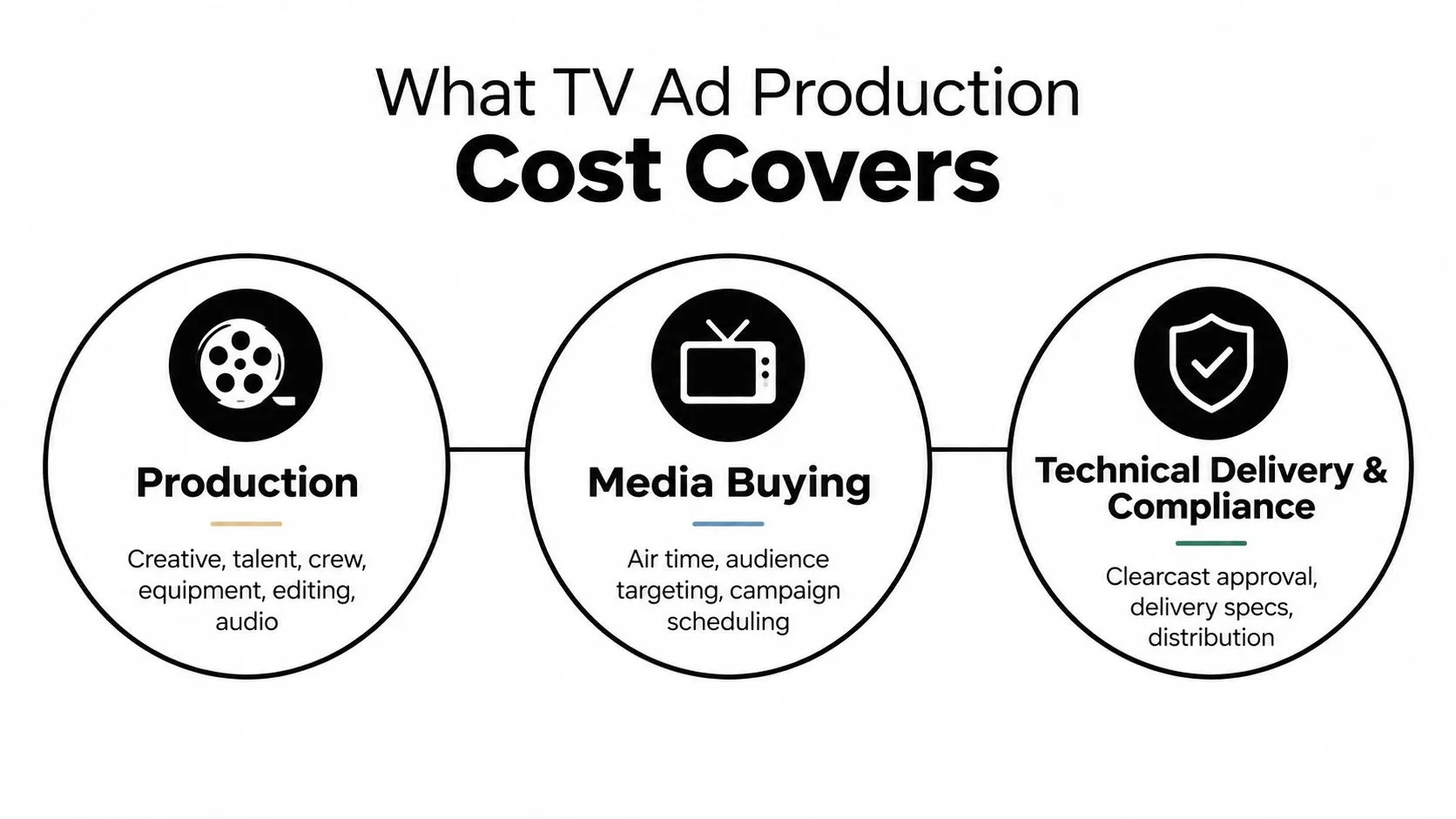
A production-only quote is clear when its boundaries are stated. Before comparing proposals, check whether both suppliers include the same development work, revision rounds, usage rights, deliverables, compliance support, and final masters. The TV commercial production guide offers useful context for assessing how production and delivery fit together.
Key Drivers That Push Your TV Ad Budget Up or Down
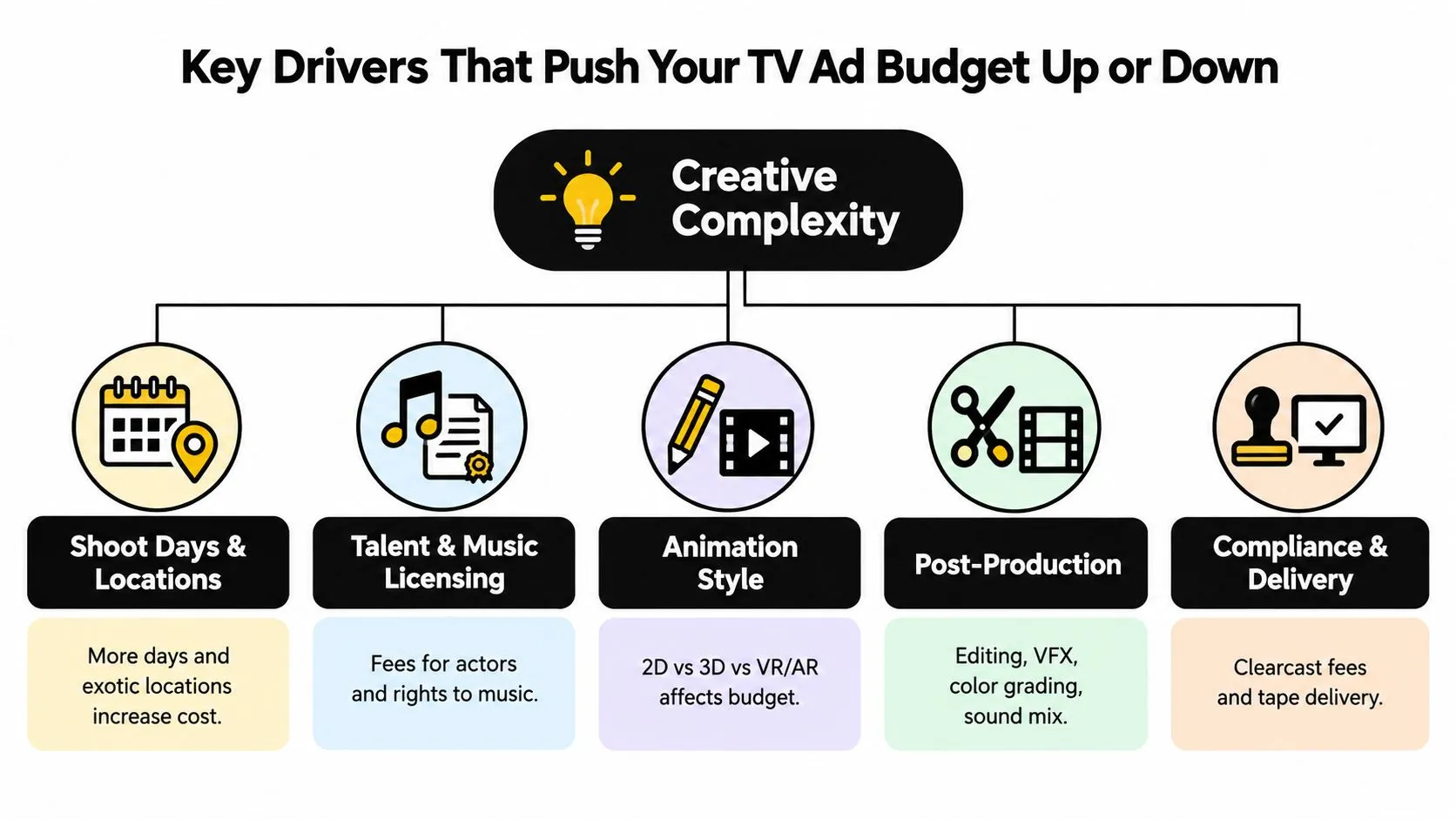
The central cost driver is creative complexity. A simple product demonstration and a story involving several characters, environments, effects, and transitions may both occupy thirty seconds, but they don't require the same production system.
Creative and production choices
Locations and shoot days can quickly alter a live-action quote. One controlled location is easier to schedule than several spaces requiring travel, permissions, resets, and separate lighting plans. A virtual set or designed animated environment may reduce physical logistics, but it can move more work into modelling, look development, lighting, rendering, and compositing. Talent and music rights need early attention. On-screen performers, voice artists, presenters, licensed tracks, original composition, and usage terms all affect the final scope. A concept built around a recognisable song may sound simple in the script, yet rights clearance can become a major commercial consideration. Animation style changes the labour profile. 2D motion graphics may suit a diagram-led explainer, while 3D animation can give a product, character, or environment greater depth and camera flexibility. Character rigging, facial performance, creature movement, cloth, hair, and realistic lighting require specialist work. AI-assisted production can accelerate selected tasks, but it doesn't remove the need for creative direction, consistency checks, rights review, or broadcast finishing.
Post-production and versions
Post-production often determines whether a spot feels polished. Editing, colour grading, visual effects, motion graphics, sound mixing, captions, and music all contribute to the finished impression. A low quote may look attractive until you discover that only one revision round, a basic audio treatment, or one final file is included. Versioning creates another cost decision. If the campaign needs a hero spot, shorter edits, vertical social assets, BVOD files, and CTV variants, the studio should know before production begins. The team can then frame shots, capture clean plates, design adaptable compositions, and organise the project for efficient reuse. You can also review examples of high-end commercial content when judging how visual ambition translates into production requirements.
Budget Ranges for Low Mid and High Production Values
A £30,000 shoot and a £30,000 campaign do not mean the same thing. The first may describe production alone, while the second may also need to cover media placement, broadcast delivery, clearances, versions, and future assets. Budget bands become useful when they explain the finished outcome, not just the day rate. UK guidance commonly places standard 20 to 30 second spots at £30,000 to £120,000, mid-range brand films at £80,000 to £250,000, and premium sponsorship-style TV work at £150,000 to £500,000 or more, as outlined by UK video production cost guidance.
| Production Level | What You Get | Indicative UK Production Range |
|---|---|---|
| Lean or lower-end | Focused concept, controlled production, straightforward animation or a compact shoot, limited versions | Around £20,000 to £30,000 for some broadcast-ready micro-to-TV workflows, with straightforward animation estimates around £40,000 in other UK guidance (source) |
| Mid-range | More developed art direction, stronger post-production, broader crew or animation pipeline, and planned campaign deliverables | £80,000 to £250,000 for mid-range brand films |
| High-end | Larger-scale filming, premium animation or VFX, substantial talent and music requirements, multiple deliverables, and national campaign ambition | £150,000 to £500,000 or more for premium sponsorship-style work |
Some UK providers position entry-level packages below the lower band. Test that saving against revisions, Clearcast submission, AS-11 DPP delivery, versioning, and multi-channel files before comparing quotes. Production is only one part of the campaign. Media spend is separate, and delivery requirements can add work even when the finished commercial is short. For context, UK TV spend was reported at £5,271.4 million in 2024, up 3.8% year on year, while the most recent quarterly update reported £5,216.1 million, down 1.2%. The different periods explain why both figures can appear in market discussions. The wider lesson is practical: efficiency matters, but a cheaper shoot is not automatically a cheaper campaign. Further cost guidance is available from UK TV commercial production cost guidance. Compare cost per usable asset, not only cost per shoot day. A modular animation or XR system may require more work at the start, yet provide reusable characters, environments, product views, and graphic components for later edits. A one-off live-action spectacle may cost more initially, but it can be the right choice when performance, scale, or a distinctive physical moment carries the idea. Ask which assets remain useful after the first transmission, because that answer can change the campaign's total value.
Inside a Sample 30 Second TV Ad Budget
A sample budget should be read as a map, not a quote. Without a defined brief, no responsible producer can assign exact amounts to pre-production, crew, animation, rights, or post-production. The point is to see how the cost accumulates and which questions prevent surprises.
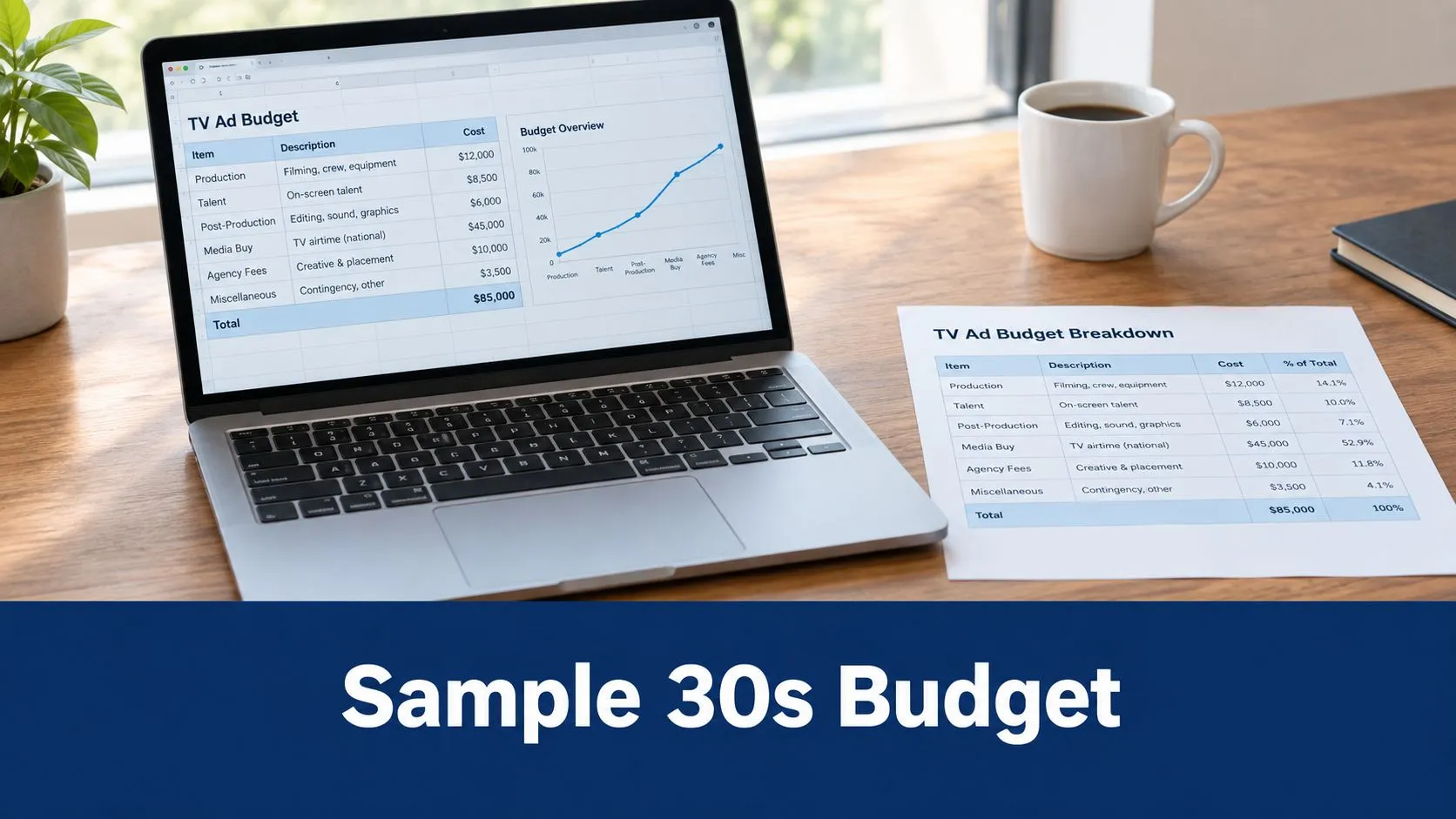
Start with the brief and treatment. The studio needs to understand the audience, product claim, tone, duration, channels, mandatory copy, brand assets, approval chain, and intended deliverables. That information shapes the storyboard, previz, shot list, asset list, casting plan, and technical route. Production then covers the people and tools needed to create the material. In live action, that may mean director, producer, camera, lighting, sound, art department, wardrobe, locations, and talent. In animation, it may mean modelling, design, rigging, layout, animation, lighting, rendering, compositing, and editorial. A mixed approach can distribute effort between filmed plates, designed graphics, virtual environments, and 3D elements. Post-production includes edit, picture finishing, sound, music, voiceover, captions, visual effects, and agreed revisions. Ask whether the quote includes a consolidated feedback process, because scattered comments from several stakeholders can create avoidable rework. Ask whether the studio is preparing one master or a complete delivery package. For UK broadcast delivery, the AS-11 UK DPP specification is commonly used for completed programme deliveries or “air-ready masters”. The Digital Production Partnership describes it as based on MXF OP1A, with AVC Intra Class 100 for HD and IMX at 50 Mb/s for SD, as detailed in the DPP technical specification. A fair quote should make exclusions visible. Check music and talent usage, Clearcast support, captions, additional versions, archive handover, source files, rush work, and technical corrections. Two proposals can have similar totals while offering very different usable outputs.
Smart Ways to Reduce TV Ad Production Cost Without Losing Quality
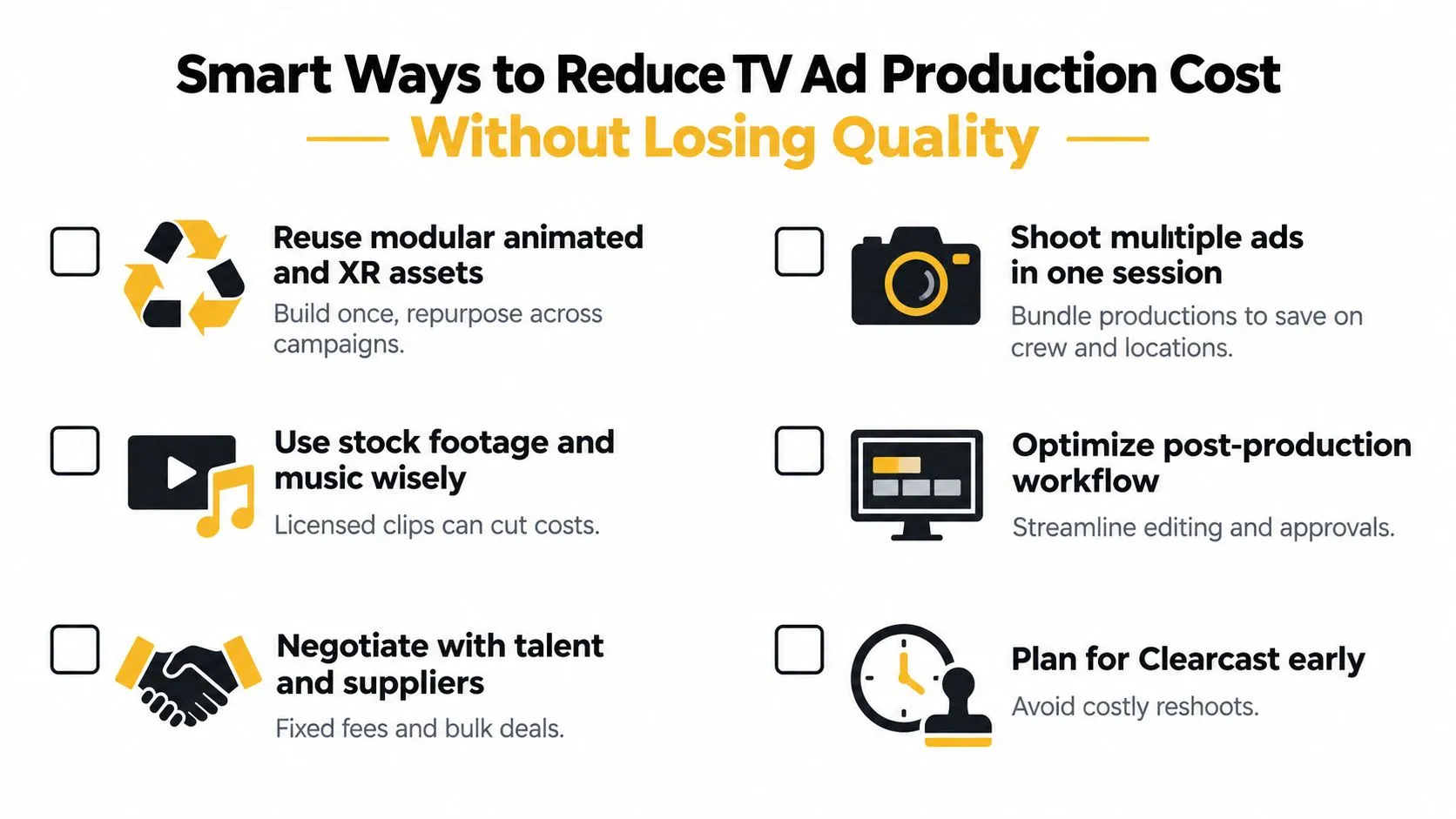
Cost control starts before the first frame is made. The safest savings usually come from reducing duplicated work, clarifying approvals, and designing the asset system around every channel that matters.
Make one production serve more purposes
Build reusable elements when the campaign has a life beyond one transmission. A 3D product model, character rig, virtual environment, title treatment, or lighting setup can support a broadcast master as well as BVOD, CTV, social, event, and sales assets. The initial planning needs to account for framing, safe areas, clean backgrounds, alternate copy, captions, and different aspect ratios. Bundle related work into one organised production. A single shoot or animation pipeline can create a hero edit and planned cut-downs without forcing the team to rebuild the visual language later. That doesn't mean making every version at once. It means collecting the right material and structuring the project so later edits remain efficient. Other practical controls include:
- •Simplify the brief: One clear proposition is usually cheaper to execute than several competing messages.
- •Use previz: Storyboards, animatics, and virtual camera planning expose problems before filming or final animation.
- •Limit location changes: Group scenes by space and design the schedule around fewer moves.
- •Plan rights early: Confirm talent, music, stock, and voice usage before the edit is locked.
- •Consolidate feedback: One organised approval round is easier to manage than contradictory comments arriving separately.
- •Check delivery requirements early: Technical fixes after final approval can affect both schedule and budget.
A lower upfront quote can become poor value if it omits versioning, revision time, audio finishing, or delivery support. Ask what the production team can reuse, what the project file contains, and which future adaptations would require rebuilding the work. The guide to reducing animation and XR production costs offers a useful way to think about efficiency as pipeline design rather than simple subtraction from the shoot budget. For UHD delivery, requirements become more specific. AS-11 X1 uses MXF OP1a and AVC/H.264 video, while ITV's 2025 delivery specification adds embedded XML metadata and a segmentation track identifying the in-point and out-point of each programme segment, as reported by Broadcast. Confirming the required master early helps the team capture and finish the work correctly the first time.
How Studios Like Studio Liddell Scope and Price TV Ad Projects
A responsible studio doesn't price a TV advert from its duration alone. It prices the creative route needed to deliver the message, the assets required to support the campaign, and the technical path to approved masters. The first conversation should establish:
- •The business objective: What should the audience understand, remember, or do?
- •The creative territory: Is the idea live action, 2D, 3D, mixed media, real-time, or XR-led?
- •The audience and placements: Which broadcast, BVOD, CTV, social, event, or internal channels matter?
- •The asset plan: Which master versions, cut-downs, captions, language adaptations, and stills are needed?
- •The approval route: Who signs off the script, storyboard, edit, sound, claims, and final delivery?
- •The technical requirement: Is HD sufficient, or does the campaign need UHD and AS-11 X1 preparation?
A strong treatment translates the script into a production plan. It shows how the team will move from brief to previz, from previz to animation or filming, and from lighting and rendering to compositing, edit, sound, and delivery. It should also show where the budget is concentrated, so you can choose deliberately between a simpler environment, a richer character performance, additional versions, or more elaborate post-production. Reusable assets can change the value equation. A studio with animation, games, and XR experience may be able to design assets that work across a TV commercial, interactive experience, product demonstration, or future campaign adaptation. That doesn't make every modular approach cheaper at the start, but it can make the total system more useful than a one-off film. For a practical commissioning checklist, consult this buyer's guide to choosing an animation studio. Ask each supplier to state inclusions, exclusions, revision limits, usage rights, delivery responsibilities, source-file access, and assumptions about approvals. Compare the production system and expected outputs, not just the headline fee. Studio Liddell is one option for brands seeking animation, TV advertising, games, XR, and AI-enhanced production workflows within a connected creative pipeline. The useful next step is a scoping discussion based on your script, audience, delivery channels, target dates, and available budget. --- If you're planning a UK TV advert, visit Studio Liddell to discuss a production route covering concept, previz, animation or filming, post-production, versioning, and broadcast delivery. Share your script and intended channels so the team can help you compare a one-off spot with a reusable campaign asset system.