TV Commercial Production: The Guide
The brief lands, the client wants a broadcast spot, and the first pressure point is already obvious. You're not making one video, you're making a package that has to survive creative approval, broadcast compliance, versioning, and the realities of a multi-platform campaign. That's why tv commercial production is a pipeline job, not a single shoot day. The smart way to think about it is simple, even if the work isn't. A TV commercial starts as a message, becomes a plan, turns into footage or animation, then gets finished for linear, VOD, social, and sometimes DOOH. If any one of those handovers is vague, the budget drifts and the schedule slips. A useful way to start is with the output, not the glamour shot. If you need a broadcast master, a social cutdown, and a version that can live on multiple channels, you need a process that plans those deliverables from day one. A practical planning aid like the video asset generation tool can help teams think in assets rather than one-off files, which is the right mental model for this kind of work.
What TV Commercial Production Really Involves
A new brief usually arrives with a business goal, a rough budget, and a hope that the concept will sort itself out later. That's where trouble starts. Commercial production works best when you treat it as a chain of decisions, because every choice, from format to location to post scope, affects what can safely reach broadcast and what can be reused afterwards. In the UK, the scale of the market shows why this is a specialised process rather than a side task. Advertising production spend reached £1.5 billion in 2024 in the UK, which is a strong signal that commercial production sits inside a mature, highly segmented ecosystem of agencies, production houses, and post specialists, not a casual one-off service commercial production industry statistics. That scale helps explain why a single campaign often involves separate creative, shoot, edit, sound, and compliance passes.
Practical rule: if the brief doesn't already mention where the finished piece has to live, the production team has to ask before anyone writes a script.
A good producer starts by mapping the job into three linked questions. What story needs to land, what format the story has to survive, and what deliverables the campaign needs beyond the hero spot. That last point matters more than most glossy guides admit, because a commercial rarely stops at one master file. It becomes a system of versions, and the system has to be designed early. For teams exploring how to build that system, a modular workflow is often easier to manage than a purely cinematic one. That's also where broadcast-friendly production partners and asset-generation tools fit naturally, because they force the team to define outputs before the expensive work begins.
The Five Stages of a TV Commercial
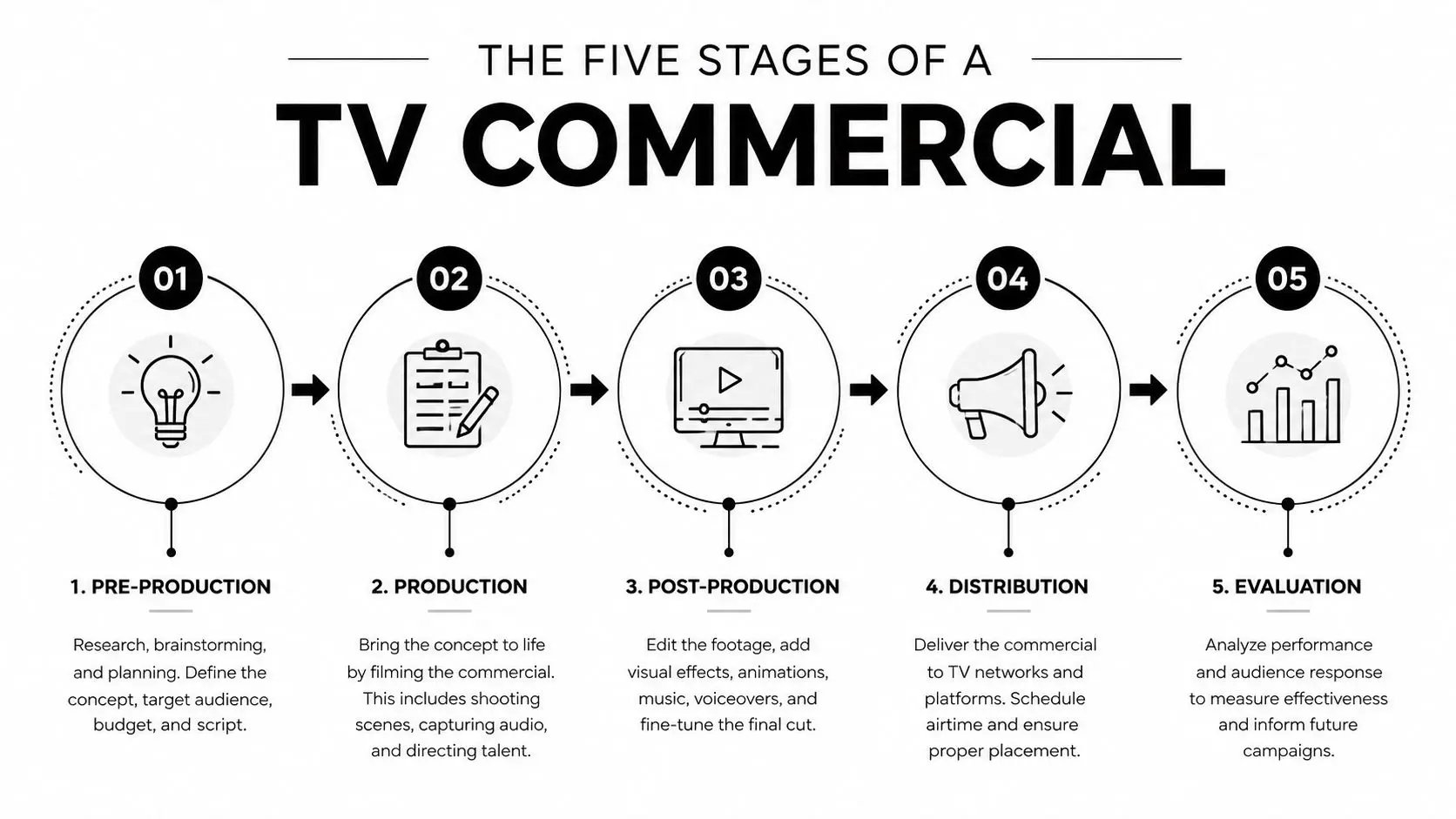
Development begins with the idea, but the output is the treatment, the script, and the approvals that prove the message is viable. A client signs off here on tone, claims, casting direction, and the campaign's creative logic. If the agency and brand can't agree at this stage, the rest of the job is already at risk. Pre-production turns the idea into a shootable plan. Call sheets, schedules, location choices, casting decisions, props, wardrobe, and a shot list all become concrete, and each one locks in a cost. This is also where a producer protects the schedule by spotting conflicts early, because a late location change or a missing clearance can consume more time than people expect. Production is the day, or days, when the camera rolls or the animation pipeline advances. The output here is not just footage, it's controlled selects, clean sound, usable performances, and enough coverage to support the intended edit. A shoot that looks good on set can still fail if the takes aren't consistent enough for the cut. Post-production is where the commercial becomes broadcast-ready. The edit is shaped, colour is corrected, graphics are added, and audio is finished, often with a disciplined workflow so the producer knows what can still change and what has to stay locked. A useful technical reference for sound teams is the Vocuno mixing workflow, especially when a campaign needs clean dialogue, music balance, and a finished mix that won't unravel late in the process. Delivery is the handover that many buyers underestimate. The broadcast master, the file versions, the subtitles, and the exact duration all need to match what the platform will accept. If delivery is treated as an afterthought, the final days become a repair job instead of a sign-off stage.
Who Is Actually in the Production Team
The people around a TV commercial are there for different kinds of accountability, and that's the useful way to read the crew list. Some roles own the idea, some own the schedule, some own the image, and some own the final technical handover. If you know which question each role answers, you can tell whether a partner is full-service or just assembling freelancers.
Creative control and scheduling control
The executive producer usually owns the relationship, the budget shape, and the level of risk the project can absorb. The creative director protects the idea and the tone, while the director turns that idea into performances and camera language. On larger commercials, the line producer becomes the person who keeps the day realistic, because they balance the shoot plan against time, crew, and location constraints. The director of photography owns how the image is captured, including lensing, lighting, and the overall visual language. The art department handles the physical world inside the frame, props, set dressing, wardrobe, and the details that make the spot feel finished rather than improvised. When budgets are tighter, some of these functions can be combined, but only if the partner has the experience to keep quality consistent.
Technical finish and post handover
The sound engineer matters more than many brands expect, especially when dialogue, music, and effects all have to sit cleanly under time pressure. The post supervisor is the person who makes sure the edit, sound, graphics, and delivery specs converge. That role becomes critical when multiple versions need to be approved at once, because one missed version note can create avoidable rework.
Ask who is actually doing the post supervision, not just who is named on the pitch deck. The answer changes how safely the commercial lands.
A smaller job may fold multiple responsibilities into a lean team, which can work well if the scope is simple and the partner's pipeline is disciplined. Bigger jobs need clearer separation, especially when there are talent approvals, VFX, or platform-specific deliverables. That's the difference between a team that looks complete on paper and one that can carry the work through to delivery.
Live Action, 3D, 2D and XR Compared
Format choice should follow the job, not the trend cycle. A product demonstration, a brand film, a fast explainer, and an event-led campaign each reward a different production path, and the wrong choice usually shows up later as scope creep, compliance friction, or revision rounds that eat the schedule. The teams that stay in control talk about flexibility, approvals, and versioning before they talk about style frames.
Where each format fits
Live action works well when human presence, real environments, and authentic product use matter. It carries real credibility for brand work, but it also brings location constraints, cast logistics, and more variables into the shoot day. If the campaign needs real faces and believable settings, live action usually gives the cleanest result. It also asks for stronger pre-production discipline, because reshoots are expensive once people, places, and weather are involved. 3D CGI suits work that needs precise product control, stylised worlds, or reusable assets for multiple cutdowns. The pipeline is less improvisational than live action, and for character or creature work it usually moves through rigging, blocking, facial performance, lighting, compositing, and quality control before broadcast delivery. That makes it attractive when the same core scene has to feed linear, VOD, and social versions without rebuilding the whole spot. It also creates more up-front planning, because model approval and look development can lock choices early. 2D animation fits clearer, flatter communication when the concept depends on graphic simplicity, speed, or a lower-friction visual language. It can be easier to revise than a live-action or heavy CGI campaign, especially when the message changes late or the cutdowns need to stay consistent across formats. XR earns its place when the campaign has to feel immersive, spatial, or demonstrable in an event, app, or exhibit setting. It is most useful when the experience itself carries the message, rather than just the finished film.
| Format choice for TV commercial production | Best for | Typical lead time | Cost per cut-down |
|---|---|---|---|
| Live action | Brand stories, testimonials, product use | Moderate to longer, depending on locations and cast | Higher if each version needs new edits |
| 3D CGI | Product reveal, stylised worlds, repeatable assets | Longer when rigging and lighting are complex | Often better when many versions reuse the same scene |
| 2D animation | Explainers, graphic-led ads, fast turnarounds | Usually shorter than full 3D | Can be efficient when the visual system is modular |
| XR | Events, immersive demos, experiential campaigns | Variable, depending on platform and interaction design | Depends heavily on deployment format |
A practical decision rule helps. If the campaign needs fast iteration and many versions, 2D or modular 3D can make more sense than a heavy live-action setup. If the story depends on real people and real-world credibility, live action is still the cleanest route. If the campaign has to live across a booth, headset, and digital touchpoint, XR can be worth the investment because the experience becomes part of the sale. The cost-control question sits underneath all of that, because the format should support the number of deliverables the campaign needs. For teams deciding between 2D animation and 3D CGI, the studio breakdown at 2D vs 3D animation is useful when the commercial has to balance polish against versioning cost.
Budget and Timeline Ranges in the UK
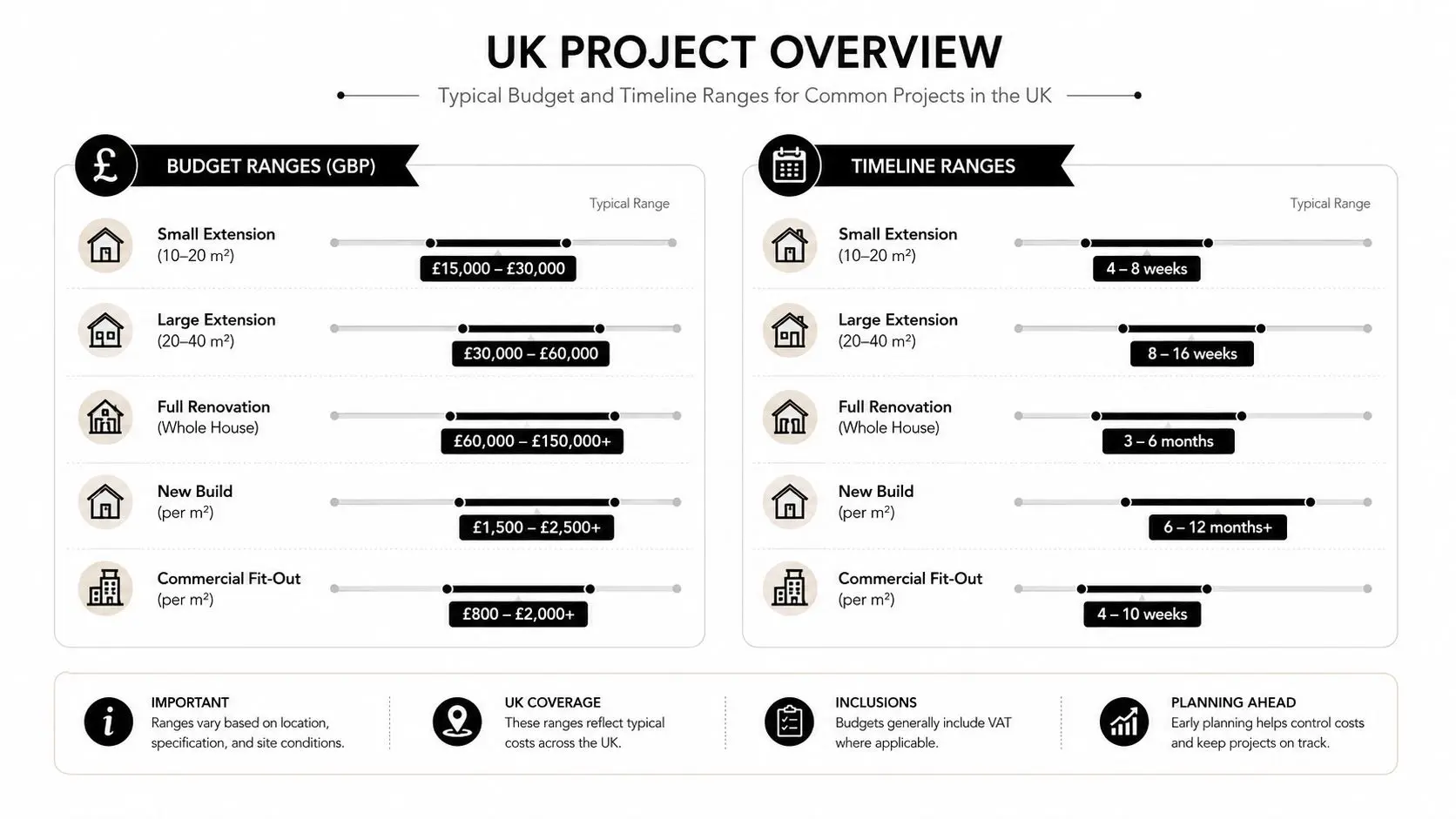
A bid should read like a map of decisions, not like a mystery number. The biggest budget drivers are format, talent, locations, shooting ratio, VFX scope, how many cut-downs are needed, and how many platforms the work has to serve. That's true whether the job is a straightforward brand spot or a more complex campaign that needs multiple deliverables from one shoot. The UK market context matters here. Record advertising spend in 2024 hit £42.6 billion, according to the Advertising Association and WARC, but TV's role keeps shifting as budget moves into addressable and online video channels record advertising spend in 2024. That change pushes buyers to ask a sharper question, how do we keep production value high while controlling the number of variants we need?
What pushes the number up
A polished broadcast spot will usually sit above a stripped-back digital-first shoot because the finishing expectations are higher. Broadcast delivery asks for more precise format control, more careful audio finishing, and more disciplined QC. If the commercial also needs several cutdowns, aspect-ratio versions, subtitles, and legal variants, the post schedule expands even when the shoot itself stays compact. Animation and virtual production can help when one campaign has to yield many assets. That doesn't automatically make the job cheap, but it can make the cost per version more manageable because the base work is reused. For brands with many placements, that matters more than chasing the lowest headline bid.
How to read a quote
If a quote is unusually low, look for the missing pieces. Revision rounds, music, usage rights, extra versions, and compliance checks are common omissions. If a quote is unusually high, ask which part of the scope is driving it, because the answer is usually one of three things, complexity, delivery volume, or schedule pressure. A useful rule is to compare bids by deliverables, not by total. One proposal may include the hero spot, vertical cutdowns, and broadcast QC, while another assumes a single file and no versioning. Those are not the same job.
Briefing and Selecting a Production Partner
A strong brief doesn't need poetry, it needs enough detail to let the production team price risk properly. Start with the goal, the audience, the required lengths, the platforms, the mandatory claims, and the deadline. If the partner can't tell you what they need after that, the project hasn't been framed clearly enough.
What to ask for in the pitch
Ask for a treatment, a bid grid, a schedule, and a QC plan. Those four artefacts tell you far more than a polished mood board because they show how the team thinks. A treatment reveals creative judgement, the bid grid shows cost discipline, the schedule shows realism, and the QC plan shows whether the partner understands broadcast handover.
Practical rule: a partner who cannot show you how they manage approvals usually cannot protect your timeline.
Full-service production partners fit campaigns that need one team to handle creative, shoot, post, and delivery. Specialist animation or XR studios make more sense when the visual problem is technical, stylised, or built around a non-live-action world. The right choice depends on the brief, not on prestige. A useful buyer's guide on how to choose an animation studio, budgets, timelines and red flags can also sharpen what to look for in a partner's process. Even if you're buying a TV commercial rather than a pure animation job, the same due-diligence logic applies, ask who does the work, how approvals move, and what happens when the scope changes. If you're speaking to a studio, ask one simple question, “What would you change in the brief to make this easier to deliver?” A good answer will usually expose whether the team understands your production pressure or just wants to sell you a look.
Planning for Linear, VOD, Social and DOOH Delivery
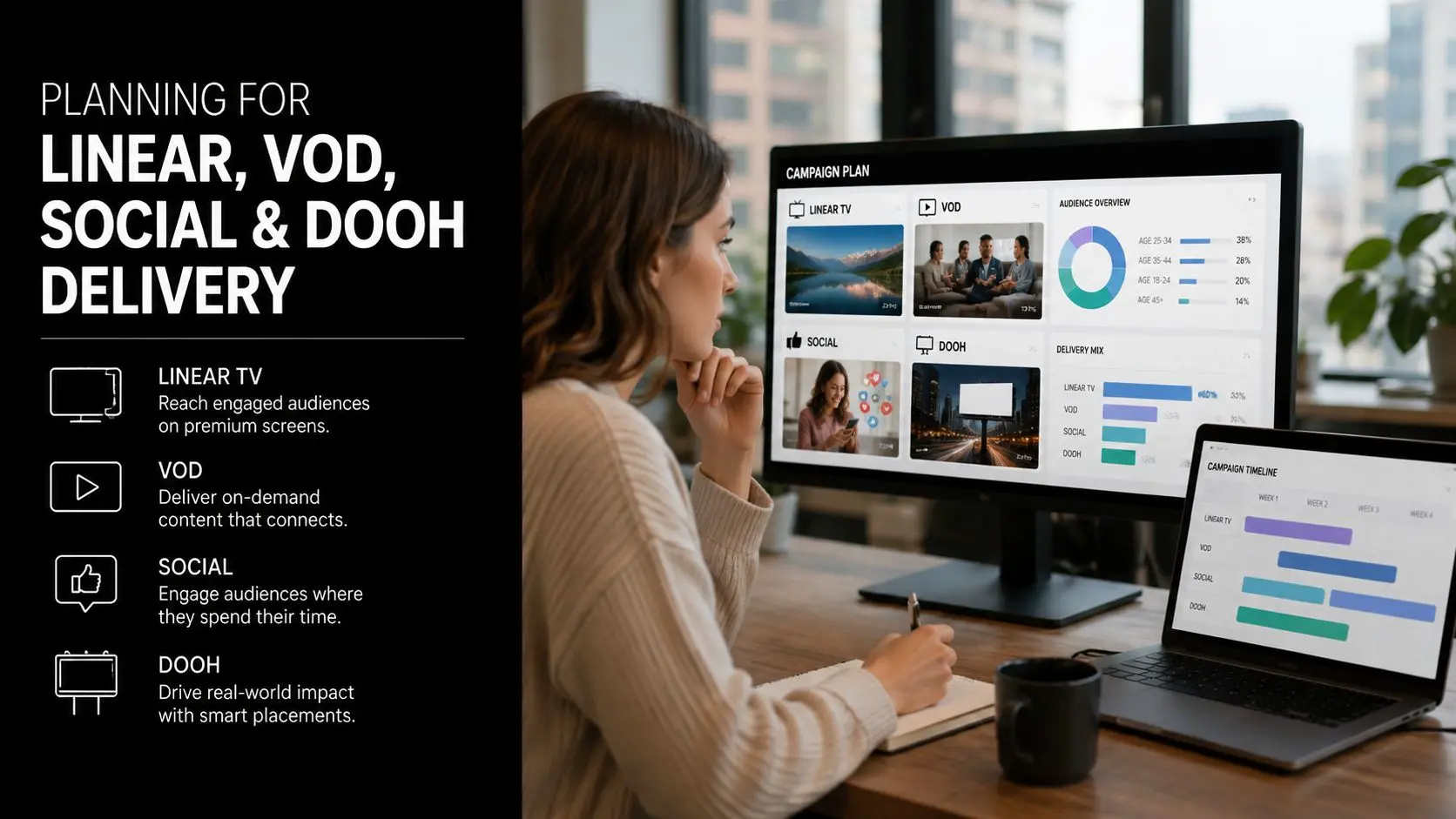
A TV commercial is rarely just a TV commercial anymore. It has to work as a broadcast spot, a broadcaster VOD asset, a social cutdown, and sometimes a DOOH or streaming version. That means the script, framing, and edit structure need to support multiple outputs from the start, not after the hero spot is already locked.
Versioning belongs in the script stage
Aspect-ratio planning matters early. A 16:9 broadcast master doesn't automatically become a clean 9:16 social version, and a 1:1 retail asset may need different framing again. If the script relies on small on-screen text or action pushed into the corners, the versioning burden rises fast. Subtitles, audio description, and regional or legal variants also need to be planned rather than improvised. That's where the production team saves money, because the edit architecture can be built around versioning instead of being forced to retrofit it later. For a broader overview of cross-channel planning, the video content production UK business guide is a useful reference point.
Compliance and finish
UK delivery is still governed by exacting rules. ITV's HD commercial delivery requirements specify a 1920×1080 master in 16:9 at 25 frames per second, interlaced, with 4:2:2 chroma subsampling ITV HD Commercial and Sponsorship Delivery Requirements. In practical terms, that means the commercial has to be conformed to 1080i/25 rather than progressive formats if it's going to pass ingest cleanly. Audio also needs discipline. Broadcast workflows aligned with European engineering logic commonly finish to -24 LKFS +/-1 LU with 48 kHz/24-bit PCM audio, and that level of control helps avoid rejection or playback issues at the platform stage technical specifications television. If the duration is off by even a small amount, automation can fail, so exact frame accuracy matters. For shared office review sessions, teams often use wireless screen sharing for offices so the producer, client, and editor can look at the same version without fighting cables and adapters. That sounds mundane, but it speeds approval meetings more than many expect.
Common Pitfalls and How to Avoid Them
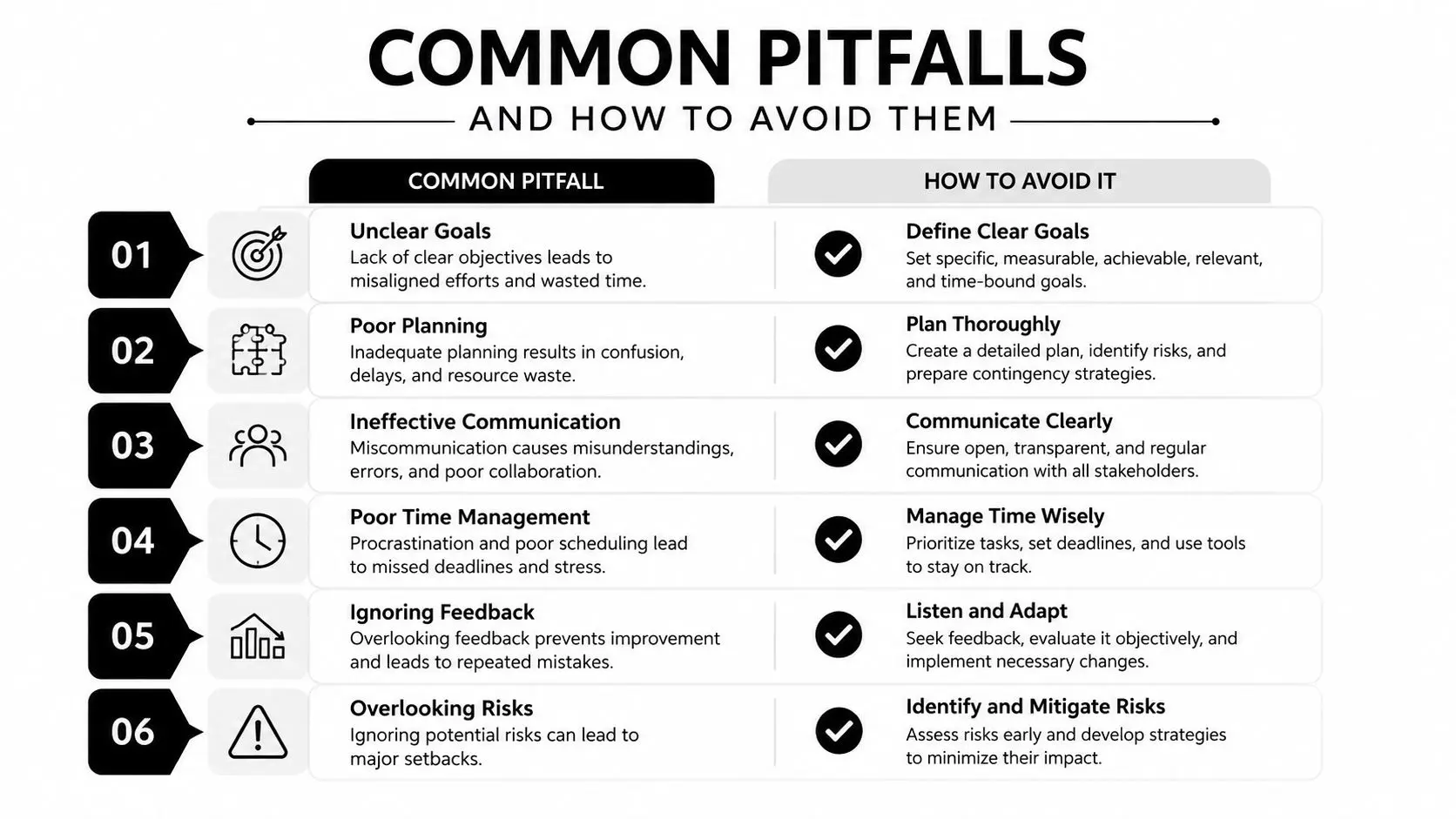
The most expensive mistakes in TV commercial production are usually process mistakes. Teams treat creative, compliance, versioning, and delivery as separate tracks, then act surprised when the final handover takes longer than planned. The fix is to connect those decisions earlier, especially when the campaign has to work in more than one format.
The recurring failure points
Treating compliance as a late-stage check creates avoidable re-edits. Script approval, claims review, and platform restrictions should be visible before the shoot. Under-budgeting versioning is another common trap. If the plan needs social cutdowns, broadcaster VOD, or regional variants, those versions need time and editorial attention. Locking the script too early also causes trouble. The script should reflect the practical realities of framing, aspect ratios, and deliverables, not just the first creative idea that won the room. Choosing the format late is equally costly. A concept that would have worked elegantly in 2D can become expensive if the team only realises the asset system needs many versions after the shoot is booked. Ignoring broadcast QC is a finish-level problem that becomes a delivery problem. A spot can look right in review and still fail once sound, duration, and file specs are checked. Separating creative from distribution leads to a single beautiful master that's hard to use anywhere else. Campaign thinking should start with the output map, not end with it. Studio Liddell is one option for teams that need a production partner across animation, TV ads, and XR, with work spanning kids' IP like BooSnoo, mixed-reality events like Dance! Dance! Dance!, and technical explanation work like GeoEnergy NI. The common thread across those examples is controlled delivery under different creative constraints, which is exactly what makes a commercial pipeline manageable when the scope gets complicated. --- If you're planning a TV commercial and want the creative, versioning, and delivery plan to hold together from the first brief, speak with Studio Liddell. They build campaigns with the practical constraints in view, so you can move from concept to broadcast-ready assets without discovering the expensive problems at the end.